 Lapsed, fee not paid5 drawings
Medical Devices · US 8,738,140 B2
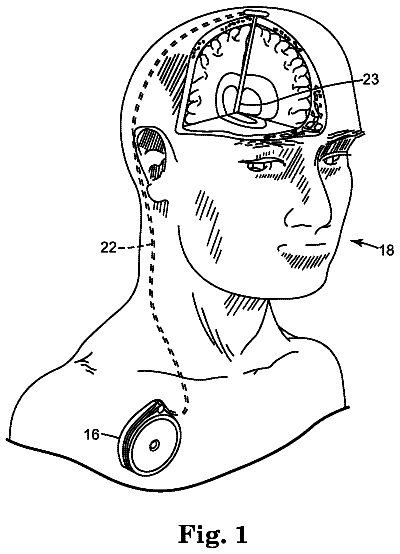
Stimulation of the amygdalohippocampal complex to treat neurological conditions
A system and/or method treating for a neurological disorder by brain region stimulation.
US 8,738,396 B2 · Assignee: Greenway Medical Technologies, Inc. · Inventors: Green, III; W. Thomas et al.
Sheet 1 of 45 from the published document. All sheets in the USPTO PDF
An integrated medical software system with embedded transcription functionality, and a method of using that system, is disclosed. The system includes a clinical software module that is configured to be executed by a processor to create an electronic document and to capture clinical data for a patient in the electronic document during an encounter with the patient. The system also includes a transcription software application that is configured to be executed by the processor to select predefined clinical data that will appear within the electronic document in response to speech commands and to automatically transcribe dictated clinical data that will appear within the electronic document in response to dictation, wherein the predefined clinical data being previously linked to at least one of a diagnosis code and a procedure code and the dictated clinical data being automatically linked to at least one of a diagnosis code and a procedure code as it is transcribed. And the system includes an account management software module that is configured to be executed by the processor to automatically generate at least one of a bill, a claim, or a statement for the patient using the at least one of a diagnosis code and a procedure code linked to at least one of the predefined clinical data and the dictated clinical data.
Traditionally, healthcare providers have kept all of their patients' information in paper filing systems. That patient information includes, but is not limited to, patients' demographic information (e.g., age, weight, gender, race, income, and geographic location), financial information (e.g., outstanding balances, insurance claims currently being processed, and other account information), and clinical information (e.g., clinician documentation of observations, thoughts and actions, treatments administered, patient history, medication and allergy lists, vaccine administration lists, laboratory reports, X-rays, charts, progress notes, consultation reports, procedure notes, hospital reports, correspondence, and test results). The healthcare providers, or clinicians, that maintain that patient information include, but are not limited to, physicians (Doctors of Medicine (MDs) and Doctors of
1 of 45 drawing sheets so far from the published document, cropped to the drawing. Every sheet is in the USPTO PDF.
What the patent claimed, word for word. All of it is now free to use.
The present invention relates to a medical software system that integrates all aspects of practice management, managed care, and medical research. More particularly, the present invention relates to an integrated medical software system with embedded transcription functionality for increasing the efficiency of data capture and flow within that system.
Traditionally, healthcare providers have kept all of their patients' information in paper filing systems. That patient information includes, but is not limited to, patients' demographic information (e.g., age, weight, gender, race, income, and geographic location), financial information (e.g., outstanding balances, insurance claims currently being processed, and other account information), and clinical information (e.g., clinician documentation of observations, thoughts and actions, treatments administered, patient history, medication and allergy lists, vaccine administration lists, laboratory reports, X-rays, charts, progress notes, consultation reports, procedure notes, hospital reports, correspondence, and test results). The healthcare providers, or clinicians, that maintain that patient information include, but are not limited to, physicians (Doctors of Medicine (MDs) and Doctors of Osteopathic Medicine (DOs)), dentists, chiropractors, podiatrists, therapists, psychologists, physician assistants, nurses, medical assistants, and technicians.
The manual, paper-based practice of keeping a patient's information, however, is a very inefficient, labor-intensive process that requires many checks and balances to ensure accurate processing of the information and, therefore, takes up a significant amount of clinician's time that could otherwise be spent with patients. Accordingly, electronic medical records (EMRs), Electronic Health Records (EHRs), and Personal Health Records (PHRs) have been developed to provide many of the functionalities and features of paper filing systems in an electronic, paperless format.
An EMR is an electronic record of patient information that can be created, gathered, managed, and consulted by the authorized clinicians and other staff at the healthcare practice where the record is created. An EHR is an electronic record of patient information that conforms to nationally recognized interoperability standards and that can be created, managed, and consulted by authorized clinicians and staff, both at the healthcare practice that creates the record and at other healthcare practice sites. And, a PHR is an electronic record of patient information that conforms to nationally recognized interoperability standards and that can be drawn from multiple sources while being managed, shared, and controlled by the patient to whom it belongs. Accordingly, EMRs are aimed primarily at the efficient management of multiple records in a single healthcare provider's practice, while EHRs and PHRs are aimed primarily at integrating multiple data sources into each electronic record.
The nationally recognized interoperability standards for EHRs are currently endorsed by the Healthcare Information Technology Standards Panel (HTISP) and certified by the Certification Commission for Healthcare Information Technology (CCHIT). Those standards require EHRs to have the ability to communicate and exchange data accurately, effectively, securely, and consistently with different information technology systems, software applications, and networks in various settings such that the clinical or operational purpose and meaning of the data are preserved and unaltered as that data is exchanged. Thus, while an EMR is generally characterized as an electronic version of a physician's paper record, an EHR is characterized as a more comprehensive record containing additional data integrated to and from other sources. EHRs are further characterized as being either "basic" or "fully functional." A basic EHR includes patient demographics, problem lists, clinical notes, orders for prescription, and viewing laboratory and imaging results. A fully functional EHR includes patient demographics, problem lists, clinical notes, medical history and follow-up, orders for prescriptions, orders for tests, prescription orders sent electronically, laboratory and imaging results, warnings of drug interactions or contraindications, out-of-range test levels, and reminders for guideline-based interventions.
At their core, EMR and EHR systems include large-capacity databases that contain patient information stored in structured, relational tables of searchable data. Unfortunately, many of the vendors of EMR and EHR systems have resisted making their software capable of exporting and importing patient information using uniform electronic messaging, document, and form management standards (e.g., the Health Level Seven (HL7) messaging standard, the Continuity of Care Document (CCD) document standard, and the Retrieve Form for Data Capture (RFD) form management standard). And, when data is not captured and stored using uniform, standardized medical vocabularies, and when it is not transmitted using uniform messaging, document, and form management standards, that data of little use outside of the system in which it is captured and stored. Instead, custom interfaces must be designed to allow the import and export of data between systems so that data can be shared between those systems. The process of developing different interfaces between the disparate formats used by different vendors is expensive and difficult. Moreover, such interfaces are also costly and labor-intensive to maintain.
The problem of interfacing different EMR and EHR systems is exacerbated by the fact that, in the present health care industry, most patient visits are to small, self-contained practices that often treasure their autonomy and are unwilling and/or unable to acquire EMR and EHR systems unless each of those systems is individually tailored to the narrow objectives of each specific self-contained practice. Accordingly, most EMR and EHR vendors have been forced to provide healthcare practices with individually customized systems that employ stand-alone features and functions on the basis of what a specific practice group wants and needs, which means that similar practice groups in adjacent counties may have very different system features and functions based on their different priorities. Thus, the various existing EMR and EHR systems are not well suited for interaction and data exchange with each other, or for maintaining information that would be useful to other systems. The data collected by the different practice groups using EMR and EHR systems is therefore severely fragmented.
In addition, most of the commercially available EMR and EHR systems have not been well received by healthcare providers. In fact, according to a 2008 survey conducted by the National Center for Health Services (NCHS), a division of the Centers for Disease Control and Prevention (CDC), while about 40% of U.S. office-based physicians reported using EMR systems, only 17% reported using basic EHR systems, and only 4% reported using fully functional EHR systems. Healthcare providers tend to resist such systems because those systems are unable to keep up with the workflow demands of clinicians during the various tasks they perform throughout the day. Traditional EMR and EHR systems are generally technology-driven, as opposed to being user-driven. Accordingly, healthcare providers find them difficult to use, especially those healthcare providers that have difficulty with computer technology, and especially when it involves adopting new software with which the healthcare provider is not already familiar. Many healthcare providers would rather focus solely on patient care than be bothered with learning how to operate the latest computer technology.
In an attempt to gain wider acceptance of EMR and EHR systems, some health information technology (HIT) engineers have developed user interfaces to help ease healthcare providers' transition into the electronic record-keeping medium. For example, because healthcare is a dictation-intensive field, some HIT engineers have adopted a speech recognition approach for interfacing with EMR and EHR systems. That approach allows healthcare providers to dictate information as they traditionally have done, except that the information is captured in a computer-readable medium (e.g., an XML file) that can be input directly into EMR and EHR systems. Two different types of speech recognition technology have been developed to help ease healthcare providers' transition into the electronic record-keeping medium and improve turnaround time in generating electronic patient records--back-end speech recognition and front-end speech recognition.
Back-end speech recognition generates an electronic text document in the background as a healthcare provider dictates without the healthcare provider being able to see or edit, and oftentimes without the healthcare provider even being aware of, what is being transcribed in the electronic text document. The resulting electronic text document, along with the corresponding voice file, is then sent to a medical transcription/editing service that reads the electronic text document, listens to the voice file, and corrects any mistakes (recognition and/or dictation) in the electronic text document. The medical transcription/editing service then returns the corrected electronic text document to the healthcare practice for entry into an EMR or EHR system. The medical transcription/editing service may also enter the appropriate information into the EMR or EHR system themselves. And, if the information captured by back-end speech recognition is used to generate documentation that requires the healthcare provider's signature (e.g., progress notes, consultation reports, procedure notes, hospital reports, etc.), that documentation will also need to be provided to the healthcare provider for review and signature. The turnaround time required for a medical transcription/editing service to review and correct the electronic text document is unpredictable and inconvenient. Using such services also creates an additional expense for healthcare providers, who already suffer from large overhead costs.
Front-end speech recognition provides faster turnaround times and eliminates the need for medical transcription/editing services by allowing the healthcare provider to view and edit the electronic text document as it is generated. Thus, instead of using medical transcription/editing services to review and edit the electronic text document, the healthcare provider can immediately see and correct any mistakes (recognition and/or dictation) in the electronic text document Like traditional EMR and EHR systems, however, traditional front-end speech recognition is often provided as separate software that must be interfaced with the EMR or EHR system with which it is being used. Thus, unlike back-end speech recognition running in the background, healthcare providers must familiarize themselves with, and ultimately accept, that new software platform for it to be of any beneficial use.
Although back-end speech recognition does not require healthcare providers to familiarize themselves with and accept new software, neither the software used to provide traditional back-end speech recognition nor the software used to provide traditional front-end speech recognition incorporates uniform electronic messaging, document, and form management standards to import and export the information captured therewith. Instead, the information captured by that software is typically only used to complete the specific clinical documentation for which it was captured (e.g., progress notes, consultation reports, procedure notes, hospital reports, etc.) rather than being provided in a format that can be used for other purposes, such as data collection and analysis for practice management and medical research. And, as discussed above, when data is not captured and stored using uniform, standardized medical vocabularies, and when it is not transmitted using uniform messaging, document, and form management standards, that data is of little use outside of the system in which it was captured unless custom interfaces are designed to connect that system to other systems. Much less, it is of little use outside of the document for which it was captured.
Another shortcoming of conventional speech recognition technology is that such technology requires a significant amount of voice recognition training by a user for the speech recognition to be accurate. For example, a user will be required to dictate several passages into a computer to "train" the voice recognition software on that computer to recognize that user's voice and mannerisms. A "voice profile" is created for that specific user based on that training. The user must either save that voice profile to a portable electronic storage medium (e.g., a CD-ROM or zip disk) or perform the training again whenever that user uses a different computer, or accesses the computer remotely, to dictate speech. Accordingly, management of a user's voice profile can become problematic and burdensome when a user frequently uses different systems to dictate speech.
Because most EMR and EHR systems, and the speech recognition software with which they are interfaced, are not capable of exporting and importing patient information in a standardized format, and because they do not utilize functions and features suited for interaction and data exchange with other systems, the fragmented pools of data collected using those systems cannot easily be combined. Accordingly, an individual healthcare practice cannot share data between its individually customized systems in a way that streamlines management of that healthcare practice, but instead must capture, store, and manage duplicate sets of data between its disparate, stand-alone systems. Moreover, researchers cannot easily collect data from multiple healthcare practices for performing medical research, maintaining disease registries, tracking patient care for quality and safety initiatives, and performing composite clinical and financial analytics. Instead, those processes remain time-consuming and expensive. For example, a clinical research organization (CRO) tasked with identifying patients that satisfy specific criteria for participating in a clinical trial must still sort through voluminous libraries of paper medical records and unstructured data, spending large amounts of time and money searching for candidates.
Those problems are compounded by the regulations of the Health Insurance Portability and Accountability Act (HIPAA). The implementation of the regulations of HIPAA has increased the overall amount of paperwork and the overall costs required for healthcare providers to operate. And the complex legal implications associated with those regulations have caused concerns with compliance among healthcare providers. With regard to researchers, the HIPAA regulations have hindered their ability to perform retrospective, chart-based research as well as their ability to prospectively evaluate patients by contacting them for follow-up surveys. The HIPAA regulations have also led to significant decreases in patient accrual for research, increases in time spent recruiting patients for research, and increases in mean recruitment costs. And by requiring that informed consent forms for research studies include extensive detail on how the participant's protected information will be kept private, those already complex documents have become even less user-friendly.
Accordingly, there is a need for a medical software system that seamlessly integrates the systems required to manage the different activities performed at a healthcare practice (i.e., an EMR or EHR system, a patient registration system, a scheduling system, an account management system, a billing system, etc.) so that duplicate and/or inconsistent data is not captured, stored, and managed by disparate, stand-alone systems. There is also a need for that integrated medical software system to include embedded speech understanding functionality for capturing data in a cost-effective and user-friendly manner. And there is a need for a plurality of such systems for systematically analyzing, collecting, and tracking patient data across a vast patient population (e.g., a community, region, state, nation, etc.) while complying with HIPAA regulations.
To solve at least the above problems and disadvantages, and to provide at least the advantages discussed below, a non-limiting object of the present invention is to provide an integrated medical software system with embedded transcription functionality and a method of using that system. The system includes a clinical software module that is configured to be executed by a processor to create an electronic document and to capture clinical data for a patient in the electronic document during an encounter with the patient. The system also includes a transcription software application that is configured to be executed by the processor to select predefined clinical data that will appear within the electronic document in response to speech commands and to automatically transcribe dictated clinical data that will appear within the electronic document in response to dictation, wherein the predefined clinical data being previously linked to at least one of a diagnosis code and a procedure code and the dictated clinical data being automatically linked to at least one of a diagnosis code and a procedure code as it is transcribed. And the system includes an account management software module that is configured to be executed by the processor to automatically generate at least one of a bill, a claim, or a statement for the patient using the at least one of a diagnosis code and a procedure code linked to at least one of the predefined clinical data and the dictated clinical data. Those and other objects of the invention, as well as many of the intended advantages thereof, will become more readily apparent when reference is made to the following description, taken in conjunction with the accompanying drawings.
The following drawings are part of the specification and represent preferred embodiments of the present invention. The components in the drawings are not necessarily to scale, emphasis instead being placed upon illustrating the principles of the present invention. And, in the drawings, like reference numerals designate corresponding parts throughout the several views.
FIG. 1 illustrates the infrastructure of an integrated physician's network according to a non-limiting embodiment of the present invention;
FIG. 2 illustrates the tiered architecture of the servers and workstations in the integrated physician's network illustrated in FIG. 1;
FIG. 3 illustrates the system architecture, from an applications standpoint, of a server in the integrated physician's network illustrated in FIG. 1;
FIG. 4 is a schematic block diagram illustrating the functional makeup of the integrated ambulatory suite provided on the EHR systems in the integrated physician's network illustrated in FIG. 1;
FIG. 5 illustrates a desktop screen and internal messaging supported by the framework module of the integrated ambulatory suite illustrated in FIG. 4;
FIGS. 6A and 6B illustrate an example of a visit information check-in screen and a patient registration information screen supported by the framework module of the integrated ambulatory suite illustrated in FIG. 4;
FIG. 7 is a schematic block diagram illustrating the functional makeup of the A/R module of the integrated ambulatory suite illustrated in FIG. 4;
FIGS. 8-10 illustrate an example of a charges screen, a contracts/fee schedule screen, and an account information screen, respectively, supported by the A/R module illustrated in FIG. 7;
FIG. 11 is a schematic block diagram illustrating the functional makeup of the clinical module of the integrated ambulatory suite illustrated in FIG. 4;
FIG. 12 is a flow chart depicting the overall operation of the clinical module illustrated in FIG. 11;
FIG. 13 illustrates an example of a main template builder screen supported by the clinical module illustrated in FIG. 11;
FIG. 14 illustrates an example of a template builder screen for a chief complaint section supported by the clinical module illustrated in FIG. 11;
FIGS. 15 and 16 illustrate an example of a template builder screen for a history of present illness section supported by the clinical module illustrated in FIG. 11;
FIGS. 17 and 18 illustrate an example of a template builder screen for a review of systems section supported by the clinical module illustrated in FIG. 11;
FIG. 19 illustrates an example of a template builder screen for a physical exam section supported by the clinical module illustrated in FIG. 11;
FIGS. 20-23 illustrate an example of a template builder screen for an assessment/plan section supported by the clinical module illustrated in FIG. 11;
FIG. 24 illustrates an example of a preview screen for a chief complaint section, a history of present illness section, and review of systems section supported by the clinical module illustrated in FIG. 11;
FIG. 25 illustrates an example of a preview screen for a review of systems section and a physical exam section supported by the clinical module illustrated in FIG. 11;
FIG. 26 illustrates an example of a preview screen for a physical exam section and an assessment/plan section supported by the clinical module illustrated in FIG. 11;
FIG. 27 illustrates an example of a preview screen for an assessment/plan section supported by the clinical module illustrated in FIG. 11;
FIG. 28 illustrates an example of a preview screen for a physical exam section supported by the clinical module illustrated in FIG. 11;
FIGS. 29-32 illustrate examples of a progress note being completed by a clinician using the EHR component of the clinical module illustrated in FIG. 11;
FIGS. 33 and 34 illustrate an example of a completed progress note generated with the clinical module illustrated in FIG. 11;
FIG. 35 illustrates a list of documents in a patient's chart screen supported by the clinical module illustrated in FIG. 11;
FIG. 36 illustrates an example of a history and physical (H&P) note being completed by a clinician using the EHR component of the clinical module illustrated in FIG. 11;
FIG. 37 illustrates an example of a facesheet screen supported by the clinical module illustrated in FIG. 11;
FIG. 38 illustrates an example of an appointment scheduling screen supported by the scheduling module of the integrated ambulatory suite illustrated in FIG. 4;
FIG. 39 is a flow chart depicting a process for transcribing and linking dictated text according to a non-limiting embodiment of the present invention;
FIG. 40 illustrates a dictation microphone according to a non-limiting embodiment of the present invention;
FIG. 40 illustrates a dictation a dictation toolbar being displayed in a document in which a clinician is working according to a non-limiting embodiment of the present invention;
FIG. 42 illustrates a dictation toolbar according to a non-limiting embodiment of the present invention;
FIG. 43 is a schematic block diagram illustrating the functional steps of a partner registration process according to a non-limiting embodiment of the present invention;
FIG. 44 is a schematic block diagram illustrating the functional steps of a sequential filtering process according to a non-limiting embodiment of the present invention;
FIG. 45 is a schematic block diagram illustrating the functional steps of a client registration process according to a non-limiting embodiment of the present invention; and
FIG. 46 is a schematic block diagram illustrating the functional steps of patient verification process according to a non-limiting embodiment of the present invention.
Non-limiting embodiments of the present invention will now be disclosed in detail, by way of example, with reference to the drawings. In describing those embodiments, specific terminology will be resorted to for the sake of clarity. However, the invention is not intended to be limited to the specific terms so selected, and it is to be understood that each specific term includes all technical equivalents that operate in similar manner to accomplish a similar purpose.
The present invention provides a medical software system that integrates each the systems required to manage the different activities performed at a healthcare practice (e.g., an EMR or EHR system, a patient registration system, a scheduling system, an account management system, a billing system, etc.) on a single technology platform so that duplicate and/or inconsistent data is not captured, stored, and managed by disparate, stand-alone systems. Such a system is hereinafter referred to as an "integrated ambulatory suite." Each of the systems integrated into the integrated ambulatory suite are built on the same architecture and are designed to share information seamlessly based on integration rather than interfacing. Integration provides a single-vendor solution for addressing all of a healthcare practice's needs. It also allows for single-vendor support and the sharing of all data across all system components through a single database, which avoids errors, duplication of data entry, and inconsistency of information.
In addition to eliminating duplicate and/or inconsistent data across multiple systems, providing a single, integrated medical software system for all of the activities of a healthcare practice allows better patient tracking, cost accounting analysis, data security, and audit trails. It also allows administration of the various functions of the integrated ambulatory suite to be managed through a single system administration feature. And it allows the entire integrated ambulatory suite to be updated with a single data push from the vendor whenever new or updated system software is released, with consideration for all of the various functionalities that may be affected within the integrated ambulatory suite. Thus, providing a single-source solution also minimizes the cost of ongoing system maintenance.
The integrated ambulatory suite of the present invention includes embedded speech recognition functionality for capturing data in a cost-effective and user-friendly manner. That speech understanding functionality is integrated with each of the different modules and components of the integrated ambulatory suite so it can be used to capture data while performing substantially any activity at a healthcare practice (e.g., messaging, scheduling, account management, generating correspondence, and generating clinical documentation). And because that functionality can be used with each of the different modules and components of the integrated ambulatory suite, data captured using that functionality can flow throughout the integrated ambulatory suite to assist in completing substantially any type of electronic record for a patient (e.g., a schedule, a bill, a prescription, etc.). For example, a healthcare provider can dictate a diagnosis into a progress note, which will be used not only to complete the progress note, but also to complete a bill, a claim, or a statement for the patient.
In addition, the present invention may be implemented as a plurality of integrated ambulatory suites at different healthcare practices that are networked together. By allowing the creation of such an integrated physician's infrastructure (IPI), the present invention provides functionality for analyzing, collecting, and tracking data across a vast patient population. Moreover, it provides infrastructure and functionality for utilizing that data to more effectively and efficiently perform medical research, to maintain disease registries, to track patient care for quality and safety initiatives, and to perform composite clinical and financial analytics. The same benefits of a single-vendor solution and seamless data sharing discussed above with respect to the integrated ambulatory suite are also present in the IPI.
By integrating the infrastructure and architecture of the various systems of the integrated ambulatory suite and of the IPI, the present invention provides a scalable solution that allows the various systems of the integrated ambulatory suite and the IPI to be expanded or contracted as required to suit a particular healthcare practice or healthcare community. It also allows data to be actively analyzed, collected, and tracked across a vast patient population in real time based on triggering events rather than requiring that queries be run on passive, "stale" data housed in a data repository. And by standardizing the format in which the data is captured and stored as well as the format by which it is exchanged across all of the modules and components of the integrated ambulatory suite and the IPI, the need for "middleware" type architecture to interface those various systems is eliminated. Thus, errors, duplication, and inconsistencies in data are further eliminated.
I. System Architecture
Turning to the drawings, FIG. 1 illustrates an exemplary non-limiting embodiment of the infrastructure of an IPI 100 according to the present invention. The IPI 100 is a network of computer systems comprising a plurality of EHR systems, a plurality of research systems, and at least one IPI provider system that are interconnected via a plurality of secured connections. Each EHR system is provided at a healthcare provider's site 102 (i.e., at a healthcare practice) and includes at least one client server 104 and at least one client workstation 106. Each research system may be provided at a researcher's site 108 and includes at least one partner server 110 and at least one partner workstation 112. And, each IPI provider system may be provided at the IPI provider's site 114 and includes at least one enhanced services server 116 and at least one administrator workstation 118. The EHR systems, research systems, and IPI provider system are all built on the same architecture so that the various systems of the IPI 100 and the functionality of each of their applications may be seamlessly integrated across the entire IPI 100.
A. EHR Systems
The client server 104 of each EHR system contains the integrated ambulatory suite of the present invention and controls the operation of the integrated ambulatory suite. The client server 104 also controls communications with the other systems within the IPI 100 and locally stores data collected using the integrated ambulatory suite. The client server 104 is at the center of the EHR system and may be located at a central location at a healthcare provider's site 102 for local communication with each of the client workstations 106. In the alternative, as opposed to being hosted at the healthcare provider's site 102, all of the applications, controls, and data for the integrated ambulatory suite may be remotely hosted at a client server 120 located at a client data center 122. The applications, controls, and data for the integrated ambulatory suite hosted by the client server 120 may also be utilized by different healthcare providers utilizing other EHR systems.
The client workstations 106 provide a point of communication between healthcare providers and the client server 104 of the EHR system so that users can access and utilize the various functionalities of the integrated ambulatory suite, such as via "cloud" computing. The client workstations 106 of each EHR system may be provided at various locations, remote from the client server 104, throughout the healthcare provider's site 102 (e.g., in different physicians' offices). When the client server 104 is also located at the healthcare provider's site 102, the client workstations 106 communicate with the client server 104 and with each other over a Local Area Network (LAN) via a client router 124. The client server 104 and client workstations 106 of each EHR system also communicate with the enhanced services server 116 and administrator workstation 118 of the IPI provider system via a provider router 126 provided at the IPI provider's site 114, which preferably communicates with the client router 124 via a broadband network, such as Digital Subscriber Line (DSL), cable modem, or other high-speed connection.
When the client server 120 is provided at the client data center 122, the client workstations 106 communicate with that client server 120 via a client data center router 128 at the client data center 122 that preferably communicates with the client router 124 via a private dedicated network, such as a frame relay network. In that configuration, the client server 120 at the client data center 122 and the client workstations 106 at the healthcare provider's site 102 may also communicate with the enhanced services server 116 and administrator workstation 118 of the IPI provider system via the provider router 126 provided at the IPI provider's site 114, which communicates both with the client router 124 and the client data center router 128 via the private dedicated network. The client data center router 128 is located behind a firewall 130 to provide security from unauthorized internet access. And use of a private dedicated network to facilitate the transmission of data when the client server 120 is provided at a location remote from the location of the client workstations 106 causes those components to perform like a private dedicated network and provides additional security to that network. Although the exemplary embodiment illustrated in FIG. 1 utilizes a broadband network when the client server 104 is provided at the healthcare provider's site 102 and a private dedicated network when the client server 120 is provided at the client data center 122, either a broadband network or a private dedicated network may be utilized in either configuration.
B. Research Systems
The partner server 110 of each research system contains all of the system applications and controls the operation of the research system. The partner server 110 also controls communications with the other components of the IPI 100 and locally stores data collected using the research system. The partner server 110 is at the center of the research system and may be located at a central location at a researcher's site 108 for communication with each of the partner workstations 112. In the alternative, as opposed to being hosted at the researcher's site 108, all of the applications, controls, and data for the research system may be remotely hosted at a partner server 132 located at a partner data center 134. A partner server 132 located at a partner data center 134 may also host the applications, controls, and data for other research systems utilized by different healthcare providers.
The partner workstations 112 provide a point of communication between researchers and the partner server 110 of the research system. The partner workstations 112 of each research system may be provided at various locations, remote from the partner server 110, throughout the researcher's site 108 (e.g., in different researchers' offices). When the partner server 110 is also located at the researcher's site 108, the partner workstations 112 communicate with the partner server 110 and with each other over a LAN via a partner router 136. The partner server 110 and partner workstations 112 of each research system also communicate with the enhanced services server 116 and administrator workstation 118 of the IPI provider system via the provider router 126 provided at the IPI provider's site 114, which preferably communicates with the partner router 136 via a broadband network.
When the partner server 132 is provided at the partner data center 134, the partner workstations 112 communicate with that partner server 132 via a partner data center router 138 at the partner data center 134 that preferably communicates with the partner router 136 via a private dedicated network. In that configuration, the partner server 132 at the partner data center 134 and the partner workstations 112 at the researcher's site 108 may also communicate with the enhanced services server 116 and administrator workstation 118 of the IPI provider system via the provider router 126 provided at the IPI provider's site 114, which communicates both with the partner router 136 and the partner data center router 138 via the private dedicated network. The partner data center router 138 is located behind a firewall 130 to provide security from unauthorized internet access. And, as discussed above, use of a private dedicated network to facilitate the transmission of data when the partner server 132 is provided at a location remote from the location of the partner workstations 112 causes those components to perform like a private dedicated network and provides additional security to that network. Although the exemplary embodiment illustrated in FIG. 1 utilizes a broadband network when the partner server 110 is provided at the researcher's site 108 and a private dedicated network when the partner server 132 is provided at the partner data center 134, either a broadband network or a private dedicated network may be utilized in either configuration.
C. IPI Provider System
The enhanced services server 116 of the IPI provider system contains all of the system applications used by the IPI provider to control and maintain the operation of the various systems of the IPI 100. The enhanced services server 116 also controls communications with systems outside of the IPI 100 and stores data aggregated from the various systems of the IPI 100. The enhanced services server 116 is provided at the center of the IPI 100 and can therefore serve as a centralized data repository (e.g., central database 410 of FIG. 4) for the data aggregated from the various systems of the IPI 100. Access to that repository of data is controlled by the enhanced services server 116.
The administrator workstation 118 provides a point of communication between IPI administrators and the enhanced services server 116 and other systems within the IPI 100. The administrator workstation 118 may be provided at a location remote from the enhanced services server 116 at the IPI provider's site 114. The administrator workstation 118 communicates with the enhanced services server 116 over a LAN via a provider router 126. The enhanced services server 116 and administrator workstation 118 also communicate with the client servers 104 and client workstations 106 of the EHR systems and the partner servers 110 and partner workstations 112 of the research systems via the provider routers 126 provided at the IPI provider's site 114. As discussed above, the provider routers 126 communicate with the client routers 124, the client data center routers 128, the partner routers 136, and the partner data center routers 138 of the EHR systems and research systems, respectively, via a broadband network and/or a private dedicated network. The enhanced services server 116 can control at least one internet router 140 that is used to provide the various systems of the IPI 100 access to the internet when the client server 104 or partner server 110 do not provide such access. The internet router 140 is located behind a firewall 130 to provide security from unauthorized internet access. Administrative functionality for the applications of each system in the IPI 100 can be handled through the administrator workstation 118.
D. Integration
The description continues in the full USPTO document.
About 6,008 words. The USPTO PDF has it with every drawing.
Fees are due 3.5, 7.5 and 11.5 years after grant. This patent expired on May 27, 2026, so the fee marked "not paid" was the one that went unpaid.
INTEGRATED MEDICAL SOFTWARE SYSTEM WITH EMBEDDED TRANSCRIPTION FUNCTIONALITY
Filed Feb 2011 · published Aug 2011Integrated medical software system with embedded transcription functionality
Filed Feb 2011 · granted May 2014Earlier publications, parents and continuations. None of them can still be enforced, or this patent would not be listed.
Prior art cited by the examiner or applicant. Useful when you check your own idea for novelty.
Everything on this page comes from the documents linked above.