 Lapsed, fee not paid17 drawings
Software & Apps · US 9,955,050 B2
Movement monitoring security devices and systems
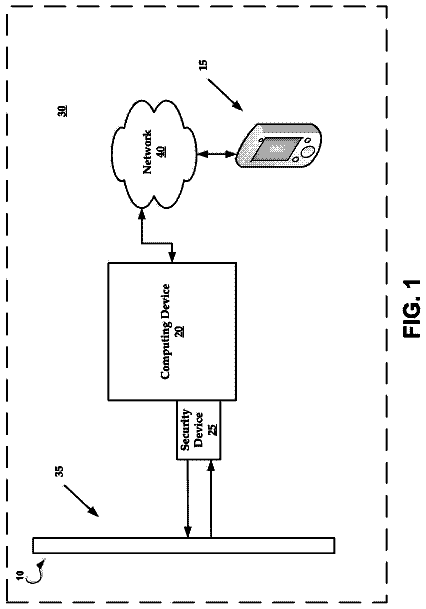
Motion sensing devices for computer security are provided herein.
US 9,955,292 B2 · Assignee: Nokia Corporation · Inventors: Räsänen; Eero et al.
Sheet 1 of 22 from the published document. All sheets in the USPTO PDF
The invention is a system and method for computing a result for a location, wherein the result indicates how novel it is for a wireless device to occupy a specific location. After determining the location of a wireless device through various means, a Novelty Index Value (NIV) is calculated for the location, and the NIV is then stored into a database. The NIV may then be subsequently used by application programs to compute a desired result from the NIV. Multiple users may utilize and/or share the same NIV values. The NIV may also be used to alter the configuration of a wireless device as well. A recommendation system is also disclosed, wherein user context is utilized along with NIV values to compute particular results for a user.
Mobile phones and wireless personal digital assistants (PDAs) are able to access the Internet using I-Mode protocol, mobile IPv6 protocol or the Wireless Application Protocol (WAP). WAP-enabled wireless devices can now access Internet applications such as headline news, exchange rates, sports results, stock quotes, weather forecasts, multilingual phrase dictionaries, personal online calendars, online travel and banking services, or download distinctive ringing tones. Broadband wireless networks make it possible for WAP-enabled wireless devices to exchange multimedia messages that combine conventional text with much richer content types, such as photographs, images, voice clips, and video clips. WAP-enabled wireless devices can be used to pay bills online using the wireless device as a virtual wallet. WAP-enabled wireless devices can deliver useful and informative advertising and transact
1 of 22 drawing sheets so far from the published document, cropped to the drawing. Every sheet is in the USPTO PDF.
What the patent claimed, word for word. All of it is now free to use.
The invention disclosed broadly relates to location services for handheld wireless devices and more particularly relates to improvements in the accessing of services based on the location or context of the wireless device, and further provides a system and method for providing recommendations on user location(s) and/or preferences.
Mobile phones and wireless personal digital assistants (PDAs) are able to access the Internet using I-Mode protocol, mobile IPv6 protocol or the Wireless Application Protocol (WAP). WAP-enabled wireless devices can now access Internet applications such as headline news, exchange rates, sports results, stock quotes, weather forecasts, multilingual phrase dictionaries, personal online calendars, online travel and banking services, or download distinctive ringing tones. Broadband wireless networks make it possible for WAP-enabled wireless devices to exchange multimedia messages that combine conventional text with much richer content types, such as photographs, images, voice clips, and video clips. WAP-enabled wireless devices can be used to pay bills online using the wireless device as a virtual wallet. WAP-enabled wireless devices can deliver useful and informative advertising and transaction services from online merchants. WAP-enabled wireless devices now also provide entertainment services, such as interactive adventure games, quizzes, and chess tournaments.
People tend to travel over the same paths from day to day. They follow their daily routines by going to work, coming back home, putting children to day-care and getting food from a local shop, etc. Using uncommon routes or travelling to places that are not part of the daily routines can be considered as exceptions. More and more, people are carrying handheld wireless devices as they carry on their daily routines, so as to remain in contact with home, work, and on line services. What is needed is a location service for handheld wireless devices, to enable users to create augmented reality services by setting up virtual environment that uses real-world locations. What is needed is a way for a mobile device/phone user to access the augmented reality services by moving inside the service's “real world” location. Another challenge of augmented reality systems is the placement of the augmented data. When using absolute locations for the augmented data, most users won't find some of the augmented data or may find it too easily because of daily routines.
What the prior art needs is a way to personalize the augmented reality services for each user so that the applications will know how novel each location is for the user by using methods and services described in this invention. By personalizing the augmented reality data for each user, it is possible to create an augmented reality that reaches each user in a manner that is more consistent with the spirit and scope of augmented reality systems and services.
Recommendation systems use information of the activity histories or preferences of numerous users to produce useful recommendations for a single user. Existing recommendation systems use collaborative filtering methods to produce recommendations for an individual user by analyzing the actions and preferences of a group of individuals. As the use of information technology has become widespread in all areas of human life, the concerns of individuals over their privacy have increased. Specifically, most distributed recommendation systems were developed for wireline Internet services, and the privacy concerns will significantly increase as the services are adopted for use by more personal, wireless devices.
What is needed is a distributed recommendation system for handheld wireless devices, to enable users to access recommendation services by moving inside the service's real world location. It would further be useful to enable third parties to access information which is a function of the wireless device's location.
The invention is a method for computing a result for a location, the result depending on how novel it is for a wireless device to occupy the location. In one embodiment of the invention, the method begins with the step of determining the location of a wireless device. Then, in accordance with the invention, the method computes a novelty index value for the location, characterizing how novel it is for the wireless device to occupy the location, and stores the novelty index value in a database. The method then runs a program to determine a result that depends on the novelty index value. To do this the method accesses the database for information associated with the novelty index value and then computes the result using the information. In a preferred embodiment, the database can be an integral part of the wireless device. In an alternate embodiment, the database can be in a server, remote from the wireless device.
In another embodiment of the invention, a method enables the wireless device to provide recommendations to its user that are appropriate to the device's current environment. The recommendation can be in the form of mobile Internet WML pages of a portal, or other service provider. The method begins by receiving sensor signals characterizing a current environment of the wireless device, processing the sensor signals with a context inference engine, and then outputting a current context result from the processing by the context inference engine. Then, in accordance with the invention, the method computes a novelty index value for the current context result, characterizing how novel it is for the wireless device to occupy the current context and stores the novelty index value in a database. The method then runs a program to determine a result that depends on the novelty index value. To do this the method accesses the database for information associated with the novelty index value and then computes the result using the information.
In still another embodiment of the invention, a method computes a result for a location, the result depending on how novel it is for a wireless device to occupy the location. The method begins by determining the location of a wireless device. Then, in accordance with the invention, the method computes a novelty index value for the location, characterizing how novel it is for the wireless device to occupy the location and stores the novelty index value in a database. The method then runs a program in a second terminal to determine a result that depends on the novelty index value. It does this by accessing with the second terminal the database for information associated with the novelty index value and computing the result using the information.
In yet another embodiment of the invention, a method changes a wireless device configuration for a location, the configuration depending on how novel it is for the wireless device to occupy the location. The method begins by determining the location of a wireless device. Then, in accordance with the invention, the method computes a novelty index value for the location, characterizing how novel it is for the wireless device to occupy the location and stores the novelty index value in a database. The method then runs a program to determine a result that depends on the novelty index value. It does this by accessing the database for information associated with the novelty index value. The method then changes a configuration of the wireless device using the information.
One aspect of the invention is personalizing the augmented reality services for each wireless device user. This enables applications to know how novel is each location traversed by the user. The novelty value of a location traversed by the user is calculated by using the travelling and moving in real world as input. The definition of the location can be defined in various different ways, such as coordinate based (GPS), proximity based (Bluetooth, proximity sensor) or cell based (triangulation methods with mobile networks). The location coordinates are trimmed into coordinate grid that is described for this invention.
Other services can query Novelty Index Value databases (NIV) for detecting the suitable placements for augmented data. An augmented reality application processes the data and can determine which data can be accessed more easily and which data should be hidden or harder to find. This information can be then converted to NIV queries that are sent to the system. The NIV system would then return a set of suitable locations according to the user NIV values.
The accumulation of NIVs during a certain time period or between certain locations is also utilized under an embodiment of the present invention. For instance, when a user is using identical routes while moving, the user does not accumulate NIV values. However, when a user is moving between places by using different routes or paths, and rarely traversing across old routes, a very large NIV value will accumulate for that user.
This information can be used for creating a personalized augmented reality for each user, where uncommon behavioral patterns in travelling from place to place is registered through NIV values. The NIV values can also be used for controlling various features in augmented reality applications. The NIV feature may also be combined, or run independently with a recommendation service to provide users with a variety of browsing or file-accessing options.
The invention applies to many wireless standards. The invention applies, for example, to the IEEE 802.11 Wireless LAN standards, the Japanese 3rd Generation (3G) wireless standard, the various 2G, 2.5G, and 3G cellular telephone system standards, the Infrared Data Association (IrDA) standard, the Digital Enhanced Cordless Telecommunications (DECT) standard, the Shared Wireless Access Protocol (SWAP) standard, the IEEE 802.15 Wireless Personal Area Network (WPAN) standard, the High Performance Radio Local Area Network (HIPERLAN) standards, and the Multimedia Mobile Access Communication (MMAC) Systems standard of the Japanese Association of Radio Industries and Businesses.
The present invention is illustrated by way of example, and not by way of limitation, in the figures of the accompanying drawings and in which like reference numerals refer to similar elements and in which:
FIG. 1 discloses an exemplary mapped grid under an embodiment of the present invention;
FIG. 1A discloses a combination network diagram and device appearance diagram for a wireless device utilizing a NIV distribution network;
FIG. 1B illustrates a process diagram showing a recommendation network process among a user device, a network server and a third-party merchant;
FIG. 2 discloses an application using a exemplary mapped grid under an embodiment of the present invention;
FIG. 2A discloses a superimposed map on a exemplary mapped grid under an embodiment of the present invention;
FIG. 3 discloses a system architecture under an embodiment of the present invention;
FIG. 4 discloses an embodiment of the invention showing a user screen using a NIV device configuration;
FIG. 4A discloses an embodiment of the invention showing a user screen using an altered NIV device configuration;
FIG. 5 is a network diagram of the invention, showing an example relationship between the user's Wireless Application Protocol (WAP)-enabled portable wireless device, the WAP protocol gateway to the Internet, the network server, a third party service provider, the Universal Description, Discovery and Integration (UDDI) registry, and a plurality of web sites;
FIG. 6 discloses an embodiment of the invention wherein a user recommendation database is located within a wireless device;
FIGS. 6A and 6B show the user's wireless device with the UPDATE PRIVACY FEATURES: sub-menu of the Recommendation Web Services menu;
FIGS. 6C and 6D show the user's wireless device with the MANAGE CONTEXT-ACTIVITY PROFILE sub-menu of the Recommendation Web Services menu;
FIGS. 6E and 6F show the user's wireless device with the REQUEST A RECOMMENDATION sub-menu of the Recommendation Web Services menu;
FIGS. 6G and 6H show two examples of the user's wireless device with a requested context-activity pair which is sent to the network server and the resultant service recommendations received back from the server;
FIG. 7 is a functional block diagram of the wireless device, showing its various components and programs;
FIG. 7A is a functional block diagram of the wireless device, the server, and the web server 160 , and their interaction when exchanging a metadata vector and privacy control data and when exchanging a context-activity pair and associated recommendations;
FIG. 8 is a network process flow diagram of the interaction of the wireless device, network server, and web server when carrying out the determination of the current context of the wireless device;
FIG. 8A is a network process flow diagram of the interaction of the wireless device and network server when the user's wireless device sends a requested context-activity pair which is sent to the network server and the resultant service recommendations are received back from the server;
FIG. 8B shows the context-pairs and services database in the network server;
FIG. 8C shows the context-pairs and service history log in the device;
FIG. 8D is a network process flow diagram of an alternate embodiment of the invention, in which the context-activity pair information sent by the wireless device to the network server, includes a metadata vector. The network server can then assist the wireless device in determining the mobile device's current context, as well as the server sending the resultant service recommendations back to the wireless device;
FIG. 8E is a network process flow diagram of an alternate embodiment of the invention, in which a recommendation algorithm in the server receives a sample of representative context-activity pairs filtered by algorithm and related service history items from log as a set of context-activity pairs and related service history items;
FIG. 9 is a functional block diagram of the network server 140 , showing the memory storing the application services software programs needed to perform the operations of the invention; and
FIG. 10 is a diagram of a server that distributes services to communications network users.
In the following description of the various embodiments, reference is made to the accompanying drawings that form a part hereof, and in which is shown, by way of illustration, various embodiments in which the invention may be practiced. It is understood that other embodiments may be utilized, and structural and functional modifications may be made without departing from the spirit and scope of the present invention.
The invention is based on methods for computing results for a location, wherein the results depend on how novel it is for a wireless device to occupy the location. In one embodiment of the invention, the method begins with the step of determining the location of a wireless device. Then, in accordance with the invention, the method computes a novelty index value for the location, characterizing how novel it is for the wireless device to occupy the location, and stores the novelty index value in a database. The method then runs a program to determine a result that depends on the novelty index value. To do this the method accesses the database for information associated with the novelty index value and then computes the result using the information.
One aspect of the invention is personalizing the Novelty Index Value (NIV) services for each wireless device user. This enables applications to know how novel is each location traversed by the user. The novelty value of a location traversed by the user is calculated using real world inputs. The user input or location can be defined in various ways, such as coordinate based (GPS), proximity based (Bluetooth, proximity sensor) or cell based (triangulation methods with mobile networks). The location coordinates are trimmed into various numbers of coordinate grids that are described in greater detail below.
An example of an NIV layout is shown in FIG. 1 . The mapping of NIV values may be provided for in a location grid layout 10 . It is understood that alternate layouts may be employed under the present invention, such as circular, triangular and even layered grids. In FIG. 1 , the exemplary grid 10 illustrates a defined area that is partitioned off into regions, blocks, or sets. As the client location is established 12 , it may then be mapped out on the location grid 10 . The invention may then partition regions near the client location 12 , in accordance to the NIV value. For example, in FIG. 1 , the clear blocks 14 illustrate common travel areas, where the client frequently occupies. Such regions 14 would be designated a low NIV value (NIV=0). Other regions 11 may also be designated, for example, as less frequented areas, where the NIV value would be in the region of 0<NIV<MAX. Still other regions 13 may be designated as areas not visited by the client (NIV=MAX).
FIG. 1B illustrates the novelty index value data gathering and novelty index value-based recommendations network process diagram. The network process diagram of FIG. 1B is divided into three columns: user's device 100 , network server 140 , and a third party merchant 180 . Reference back to FIG. 1A illustrates that in a network, the wireless device 100 communicates over a radio frequency link to a radio tower 114 that is connected by means of the wireless network 116 and through a gateway 120 to the Internet 130 . Connected to the Internet 130 is a network server 140 , which is represented by the center column in FIG. 1B . Also connected to the Internet 130 is the third party service provider or merchant 180 , which is represented in the rightmost column of FIG. 1B . The wireless device 100 is represented in the leftmost column of FIG. 1B .
In accordance with the invention, as the user travels about various routes during the day, the wireless device 100 periodically transmits information on the current context of the wireless device 100 . That current context information is transmitted from the wireless device 100 through the Internet 130 to the network server 140 and is stored in a novelty index value database 40 . This stage of the network process is shown in FIG. 1B beginning with step 50 , where the wireless device 100 automatically obtains the current context state of the wireless device and transmits it to the network server 140 . If the user has indicated an interest in a particular activity (e.g., shopping, travel, restaurants) at that particular location or context, then that activity category is also transmitted to the network server 140 to be associated with the current context. As is seen in FIG. 1B , step 52 is performed by the network server 140 wherein the server periodically receives the context state, and further computes the novelty index value (discussed in greater detail below). Thereafter, the network server 140 associates the computed novelty index value with the user's activity and stores that information in the novelty index value database 40 .
In the meantime, the third party merchant 180 compiles pricing, promotions, and discount information which the merchant wishes to associate with particular novelty index values for a particular user or groups of users. For example, if a prospective customer has never been to the merchant's store, the merchant may want to offer the new customer special discounts, pricing or promotions. The merchant in step 54 of FIG. 1B , stores the compiled pricing, promotion and discount information which has been associated with respective novelty index values, in the novelty index value database 40 . To do this, the merchant 180 may communicate over the Internet 130 and through the network server 140 with the novelty index value database 40 , shown in FIG. 1A .
During the course of traveling throughout the day, a user may wish to obtain a recommendation, for example, of shopping opportunities at a shopping mall. Accordingly, the user selects on the wireless device 100 of FIG. 1A , the entry (C) REQUEST NIV RECOMMENDATION, and this is followed by the selection of the sub-menu
SHOPPING, wherein the user selects new shopping opportunities. Step 56 in FIG. 1B has the wireless device 100 receive the user's selection from the keypad 104 of the device, the user having input the activity category NEW SHOPPING of the recommendation that the user wishes to receive from the NIV network. At the same time, the wireless device 100 interrogates sensors shown in FIG. 1A to compile the current context state for the wireless device 100 . The current context state can be as simple as to be directly in conjunction with the geographic location of the wireless device. However, many other ambient signals can be assembled to prepare a more detailed context characterizing the current location of the wireless device. For example, in addition to positioning, information on the ambient sounds, on the orientation of the device, on the ambient light, on the ambient temperature, and other physical environmental values can be gathered by the sensors of the wireless device 100 and assembled into a current context state. A detailed description of how a current context state is computed with the wireless device 100 is given below. It is also understood that the example given of the embodiment is not limited to merchant recommendations and services, but may also be configured to provide news, information, or other similar content.
Step 56 then transitions to step 58 in FIG. 1B , where the context-activity pair and other information generated by the algorithms 112 ( FIG. 1A ) stored in the wireless device 100 are transmitted to the server 140 . Then, step 60 in FIG. 1B has the network server 140 match the context activity pair received from the user's device 100 in a context activity database 192 which has accumulated past context activity pairs. Details of the context activity pair database 192 are provided below. The network server 140 matches the past context activity pairs in the database which are similar to the context activity pair received from the user's device 100 and in response to the search and match, gets the associated novelty index value.
Over the course of using the device 100 , the user may make repeated entries of activities of interest. Those activities of interest are correlated with the currently measured context of the device 100 , and these context activity pairs are periodically transmitted and stored at the network server 140 . The network server 140 stores the context activity pairs in association with the novelty index values in a novelty index value database 40 . It is from this database 40 that the network server 140 obtains the novelty index value for the nearest match. T
The novelty index value for the nearest match in step 60 is then transmitted from the network server 140 to the third party merchant 180 , where, in step 62 , the merchant 180 receives the novelty index value. In step 62 , the merchant accesses the corresponding pricing, promotions and/or discounts from the merchant's database. The merchant also accesses pricing, promotions and/or discounts corresponding to the novelty index value received from step 60 , from the network server 140 . Then the process flows to step 64 where the third party merchant 180 returns the pricing, promotions, and/or discount recommendations to the network server 140 . Step 66 in the network server 140 of FIG. 1B then transmits the associated recommendations to the device 100 .
Step 68 of the user's device 100 in FIG. 1B receives the associated recommendations from the network server 140 and then performs a filtering operation of the received recommendations to identify new and/or significant information. Additional description of this step is provided below. Then the process flows to step 70 wherein the user's device 100 displays the filtered recommendations to the user, as requested. For example, if the user is traveling to a new shopping mall and has entered the shopping mall, the merchant or merchants 180 in the shopping mall can provide appropriate pricing, promotion and/or discounts to the user based on a user's NIV value. Thus a high or low NIV value could trigger special offers from the merchants.
Step 70 in FIG. 1B can also transfer these recommendations to an application program for further processing. An additional feature of the invention is shown in FIG. 1B where the network server 140 transitions from step 66 to step 72 which adds the new context activity pair and recommendations to the database 192 . The process then flows to step 74 which computes user statistics for the context activity pairs and recommendations in the database 192 . This can become another source of revenue for the network server 140 , because the usage statistics can then be marketed to third party merchants such as the merchant 180 who would, in step 76 of FIG. 1B , purchase selected data sets from the database 192 for additional market research purposes. In an alternate embodiment of the invention, step 58 can transmit the context activity pair and information gathered by the algorithms 112 to the server using user privacy protocols.
It is understood that the NIV value is capable of being combined or calculated along with other factor values that are provided from sensors that are communicatively coupled to the device. The sensor information would be particularly useful for merchants to learn with greater specificity the reasons behind particular NIV values. Since a user's NIV may be unrelated to reasons of commerce (e.g., a shop is located nearby a user's bus terminal), it would be important to give the owner additional sensor information to better understand the user's behavior. For example, ambient temperature/pressure/humidity, ambient noise, compass, ambient light, wireless device activity, etc. may all be combined in various forms to add context to a NIV reading. Furthermore, user feedback in response to
An application of a grid that would be used to establish NIV values is shown in FIG. 2 in the context of an augmented reality shopping space. Under the embodiment, the augmentations are customized according to user's moving behavior between places. Some of the augmentations are located in the common traveling routes 14 , where a user's routes are established. A shopping center or a virtual trading place 17 is affixed to the grid, where the user may buy or sell items. Some of the augmentations may also be promotional items 15 and placed outside the common walking routes 11 , 14 . The promotional items may be evident to the user, or may be affixed in secret, where the user would have to solve a series of clues or hints 16 in order to find and redeem the promotional item 15 . Thus the NIV values can also be used as elements that control the nature of the grid. For instance, in the virtual trading place 17 , the prices might follow the NIV value of the location so that the prices are higher when the user visits the place often and when he/she does not visit the place for a while, the prices will go down again.
A user can also be categorized according to the location occupied by the user. If a user goes to a shopping mall often, the user's NIV value for that area will be small. The small NIV value would qualify the person to be categorized as a regular customer by the shop or mall that the user visits. As a result, the shop or mall may authorize the user for special discounts or bonuses. On the other hand if the user has a high NIV value (i.e., the user is not a regular customer), the mall or shop may offer introductory discounts to entice the user to physically visit the store. By monitoring such changes in the user NIVs, the shop gains valuable information on user interests towards the shop, or whether that interest is rising or falling.
An example of a “real-world” application is illustrated in FIG. 2A , where the grid 10 is superimposed on a walkway or road 19 and the surrounding geographical area 18 , 20 . The geographical maps may be developed on a proprietary basis, or may alternately be acquired from existing electronic mapping services. Assuming in FIG. 2A that the geographical areas are a mall 18 and a strip mall 20 , shop owners in the mall 18 or strip mall 20 may monitor customer movements, and apply any commercial incentives (e.g., regular customer discounts or introductory discounts) to the customers.
In another embodiment of the invention, a method runs a program in a second terminal to determine a result that depends on the novelty index value. It does this by accessing with the second terminal the database for information associated with the novelty index value and computing the result using the information. Multiple external users may monitor the NIV value of a particular user as well. Monitoring by other users requires that the NIV-database be accessible to the other users. This feature can also be built into the device itself, or may be set in a remote device or location. For example, the device can monitor the NIV-value, and if the value has been MAX for a predetermined period of time (meaning the user has been in a new area), a notification signal is transmitted to a remote device.
An alternate application can be set in the context of a child-monitoring system. Parents are usually very worried about their small children, so the system can be used to warn parents when the child goes into an area that the child has previously not visited. If the NIV has been at a large value MAX for a short while, the child might be classified as lost and a phone call may be automatically initiated. The system can thus act as a care-taker when the parent cannot be with the child. This embodiment helps users monitor travelling behavior to learn how novel a place is relative to the user being monitored. The augmented reality services can further use this information to customize and/or build the augmented data inside and around the user's common routes. Thus parents or teachers will be enabled to monitor children according to school property boundaries or travelling paths. Children that stray beyond permitted limits would set off an alarm to notify the parent or teacher that a travelling violation has occurred.
FIG. 3 discloses an embodiment of the system architecture of the present invention. Disclosed is a NIV database 40 , which may transmit NIV values for processing to NIV Program Tools 42 . The NIV Tools 42 are preferably disposed in a Network server 140 (shown in FIG. 5 ), or may be partitioned off in a wireless device. An application program 44 , preferably disposed in the wireless device 100 , utilizing the NIV system may transmit NIV queries through the NIV Tools 42 , wherein the Tools 42 send back the requested information. Updates from the Database 40 are transmitted to NIV Event Handles 41 , which are in contact with Location Service 43 . Both the Location Services 43 and the Applications Program 44 may be set within the user's wireless device 100 as well.
The NIV is typically configured so that when NIV “events” occur, a system response is requested or automatically invoked. These events include a user entering a location (enter_loc), leaving a location (leave_loc), or returning to a location (update_loc). The NIV is defined for each location based on information as to how often user has been in that location and how much time has passed since the previous visit to that location. Each location handles update_loc and leave_loc events per each user. When a user enters a location, the enter_loc event is triggered. When the location is departed, the leave_loc event is triggered. Each time the enter_loc is triggered, the current NIV is calculated for that location and user. If a location does not have a NIV value, the NIV value is assumed as MAX. Each time the leave_loc is triggered the NIV value for the location and user is updated and the NIV value is marked with a time stamp using a global time notation, such as UTC. The time is converted to values that can be used in base 10 calculations, such as expressing a time differ in seconds using a date Jan. 1, 2000 and a time 00:00.00.
The database uses the location grid to reduce the amount of NIV data that is utilized by the system at one time. When a enter_loc or leave_loc event is sent to the NIV system, it trims the location coordinates to the location grid. The size of one location is defined in the top level of the NIV database, with a default value set under location_grid_size. The location grid size can be chosen according to the error tolerance of the location service and amount of storage space available for the data. To further illustrate an embodiment of the present invention, the text below and the associated tables discuss a method of utilizing the NIV system in the embodiment.
Typically, the system's data collection works through the following steps:
the device obtains the user's location (e.g., GPS);
the location is sent to the NIV system; and
the NIV system trims the location to its location grid and updates the user's current grid value. Regarding system queries, the query is typically sent to the NIV system, where the NIV system processes replies to the query accordingly. An example of the events utilized in the system is tabulated below:
[1] EVENT: update_loc(user,location,time)
TABLE-US-00001 NIV.sub.(user, location) Updated NIV value NIV0.sub.(user, location) Previous NIV value NIV AGING RATE The rate at which the NIV value is incremented over time, for the length of time the device is absent from the location. NIV(.sub.user,location)=[NIV0(.sub.user,location)]+[delta_time_absent]*NIV_AGING_RATE where delta_time_absent=current_time−time_last_updated(location).
In order to keep the NIV value within a prescribed grid, if the updated NIV value NIV(.sub.user, location) exceeds the maximum value (MAX), the NIV(.sub.user, location) value is deleted from a NIV database. However, if NIV0(.sub.user, location) is not defined in the NIV(.sub.user, location) (i.e., the user is entering the grid for the first time), the NIV value is assumed as a value MAX. Furthermore, if user movements are not defined for the location, it is assigned a default value NIV_AGING_RATE.
[2] EVENT: leave_loc (user, location)
TABLE-US-00002 <NIV_rate_decrease> The rate at which the NIV is decreased in value each time an enter_loc event occurs <NIV_rate_increase> The rate at which the NIV is increased in value in the absence of an enter_loc event. <MAX> The maximum NIV value <User> The user ID <Accumulation> Accumulated NIV values <NIV data> The NIV data NIV(.sub.user,location)=NIV0(.sub.user,location)−NIV_rate_decrease.
In addition to users entering and leaving a location, it becomes important to determine what to do with the NIV values once the users occupy (or fail to occupy) a particular space in the grid. When a device obtains a NIV from a highly frequented area (e.g., the home or office), the NIV values may be disproportionately low relative to other areas visited by the user. In such instances, the NIV_rate_decrease may be used in conjunction with, or independently from the NIV_aging_rate to establish NIV values. Typically, if the updated NIV value NIV(.sub.user, location) exceeds its minimum value, the NIV(.sub.user, location) is reset to 0. However, it is also possible under the present invention to specify different NIV_rate_decrease values when an enter_loc event occurs for a particular portion of the grid. If a NIV_rate_decrease is not defined for the location, a default_NIV_rate_decrease value is assigned. Similarly, when a user is absent from an area, a default_NIV_rate_increase is typically assigned.
NIV Data:
TABLE-US-00003 <NIV node 0> 1.sup.st NIV data element <NIV node1> 2.sup.nd NIV data element <NIV nodeN> Nth NIV data element
NIV Node:
TABLE-US-00004 <Location_name> (Optional) Optional unique location descriptor <Novelty Index Value> Current NIV value <Time_last_updated> Time the NIV node for last updated <Location_Y> Location coordinate Y <Location_X> Location coordinate X <NIV_rate_increase> The rate at which the NIV is decreased in value each time a enter_loc event occurs <NIV_rate_decrease> The rate at which the NIV is increased in value in the absence of an enter_loc event.
The augmented reality services can use NIV system for detecting suitable placements of augmented objects. The queries includes the following:
Find_Suitable_Places (User, Area, NIV.sub.min, NIV.sub.max)—Returns a set of suitable places for object that has NIV values inside the range of NIV.sub.min . . . NIV.sub.max for the user. The returned places are real-world coordinates of the NIV grid.
TABLE-US-00005 <User> The user ID <Area> Real-world coordinates that defines an rectangular area <NIVmin> Minimum NIV value accepted <NIVmax> Maximum NIV value accepted
Get_Accumulated_NIV(User)—Returns the accumulated NIV value that has been gathered since this query was last used and may further reset the accumulation value to zero.
Get_NIV(User, Location)—Returns the current NIV of a location.
Optimize (User, NIVmax)—Optimizes the use NIV database, by updating the NIV values and deleting the ones that have value higher than NIVmax.
Implementation of a NIV system can be embodied in a NIV server that is run from a mobile device. When the user subscribes to an augmented reality service, the service can query for suitable places for each augmented object. Since the data storage of a mobile phone is quite limited, the Optimize query option can be used to reduce the storage requirements. Choosing a larger or smaller location grid size for the user would help minimize database storage issues. Alternately, the NIV server can also be run remotely and the mobile device would send location updated to the sever. SIP technology can also be used for sending the NIV updates to the server in case the NIV database resides in a remote server. The NIV queries might use a Service Provider interface (SIP) in cases where the NIV database resides in the mobile device. The SIP technology enables the mobile phone to receive and send wireless messages to/from the NIV system.
An alternate embodiment allows the system to also change a configuration of a wireless device as well using the NIV system. In FIGS. 4 and 4A , a user's wireless device is shown 100 as well as a user display 25 . In FIG. 4 , the user may have the wireless device 100 automatically configured to an NIV or location value, wherein an application program or display is automatically configured for that location, in the example of FIG. 4 , the user has a display configured to a work application that is loaded into the device when the device is located at the user's workplace. Various applications (corporate, third-party, or user-defined) are set in the device, where the user may view or interact with those applications. As the user moves about, the device may be configured to load alternate applications at specified locations. In the example of FIG. 4A , the user arrives at a golf course after work, wherein a different application is automatically loaded into the wireless device 100 , and displayed on the screen 25 . The user may now view and interact with the newly-loaded application at the new location (i.e., the golf course). The user may further specify which features of the applications are activated when the application is loaded and executed.
The description continues in the full USPTO document.
About 6,477 words. The USPTO PDF has it with every drawing.
Fees are due 3.5, 7.5 and 11.5 years after grant. This patent expired on April 24, 2026, so the fee marked "not paid" was the one that went unpaid.
LOCATION-BASED NOVELTY INDEX VALUE AND RECOMMENDATION SYSTEM AND METHOD
Filed Mar 2008 · published Sep 2008Location-based novelty index value and recommendation system and method
Filed Mar 2008 · granted May 2009LOCATION-BASED NOVELTY INDEX VALUE AND RECOMMENDATION SYSTEM AND METHOD
Filed Mar 2009 · published Sep 2009LOCATION-BASED NOVELTY INDEX VALUE AND RECOMMENDATION SYSTEM AND METHOD
Filed Aug 2011 · published Dec 2011Location-based novelty index value and recommendation system and method
Filed Aug 2011 · granted Apr 2018Earlier publications, parents and continuations. None of them can still be enforced, or this patent would not be listed.
Prior art cited by the examiner or applicant. Useful when you check your own idea for novelty.
Everything on this page comes from the documents linked above.


