 Lapsed, fee not paid9 drawings
Software & Apps · US 9,928,546 B2
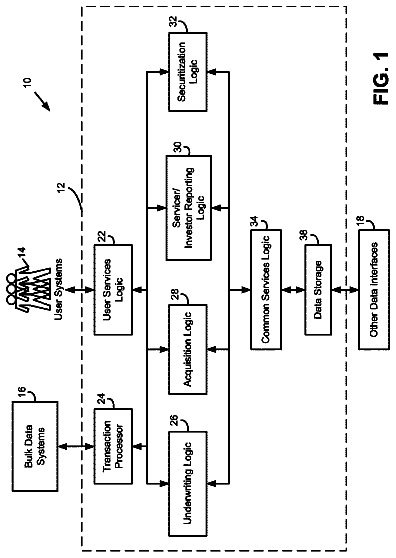
System and method for processing data pertaining to financial assets
A method of processing data in connection with a security is provided.
US 9,928,559 B2 · Assignee: SEND ONLY OKED DOCUMENTS (SOOD) · Inventors: Lahmi; Paul et al.
Sheet 1 of 22 from the published document. All sheets in the USPTO PDF
A method for watermarking a document containing at least one text portion comprising the following steps: —determining a specific character font comprising, for at least one character, an original graphic and at least one variation, each of the variations being associated with a different value, said character being termed encodable characters; —using the specific character font to encode an item of information in the text portion of the document, by replacing at least one original graphic with a variation, the original graphic and the variation or variations being identified as a single character by a first optical character recognition process referred to as standard OCR and identified as a plurality of characters by a second optical character recognition process referred to as specific OCR that is capable of determining if the represented character is the original graphic or one of the variations of same and, if so, making it possible to determine the variation that is represented, a strict order relationship being defined on the encodable characters in order to establish the order in which the encodable characters are to be processed during the decoding phase.
1 of 22 drawing sheets so far from the published document, cropped to the drawing. Every sheet is in the USPTO PDF.
What the patent claimed, word for word. All of it is now free to use.
The invention concerns on the one hand a method of encoding computer type information superimposed on the text portion of a document and on the other hand the corresponding decoding method. This encoding and decoding is particularly suitable for managing the authentication of a document and for securing any process of reproduction of this document, the information superimposed in this way on the text being in particular able to serve as “rules” for reproduction of said document. This technology is particularly relevant to rendering permanent any transfer of information linked to a document when the latter is flashed, i.e. photographed or videoed, by a portable device such as a smartphone (intelligent telephone) or digital tablet.
There exist at present various digital watermarking technologies for inserting computer type data into a document. As a general rule, these techniques utilize document portions rich in information such as images or if the document is insufficiently rich necessitate the superimposition of a frame for supporting the watermark. Indeed, in the case of a color image, each pixel is RGB (red, green, blue) coded with a coding level for each of these colors having a value from 0 to 255, which allows effective encoding subject to elementary variations at each of these points. The insertion of a simple or 2D bar code can also be substituted for this watermarking.
In the case of the text portion of a document, each elementary point is originally either black and represents the form or white and represents the ground. Although it is possible to assign each point of such a text portion a gray level value from 0 to 255, that value is somewhat unreliable because it does not result from real coding but from a measurement itself depending on the printing quality and the method of acquisition, which is generally digitization. The difficulty of separating the “added” information and the inherent digitization and/or printing noise are therefore obstacles to this type of strategy.
There therefore exists a requirement for a solution that enables the watermarking of such documents without degrading their esthetics, the watermarked document being virtually identical visually to the same non-watermarked document.
Such a solution enabling the watermarking of a text portion should be simple to implement and necessitate very little computing power. This would make it possible to insert the watermarking phase into a process of producing a large number of documents without slowing it down. This may be the case for batch production by a service (telephone, electricity, etc.) provider linked to customer invoices.
In order to better define the field of use of our invention, we summarize some basic concepts referred to in previous patents. Indeed the watermarking proposed for the present invention is particularly suited to the application of these patents.
Reference may be made in particular to FR2732532 which introduces the concept of “sensitive documents”, i.e. a set of documents reproduction of which is not free as opposed to “classic documents” the reproduction of which is not subject to constraints or restrictions.
Our work has enabled us to define a more sophisticated way of transmitting documents with authentication. “Authenticated documents” represent one of the four categories of “sensitive documents” listed in FR2732532. The “author documents” also listed in FR2732532 are also relevant in the context of the present invention since adding a watermark specific to each copy converts the latter into a “authenticatable copy”. The speed of the proposed encoding is also effective for defining “rules” in the context of “confidential documents” also listed with the additional advantage that the latter are difficult for a malicious user to neutralize.
We summarize hereinafter a number of definitions from the above patents that will be usable in certain aspects of the disclosure of our invention.
We should first define the various types of documents on which our invention impacts, and in particular we can make a first distinction by considering the media used to make it possible to distinguish “material documents” and “immaterial documents”.
A “material document” is a document in its form printed on a medium similar to paper by any existing or future technical means such as, non-limitingly, offset printing and/or printing by a printer controlled by an information system possibly completed by additional elements such as handwritten elements and any combinations of these means. The medium could be standard paper or any other medium that can be printed in this way in order to obtain a physical document. The format has no impact on this definition: an A4 or A3 format document (standard format in Europe), letter format document (standard format in America) and any other standard or non-standard format, single-sided or double-sided or made up of a plurality of sheets or even a book remains a “paper document” including if the medium has nothing to do with paper: synthetic material, metallic material or material made of any substance.
Unlike a “material document”, an “electronic document” is an “immaterial document”. It can take a number of forms.
An “electronic document” may be in the form of a computer file in a format that can be displayed directly such as the PDF format and such that printing this document produces a “material document” visually identical to this document when it is displayed on a computer type screen. In a non-limiting way this screen can be the screen associated with or controlled by a desktop or laptop computer or tablet or any other screen managed by a computer intelligence such as the screens of smartphones (intelligent telephones). The format of this type of file is important for the remainder of the description of the patent, and it is therefore necessary to distinguish two types of “electronic document” formats, and this format can also qualify other “electronic documents”, namely “image electronic documents” and “descriptive electronic documents”.
The file format of “image electronic documents” emphasizes the viewing of the document and lists all the elementary constituents of this document linked to the display of the document, for example the definition of a certain number of pixels or any set of graphical elements enabling reconstitution of the image of the document with a view to displaying it on a screen or printing it. In this case, the “unitary characters” are not identifiable by a direct analysis of the file but could be detected by OCR (optical character recognition) technologies applied to the complete image of a page or to a portion thereof. As a general rule, we will consider as “image electronic documents” any electronic document where the characters cannot be determined by a direct analysis of the content of the file but must be retrieved indirectly from images that this document makes it possible to reconstitute. For example, documents in the Tiff or JPEG format are as a general rule “image electronic documents”.
The file format of “descriptive electronic documents” emphasizes the identification of the components of the document and the positioning of each of its components in the pages of the document. As a general rule, we will consider as “descriptive electronic documents” any documents the format of which makes it possible to identify the “unitary characters” that constitute it without having to reconstitute the image thereof or the images that it materializes in the event of printing or display. For example, documents in WORD format (.doc, .docx . . . ), EXCEL format (.xls, .xlsx . . . ) or PDF format are as a general rule “descriptive electronic documents” when they result from a computer process. There nevertheless exist certain cases in which these same documents are “image electronic documents”, in particular when these documents are the result of a digitization operation or incorporate external resources.
In some cases, “descriptive electronic documents” take the form of a declarative type file, such as an XML file, for example, which in this case includes a certain number of items of data and formatting instructions. These elements may be defined either explicitly in the file or implicitly via calling on external data systems and the use of appropriate algorithms. By extrapolation, a document may be limited to a collection of information on condition that a computer intelligence is capable of using appropriate algorithms to produce either an “electronic document” that is displayable as defined above or a “material document” as defined above by adding to this data complementary data and/or defined formatting operations managed by this computer intelligence and/or by one or more third party information systems relating thereto.
A document displayed on a computer screen is both similar to a “material” document when it is associated with its screen medium and an “electronic document” when it is associated with a computer type file or the like as defined above. A document displayed on any type of screen is therefore a “material document” when it is for example photographed or videoed by a device such as a smartphone, for example. It is on the other hand considered as an “electronic document” when the user viewing it decides to save it or to transmit it via an information system.
A “conceptual document” is all of the information necessary for obtaining an “electronic document” and/or a “material document”. A “conceptual document” is materialized by a set of computer data, whether the latter is stored on the same physical file, the same database or a plurality of these elements is divided across a set of storage units distributed across different computer media such as one or more computer files or the like and/or databases or the like themselves present on one or more information systems. This data may be integrated into a computer object such as an XML file, for example. This data may integrate formatting definition elements. In this case formatting consists in the definition of the presentation of the data when the latter is integrated into an “electronic document” and/or a “material document”.
In the context of the invention an “exploitable document” is a document to which the decoding steps of the invention can be applied. These steps are of a kind executed by a computer; they necessitate the recognition of graphical elements and/or graphical characteristics. This document will be in an “electronic document” form enabling such recognition. If the document to be processed is a “material document”, an “exploitable document” will therefore be obtained by a digitization phase, either through use of a scanner or by taking a photograph or an equivalent operation. The format of the “electronic document” obtained must allow the decoding phases by graphical analysis of the result of digitization. If the document to be processed is already an “electronic document”, this document is an “exploitable document” if the explicit decoding phases of the present invention can where applicable detect therein the “marks” and/or the “rules” present or, generally speaking, any encoding portion intended to be decoded.
The above definitions are complemented by general technical definitions:
A “requesting unit” is an entity that takes the decision to encode a “conceptual document”. The “requesting unit” may be human, i.e. a user or any person or group of persons having defined a requirement for encoding compatible with the present invention applied to a document for a particular functional aim. The “requesting unit” may equally be any computer or other process which during the process of creating a “material document” and/or an “electronic document” necessitates encoding compatible with the present invention.
The “rules” element when it is inserted in a “sensitive document” enables the reproduction system to identify the reproduction rules and restrictions associated with this document subject to reproduction, this definition resulting from my previous patents. This information may include not only referencing information for reaching previously stored information associated with the document subjected to reproduction. In this case, the “rules” may equally be defined in a manner complementary to the other referencing elements classically inserted into the document in the form of one-dimensional or two-dimensional bar codes, for example, or even data inserted in a visually exploitable form such as a contract number. Any computer type information, i.e. any information that can be processed by a computer type algorithm in order to enable this algorithm to respond to a request for reproduction of a “sensitive document” in order to manage the methods and the restrictions of such reproduction, is referred to hereinafter by the term “rules”. These “rules” are graphically defined on a “material document”. For an “electronic document”, they are defined freely on condition that any “material document” obtained from this medium can integrate “rules” defined graphically either via a standard printing process or via a specific printing process ensuring the transposition of the rules of the electronic document into rules in the printed document, whether these two occurrences are identical or not.
The “mark” element when it is inserted in a “sensitive document” enables a reproduction system incorporating appropriate technology to detect the “sensitive” nature of the document subject to reproduction independently of the decoding of the “rules”, this definition resulting from my previous patents. In the case of a “material document”, the “marks” are graphical elements integrated into the general graphics of the document and that can be detected by a phase of digitization of this document and by direct searching in the result of this digitization. The digitization of a “paper document” consists of modeling a document as a set of points or the like with particular attributes for each of them such as color attributes. The result of this digitization makes it possible to transform this “material document” into an “image electronic document” that may be subjected to appropriate computer processing such as for example the possibility of displaying this document on a computer type screen. There exist at present numerous methods for modeling a “material document” after digitization, and the following formats may be cited in a non-limiting manner: TIFF, JPEG, PDF. In the case of an “electronic document”, the “mark” may be integrated as a specific attribute such as for example the definition of a computer value stored in the body of the “electronic document” or in a dedicated area. It may equally correspond to elementary modifications of the content of the document proper which in this case could correspond to the “mark” of the material document obtained by direct printing of the “electronic document”.
A “LAD/RAD system” (LAD: automatic document reading, RAD: automatic document recognition) is mainly applied to the result of digitization of a “material document” and consists in recognizing or identifying its structure possibly by identification of the form used. Various techniques exist for RAD or generally LAD; our invention being able to implement this type of technology, we summarize this prior art hereinafter before disclosing our invention.
“OCR” (optical character recognition). Various techniques exist. Our invention implementing this type of technology, we summarize this prior art hereinafter before disclosing our invention.
Here we propose to outline the prior art concerning image interpretation in the context of the application to automatic document reading (LAD/RAD) and optical character recognition (OCR):
The following definition of the prior art refers to FIG. 11 .
The interpretation of digital images in the broad sense is generally based on chaining appropriate operators, aiming to reconstruct high-level semantic information from the pixels resulting from the acquisition process. The forms of processing most widely used can most often be broken down into layers depending on the level of abstraction concerned. The number of levels may be more or less variable, depending on the authors, but it is nevertheless possible to disengage relatively stable invariants that are characteristic of a classical analysis system.
These invariants can be integrated into highly varied strategies, depending on the priorities defined by the development teams. Two major categories of methodologies are therefore found in the literature and on the “classic” market.
Firstly, there are bottom up approaches, the principle of which is to start from the pixel and to go to the object, progressively grouping together in accordance with homogeneity or connection criteria the pixel information of the image to construct high-level semantic objects (example: pixel.fwdarw.character.fwdarw.word.fwdarw.line.fwdarw.paragraph.fwdarw.page, in the case of a simple printed text page).
There also are contrary approaches, top down approaches, the principle of which is to apply homogeneity and connection criteria to progressively break down the image of the document into elements of ever simpler nature, to arrive at the elementary components of the page.
Other, more original approaches rely on so-called “heterarchic” or “cyclic” mechanisms consisting in alternating these different approaches as a function of intentions or consistency or recognition quality criteria.
These major method categories all rely on elementary processing components the outlines of which are described hereinafter. FIG. 11 is a block diagram summarizing these major steps of a bottom up approach. In accordance with a relatively “classic” scheme, it is therefore possible to distinguish the low-level operators aiming to filter/restore the image. They consist in identifying the nature of the deterioration and its parameters in order to improve the quality of the image in respect of subsequent processing. Depending on the objective, different classes of processing may be integrated at this level. Among these it is possible to cite contrast enhancement techniques. These tools generally consist in redeploying the histogram of the image over an optimum analysis range when the images are of relatively low information content, generally because of the acquisition conditions. This type of situation is encountered when scenes are underexposed or the sensor does not supply information with sufficient discrimination for the remainder of the operations. Filtering techniques also come into this processing category. They aim to eliminate the disturbances introduced during acquisition/digitization of the image. Different kinds of noise are encountered (additive, multiplicative, impulse, etc.) and the methodologies used are generally adapted accordingly. Their aim may also be to “binarize” the image if the designer of the analysis system does not wish to use the binarization “black box” supplied with the sensor, generally a scanner. Indeed, although the binarization algorithms supplied with the acquisition devices have seen real progress through integrating the dynamic of the histogram, they remain relatively unsuitable if the image includes local characteristics that cannot be analyzed by these global techniques. In particular these global binarization tools raise problems for the segmentation of locally dense documents, such as certain cards, envelopes, newspapers or forms. The major problem arising from these techniques is the segmentation of the characters, which if the binarization process is poorly executed may be joined to one another or to elements that are not part of the text layer. This step can prove decisive for the remainder of the operations because the management of the text information connected to other elements is a very delicate processing phase. Finally, also encountered at this processing level are restoration tools aiming to eliminate noise and/or fuzziness from the image, such deterioration generally being introduced by the acquisition device and conditions. Generally speaking, most techniques used at this level aim to be “blind or semi-blind”, i.e. entailing minimum introduction of a priori knowledge. Such is the entire problematic of the inverse problems.
These processing operations precede an information segmentation phase aiming to separate the information aspect from the background of the image.
Complementing the methods referred to above there is then a raft of processes for extracting elementary information from the image, with a view to starting the information structuring phase. In document analysis, these segmentation techniques generally rely on data relating to knowledge of the properties of the information looked for. This data may concern attributes inherent to the objects looked for, such as geometrical characteristics of the shapes to be recognized: size of forms, areas, etc. Connex component extractors are then used to separate the information layers.
As a general rule, there is then encountered a set of processing operations the aim of which is to extract primitives for recognition. Depending on the context, the techniques used can either be rendered operational directly on the forms to be recognized or necessitate a segmentation phase beforehand (the term segmentation is also employed here, even though it is not an operation of the same type, because here it is a question of breaking the usable information down into “elementary particles” that are simple to recognize).
In the case of printed documents, the text information may simply be segmented, the characters naturally being separated from one another during printing. Simply extracting the connex components from the document is sufficient to extract the characters. In cases of this kind, the primitive extraction techniques are applied directly to the forms materialized by the connex components.
In other cases, such as the recognition of handwritten cursive script, for example, the problem of extraction of primitives for recognition is more delicate because the forms to be recognized are connected to one another. The techniques generally applied then aim to “chop” the information into “pieces” (form-form segmentation operation) and to feed the recognition device with the “pieces” resulting from segmentation. Depending on the nature of the problem analyzed, the pieces could be letters, groups of letters or portions of letters generally referred to as graphemes (this term will be used with this meaning in the remainder of the patent). Although the cursive characters resulting from handwriting are not potentially bearers of information in the sense of our invention, their recognition in a document that includes encoding in accordance with our invention makes it possible for example to identify annotations added to a “sensitive document” and to be able to associate them with appropriate processing.
During these processing phases, these steps preceding recognition are generally combined with phases of extraction of information on the objects to be recognized. In the case of unconnected characters, for example, the tools for extraction of connex components previously mentioned therefore make it possible to extract a lot of information usable for recognition (center of gravity, eccentricity, etc.).
In the case of cursive handwriting, the segmentation phase can make it possible to proceed to coding of the analyzed information for subsequent recognition steps. For example, in handwriting, the graphemes extracted will be matched with graphemes stored in databases (examples of graphemes: a stem or stroke of a letter, a loop, etc.) and their sequential chaining may be stored (example: a stem followed by a loop may constitute an index for recognition of the handwritten letter “k”). This sequential chaining is generally used in subsequent processing phases in probabilistic mechanisms, for example (example of sequential chaining: in the case of recognition of checks, the probability of having the word “fifty” before the word “hundred” is zero: if the recognition process tends to take this type of decision, information on these transition probabilities can then be used to reject the information).
Depending on the context concerned, there may follow a method of characterization of the forms before recognition. These characterization methods aim to represent the image of the forms to be recognized in a stable space facilitating recognition. Some approaches use the image directly to represent the forms, but these approaches generally suffer from the problem of stability, and often run into difficulties as soon as it is necessary to process problems of invariance of scale or orientation.
The techniques used to characterize the forms are generally “structural” or “statistical”. The structural approaches attempt to represent the forms via structural information of the form, such as the number of line ends, the number of nodes of the skeleton, or the number of concavities, etc. The structural information may also in some cases concern the topological relations that may exist between elementary primitives constituting the forms. As appropriate, information bases are then constituted representing the forms to be recognized in “characteristics vectors” form and the recognition phase then amounts to seeking in the base that which most closely approximates an unknown form. In other cases, the forms to be recognized could be described by states in a graph and probabilistic or syntactic mechanisms then make it possible to proceed to recognition.
The statistical approaches also aim to represent the forms in another, stable space enabling recognition to follow. The techniques generally used may rely on more or less sophisticated mathematical tools to represent the forms (frequency-based representation, representation by geometrical moments, by invariants, etc.). In this type of situation, the output from this step is generally a description of the forms by descriptors vectors that can be used for recognition.
The step following this characterization phase is generally a recognition phase that depends on how the form has been characterized. If the forms to be recognized are described in structural form, a syntactic analysis or a structural analysis can make it possible to proceed through recognition (in simplified terms, a syntactic analysis may be compared to the analysis of the structure of a phrase that is correct or not depending on how the words are strung together).
Depending on the nature of the problem, probabilistic methods could equally be used here to proceed to recognition.
If the forms are described by vectors coming from mathematical transforms—statistical approaches—the recognition problematic then consists in comparing the vectors representing unknown forms with those representing forms known a priori. It is then a question of measuring resemblances between characteristics vectors in n-dimensional spaces (n corresponding to the number of characteristics retained to represent a form). The decision is then generally based on criteria of the distance between the forms to be recognized and the unknown forms to make a decision. The techniques used may then rely on highly varied mechanisms, such as probabilistic classification, connection-based (neuronal) approaches, fuzzy methods, etc., or a combination/merging of these approaches. The current reference methods in the matter of recognition are generally support vector machines (SVM) and connection-based techniques on the basis of recurrent neural networks.
This technology for identification of an unknown form to associate it with a known value by a statistical analysis of a characteristics vector is referred to as “statistical classification” hereinafter and when OCR uses such a recognition method to recognize an unknown character to identify it against known characters it is referred to as “OCR using a statistical classification method” hereinafter.
Depending on the methodology employed, the output from these techniques may be the “class” of the recognized object, possibly associated with a confidence or probability linked to the decision.
It goes without saying that in these recognition mechanisms preliminary steps are necessary for the system to “learn” to recognize the forms to be analyzed. The learning methods are also highly variable depending on the recognition technique adopted.
Where statistical recognition methods are concerned, the approaches are very often referred to as “supervised” and consist in bringing to the input of the recognition device a large base of labeled samples representative of the problem and calibrating the recognition system using these samples.
For example, in character recognition, a labeled character base could be used (for which the response that the recognition system should produce is known). These bases are generally very large because they condition the subsequent processing. The size of these bases is directly proportional to the size of the vectors representing the forms (to alleviate a problem referred to as the dimensionality curse).
Where the structural recognition methods are concerned, the approach is somewhat the same and consists in bringing to the system bases of elements known a priori.
Note here that, depending on the recognition device concerned, the systems will or will not be in a position to proceed to “incremental” qualified learning, enabling the system to learn dynamically new samples or to correct errors that it may have committed that would be detected by the user. In many systems, the learning is non-incremental and is based on an upstream learning phase that is not challenged thereafter.
The problem with the interfaces is multi-faceted according to whether it is the man-machine interface that is considered or the interfaces between the processes involved in the chain.
In the case of the man-machine interface, the aim will be to enhance the ergonomics of the device for the correction and learning phases, either through phases dedicated to correction or via interactive corrections.
In the case of interfaces between processes, the aim will be to define the most generic possible formalisms in standard formats (for example XML) to guarantee the greatest flexibility and the interchangeability of the software components involved in the chain.
This “interface” aspect is essential when considering systems having incremental learning capabilities because the human operator interferes with the device to assist it in the construction of its solution.
All these complex mechanisms are generally integrated into more or less dynamic systems that are based on numerous kinds of knowledge in very different categories.
Among these, knowledge in the field concerning the problematic analyzed and its specifics are generally buried in the code of the device, making evolution and adaptation of the system difficult. Innovative approaches aim to externalize this knowledge and to make it as independent as possible of the recognition device so that the latter is organized dynamically as a function of each application.
Other knowledge categories are implicitly used in such devices, such as the knowledge of an image processing expert, who has the know-how to chose an image processing operator as a function of the context and who knows how to set its parameters. Some approaches also attempt to externalize this knowledge so that the image processing part is self-adapting as a function of the context.
Depending on the context analyzed, numerous paths are therefore possible at each step of the chain. As indicated above, the implementation of a processing chain involves numerous types of knowledge that it is of fundamental importance to externalize to guarantee that the system is perennial, adaptable and evolvable. Indeed, as a function of the context encountered, the processing chain deployed and its parameters can be very varied.
The present invention enables the text portion of a document to be used to encode computer type information that can itself inter alia serve as “rules” as defined above. To facilitate the description of the invention, the following concepts are explained:
A “strict order relation” is a mathematical concept. In the present case, a “strict order relation” is defined when for two distinct elements of the same kind it is possible to associate an index such that:
if x is the first element,
if y is the second element,
if f is the function enabling association of an index (in our case a positive integer is sufficient, although any other type of data is compatible) such that f(x) is the index associated with x,
if x is considered to precede y in the classification method adopted, then it is strictly true that f(x)<f(y) (i.e. f(x) is different from f(y)),
this relation is transitive, i.e. if x precedes y and y precedes z according to the classification method adopted, then x precedes z, which translates at the level of the associated indices, if f(x)<f(y) and f(y)<f(z) then f(x)<f(z),
the relation as we define it is mathematically a total strict order relation, i.e. two elements cannot have the same index if they are distinct.
For simplicity it will be considered hereinafter, unless otherwise stipulated, that the “strict order relations” that will be used to implement the invention correspond to continuous indexations starting from 1. That is to say, the first element identified is associated with 1, the second with 2 and so on using only integer numbers. It is obvious that any other numbering system that is not continuous and does not start from 1 or is not based on integer numbers is equally satisfactory for the implementation of our invention. It is therefore possible to use a form of indexation using relative numbers, decimal numbers or numbers of any kind such that the above definition is respected. Likewise, it is possible to use an n-tuplet, i.e. an element of the form (a1, a2, . . . , an). To create a “strict order relation” of a character in a document, therefore: a1 could identify the page, a2 the line, a3 the word and a4 the position within the word assuming that “strict order relations” can be defined for the pages, for the lines of a page, for the words of a line and then for the characters of a word. In this case a character associated with the n-tuplet (a1,a2,a3,a4) precedes the character associated with an n-tuplet (b1,b2,b3,b4) if a1<b1 or if (a1=b1 and a2<b2) or if ((a1=b1 and a2=b2) and a3<b3) or if ((a1=b1 and a2=b2 and a3=b3) and a4<b4).
A “unitary page” represents the equivalent of the recto side or the verso side of a “material document”. The recto page or the verso page may be considered as not forming part of the “material document” if this page is blank, for example, or does not include any information that can be exploited. A “material document” of several pages will therefore include at most as many “unitary pages” as recto faces and verso faces. It is incumbent upon the designer of the original document or the person who will be responsible for incorporating the watermark that is the subject matter of our invention to define which recto and/or verso pages will be “unitary pages”. On the “unitary pages” defined in this way, it is possible to define a “strict order relation” that enables page numbers to be defined. This concept is also applicable to “electronic documents” that also identify “unitary pages”. These pages generally correspond to the “unitary pages” that will be obtained after printing, although this correspondence is optional. For some documents, the pagination concept does not exist, in which case these “electronic documents” will be considered to be constituted of one and only one “unitary page”. Similarly, in some cases, it could be considered that a set of several pages as defined above constitutes the same document or the same sub-document and that, in this case, the encoding should not take account of the pagination, apart from the establishment of a strict order relation, if any. In this case the processes described in relation to the present invention will be applied globally to this document or sub-document in the same way as if it were constituted of a single page. The same recto page or the same verso page may equally be considered to contain a plurality of unitary pages, which must therefore be identifiable during the digitization phase by an appropriate algorithm.
A “unitary line” is a set of words and/or characters that are aligned within the same “unitary page”, which means that if a “strict order relation” is defined for the “unitary lines” then:
if two characters belong to the same “unitary line”, it is not possible to know which character precedes the other based only on this,
if two characters belong to two distinct “unitary lines”, it is possible to know which character precedes the other based only on this.
For a given language, or for a set of languages, a “font” is the collection of characters of the alphabet associated with that language or languages, according to a particular graphic defined by the creator of the “font”. There are many fonts available at this time, especially since the popularization of word processing software. A non-limiting list could include the Arial, Times, Courier fonts. The use of some of these fonts is subject to author's rights. In the context of the invention, a “font” corresponds to any collection of characters determined independently of the invention or specifically for using the invention, depending or not on usage. A usual “font” could therefore correspond to the integration of characters from a plurality of “fonts” defined in the context of the invention and conversely a “font” defined in the context of the invention could correspond to the integration of characters from a plurality of the usual fonts. If a “font” defined in this way is made to correspond with characters coming from several “fonts”, it does not necessarily incorporate all of the characters defined for that plurality of “fonts”.
A “font style” represents a specific way of representing the “font”. The most common “font style” is therefore the roman style (text in its current version). there also exist bold, italic and “bold italic”; this list is not limiting and some of these styles exist in several variations. Hereinafter it will be considered that a “font” is associated with a single “font style”; “Arial roman” characters therefore belong to a “font” distinct from that which incorporates the “Arial bold” characters. There are therefore as many Arial “fonts” as there are Arial “font styles”.
A “font point size” is characteristic of the size of the characters of the corresponding “font”. The “point size of a font” classically determines its size expressed in points (in typographic points, this concept coming from printing). For example, the characters of a “font” in 12-point are thicker than the same characters of the same “font” in 10-point (approximately 20% in terms of height and approximately 44% in terms of area).
The description continues in the full USPTO document.
About 6,146 words. The USPTO PDF has it with every drawing.
Fees are due 3.5, 7.5 and 11.5 years after grant. This patent expired on March 27, 2026, so the fee marked "not paid" was the one that went unpaid.
METHOD FOR WATERMARKING THE TEXT PORTION OF A DOCUMENT
Filed Mar 2014 · published Feb 2016Method for watermarking the text portion of a document
Filed Mar 2014 · granted Mar 2018Earlier publications, parents and continuations. None of them can still be enforced, or this patent would not be listed.
Prior art cited by the examiner or applicant. Useful when you check your own idea for novelty.
Everything on this page comes from the documents linked above.


