Lapsed, fee not paid8 drawings
Software & Apps · US 8,769,396 B2
Calibration and annotation of video content
Various embodiments provide techniques for calibrating and annotating video content.
US 8,769,399 B2 · Assignee: Microsoft Corporation · Inventors: Marantz; Daniel et al.
Sheet 1 of 17 from the published document. All sheets in the USPTO PDF
Computer-storage media, methods, and systems for formatting and surfacing a badge are provided. The badge represents a graphical region presented in visual association with a search result on a web-results page. The format of the badge is initially dictated by a template that is automatically generated. Upon collecting performance information, a website owner is granted permission to alter the template and appearance of the badge, via a publisher portal. During interaction with the publisher portal, the website owner is prompted to provide feedback in order to manage parameters of the badge, such as uploading a visual representation of a logo, trademark, or other branded element, or specifying a type of metadata to be imported to the graphical region. Accordingly, the badge operates to improve a users' ability to distinguish between search results on the web-results page and assists users in confidently deciding upon and selecting a relevant search result.
Presently, the Internet provides a vast variety of utilities that assist Internet searching for information. Typically, this information is delivered from a search engine to a web browser located on a user's computing device in the form of search results. These "search results" are often similarly formatted within a web-results page, thus, obscuring those members of the search results that may by more useful or relevant than others. For example, conventional search engines surface the search results as a number of blue links describing their respective online documents. These commonly situated blue links force users to actively scan for familiar terms and authoritative indicators within the search results to provide confidence prior to selection.
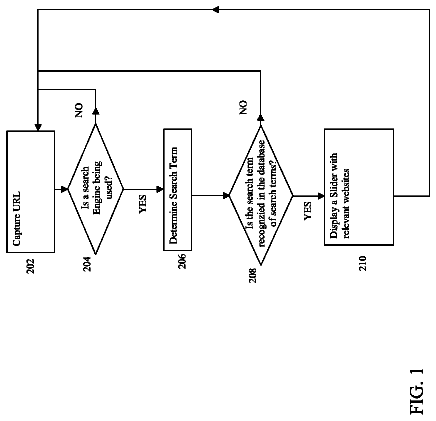
1 of 17 drawing sheets so far from the published document, cropped to the drawing. Every sheet is in the USPTO PDF.
What the patent claimed, word for word. All of it is now free to use.
Not applicable.
Not applicable.
Presently, the Internet provides a vast variety of utilities that assist Internet searching for information. Typically, this information is delivered from a search engine to a web browser located on a user's computing device in the form of search results. These "search results" are often similarly formatted within a web-results page, thus, obscuring those members of the search results that may by more useful or relevant than others. For example, conventional search engines surface the search results as a number of blue links describing their respective online documents. These commonly situated blue links force users to actively scan for familiar terms and authoritative indicators within the search results to provide confidence prior to selection.
This Summary is provided to introduce a selection of concepts in a simplified form that are further described below in the Detailed Description. This Summary is not intended to identify key features or essential features of the claimed subject matter, nor is it intended to be used as an aid in determining the scope of the claimed subject matter.
Embodiments of the present invention relate to systems, methods, and computer-storage media for improving the ability of a user to distinguish between search results in a web-results page. In one instance, the particular search results are distinguished because they are decorated with a badge. As used herein, the term "badge" is not meant to be limited to any particular visual characteristics or attributes drawn from a web page, but may encompass any attributes pulled from a source (e.g., metadata extracted from an online document), material submitted by a publisher (e.g., uploaded logo for use as a branded element), or any other data that may be incorporated into a graphical region. For example, a badge may provide a concise visual representation, or lens, that is reflective of an underlying web page's content and company logo.
In other embodiments, a self-service, publisher-portal component is established that allows site owners and other content providers to select metadata to be displayed alongside their search result (e.g., providing a feedback loop with a site owner for a certain search result in order to control parameters for the display and maintenance of the logo and metadata). This selected metadata and the logo, or branded element, are both incorporated within the graphical region of the badge. As such, the badge assists users in quickly and easily differentiating between those search results that include a badge and the balance of the similarly situated links on the web-results page. In other words, the badges provide a visual guide, or sign post, that helps users scan the search results faster in order to quickly identify meaningful links. As a result, the users are enabled to confidently select the search results decorated with badges, which indicate providers the users recognize (e.g., improves the users' ability to key in on visual patterns for well-known and trusted branded marks).
Although not offered by conventional search engines, some web-browser plug-ins attempt to reveal a small graphic (16 pixel.times.16 pixel), or "fav icon," representing a marking of each search result. This "fav icon" is provided by the website itself, via the plug-in, and is exposed on or near the associated web result. Further, the "fav icon" has various limitations, such as the following: the small graphic is too diminutive to be easily recognized (e.g., the "O" of the Overstock.TM. website is indistinguishable, and frequently confused with, the "O" representing a web location having to do with Oprah Winfrey); the plug-in is a third-party program that requires separate installation; the small graphic fails to include key aspects of the search results that aid in decision making; and the plug-in does not offer a feedback loop that allows publishers to amend the composition and appearance of the small graphic.
In contrast, the badge of the present invention is allocated a greater amount of canvas space within a web-results page (e.g., 80 pixel.times.50 pixel), thus, allowing the badge to accommodate various forms of information, such as metadata from an online document, a publicly recognizable branded element (i.e., element of a larger size than the "fav icons," thus, solving the recognition problem), a labeled control button for user interaction, and other visual depictions of relevant data to draw the focus of a user. Further, the badge is configurable via an interface (e.g., publisher portal) that allows publishers to monitor performance and update parameters of the badge. Even further, the badge is developed by a searching service and surfaced according to a scheme managed by the searching service, thus, providing a comprehensive and consistent format for all web-results pages with no ad-hoc programs to install.
The present invention is described in detail below with reference to the attached drawing figures, wherein:
FIG. 1 is a block diagram of an exemplary computing environment suitable for use in implementing embodiments of the present invention;
FIG. 2 is a schematic diagram of an exemplary system architecture suitable for use in implementing embodiments of the present invention, in accordance with an embodiment of the present invention;
FIG. 3 is a diagrammatic badge depicting various illustrative aspects of a template, in accordance with an embodiment of the present invention;
FIG. 4 is a schematic diagram depicting a first illustrative search result that includes a representation of an exemplary badge surfaced concurrently with the search result, in accordance with embodiments of the invention;
FIG. 5 is a schematic diagram depicting a second illustrative search result that includes a representation of an exemplary badge surfaced concurrently with the search result, in accordance with embodiments of the invention;
FIG. 6 is a schematic diagram depicting a third illustrative search result that includes a representation of an exemplary badge surfaced concurrently with the search result, in accordance with embodiments of the invention;
FIG. 7 is a schematic diagram depicting a first illustrative UI display that includes representations of badges surfaced in association with respective search results, in accordance with embodiments of the invention;
FIG. 8 is a schematic diagram depicting a second illustrative UI display that includes representations of badges surfaced in association with respective search results, in accordance with embodiments of the invention;
FIG. 9 is a schematic diagram depicting a third illustrative UI display that includes representations of badges surfaced in association with respective search results, in accordance with embodiments of the invention;
FIGS. 10-16 are schematic diagrams that represent a progression of illustrative UI displays that depict an exemplary method for interacting with a publisher portal, in accordance with embodiments of the invention;
FIG. 17 is a flow diagram illustrating an overall method for formatting a badge according to a template, in accordance with an embodiment of the present invention; and
FIG. 18 is a flow diagram illustrating an overall method for focusing a user's attention on a subject search result by rendering a badge therein, in accordance with an embodiment of the present invention.
The subject matter of embodiments of the invention disclosed herein is described with specificity to meet statutory requirements. However, the description itself is not intended to limit the scope of this patent. Rather, the inventors have contemplated that the claimed subject matter might also be embodied in other ways, to include different steps or combinations of steps similar to the ones described in this document, in conjunction with other present or future technologies.
Generally, embodiments of the present invention pertain to employing a search engine to produce search results that are responsive to a query, where some of the search results include a badge associated therewith. As discussed above, the term "badge" generally refers to a graphical region, or tile image, that is presented in proximity or integrated with a search result. Advantageously, the badge improves the ability of a user to distinguish between search results by highlighting or drawing the user's focus to a certain search results within a web-results page. In an exemplary embodiment, the badge improves the ability of a user to distinguish between search results by visually branding a search result using a logo and/or metadata from an underlying online document (e.g., web site or webpage). Exposing the visual brand assists the user in selecting a particular search result by leveraging the visual brand to enhance a user's confidence that the particular search result decorated with the badge is an authoritative source.
Further, embodiments of the present invention relate to formatting search result(s) that are surfaced within a display area on a graphical user interface (GUI). More particularly, an improved computerized system that generates badges for incorporation into respective search results, which are typically populated in a web-results page of the GUI, and that facilitates publisher-initiated modification of the badges is provided. Advantageously, these novel badges improve the users' ability to distinguish between the search results and to aid in targeting one or more of the search results based on confidence built in by information delivered by the badge (e.g., by leveraging a visual branded element of authoritative sites alongside an authorized search result and by exposing key aspects drawn from the underlying online document).
In operation, when a request for an online search is made (e.g., entry of a query to a searching service), one or more of the search results may be decorated with a badge that is generated or retrieved upon selecting the search results that satisfy the request. The badge, as more fully discussed below, may include a branded element (e.g., logo, trademark, or image affiliated with an entity operating the website), content drawn from predefined metadata fields in an online document (e.g., ratings of a website's service or goods), and/or any other information (e.g., link to related web page) that is relevant to the user's pursuit of a search result that best meets their searching intent.
Unfortunately, the conventional search engines fail to surface badges or branded elements, either explicitly or implicitly. To address this deficiency of conventional search engines, exemplary embodiments of the present invention include configuring search engines to return and surface badges that are relevant to certain search results. As a result, providing these badges as in tandem with the search results will potentially help users to complete their tasks faster and with better accuracy. As can be gleaned from the disclosure above, various embodiments of the present invention involve employing a mapping between badges and search results. Often, the search results are generated and surfaced on a graphical user-interface (GUI) display through the employment of task-based engines (e.g., decision engines, task engines, individual applications or operations, applet systems, operating systems, and task-based mobile systems), or general systems that allow a user to accomplish tasks by matching apps to user intent. For simplicity of discussion, these engines and/or systems will be hereinafter referred to as "search engines" or "search-engine components."
Accordingly, in one aspect, the present invention provides one or more computer-storage media having computer-executable instructions embodied thereon that, when executed, perform a method for formatting a badge according to a template, where the badge is associated with at least one search result selected for display on a graphical user interface (GUI). Initially, the method involves providing a plurality of metadata extracted from one or more online documents. In addition, a template that is previously assigned to the badge is accessed. Typically, the badge represents a graphical region that is revealed in association with a search result, while the search result includes a brief description (e.g., summary of content, link, title, matching terms, and the like) of the online document(s).
The method may further involve the steps of selecting one or more metadata from the plurality of extracted metadata as specified by the template and constructing the badge by incorporating the selected metadata into the badge. In an exemplary embodiment, the step of incorporating comprises inserting visual depictions of the selected metadata, as well as other data (e.g., branded element, control button, label, and the like), within the visual confinements of the badge. When displaying the web-results page, the search result may be rendered within the GUI by incorporating the badge within its description of the online document(s) that are referenced by the search result. In instances, the step of incorporating involves integrating the badge within the search-result description or arranging the badge in proximity with the search result such that they are visually associated with one another.
In another aspect, a computerized method is provided for focusing a user's attention on a subject search result by rendering a badge therein or therewith. In embodiments, the method includes the steps of recognizing that the subject search result is retrieved for presentation on a web-result page and identifying a template that is associated with the subject search result. Typically, the associated template is selected, via a partner-interaction process, by a publisher of an online document. Often, the online document is the web page or website that is being referenced by the subject search result.
The method may further involve formatting the badge based on the template. Generally, the badge represents a graphical region that includes a brand element and/or metadata extracted from the online document as dictated by the template. When rendering the web-results page, the badge may be visually associated with the subject search result by initiating a display of the badge in physical proximity with the subject search result. Further, upon viewing the badge, the publisher may invoke the partner-interaction process to alter the appearance of the badge, as more fully discussed below.
In yet another embodiment of the present invention, a computer system is provided for establishing a badge that is visually associated with a search result on a web-result page and for hosting an interface that permits alteration of the badge. By way of system architecture, the computer system comprises a processing unit coupled to a computer storage medium that stores a plurality of computer software components executable by the processing unit. The computer software components may include a search-engine component, a publisher-portal component, and a badge-composer component.
Initially, the search-engine component is configured for crawling a web index to retrieve a plurality of web results. Typically, the web results include a search result preauthorized to include a badge. As mentioned above, the term "badge" broadly represents a visual icon structured with a template that holds a branded element and/or metadata extracted from an online document referenced by the preauthorized search result. The publisher-portal component is configured to prompt a publisher of the online document to upload a logo for use as the branded element and to indicate a type of the extracted metadata to be populated into the template. In embodiments, the type of the extracted metadata may include one or more of the following: rating information, ranking information, number-of-visit information, or any other customer-reviews of the publisher's goods or services being marketed through the online document.
The badge-composer component is configured to automatically construct the badge using configuration data when initially establishing a presence of the badge. The configuration data, as described more fully below, is data automatically assembled to form the initial elements of the badge's graphical region. Upon a publisher making amendments to the graphical region, the badge may be modified by replacing the configuration data with solicited data and extracted data. The solicited data may involve information requested by the publisher-portal component, such as a logo or link to upload, while the extracted data involves the publisher indicating a type of metadata through the publisher-portal component that is intended for extraction from an online document. Further, the badge-composer component may be configured for rendering the badge on a web-results page. In an exemplary embodiment, rendering may include crawling the online document to extract the metadata as dictated by the indicated type of metadata. During the lifespan of the badge, the extracted metadata input within the badge's graphical region may be dynamically updatable based, in part, upon changes to the online document.
As discussed herein, the "templates" include instructions on how to format a layout of a badge, among other things. In an exemplary embodiment, the template establishes content panes or areas on the layout that are configured to accept various data, respectively. Typically, the content panes are configured as placeholders for metadata, images, logos, or any other content that may be presented on the GUI. In one instance, the content panes are rectangles that are adapted to be populated with metadata derived from one or more online documents targeted by the template. In still other embodiments, the adaptive template performs a routine that determines the number, size, and position of the content panes based on the configuration data, solicited data, and/or extracted data that is determined to be revealed by the badge.
Having briefly described an overview of embodiments of the present invention and some of the elements featured therein, an exemplary operating environment suitable for implementing the present invention is described below.
Referring initially to FIG. 1 in particular, an exemplary operating environment for implementing embodiments of the present invention is shown and designated generally as computing device 100. Computing device 100 is but one example of a suitable computing environment and is not intended to suggest any limitation as to the scope of use or functionality of the invention. Neither should the computing device 100 be interpreted as having any dependency or requirement relating to any one or combination of components illustrated.
The invention may be described in the general context of computer code or machine-useable instructions, including computer-executable instructions such as program modules, being executed by a computer or other machine, such as a personal data assistant or other handheld device. Generally, program modules including routines, programs, objects, components, data structures, etc., refer to code that performs particular tasks or implements particular abstract data types. The invention may be practiced in a variety of system configurations, including handheld devices, consumer electronics, general-purpose computers, more specialty computing devices, etc. The invention may also be practiced in distributed computing environments where tasks are performed by remote-processing devices that are linked through a communications network.
With reference to FIG. 1, computing device 100 includes a bus 110 that directly or indirectly couples the following devices: memory 112, one or more processors 114, one or more presentation components 116, input/output (I/O) ports 118, input/output components 120, and an illustrative power supply 122. Bus 110 represents what may be one or more busses (such as an address bus, data bus, or combination thereof). Although the various blocks of FIG. 1 are shown with lines for the sake of clarity, in reality, delineating various components is not so clear, and metaphorically, the lines would more accurately be grey and fuzzy. For example, one may consider a presentation component such as a display device to be an I/O component. Also, processors have memory. The inventors recognize that such is the nature of the art, and reiterate that the diagram of FIG. 1 is merely illustrative of an exemplary computing device that can be used in connection with one or more embodiments of the present invention. Distinction is not made between such categories as "workstation," "server," "laptop," "handheld device," etc., as all are contemplated within the scope of FIG. 1 and reference to "computing device."
Computing device 100 typically includes a variety of computer-readable media. Computer-readable media can be any available media that can be accessed by computing device 100 and includes both volatile and nonvolatile media, removable and nonremovable media. By way of example, and not limitation, computer-readable media may comprise computer storage media and communication media. Computer storage media include both volatile and nonvolatile, removable and nonremovable media implemented in any method or technology for storage of information such as computer-readable instructions, data structures, program modules, or other data. Computer storage media include, but are not limited to, RAM, ROM, EEPROM, flash memory or other memory technology, CD-ROM, digital versatile disks (DVD) or other optical disk storage, magnetic cassettes, magnetic tape, magnetic disk storage or other magnetic storage devices, or any other medium, which can be used to store the desired information and which can be accessed by computing device 100. Communication media typically embody computer-readable instructions, data structures, program modules or other data in a modulated data signal such as a carrier wave or other transport mechanism and include any information delivery media. The term "modulated data signal" means a signal that has one or more of its characteristics set or changed in such a manner as to encode information in the signal. By way of example, and not limitation, communication media include wired media such as a wired network or direct-wired connection, and wireless media such as acoustic, RF, infrared, and other wireless media. Combinations of any of the above should also be included within the scope of computer-readable media.
Memory 112 includes computer-storage media in the form of volatile and/or nonvolatile memory. The memory may be removable, nonremovable, or a combination thereof. Exemplary hardware devices include solid-state memory, hard drives, optical-disc drives, etc. Computing device 100 includes one or more processors that read data from various entities such as memory 112 or I/O components 120. Presentation component(s) 116 present data indications to a user or other device. Exemplary presentation components include a display device, speaker, printing component, vibrating component, etc.
I/O ports 118 allow computing device 100 to be logically coupled to other devices including I/O components 120, some of which may be built in. Illustrative components include a microphone, joystick, game pad, satellite dish, scanner, printer, wireless device, etc.
Technology introduced by embodiments of the present invention for automatically generating badges relevant to one or more search results, altering the appearance of the badges based on publisher feedback (e.g., upon the publisher monitoring performance of the badges and updating the badge's graphical region based on the monitored performance), and surfacing on a GUI display representation(s) of the altered badges as part of the search results will now be discussed with reference to FIG. 2. In particular, FIG. 2 depicts a block diagram that illustrates an exemplary system architecture 200 of a distributed computing environment, suitable for use in implementing embodiments of the present invention. Generally, implementing embodiments of the present invention relate to systems and methods for improving a users' ability to distinguish between search results on a web-results page and assisting users in confidently deciding upon and selecting a relevant search result (i.e., satisfying the user's searching intent) by leveraging a branded element (e.g., visual representation of a logo or trademark) of authoritative websites alongside the search result and/or by exposing metadata extracted from the website. It should be understood and appreciated that the exemplary system architecture 200 shown in FIG. 2 is merely an example of one suitable computing environment and is not intended to suggest any limitation as to the scope of use or functionality of the present invention. Neither should the exemplary system architecture 200 be interpreted as having any dependency or requirement related to any single component or combination of components illustrated therein.
Initially, the exemplary system architecture 200 includes a client device 210, a user experience (UX) layer 220, a server 250, online documents 280, data store(s) 290, and a network (not shown) that interconnects each of these items. Each of the client device 210, the data store(s) 290, and the server 250 shown in FIG. 2, may take the form of various types of computing devices, such as, for example, the computing device 100 described above with reference to FIG. 1. By way of example only and not limitation, the client device 210 and/or the server 250 may be a personal computer, desktop computer, laptop computer, consumer electronic device, handheld device (e.g., personal digital assistant), various servers, processing equipment, and the like. It should be noted, however, that the invention is not limited to implementation on such computing devices but may be implemented on any of a variety of different types of computing devices within the scope of embodiments of the present invention.
Typically, each of the devices 210 and 250 includes, or is linked to, some form of computing unit (e.g., central processing unit, microprocessor, etc.) to support operations of the component(s) running thereon (e.g., search-engine component 225, publisher-portal component 230, badge-composer component 240, and the like). As utilized herein, the phrase "computing unit" generally refers to a dedicated computing device with processing power and storage memory, which supports operating software that underlies the execution of software, applications, and computer programs thereon. In one instance, the computing unit is configured with tangible hardware elements, or machines, that are integral, or operably coupled, to the devices 210 and 250 to enable each device to perform communication-related processes and other operations (e.g., accessing the data store 290 to retrieve a branded element or parsing the marked-up online documents 280 for metadata). In another instance, the computing unit may encompass a processor (not shown) coupled to the computer-readable medium accommodated by each of the devices 210 and 250.
Generally, the computer-readable medium includes physical memory that stores, at least temporarily, a plurality of computer software components that are executable by the processor. As utilized herein, the term "processor" is not meant to be limiting and may encompass any elements of the computing unit that act in a computational capacity. In such capacity, the processor may be configured as a tangible article that processes instructions. In an exemplary embodiment, processing may involve fetching, decoding/interpreting, executing, and writing back instructions.
Also, beyond processing instructions, the processor may transfer information to and from other resources that are integral to, or disposed on, the devices 210 and 250. Generally, resources refer to software components or hardware mechanisms that enable the devices 210 and 250 to perform a particular function. By way of example only, the resources accommodated by the server 250 may include one or more of the following software components or modules: the search-engine component 225 that interfaces with a web index 255, the publisher-portal component 230, and the badge-composer component 240.
The client device 210 may include an input device (not shown) and a presentation device (not shown). Generally, the input device is provided to receive input(s) affecting, among other things, a presentation of the search results in a browser window surfaced at a GUI display area. Illustrative devices include a mouse, joystick, key pad, microphone, I/O components 120 of FIG. 1, or any other component capable of receiving a user input and communicating an indication of that input to the client device 210. By way of example only, the input device facilitates entry of a query and controls the location of a selection tool (e.g., mouse pointer) hovering over the search results and badges that are responsive to the query.
In embodiments, the presentation device is configured to render and/or present the GUI display thereon. The presentation device, which is operably coupled to an output of the client device 210, may be configured as any presentation component that is capable of presenting information to a user, such as a digital monitor, electronic display panel, touch-screen, analog set top box, plasma screen, audio speakers, Braille pad, and the like. In one exemplary embodiment, the presentation device is configured to present rich content, such as the browser window that includes a display area populated with search results (e.g., descriptions of online documents and tile images). In another exemplary embodiment, the presentation device is capable of rendering other forms of media (e.g., audio signals). In yet another exemplary embodiment, the presentation device may present a portion of the search results (e.g., descriptions of and links to websites) in proximity with representations of badges, as more fully discussed below.
The data store(s) 290 are generally configured to store information to support generation of a badge, such as a branded element 295. As discussed above, the phrase "branded element" is not meant to be limited to the embodiments described herein, but may encompass any form of image, icon, trademark, graphic, animation, text, symbol, letter or number, audio signal, or visual that allows a user to recognize a source (e.g., company, organization, firm, individual, partnership, or other entity) that is attached in some fashion to a search result. For instance, the branded element IMDb.TM. for the Internet Movie Database may appear within the layout of a badge that decorates a search result for Disney.TM. videos, as shown in FIG. 9. In various embodiments, the information stored in the data store(s) 290 may also include, without limitation, metadata extracted from the online documents 280, configuration data used to automatically set up the initial version of the badge, a user profile that stores parameters of a template assigned to a publisher, visual depictions of data that are populated within a layout of the badge, and any other information that pertains to embodiments of the present invention.
In addition, the data store(s) 290 may be configured to be searchable for suitable access of the stored information. For instance, the data store(s) 290 may be searchable for one or more branded elements 295 or extracted metadata. It will be understood and appreciated by those of ordinary skill in the art that the information stored in the data store(s) 290 may be configurable and may include any information relevant to the execution of the badge-composer component 240. The content and volume of such information are not intended to limit the scope of embodiments of the present invention in any way. Further, though illustrated as single, independent components, the data store(s) 290 may, in fact, be a plurality of databases, for instance, a database cluster, portions of which may reside on the client device 210, the server 250, another external computing device (not shown), and/or any combination thereof.
This exemplary system architecture 200 is but one example of a suitable environment that may be implemented to carry out aspects of the present invention and is not intended to suggest any limitation as to the scope of use or functionality of the invention. Neither should the illustrated exemplary system architecture 200 be interpreted as having any dependency or requirement relating to any one or combination of the client device 210, the data store(s) 290, the server 250, the UX layer 220, and components 225, 230, and 240, as illustrated. In some embodiments, one or more of the components 225, 230, and 240 may be implemented as stand-alone devices. In other embodiments, one or more of the components 225, 230, and 240 may be integrated directly into the server 250, or on distributed nodes that interconnect to form the server 250. It will be understood by those of ordinary skill in the art that the components 225, 230, and 240 (illustrated in FIG. 2) are exemplary in nature and in number and should not be construed as limiting.
Accordingly, any number of components may be employed to achieve the desired functionality within the scope of embodiments of the present invention. Although the various components of FIG. 2 are shown with lines for the sake of clarity, in reality, delineating various components is not so clear, and, metaphorically, the lines would more accurately be grey or fuzzy. Further, although some components of FIG. 2 are depicted as single blocks, the depictions are exemplary in nature and in number and are not to be construed as limiting (e.g., although only one entry interface 235 is shown, many more may be communicatively coupled via the entry interface 235).
Further, the devices of the exemplary system architecture may be interconnected by any method known in the relevant field. For instance, the server 250 and the client device 210 may be operably coupled via a distributed computing environment that includes multiple computing devices coupled with one another via one or more networks. In embodiments, the network may include, without limitation, one or more local area networks (LANs) and/or wide area networks (WANs). Such networking environments are commonplace in offices, enterprise-wide computer networks, intranets, and the Internet. Accordingly, the network is not further described herein.
In operation, the components 225, 230, and 240 are designed to perform a process that determines whether a search result 265 warrants the inclusion of a badge 260, generation of the badge 260, and soliciting customization of the badge's template or parameters within predefined constraints. Initially, the search-engine component 225 is configured for crawling a web index 255 to retrieve a plurality of search results 265. In embodiments, the web-browser application 215 is generally configured to access and communicate with the search-engine component 225 running on the server 250. In one instance, access to the search-engine component 225 is attained by providing an appropriate uniform resource locator (URL) address to the web-browser application 215 that targets the search-engine component 225. In another instance, communication may be via an Internet (e.g., the World Wide Web) or an intranet (e.g., internal system to the communications network). Accordingly, the web-browser application 215 may be configured to convey the query 270 to the search-engine component 225 and receive search results 265 in return.
In an exemplary embodiment, the search-engine component 225 is responsible for receiving the query 270 from a web-browser application 215 running on the client device 210, generating search results 265 that are responsive to the query 270, delivering the search results 265 to the badge-composer component 240 to determine whether any of the search results 265 are preauthorized and/or approved for having a badge 260 presented therewith, and sending the search results 265 that are preauthorized for assuming the badge 260 through the UX layer 220 for rendering on the web-results page at the web-browser application 215.
The publisher-portal component 230, as more fully discussed below, is configured to employ the entry interface 235 (see FIGS. 10-16) to prompt a publisher of the online documents 280 (e.g., documents A 281, B 282, and C 283) to upload a logo or trademark (represented by reference numeral 245) for use as the branded element 295. Further, the publisher-portal component 230 functions to indicate a type of the extracted metadata to be populated into the layout of the badge 260, thereby governing the appearance of the badge 260. In embodiments, the type of the extracted metadata (represented by reference numeral 285) may include rating information (see reference numeral 862 of FIG. 8), ranking information, number-of-visit information (see reference numeral 863 of FIG. 8), or any other customer-reviews of the publisher's goods or services being advertised or disseminated through the online documents 280.
The badge-composer component 240 is configured to automatically construct an initial version of the badge 260 using configuration data when initially establishing a presence of the badge 260. The phrase "configuration data" generally refers to data automatically assembled to form the initial elements of the badge's graphical region. Typically, the type of quality of the configuration data retrieved to form the badge is dictated by a default template assigned by the system to the publisher. By way of example, the configuration data may include a logo that describes some aspect of the publisher, labels on the badge, background colors, fonts, initial metadata pulled from the online documents 280, static data (e.g., stored in a separate data store 290), an audio file, an animation sequence, link(s) to website(s), or any other information or tools that may be recovered and employed by the badge-composer component 240.
Although various different examples of the configuration data have been described, it should be understood and appreciated that other types of suitable articles of information or images that provide insight to the relevance, value, or identity of the decorated search result may be used, and that embodiments of the present invention are not limited to the exemplary configuration data described herein. For instance, the configuration data may include, in part or in full, data submitted by the publisher that assists in composing the graphical region of the badge.
Upon using the configuration data to generate an initial version of the badge 260, the badge 260 is then tested to preauthorize the corresponding search result or website for being awarded the badge 260. In embodiments, websites that meet a bar of authority are enabled for being granted the distinction of having badge-decorated search results. This preauthorization testing, or "fighting," is carried out by the badge-composer component 240. Generally, the process of fighting involves exposing a small pool of users (e.g., randomly rendering the badge to 2% of a total population of users) to the initial version of the badge and measuring their reactions to and/or interactions with the badge. Based on the context surrounding the subject matter of the badge and/or the website underlying the search result being flighted, the fighting process may comprise a regional, national, or international review.
The description continues in the full USPTO document.
About 6,107 words. The USPTO PDF has it with every drawing.
Fees are due 3.5, 7.5 and 11.5 years after grant. This patent expired on July 1, 2026, so the fee marked "not paid" was the one that went unpaid.
AIDING SEARCH-RESULT SELECTION USING VISUALLY BRANDED ELEMENTS
Filed Jun 2011 · published Jan 2013Aiding search-result selection using visually branded elements
Filed Jun 2011 · granted Jul 2014Earlier publications, parents and continuations. None of them can still be enforced, or this patent would not be listed.
Prior art cited by the examiner or applicant. Useful when you check your own idea for novelty.
Everything on this page comes from the documents linked above.