 Lapsed, fee not paid10 drawings
Hardware & Electronics · US 9,998,164 B2
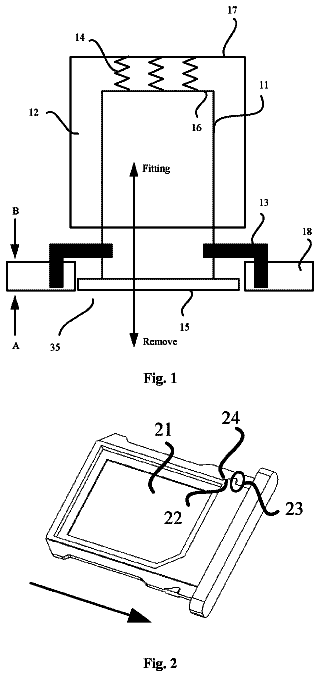
Device for affixing SIM card and mobile terminal
A device for affixing SIM card and a mobile terminal are provided.
US 9,998,188 B2 · Assignee: Huawei Technologies Co., Ltd · Inventors: Jiang; Yajun et al.
Sheet 1 of 4 from the published document. All sheets in the USPTO PDF
Embodiments provide a signal transmission apparatus and a downlink signal transmission method. A downlink common channel signal that needs to be sent by using a wide beam is divided into multiple groups of grouped signals; for each group of grouped signals, signal weighting is separately performed on different radio frequency paths in a multi-antenna system; weighted grouped signals are combined to obtain a weighted downlink common channel signal; and the weighted downlink common channel signal is transmitted.
To meet a requirement of a user equipment (UE) for an increasingly high data transmission rate, a multiple-input multiple-output (MIMO) technology is widely used in third generation (3G,) and next generation communications systems. A multi-antenna technology is an important constituent part of the MIMO technology. Beams in different shapes and directions may be formed in space by performing weighting processing on a to-be-transmitted signal by using the multi-antenna technology, so as to adapt to demands on transmission of different signals. For example, a wide beam and a narrow beam may be formed through beamwidth division, where the wide beam may be used for transmitting a downlink signal, such as a downlink common channel signal. When the wide beam is used, beam transmission gains are small, and especially in a multi-antenna system with a relatively large-scale antenna array, coverage
All 4 drawing sheets from the published document, cropped to the drawing.
What the patent claimed, word for word. All of it is now free to use.
Embodiments of the present invention relate to the field of communications technologies, and in particular, to a signal transmission apparatus and a downlink signal transmission method.
To meet a requirement of a user equipment (UE) for an increasingly high data transmission rate, a multiple-input multiple-output (MIMO) technology is widely used in third generation (3G,) and next generation communications systems. A multi-antenna technology is an important constituent part of the MIMO technology.
Beams in different shapes and directions may be formed in space by performing weighting processing on a to-be-transmitted signal by using the multi-antenna technology, so as to adapt to demands on transmission of different signals. For example, a wide beam and a narrow beam may be formed through beamwidth division, where the wide beam may be used for transmitting a downlink signal, such as a downlink common channel signal. When the wide beam is used, beam transmission gains are small, and especially in a multi-antenna system with a relatively large-scale antenna array, coverage of transmitted signals is limited.
Embodiments provide a signal transmission apparatus and a downlink signal transmission method, which can increase beam transmission gains and improve signal coverage capability.
According to a first aspect, an embodiment provides a signal transmission apparatus configured to transmit a downlink signal, where the downlink signal includes multiple downlink common channel signals. The transmission apparatus includes a signal dividing unit, configured to divide one downlink common channel signal in the multiple downlink common channel signals into N groups of grouped signals, where N represents a quantity of groups of grouped signals, and N≥2. The transmission apparatus also includes a signal weighting unit, configured to perform, according to a weight vector that corresponds to each group of grouped signals in the N groups of grouped signals, signal weighting on the group of grouped signals to generate N first weighted signals, where the weight vector is used for adjusting amplitudes and phases of each group of grouped signals, so that the N first weighted signals meet a wide-beam forming condition. The transmission apparatus includes a signal combining unit, configured to combine the N first weighted signals that correspond to the N groups of grouped signals to obtain a second weighted signal. The transmission apparatus also includes a transmit unit, including k parallel radio frequency subunits, where the transmit unit is configured to transmit the second weighted signal, k represents a quantity of radio frequency subunits, and k≥2.
In a first possible implementation manner of the first aspect, the weight vector includes components corresponding to the k radio frequency subunits, and that the signal weighting unit is configured to generate N first weighted signals includes generating N first weighted signals including k channels of first weighted sub-signals that correspond to the k radio frequency subunits.
With reference to the first possible implementation manner of the first aspect, in a second possible implementation manner of the first aspect, that the signal weighting unit is configured to generate N first weighted signals including k channels of weighted sub-signals that correspond to the k radio frequency subunits includes that: the k channels of first weighted sub-signals include at least one channel of effective first weighted sub-signal, the effective first weighted sub-signal includes an effective component, and the effective component includes a non-zero component in the weight vector or a component greater than a preset threshold.
With reference to the first aspect, or the first possible implementation manner of the first aspect, or the second possible implementation manner of the first aspect, in a third possible implementation manner of the first aspect, the radio frequency subunit is configured to transfer a second weighted sub-signal included in the second weighted signal.
With reference to any one of the foregoing possible implementation manners, in a fourth possible implementation manner of the first aspect, that the signal dividing unit is configured to divide one downlink common channel signal in the multiple downlink common channel signals into N groups of grouped signals includes: performing, according to a quantity of subcarriers occupied by the one downlink common channel signal, frequency domain division on the one downlink common channel signal to obtain the N groups of grouped signals.
With reference to the first aspect, or the first possible implementation manner of the first aspect, or the second possible implementation manner of the first aspect, or the third possible implementation manner of the first aspect, in a fifth possible implementation manner of the first aspect, that the signal dividing unit is configured to divide one downlink common channel signal in the multiple downlink common channel signals into N groups of grouped signals includes: performing phase deflection on the one downlink common channel signal for N times, where a downlink common channel signal obtained after each time of phase deflection is used as one group of grouped signals, so as to obtain the N groups of grouped signals.
With reference to any one of the foregoing implementation manners of the first aspect, in a sixth possible implementation manner of the first aspect, the apparatus further includes a digital-to-analog conversion unit configured to perform to-analog processing on the second weighted signal and send an obtained analog signal to the transmit unit.
According to a second aspect, an embodiment provides a signal transmission apparatus configured to transmit a downlink signal, where the downlink signal includes multiple downlink common channel signals, and the signal transmission apparatus includes a memory, a processor, and a transmission circuit, where the transmission circuit includes k parallel radio frequency paths, k represents a quantity of radio frequency paths, and k≥2; and the memory is configured to store instructions enabling the processor to perform the following operations: dividing one downlink common channel signal in the multiple downlink common channel signals into N groups of grouped signals, where N represents a quantity of groups of grouped signals, and N≥2; performing, according to a weight vector that corresponds to each group of grouped signals in the N groups of grouped signals, signal weighting on the group of grouped signals to generate first weighted signals, where the weight vector is used for adjusting amplitudes and phases of each group of grouped signals, so that the N first weighted signals meet a wide-beam forming condition; combining the N first weighted signals that correspond to the N groups of grouped signals to obtain a second weighted signal; and transmitting the second weighted signal.
In a first possible implementation manner of the second aspect, the weight vector includes components corresponding to the k radio frequency paths, and the memory is further configured to store an instruction enabling the processor to perform the following operation: generating N first weighted signals including k channels of first weighted sub-signals that correspond to the k radio frequency paths.
With reference to the first possible implementation manner of the second aspect, in a second possible implementation manner of the second aspect, the memory is further configured to store an instruction enabling the processor to perform the following operation: the k channels of first weighted sub-signals include at least one channel of effective first weighted sub-signal, the effective first weighted sub-signal includes an effective component, and the effective component includes a non-zero component in the weight vector or a component greater than a preset threshold.
With reference to the second aspect, or the first possible implementation manner of the second aspect, or the second possible implementation manner of the second aspect, in a third possible implementation manner of the second aspect, the radio frequency path is configured to transfer a second weighted sub-signal included in the second weighted signal.
With reference to any one of the foregoing possible implementation manners of the second aspect, in a fourth possible implementation manner of the second aspect, the memory is further configured to store an instruction enabling the processor to perform the following operation: performing, according to a quantity of subcarriers occupied by the one downlink common channel signal, frequency domain division on the one downlink common channel signal to obtain the N groups of grouped signals.
With reference to the second aspect, or the first possible implementation manner of the second aspect, or the second possible implementation manner of the second aspect, or the third possible implementation manner of the second aspect, in a fifth possible implementation manner of the second aspect, the memory is further configured to store an instruction enabling the processor to perform the following operation: performing phase deflection on the one downlink common channel signal for N times, where a downlink common channel signal obtained after each time of phase deflection is used as one group of grouped signals, so as to obtain the N groups of grouped signals.
With reference to any one of the foregoing possible implementation manners of the second aspect, in a fifth possible implementation manner of the second aspect, the apparatus further includes a digital-to-analog signal converter configured to perform to-analog processing on the second weighted signal and send an obtained analog signal to the transmission circuit.
According to a third aspect, an embodiment provides a user equipment. The user equipment includes a receiving unit, configured to receive a second weighted signal sent by a base station, where the second weighted signal is obtained by combining N first weighted signals. The N first weighted signals correspond to N groups of grouped signals, where the N groups of grouped signals are obtained by dividing one downlink common channel signal in multiple downlink common channel signals, N represents a quantity of groups of grouped signals, and N≥2; and the N first weighted signals are obtained by performing, according to a weight vector that corresponds to each group of grouped signals in the N groups of grouped signals, signal weighting on the group of grouped signals that corresponds to the weight vector, where the weight vector is used for adjusting amplitudes and phases of each group of grouped signals, so that the first weighted signals meet a wide-beam forming condition. The user equipment includes a processing unit, acquiring system information comprised in the second weighted signal.
According to a fourth aspect, an embodiment provides a user equipment. The user equipment includes a receiver, configured to receive a second weighted signal sent by a base station, where the second weighted signal is obtained by combining N first weighted signals. The N first weighted signals correspond to N groups of grouped signals, where the N groups of grouped signals are obtained by dividing one downlink common channel signal in multiple downlink common channel signals, N represents a quantity of groups of grouped signals, and N≥2. The N first weighted signals are obtained by performing, according to a weight vector that corresponds to each group of grouped signals in the N groups of grouped signals, signal weighting on the group of grouped signals that corresponds to the weight vector, where the weight vector is used for adjusting amplitudes and phases of each group of grouped signals, so that the first weighted signals meet a wide-beam forming condition. The user equipment also includes a processor, acquiring system information comprised in the downlink signal.
According to a fifth aspect, an embodiment provides a downlink signal transmission method that is applied to a multi-antenna system, where the multi-antenna system includes k parallel radio frequency paths, k represents a quantity of radio frequency paths, and k≥2. The method is used for transmitting a downlink signal, where the downlink signal includes multiple downlink common channel signals. The method includes dividing one downlink common channel signal in the downlink common channel signals into N groups of grouped signals, where N represents a quantity of groups of grouped signals, and N≥2. The method also includes performing, according to a weight vector that corresponds to each group of grouped signals in the N groups of grouped signals, signal weighting on the group of grouped signals to generate N first weighted signals, where the weight vector is used for adjusting amplitudes and phases of each group of grouped signals, so that the N first weighted signals meet a wide-beam forming condition. The method also includes combining the N first weighted signals that correspond to the N groups of grouped signals to obtain a second weighted signal. The method also includes transmitting the second weighted signal.
In a first possible implementation manner of the fifth aspect, the weight vector includes components corresponding to the k radio frequency paths, and the generating N first weighted signals includes generating N first weighted signals including k channels of first weighted sub-signals that correspond to the k radio frequency paths.
With reference to the first possible implementation manner of the fifth aspect, in a second possible implementation manner of the fifth aspect, the generating N first weighted signals including k channels of first weighted sub-signals that correspond to the k radio frequency paths includes: the k channels of first weighted sub-signals include at least one channel of effective first weighted sub-signal, the effective first weighted sub-signal includes an effective component, and the effective component includes a non-zero component in the weight vector or a component greater than a preset threshold.
With reference to the fifth aspect, or the first possible implementation manner of the fifth aspect, or the second possible implementation manner of the fifth aspect, in a third possible implementation manner of the fifth aspect, the transmitting the second weighted signal includes: transferring, by using a corresponding radio frequency path, a second weighted sub-signal included in the second weighted signal.
With reference to any one of the foregoing possible implementation manners of the fifth aspect, in a fourth possible implementation manner of the fifth aspect, the dividing one downlink common channel signal in the multiple downlink common channel signals into N groups of grouped signals includes: performing, according to a quantity of subcarriers occupied by the one downlink common channel signal, frequency domain division on the one downlink common channel signal to obtain the N groups of grouped signals.
With reference to the fifth aspect, or the first possible implementation manner of the fifth aspect, or the second possible implementation manner of the fifth aspect, or the third possible implementation manner of the fifth aspect, in a fifth possible implementation manner of the fifth aspect, the dividing one downlink common channel signal in the multiple downlink common channel signals into N groups of grouped signals includes: performing phase deflection on the one downlink common channel signal for N times, where a downlink common channel signal obtained after each time of phase deflection is used as one group of grouped signals, so as to obtain the N groups of grouped signals.
With reference to any one of the foregoing possible implementation manners of the fifth aspect, in a sixth possible implementation manner of the fifth aspect, before the transmitting the second weighted signal, further including: performing to-analog processing on the second weighted signal.
By using the downlink signal transmission apparatus and method provided in the embodiments of the present invention, a downlink common channel signal that needs to be sent by using a wide beam is divided into multiple groups of grouped signals; for each group of grouped signals, signal weighting is separately performed on different radio frequency paths in a multi-antenna system; weighted grouped signals are combined to obtain a weighted downlink common channel signal; and the weighted downlink common channel signal is transmitted, so that a transmit power of each radio frequency path in the multi-antenna system is fully used, thereby increasing transmission gains of a wide beam, further increasing the coverage of a downlink common channel signal, and improving the signal transmission effect.
FIG. 1 is a schematic diagram of an application scenario according to an embodiment;
FIG. 2 is a flowchart of a downlink signal transmission method according to an embodiment;
FIG. 3 is a schematic structural diagram of a signal transmission apparatus according to an embodiment;
FIG. 4 is a schematic structural diagram of a signal transmission apparatus according to an embodiment;
FIG. 5 is a schematic structural diagram of a user equipment according to an embodiment; and
FIG. 6 is a schematic structural diagram of a user equipment according to an embodiment.
To make the objectives, technical solutions, and advantages of the present invention clearer, the following further describes the implementation manners of the present invention in detail with reference to the accompanying drawings.
Technologies described in this specification may be applied to multiple types of communications systems, including 3G communications systems such as a Wideband Code Division Multiple Access (WCDMA) system and a Time Division-Synchronous Code Division Multiple Access (TD-SCDMA) system, and next generation communications systems such as a Long Term Evolution (LTE) communications system and systems subsequently evolved from the LTE communications system.
A method provided in the embodiments relates to a base station. The base station may be a node B in a WCDMA system, an evolved Node B (e-NodeB) in an LTE communications system, or a similar device in a communications system subsequently evolved from the LTE. Further, the method provided in the embodiments of the present invention may be executed jointly by a remote radio unit (RRU) and a passive antenna of a base station, may be executed jointly by a baseband unit (BBU) and a passive antenna of a base station, may be executed by an active antenna integrated with a function of a radio frequency part of a base station, or may be executed by another similar radio frequency function unit within a base station, which is not particularly limited in the embodiments.
The user equipment (UE) in the embodiments may be a user equipment that performs data transfer with the foregoing base station in a wireless manner, for example, a mobile phone or a personal computer with a wireless communication function.
FIG. 1 is a schematic diagram of an application scenario of a downlink signal transmission method according to an embodiment. As shown in FIG. 1 , the method is implemented in a base station. The base station includes k (K≥2) radio frequency paths. The radio frequency path refers to a transmit route for a signal within the base station and is used for performing processing such as filtering and amplification on a to-be-transmitted signal, and transferring a signal obtained after the above processing to an antenna element of the base station, which then transmits the signal to the air. The radio frequency path has a specific structure similar to that of an RRU path, and the details are not described in this embodiment of the present invention. Each radio frequency path separately drives a corresponding antenna element to perform signal transmission, and one radio frequency path may drive at least one antenna element. In FIG. 1 , a one-driving-one configuration is described, one-driving-one indicates that one radio frequency path drives one antenna element, for example, four, eight, or sixteen columns of antennas may be configured for a base station, and accordingly, the base station may include four, eight, or sixteen radio frequency paths. Multiple radio frequency paths and multiple antenna elements corresponding to the multiple radio frequency paths may be collectively referred to as a multi-antenna system. The base station may further include k digital-to-analog conversion (DAC) units corresponding to the k radio frequency paths, namely, a DAC unit 1 , a DAC unit 2 , . . . , and a DAC unit k (k≥2) that are in FIG. 1 .
In FIG. 1 , a signal 1 is a downlink common channel signal and generated within the base station, and the signal 1 is divided into N groups of grouped signals, which are a signal 1 - 1 , a signal 1 - 2 , . . . , and a signal i-N (N≥2), according to a specific division method; weighting processing is separately performed on the signal 1 - 1 , the signal 1 - 2 , . . . , and the signal i-N according to weight vectors W 1 - 1 , W 1 - 2 , . . . , and Wi-N that correspond to the grouped signals, where the weight vectors are used for adjusting amplitudes and phases of the grouped signals, and the amplitudes and the phases may be determined according to a requirement for forming a signal into a wide beam. All the weight vectors W 1 - 1 , W 1 - 2 , . . . , and Wi-N are k-dimensional vectors and separately include components corresponding to k radio frequency paths; and vector addition is performed on the signal 1 - 1 , the signal 1 - 2 , . . . , and the signal i-N that have been weighted, so as to obtain a signal 2 , where the signal 2 represents a weighted downlink common channel signal, the signal 2 includes sub-signals corresponding to the k radio frequency paths, namely, a signal 2 - 1 , a signal 2 - 2 , . . . , and a signal 2 - k ; the DAC unit 1 , the DAC unit 2 , . . . , and the DAC unit k respectively perform to-analog processing on the signal 2 - 1 , the signal 2 - 2 , . . . , and the signal 2 - k , and obtained analog signals are transferred to antenna elements through corresponding radio frequency paths and transmitted to the air. The obtained analog signals are automatically superposed in the air to form a required wide beam.
It should be noted that, although a one-driving-one multi-antenna system is described in this embodiment, a person skilled in the prior art can easily conceive that the method and apparatus provided in this embodiment may be applied to other multi-antenna systems, for example, a two-driving-ten system and a four-driving-ten system, to achieve technical effects of this embodiment, where method processes or structures of apparatuses are similar, and therefore the details are not described herein again.
An embodiment provides a downlink signal transmission method. The method is applicable to a multi-antenna system, and the multi-antenna system includes k parallel radio frequency paths, where k represents a quantity of radio frequency paths, and k≥2.
The method may be used for transmitting a downlink signal, where the downlink signal may include multiple downlink common channel signals.
Specifically, a base station may send multiple downlink common channel signals to a UE simultaneously, the multiple downlink common channel signals may form a downlink signal or a part of the downlink signal, any one or more downlink common channel signals in the downlink signal may be processed by using the signal transmission method provided in this embodiment. In an actual application, the technical solution provided in this embodiment may be used for all or some of downlink common channel signals in a to-be-transmitted downlink signal, and the quantity or type of processed downlink common channel signals should not be construed as any limitation on the present invention. The downlink common channel signal may be, for example, a physical downlink control channel (PDCCH) signal, a physical control format indicator channel (PCFICH) signal, a physical hybrid ARQ indicator channel (PHICH,) signal, a physical broadcast channel (PBCH) signal, or the like, and the type of the downlink common channel signal is not particularly limited in the present invention. The UE may receive and parse a downlink common channel signal sent by the base station to acquire system information of an available network and to perform network access.
The method may be executed by the base station and may include at least steps S 201 to S 204 , and the process of the method is shown in FIG. 2 .
S 201 : Divide one downlink common channel signal in multiple downlink common channel signals into N groups of grouped signals, where N represents a quantity of groups of grouped signals, and N≥2.
It is assumed that a downlink common channel signal is X. X may be divided into N groups (N≥2) and is expressed as X=[x.sub.1, . . . , x.sub.n] (1<n≤N). The N groups of grouped signals are used for representing the downlink common channel signal, that is, information of X can still be completely represented after the grouped signals are superposed, and after undergoing weighting processing, the N groups of grouped signals can enable all radio frequency paths of the system to transmit the N groups of grouped signals at full power. N may be set according to a parameter of the system, for example, considering a quantity of antennas of the system or a maximum transmit power; a maximum quantity of groups that can be supported is determined according to a signal processing capacity of the system; N may be self-adaptively adjusted within a specific range according to a running situation of the system.
S 202 : Perform, according to a weight vector that corresponds to each group of grouped signals in the N groups of grouped signals, signal weighting on the group of grouped signals to generate N first weighted signals, where the weight vector is used for adjusting amplitudes and phases of each of the grouped signals, so that the N first weighted signals meet a wide-beam forming condition.
A beam forming process is corresponding to a signal weighting process naturally, and a property of a beam depends on a weight vector for weighting. To ensure that all UEs within a cell can normally receive a downlink common channel signal, the downlink common channel signal may be sent by using a wide beam meeting a specific beamwidth requirement, for example, by using a wide beam with a beamwidth of 65 degrees. Specifically, selection of a weight vector is related to a setting and an attribute of an antenna array in the system. For example, different locations of antennas may lead to different physical properties of antennas or different shapes of formed beams. Therefore, a weight vector may be preset according to a beamwidth of a wide beam expected to be acquired. In addition, weight vectors used by groups of grouped signals may be the same or different, which may be determined according to an actual beam forming demand and is not particularly limited herein.
Selecting a weight value used for weighting for each group of grouped signals according to a wide-beam forming condition ensures that a divided downlink common channel signal can still form a wide beam after being transmitted to the air.
It is assumed that the downlink common channel signal after division is X=[x.sub.1, . . . , x.sub.n] (1<n≤N, and N≥2), and y.sub.n=w.sub.1.Math.x.sub.n is obtained after weighting processing is performed on the grouped signal x.sub.n, where w.sub.i is a weight vector, and w.sub.i=[w.sub.i.sup.1, w.sub.i.sup.2, . . . , w.sub.i.sup.k].sup.T where w.sub.i.sup.1, w.sub.i.sup.2, . . . , w.sub.i.sup.k are components of weight vectors corresponding to first to kth radio frequency paths in the system, T represents a transpose of a matrix, i represents a serial number of the weight vector, i≥1, and y.sub.n is a k-dimensional vector (k≥2).
To be distinguished from a weighted signal corresponding to the entire downlink common channel signal, y.sub.n is referred to as a first weighted signal. y.sub.n includes k channels of first weighted sub-signals, that is, signal components of corresponding grouped signals after being weighted on the k radio frequency paths.
S 203 : Combine the N first weighted signals that correspond to the N groups of grouped signals to obtain a second weighted signal.
It is assumed that an i.sup.th group of grouped signals is x.sub.i (i≥1) and the first weighted signal obtained after weighting is y.sub.i, where y.sub.i includes k channels of first weighted sub-signals that correspond to the k radio frequency paths. A combination process is specifically: on each radio frequency path, adding and combining the first weighted sub-signals included in y.sub.i and first weighted sub-signals, corresponding to the radio frequency path, of other weighted grouped signals to obtain the second weighted signal. That is, Y=y.sub.1+ . . . +y.sub.i+ . . . +y.sub.n (1<n≤N, and N≥2), where Y is a k-dimensional vector and represents a weighted downlink common channel signal. To be distinguished from a weighted signal of a grouped signal, Y is referred to as a second weighted signal. Y includes k channels of second weighted sub-signals that correspond to the k radio frequency paths, and the k channels of second weighted sub-signals each include an effective component.
S 204 : Transmit the second weighted signal.
After the foregoing signal division and weighting processes, the downlink common channel signal may be transmitted by using different antenna elements and superposed in the air to form a wide beam.
Optionally, before the transmitting the second weighted signal, the method may further include: performing to-analog processing on the second weighted signal, transferring obtained analog signals through the k radio frequency paths to an air interface and transmitting the obtained analog signals, where the obtained analog signals are naturally superposed in the air to form a wide beam, and the wide beam may be used for transmitting a downlink common channel signal and has relatively large signal coverage and relatively high beam gains.
In an actual application, a base station may simultaneously send multiple downlink common channel signals, and division and weighting processing may be performed on each downlink common channel signal by using the foregoing method. It is assumed that k channels of weighted sub-signals are generated after a common channel 1 is weighted by using a weight vector w.sub.1. The k channels of weighted sub-signals and k channels of weighted signals of other downlink common channel signals may be added, then sent correspondingly to next k digital-to-analog conversion units and k radio frequency units, and finally transmitted through the air interface. That is, a signal that is finally transmitted through the air interface is a downlink signal including multiple weighted downlink common channel signals, and a beam formed in the air includes wide beams corresponding to different downlink common channel signals. Therefore, the method provided in this embodiment is applicable to various scenarios in which coverage of a downlink common channel signal that needs to be sent by using a wide beam is limited, for example, in a situation in which cell planning does not meet a requirement in a rural area or a suburban area, or a signal transmit power of a system is low, thereby having a wide range of application scenarios.
Optionally, as another embodiment, the k channels of first weighted sub-signals in S 203 include at least one channel of effective first weighted sub-signal, where the effective first weighted sub-signal includes an effective component, and the effective component may include a non-zero component in the foregoing weight vector or a component greater than a preset threshold.
Specifically, using a multi-antenna system including 16 columns of antennas as an example, and for a grouped signal, a weight vector including effective components corresponding to four radio frequency paths may be selected for performing weighting, as shown in Table 1. An i.sup.th group of weighted grouped signals is marked as a first weighted signal y.sub.i (i≥1), where y.sub.1 to y.sub.i may be distinguished by different radio frequency paths corresponding thereto, and each of effective components of y.sub.1 to y.sub.i is corresponding to at least one radio frequency path in the k radio frequency paths. Still using a multi-antenna system (one-driving-one) with 16 columns of antennas as an example, a downlink common channel signal X is divided into [x.sub.1, x.sub.2, x.sub.3, x.sub.4], weighted grouped signals are expressed as: [y.sub.1, y.sub.2, y.sub.3, y.sub.4]=[w.sub.1.Math.x.sub.1, w.sub.2.Math.x.sub.2, w.sub.3.Math.x.sub.3, w.sub.4.Math.x.sub.4], where w.sub.1, w.sub.2, w.sub.3, and w.sub.4 are weight vectors. It is assumed that the weight vector w.sub.1 of the signal y.sub.1 has four effective components corresponding to k.sub.1, k.sub.2, k.sub.3, and k.sub.4 in the k radio frequency paths; the weight vector w.sub.2 of the signal y.sub.2 has four effective components corresponding to k.sub.5, k.sub.6, k.sub.7, and k.sub.8 in the k radio frequency paths; the weight vector w.sub.3 of the signal y.sub.3 has four effective components corresponding to k.sub.9, k.sub.10, k.sub.11, and k.sub.12 in the k radio frequency paths; and the weight vector w.sub.4 of the signal y.sub.4 has four effective components corresponding to k.sub.13, k.sub.14, k.sub.15, and k.sub.16 in the k radio frequency paths. It may be seen that, in the system, each radio frequency path in all the 16 radio frequency paths has a corresponding transmit power, and an effective component of a weight vector may have a full-scale amplitude; therefore, the radio frequency path may transmit a signal at full power.
TABLE-US-00001 TABLE 1 Example of selecting a weight vector for weighting a grouped signal Wide-beam weight vectors of four channels normalized according to 16 radio frequency paths at a maximum power on each channel Real part Imaginary part −0.0249856 0.0433011 0.25 0 0.25 0 −0.0249856 0.0433011
In this embodiment, all antennas in the system can participate in a signal transmission process. Therefore, not only a downlink signal transmit power is increased, but also radio frequency resources of the system are fully used.
Optionally, as another embodiment, in S 201 , the downlink common channel signal may be divided by using multiple methods, and two optional manners are provided below.
Optionally, the dividing one downlink common channel signal into N groups of grouped signals includes: performing, according to a quantity of subcarriers occupied by the one downlink common channel signal, frequency domain division on the one downlink common channel signal to obtain the N groups of grouped signals.
For example, it is assumed that a downlink common channel signal X occupies 100 subcarriers in a frequency domain, and may be divided in the frequency domain division according to the subcarriers to obtain 10 groups, that is, X=[x.sub.1, x.sub.2, . . . , x.sub.10], where each group includes some subcarriers of X, and quantities of subcarriers included in the groups of grouped signals may be the same or may be different as long as it is ensured that 10 groups of grouped signals together occupy all the 100 subcarriers of X. In addition, to ensure that grouped signals after undergoing weighting processing can enable all radio frequency paths of the system to transmit the grouped signals at full power, that is, weighting processing for a grouped signal may be performed on each radio frequency path; and subcarriers included in each group and subcarriers included in another group may be incompletely identical or completely different subcarriers, that is, at least some of grouped signals do not overlap.
Optionally, the dividing one downlink common channel signal into N groups of grouped signals includes: performing phase deflection on the downlink common channel signal for N times, where a downlink common channel signal obtained after each time of phase deflection is used as one group of grouped signals, so as to obtain the N groups of grouped signals.
For example, phase deflection at different angles is performed on a downlink common channel signal X, and a downlink common channel signal obtained after each time of phase deflection of X is used as a group of grouped signals, so that multiple groups of grouped signals may be generated. It is assumed that each time the phase is deflected by an angle θ (−180°<θ<180°), where θ is a variable and a specific value of θ may be preset or may be self-adaptively determined according to a running situation of the system, which is not particularly limited herein. Because each time the phase is deflected by a different angle, different grouped signals are obtained after each time of phase deflection.
By using the foregoing frequency domain division or phase-change division method, large space can be utilized in terms of signal phase and frequency, and there are multiple candidate division forms, which can fully adapt to the structure and performance of the system, and achieve a good signal division effect.
The method provided in this embodiment is applicable to a multi-antenna system. A downlink common channel signal that needs to be sent by using a wide beam is divided into multiple groups of grouped signals; for each group of grouped signals, signal weighting is separately performed on different radio frequency paths; weighted grouped signals are combined to obtain a weighted downlink common channel signal; and the weighted downlink common channel signal is transmitted, so that a transmit power of each radio frequency path in the multi-antenna system is fully used, thereby increasing transmission gains of a wide beam, further increasing the coverage of the downlink common channel signal, improving the signal transmission effect, optimizing the system design, and avoiding waste of resources.
An embodiment provides a signal transmission apparatus, as shown in FIG. 3 , configured to transmit a downlink signal, where the downlink signal includes multiple downlink common channel signals.
The apparatus includes: a signal dividing unit 301 , a signal weighting unit 302 , a signal combining unit 303 , and a transmit unit 304 , where the transmit unit 304 includes k (k≤2) parallel radio frequency subunits 3041 .
The signal dividing unit 301 may be configured to divide one downlink common channel signal in the multiple downlink common channel signals into N groups of grouped signals, where N represents a quantity of groups of grouped signals, and N≤2.
It is assumed that a downlink common channel signal is X. X may be divided into N groups (N≥2) and is expressed as: X=[x.sub.1, x.sub.2, . . . , x.sub.n, . . . , x.sub.N] (1≤n≤N). The N groups of grouped signals are used for representing the downlink common channel signal, that is, information of X can still be completely represented after the grouped signals are superposed, and after undergoing weighting processing, the N groups of grouped signals can enable all radio frequency subunits of a system to transmit the N groups of grouped signals at full power.
Optionally, the signal dividing unit 301 may be further configured to perform, according to a quantity of subcarriers occupied by the one downlink common channel signal, frequency domain division on the one downlink common channel signal to obtain the N groups of grouped signals.
The description continues in the full USPTO document.
About 6,348 words. The USPTO PDF has it with every drawing.
Fees are due 3.5, 7.5 and 11.5 years after grant. This patent expired on June 12, 2026, so the fee marked "not paid" was the one that went unpaid.
Signal Transmission Apparatus and Downlink Signal Transmission Method
Filed Oct 2016 · published Feb 2017Signal transmission apparatus and downlink signal transmission method
Filed Oct 2016 · granted Jun 2018Earlier publications, parents and continuations. None of them can still be enforced, or this patent would not be listed.
Prior art cited by the examiner or applicant. Useful when you check your own idea for novelty.
Everything on this page comes from the documents linked above.


