 Lapsed, fee not paid33 drawings
Software & Apps · US 9,990,659 B2
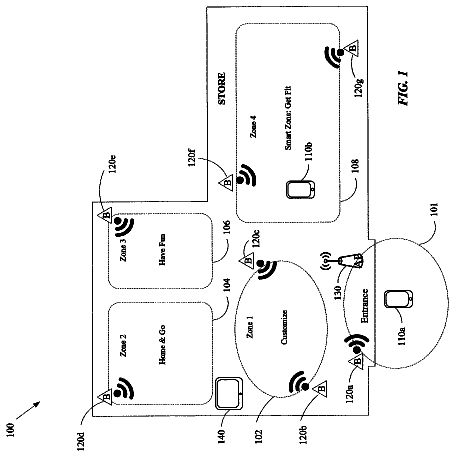
In-store self-serve and zoning using geo-fencing
A geo-fencing system includes a plurality of beacons defining zones within a venue.
US 9,990,680 B2 · Assignee: Facebook, Inc. · Inventors: Green; Bradley Ray et al.
Sheet 1 of 3 from the published document. All sheets in the USPTO PDF
A social networking system selects a set of groups for presentation to a user of the social networking system. To select groups, the social networking system determines scores for various groups representing a likelihood of the user interacting with the groups. The social networking system may identify a set of groups based on interactions between the user and various groups occurring during a specific time interval and determine scores for groups in the set. When determining a score for a group, the social networking system accounts for times associated with interactions between the user and various groups. Based on the scores, one or more groups are selected and presented to the user. Additionally, the social networking system may identify a time to present the selected one or more groups to the user based on prior user interactions with various groups.
This disclosure relates generally to social networking systems, and more specifically to identifying groups of users to a social networking system user. An online system, such as a social networking system, allows its users to connect to and communicate with other online system users. Users may create profiles on an online system that are tied to their identities and include information about the users, such as interests and demographic information. The users may be individuals or entities such as corporations or charities. Additionally, a social networking system may maintain groups of users, allowing a user to provide content to a group for presentation to each user included in the group. A group may be associated with a topic, a location, or with any other suitable characteristic, so a user included in the group may more easily view or share content associated with the characteristic
All 3 drawing sheets from the published document, cropped to the drawing.
What the patent claimed, word for word. All of it is now free to use.
This disclosure relates generally to social networking systems, and more specifically to identifying groups of users to a social networking system user.
An online system, such as a social networking system, allows its users to connect to and communicate with other online system users. Users may create profiles on an online system that are tied to their identities and include information about the users, such as interests and demographic information. The users may be individuals or entities such as corporations or charities.
Additionally, a social networking system may maintain groups of users, allowing a user to provide content to a group for presentation to each user included in the group. A group may be associated with a topic, a location, or with any other suitable characteristic, so a user included in the group may more easily view or share content associated with the characteristic associated with the group. However, as a social networking system may maintain a large number of groups, a user may expend significant time identifying groups associated with characteristics of interest to the user. This decreases the likelihood of the user identifying groups of interest to the user, which may decrease the amount of interaction between the user and the social networking system.
Users of a social networking system communicate messages or other content to each other via the social networking system. To simplify communication of content, the social networking system may maintain various groups each including one or more users of the social networking system. A user may communicate content to a group, which causes the social networking system to present the content to the users included in the group. A user may provide content to a group including the user for distribution to other users in the group or may view or otherwise access content associated with the including the user.
To allow a user to more easily identify a group of interest to the user, the social networking system determines a score for various groups maintained by the social networking system. The social networking system may identify a set of groups as groups with which the user has at least a threshold likelihood of interacting within a time interval and determine scores associated with each group. For example, the set of groups includes groups with which the user has at least a threshold likelihood of interacting during a 24-hour interval. In various embodiments, the social networking system identifies interactions between the user and various groups associated with times within a threshold time interval of a current time and determines likelihoods of the user interacting with groups based on the identified interactions, allowing the social networking system to account for recent interactions with groups by the user when identifying the set of groups. Additionally, when identifying the set of groups, the social networking system excludes groups that the user left within a threshold time interval of a current time or groups from which the user was removed within the threshold time interval from the set based on interactions between the user and groups.
To determine the likelihood of a user's interacting with a group within the time interval, the social networking system identifies characteristics associated with the group (e.g., a topic associated with the group, a location associated with the group, etc.) and identifies one or more groups with which the user previously interacted and having characteristics matching, or similar to, the characteristics associated with the group. Based on one or more types of interactions between the user and the identified groups (e.g., interactions where the user accessed content associated with one or more of the identified groups, interactions where the user provided content to one or more of the identified groups, interactions where the user joined an identified group, interactions where the user left an identified group), the social networking system determines the likelihood of the user's interacting with the group. For example, the social networking system applies a model to various interactions between the user and one or more of the identified groups to determine a frequency with which the user performs an interaction with the identified groups. In some embodiments, the model associates weights with various interactions based on times associated with the interactions. The likelihood of the user's interacting with the group during a time interval is based on the determined frequency, and if the likelihood is at least a threshold value, the social networking system includes the group in the set of groups. Characteristics of the group and the one or more identified groups having matching or similar characteristics of the group may also be used to determine the likelihood of the user interacting with the group during the time interval.
A score for a group is based on a model that determines a likelihood of the user interacting with the group within a specified time interval. For example, the score associated with the group represents a likelihood of the user interacting with the group during a 24-hour interval. Various interactions between the user and other groups maintained by the social networking system are used to determine the score for a group. For example, the user's interactions with groups having at least a threshold number of characteristics matching or similar to a group are used to determine the score for the group. Examples of interactions used to determine the score for a group include the user providing one or more content items to an additional group with similar characteristics to the group for presentation to users associated with the additional group, the user commenting on content items associated with an additional group with similar characteristics to the group, the user sharing content items associated with an additional group having similar characteristics to the group, and the user indicating a preference for a content item associated with an additional group having similar characteristics to the group, the user joining an additional group having similar characteristics to the group, the user leaving an additional group having similar characteristics to the group, the user hiding information describing an additional group having similar characteristics to the group, or other suitable interactions. Additionally, the score associated with the group is based in part on interactions where the user accessed content items associated with one or more groups having similar characteristics to the group. For example, if the user views a content item associated with an additional group having similar characteristics to the group for at least a threshold length of time, the social networking system identifies an interaction where the user has viewed the content item. A frequency with which the user interacts with additional groups having similar characteristics to the group (e.g., views content items associated with groups having similar characteristics to the group, views content items associated with groups having similar characteristics to the group, joins groups having similar characteristics to the group, leaves groups having similar characteristics to the group) is used to determine the score for the group. Accounting for interactions where the user provides content to groups as well as interactions where the user passively views content associated with groups increases the likelihood of the social networking system identifying a group with which the user is likely to interact, even by passively consuming content items associated with the group.
Based on the scores associated with various groups, the social networking system selects one or more groups for identification to the user. For example, the social networking system ranks groups based on their associated scores and selects one or more groups having at least a threshold position in the ranking. Alternatively, the social networking system selects one or more groups associated with at least a threshold score. Information describing the selected groups is communicated from the social networking system to a client device associated with the user. The information may be presented in an order based at least in part on the scores associated with selected groups to allow the user to more easily identify selected groups with higher scores, which increases the likelihood of the user identifying a group with which the user will subsequently interact.
In some embodiments, the social networking system determines a time to send information identifying selected groups to a user based on prior interactions between the user and various groups. For example, if the user has performed certain interactions (e.g., joined groups, left groups, hid information describing groups) with at least a threshold number of groups within a threshold time interval of a current time, the social networking system delays communication of information describing selected groups to the user, so the information identifying the selected groups is presented to the user at a time when the user is more likely to interact with the information describing the selected groups. The threshold number of groups may or the threshold time interval may be modified by the social networking system over time based on interactions between the user and additional groups or based on interactions between additional users and various groups.
FIG. 1 is a block diagram of a system environment in which a social networking system operates, in accordance with an embodiment.
FIG. 2 is a block diagram of a social networking system, in accordance with an embodiment.
FIG. 3 is a flowchart of a method for identifying groups of users to a requesting user of a social networking system, in accordance with an embodiment.
FIG. 4 is a process flow diagram of the social networking system identifying sets of candidate groups from stored groups, in accordance with an embodiment.
The figures depict various embodiments for purposes of illustration only. One skilled in the art will readily recognize from the following discussion that alternative embodiments of the structures and methods illustrated herein may be employed without departing from the principles described herein.
System Architecture
FIG. 1 is a block diagram of a system environment 100 for a social networking system 140 . The system environment 100 shown by FIG. 1 comprises one or more client devices 110 , a network 120 , one or more third-party systems 130 , one or more machines 135 , and the social networking system 140 . In alternative configurations, different and/or additional components may be included in the system environment 100 . The embodiments described herein may be adapted to online systems that are not social networking systems.
The client devices 110 are one or more computing devices capable of receiving user input as well as transmitting and/or receiving data via the network 120 . In one embodiment, a client device 110 is a conventional computer system, such as a desktop or a laptop computer. Alternatively, a client device 110 may be a device having computer functionality, such as a personal digital assistant (PDA), a mobile telephone, a smartphone or another suitable device. A client device 110 is configured to communicate via the network 120 . In one embodiment, a client device 110 executes an application allowing a user of the client device 110 to interact with the social networking system 140 . For example, a client device 110 executes a browser application to enable interaction between the client device 110 and the social networking system 140 via the network 120 . In another embodiment, a client device 110 interacts with the social networking system 140 through an application programming interface (API) running on a native operating system of the client device 110 , such as IOS® or ANDROID™.
The client devices 110 are configured to communicate via the network 120 , which may comprise any combination of local area and/or wide area networks, using both wired and/or wireless communication systems. In one embodiment, the network 120 uses standard communications technologies and/or protocols. For example, the network 120 includes communication links using technologies such as Ethernet, 802.11, worldwide interoperability for microwave access (WiMAX), 3G, 4G, code division multiple access (CDMA), digital subscriber line (DSL), etc. Examples of networking protocols used for communicating via the network 120 include multiprotocol label switching (MPLS), transmission control protocol/Internet protocol (TCP/IP), hypertext transport protocol (HTTP), simple mail transfer protocol (SMTP), and file transfer protocol (FTP). Data exchanged over the network 120 may be represented using any suitable format, such as hypertext markup language (HTML) or extensible markup language (XML). In some embodiments, all or some of the communication links of the network 120 may be encrypted using any suitable technique or techniques.
One or more third party systems 130 may be coupled to the network 120 for communicating with the social networking system 140 , which is further described below in conjunction with FIG. 2 . In one embodiment, a third party system 130 is an application provider communicating information describing applications for execution by a client device 110 or communicating data to client devices 110 for use by an application executing on the client device. In other embodiments, a third party system 130 provides content or other information for presentation via a client device 110 . A third party system 130 may also communicate information to the social networking system 140 , such as advertisements, content, or information about an application provided by the third party system 130 .
FIG. 2 is a block diagram of an architecture of the social networking system 140 . The social networking system 140 shown in FIG. 2 includes a user profile store 205 , a content store 210 , an action logger 215 , an action log 220 , an edge store 225 , a group store 230 , a topic extraction engine 235 , a group selection module 240 and a web server 245 . In other embodiments, the social networking system 140 may include additional, fewer, or different components for various applications. Conventional components such as network interfaces, security functions, load balancers, failover servers, management and network operations consoles, and the like are not shown so as to not obscure the details of the system architecture.
Each user of the social networking system 140 is associated with a user profile, which is stored in the user profile store 205 . A user profile includes declarative information about the user that was explicitly shared by the user and may also include profile information inferred by the social networking system 140 . In one embodiment, a user profile includes multiple data fields, each describing one or more attributes of the corresponding online system user. Examples of information stored in a user profile include biographic, demographic, and other types of descriptive information, such as work experience, educational history, gender, hobbies or preferences, location and the like. A user profile may also store other information provided by the user, for example, images or videos. In certain embodiments, images of users may be tagged with information identifying the social networking system users displayed in an image. A user profile in the user profile store 205 may also maintain references to actions by the corresponding user performed on content items in the content store 210 and stored in the action log 220 .
While user profiles in the user profile store 205 are frequently associated with individuals, allowing individuals to interact with each other via the social networking system 140 , user profiles may also be stored for entities such as businesses or organizations. This allows an entity to establish a presence on the social networking system 140 for connecting and exchanging content with other online system users. The entity may post information about itself, about its products or provide other information to users of the online system using a brand page associated with the entity's user profile. Other users of the online system may connect to the brand page to receive information posted to the brand page or to receive information from the brand page. A user profile associated with the brand page may include information about the entity itself, providing users with background or informational data about the entity.
The content store 210 stores objects that each represent various types of content. Examples of content represented by an object include a page post, a status update, a photograph, a video, a link, a shared content item, a gaming application achievement, a check-in event at a local business, a page (e.g., brand page), or any other type of content. Online system users may create objects stored by the content store 210 , such as status updates, photos tagged by users to be associated with other objects in the social networking system 140 , events, groups or applications. In some embodiments, objects are received from third-party applications or third-party applications separate from the social networking system 140 . In one embodiment, objects in the content store 210 represent single pieces of content, or content “items.” A content identifier is associated with each content item to allow the social networking system 140 to more easily identify and retrieve various content items. Hence, online system users are encouraged to communicate with each other by posting text and content items of various types of media to the social networking system 140 through various communication channels. This increases the amount of interaction of users with each other and increases the frequency with which users interact within the social networking system 140 .
The action logger 215 receives communications about user actions internal to and/or external to the social networking system 140 , populating the action log 220 with information about user actions. Examples of actions include adding a connection to another user, sending a message to another user, uploading an image, reading a message from another user, viewing content associated with another user, and attending an event posted by another user. In addition, a number of actions may involve an object and one or more particular users, so these actions are associated with those users as well and stored in the action log 220 .
The action log 220 may be used by the social networking system 140 to track user actions on the social networking system 140 , as well as actions on third party systems 130 that communicate information to the social networking system 140 . Users may interact with various objects on the social networking system 140 , and information describing these interactions is stored in the action log 220 . Examples of interactions with objects include: commenting on posts, sharing links, checking-in to physical locations via a mobile device, accessing content items, and any other suitable interactions. Additional examples of interactions with objects on the social networking system 140 that are included in the action log 220 include: commenting on a photo album, communicating with a user, establishing a connection with an object, joining an event, joining a group, creating an event, authorizing an application, using an application, expressing a preference for an object (“liking” the object), and engaging in a transaction. Additionally, the action log 220 may record a user's interactions with advertisements on the social networking system 140 as well as with other applications operating on the social networking system 140 . In some embodiments, data from the action log 220 is used to infer interests or preferences of a user, augmenting the interests included in the user's user profile and allowing a more complete understanding of user preferences. Additionally, the action log 220 associates a time with actions or interactions associated with various users in various embodiments. For example, an interaction is associated with a time when the action logger 215 received information identifying the interaction or is associated with a time when the online system 140 performed the interaction or action, allowing the action log 220 to maintain a record of interactions as the interactions occur, so real-time or near-real time information describing interactions by a user is maintained in the action log 220 .
The action log 220 may also store user actions taken on a third party system 130 , such as an external website, and communicated to the social networking system 140 . For example, an e-commerce website may recognize a user of a social networking system 140 through a social plug-in enabling the e-commerce website to identify the user of the social networking system 140 . Because users of the social networking system 140 are uniquely identifiable, e-commerce websites, such as in the preceding example, may communicate information about a user's actions outside of the social networking system 140 to the social networking system 140 for association with the user. Hence, the action log 220 may record information about actions users perform on a third party system 130 , including webpage viewing histories, advertisements that were engaged, purchases made, and other patterns from shopping and buying.
In one embodiment, the edge store 225 stores information describing connections between users and other objects on the social networking system 140 as edges. Some edges may be defined by users, allowing users to specify their relationships with other users. For example, users may generate edges with other users that parallel the users' real-life relationships, such as friends, co-workers, partners, and so forth. An edge between a user and another user may be associated with a connection strength specified by the user and providing information about a relationship between the user and the other user. For example, connections between a user and other users with which the user has a close relationship, such as family members, have relatively high connection strengths, while connections between the user and additional users with which the user has a more distant relationship have lower connection strengths. In some embodiments, a user selects from connection strengths associated with different types of relationships (e.g., family members, co-workers, friends, partners, etc.) when specifying a connection with another user, and the edge store 225 associates a selected connection strength with an edge describing the connection. Other edges are generated when users interact with objects in the social networking system 140 , such as expressing interest in a page on the social networking system 140 , sharing a link with other users of the social networking system 140 , and commenting on posts made by other users of the social networking system 140 .
In one embodiment, an edge may include various features each representing characteristics of interactions between users, interactions between users and objects, or interactions between objects. For example, features included in an edge describe rate of interaction between two users, how recently two users have interacted with each other, the rate or amount of information retrieved by one user about an object, or the number and types of comments posted by a user about an object. The features may also represent information describing a particular object or user. For example, a feature may represent the level of interest that a user has in a particular topic, the rate at which the user logs into the social networking system 140 , or information describing demographic information about a user. Each feature may be associated with a source object or user, a target object or user, and a feature value. A feature may be specified as an expression based on values describing the source object or user, the target object or user, or interactions between the source object or user and target object or user; hence, an edge may be represented as one or more feature expressions.
The edge store 225 also stores information about edges, such as affinity scores for objects, interests, and other users. Affinity scores, or “affinities,” may be computed by the social networking system 140 over time to approximate a user's interest in an object or in another user in the social networking system 140 based on the actions performed by the user. A user's affinity may be computed by the social networking system 140 over time to approximate a user's interest in an object, a topic, or another user in the social networking system 140 based on actions performed by the user. Computation of affinity is further described in U.S. patent application Ser. No. 12/978,265, filed on Dec. 23, 2010, U.S. patent application Ser. No. 13/690,254, filed on Nov. 30, 2012, U.S. patent application Ser. No. 13/689,969, filed on Nov. 30, 2012, and U.S. patent application Ser. No. 13/690,088, filed on Nov. 30, 2012, each of which is hereby incorporated by reference in its entirety. Multiple interactions between a user and a specific object may be stored as a single edge in the edge store 225 , in one embodiment. Alternatively, each interaction between a user and a specific object is stored as a separate edge. In some embodiments, connections between users may be stored in the user profile store 205 , or the user profile store 205 may access the edge store 225 to determine connections between users.
The group store 230 includes information identifying various groups of users. A group is associated with a group identifier stored by the group score 230 that uniquely identifies the group. One or more identifiers associated with users are associated with the group identifier to identify users of social networking system 140 included in the group. Other information may be associated with a group identifier, such as a name identifying a group corresponding to the group identifier, a description associated with the group, descriptive information associated with the group (e.g., a location), or other suitable information. Additionally, one or more content identifiers specifying content items are associated with a group identifier to identify content items associated with a group associated with the group identifier. If a content item, such as a message, is communicated to a group, the message is communicated to users associated with the group. Hence, maintaining a group allows content to be more easily communicated to users within the group by allowing content to be communicated to the group rather than communicated to various individual users. A group may be generated by a user of the social networking system 140 identifying users associated with the group or the social networking system 140 may generate one or more groups based on characteristics associated with users of the social networking system 140 . Additionally, a user's interactions with a group are identified in the action log 220 or in the group store 230 by associating a group identifier with information describing an interaction with the group.
The social networking system 140 includes a topic extraction engine 235 , which identifies one or more topics associated with objects in the content store 210 or with groups in the group store 230 . To identify topics associated with content items, the topic extraction engine 235 identifies anchor terms included in a content item and determines a meaning of the anchor terms as further described in U.S. application Ser. No. 13/167,701, filed Jun. 24, 2011, which is hereby incorporated by reference in its entirety. For example, the topic extraction engine 235 determines one or more topics associated with a content item maintained in the content store 210 . The one or more topics associated with a content item are stored and associated with an object identifier corresponding to the content item. In various embodiments, associations between object identifiers and topics are stored in the topic extraction engine 240 or in the content store 210 to simplify retrieval of one or more topics associated with an object identifier or retrieval of object identifiers associated with a specified topic. Structured information associated with a content item may also be used to extract a topic associated with the content item.
To identify topics associated with a group, the topic extraction engine 235 identifies content items associated with the group based on information included in the group store 230 and determines topics associated content items associated with the group based on anchor terms included in the content items as described above. In one embodiment, the topic extraction engine 235 associates topics with a group that are associated with at least a threshold number or threshold percentage of content items associated with the group. Alternatively, the topic extraction engine ranks topics based on a frequency with which the topics are associated with content items associated with a group and associates topics having at least a threshold position in the ranking with the group. Topics associated with a group may be stored in the group store 230 along with the group's group identifier.
The group selection module 240 identifies one or more groups having at least a threshold likelihood of being relevant to a user, allowing the user to more easily identify groups associated with content with which the user is likely to interact or groups including users with which the user is likely to interact of interest. Identifying groups for a user allows the social networking system 140 to encourage the user to interact with a broader range of content items or users, which increases the amount of interaction between the user and the social networking system 140 . In one embodiment, the group selection module 240 determines a score for various groups, where a score for a group is based on a model determining a likelihood of the user interacting with the group within a specified time interval. A score for a group is based on a model determining a likelihood of the user interacting with the group within a specified time interval. Various interactions between the user and other groups maintained by the social networking system are used to determine the score for a group. For example, the user's interactions with groups having at least a threshold number of characteristics matching or similar to a group are used to determine the score for the group. Examples of interactions used to determine the score for a group include the user providing one or more content items to an additional group with similar characteristics to the group for presentation to users associated with the additional group, the user commenting on content items associated with an additional group with similar characteristics to the group, the user sharing content items associated with an additional group having similar characteristics to the group, and the user indicating a preference for a content item associated with an additional group having similar characteristics to the group.
Additionally, the score associated with the group is based in part on interactions where the user accessed content items associated with one or more groups having similar characteristics to the group. For example, if the user views a content item associated with an additional group having similar characteristics to the group for at least a threshold length of time, the social networking system identifies an interaction where the user has viewed the content item. A frequency with which the user views content items associated with groups having similar characteristics to the group or a number of times the user views content items associated with groups having similar characteristics to the group is used when determining the score for the group. Accounting for interactions where the user provides content to groups as well as interactions where the user passively views content associated with groups increases the likelihood of the group selection module 240 identifying a group with which the user is likely to interact by accounting for a broader range of interactions when determining scores for groups.
Based on the scores associated with various groups, the group selection module 240 selects one or more groups for identification to the user. For example, the group selection module 240 ranks groups based on their associated scores and selects one or more groups having at least a threshold position in the ranking. Alternatively, the group selection module 240 selects one or more groups associated with at least a threshold score. Information describing the selected groups is communicated from the social networking system 140 to a client device 110 associated with the user. The information may be presented in an order based at least in part on the scores associated with selected groups to allow the user to more easily identify selected groups with higher scores, which increases the likelihood of the user identifying a group with which the user will subsequently interact.
In some embodiments, the group selection module 240 applies one or more rules when selecting groups to select groups satisfying different criteria. For example, the group selection module 240 identifies multiple sets of groups form the group store 230 using various criteria, with each set including groups satisfying one or more criteria associated with the set. Example criteria associated with a set include: a location, a user, information describing additional social networking system users, types of connections between the user and additional users, or any other suitable information. For example, a set includes groups associated with a location specified by criteria associated with the set or a set includes groups including users having a specific type of connection to a user specified by criteria associated with the set. When selecting the groups, the group selection module 240 applies one or more rules specifying a minimum number of criteria associated with different sets. Alternatively, scores associated with a group may be modified based on criteria associated with a set including the group and criteria associated with sets including previously selected groups. For example, if a group is included in a set that also includes at least a threshold number of previously selected groups, the score of the group is decreased or a position of the group in a ranking is reduced. Alternatively, the group selection module 240 ranks candidate groups based on their associated scores and penalizes a ranking of a candidate group if it is included in a set that also includes another candidate group having a higher ranking than the group. As another example, the group selection module 240 generates different rankings for each set of groups, with a ranking for a set based on scores of groups included in the set. A threshold number of groups are selected from at least a threshold number of sets, based on the ranking for each set, to provide the user with different groups associated with different characteristics.
The group selection module 240 accounts for times associated with various interactions between a user and groups when selecting groups for the user. For example, interactions stored in the action log 220 are associated with a time, such as a time when the action logger 215 received the interaction or a time when the social networking system 140 performed the interaction. When identifying groups to a user, the group selection module 240 accounts for times associated with interactions between the user and various groups. For example, the group selection module 240 determines likelihoods of the user interacting with various groups based on interactions between the user and groups that are associated with times within a threshold time interval from a current time. Additionally, when determining scores associated with groups, the group selection module 240 weights various interactions based at least in part on a difference between times associated with the interactions and the current time. Further, the group selection module 240 may determine when to communicate information identifying selected groups to a user based on interactions by the user with other groups. For example, if the user has performed certain interactions (e.g., joined groups, left groups, hid information describing groups) with at least a threshold number of groups within a threshold time interval of a current time, the group selection module 240 delays communication of information describing selected groups to the user, so the information identifying the selected groups is presented to the user at a time when the user is more likely to interact with the information describing the selected groups. The threshold number of groups or the threshold time interval may be modified by the social networking system over time based on interactions between the user and additional groups or based on interactions between additional users and various groups. Selection of groups is further described below in conjunction with FIG. 3 .
The web server 245 links the social networking system 140 via the network 120 to the one or more client devices 110 , as well as to the one or more third party systems 130 . The web server 245 serves web pages, as well as other content, such as JAVA®, FLASH®, XML and so forth. The web server 245 may receive and route messages between the social networking system 140 and the client device 110 , for example, instant messages, queued messages (e.g., email), text messages, short message service (SMS) messages, or messages sent using any other suitable messaging technique. A user may send a request to the web server 245 to upload information (e.g., images or videos) that are stored in the content store 210 . Additionally, the web server 240 may provide application programming interface (API) functionality to send data directly to native client device operating systems, such as IOS®, ANDROID™, WEBOS® or BlackberryOS.
Identifying Groups for Recommendation to a Social Networking System User
FIG. 3 is a flowchart of one embodiment of a method for identifying groups of users to a requesting user of a social networking system 140 . In other embodiments, the method may include different and/or additional steps than those shown in FIG. 3 . Additionally, steps of the method may be performed in different orders than the order described in conjunction with FIG. 3 .
The description continues in the full USPTO document.
About 6,201 words. The USPTO PDF has it with every drawing.
Fees are due 3.5, 7.5 and 11.5 years after grant. This patent expired on June 5, 2026, so the fee marked "not paid" was the one that went unpaid.
Identifying Groups For A Social Networking System User Based On Interactions By The User With Various Groups
Filed Jun 2015 · published Dec 2016Identifying groups for a social networking system user based on interactions by the user with various groups
Filed Jun 2015 · granted Aug 2017IDENTIFYING GROUPS FOR A SOCIAL NETWORKING SYSTEM USER BASED ON INTERACTIONS BY THE USER WITH VARIOUS GROUPS
Filed May 2017 · published Sep 2017Identifying groups for a social networking system user based on interactions by the user with various groups
Filed May 2017 · granted Jun 2018Earlier publications, parents and continuations. None of them can still be enforced, or this patent would not be listed.
Prior art cited by the examiner or applicant. Useful when you check your own idea for novelty.
Everything on this page comes from the documents linked above.


