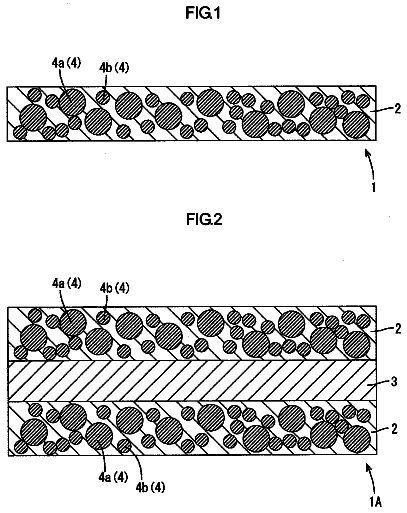
Technical field
The present invention relates to a curable resin composition and a composition for hard coating that contain hard inorganic microparticles of silica, zirconia or the like at a high concentration. In particular, it relates to those which are solventless and can cure instantaneously through irradiation with active energy rays such as ultraviolet rays (UV) and electron beams (EB), in which the inorganic microparticles are not surface-treated.
Background art
For performing hard coating on the surfaces of electronic/electric devices or various plastic materials for imparting scratch resistance or the like thereto, compositions containing an energy ray-curable resin and hard (especially having a Mohs hardness of 6 or more) inorganic microparticles have heretofore been investigated.
The UV-curable resin concretely described in PTL 1 contains, for the purpose of protecting the display surface of liquid-crystal displays, a polyfunctional urethane acrylate, surface-treated silica microparticles that have been prepared by introducing a reactive group into the surfaces of microparticles of colloidal silica by methacrylic acid or the like, and a relatively large amount of an organic solvent. On the other hand, PTL 2 describes use of a UV-curable resin that contains zinc antimonate microparticles for antistatic, a dispersant, a polyfunctional acrylate compound such as dipentaerythritol hexaacrylate, and an organic solvent such as toluene. In this, “a dispersant of an ethylene oxide (EO)/propylene oxide (PO) adduct of an amine” is said to be an indispensable component (claim 1 ).
On the other hand, PTL 3 describes preparation of “a curable composition prepared by blending a silica-based polycondensation product (a) obtained through two-stage hydrolysis and polycondensation, in the presence of colloidal silica having a mean particle size of 1 to 100 nm, of a γ-methacryloyloxypropyltrimethoxysilane or the like (a-1) and a phenyltrimethoxysilane or the like (a-2), a polyfunctional (meth)acrylate (d) and an initiator (e)”, and carrying out “each reaction for the production at 45 to 100° C. for 3 to 24 hours” (abstract). In Examples in PTL 3, one prepared by adding bis(4-methacryloyloxyethoxyphenyl)propane and triethylene glycol dimethacrylate to a liquid in which the “silica-based polycondensation product (a)” is dispersed in an organic solvent, followed by distillation of volatile components under reduced pressure is used as a curable composition.
On the other hand, PTL 4 proposes one containing an alkylene oxide-modified dipentaerythritol (meth)acrylate as an energy ray-curable resin for use for a resist resin or the like. On the other hand, PTL 5 shows “an active energy ray-curable composition for hard coating, characterized by containing silica whose surface has been hydrophobized, and a dispersant prepared by reacting a (meth)acrylic acid-(meth)acrylic acid ester copolymer with 3,4-epoxycyclohexylmethyl (meth)acrylate” (abstract). PTL 6 describes producing an organic solvent-dispersed silica sol, then dispersing it in an ester-modified epoxy resin and thermally curing it. CITATION LIST Patent Literatures
PTL 1: JP-A 2009-084328 PTL 2: JP-A 10-244618 PTL 3: JP-A 10-298253 PTL 4: JP-A 2013-177339 PTL 5: JP-A 2011-201930 PTL 6: WO2009/101974 (republication) SUMMARY OF INVENTION Technical Problem
It is considered that all the energy ray-curable resins for hard coating described in the above-mentioned PTLs 1 to 3 and 5 would need at least one of
a relatively large quantity of an organic solvent,
surface treatment for silica and
a dispersant, for uniformly dispersing silica microparticles in the resin. In Examples in PTL 1, an organic solvent in an amount of two times by weight of the curable resin component is used and silica microparticles with an acryloyl group or the like introduced thereinto are used. In Examples in PTLs 2 and 5, a large quantity of an organic solvent in a similar manner and a dispersant are used. In particular, Comparative Example 3 in PTL 5 demonstrates that, as for the organic solvent-dispersed colloidal silica (organosilica sol), in the case where a surface treatment thereof has not been performed, scratch resistance thereof was poor though the haze value thereof was low (Table 1). Though not containing an organic solvent, PTL 3 needs relatively complicated surface treatment in which silica microparticles are treated by 2-stage reaction to give “silica-based polycondensation product (a)”.
It is presumed that the compositions for hard coating in those conventional techniques could not always be sufficient also in point of the properties thereof after curing. PTL 1 says that curling resistance, high hardness and cracking resistance could have been attained, and the hardness thereof has reached a certain numerical level. However, even in Examples demonstrating the best case, the curling of the thin film substrate is 10 mm and is extremely large, and therefore in this, it could not be said that the film curling could be prevented. In addition, it may be said that the cracking resistance is still insufficient. Further, resin compositions with inorganic particles dispersed therein have become problematic in point of the pot life thereof since the particles may flocculate and aggregate with time; however, no evaluation results relating to stable dispersion of such inorganic particles are shown.
On the other hand, PTL 2 needs a dispersant as an indispensable ingredient for stable dispersion, and the influence of the dispersant on appearance such as haze is investigated as a parameter; however, the influence thereof on flex resistance is not clear. The same could apply to PTL 5. On the other hand, PTL 3 discloses that the resin dispersion of inorganic microparticles eventually having been subjected to solvent removal could have good flowability or the like, but has no concrete description relating to the stability and the viscosity of the dispersion. Consequently, there is a probability that the dispersion would not be always satisfactory in these points. In addition, though a polyfunctional (meth)acrylate is referred to, bis(4-methacryloyloxyethoxyphenyl)propane that is bifunctional is used in Examples, and triethylene glycol dimethacrylate is necessarily contained. From this, there is a probability that the resultant composition could not always be said to be hydrophobic and the adhesiveness of the film to be formed through curing to a hydrophobic substrate would not always be sufficient.
The present invention has been made in consideration of the above, and is to provide those excellent in dispersion stability and capable of bettering various physical properties of hard coating films to be formed through curing, without requiring surface treatment of inorganic microparticles of silica or the like and use of a dispersant. Solution to Problem
The present inventor has assiduously studied for the purpose of solving the above-mentioned problems and have tried a simple method of using, as a crosslinkable monomer to constitute an energy ray-curable resin component, an alkylene oxide-modified dipentaerythritol (meth)acrylate that is a modified dipentaerythritol (meth)acrylate having a suitably small addition molar number of the alkylene oxide, and adding, to the crosslinkable monomer, a dispersion prepared by dispersing inorganic microparticles having a mean particle size of from 1 to 150 nm such as organosilica sol in an organic solvent, mixing them so that the weight ratio of the crosslinkable monomer to the inorganic microparticles could fall within a specific range, and then removing the organic solvent under reduced pressure. With that, quite surprisingly, the inventor has found that the inorganic microparticles can be uniformly and stably dispersed and a good one as a composition for hard coating can be obtained. Specifically, an unexpectedly excellent result has been obtained by employing the method of selecting a specific (meth)acrylate compound, mixing the compound and an organosilica sol while controlling the weight ratio of the compound to inorganic microparticles so as to fall within a specific range, and then removing the solvent. With reference to the above-mentioned prior-art techniques for compositions for hard coating, the present inventor has overcome the preconception that surface treatment for inorganic microparticles and use of a dispersant are indispensable for uniformly and stably dispersing inorganic microparticles in an energy ray-curable resin, and have completed the present invention in the manner as above.
That is, the curable resin composition and the composition for hard coating of the present invention contain an alkylene oxide-modified dipentaerythritol (meth)acrylate having a structure represented by the following general formulae (I) and (II), and, as dispersed therein, inorganic microparticles having a mean particle size of from 1 to 150 nm, in which a ratio of the inorganic microparticles in a total weight of these is from 10 to 45% by weight. Particularly, the surfaces of the inorganic microparticles substantially do not have a hydrophobic group or a reactive group and the compositions substantially do not contain a dispersant other than a (meth)acrylate compound.
##str00001##
In the general formula (I), R represents a substituent represented by the general formula (II), AO indicates one kind or two or more kinds selected from alkylene oxide units represented by —CH.sub.2CH.sub.2O—, —CH.sub.2CH(CH.sub.3)O—, —CH.sub.2CH.sub.2CH.sub.2CH.sub.2O—, and —CH.sub.2CH(C.sub.2H.sub.5)O—, L indicating a mean degree of polymerization of added alkylene oxide chains is 0<L≤5, a mean value of m is more than 0 and 5 or less, a mean addition molar number L×m of alkylene oxides is 0<L×m≤5, n is 1 or 2, a mean value of o is 0 or more and 6 or less, and a total value of m, n and o is 6. In the general formula (II), R.sup.2 represents a hydrogen atom or a methyl group. Advantageous Effects of Invention
The curable resin composition and the composition for hard coating, which contain inorganic microparticles, according to the present invention can save the step and the cost for performing surface treatment of inorganic microparticles in advance. In addition, addition of a solvent, a monofunctional monomer and a non-crosslinkable dispersant compound that are added for uniform and stable dispersion and for viscosity reduction and viscosity control is unnecessary or the content thereof can be significantly reduced. Further, from these, the concentration of the (meth)acryloyl group that is a polymerizable functional group in the reactive composition can be increased, and after curing, good mechanical strength can be maintained.
Description of embodiments
The curable resin composition containing inorganic microparticles and the composition for hard coating, which contain inorganic microparticles, according to the present invention contain a crosslinkable monomer having a structure represented by the above-mentioned general formulae (I) and (II), and as dispersed therein, inorganic microparticles having a mean particle size of from 1 to 150 nm, in which the ratio of the inorganic microparticles in the total weight of these is from 10 to 45% by weight, preferably from 15 to 45% by weight. Preferably, a hydrophobic group or a reactive group does not substantially bond to the surface of the inorganic microparticles, and a component having an action of dispersing the inorganic microparticles is substantially the above-mentioned crosslinkable monomer alone. Here, the inorganic microparticles are substantially non-porous and non-hollow particles, and have a specific surface area diameter obtained by a measurement according to a nitrogen adsorption method (BET method) being from 1 to 150 nm, preferably from 1 to 100 nm, more preferably from 10 to 80 nm, and even more preferably from 20 to 70 nm. However, in the case where high transparency is required, it is preferably from about 10 to 30 nm. For measurement of the mean particle size, use can be made of “Monosorb (registered trademark) MS-16 (manufactured by Yuasa Ionics)” described in the paragraph 0074 of the above-mentioned PTL 6. In the curable resin composition and the composition for hard coating, the content of the crosslinkable monomer is preferably from 25 to 85% by weight and more preferably from 30 to 80% by weight.
Preferably, the curable resin composition containing inorganic microparticles and the composition for hard coating, which contain inorganic microparticles, according to the present invention do not contain a solvent at all. Even when a solvent is contained, the content thereof is preferably 3% by weight or less, more preferably 1% by weight or less, even more preferably 0.3% by weight or less, and still more preferably 0.1% by weight or less. Also preferably, any nonreactive dispersant compound not having reactivity with the crosslinkable monomer is not contained at all. Even when the compound is contained, the content thereof is preferably 3% by weight or less, more preferably 1% by weight or less, even more preferably 0.3% by weight or less, and still more preferably 0.1% by weight or less. The curable resin composition containing inorganic microparticles and the composition for hard coating, which contain inorganic microparticles, according to the present invention have a viscosity at 25° C. of preferably from 300 to 10,000 mPas and more preferably from 500 to 9000 mPas. The measurement of the viscosity may be performed according to JIS K 5600-2-3.
Especially, the curable resin composition containing inorganic microparticles and the composition for hard coating, which contain inorganic microparticles, according to the present invention are curable through irradiation with active energy rays such as UV rays, electron beams, blue visible light rays and gamma rays. In the case where UV rays are used, a light source containing light that falls within a wavelength range of from 150 to 450 nm may be used, and if desired, a photopolymerization initiator may be contained. Combined use of heat from IR rays, far-IR rays, hot air, high-frequency heating or the like is employable here. In the curable resin composition containing inorganic microparticles and the composition for hard coating, which contain inorganic microparticles, according to the present invention, the ratio of the energy ray-curable component, especially the UV-curable component in the moiety except inorganic microparticles and pigment therein is generally from 70 to 100% by weight, and typically from 80 to 100% by weight. Curing through irradiation with active energy rays, for example, may be carried out almost along with coating, by arranging an irradiation lamp just after the coating roll or the discharge nozzle, or may be carried out after entire surface coating or after completion of coating pattern formation, by setting the subject in an irradiation device.
<Alkylene Oxide-Modified Dipentaerythritol (Meth)Acrylate>
The curable resin composition containing inorganic microparticles and the composition for hard coating, which contain inorganic microparticles, according to the present invention contain a structure represented by the above-mentioned general formulae (I) and (II) as the crosslinkable monomer therein. In the formula (I), AO indicates an alkylene oxide unit represented by —CH.sub.2CH.sub.2O—, —CH.sub.2CH(CH.sub.3)O—, —CH.sub.2CH.sub.2CH.sub.2CH.sub.2O—, or —CH.sub.2CH(C.sub.2H.sub.5)O—. Specifically, indicated is any of an ethylene oxide (EO) unit, a propylene oxide (PO) unit and a butylene oxide unit, and above all, preferred is an ethylene oxide unit from the viewpoint of viscosity, photosensitivity and polymerization degree. These alkylene oxide units may be present as one kind alone or may be present as combination of two or more kinds.
The mean addition molar number (L×m) of alkylene oxides per 1 mole of dipentaerythritol is more than 0 and 5 or less and from 3 to 5. When the mean addition molar number of alkylene oxides is smaller than the range, the function of reducing the viscosity of the crosslinkable monomer or the like would be insufficient. When the number is larger than the range, the viscosity of the crosslinkable monomer would be rather large, and the amount of the monofunctional (diluting) monomer to be incorporated must be increased. In addition, the crosslinking density lowers by the prolongation of the alkylene oxide chain, and therefore the strength of the cured product lowers. On the other hand, L indicating the mean degree of polymerization of added alkylene oxide chains is 0<L≤5 and preferably 1≤L≤3. The mean value of m is more than 0 and 6 or less, preferably more than 0 and 5 or less and more preferably 1 or more and 2 or less. The mean value of n indicating the remaining hydroxyl groups is 0 or more and less than 6, preferably 1 or more and 2 or less and more preferably 1 or 2. The mean value of o is 0 or more and 6 or less, preferably 0 or more and less than 6 and more preferably 0 or more and 4 or less. The total of these m, n and o is 6.
R represents a (meth)acryloyl group represented by the general formula (II), and R.sup.2 in the general formula (II) is a hydrogen atom or a methyl group and the waved line indicates a bonding part.
Specifically, the above-mentioned crosslinkable monomer has a structure in which a part or all of six hydroxyl groups of dipentaerythritol are converted into (meth)acrylic acid ester groups represented by the general formula (II) via spacers of ethylene oxide, propylene oxide, butylene oxide, or plural types of these. In this, one or two hydroxyl groups not having a (meth)acrylic acid ester group remain as hydrophilic groups, and therefore contribute toward adhesion to various types of substrates or the like.
<Production Method for Alkylene Oxide-Modified Dipentaerythritol (Meth)Acrylate>
The crosslinkable monomer may be produced, for example, according to the method mentioned below, but the production route is not specifically limited and any production method is employable.
The alkylene oxide modification method using dipentaerythritol as a source material may be selected in any desired manner. As a general method, there is mentioned a method of using an alkylene oxide such as ethylene oxide, propylene oxide or butylene oxide and, in addition thereto, there are also mentioned a method of using a cyclic carbonate such as ethylene carbonate, propylene carbonate or butylene carbonate, and a method of using ethylene chlorohydrin.
In the production method to be mentioned below, the (meth)acrylic acid compound that is used as a source material for the crosslinkable monomer has high polymerizability, and therefore during production or during storage of products, a polymerization inhibitor may be suitably used for preventing the polymerization from proceeding. The polymerization inhibitor includes hydroquinones such as p-benzoquinone, hydroquinone, hydroquinone monomethyl ether, and 2,5-diphenyl-parabenzoquinone, N-oxy radicals such as tetramethylpiperidinyl-N-oxy radical (TEMPO), substituted catechols such as t-butylcatechol, amines such as phenothiazine, diphenylamine and phenyl-β-naphthylamine, cupferron, nitrosobenzene, picric acid, molecular oxygen, sulfur, and copper(II) chloride. Of those, preferred are hydroquinones, phenothiazine and N-oxy radicals from the viewpoint of the general versatility and the polymerization inhibiting effect.
Regarding an amount of the polymerization inhibitor to be added, relative to the intended compound represented by the general formula (I), a lower limit is about 10 ppm or more and preferably 30 ppm or more, and an upper limit is generally 5000 ppm or less and preferably 1000 ppm or less. In case the amount is too small, then a sufficient polymerization inhibiting effect could not be expressed and there is a risk of progression of polymerization during production and during storage of products, and in case too large, then on the contrary, there is a risk of inhibiting the curing and polymerization reaction. Consequently, in the compound of the present invention alone or in the polymerizable resin composition thereof, there may be a risk of occurring reduction in the photosensitivity, crosslinking failure of cured products, degradation of the physical properties such as the mechanical strength, or the like, and it is not preferred.
An ordinary method for (meth)acrylic acid ester group introduction in producing the crosslinkable monomer includes an interesterification method that uses a (meth)acrylic acid ester corresponding to the intended structure such as methyl acrylate or methyl methacrylate, an acid chloride method that uses a (meth)acrylic acid chloride, a method using a condensing agent such as N,N′-dicyclohexylcarbodiimide, 2-chloro-1,3-dimethylimidazolium chloride, propanephosphonic acid anhydride, carbonyldiimidazole (CDI), or WSCD (water-soluble carbodiimide), and a dehydration esterification method of azeotropic dehydration with (meth)acrylic acid in the presence of an acid catalyst. For typical esterification of an alkylene oxide-modified dipentaerythritol, possible conditions in production are mentioned below.
The reaction can be carried out by reacting (meth)acrylic acid and an alkylene oxide-modified dipentaerythritol in the presence of an acid catalyst while the formed water is distilled away. The acid to be used is not specifically limited, and may be any acid usable in ordinary esterification. For example, there are mentioned inorganic acids such as sulfuric acid and hydrochloric acid, organic sulfonic acids such as p-toluenesulfonic acid, methanesulfonic acid and camphorsulfonic acid, acid-type ion-exchange resins, Lewis acids such as boron fluoride/ether complex, water-soluble Lewis acids such as lanthanide triflate, and the like. These acids can be used as one alone or as two or more types of arbitrary acids mixed.
Regarding the amount of the acid to be used, relative to alkylene oxide-modified dipentaerythritol as a substrate, a lower limit is 0.1 molar equivalent or more and preferably 0.5 molar equivalent or more. On the other hand, an upper limit is not specifically limited, but is generally 20 molar equivalents or less and preferably 10 molar equivalents or less. In the case the amount of the acid catalyst is too small, such is unfavorable since the reaction progress would be slow or the reaction may stop, and in case too large, some problems such as product discoloration or catalyst residue and some unfavorable side reaction such as production of Michael adducts tend to occur.
The reaction may be carried out in solvent-based system or non-solvent-based system, but in view of side product formation and of handleability in the process, solvent-based system is preferred. In case the solvent is used, the solvent to be used is not specifically limited, but preferably used is an aromatic hydrocarbon solvent such as toluene and xylene, an aliphatic hydrocarbon solvent such as hexane and heptane, an ether solvent such as diethyl ether, tetrahydrofuran, monoethylene glycol dimethyl ether, and diethylene glycol dimethyl ether, a halogen solvent such as methylene chloride, chloroform and carbon tetrachloride, and the like. These solvents may be used as one alone or as plurality of arbitrary solvents mixed.
In case the solvent is used, the amount thereof may be so adjusted that the concentration of a source material, alkylene oxide-modified dipentaerythritol therein could be generally 1% by mass or more and preferably 20% by mass or more. An upper limit is not specifically limited, but is generally 80% by mass or less and preferably 70% by mass or less. The reaction is carried out generally at a temperature equal to or higher than the boiling point of the solvent used while the formed water is distilled away. However, in case where the reaction using the above-mentioned (meth)acrylic acid chloride or the condensing agent is carried out, the reaction may be carried out at a temperature equal to or lower than the boiling point of the solvent or with cooling with ice. The reaction time may be selected in any desired manner. By measuring the amount of the formed water and the acid value inside the system, the end point of the reaction can be recognized.
Regarding the reaction time, a lower limit is generally 30 minutes or more and preferably 60 minutes or more, and an upper limit is, though not specifically limited, generally 20 hours or less and preferably 10 hours or less.
<Purification Method>
The compound produced through the above-mentioned reaction and represented by the general formula (I) may be purified in any purification method heretofore employed, with no specific limitation thereon. For example, there may be mentioned a distillation method, a recrystallization method, an extraction washing method, an adsorption treatment method, and the like. In the case where distillation is performed, the mode thereof may be arbitrary selected from single distillation, precision distillation, thin film distillation, molecular distillation, and the like.
<Method for Storage of (Meth)Acrylic Acid Ester Monomer>
The crosslinkable monomer is polymerizable and is therefore desired to be stored in a cold and dark place. For preventing polymerization, the above-mentioned polymerization inhibitor may be used in the above-mentioned amount for storage.
<Inorganic Microparticles>
The inorganic microparticles are composed of a material having a Mohs hardness of preferably 5 or more and more preferably 6 or more. As the inorganic microparticles, silica, zirconia, alumina, and the like are preferred. As the case may be, however, use can be made of metal oxide microparticles of such as titania, zinc oxide, germanium oxide, indium oxide, tin oxide, indium tin oxide (ITO), antimony oxide, or cerium oxide, and metal fluoride microparticles of such as magnesium fluoride or sodium fluoride. Hollow silica microparticles may be suitably added, and in the case where antistatic characteristic or electroconductivity is desired to be given, indium tin oxide (ITO), tin oxide or the like may be suitably added. Also if desired, a pigment or a dye as a colorant component, or a metal micropowder for imparting electroconductivity may be contained, or in the case where the pigment is used, if desired, a pigment dispersion may be contained.
In one preferred embodiment, the inorganic microparticles are colloidal silica. For synthesis of colloidal silica, there are known a vapor-phase synthesis method for Aerosil synthesis through thermal decomposition of silicon tetrachloride, a method using water glass as the source material, a liquid-phase synthesis method of hydrolysis of an alkoxide, and the like, and any of these is employable. However, synthesis from a liquid-phase silicic acid is preferred, as readily providing spherical, amorphous and mono-dispersed microparticles. Preferred examples of commercial products of colloidal silica include various products of “organosilica sol” (organic solvent-dispersed silica sol) manufactured by Nissan Chemical Industries, Ltd.; and various products of “high-purity organosol” manufactured by Fuso Chemical Co., Ltd. These are ones prepared by dispersing colloidal silica in an organic solvent. Of those, “L Type” (40 to 50 nm) of surface-unmodified “organosilica sols” “general types” is especially preferred. However, “standard type” (10 to 15 nm) of “general types” is also usable. For obtaining colloidal silica dispersed in an organic solvent, a thick silica sol is first prepared by using an ion-exchange resin and ultrafiltration, and then water therein is replaced by an organic solvent, for example, as described in the paragraphs 0075 to 0076 and 0080 in the above-mentioned PTL 6. As the case may be, in place of the organic solvent-dispersed silica sol, a silica sol dispersed in water, for example, various products of “Adelite AT Series” by ADEKA Corporation may also be used. The silica sol may be any one whose acidity of pH in dispersion in water is any of neutral, acid or alkaline.
In a preferred embodiment, the inorganic microparticles are surface-unmodified ones. That is, they are such ones that surface coating through reaction of the surface functional group of the inorganic microparticle with a coupling agent, a reactive monomer or the like is not substantially carried out. For example, they are such ones that 90% or more and especially 95% or more of the surface functional groups such as hydroxyl groups therein are in an unbonding (free) state. Regarding colloidal silica to be obtained from a silicate, they are such ones prepared by forming a sol followed by concentration through ultrafiltration alone, or ones optionally further subjected only to solvent substitution or pH control.
For dispersing inorganic microparticles in an energy ray-polymerizable monomer composed of the above-mentioned crosslinkable monomer (specific alkylene oxide-modified dipentaerythritol (meth)acrylate), a thick silica sol dispersed in an organic solvent (generally having a concentration (solid content) of from 15 to 35%) and the energy ray-polymerizable monomer may be strongly stirred with a stirring blade such as an ordinary screw propeller in a container that enables nitrogen purging or pressure reduction. After the stirring has been finished in some degree, the pressure is reduced and the solvent is removed while continuing the stirring, whereby the organic solvent may be almost completely removed away. For the pressure reduction and solvent removal operation, nitrogen or air may be introduced little by little through a nozzle or the like arranged in the solution to thereby promote solvent removal. Since the viscosity of the above-mentioned alkylene oxide-modified dipentaerythritol (meth)acrylate is low, the solvent removal operation may be carried out at room temperature (18 to 25° C.), but if desired, the system may be heated up to 40° C. or so. In place of adding such a thick silica sol dispersed in an organic solvent and thus mixing and dispersing with the energy-polymerizable monomer in the manner as above, the thick silica sol dispersed in water may be stirred and mixed with the energy-polymerizable monomer and thereafter an organic solvent may be added thereto, and in the same manner as above, water and the organic solvent may be removed.
<Other Energy Ray-Polymerizable Monomers>
Any other crosslinkable monomers may be used along with the above-mentioned crosslinkable monomer, and along with such crosslinkable monomers, a small amount of a non-crosslinkable monomer may be used. In such a case of combination use, the ratio of the above-mentioned crosslinkable monomer in the energy ray-polymerizable monomer may be from 30 to 99% by weight, preferably from 35 to 99% by weight or from 40 to 99% by weight. In the case where a non-crosslinkable (monofunctional) monomer is added, the ratio of the non-crosslinkable monomer in the energy ray-polymerizable monomer may be 10% by weight or less and especially 5% by weight or less. As the monomer to be combined for use herein, use can be made of any one copolymerizable during irradiation with energy rays. Specifically, there are mentioned (meth)acrylates having a carbon number of from 4 to 30, (meth)acrylamides having a carbon number of from 5 to 35, aromatic vinyls having a carbon number of from 5 to 35, vinyl ethers having a carbon number of from 2 to 20, and other radical-polymerizable compounds, etc. Of those, (meth)acrylates and (meth)acrylamides are preferred. In this description, “(meth)acrylate” is meant to indicate both or any one of “acrylate” and “methacrylate”.
The other crosslinkable monomer that may be used along with the above-mentioned crosslinkable monomer is preferably a polyfunctional (meth)acrylate monomer having 2 or more polymerizable unsaturated groups in one molecule. The polyfunctional (meth)acrylate monomer includes bifunctional (meth)acrylate compounds such as 1,6-hexanediol di(meth)acrylate, neopentyl glycol di(meth)acrylate, ethylene glycol di(meth)acrylate, and isocyanuric acid ethylene oxide-modified di(meth)acrylate; trimethylolpropane tri(meth)acrylate, and EO- (ethylene oxide, hereinafter referred to as EO), PO- (propylene oxide, hereinafter referred to as PO) or epichlorohydrin-modified products thereof; pentaerythritol tri(meth)acrylate, glycerol tri(meth)acrylate, and EO-, PO- or epichlorohydrin-modified products thereof; trifunctional (meth)acrylate compounds such as isocyanuric acid EO-modified tri(meth)acrylate (Aronix M-315 manufactured by Toagosei Co., Ltd., etc.), tris(meth)acryloyloxyethyl phosphate, phthalic acid hydrogen-(2,2,2-tri-(meth)acryloyloxymethyl)ethyl, glycerol tri(meth)acrylate, and EO-, PO- or epichlorohydrin-modified products thereof; pentaerythritol tetra(meth)acrylate and EO-, PO- or epichlorohydrin-modified products thereof; tetrafunctional (meth)acrylate compounds such as ditrimethylolpropane tetra(meth)acrylate; pentafunctional (meth)acrylate compounds such as dipentaerythritol penta(meth)acrylate, and EO-, PO-, epichlorohydrin-, fatty acid-, alkyl- or urethane-modified products thereof; and hexafunctional (meth)acrylate compounds such as dipentaerythritol hexa(meth)acrylate and EO-, PO-, epichlorohydrin-, fatty acid-, alkyl- or urethane-modified products thereof, and sorbitol hexa(meth)acrylate and EO-, PO-, epichlorohydrin-, fatty acid-, alkyl- or urethane-modified products thereof.
<Other Crosslinkable Energy Ray-Polymerizable Compound Having Molecular Weight of 10,000 or Less>
In addition to the above, use can be made of epoxy(meth)acrylates obtained through addition reaction of a glycidyl ether and (meth)acrylic acid or a carboxylic acid base-having monomer; urethane (meth)acrylates obtained through addition reaction of a reaction product of a polyol and a polyisocyanate, and a hydroxyl group-having (meth)acrylate; polyester acrylates obtained through esterification of a polyester polyol formed of a polyol and a polybasic acid, and (meth)acrylic acid; polybutadiene (meth)acrylates that are (meth)acrylic compounds having a polybutadiene or hydrogenated polybutadiene skeleton; and the like, all of which have a molecular weight of 10,000 or less and preferably 3,000 or less. The urethane (meth)acrylates are preferred as giving hardness and flexibility to cured films. Preferred examples of the (crosslinkable) urethane (meth)acrylates having 2 or more polymerizable unsaturated groups include New Frontier Series R-1901, R-1214, R-1150D, and GX8801A by DKS Co. Ltd. Further mentioned are AH-600, AT-600, UA-306H, UA-306T, UA-306I, and the like, trade names, manufactured by Kyoeisha Chemical Co., Ltd.; UV-1700B, UV-3000B, UV-3200B, UV-6300B, UV-6330B, UV-7000B, and the like, trade names, manufactured by The Nippon Synthetic Chemical Industry Co., Ltd.; Beam Set 500 Series (502H, 504H, 550B, etc.), trade names, manufactured by Arakawa Chemical Industries, Ltd.; U-6HA, U-15HA, UA-32P, U-324A, and the like, trade names, manufactured by Shin-Nakamura Chemical, Co., Ltd.; M-9050 and the like, trade name, manufactured by Toagosei Co., Ltd. The glycidyl ethers for use in the above-mentioned epoxy (meth)acrylates include 1,6-hexanediglycidyl ether, a polyethylene glycol glycidyl ether, a bisphenol A-type epoxy resin, a naphthalene-type epoxy resin, a cardoepoxy resin, glycerol triglycidyl ether, and a phenol-novolak-type epoxy resin. The polyols for use in the urethane (meth)acrylates include 1,6-hexanediglycidyl ether, a polyethylene glycol, a polypropylene glycol, a polytetramethylene glycol, a polycaprolactone diol, a polycarbonate diol, a polybutadiene polyol, and a polyester diol. The polyisocyanates for use in the urethane (meth)acrylates include tolylene diisocyanate, xylylene diisocyanate, diphenylmethane diisocyanate, tetramethylxylene diisocyanate, hexamethylene diisocyanate, isophorone diisocyanate, and dicyclohexylmethane diisocyanate. The hydroxyl group-containing (meth)acrylates for use in the urethane (meth)acrylates include 2-hydroxyethyl (meth)acrylate, 2-hydroxypropyl (meth)acrylate, 4-hydroxybutyl (meth)acrylate, pentaerythritol (meth)acrylate, and caprolactone-modified 2-hydroxyethyl (meth)acrylate. The polyols to form polyester polyols for use in the above-mentioned polyester acrylates include ethylene glycol, a polyethylene glycol, propylene glycol, a polypropylene glycol, neopentyl glycol, 1,4-butanediol, trimethylolpropane, and pentaerythritol; the polybasic acids includes succinic acid, adipic acid, sebacic acid, phthalic acid, isophthalic acid, terephthalic acid, trimellitic acid, and pyromellitic acid. On the other hand, the non-crosslinkable (monofunctional) monomers include (meth)acrylate compounds having a carbon number of from 5 to 35 such as hexyl (meth)acrylate, and (meth)acrylamide compounds having a carbon number of from 5 to 35 such as (meth)acrylamide and N-methyl(meth)acrylamide.
<Polymerization Initiator>
The curable resin composition containing inorganic microparticles and the composition for hard coating, which contain inorganic microparticles, according to the present invention may contain a radical polymerization initiator, a cationic polymerization initiator, a radical and cationic polymerization initiator, etc if necessary. The polymerization initiator includes an energy ray polymerization initiator for radical polymerization or cationic polymerization, and for example, includes compounds containing aromatic ketones, aromatic onium salt compounds, organic peroxides, hexaarylbiimidazole compounds, ketoxime ester compounds, borate compounds, azinium compounds, metallocene compounds, and active ester compounds, etc.
The description continues in the full USPTO document.