 Lapsed, fee not paid5 drawings
Telecom & Networks · US 9,980,109 B2
Methods and devices for reporting broadcast state of warning message
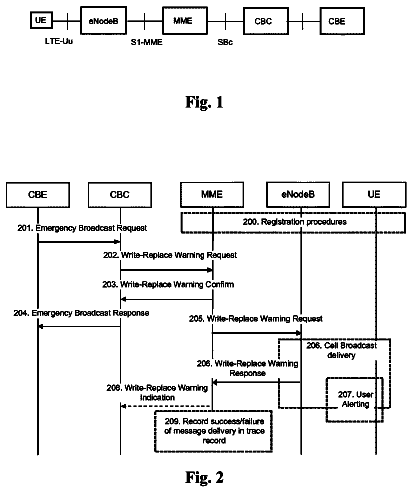
Provided are methods and devices for reporting a broadcast state of a warning message.
US 9,980,147 B2 · Assignee: Huawei Technologies Duesseldorf GMBH · Inventors: Luo; Jian et al.
Sheet 1 of 5 from the published document. All sheets in the USPTO PDF
A spectrum manager for allocating a shared frequency spectrum in a wireless communication system is disclosed. The wireless communication system comprises a plurality of base stations which are operated by at least two operators, said spectrum manager being configured to group the plurality of base stations into clusters based on spectrum demand related information; and determine a spectrum partition pattern for each cluster based on the spectrum demand related information and information of the grouped based station clusters, a spectrum partition pattern specifying the partition and allocation of frequency spectrum fragments to said at least two operators in a corresponding cluster, wherein a frequency spectrum fragment is allocated to only one of said at least two operators in each cluster, and forward information regarding the spectrum partition pattern to the plurality of base stations or to one or a plurality of network entities of the at least two operators.
Conventionally, the allocation of a frequency spectrum and the licensing to operators for mobile broad band (MBB) has been done in an exclusive manner, i.e. each operator obtains and licenses a fixed certain part of the frequency spectrum for exclusive usage. Such an exclusive frequency spectrum licensing and allocation has the advantages of a certain guarantee of quality of service (QoS), good interference management and a high degree of market certainty which was considered necessary to create adequate investment and innovation incentives. However, as the demand on mobile data traffic grows exponentially, the problem of “spectrum shortage” arises, i.e. there will be not enough spectrum bands or subcarriers, especially in the range below 6 Ghz, to be exclusively allocated and licensed to different operators. In other words, there is a need for more available frequency spectrum or a bett
All 5 drawing sheets from the published document, cropped to the drawing.
What the patent claimed, word for word. All of it is now free to use.
The present invention refers to a spectrum manager and a method for allocating a shared frequency spectrum to operators in a wireless communication system, as well as to a corresponding base station.
Conventionally, the allocation of a frequency spectrum and the licensing to operators for mobile broad band (MBB) has been done in an exclusive manner, i.e. each operator obtains and licenses a fixed certain part of the frequency spectrum for exclusive usage. Such an exclusive frequency spectrum licensing and allocation has the advantages of a certain guarantee of quality of service (QoS), good interference management and a high degree of market certainty which was considered necessary to create adequate investment and innovation incentives. However, as the demand on mobile data traffic grows exponentially, the problem of “spectrum shortage” arises, i.e. there will be not enough spectrum bands or subcarriers, especially in the range below 6 Ghz, to be exclusively allocated and licensed to different operators. In other words, there is a need for more available frequency spectrum or a better usage of the currently available frequency spectrum. Even assumed that there is a sufficient amount of spectrum bands available in the available frequency spectrums for exclusive allocation, the mobile operators will face the pressure of a high spectrum cost. Such high costs for licensing and operation will become less and less acceptable. Furthermore, an exclusive allocation of frequency spectrum bands has the disadvantage of a low flexibility and low scalability, i.e. it often leads to an underutilization of the available resources in certain locations/regions and/or in certain periods of time. In other words, the efficiency of the usage of the available frequency spectrum is low. Thus, frequency spectrum sharing becomes a necessary and important tool to meet future spectrum requirements. On the one hand, mobile operators will have to share the available frequency spectrum with other communication or non-communication systems. On the other hand, mobile operators will have to share at least certain amounts, if not all, of the available frequency spectrum with each other. Actually, both sharing cases may occur simultaneously, for example, several operators may share a frequency band with a radar service in a primary/secondary manner, while they share the available frequency band with each other on an equal basis.
In the prior art, inter-operator spectrum sharing solutions normally work well only under ideal network deployment, e.g. all operators have collocated base stations, BSs, identical network deployment and homogenous Radio Access Network, RAN (same cell size everywhere). In practice, such ideal network deployment can only be found in delimited and special cases of RAN sharing. In a more general case, different operators have independent network deployments. Moreover, within the RAN of each operator, the cells would have various sizes and shapes in order to adapt to various network deployment environments or scenarios. For such realistic network deployment, the inter-operator spectrum sharing solutions of the prior art do not work well. Thus, a more efficient solution is required for realistic network deployment to allow a flexible spectrum sharing between operators.
In future wireless communication systems, a considerable part of the allocation of the available frequency spectrum will have to be done in a dynamic way and to sharing operators. This can for example be done under a licensed shared access, LSA, framework, where the frequency band of an incumbent user, for example a radar service, is temporarily licensed to multiple operators in a certain location and for a certain time period. Another example would be that the regulator licenses a spectrum band to multiple operators without fixed boundaries between the spectrum bands allocated to the different operators, so that the operators can coordinate their spectrum usage according to mutual agreement and/or specific or varying sharing rules. Irrespective of the scenario under which the spectrum is shared between operators, the key problem is the allocation of a certain available frequency spectrum band for shared usage to multiple, i.e. at least two operators. In an example of a previously suggested frequency spectrum sharing technique, Orthogonal Frequency-Division Multiplexing, OFDM, waveform is used, and fragments of the frequency spectrum, i.e. frequency subcarriers of the frequency spectrum, are allocated to the operators in an orthogonal manner. Orthogonal hereby and in the frame of the present application generally means that a specific subcarrier, or a specific group of subcarriers, or a frequency subband is only allocated to a specific operator, but not at the same time allocated to a different operator. At a given point of time, each frequency subcarrier or subband is therefore allocated to a specific operator, but not to two operators at the same time. The mutual interference between adjacent spectrum fragments consisting of subcarriers/subbands allocated to different operators can therefore be avoided by such orthogonal allocation of the resource blocks, i.e. subcarrier/subband fragments.
The present application and the technology underlying the invention, as later described, bases on partitioning of a shared frequency spectrum dynamically into frequency spectrum fragments and the allocation of the frequency spectrum fragments to the different operators. In order to minimize inter-operator or co-channel interference, different operators are allocated orthogonal sets of frequency spectrum fragments. The amount of allocated frequency spectrum for each operator should be adapted to the traffic demand of this operator, while taking the sharing policy into account, which is for example fairness or balance and so forth.
FIG. 1 shows an illustration for two cases in which the operators sharing the frequency spectrum have an ideal network deployment. Ideal network deployment is defined as a network deployment of different operators that is done in such a way that each sector or cell (in the shown example, each cell has 3 sectors of the same size) of one operator is only overlapping with only one sector or cell of another operator, respectively. A typical example is that cells of all operators have the same size and shape. FIG. 2 now shows two examples, an example 1 of non-co-located base stations 210 , 220 and an example 2 of co-located base stations 210 , 220 . The base stations 210 belong to operator 1 (indicated by the solid lines of the cells around the base stations 210 ) and the base stations 220 belong to operator 2 (visualized by the broken lines of the cells around the respective base stations 220 ). In example 2, the base stations 210 and 220 are at the same location and the cells and sectors are co-located, i.e. are identically overlapping each other. In example 1, the base stations 210 , 220 are non-co-located, but the respective sectors of each cell are identically co-located with respective sectors of an adjacent cell of the base station of the respectively different operator. Under such ideal network deployment and by ignoring inter-cell and inter-sector interference within each operator's network, each overlapping sector or cell contains the signals transmitted by one base station 210 , 220 of each operator. Therefore, the spectrum partition pattern for each such overlapping sector or cell can be different and be handled independently. Here, the spectrum partition pattern is a pattern which defines the size and position of each frequency spectrum fragment as well as to which operator it is allocated. With each spectrum partition pattern, different operators are allocated orthogonal sets of spectrum fragments. Typically, the spectrum partition pattern of each such overlapping sector or cell is adapted to the traffic demand of each base station 210 , 220 of each operator in a flexible manner.
In FIG. 2 , an example of a realistic network deployment taking into consideration the co-channel interference is visualized. In a realistic implementation, the cells of the different base stations 210 , 220 of the different operators have various and different sizes. Moreover, each sector or cell of one operator can be overlapping multiple sectors or cells of another operator. Under such realistic network deployment, if each sector or cell of one operator applies a different spectrum partition pattern, co-channel interference can occur, which means that in a certain overlapping area of the sectors or cells of different operators, a common spectrum fragment is used, causing inter-operator interference. Such co-channel interference is visualized in FIG. 2 by the fragment 2 , which is used by both operators in an overlapping area of the sectors. Therefore, the user terminals using this fragment 2 in each of the overlapping sectors or cells can suffer from co-channel interference between operators.
One object of the present invention is therefore to provide a technology for allocating a shared frequency spectrum to operators in a wireless communication system, which allows a flexible spectrum sharing between operators. Specifically, it provides a flexible adaption to the spectrum demands of the base stations while providing an efficient co-channel interference management at the same time.
The above object is achieved by the solution provided in the enclosed independent claims. Advantageous implementations are defined in the respective dependent claims.
A first aspect of the present invention provides a spectrum manager for allocating a shared frequency spectrum in a wireless communication system, said wireless communication system comprises a plurality of base stations for wireless communication with terminals, said plurality of base stations being operated by at least two operators, said spectrum manager being configured to group the plurality of base stations into clusters based on spectrum demand related information; and determine a spectrum partition pattern for each cluster based on the spectrum demand related information and information of the grouped based station clusters, a spectrum partition pattern specifying the partition and allocation of frequency spectrum fragments to said at least two operators in a corresponding cluster of said wireless communication system, wherein a frequency spectrum fragment is allocated to only one of said at least two operators in each cluster, and forward information regarding the spectrum partition pattern to the plurality of base stations or to one or a plurality of network entities of the at least two operators.
A frequency spectrum fragment is e.g. a contiguous frequency spectrum portion of said shared frequency spectrum. The network entities e.g. forward the mentioned information to base stations.
The present invention thus provides an efficient solution for realistic network deployment allowing flexible spectrum sharing between operators. Specifically, the present invention achieves a good tradeoff between flexible adaptation to spectrum demands of the base stations on the one hand and costs and efforts of co-channel interference management on the other hand.
In a first implementation form of the spectrum manager according to the first aspect of the present invention, the spectrum manager is further configured to dynamically group the plurality of base stations into clusters each time when the spectrum demand related information is updated, or group the plurality of base stations on demand of request from operators or base stations.
In a second implementation form of the spectrum manager according to the first aspect as such or the first implementation form of the first aspect of the present invention, the spectrum manager is further configured to receive spectrum demand related information from the plurality of based stations or from the network entities of the at least two operators, wherein the spectrum demand related information comprises information regarding the spectrum demand of each of the plurality of base stations and/or the network deployment information of the at least two operators.
In a third implementation form of the spectrum manager according to the first aspect as such or the first or second implementation forms of the first aspect of the present invention, the spectrum manager is further configured to classify the base stations of each cluster into inner base stations and edge base stations, inner base stations being base stations inside the respective cluster without being affected by co-channel interference, and edge base stations being base stations located in an edge area of the respective cluster being affected by co-channel interference, an edge area of a cluster being the area which overlaps with at least one edge area of a neighboring cluster. For example, the spectrum partition pattern for each cluster is hereby determined only based on the spectrum demand of each inner base station of the respective cluster without considering the co-channel interference. In addition, both the spectrum demand and the co-channel interference of each edge base station of the respective cluster can also be taken into account.
In a fourth implementation form of the spectrum manager according to the third implementation form of the first aspect of the present invention, the spectrum manager is further configured to group the base stations into a cluster by putting bases stations with a lower spectrum demand in the edge area of the cluster and base stations with a higher spectrum demand in the central area of the cluster.
In fifth implementation form of the spectrum manager according to the third or fourth implementation form of the first aspect of the present invention, the spectrum manager is further configured to categorize, for each edge base station, the frequency spectrum fragments, into different types of frequency spectrum fragments according to the spectrum partition patterns of all neighboring clusters of each edge base station, and
wherein said different types of frequency spectrum fragments comprise a first type of frequency spectrum fragments which are used by the operator of the said edge base station in said neighboring clusters, a second type of frequency spectrum fragments which are used by different operators, including the operator of the concerned edge base station, in said neighboring clusters and a third type of frequency spectrum fragments which are not used by the operator of the said edge base station in said neighboring clusters.
In a sixth implementation form of the spectrum manager according to the fifth implementation form of the first aspect of the present invention, the spectrum manager is further configured to forward, to each edge base station, information about spectrum partition patterns allocated to all neighboring clusters of the respective edge base station in order to enable the edge base stations to classify the fragments of the allocated spectrum partition patterns into different types depending on the spectrum partition patterns allocated to the said neighboring clusters.
In a seventh implementation form of the spectrum manager according to the fifth or sixth implementation forms of the first aspect of the present invention for the second type of the frequency spectrum fragments a co-channel interference management is to be performed between the involved edge base stations.
In an eighth implementation form of the spectrum manager according to the sixth or seventh implementation forms of the first aspect of the present invention, the spectrum manager is further configured to partition frequency spectrum fragments of the second type into sub-fragments, and to allocate the different sub-fragments to the edge base stations of respective different operators.
A second aspect of the present invention provides a base station for wireless communication with terminals and a wireless communication system which comprises a spectrum manager according to the first aspect as such or according to any of the previous implementation forms of the first aspect and a plurality of base stations for wireless communication with terminals in said wireless communication system, wherein said base station is configured to receive information regarding said spectrum partition patterns from spectrum manager, and to communicate with terminals in said wireless communication system on the basis of said received information regarding said spectrum partition patterns. In addition, said base station may optionally be configured to receive said cluster related information. For example, an inner base station may only be configured to receive said spectrum partition pattern information, but not said cluster related information. An edge base station may e.g. be configured to receive both the spectrum partition pattern information as well as said cluster related information.
In a first implementation form of the base station of the second aspect of the present invention, the base station is an edge base station and is further configured to receive information about spectrum partition patterns allocated to neighboring clusters and categorize the fragments of the allocated spectrum partition patterns into different types depending on the spectrum partition patterns allocated to the neighboring clusters, wherein said different types comprise a first type of frequency spectrum fragments which are commonly used by the same operator of edge base station in neighboring clusters, a second type of frequency spectrum fragments which are used by different operators, including the operator of the concerned edge base station, in respective neighboring clusters and a third type of frequency spectrum fragments which are not used by the operator of the concerned edge base station in respective neighboring clusters.
In a second implementation form of the base station according to the first implementation form of the second aspect of the present invention, the base station is further configured to negotiate, with respective edge base stations of neighboring clusters, a usage plan for the second type of fragments which are used by different operators, including the operator of the concerned edge base station, in respective neighboring clusters.
In a third implementation form of the base station according to the first implementation form of the second aspect of the present invention, the base station is further configured to transmit, to respective edge base stations of neighboring clusters, its usage parameters for the second type of fragments, which are used by different operators, including the operator of the concerned edge base station, in respective neighboring clusters.
In a fourth implementation form of the base station according to the first implementation form of the second aspect of the present invention, the base station is further configured to let its allocated terminals determine co-channel interference in the second type of fragments, and to allocate resources in said second type of fragments only to terminals with low co-channel interference.
A third aspect of the present invention provides a method for allocating shared frequency spectrum to operators in a wireless communication system for wireless communication with terminals in said wireless communication system, said wireless communication system comprising a plurality of base stations being operated by at least two operators, comprising the steps of grouping said plurality of base stations into clusters on the basis of spectrum demand related information; and determining a spectrum partition pattern for each cluster based on the spectrum demand related information and information of the grouped based station clusters, a spectrum partition pattern specifying the partition and allocation of frequency spectrum fragments to said at least two operators in a corresponding cluster of said wireless communication system, wherein a frequency spectrum fragment is allocated to only one of said at least two operators within each cluster, and forwarding information regarding the spectrum partition pattern to the plurality of base stations or to one or a plurality of network entities of the at least two operators.
The method according to the third aspect of the present invention is advantageously performed by a spectrum manager of the first aspect or any of its implementation forms, which can for example be a control unit which is physically separate from said plurality of base stations, or which could comprise distributed functional control elements, which are respectively part of the plurality of base stations. These exemplary implementations also apply to the spectrum manager according to the first aspect and its various implementation forms described above.
A first implementation form of the method according to the third aspect, further comprises to dynamically group the plurality of base stations into clusters each time when the spectrum demand related information is updated, or group the plurality of base stations on demand of request from operators or base stations.
A second implementation form of the method according to the third aspect as such or to the first implementation form of the third aspect further comprises to receive spectrum demand related information from the plurality of based stations or from the network entities of the at least two operators, wherein the spectrum demand related information comprises information regarding the spectrum demand of each of the plurality of base stations and/or the network deployment information of the at least two operators.
A third implementation form of the method according to the third aspect as such or to the first of second implementation form of the third aspect further comprises to classify the base stations of each cluster into inner base stations and edge base stations, inner base stations being base stations inside the respective cluster without being affected by co-channel interference, and edge base stations being base stations located in an edge area of the respective cluster being affected by co-channel interference, an edge area of a cluster being the area which overlaps with at least one edge area of a neighboring cluster, and determine a spectrum partition pattern for each cluster.
A fourth implementation form of the method according to the third implementation form of the third aspect further comprises to group the base stations into a cluster by putting bases stations with a lower spectrum demand in the edge area of a cluster and base stations with a higher spectrum demand in the central area of the a cluster.
In a fifth implementation form of the method according to the third or fourth implementation form of the third aspect, further comprises to categorize, for each edge base station, the frequency spectrum fragments, into different types of frequency spectrum fragments according to the spectrum partition patterns of all neighboring clusters of each edge base station, and wherein said different types of frequency spectrum fragments comprise a first type of frequency spectrum fragments which are used by the operator of the said edge base station in said neighboring clusters, a second type of frequency spectrum fragments which are used by different operators, including the operator of the concerned edge base station, in said neighboring clusters and a third type of frequency spectrum fragments which are not used by the operator of the said edge base station in said neighboring clusters.
A sixth implementation form according to the method of the fifth implementation form of the third aspect further comprises to forward, to each edge base station, information about spectrum partition patterns allocated to all neighboring clusters of the respective edge base station in order to enable the edge base stations to classify the fragments of the allocated spectrum partition patterns into different types depending on the spectrum partition patterns allocated to the said neighboring clusters.
In a seventh implementation form of the method according to the fifth or sixth implementation forms of the third aspect for the second type of the frequency spectrum fragments a co-channel interference management is to be performed between the involved edge base stations.
An eighth implementation form of the method according to the sixth or seventh implementation forms of the third aspect further comprises to partition frequency spectrum fragments of the second type into sub-fragments, and to allocate the different sub-fragments to the edge base stations of respective different operators.
A fourth aspect of the present invention provides a method performed in a base station for wireless communication with terminals in a wireless communication system which comprises a spectrum manager according to the first aspect as such or any of the implementation forms of the first aspect, and a plurality of base stations for wireless communication with terminals in said wireless communication system, comprising the steps of receiving information regarding said spectrum partition patterns or optionally in addition, the said cluster related information from said spectrum manager, and communicating with terminals in said wireless communication system on the basis of said received information regarding said spectrum partition patterns or optionally in addition, the said received cluster related information.
In a first implementation form of the method according to the fourth aspect of the invention, said base station is an edge base station, and the method comprises to receive information about spectrum partition patterns allocated to neighboring clusters and categorize the fragments of the allocated spectrum partition patterns into different types depending on the spectrum partition patterns allocated to neighboring clusters, wherein said different types comprise a first type of frequency spectrum fragments which are commonly used by a same operator in neighboring clusters, a second type of frequency spectrum fragments which are used by different operators, including the operator of the concerned edge base station, in neighboring clusters and a third type of frequency spectrum fragments which are not used by any operator in neighboring clusters.
A second implementation form of the method according to the first implementation form of the fourth aspect further comprises to negotiate, with respective edge base stations of neighboring clusters, a usage plan for the second type of fragments which are used by different operators, including the operator of the concerned edge base station, in respective neighboring clusters.
A third implementation form of the method according to the first implementation form of the fourth aspect further comprises to transmit, to respective edge base stations of neighboring clusters, its usage parameters for the second type of fragments which are used by different operators, including the operator of the concerned edge base station, in respective neighboring clusters.
A fourth implementation form of the method according to the first implementation form of the fourth aspect comprises to let its allocated terminals determine co-channel interference in the second type of fragments, and to allocate resources in said second type of fragments only to terminals with low co-channel interference.
The above described first, second, third and fourth aspects of the invention solved the above described object in an advantageous way. Specifically, these aspects of the invention provide an efficient solution for flexible spectrum sharing between operators under realistic network deployment implementations. Also, the aspects of the invention provide a good tradeoff between flexible adaptation to spectrum demands of the base stations on the one side and the costs and efforts of co-channel interference management on the other side. It has to be understood that the spectrum manager according to the first aspect of the invention or its various implementations can be implemented in one or more control units which is or are physically separate from said plurality of base stations. Alternatively, the spectrum manager could comprise or even consist of distributed functional control elements which are respectively part and implemented in some or all of the plurality of base stations or intermediate network entities. The methods defined in the third aspect and the fourth aspect of the invention as well as their implementation forms could be combined to a method according to a fifth aspect of the invention, which comprises respective steps performed in or by a spectrum manager as defined, as well as corresponding steps performed in or by a base station or several base stations as defined. Further advantageous but optional implementation forms are defined in the various above described implementation forms.
The present invention specifically provides a technical framework and a technical solution enabling at least two operators to share an available frequency spectrum in a wireless communication system, while allowing the operators to manage their mutual interference while still achieving a high efficiency of spectrum usage and still providing flexibility to adapt the spectrum partition and allocation to the spectrum demands of the base stations. The present invention provides a particularly advantageous solution even if the different operators do not have ideal network deployment. Further, the present invention supports inter-operator frequency spectrum sharing in all possible sharing scenarios, including but not limited to mutual renting, spectrum spot market, co-primary sharing, licensed shared access, LSA, secondary horizontal sharing, unlicensed sharing and so forth. The present invention supports cases with and without ideal network deployments of the operators or RAN sharing. It also supports a mixture of both, i.e. if a part of the operators of the communication system have ideal network deployment or RAN sharing, while the other part of operators has not.
It is to be noted that the wireless communication system in which the present invention works and is implemented could be based on any kind of present or future system comprising a plurality of frequency subcarriers or subbands which span a certain frequency spectrum band. The frequency subcarriers or subbands could have a constant width and spacing, or could have a flexible and adaptive width and spacing. The wireless communication system could e.g. be any kind of past, present or future multi-carrier or multi-band communication system. Possible but not limiting implementations of a multi-carrier system could be based on filter bank based multi carriers, FBMC, generalized frequency division multiplexing, GFDM, wave forms and so forth. A further possible but not limiting requirement on the multi carriers could be a low radiation outside of the fragments and thus a low inter-operator inference and/or low guard band overhead and/or high spectrum usage efficiency. Also, the communication system of the present invention may be, but does not have to be, backwards compatible with existing wireless communication systems, such as orthogonal frequency division multiplexing, OFDM, systems, UMTS systems, GSM systems etc.
Generally, the wireless communication system of the present invention, which comprises a central control means and at least two base stations as defined, could be defined for any geographical size, for example in a cell as in a traditional cellular wireless communication system, a larger region or even a country.
The term base station as used and defined throughout the present application is a physically separate entity which is adapted to wirelessly exchange signaling and content data with terminals allocated to the base station. An operator is a legal entity responsible for operating one or more base stations. In the frame of the present application, two or more operators could use one base station in a shared manner to communicate with the respective terminals of their users via this base station. Also, alternatively and additionally, a base station could belong to only a single operator. It has to be noted, that, throughout the present application, the description of functionalities, features, characteristics and so forth of an operator or operators refers to the respective entities in which these functionalities, features, characteristics and so forth are implemented. For example, interference between different operators to which adjacent fragments are allocated may refer to interference caused between a first and a second base station which belong to different operators. Additional or alternative operator functionalities could be implemented in or allocated to other physical or functional entities of the core network. The term terminal refers to terminal devices used by users which are allocated to and have contracts with the respective operators. Such terminals may include but are not limited to cell phones, wireless phones, personal digital assistants, tablets, photo computers of any kind, and so forth.
One advantageous feature of the present invention is that, at a given point in time and within a certain geographic area, one fragment is only allocated to one operator, but not to another operator of the wireless communication system. In other words, a fragment allocated to one operator does not overlap with another fragment allocated to a different operator at any given point in time. However, since the allocation of fragments to operators according to the present invention is flexible and can vary in time, one fragment or parts of a fragment allocated to one operator at one time point can be allocated to a different operator at another time point.
Further, it has to be noted that the shared frequency spectrum consisting of the plurality of frequency subcarriers or frequency subbands can be a contiguous or non-contiguous frequency spectrum. This means that the frequency spectrum, from which fragments in the form of at least one respective subcarrier or subband are allocated to respective operators, can consist of a plurality of subcarriers or subbands which are respectively adjacent to each other, or can consist of different parts of the frequency spectrum which are not immediately adjacent but distant from each other, wherein the other parts could be allocated to other services, for example public services or the like. Also, in the frame of the present invention, one or more fragments of the frequency spectrum could be allocated to a single operator, wherein these allocated fragments are not necessarily immediately adjacent to each other, but could be spaced apart within the frequency spectrum.
It is further to be noted that the spectrum partition pattern, which is determined by the central control means can be flexibly determined regularly in time or irregularly depending on the occurrence of certain conditions or situations. This allows a very flexible and efficient use of the available frequency spectrum.
It has to be noted that all devices, elements, units and means described in the present application could be implemented by software or hardware elements or any kind of combination thereof. All steps which are performed by the various entities described in the present application as well as the functionality described to be performed by the various entities are intended to mean that the respective entity is adapted to or configured to perform the respective steps and functionalities. Even if in the following description of specific embodiments, a specific functionality or step to be performed by a general entity is not reflected in the description of a specific detailed element of that entity which performs that specific step or functionality, it should be clear for a skilled person that these methods and functionalities can be implemented in respective software or hardware elements, or any kind of combination thereof.
The above aspects and implementations of the present invention will be explained in the following description of specific embodiments in relation to the enclosed drawings, in which
FIG. 1 shows an illustration of an ideal network deployment and a per-sector adaption of a spectrum partition pattern known from the prior art;
FIG. 2 shows an illustration of a realistic network deployment and co-channel interference caused by per-sector adaption of the spectrum partition pattern;
FIG. 3 shows an illustration of an example of frequency spectrum sharing as suggested by embodiments of the present invention;
FIG. 4 shows an illustration of a clustering of base stations as suggested by embodiments of the present invention;
FIG. 5 shows an illustration of the clustering of base stations as suggested by embodiments of the present invention with inner base stations and edge base stations;
FIG. 6 shows an illustration of the categorization of frequency spectrum fragments into three different types for each edge base station according to embodiments of the present invention;
FIG. 7 shows a further example of the categorization of frequency spectrum fragments;
FIG. 8 shows an illustration of two possible implementation scenarios of the signaling between the spectrum manager and the base stations according to embodiments of the present invention;
FIG. 9 shows an illustrated example of uncoordinated co-channel interference management; and
FIG. 10 shows an illustration of an example of spectrum partition sub patterns for operators with ideal network deployment.
As discussed above embodiments of the present invention refers to a spectrum manager 300 for allocating a shared frequency spectrum in a wireless communication system, as well as a to base station 310 , 320 for wireless communication with terminals in a wireless communication system, which comprises a spectrum manager 300 according to the invention and plurality of base stations 310 , 320 , as well as to corresponding methods performed in or by the spectrum manager 300 and in or by the base station 310 , 320 of the invention, as well as to a corresponding wireless communication system comprising a spectrum manager 300 as well as a plurality of base stations 310 , 320 according to the invention and a corresponding communication method.
The description continues in the full USPTO document.
About 5,924 words. The USPTO PDF has it with every drawing.
Fees are due 3.5, 7.5 and 11.5 years after grant. This patent expired on May 22, 2026, so the fee marked "not paid" was the one that went unpaid.
SPECTRUM MANAGER AND METHOD FOR ALLOCATING A SHARED FREQUENCY SPECTRUM TO OPERATORS IN A WIRELESS COMMUNICATION SYSTEM, AS WELL AS A CORRESPONDING BASE STATION
Filed Sep 2016 · published Jan 2017Spectrum manager and method for allocating a shared frequency spectrum to operators in a wireless communication system, as well as a corresponding base station
Filed Sep 2016 · granted May 2018Earlier publications, parents and continuations. None of them can still be enforced, or this patent would not be listed.
No US citations on record.
Everything on this page comes from the documents linked above.


