Lapsed, fee not paid4 drawings
Consumer Products · US 9,974,418 B1
Bodily washing assembly
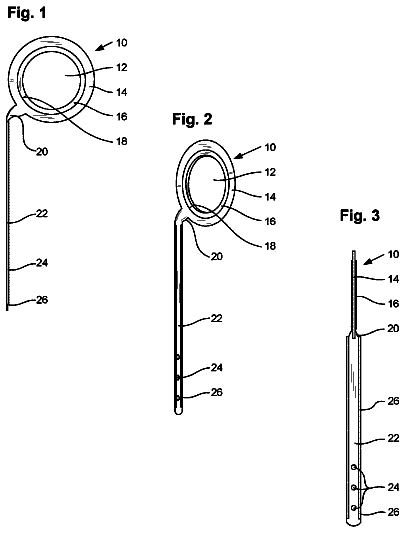
A bodily washing assembly for inhibiting cross contamination between patients in a medical environment includes a mitt that is selectively worn on a hand.
US 9,974,424 B2 · Assignee: The Procter & Gamble Company · Inventors: Roe; Donald Carroll et al.
Sheet 1 of 6 from the published document. All sheets in the USPTO PDF
A laminate cleaning implement with a facing sheet, a substrate, and optionally a backing sheet. The facing sheet, the substrate, and the optional backing sheet are mechanically intermeshed. The mechanically intermeshing can provide one or more discrete tufts protruding outwardly from the laminate.
Many cleaning products, including shampoo, body wash, dentifrice, and hard surface cleaners, are sold containing water. The water in the formula adds to the weight of the products and translates into greater shipping and storage costs. Additionally, these types of products also have disadvantages in terms of packaging, storage, transportation, and convenience of use. In order to use many cleaning products, the user must dispense the cleaning product from a bottle or other closed vessel onto the target surface, and then utilizing a sponge, towel, brush, or other implement distribute the product on the surface and, if desired, absorb any excess product, potentially with another implement or substrate. This practice is widely used, but is often inefficient. For instance, when a caregiver washes a pet she must wet the pet, open the shampoo, put shampoo on the pet, rub the shampoo into the pe
1 of 6 drawing sheets so far from the published document, cropped to the drawing. Every sheet is in the USPTO PDF.
What the patent claimed, word for word. All of it is now free to use.
The present invention is generally relates to a laminate cleaning implement, and more particularly to a multilayer laminate wherein at least one layer is a substrate.
Many cleaning products, including shampoo, body wash, dentifrice, and hard surface cleaners, are sold containing water. The water in the formula adds to the weight of the products and translates into greater shipping and storage costs. Additionally, these types of products also have disadvantages in terms of packaging, storage, transportation, and convenience of use.
In order to use many cleaning products, the user must dispense the cleaning product from a bottle or other closed vessel onto the target surface, and then utilizing a sponge, towel, brush, or other implement distribute the product on the surface and, if desired, absorb any excess product, potentially with another implement or substrate.
This practice is widely used, but is often inefficient. For instance, when a caregiver washes a pet she must wet the pet, open the shampoo, put shampoo on the pet, rub the shampoo into the pet's coat, and then rinse the pet. This process must be repeated multiple times to clean the entire pet and it can be particularly difficult to adequately clean the legs, abdomen, and buttocks of the animal. Furthermore, if the caregiver is using a bottled shampoo, she must repeatedly handle the shampoo container with wet, slippery, soapy hands to dispense shampoo. All of this must be done while keeping the pet in the washing area. Since washing a pet can be difficult, the user may rush and not thoroughly clean the pet.
It would be desirable to have a cleaning product combined with an implement to make cleaning more efficient. However, making these combination products can be cumbersome. For instance, some products have a cleaning product sprayed onto an outer surface of an assembled cleaning implement and a drying step is required before the cleaning product can be packaged. Other combination products have a cleaning composition residing within a cleaning implement, however, processing steps, such as adding texture to a surface of the cleaning implement, must be completed before the cleaning composition is combined with the other parts of the cleaning implement.
It would also be desirable for such a cleaning product to capture the removed soil from the animate and/or inanimate surfaces being cleaned.
Accordingly, there is a need for a laminate cleaning implement comprising a substrate that provides cleaning benefits, soil capture benefits, streamlines the cleaning process, and allows for a simplified manufacturing method. The cleaning implement can eliminate the need to carry and store cumbersome bottles, bars, jars, tubes, and other forms of clutter associated with cleaning products. Additionally, the cleaning implement can be designed to provide superior cleaning to the intended surface and soil removal from the intended surface. Furthermore, if the laminate cleaning implement is disposable it can be more sanitary than using a sponge, washcloth, or other cleaning implement intended for extensive reuse, because such implements can develop bacterial growth, unpleasant odors, and other undesirable characteristics related to repeated use.
A laminate cleaning implement comprising: (a) a facing sheet comprising a fibrous nonwoven; (b) a backing sheet; and (c) a substrate comprising an active agent wherein the substrate is disposed between the facing sheet and the backing sheet and wherein upon exposure to conditions of intended use the active agent is released; wherein the facing sheet, the substrate, and the backing sheet are mechanically intermeshed to provide one or more discrete tufts protruding outwardly from the laminate and wherein the tufts comprise a portion of the substrate.
A laminate cleaning implement comprising: (a) a facing sheet; (b) a backing sheet; and (c) a substrate comprising an active agent wherein the substrate is disposed between the facing sheet and the backing sheet wherein upon exposure to conditions of intended use the active agent is released; wherein the facing sheet, the substrate, and the backing sheet are mechanically intermeshed to provide one or more discrete tufts protruding outwardly from the laminate and wherein a portion of the substrate extends through the facing sheet at the tufts.
A laminate cleaning implement comprising: (a) a facing sheet; (b) a substrate comprising an active agent wherein upon exposure to conditions of intended use the active agent is released; and (c) optionally a backing sheet; wherein the facing sheet, the substrate, and optionally the backing sheet are mechanically intermeshed.
In still another example of the present invention, a laminate cleaning implement comprising (a) a facing sheet and (b) a substrate comprising an active agent wherein upon exposure to conditions of intended use the active agent is released, wherein the facing sheet and substrate are mechanically intermeshed, and optionally, wherein a composition, such as a composition comprising a soil capture agent, is present on the facing sheet, is provided.
While the specification concludes with claims particularly pointing out and distinctly claiming the subject matter of the present invention, it is believed that the invention can be more readily understood from the following description taken in connection with the accompanying drawings, in which:
FIG. 1 is a perspective view of a tufted laminate web suitable for use in a cleaning implement of the present invention;
FIG. 2 is an is an enlarged perspective view of a portion of the web shown in FIG. 1 ;
FIG. 3 is a perspective view of a tufted laminate web suitable for use in a cleaning implement of the present invention;
FIG. 4 is an is an enlarged perspective view of a portion of the web shown in FIG. 3 ;
FIG. 5 is a schematic representation of a top view of a portion of an indented web suitable for use in a cleaning implement of the present invention;
FIG. 6 is schematic representation of an enlarged cross-sectional view of section 6 - 6 of FIG. 5 ;
FIG. 7 is a perspective view of tufted and bonded laminate web suitable for use in a cleaning implement of the present invention;
FIG. 8 is an enlarged perspective view of a portion of the web shown in FIG. 9 ;
FIG. 9 is a top view of a tufted and bonded web suitable for use in a cleaning implement of the present invention;
FIG. 10 is an enlarged cross-sectional view of a portion of the web shown in FIG. 9 ; and
FIG. 11 is a perspective view of an apparatus for forming the web for use in the present invention.
The laminate cleaning implement can comprise a facing sheet, a backing sheet, and a substrate disposed between the facing sheet and the backing sheet that can be used to clean and/or capture soil from any surface, hard or soft. The substrate can comprise an active agent that can be used to clean any surface including hard surfaces (i.e., kitchen countertops, bath tubs, toilets, toilet bowls, sinks, floors, walls, teeth, cars, windows, mirrors, dishes), soft surfaces (i.e., fabric, hair including human hair and pet hair, skin, carpet, crops, plants), and combinations thereof. Soon after the cleaning implement is exposed to conditions of intended use, the substrate becomes dispersible and the active agent can be distributed across the surface to be cleaned or treated.
At least a portion of the facing sheet, the backing sheet, and the substrate can be mechanically intermeshed to form a coherent laminate cleaning implement. The mechanical intermeshing can be any process that combines the sheets with the substrate without using adhesive, bonding, or sewing. Non-limiting examples of mechanical intermeshing can include nested embossing, male/female embossing, and SELFing (a process for making a Structural Elastic Like Film).
The mechanical intermeshing can create textured portions on at least a portion of the surface of the facing sheet and backing sheet, which can include protrusions, depressions, apertures, embossing, debossing, and combinations thereof. The textured portion can improve the cleaning functionality of the implement as well as increase the surface area of the laminate cleaning implement, which can increase the rate the substrate becomes dispersible after being in contact with conditions of intended use.
In one example, the textured portions can be made by SELFing, which creates protrusions that extend outwardly from the facial sheet, referred to herein as tufts, on one side of the laminate cleaning implement and depressions, referred to herein as indentations, on the opposite side of the laminate cleaning implement. In another example, the tufts can comprise a portion of the substrate. In another example, the facing sheet ruptures during SELFing such that portions of the substrate extend through the facing sheet at the tufts.
Intermeshing the facing sheet, the backing sheet, and the substrate can help simplify manufacturing as well as improve performance of the cleaning implement. In one example, the substrate can be a solid before it is exposed to conditions of intended use. Combining a solid substrate with the facing and backing sheets can simplify manufacturing by eliminating the drying step. It can also be easier to control the three-dimensional structure of the textured portions, especially when compared to spraying a liquid over the sheets, which can enhance both the appearance and cleaning effectiveness of the implement. Finally, the substrate can comprise enough cleaning composition to clean a large area, if desired. This allows the laminate cleaning implement to have a wide variety of uses including cleaning large pets, cars, hard surfaces, or humans, with only one cleaning implement.
In order to use the laminate cleaning implement, the user exposes the cleaning implement to conditions of intended use. As used herein, “conditions of intended use” means the temperature, physical, chemical, and/or mechanical conditions that a substrate is exposed to when it is used as a cleaning implement.
The facing sheet can have a textured portion on the surface. The textured portion can increase the effective available surface area and therefore when the laminate is exposed to conditions of intended use, such as water or another aqueous solution, the water or solution can more quickly penetrate through the facing sheet and come into contact with the substrate.
In one example, the substrate can include an active agent. As used herein, “active agent” or “active” means an additive that produces an intended effect in an environment external to a substrate, such as when the substrate is exposed to conditions of intended use. In one example, an active agent treats a surface, such as a hard surface and/or a soft surface. In another example, an active agent creates a chemical reaction (i.e., foaming, fizzing, coloring, warming, cooling, lathering, disinfecting). In yet another example, an active agent treats an environment (i.e., deodorizes, adsorbs odor, purifies, perfumes air). In yet another example, the active agent binds a target substance, such as soil.
Active agents may be any suitable additive that produces an intended effect under intended use conditions of the substrate. For example, the active agent may be selected from the group consisting of: personal cleansing and/or conditioning agents such as hair care agents including shampoo agents, skin cleansing agents, hair conditioning agents, hair coloring agents, bleaching agents, skin care agents, surfactants, moisturizers, protectants, barrier materials, smoothing agents, lubricants, fabric care agents, fabric softening agents, fabric care stain removal agents, soil release agents, soil-capture or binding agents, dispersing agents, dishwashing agents (for hand dishwashing and/or automatic dishwashing machine applications), hard surface cleansing agents, bleaching agents, carpet care agents, make-up removal agents, deposition aids, perfumes, odor absorbing agents, tooth care agents that can comprise abrasives for humans and pets, ear care agents for humans and pets, and mixtures thereof.
One or more classes of chemicals may be useful for one or more of the active agents. For example, surfactants may be used for any number of the active agents. Likewise, bleaching agents may be used for fabric care, hard surface cleaning, dishwashing and even teeth whitening. Therefore, one of ordinary skill in the art will appreciate that the active agents will be selected based upon the desired intended use of the cleaning implement made therefrom.
In another example, a second active agent can be deposited on or incorporated into the facing sheet and/or the backing sheet.
As used herein, the term “aperture”, refers to a hole. The apertures can either be punched cleanly through the facing sheet, the backing sheet, and/or the substrate so that the material surrounding the aperture lies in the same plane as the facing sheet, backing sheet, or substrate prior to the formation of the aperture (a “two dimensional” aperture), or holes formed in which at least some of the material surrounding the opening is pushed out of the plane of the facing sheet, backing sheet, and/or substrate. In the latter case, the apertures may resemble a protrusion or depression with an aperture therein, and may be referred to herein as a “three dimensional” aperture, a subset of apertures. The apertures can be created by any suitable means including die cut holes, slitting and stretching the sheets and/or substrate, and combinations thereof. The laminate cleaning implement can comprise one or more sheets comprising apertures.
As used herein, the term “bicomponent fibers” refers to fibers which have been formed from at least two different polymers extruded from separate extruders but spun together to form one fiber. Bicomponent fibers are also sometimes referred to as conjugate fibers or multicomponent fibers. The polymers are arranged in substantially constantly positioned distinct zones across the cross-section of the bicomponent fibers and extend continuously along the length of the bicomponent fibers. The configuration of such a bicomponent fiber may be, for example, a sheath/core arrangement wherein one polymer is surrounded by another, or may be a side-by-side arrangement, a pie arrangement, or an “islands-in-the-sea” arrangement.
As used herein, the term “biconstituent fibers” refers to fibers which have been formed from at least two polymers extruded from the same extruder as a blend. Biconstituent fibers do not have the various polymer components arranged in relatively constantly positioned distinct zones across the cross-sectional area of the fiber and the various polymers are usually not continuous along the entire length of the fiber, instead usually forming fibrils which start and end at random. Biconstituent fibers are sometimes also referred to as multiconstituent fibers.
As used herein, “disposable” refers to an implement that is disposed or discarded after a limited number of usage events. In one example, the disposable implement is used five or fewer times, in another example three or fewer times, in another example two or fewer times, and in another example the disposable implement is used only one time.
As used herein, “g/use” refers to grams per use. This is the unit used for rate of consumption and the method for measuring and/or calculating it is described in the Consumption Rate Test herein.
As used herein, “glove” refers to a covering for the hand having separate sections for each finger.
As used herein, “indicia” provides information to a potential user or user of the systems, liquid medication (e.g. the active contained therein) and sachets. The indicia can comprise many forms and present the information in many ways and in many types of media. Non-limiting examples of types of indicia include alpha-numeric indicia, pictures, drawings, illustrations, photographs, computer-produced images, colors, sounds, textures, shapes, symbols, letters, numbers, and combinations thereof.
As used herein, “mitt” refers to a covering for the hand that is partially or wholly unseparated and that may include space for the thumb in the main enclosure or may provide space for the thumb in a separate enclosure for the thumb or may not include a thumb enclosure at all. This term is also applicable to an implement that covers only one or more digits of a user, such as in the case of a “finger mitt”.
While the terms “glove” and “mitt” have been defined with respect to the human hand, similar structures could be utilized to cover or enclose other elements of human anatomy, such as foot coverings, or other items for which coverings of a particular shape are preferred.
As used herein, “joined” refers to configurations in which a first element is directly secured to a second element. Joined also includes configurations in which the first element is indirectly secured to the second element.
As used herein, the term “meltblowing” refers to a process in which fibers are formed by extruding a molten thermoplastic material through a plurality of fine, usually circular, die capillaries as molten threads or filaments into converging high velocity, usually heated, gas (for example air) streams which attenuate the filaments of molten thermoplastic material to reduce their diameter, which may be to microfiber diameter. Thereafter, the meltblown fibers are carried by the high velocity gas stream and are deposited on a collecting surface, often while still tacky, to form a web of randomly dispersed meltblown fibers. Meltblown fibers are micro fibers which may be continuous or discontinuous and are generally smaller than 10 microns in average diameter.
As used herein, the term “monocomponent” fiber refers to a fiber formed from one or more extruders using only one polymer. This is not meant to exclude fibers formed from one polymer to which small amounts of additives have been added for coloration, antistatic properties, lubrication, hydrophilicity, etc. These additives, for example titanium dioxide for coloration, are generally present in an amount less than 5 weight percent and more typically 2 weight percent.
As used herein, the term “non-round fibers” describes fibers having a non-round cross-section, and includes “shaped fibers” and “capillary channel fibers.” Such fibers can be solid or hollow, and they can be tri-lobal, delta-shaped, and are preferably fibers having capillary channels on their outer surfaces. The capillary channels can be of various cross-sectional shapes such as “U-shaped”, “H-shaped”, “C-shaped” and “V-shaped”. One preferred capillary channel fiber is T-401, designated as 4DG fiber available from Fiber Innovation Technologies, Johnson City, Term. T-401 fiber is a polyethylene terephthalate (PET polyester).
As used herein, the term “nonwoven web” refers to a web having a structure of individual fibers or threads which are interlaid, but not in a repeating pattern as in a woven or knitted fabric, which do not have randomly oriented fibers. Nonwoven web or fabrics can be formed from many known processes, such as, for example, air laying processes, meltblowing processes, spunbonding processes, hydroentangling processes, spunlacing processes, and bonded carded web processes. Also, multi-layer webs, such as spunbond-meltblown-spunbond webs and the like made by multiple beam spunbond processes, can be used. Fibers can be bicomponent, multicomponent, multiconstituent, and the like, as known in the art. The basis weight of nonwoven fabrics is usually expressed in grams per square meter (gsm). The basis weight of the laminate web is the combined basis weight of the constituent layers and any other added components. Fiber diameters are usually expressed in microns; fiber size can also be expressed in denier, which is a unit of weight per length of fiber. The basis weight of laminate webs suitable for use in the present invention can range from 5 to 500 g/m.sup.2.
As used herein, “on-the-hand implement” refers to a covering for the hand or portion of the hand such as a finger, thumb, or palm.
As used herein, “pet” means dogs, cats, small mammals such as gerbils, hamsters, chinchillas, rats, rabbits, guinea pigs, and ferrets, and/or other domesticated animals.
As used herein, “permanently joined” refers to configurations in which a first element is secured to a second element such that the elements generally cannot be separated from one another without at least partially destroying one or both of the elements.
As used herein, the term “polymer” is used in its conventional meaning, and generally includes, but is not limited to, homopolymers, copolymers, such as for example, block, graft, random and alternating copolymers, terpolymers, etc., and blends and modifications thereof. In addition, unless otherwise specifically limited, the term “polymer” includes all possible geometric configurations of the material. The configurations include, but are not limited to, isotactic, atactic, syndiotactic, and random symmetries. In general, any of the known polymer types can be used, for example, polyolefinic polymers such as polypropylene or polyethylene can be used either as monocomponent fibers or bicomponent fibers. Other polymers such as PVA, PET polyesters, metallocene catalyst elastomers, nylon and blends thereof can be used. Any or all of the polymers can be cross-linked if desired.
As used herein, “releasably joined” refers to configurations in which a first element is secured to a second element, such that the first element and the second element can be separated with no or minimal damage to the first and second elements.
As used herein, “SELF” or “SELFing”, refer to Procter & Gamble technology in which SELF stands for Structural Elastic Like Film. While the process was originally developed for deforming polymer film to have beneficial structural characteristics, it has been found that the SELFing process can be used to produce beneficial structures in other materials, such as fibrous materials. Processes, apparatus, and patterns produced via SELF are illustrated and described in U.S. Pat. Nos. 5,518,801; 5,691,035; 5,723,087; 5,891,544; 5,916,663; 6,027,483; and, 7,527,615.
As used herein, “spunbond fibers” refers to small diameter fibers which are formed by extruding molten thermoplastic material as filaments from a plurality of fine, usually circular capillaries of a spinneret with the diameter of the extruded filaments then being rapidly reduced. Spunbond fibers are generally not tacky when they are deposited on a collecting surface. Spunbond fibers are generally continuous and have average diameters (from a sample of at least 10) larger than 7 microns, and more particularly, between about 10 and 40 microns.
As used herein, “tuft”, refers to a particular type of protrusion that may be formed in a nonwoven web. Tufts typically have a tunnel-like configuration, and in some cases may be open at one or both of their ends.
As used herein, “water-soluble material” means a material that is miscible in water with sufficient time and/or agitation. In other words, a material that is capable of forming a stable (does not separate for greater than 5 minutes after forming the homogeneous solution) homogeneous solution with water at ambient conditions.
As used herein, “usage event” refers to one three minute cycle of the Consumption Rate Test described herein.
As used herein, “ambient conditions” means 73° F.±4° F. (about 23° C.±2.2° C.) and a relative humidity of 50%±10%.
As used herein, the articles “a” and “an” when used herein, for example, “an anionic surfactant” or “a fiber” is understood to mean one or more of the material that is claimed or described.
The laminate cleaning implement can comprise any number of sheets. In one example, the laminate cleaning implement can comprise a facing sheet, a backing sheet, and a substrate disposed between the facing sheet and the backing sheet. After the cleaning implement is exposed to conditions of intended use, at least a portion of the substrate becomes dispersible and the substrate and/or active agent can be distributed across the surface to be cleaned or treated.
The facing sheet, the backing sheet, and the substrate comprising an active agent can be mechanically intermeshed to form a coherent laminate cleaning implement. In one example, the sheets are not mechanically deformed until they are intermeshed with the substrate to form a coherent laminate. After exposure to conditions of intended use, the substrate can release the active agent and the active agent can be dispersed across the surface to be cleaned. In one example, the condition of intended use is exposure to water. In another example, after exposure to conditions of intended use the substrate becomes a liquid or otherwise dispersible.
The mechanical intermeshing can create textured portions on at least a portion of a surface of the facing sheet and the backing sheet. The textured portion can include protrusions, depressions, apertures, embossing, debossing, and combinations thereof.
The textured portions can also assist in cleaning. For instance, the textured portions can provide additional abrasion which can be helpful in removing dirt and stains, especially tightly adhered stains, from a surface. The textured portions can also be customized depending on the desired use for the cleaning implement.
In one example, the cleaning implement can be used to clean a pet's coat and the textured portions can help penetrate the coat, which helps to disperse the substrate and any active agents throughout the coat as well as remove debris including hair and massage the pet's skin. In one example, the cleaning implement is a mitt or glove and the textured portions are on the portion of the glove that covers the user's fingers.
The textured portions can be randomly arranged or arranged in a repetitive pattern of some form on either side of the laminate cleaning implement. In one example, the textured portions are evenly distributed on the entire surface of the laminate. In another example, the textured portions are only located on a certain part of the cleaning implement, for instance portion(s) that are involved in scrubbing and/or the portion(s) of the cleaning implement that comprises the substrate.
In one example, the textured portions can be made by SELFing. SELFing creates protrusions, referred to herein as tufts. In one example, the tufts can protrude outwardly from the facing sheet or backing sheet and can comprise a portion of the substrate. The tufts can comprise loops the loops can be complete loops and/or the loops can partially extend and then break to form loose ends.
In another example, the tufts can protrude outwardly from the facing sheet and the facing sheet ruptures such that portions of the substrate extend through the facing sheet at the tufts. Whether or not the facing sheet ruptures depends on the ability of the facing sheet to extend and permanently deform during the mechanical deformation process. The facing sheet can break to form a volcano-like structure, may partially extend and then break on one side of the loop to form a flap, or may break without much extension forming an aperture.
In one example, the textured portion can comprise protrusions. The protrusions can be from about 1 mm to about 10 mm tall, in another example from about 2 mm to about 8 mm tall, in another example from about 3 mm to about 7 mm tall, and in another example about 4 mm to about 6 mm tall.
In another example, one sheet, for instance the backing sheet, is water impermeable. In another example, the laminate cleaning implement further comprises a water impermeable substrate. The water impermeable substrate and/or water impermeable sheet can prevent the user's hand from getting wet and/or coming into contact with the cleaning composition during use. In one example, the water impermeable substrate and/or water impermeable sheet is adapted to be held by the user during cleaning. In another example, the impermeable substrate or impermeable sheet can be used to distribute the cleaning composition across the surface to be cleaned.
In another example, the laminate cleaning implement further comprises a rigid backing layer that can provide additional stiffness to the cleaning implement, which can make it easier to use.
The facing sheet and backing sheet can be any suitable material and the material can be selected based on the surface to be cleaned. For instance, if the laminate cleaning implement is intended to be used to clean something delicate or sensitive, such as human skin, then a material that feels softer can be selected for the sheet. However, if the cleaning implement is intended to be used to clean a more robust surface, then a material that feels stiffer or rougher can be selected. The softness or stiffness of the sheets can be changed depending on the basis weight of the constituent material, the size of the denier fibers, and the strength or stiffness of the constituent material.
In certain examples, the sheets can be nonwovens (i.e. a natural or synthetic nonwovens including fibrous and nonfibrous nonwovens), wovens, films (e.g. a formed film), sponges (e.g. a natural or synthetic sponge), polymeric netted meshes (i.e. a “scrim”), batting, spunbond, spunlace, hydroentangled, carded, needlepunch, or any other suitable material. In one example, the sheets can be fibrous nonwovens. In another example, one or both sheets are water-stable but water permeable.
In one example, the backing sheet is the same as the facing sheet. In another example, the backing sheet is a different material than the facing sheet. For example, the backing sheet can be stiffer than the facing sheet thereby making the laminate cleaning implement more rigid. In another example, each side of the cleaning implement can be used for a different purpose. For instance, the first side comprising the facing sheet can be used for a first purpose, such as distributing a first active agent, such as a shampoo, soap, body wash, or dish cleaner, across the surface to be cleaned and the second side comprising the backing sheet can be used for a second purpose, such as drying the surface and/or spread a second active agent, such as a conditioner or drying agent, across the surface.
The substrate can be any composition that can comprise an active agent, can become dispersible upon conditions of intended use, and can be subjected to a mechanical deformation process. Non-limiting examples of substrates can include open cell foams, as described herein and in U.S. Pat. No. 8,268,764 and U.S. patent application Ser. No. 12/361,634, now U.S. Pat. No. 8,765,170; Ser. No. 12/633,415, now U.S. Pat. No. 8,415,287; and Ser. No. 13/440,475, abandoned Dec. 16, 2015; dissolvable filament substrates, as described herein and in U.S. patent application Ser. No. 13/229,791, Publication No. 2012/0052036 A1; Ser. No. 13/229,818, Publication No. 2012/0027838 A1; and Ser. No. 13/229,845, now U.S. Pat. No. 9,175,250; compliant doughs, as described herein and in U.S. Pat. No. 6,491,928 and U.S. patent application Ser. No. 13/438,918, now U.S. Pat. No. 9,592,181; films, fibers including nonwoven fibers, webs including nonwoven webs, closed cell foams, pastes, particles, flakes, powders, and combinations thereof. Alternatively, the substrate may comprise a composition deposited onto a web or other surface via an aqueous composition and subsequently dried to localize it on the web.
The laminate cleaning implement can have a rate of consumption. This is a measure of how much of the substrate is used during a usage event. If the consumption rate is too low, then cleaning can be difficult due to reduced access to the substrate and the active agents. However, if the consumption rate is too high, then the substrate and active agents can be released too quickly and the laminate cleaning composition can run out of substrate and/or active agent before the entire surface is cleaned. The consumption rate can vary based on the properties of the substrate and the sheets.
In one example, the laminate will have a consumption rate of about 3 g/use to about 30 g/use, in another example from about 6 g/use to about 25 g/use, and in another example from about 10 g/use to about 20 g/use as determined by the Consumption Rate Test described herein. In alternate examples, the laminate cleaning implement will have a consumption rate of about 0.5 g/use to about 15 g/use, in another example from about 1.5 g/use to about 10 g/use, and in another example from about 3.5 g/use to about 6.5 g/use as determined by the Consumption Rate Test described herein.
In one example, the laminate cleaning implement can further comprise an attachment means to attach or releasably attach the laminate cleaning implement to another article. Non-limiting examples of attachment means can include hook and loop fasteners such as Velcro®, buttons, fasteners, snaps, magnets, clips, adhesives, refastenable adhesives, and combinations thereof. The article can be a cleaning implement such as a broom, vacuum, sweeper, sponge, or toilet bowl cleaner. In one example, the attachment means is attached to or releasably attached to the backing sheet.
In another example, the laminate cleaning implement can be made into, affixed to, or releasably attached to, a glove, mitt, or other on-the-hand implement. In one example, the on-the-hand implement can be adapted so it is ambidextrous. In one example, the on-the hand implement comprises a water impermeable substrate or water impermeable sheet that is adapted to be in contact with the user's hand during use. The on-the-hand implement comprises a slip resistant substrate or slip resistant sheet, thereby preventing the on-the-hand implement from twisting or slipping during use. In one example the water impermeable substrate or water impermeable sheet is slip resistant.
In another example, the on-the-hand implement only covers the palm of the user's hand, and does not cover the user's fingers or back of the user's hand. This cleaning implement can be attached to the user's hand by one or more suitable attachment means including but not limited to an elastic or Velcro® strap.
In another example, the on-the-hand implement can be a mitt or glove and can comprise a grasping means. The grasping means can be a loop, hook, or tab. The grasping means can be attached to any portion of the on-the-hand implement. In one example, the grasping means can be attached to an interior portion of the on-the-hand implement and in another example the grasping means can be attached to an exterior portion and in another example the grasping means is attached to an exterior portion near a user's wrist. In another example, the grasping means can be formed by bonding the facing sheet to the backing sheet to provide a full or partial pocket, loop or hook, for one or more fingers of the user. The grasping means can also be attached to the water impermeable sheet or substrate. The grasping means can help a user turn the cleaning implement inside out as she takes it off her hand.
In another example, the on-the-hand implement comprises an adjustment means which can be any suitable means for permitting the on-the-hand implement to snugly accommodate different hand sizes. Suitable adjustment means, include but are not limited to, include, hook and loop fasteners such as Velcro® and the like, elastic members, elastic strands, strings including draw strings, gussets, cinches, buttons, fasteners, tabs, tongue and grove fasteners such as Zip-Lock® type fasteners, resealable tape, belts, clips, adhesives, such as refastenable adhesives, and combinations thereof.
In another example, the laminate cleaning implement can comprise a usage indicator. In one example, the usage indicator lets the user know when the laminate cleaning implement runs out of the substrate. The usage indicator can be a separate feature or it can be part of the substrate, or it may be a part of a graphic. Other suitable usage indicators can include, but are not limited to, pH (e.g., at a specific pH or pH range a noticeable event occurs such as color change, noise generation or cessation and the like and combinations thereof), temperature (e.g., the implement may feel warm or cold for its intended use and then revert to ambient temperature, or change temperature form ambient after a period of time), time (e.g., the indicator may change size shape, color etc. after a time period since it was exposed to water air, oxygen, shear or other force and the like), and the like and combinations thereof. In one example, the usage indicator can be a color that is associated with the substrate and the color changes or dissipates as the cleaning implement is used.
The facing sheet and/or backing sheet can comprise indicia. The indicia can be in the form of logos, trademarks, geometric patterns, images of the surfaces that the implement is intended to clean, instructions on how to use the cleaning implement including the function or purpose of one or both sides of the implement, other indicia, or combinations thereof.
The cleaning implement can be disposable. In one example, the cleaning implement is intended to be used only once before it is disposed of and contains enough substrate and active agent for one use. In another example, the cleaning implement can be adapted for multiple uses.
The cleaning implement can be packaged in a secondary container. In one example, the cleaning implement does not have to be individually wrapped and multiple cleaning implements can be packaged together in one secondary package. The secondary package can be any suitable package. Non-limiting examples can include a box, bag, and plastic and/or cellophane packaging.
In another example, the cleaning implement does not comprise a substrate. In another example, a liquid cleaning solution can be sprayed or poured onto the cleaning implement. This can be useful for spot-cleaning and/or in-between cleaning and can be sold in combination with a laminate cleaning implement comprising a substrate as a cleaning system. In one example, the two cleaning implements are co-packaged and in another example the two products are placed adjacent to or near each other in the store. In one example, a cleaning implement comprising a substrate can be used to bathe a pet and can be used in combination with an in-between cleaning implement that is an on-the-hand implement that does not comprise a substrate. The in-between implement can be sprayed with a liquid cleaning composition prior to use. The in-between implement can be used to spot clean areas like a pet's muzzle or paws or can be used to quickly refresh the entire pet. The in-between mitt can be used on a pet as needed, while the cleaning implement is intended to be used intermittently, for example once every two weeks.
The following examples are intended for illustrative purposes only and are not intended to limit the invention. Furthermore, the examples can be combined and duplicated to make more complex laminate cleaning implements, in particular cleaning implements with more than one substrate.
FIG. 1 shows a tufted laminate web 1 suitable for use in a laminate cleaning implement of the present invention, hereinafter referred to simply as web 1 . Web 1 can be made by SELFing, as described herein. Web 1 comprises three layers. The layers are referred to herein as generally planar, two-dimensional sheets, such as backing sheet 20 and facing sheet 21 , and a generally planar, substrate 22 . As disclosed below, the sheets and substrate of web 1 can be joined by interlocking mechanical engagement resulting from the formation of tufts 6 .
The description continues in the full USPTO document.
About 6,369 words. The USPTO PDF has it with every drawing.
Fees are due 3.5, 7.5 and 11.5 years after grant. This patent expired on May 22, 2026, so the fee marked "not paid" was the one that went unpaid.
LAMINATE CLEANING IMPLEMENT
Filed Jun 2014 · published Dec 2014Laminate cleaning implement
Filed Jun 2014 · granted May 2018Earlier publications, parents and continuations. None of them can still be enforced, or this patent would not be listed.
Prior art cited by the examiner or applicant. Useful when you check your own idea for novelty.
Everything on this page comes from the documents linked above.