 Lapsed, fee not paid2 drawings
Biotech & Lab · US 9,970,918 B2
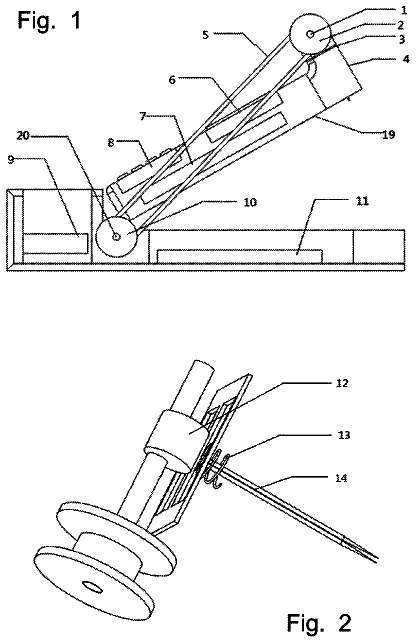
Portable device for detecting nutrition level of plant
A portable device for detecting the nutrition level of a plant includes an outer casing and a detection circuit.
US 9,970,928 B2 · Inventors: Bovin; Nicolai Vladimirovich et al.
Sheet 1 of 15 from the published document. All sheets in the USPTO PDF
Method of localizing a functional moiety (F) to at least one discrete area on a surface of a substrate, by propelling droplets of an aqueous dispersion of a synthetic construct of the structure F-S-L from a plurality of orifices located in a print head of an inkjet printer onto the surface. In the structure F-S-L, S is a spacer selected to provide a construct that is dispersible in water at a temperature of 25° C. in the absence of organic solvents or detergents, L is a diacyl- or dialkyl lipid and the at least one discrete area is in the shape of a symbol readable by optical character recognition (OCR) apparatus or a pattern having a combination of indicia in which the synthetic construct is present at different densities.
Glycomics has emerged with proteomics as an area for development and exploration in the postgenomics era (Blixt et al (2004)). Despite the increasing awareness of the biological significance of carbohydrates, the study of carbohydrate-protein interactions still encounters much difficulty. There is a need for the development of highly sensitive and high-throughput methods for identification and binding study of carbohydrates recognized by various receptors (Chung-Yi et al (2009)). The immobilization of glycans on the derivatised surface of substrates is a commonly employed method of fabricating glycan microarrays. Blixt et al discloses immobilisation of amine functionalised synthetic glycan ligands on N-hydroxysuccinimide (NHS) activated glass slides using a custom made robotic printing arrayer. Bovin and Huflejt have reviewed the use of binding chemistries exploiting amide bond formation
8 of 15 drawing sheets so far from the published document, cropped to the drawing. Every sheet is in the USPTO PDF.
What the patent claimed, word for word. All of it is now free to use.
This application is the U.S. national phase of International Application No. PCT/NZ2010/000127 filed 29 Jun. 2010 which designated the U.S. and claims priority to NZ 578036 filed 29 Jun. 2009, NZ 578338 filed 10 Jul. 2009, NZ 581481 filed 26 Nov. 2009, NZ 583516 filed 23 Feb. 2010 and NZ 586448 filed 25 Jun. 2010, the entire contents of each of which are hereby incorporated by reference.
The invention relates to a method of printing constructs of the generic structure F-S-L (where F is a functional moiety, S is a spacer covalently linking F to L, and L is a lipid).
In particular, the invention relates to the use of the method in the fabrication of diagnostic test cards and sticks, microarrays and multiwell plates.
Glycomics has emerged with proteomics as an area for development and exploration in the postgenomics era (Blixt et al (2004)). Despite the increasing awareness of the biological significance of carbohydrates, the study of carbohydrate-protein interactions still encounters much difficulty. There is a need for the development of highly sensitive and high-throughput methods for identification and binding study of carbohydrates recognized by various receptors (Chung-Yi et al (2009)).
The immobilization of glycans on the derivatised surface of substrates is a commonly employed method of fabricating glycan microarrays. Blixt et al
discloses immobilisation of amine functionalised synthetic glycan ligands on N-hydroxysuccinimide (NHS) activated glass slides using a custom made robotic printing arrayer. Bovin and Huflejt
have reviewed the use of binding chemistries exploiting amide bond formation. Short spacers are used to reduce non-specific contacts to a minimum. Attachment to a flexible layer of polyethylene glycol on a glass surface is presented as assuring availability of glycan moieties for interaction with binding molecules.
The localization of glycans to the surface of substrates in the form of neoglycolipids has also been employed as a method of fabricating glycan microarrays. Chai et al
describe a multiwell-binding assay in which neoglycolipids are diluted either in methanol, or in methanol containing the carrier lipids egg lecithin and cholesterol. The dispersions of neoglycolipids are then used to coat the wells of the multiwell plates. Chai et al
describe the bandwise application of the dispersions of neoglycolipids by a spray-on technique employing a sample applicator comprising a single syringe as applicator (LINOMAT IV, Camag, Switzerland)
Fukui et al
and Huang et al (2006a, 2006b) have each described a non-covalent glycoarray assembly method utilising lipid-linked saccharides and oligosaccharides. Both methods employ reductive amination to produce a lipid-linked saccharide of oligosaccharide (neoglycolipid). In the method of Fukui et al
oligosaccharides were conjugated to 1,2-dihexadecyl-sn-glycero-3-phosphoethanolamine (DHPE) directly or after mild periodate oxidation. The neoglycolipids were then applied by jet spray as bands or spots onto nitrocellulose membranes. In the method of Huang et al (2006a, 2006b) the reaction to produce lipid-linked saccharides uses an excess of saccharides in order to exhaust the tetradecylamine employed in the reaction. The lipid-linked saccharides were then applied to multi-well high binding polystyrene plates.
Liu et al
describe the preparation of neoglycolipids from N-aminooxyacetal DHPE (AOPE) by a chemoselective oxime-ligation reaction with reducing sugars. The binding of the neoglycolipids by antibodies and lectins was assayed by an enzyme-linked immunosorbent assay (ELISA) in plastic microwells as described by Chai et al (2003). In these studies the neoglycolipids were incorporated into liposomes for arraying and spotted onto nitrocellulose membranes or robotically arrayed onto nitrocellulose-coated glass slides.
Palma et al
and Campanero-Rhodes et al
describe the preparation of arrays of natural and synthetic glycolipids and neoglycoplipids by printing on nitrocellulose-coated glass slides using a non-contact piezoelectric arrayer (PIEZORRAY, Perkin-Elmer, United Kingdom). Liu et al
also describes the use of this non-contact piezoelectric arrayer. The arrayer employs an assembly containing four PIEZOTIP™ dispensers to dispense sub-nanoliter to nanoliter volumes with 20 to 25 μm accuracy and precision.
It is an object of the invention to provide an improved method for the localisation of functional moieties, including glycans, to the surface of substrates.
It is an object of the invention to provide a method of fabricating diagnostic test cards and sticks, microarrays and multiwell plates.
It is an object of the invention to provide templates for use in the fabrication of diagnostic test cards and sticks, microarrays and multiwell plates microarray formats by the method that improve accuracy and reliability of assay results.
These objects are each to be read disjunctively with the object to at least provide the public with a useful choice.
In a first aspect the invention provides a method of localising a functional moiety (F) to at least one discrete area on a surface of a substrate including the step of: Propelling droplets of a dispersion of a synthetic construct of the structure F-S-L from a plurality of orifices onto the surface of the substrate; where: S is a spacer; and L is a lipid.
Preferably, F is biotin, a glycan or a peptide.
In a first preferment of the first aspect of the invention, the at least one discrete area is in the shape of a symbol. More preferably, the at least one discrete area is in the shape of a symbol readable by optical character recognition (OCR) apparatus.
Most preferably, the at least one discrete area is in the shape of a symbol comprising one or more alphanumeric characters. In a second preferment of the first aspect of the invention, the at least one discrete area is a pattern comprising a combination of indicia in which the dispersion of a synthetic construct is present at different densities (amount per unit area). The first and second preferments of this aspect of the invention are not mutually exclusive.
Preferably, the substrate is selected from the group consisting of: derivatised silica gel (e.g. C.sub.8 or C.sub.18), nitrocellulose, coated paper, silica gel or uncoated paper. More preferably, the substrate is selected from the group consisting of: coated paper or uncoated paper.
Preferably, the method is a non-impact method of printing. More preferably, the propelling droplets from a plurality of orifices is from a plurality of orifices located in a monolithic print head. Yet more preferably, the propelling droplets from a plurality of orifices is from a plurality of orifices located in a monolithic print head of an inkjet printer. Most preferably, the propelling droplets from a plurality of orifices is from a plurality of orifices located in a monolithic print head of a piezoelectric inkjet printer.
Preferably, the volume of each of the droplets is 1 to 100 picoliters (pL). More preferably, the volume of each of the droplets is 1 to 50 pL. Most preferably, the volume of each of the droplets is 1 to 5 pL.
Preferably, the concentration of the synthetic construct in the dispersion is 1 μmolar (μM) to 10 mmolar (mM). More preferably, the concentration of the synthetic construct in the dispersion is 10 μM to 10 mM. Most preferably, the concentration of the synthetic construct in the dispersion is 0.1 to 10 mM.
Preferably, the spacer (S) is selected to provide a construct that is dispersible in water in the absence of organic solvents or detergents at a temperature of 25° C. More, preferably, the synthetic construct of the structure F-S-L is dispersible in water in the absence of organic solvents or detergents at a temperature of 25° C. at a concentration of at least 6 millimolar (mM). More preferably, the synthetic construct of the structure F-S-L is dispersible in water in the absence of organic solvents or detergents at a temperature of 25° C. at a concentration of at least 12 millimolar (mM).
Preferably, L is a diacyl- or dialkyl lipid. More preferably, L is a glycerophospholipid. Yet more preferably, L is a phosphatidylethanolamine. Most preferably, L is selected from the group consisting of: 1,2-O-dioleoyl-sn-glycero-3-phosphatidylethanolamine (DOPE) and 1,2-O-distearyl-sn-glycero-3-phosphatidylethanolamine (DSPE).
In a first preferment of the first aspect of the invention F is a glycan. Preferably, F is a glycan that is an oligosaccharide. More preferably, F is a glycan that is an oligosaccharide selected from the group consisting of: GalNAcα3(Fucα2)Galβ-; Galα3(Fucα2)Galβ-; GalNα3(Fucα2)Galβ-; Fucα2Galβ-; Galβ4GlcNAβ3(Galβ4GlcNAβ6)Galβ-; Galβ4GlcNAcβ3-; Galβ4Glcβ-; Galβ3GlcNAcβ-; Galβ3(Fucα4)GlcNAβ-; Fucα2Galβ3(Fucα4)GlcNAcβ-; GalNAcα3(Fucα2)Galβ3(Fucα4)GlcNAcβ-; Galα3(Fucα2)Galβ3(Fucα4)GlcNAcβ-; Galβ4(Fucα3)GlcNAcβ-; Fucα2Galβ4(Fucα3)GlcNAcβ-; NeuAcα2-3Galβ3(Fucα4)GlcNAcβ-; NeuAcα2-3Galβ4(Fucα3)GlcNAcβ-; GalNAβ4(NeuAcα2-3)Galβ4-; Galβ3GalNAcα-; NeuAcα2-3Galβ4-; NeuAcα2-6Galβ4-; Galα4Galβ4-; GalNAcβ3Galα4Galβ4-; Galα4Galβ4GlcNAβ3-; Galβ3GalNAcβ3Galα4-; NeuAcα2-3Galβ3GalNAcβ3Galα4-; Galα3Galβ-; GalNAcα3GalNAcβ3Galα4-; GalNAcβ3GalNAcβ3Galα4-; Galβ1-4GlcNAc; Galβ1-3GlcNAc; SAα2-6Galβ1-4Glc; SAα2-3Galβ1-4Glc; SAα2-6Galβ1-4GlcNAc; SAα2-3Galβ1-4GlcNAc; SAα2-3Galβ1-3GlcNAc; Galβ1-4(Fucα1-3)GlcNAc; Galβ1-3(Fucα1-3)GlcNAc; SAα2-3Galβ1-3(Fucα1-4)GlcNAc; SAα2-3Galβ1-4(Fucα1-3)GlcNAc; Galβ1-4GlcNAcβ1-4GlcNAc; Galβ1-3GlcNAcβ1-4GlcNAc; SAα2-6Galβ1-4GlcNAβ1-4GlcNAc; SAα2-3Galβ1-4GlcNAβ1-4GlcNAc; SAα2-3Galβ1-3GlcNAβ1-4GlcNAc; Galβ1-4(Fucα1-3)GlcNAβ1-4GlcNAc; Galβ1-3(Fucα1-4)GlcNAβ1-4GlcNAc; SAα2-3Galβ1-3(Fucα1-4)GlcNAβ1-4GlcNAc; SAα2-3Galβ1-4(Fucα1-3)GlcNAcβ1-4GlcNAc; SAα2-3Galβ1-3(Fucα1-4)GlcNAβ1-4Gal; SAα2-3Galβ1-4(Fucα1-3)GlcNAβ1-4Gal; SAα2-3Galβ1-4GlcNAβ1-3Galβ1-4(Fucα1-3)GlcNAc; SAα2-6Galβ1-4GlcNAβ1-3Galβ1-4(Fucα1-3)GlcNAc; SAα2-3Galβ1-4(Fucα1-3)GlcNAβ1-3Galβ1-4Glc; SAα2-6Galβ1-4(Fucα1-3)GlcNAβ1-3Galβ1-4Glc; SAα2-3Galβ1-4GlcNAβ1-3Galβ1-4(Fucα1-3)GlcNAβ1-3Galβ1-4Glc; SAα2-6Galβ1-4GlcNAβ1-3Galβ1-4(Fucα1-3)GlcNAβ1-3Galβ1-4Glc; SAα2-3Galβ1-4(Fucα1-3)GlcNAβ1-3Galβ1-4(Fucα1-3)GlcNAβ1-3Galβ1-4Glc; SAα2-6Galβ1-4(Fucα1-3)GlcNAβ1-3Galβ1-4(Fucα1-3)GlcNAβ1-3Galβ1-4Glc; SAα2-3Galβ1-4(Fucα1-3)GlcNAβ1-3Galβ1-4(Fucα1-3)Glc; SAα2-6Galβ1-4(Fucα1-3)GlcNAβ1-3Galβ1-4(Fucα1-3)Glc; SAα2-3Galβ1-4GlcNAβ1-3Galβ1-4(Fucα1-3)GlcNAβ1-3Galβ1-4(Fucα1-3)Glc; SAα2-6Galβ1-4GlcNAβ1-3Galβ1-4(Fucα1-3)GlcNAβ1-3Galβ1-4(Fucα1-3)Glc; SAα2-3Galβ1-4(Fucα1-3)GlcNAβ1-3Galβ1-4(Fucα1-3)GlcNAβ1-3Galβ1-4(Fucα1-3)Glc; SAα2-6Galβ1-4(Fucα1-3)GlcNAβ1-3Galβ1-4(Fucα1-3)GlcNAβ1-3Galβ1-4(Fucα1-3)Glc; SAα2-3Galβ1-3(Fucα1-4)GlcNAc; SAα2-6Galβ1-3(Fucα1-4(GlcNAc; SAα2-3Galβ1-3GlcNAβ1-4Galβ1-4(Fucα1-3)GlcNAc; SAα2-6Galβ1-3GlcNAβ1-4Galβ1-4(Fucα1-3)GlcNAc; SAα2-3Galβ1-3(Fucα1-4)GlcNAβ1-3Galβ1-4(Fucα1-3)GlcNAc; SAα2-6Galβ1-3(Fucα1-4)GlcNAβ1-3Galβ1-4(Fucα1-3)GlcNAc; SAα2-3Galβ1-3(Fucα1-4)GlcNAβ1-3Galβ1-4Glc; SAα2-6Galβ1-3(Fucα1-4)GlcNAβ1-3Galβ1-4Glc; SAα2-3Galβ1-3GlcNAβ1-4Galβ1-4(Fucα1-3)GlcNAβ1-3Galβ1-4Glc; SAα2-6Galβ1-3GlcNAβ1-4Galβ1-4(Fucα1-3)GlcNAβ11-3Galβ1-4Glc; SAβ2-3Galβ1-3(Fucα1-4)GlcNAβ1-3Galβ1-4(Fucα1-3)GlcNAβ1-3Galβ1-4Glc; SAα2-6Galβ1-3(Fucα1-4)GlcNAβ1-3Galβ1-4(Fucα1-3)GlcNAβ1-3Galβ1-4Glc; SAα2-3Galβ1-3(Fucα1-4)GlcNAβ1-3Galβ1-4(Fucα1-3)Glc; SAα2-6Galβ1-3(Fucα1-4)GlcNAβ1-3Galβ1-4(Fucα1-3)Glc; SAα2-3Galβ1-3GlcNAβ1-4Galβ1-4(Fucα1-3)GlcNAβ1-3Galβ1-4(Fucα1-3)Glc; SAα2-6Galβ1-3GlcNAβ1-4Galβ1-4(Fucα1-3)GlcNAβ1-3Galβ1-4(Fucα1-3)Glc; SAα2-3Galβ1-3(Fucα1-4)GlcNAβ1-3Galβ1-4(Fucα1-3)GlcNAβ1-3Galβ1-4(Fucα1-3) Glc; SAα2-6Galβ1-3(Fucα1-4)GlcNAβ1-3Galβ1-4(Fucα1-3)GlcNAβ1-3Galβ1-4(Fucα1-3)Glc; SAα2-3Galβ1-4GlcNAβ1-3Galβ1-3(Fucα1-4)GlcNAc; SAα2-6Galβ1-4GlcNAβ1-3Galβ1-3(Fucα1-4)GlcNAc; SAα2-3Galβ1-4(Fucα1-3)GlcNAβ1-3Galβ1-3(Fucα1-4)GlcNAc; SAα2-6Galβ1-4(Fucα1-3)GlcNAβ1-3Galβ1-3(Fucα1-4)GlcNAc; SAα2-3Galβ1-4GlcNAβ1-3Galβ1-3(Fucα1-4)GlcNAβ1-3Galβ1-4Glc; SAα2-6Galβ1-4GlcNAβ1-3Galβ1-3(Fucα1-4)GlcNAβ1-3Galβ1-4Glc; SAα2-3Galβ1-4(Fucα1-3)GlcNAβ1-3Galβ1-3(Fucα1-4)GlcNAβ1-3Galβ1-4Glc; SAα2-6Galβ1-4(Fucα1-3)GlcNAβ1-3Galβ1-3(Fucα1-4)GlcNAcβ1-3Galβ1-4Glc; SAα2-3Galβ1-4(Fucα1-3)GlcNAβ1-3Galβ1-3(Fucα1-4)Glc; SAα2-6Galβ1-4(Fucα1-3)GlcNAβ1-3Galβ1-3(Fucα1-4)Glc; SAα2-3Galβ1-4GlcNAβ1-3Galβ1-3(Fucα1-4)GlcNAcβ1-3Galβ1-4(Fucα1-3)Glc; SAα2-6Galβ1-4GlcNAcβ1-3Galβ1-3(Fucα1-4)GlcNAcβ1-3Galβ1-4(Fucα1-3)Glc; SAα2-3Galβ1-4(Fucα1-3)GlcNAβ1-3Galβ1-3(Fucα1-4)GlcNAβ1-3Galβ1-4(Fucα1-3)Glc; and SAα2-6Galβ1-4(Fucα1-3)GlcNAβ1-3Galβ1-3(Fucα1-4)GlcNAβ1-3Galβ1-4(Fucα1-3)Glc, where SA is sialic acid.
In a second preferment of the first aspect of the invention F is a peptide. More preferably, F is a peptide that is an oligopeptide. Most preferably, F is a peptide selected from the group listed in the Table of Peptides.
In a third preferment of the first aspect of the invention F is a conjugator. More preferably, F is a conjugator that is biotin. When F is a conjugator that is biotin, the biotin may or may not be conjugated to an avidinylated functional moiety.
Preferably, the method includes the step of coating the surface of the substrate with a polymer after the propelling of the droplets of the dispersion of the synthetic construct of the structure F-S-L onto the surface of the substrate. More preferably, the method includes the step of coating the surface of the substrate with isobutyl methacrylate polymer after the propelling of the droplets of the dispersion of the synthetic construct of the structure F-S-L.
Preferably, when F is a glycan, S is selected from the group consisting of:
##STR00001## where: a and b are independently the integer 3, 4 or 5; and R.sub.1 and R.sub.2 are, respectively, O of the glycan and N of the primary amino of a diacyl or dialkyl-glycerophospholipid or N of the primary amino of a diacyl or dialkyl-glycerophospholipid and O of the glycan, or
##STR00002## where: M is CH.sub.3 or H; c is the integer 3, 4 or 5; d and e are independently the integer 1 or 2; f is the integer 2, 3 or 4; R.sub.3 is N of the primary amino of a diacyl or dialkyl-glycerophospholipid; and R.sub.4 is O of the glycan.
Preferably, when F is a peptide, S is selected from the group consisting of:
##STR00003## where: M is CH.sub.3 or H; c is the integer 3, 4 or 5; d and e are independently the integer 1 or 2; R.sub.5 is N of the primary amino of a diacyl or dialkyl-glycerophospholipid; and R.sub.6 is S of the sulfhydryl of an amino acid residue of the peptide,
##STR00004## where: g is a value in the range 6 to 14; R.sub.7 and R.sub.8 are, respectively, N of the amino terminus of the peptide and N of the primary amino of a diacyl or dialkyl-glycerophospholipid or N of the primary amino of a diacyl or dialkyl-glycerophospholipid and N of the amino terminus of the peptide, or
##STR00005## where: g is a value in the range 6 to 14; h is the integer 1 or 2; R.sub.9 is N of the primary amino of a diacyl or dialkyl-glycerophospholipid; and R.sub.10 is S of the sulfhydryl of an amino acid residue of the peptide, or or
##STR00006## g is a value in the range 6 to 14; R.sub.11 and R.sub.12 are, respectively, N of the amino terminus of the peptide and N of the primary amino of a diacyl or dialkyl-glycerophospholipid or N of the primary amino of a diacyl or dialkyl-glycerophospholipid and N of the amino, terminus of the peptide. [followed by page 11]
Preferably, when F is a conjugator that is biotin, F-S is selected from the group consisting of:
##STR00007## where: M is CH.sub.3 or H; c is the integer 3, 4 or 5; d and e are independently the integer 1 or 2; and R.sub.13 is N of the primary amino of a diacyl or dialkyl-glycerophospholipid.
F may or may not include an avidinylated functional moiety.
In a second aspect the invention provides a diagnostic test card or stick, microarray or multiwell plate fabricated using the method of the first aspect of the invention.
In the description and claims of this specification the following acronyms, terms and phrases have the meaning provided:
“Belt” means, with reference to inkjet printing, the means of attachment between the printhead and stepper motor.
“Control Circuitry” means, with reference to inkjet printing, that part of the printer that controls the mechanical aspects of operation of the printer.
“Dispersible in water” means a stable, single phase system is formed when the synthetic construct is contacted with water.
“Glycan” means a polysaccharide or oligosaccharide and includes the carbohydrate portion of a glycoconjugate, such as a glycoprotein, glycolipid, or a proteoglycan.
“Immobilised” means covalently bound to a surface and “immobilising” and “immobilisation” have a corresponding meaning.
“Impact” means, with reference to printing on the surface of a substrate, a method of printing where in image is created by a printer mechanism contacting the surface, e.g. character and dot matrix printers.
“Ink Cartridge” means with reference to inkjet printing, that part of the print head assembly comprising a reservoir for containing ink.
“Inkjet Printer” means a non-impact printer that propels droplets of ink onto the surface of a substrate to create an image consisting of a plurality of dots (typically between 45 and 65 μm in diameter.
“Localised” means associated with a surface by non-covalent interactions and “localising” and “localisation” have a corresponding meaning.
“Microarray” means a two-dimensional array of small quantities of biological material.
“Monolithic” means, with reference to a printhead, the plurality of orifices (nozzles) from which droplets of ink are propelled are formed in a single body of material, e.g. a silicon substrate, by means such as photolithography or chemical etching.
“Non-Impact” means, with reference to printing on the surface of a substrate, a method of printing where an image is created without a printer mechanism contacting the surface, e.g. inkjet and laser printers.
“Picoliter” means a volume of 10.sup.−12 liter (pL).
“Piezoelectric” means, with reference to inkjet printing, the method of propelling droplets of ink from the orifices (nozzles) of the printhead by vibration of piezo crystals.
“Polar functional groups” means any one or more of a carbonyl (—C═O), carboxyl (—COOH) or secondary amino (>NH) group.
“Printhead” means, with reference to inkjet printing, that part of the print head assembly comprising a plurality of orifices (nozzles) from which droplets of ink are propelled.
“Printhead Stepper Motor” means, with reference to inkjet printing, that part of the printer that drives the movement of the printhead across the surface of a substrate.
“Rollers” means, with reference to inkjet printing, a set of rollers operating to advance the surface of a substrate through the transverse path of the printhead.
“Substrate Feed Stepper Motor” means, with reference to inkjet printing, that part of the printer that drives the rollers to advance the surface of the substrate through the transverse path of the printhead.
“Thermal Bubble” means, with reference to inkjet printing, the method of propelling droplets of ink from the orifices (nozzles) of the printhead by vaporizing a volume of the ink.
“Spacer” means a chemical moiety distinct from the base (e.g. ethanolamine) of a glycerophospholipid comprising at least three polar functional groups.
In the description and claims of this specification the amino acids of peptides are identified in accordance with Tables 1 to 4 of Annex C, Appendix 2 of the PCT Administrative Instructions (as in force from Jan. 1, 2010).
The use of the terms “first”, “second”, “third”, etc. with reference to elements, features or integers of the subject matter defined in the Statement of Invention and Claims, or with reference to alternative embodiments or preferments of the invention is intended to distinguish between alternatives and is not intended to imply an order of preference unless specifically stated.
The invention will now be described with reference to the following Table of Peptides, embodiments or examples, and the figures of the accompanying drawings pages.
FIG. 1 . Schematic representation of a conventional inkjet printer adapted for use in a method of fabricating microarrays in accordance with the method of the invention.
FIG. 2 . Diagrammatic illustration of patterning of water dispersible synthetic constructs to provide test strips capable of identifying the presence of a plurality of binding molecules in a test sample.
FIG. 3 . Diagrammatic illustration of patterning of water dispersible synthetic constructs to provide (A) test strips, and (B) multi-well microplates, capable of use in determining the titre a binding molecule in a test sample.
FIG. 4 . Appearance of samples of substrate to which solutions of the aminopropyl derivatives of blood group A (A.sub.tri) and blood group B (B.sub.tri trisaccharides and the construct A.sub.tri-Sp-Ad-DOPE (I) (FSL-A) had been applied following visualisation by: i) anisaldehyde (aluminium-backed silica gel plate); ii) immunostaining (aluminium-backed silica gel plate with plasticizer); iii) immunostaining (aluminium backed C.sub.18 derivatised silica gel plate with plasticizer); iv) immunostaining (aluminium backed C.sub.18) derivatised silica gel without plasticizer); and V) immunostaining (nitrocellulose).
FIG. 5 . A multiwell plate fabricated according to the method described showing visualisation of anti-A immunoglobulin binding to A.sub.tri-sp-Ad-DOPE (I) (FSL-A) applied at increasing densities (quantity per unit area) employing the standard ink cartridge and grey scale setting (30% “2” to 100% “9’) of an EPSON Stylus™ Colour 460 printer.
FIG. 6 . Template design for use in the fabrication of a multiwell plate for use in quantifying antibody titres.
FIG. 7A . A fabricated multiwell plate employing the template of FIG. 6 .
FIG. 7B . An enlargement of one of the wells of the fabricated multiwell plate of FIG. 7A .
FIG. 8A . A fabricated multiwell plate employing a template to identify the location of each well.
FIG. 8B . An enlargement of one of the wells of the fabricated multiwell plate of FIG. 8A .
FIG. 9 . The fabricated multiwell plates used in the detection of binding molecules in biological samples.
FIG. 10 . Immunostaining with monoclonal antibody of the surface of substrates (silica gel and paper) printed with a dispersion of FSL-A. The identity of the substrate employed is identified by the words appearing following immunostaining: silica gel (A), Sapphire Cast Coated (Spicers)(B), Impress Silk (Spicers) (C), Impress Gloss (Spicers)(D), Hello Silk (Spicers)(E), Black Velvet Artboard (F), G-Print Matt (G), Alpine Artboard (H), Superfine Hi Gloss (Spicers)(I and J) and uncoated paper (K).
FIG. 11 . Immunostaining with monoclonal and polyclonal (serum) antibody of the surface of substrates (paper) printed with a dispersion of FSL-A. The identity of the substrate employed is identified by the words appearing following immunostaining: Sapphire Cast Coated (Spicers)(B), Impress Silk (Spicers) (C), Impress Gloss (Spicers)(D), G-Print Matt (G), Superfine Hi Gloss (Spicers)(J) and uncoated paper (K).
FIGS. 12A and 12B . Immunostaining with alkaline phosphatase conjugated streptavidin of the surface of substrates (nitrocellulose, silica, and paper) printed with a dispersion of FSL-Biotin. The identity of the substrate employed is identified by the words appearing following immunostaining: Silica (Ai and Aii), Sapphire paper (Spicers) (B), Impress Silk paper (Spicers) (C), Sapphire Cast Impress Gloss paper (Spicers)(D), G-Print Matt paper (G), uncoated printer paper (K) and nitrocellulose (L).
FIG. 13 . The structure of the construct A.sub.tri-Sp-Ad-DOPE (I) (FSL-A) printed on paper using a dispersion of the construct according to the method of the invention.
FIG. 14 . The structure of the construct FSL-Biotin.
TABLE-US-00001 SEQ ID Table of Peptides NO: Cys (Xaa).sub.zTrpThrProProArgAlaGlnIleThrGlyTyrLeuThrValGlyLeuThrArgArg 1 Cys (Xaa).sub.zTrpThrProProArgAlaGlnIleThrGlyTyrArgLeuThrValGlyLeuThrArgArg 2 Cys (Xaa).sub.zValMetTyrAlaSerSerGly 3 ValMetTyrAlaSerSerGly(Xaa).sub.z Cys 4 AspTyrHisArgValMetTyrAlaSerSerGly(Xaa).sub.z Cys 5 ThrAsnGlyGluThrGlyGlnLeuValHisArgPhe(Xaa).sub.z Cys 6 ThrAsnGlyGluMetGlyGlnLeuValHisArgPhe(Xaa).sub.z Cys 7 AspThrTyrProAlaHisThrAlaAsnGluValSerGlu(Xaa).sub.z Cys 8 ThrTyrProAlaHisThrAlaAsnGluVal(Xaa).sub.z Cys 9 ProAlaHisThrAlaAsnGluVal(Xaa).sub.z Cys 10 TyrProAlaHisThrAlaAsnGlu(Xaa).sub.z Cys 11 ThrTyrProAlaHisThrAlaAsn(Xaa).sub.z Cys 12 ThrTyrProAlaHisThrAlaAsnGlu(Xaa).sub.z Cys 13 TyrProAlaHisThrAlaAsnGluVal(Xaa).sub.z Cys 14 ProAlaHisThrAlaAsnGluValSer(Xaa).sub.z Cys 15 AspThrTyrProAlaHisThrAlaAsnGlu(Xaa).sub.z Cys 16 TyrProAlaHisThrAlaAsnGluValSer(Xaa).sub.z Cys 17 SerGlnThrAsnAspLysHisLysArgAsp(Xaa).sub.z Cys 18 GlnThrAsnAspLysHisLysArgAspThrTyr(Xaa).sub.z Cys 19 GlnThrAsnAspLysHisLysArgAspThrTyrSerSerGlnThrAsnAspMetHisLysArgAspThrTyr(Xaa).sub.z Cys 20 GlnThrAsnAspMetHisLysArgAspThrTyr(Xaa).sub.z Cys 21 SerSerGlnThrAsnAspLysHisLysArg(Xaa).sub.z Cys 22 SerSerGlnThrAsnAspLysHisLysArgAspThrTyr(Xaa).sub.z Cys 23 SerSerGlnThrAsnAspMetHisLysArgAspThrTyr(Xaa).sub.z Cys 24 SerSerGlnThrAsnAspLysHisLysArgAspThrTyrSerSerGlnThrAsnAspMetHisLysArgAspThrTyr(Xaa).sub.z Cys 25 GlnThrAsnAspLysHisLysArgAspThr(Xaa).sub.z Cys 26 SerGlnThrAsnAspLysHisLysArgAspThr(Xaa).sub.z Cys 27 ThrAsnAspLysHisLysArgAspThrTyrPro(Xaa).sub.z Cys 28 GluGluThrGlyGluThrGlyGlnLeuVal(Xaa).sub.z Cys 29 GluGluGluThrGlyGluThrGlyGlnLeu(Xaa).sub.z Cys 30 GluThrGlyGluThrGlyGlnLeuValHis(Xaa).sub.z Cys 31 SerProProArgArgAlaArgValThr(Xaa).sub.z Cys 32 TyrArgTyrArgTyrThrProLysGluLysThrGlyProMetLysGlu(Xaa).sub.z Cys 33 TrpGlnProProArgAlaArgIle(Xaa).sub.z Cys 34 ThrIleThrGlyLeuGluProGlyThrGlu(Xaa).sub.z Cys 35 DETAILED DESCRIPTION
The advantages provided by the invention arise from the favourable working interrelationship between a combination of features. Firstly, the synthetic constructs of the structure F-S-L are readily dispersible in water (“water soluble” as defined herein). Secondly, the synthetic constructs remain localised to the surface of a substrate despite washing with aqueous solutions. Thirdly, inkjet printer technology has proven to be readily adaptable as a means of applying the dispersions of the synthetic constructs to the surface of the substrate.
Adopting the analogy with conventional inkjet printing the dispersions of synthetic constructs are used as an “ink” to print on the surface of a substrate used as “paper”. Indeed it has been discovered that the synthetic constructs are localised to the surface of paper with sufficient strength that the functional moiety is not washed away during blocking and washing steps routinely used in diagnostic assays. The use of existing inkjet printer technology permits the numbers of functional moieties to be localised to the surface of the substrate with greater control and accuracy. The ability to accurately control both the quantity and location of functional moieties localised to the surface of a substrate also permits the printing of “images” that improve the accuracy and reliability of assay results.
The preparation of water dispersible synthetic constructs F-S-L with a range of functional moieties (F) including biotin, glycans and peptides is described in the specifications accompanying international application nos. PCT/NZ2005/000052 (publ. no. WO2005/090368), PCT/NZ2006/000245 (publ. no. WO2007/035116) and PCT/NZ2008/000266 (publ. no. WO 2009/048343).
The selection of a spacer (S) provides a synthetic construct that is readily dispersible in water. It is also apparent that “printed” synthetic constructs are oriented to permit interaction between the functional moiety (F) with a putative binding molecule.
The method of the invention provides the advantage that the requirement for subsequent blocking of unreacted groups on a chemically activated surface (cf. chemical immobilisation) is negated. An additional advantage is the prospect of eluting binding molecule bound to its target functional moiety from the surface by the use of solvents. The opportunity to then characterise the functional moiety and binding molecule arises.
The use of the chemistry employed in the manufacture of conventional reverse phase media such as C.sub.8, C.sub.18, etc. was initially considered to be most appropriate for the preparation of lipophilic surfaces to which the constructs could be localised. In this context it should be noted that the term “lipophilic” is being used to encompass any chemistry that provides a surface with a strong affinity for the lipid (L) of the synthetic construct. It is to be recognised that some substrates provide a lipophilic surface without the requirement for chemical modification, e.g. nitrocellulose (Fukui et al (2005)) and polystyrene (Huang et al (2006)). The term “lipophilic” as used herein is to be understood as a functional feature. Of particular note in the context of the present invention is that both coated and uncoated printer paper have been demonstrated to provide a suitable “lipophilic” surface.
The monomeric dissociation constant (K.sub.D) in a carbohydrate-protein interaction is typically in the millimolar (mM) range. Carbohydrate mediated biological responses often occur through multivalent interactions on the cell surface in order to achieve high affinity and specificity (Chung-Yi et al (2009)). It is anticipated that localising the functional moieties to the surface of a substrate by the interaction of the lipophilic surface and the lipid moiety of the synthetic construct F-S-L permits the functional moieties of a population of deposited synthetic constructs to have a greater opportunity to participate in multivalent interactions with binding molecules, e.g. glycan binding proteins (GBPS).
The adaptation of existing inkjet printing technology to deposit quantities of a dispersion of synthetic construct provides a convenient and cost effective means of fabricating diagnostic test cards and sticks, microarrays and multiwell plates of standard dimensions. Indeed it will be recognised by analogy with conventional colour inkjet printing that the patterning of deposition is also readily achievable. Chambers containing dispersions of populations of synthetic construct are substituted for the colour cartridges of the inkjet printer. Chamber size and design can be readily optimised for the fabrication of microarrays and use of aqueous dispersions. The inclusion of a relatively volatile solvent in the aqueous dispersion is anticipated to facilitate fabrication of the microarrays by promoting evaporation of the vehicle. However, as conventional inject technology permits the delivery of droplets of small size the surface area to volume ratio results in a sufficient rate of evaporation to permit the use of water as a vehicle for the dispersions.
Printheads of designs adaptable for use in the method of the present invention are well described. A description of the adaptation of an inkjet printer for use in the fabrication of microarrays in accordance with the method of the invention will now be described with reference to FIG. 1 of the accompanying drawings.
FIG. 1 is a side cross-sectional view schematically showing the printhead ( 1 ) of an inkjet printer and the surface of a substrate ( 2 ) in juxtaposition. The printhead ( 1 ) is mounted on a carriage ( 3 ) that permits reciprocating motion ( 4 ) of the printhead ( 1 ) relative to the surface of the substrate ( 2 ).
The printhead ( 1 ) comprises a plurality of modules ( 4 a , 4 b , 4 c ) comprising chambers ( 5 a , 5 b , 5 c ), each containing a dispersion of a population of synthetic construct F-S-L. Each chamber ( 5 a , 5 b , 5 c ) includes an orifice (nozzle) ( 6 a , 6 b , 6 c ) through which a droplet of the dispersion is discharged when a voltage is applied to a piezoelectric assembly ( 7 a , 7 b , 7 c ) in fluid communication with the dispersion.
Each chamber ( 5 a , 5 b , 5 c ) additionally includes a sealable port ( 8 a , 8 b , 8 c ) through which the contents of the chamber may be replenished and a convoluted channel ( 9 a , 9 b , 9 c ) to provide for pressure equalisation subsequent to the discharge of a droplet.
The application of a voltage to each of the piezoelectric assemblies ( 7 a , 7 b , 7 c ) is under the control of a controller ( 10 ). In turn the controller and reciprocating motion of the printhead relative to the surface of the substrate are under computer control to permit patterning of the surface of the substrate ( 2 ).
The application by the controller ( 10 ) of a voltage to the piezoelectric assembly ( 7 a ) causes a droplet of predetermined size to be discharged via the orifice ( 6 a ) with sufficient momentum to traverse the distance to the juxtaposed surface ( 2 ).
On contact with the lipophilic surface it is anticipated the synthetic constructs F-S-L will orient so that the lipid moiety (L) is associated with the surface. This dynamic process is promoted by evaporation of the aqueous vehicle and will be dependent on ambient conditions of temperature and pressure as well as droplet volume as well as the percentage, if any, of co-solvent, e.g. methanol, present in the aqueous vehicle.
It will be apparent from the foregoing description that droplets consisting of different populations of synthetic construct may be deposited in the same discrete area on the surface of the substrate. Microarrays with patterning of this type may be of assistance in identifying binding molecules that form multivalent interactions with a plurality of receptors present in the glycocalyx of cells.
Similarly it will be apparent from the foregoing description that droplets consisting of different populations of synthetic construct may be deposited in the discrete areas spaced apart on the surface of the substrate and at different concentrations. Microarrays with patterning of this type may be of assistance in identifying the avidity and specificity of binding molecules.
As discussed above the non-covalent localisation of functional moieties to a surface presents the prospect of eluting the binding molecule bound to its target functional moiety from the surface. The opportunity to characterise the functional moiety and binding molecule then arises.
In anticipated embodiments the method is used to conveniently and cost effectively produce diagnostic test cards and strips and arrays of the type illustrated diagrammatically in FIG. 2 and FIG. 3 .
The diagnostic test cards and strips and arrays may be produced in large numbers with a high degree of reproducibility making them eminently suitable for use in inter-laboratory standardisation.
Reliability and ease of use also suggests the use of the diagnostic test cards and strips and arrays in over-the-counter home test kits.
The patterning of the different populations of synthetic construct may be readily adjusted to correspond to the format of the automated reading device where one is to be used.
In use a test sample is contacted with the diagnostic test strip or array for a predetermined time to allow binding of binding molecules present in the test sample to bind to the functional moiety, e.g. glycotope, of the deposited synthetic construct.
The surface of the diagnostic test strip or array is then washed with an aqueous buffer, such washing facilitated by the lipophilicity of the surface of the test strip or array.
The presence of bound binding molecule may then be detected by use of detection systems such as anti-IgG enzyme conjugates that give rise to a chromogenic response in the presence of the appropriate reagents.
It will be recognised that the ability to deposit populations of synthetic constructs in discreet areas conveniently provides a negative control for the assay to be performed.
By way of illustration, if the assay to be performed is a detection of a particular binding molecule in a sample fluid by chromogenic means the non-deposited area in contact with the sample fluid provides the negative control.
Confirmation of the presence of the binding molecule in the sample fluid is provided by the contrast in chromogenic response between the deposited and non-deposited (negative control) area.
Similarly, it will be recognised that a positive control may be incorporated by depositing in a discreet area a population of synthetic construct comprising a functional moiety (F) known to be present at detectable levels in all sample fluids to be tested.
Assurance that the assay has been performed correctly is provided by the contrast in chromogenic response between the deposited (positive control) and non-deposited area.
The discreet area in which the synthetic construct providing for this positive control is deposited may be delineated so as to provide a confirmatory indica to the user, such as a tick symbol or smiley face, or readable phrase.
Dispersions of the aminopropyl derivatives of blood group A trisaccharide (A.sub.tri-S.sub.1) and blood group B trisaccharide (B.sub.tri-S.sub.1) were prepared at a concentration of 0.6 mM in phosphate buffered saline (pH 7.2) (PBS). A solution of the construct A.sub.tri-sp-Ad-DOPE (FSL-A) was also prepared at a concentration of 0.6 mM in PBS.
The solutions were applied using a fine tipped artist's paintbrush onto the surface of each of three substrates: 1. Aluminium-backed silica gel thin layer chromatography plates (Alugram Nano-SIL G silica TLC plate, 0.2 nm Nano siica gel 60, Macherey-Nagel); 2. Aluminium-backed C.sub.18 derivatised silica gel plates; and 3. Nitrocellulose membranes.
One of the samples of aluminium-backed silica gel thin layer chromatography plates to which the solution had been applied was sprayed with a solution of anisaldehyde. The sprayed plate was heated to 200° C. to visualise staining.
The remaining samples of aluminium-backed silica gel thin layer chromatography plates and aluminium-backed C.sub.18 derivatised silica gel thin layer chromatography plates to which the solution had been applied were immersed in a solution of PLEXIGUM™ P28 (0.5% isobutyl methacrylate polymer in n-hexane and diethyl ether) for 1 minute and then air dried.
The surface of all samples to which the solutions had been applied were then immersed in a solution of 2% (w/v) bovine serum albumin (BSA) in PBS prior to being flooded with a dilution of anti-A immunoglobulin (EPICLONE™ monoclonal, CSL Limited).
The flooded surfaces of the substrates were then washed with PBS prior to being flooded with a 1:400 dilution of alkaline phosphatase conjugated sheep anti-mouse immunoglobulin (Chemicon) for 30 minutes. The flooded surfaces of the substrates were then washed with PBS followed by a washing of substrate buffer (100 mM Tris, 100 mM NaCl, 50 mM MgCl.sub.2, pH 9.5).
The substrate buffer washed samples were then flooded with a 1:55 dilution of chromogenic substrate (18.75 mg/mL nitro blue tetrazolium chloride and 9.4 mg/mL 5-bromo-4-chloro-3-indolyl phosphate, toluidine salt)(NBTC-BCIP) for 15 minutes. The appearance of the samples following incubation with substrate is provided in FIG. 4 .
Fabrication of Multiwell Plates
Thirty two holes of 7 mm diameter were cut in a 85×63×3 mm planar piece of acrylic in a 4×8 matrix so as to correspond with the positions of half of the wells of a standard multiwell microplate. The upper surface of the planar piece of acrylic was also engraved with letters along the long edge and numbers along the short edge so as to allow each hole in the matrix to be uniquely identified by a two character alphanumeric code. Employing the same template used to direct laser cutting of the planar piece of acrylic, a solution of the construct A.sub.tri-S.sub.1-Ad-DOPE (FSL-A) at a concentration of 1 mg/mL in water was printed onto the surface of an aluminium-backed silica gel plate.
The description continues in the full USPTO document.
About 5,622 words. The USPTO PDF has it with every drawing.
Fees are due 3.5, 7.5 and 11.5 years after grant. This patent expired on May 15, 2026, so the fee marked "not paid" was the one that went unpaid.
PRINTING OF FSL CONSTRUCTS
Filed Jun 2010 · published Jul 2012Printing of FSL constructs
Filed Jun 2010 · granted May 2018Earlier publications, parents and continuations. None of them can still be enforced, or this patent would not be listed.
No US citations on record.
Everything on this page comes from the documents linked above.


