Cross-reference to related application
This application claims priority to and the benefit of Korean Patent Application No. 10-2016-0117351 filed on Sep. 12, 2016, which is incorporated herein by reference in its entirety.
Field
The present disclosure relates to a planetary gear train of an automatic transmission for a vehicle.
Background
The statements in this section merely provide background information related to the present disclosure and may not constitute prior art.
Generally, an automatic transmission with more speed stages has been developed to enhance fuel economy and drivability of a vehicle. The increase of oil price makes it difficult to enhance fuel consumption of a vehicle.
In this sense, many researches for reducing weight and enhancing fuel economy through downsizing of an engine and for securing drivability and fuel economy through multiple speed stages of automatic transmissions have been developed.
For more shift-stages of an automatic transmission, the number of internal parts is typically increased, which may affect installability, production cost, weight and/or power flow efficiency. In that aspect, less number of parts is desired to enhance fuel efficiency of an automatic transmission having more shift-stages. An eight-speed automatic transmission has been introduced recently and a planetary gear train for an automatic transmission capable of more shift-stages is under development.
However, a conventional eight-speed automatic transmission typically includes three to four planetary gear sets and five to seven control elements (frictional elements), and this may largely affect the weight of the vehicle.
In this regard, disposing planetary gear sets in parallel or employing dog clutches instead of wet-type control elements has been attempted.
However, such an arrangement may not be widely applicable, and using dog clutches may easily deteriorate shift-feel.
Summary
The present disclosure provides a planetary gear train of an automatic transmission for a vehicle having shift stages of ten forward speeds and one reverse speed, thereby improving power delivery performance and fuel economy.
A planetary gear train of an automatic transmission for a vehicle according to one form of the present disclosure may include an input shaft configured to receive torque of an engine, an output shaft configured to output a shifted torque, a first planetary gear set having a first, a second, and a third rotational elements, a second planetary gear set having a fourth, a fifth, and a sixth rotational elements, a third planetary gear set having a seventh, an eighth, and a ninth rotational elements, a fourth planetary gear set having a tenth, an eleventh, and a twelfth rotational elements, a first shaft connected to the first rotational element, a second shaft connected to the second rotational element and the fourth rotational element and connected to the input shaft, a third shaft connected to the third rotational element, the sixth rotational element and the tenth rotational element, a fourth shaft connected to the fifth rotational element, a fifth shaft connected to the seventh rotational element and selectively connected to the first shaft and the second shaft, a sixth shaft connected to the eighth rotational element and selectively connected to the fourth shaft, a seventh shaft connected to the ninth rotational element and the eleventh rotational element and connected to the output shaft, and an eighth shaft connected to the twelfth rotational element and selectively connected to the sixth shaft.
Each of the first shaft and the eighth shaft may be selectively connected to a transmission housing.
The first, the second, and the third rotational elements of the first planetary gear set may be respectively a first sun gear, a first planet carrier, and a first ring gear. The fourth, the fifth, and the sixth rotational elements of the second planetary gear set may be respectively a second sun gear, a second planet carrier, and a second ring gear. The seventh, the eighth, and the ninth rotational elements of the third planetary gear set may be respectively a third sun gear, a third planet carrier, and a third ring gear. The tenth, the eleventh, and the twelfth rotational elements of the fourth planetary gear set may be respectively a fourth sun gear, a fourth planet carrier, and a fourth ring gear.
The first, the second, the third, and the fourth planetary gear sets may be arranged in an order of the first, the second, the third, and the fourth from an engine side.
The planetary gear train may further include a first clutch selectively connecting the second shaft and the fifth shaft; a second clutch selectively connecting the first shaft and the fifth shaft; a third clutch selectively connecting the fourth shaft and the sixth shaft; a fourth clutch selectively connecting the sixth shaft and the eighth shaft; a first brake selectively connecting the first shaft and the transmission housing; and a second brake selectively connecting the eighth shaft and the transmission housing.
A planetary gear train of an automatic transmission for a vehicle according to one form of the present disclosure may include an input shaft configured to receive an engine torque, an output shaft configured to output a shifted torque, a first planetary gear set having a first, a second, and a third rotational elements, a second planetary gear set having a fourth, a fifth, and a sixth rotational elements, a third planetary gear set having a seventh, an eighth, and a ninth rotational elements, and a fourth planetary gear set having a tenth, an eleventh, and a twelfth rotational elements, wherein the input shaft may be connected to the second rotational element, the output shaft may be connected to the eleventh rotational element, the second rotational element may be connected to the fourth rotational element, the third rotational element may be connected to the sixth rotational element and the tenth rotational element, the ninth rotational element may be connected to the eleventh rotational element, the seventh rotational element may be selectively connected to the first, second rotational elements, the eighth rotational element may be selectively connected to the fifth rotational element, and the twelfth rotational element may be selectively connected to the eighth rotational element.
Each of the first rotational element and the twelfth rotational element may be selectively connected to a transmission housing.
The first, the second, and the third rotational elements of the first planetary gear set may be respectively a first sun gear, a first planet carrier, and a first ring gear. The fourth, the fifth, and the sixth rotational elements of the second planetary gear set may be respectively a second sun gear, a second planet carrier, and a second ring gear. The seventh, the eighth, and the ninth rotational elements of the third planetary gear set may be respectively a third sun gear, a third planet carrier, and a third ring gear. The tenth, the eleventh, and the twelfth rotational elements of the fourth planetary gear set may be respectively a fourth sun gear, a fourth planet carrier, and a fourth ring gear.
The first, the second, the third, and the fourth planetary gear sets may be arranged in an order of the first, the second, the third, and the fourth from an engine side.
The planetary gear train may further include a first clutch selectively connecting the fourth rotational element and the seventh rotational element; a second clutch selectively connecting the first rotational element and the seventh rotational element; a third clutch selectively connecting the fifth rotational element and the eighth rotational element; a fourth clutch selectively connecting the eighth rotational element and the twelfth rotational element; a first brake selectively connecting the first rotational element and the transmission housing; and a second brake selectively connecting the twelfth rotational element and the transmission housing.
The planetary gear train according to one form of the present disclosure may achieve ten forward speed stages and one reverse speed stage by operating the four planetary gear sets and controlling six control elements.
In addition, the planetary gear train according to one form of the present disclosure may improve driving stability when speed stages become suitable for a rotational speed of the engine. Particularly, silent driving of the vehicle may be improved by using operation point positioned at a low rotational speed region of an engine.
Moreover, the planetary gear train according to one form of the present disclosure may increase driving efficiency of the engine and may improve power delivery performance and fuel efficiency.
Further areas of applicability will become apparent from the description provided herein. It should be understood that the description and specific examples are intended for purposes of illustration only and are not intended to limit the scope of the present disclosure.
Drawings
In order that the disclosure may be well understood, there will now be described various forms thereof, given by way of example, reference being made to the accompanying drawings, in which:
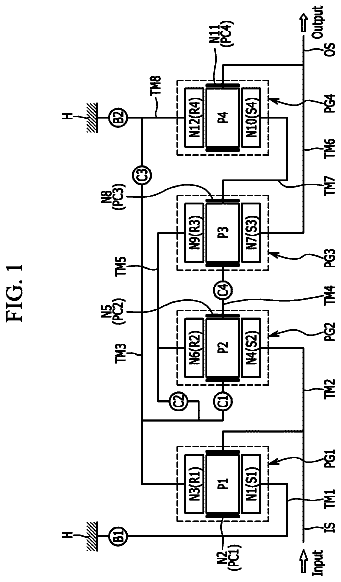
FIG. 1 is a schematic diagram of a planetary gear train; and
FIG. 2 is an operation chart of respective control elements at each respective shift stages in a planetary gear train.
The drawings described herein are for illustration purposes only and are not intended to limit the scope of the present disclosure in any way.
Detailed description
The following description is merely exemplary in nature and is not intended to limit the present disclosure, application, or uses. It should be understood that throughout the drawings, corresponding reference numerals indicate like or corresponding parts and features.
In the following description, dividing names of components into first, second, and the like is to avoid any confusion as the names of the components are identical to one another; thus, an order thereof is not particularly limited.
FIG. 1 is a schematic diagram of a planetary gear train according to one form of the present disclosure.
Referring to FIG. 1 , a planetary gear train according to one form of the present disclosure includes a first, a second, a third, and a fourth planetary gear sets PG 1 , PG 2 , PG 3 , and PG 4 arranged on the same axis, an input shaft IS, an output shaft OS, eight rotational shafts TM 1 to TM 8 connected to at least one of rotational elements of the first, the second, the third, and the fourth planetary gear sets PG 1 , PG 2 , PG 3 , and PG 4 , four clutches C 1 to C 4 and two brakes B 1 and B 2 that are control elements, and a transmission housing H.
Torque input from the input shaft IS is changed by cooperation of the first, the second, the third, and the fourth planetary gear sets PG 1 , PG 2 , PG 3 , and PG 4 and the changed torque is delivered through the output shaft OS.
The planetary gear sets are arranged in the order of the first, the second, the third, and the fourth planetary gear sets PG 1 , PG 2 , PG 3 and PG 4 from an engine side.
The input shaft IS is an input member and the torque from a crankshaft of an engine, after being torque-converted through a torque converter, is input into the input shaft IS.
The output shaft OS is an output member, is arranged in parallel with the input shaft IS, and transmits driving torque to a driving wheel through a differential apparatus.
The first planetary gear set PG 1 is a single pinion planetary gear set and includes a first sun gear S 1 , a first planet carrier PC 1 rotatably supporting a first pinion P 1 that is externally meshed with the first sun gear S 1 , and a first ring gear R 1 that is internally meshed with the first pinion P 1 . The first sun gear S 1 , the first planet carrier PC 1 , and the first ring gear R 1 respectively act as first, second, and third rotational elements N 1 , N 2 , and N 3 .
The second planetary gear set PG 2 is a single pinion planetary gear set and includes a second sun gear S 2 , a second planet carrier PC 2 rotatably supporting a second pinion P 2 that is externally meshed with the second sun gear S 2 , and a second ring gear R 2 that is internally meshed with the second pinion P 2 . The second sun gear S 2 , the second planet carrier PC 2 , and the second ring gear R 2 respectively act as fourth, fifth, and sixth rotational elements N 4 , N 5 , and N 6 .
The third planetary gear set PG 3 is a single pinion planetary gear set and includes a third sun gear S 3 , a third planet carrier PC 3 rotatably supporting a third pinion P 3 that is externally meshed with the third sun gear S 3 , and a third ring gear R 3 that is internally meshed with the third pinion P 3 . The third sun gear S 3 , the third planet carrier PC 3 , and the third ring gear R 3 respectively act as seventh, eighth, and ninth rotational elements N 7 , N 8 , and N 9 .
The fourth planetary gear set PG 4 is a single pinion planetary gear set and includes a fourth sun gear S 4 , a fourth planet carrier PC 4 rotatably supporting a fourth pinion P 4 that is externally meshed with the fourth sun gear S 4 , and a fourth ring gear R 4 that is internally meshed with the fourth pinion P 4 . The fourth sun gear S 4 , the fourth planet carrier PC 4 , and the fourth ring gear R 4 respectively act as tenth, eleventh, and twelfth rotational elements N 10 , N 11 , and N 12 .
The second rotational element N 2 and the fourth rotational element N 4 are directly connected to each other, the third rotational element N 3 , the sixth rotational element N 6 and the tenth rotational element N 10 are directly connected to each other, and the ninth rotational element N 9 and the eleventh rotational element N 11 are directly connected to each other such that the first, the second, the third and the fourth planetary gear sets PG 1 , PG 2 , PG 3 and PG 4 include eight shafts TM 1 to TM 8 .
The eight shafts TM 1 to TM 8 will be described in further detail.
The eight shafts TM 1 to TM 8 may be rotational members that directly connect a plurality of rotational elements among the rotational elements of the planetary gear sets PG 1 , PG 2 , PG 3 , and PG 4 with each other or that are directly connected to any one rotational element of the planetary gear sets PG 1 , PG 2 , PG 3 , and PG 4 and rotate with the any one rotational element to transmit torque, or may be fixed members that selectively or directly connect any one rotational element of the planetary gear sets PG 1 , PG 2 , PG 3 , and PG 4 to the transmission housing H to fix the any one rotational element.
The first shaft TM 1 is connected to the first rotational element N 1 (the first sun gear S 1 ) and is selectively connected to the transmission housing H to be operated as a selective fixed element.
The second shaft TM 2 is connected to the second rotational element N 2 (the first planet carrier PC 1 ) and the fourth rotational element N 4 (the second sun gear S 2 ) and is directly connected to the input shaft IS.
The third shaft TM 3 is connected to the third rotational element N 3 (the first ring gear R 1 ), the sixth rotational element N 6 (the second ring gear R 2 ) and the tenth rotational element N 10 (the fourth sun gear S 4 ).
The fourth shaft TM 4 is connected to the fifth rotational element N 5 (the second planet carrier PC 2 ).
The fifth shaft TM 5 is connected to the seventh rotational element N 7 (the third sun gear S 3 ) and is selectively connected to the first shaft TM 1 and the second shaft TM 2 .
The sixth shaft TM 6 is connected to the eighth rotational element N 8 (the third planet carrier PC 3 ) and is selectively connected to the fourth shaft TM 4 .
The seventh shaft TM 7 is connected to the ninth rotational element N 9 (the third ring gear R 3 ) and the eleventh rotational element N 11 (the fourth planet carrier PC 4 ) and is directly connected to the output shaft OS.
The eighth shaft TM 8 is connected to the twelfth rotational element N 12 (the fourth ring gear R 4 ), is selectively connected to the sixth shaft TM 6 , and is selectively connected to the transmission housing H to be operated as a selective fixed element.
In addition, four clutches C 1 , C 2 , C 3 , and C 4 are arranged at portions at which any two shafts among the eight shafts TM 1 to TM 8 including the input shaft IS and the output shaft OS are selectively connected to each other.
In addition, two brakes B 1 and B 2 are arranged at portions at which any one shaft among the eight shafts TM 1 to TM 8 is selectively connected to the transmission housing H.
Arrangements of the four clutches C 1 to C 4 and the two brakes B 1 and B 2 are described in detail.
The first clutch C 1 is arranged between the second shaft TM 2 and the fifth shaft TM 5 and selectively connects second shaft TM 2 and the fifth shaft TM 5 .
The second clutch C 2 is arranged between the first shaft TM 1 and the fifth shaft TM 5 and selectively connects the first shaft TM 1 and the fifth shaft TM 5 .
The third clutch C 3 is arranged between the fourth shaft TM 4 and the sixth shaft TM 6 and selectively connects the fourth shaft TM 4 and the sixth shaft TM 6 .
The fourth clutch C 4 is arranged between the sixth shaft TM 6 and the eighth shaft TM 8 and selectively connects the sixth shaft TM 6 and the eighth shaft TM 8 .
The first brake B 1 is arranged between the first shaft TM 1 and the transmission housing H and selectively connects the first shaft TM 1 and the transmission housing H.
The second brake B 2 is arranged between the eighth shaft TM 8 and the transmission housing H and selectively connects the eighth shaft TM 8 and the transmission housing H.
The control elements including the first, the second, the third, and the fourth clutches C 1 , C 2 , C 3 , and C 4 and the first and second brakes B 1 and B 2 may be frictionally engaging units that are operated by hydraulic pressure. Particularly, the control elements may be, but not limited to, multi-plates friction elements of wet type. Also, the control elements may be engaging units that are operated by electrical signal, such as dog clutches, electric clutches, magnetic particle clutches, etc.
FIG. 2 is an operation chart of control elements at each speed stage in the planetary gear train according to one form of the present disclosure.
As shown in FIG. 2 , three control elements among the first, the second, the third, and the fourth clutches C 1 , C 2 , C 3 , and C 4 and the first and the second brakes B 1 and B 2 are operated at each speed stage in the planetary gear train according to one form of the present disclosure.
The second, the third clutches C 2 and C 3 and the second brake B 2 are simultaneously operated at a first forward speed shift-stage D 1 .
In a state that the first shaft TM 1 is connected to the fifth shaft TM 5 by operation of the second clutch C 2 and the fourth shaft TM 4 is connected to the sixth shaft TM 6 by operation of the third clutch C 3 , torque of the input shaft IS is input to the second shaft TM 2 .
In addition, the eighth shaft TM 8 is operated as the fixed element by operation of the second brake B 2 . Therefore, the torque of the input shaft IS is shifted into the first forward speed stage, and the first forward speed stage is delivered through the output shaft OS connected to the seventh shaft TM 7 .
The first, the second clutches C 1 and C 2 and the second brake B 2 are simultaneously operated at a second forward speed shift-stage D 2 .
In a state that the second shaft TM 2 is connected to the fifth shaft TM 5 by operation of the first clutch C 1 and the first shaft TM 1 is connected to the fifth shaft TM 5 by operation of the second clutch C 2 , torque of the input shaft IS is input to the second shaft TM 2 .
In addition, the eighth shaft TM 8 is operated as the fixed element by operation of the second brake B 2 . Therefore, the torque of the input shaft IS is shifted into the second forward speed stage, and the second forward speed stage is delivered through the output shaft OS connected to the seventh shaft TM 7 .
The second clutch C 2 and the first and the second brakes B 1 and B 2 are simultaneously operated at a third forward speed shift-stage D 3 .
In a state that the first shaft TM 1 is connected to the fifth shaft TM 5 by operation of the second clutch C 2 , torque of the input shaft IS is input to the second shaft TM 2 .
In addition, the first shaft TM 1 and the eighth shaft TM 8 are operated as the fixed elements by operation of the first and the second brakes B 1 and B 2 . Therefore, the torque of the input shaft IS is shifted into the third forward speed stage, and the third forward speed stage is delivered through the output shaft OS connected to the seventh shaft TM 7 .
The second and the fourth clutches C 2 and C 4 and the second brake B 2 are simultaneously operated at a fourth forward speed shift-stage D 4 .
In a state that the first shaft TM 1 is connected to the fifth shaft TM 5 by operation of the second clutch C 2 and the sixth shaft TM 6 is connected to the eighth shaft TM 8 by operation of the fourth clutch C 4 , torque of the input shaft IS is input to the second shaft TM 2 .
In addition, the eighth shaft TM 8 is operated as the fixed element by operation of the second brake B 2 . Therefore, the torque of the input shaft IS is shifted into the fourth forward speed stage, and the fourth forward speed stage is delivered through the output shaft OS connected to the seventh shaft TM 7 .
The second and the fourth clutches C 2 and C 4 and the first brake B 1 are simultaneously operated at a fifth forward speed shift-stage D 5 .
In a state that the first shaft TM 1 is connected to the fifth shaft TM 5 by operation of the second clutch C 2 and the sixth shaft TM 6 is connected to the eighth shaft TM 8 by operation of the fourth clutch C 4 , torque of the input shaft IS is input to the second shaft TM 2 .
In addition, the first shaft TM 1 is operated as the fixed element by operation of the second brake B 1 . Therefore, the torque of the input shaft IS is shifted into the fifth forward speed stage, and the fifth forward speed stage is delivered through the output shaft OS connected to the seventh shaft TM 7 .
The first, the second and the fourth clutches C 1 , C 2 , and C 4 are simultaneously operated at a sixth forward speed shift-stage D 6 .
In a state that the second shaft TM 2 is connected to the fifth shaft TM 5 by operation of the first clutch C 1 , the first shaft TM 1 is connected to the fifth shaft TM 5 by operation of the second clutch C 2 and the sixth shaft TM 6 is connected to the eighth shaft TM 8 by operation of the fourth clutch C 4 , torque of the input shaft IS is input to the second shaft TM 2 .
In this case, the first, the second, the third, and the fourth planetary gear sets PG 1 , PG 2 , PG 3 , and PG 4 become lock-up states. Therefore, the torque of the input shaft IS is shifted into the sixth forward speed stage, and the sixth forward speed stage is delivered through the output shaft OS connected to the seventh shaft TM 7 . At the sixth forward speed stage, rotation speed which is the same as rotation speed of the input shaft IS is output.
The first and the fourth clutches C 1 and C 4 and the first brake B 1 are simultaneously operated at a seventh forward speed shift-stage D 7 .
In a state that the second shaft TM 2 is connected to the fifth shaft TM 5 by operation of the first clutch C 1 and the sixth shaft TM 6 is connected to the eighth shaft TM 8 by operation of the fourth clutch C 4 , torque of the input shaft IS is input to the second shaft TM 2 .
In addition, the first shaft TM 1 is operated as the fixed element by operation of the second brake B 1 . Therefore, the torque of the input shaft IS is shifted into the seventh forward speed stage, and the seventh forward speed stage is delivered through the output shaft OS connected to the seventh shaft TM 7 .
The third and the fourth clutches C 3 and C 4 and the first brake B 1 are simultaneously operated at an eighth forward speed shift-stage D 8 .
In a state that the fourth shaft TM 4 is connected to the sixth shaft TM 6 by operation of the third clutch C 3 and the sixth shaft TM 6 is connected to the eighth shaft TM 8 by operation of the fourth clutch C 4 , torque of the input shaft IS is input to the second shaft TM 2 .
In addition, the first shaft TM 1 is operated as the fixed element by operation of the second brake B 1 . Therefore, the torque of the input shaft IS is shifted into the eighth forward speed stage, and the eighth forward speed stage is delivered through the output shaft OS connected to the seventh shaft TM 7 .
The first and the third clutches C 1 and C 3 and the first brake B 1 are simultaneously operated at a ninth forward speed shift-stage D 9 .
In a state that the second shaft TM 2 is connected to the fifth shaft TM 5 by operation of the first clutch C 1 and the fourth shaft TM 4 is connected to the sixth shaft TM 6 by operation of the third clutch C 3 , torque of the input shaft IS is input to the second shaft TM 2 .
In addition, the first shaft TM 1 is operated as the fixed element by operation of the second brake B 1 . Therefore, the torque of the input shaft IS is shifted into the ninth forward speed stage, and the ninth forward speed stage is delivered through the output shaft OS connected to the seventh shaft TM 7 .
The second and the third clutches C 2 and C 3 and the first brake B 1 are simultaneously operated at a tenth forward speed shift-stage D 10 .
In a state that the first shaft TM 1 is connected to the fifth shaft TM 5 by operation of the second clutch C 2 and the fourth shaft TM 4 is connected to the sixth shaft TM 6 by operation of the third clutch C 3 , torque of the input shaft IS is input to the second shaft TM 2 .
In addition, the first shaft TM 1 is operated as the fixed element by operation of the second brake B 1 . Therefore, the torque of the input shaft IS is shifted into the tenth forward speed stage, and the tenth forward speed stage is delivered through the output shaft OS connected to the seventh shaft TM 7 .
The third and the fourth clutches C 3 and C 4 and the second brake B 2 are simultaneously operated at a reverse speed REV.
In a state that the fourth shaft TM 4 is connected to the sixth shaft TM 6 by operation of the third clutch C 3 and the sixth shaft TM 6 is connected to the eighth shaft TM 8 by operation of the fourth clutch C 4 , torque of the input shaft IS is input to the second shaft TM 2 .
In addition, the eighth shaft TM 8 is operated as the fixed element by operation of the second brake B 2 . Therefore, the torque of the input shaft IS is shifted into the reverse speed stage, and the reverse speed stage is delivered through the output shaft OS connected to the seventh shaft TM 7 as inverse rotation speed.
The planetary gear trains according to one form of the present disclosure may achieve at least ten forward speed stages and one reverse speed stage by combining four planetary gear sets PG 1 , PG 2 , PG 3 , and PG 4 with the four clutches C 1 , C 2 , C 3 , and C 4 and the two brakes B 1 and B 2 .
In addition, the planetary gear train according to one form of the present disclosure may achieve suitable speed stages per rotation speed of the engine. Particularly, silent driving of the vehicle may be improved by using operation point positioned at a low rotational speed region of the engine.
Moreover, the planetary gear train according to the exemplary form of the present disclosure may enhance driving efficiency of the engine and may improve power delivery performance and fuel efficiency.
The description of the disclosure is merely exemplary in nature and, thus, variations that do not depart from the substance of the disclosure are intended to be within the scope of the disclosure. Such variations are not to be regarded as a departure from the spirit and scope of the disclosure.
 Lapsed, fee not paid2 drawings

