 Lapsed, fee not paid8 drawings
AI & Machine Learning · US 9,947,219 B2
Monitoring of a traffic system
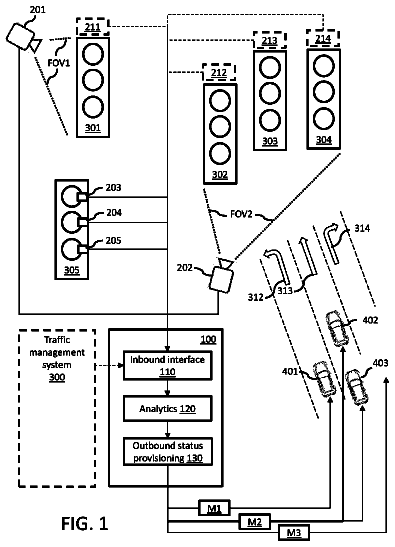
A traffic control system can includes a plurality of traffic lights.
US 9,952,836 B2 · Assignee: NOMURA RESEARCH INSTITUTE, LTD. · Inventors: Ohara; Soichi
Sheet 1 of 9 from the published document. All sheets in the USPTO PDF
A system that generates source code of a Web application program. A typical embodiment includes a dictionary table for each language environment that uses identification information on the input/output item as a key to retain, as dictionary data, information made up of initial values of parameters of a parts object, and a dictionary processing unit that acquires the dictionary data corresponding to the identification information on the input/output item from the dictionary table of a specified language environment, and a response processing unit that uses the identification information on the input/output item corresponding to the parts object contained in a processing result as the key to acquire the information on the parameters of the parts object from the dictionary table of the specified language environment and to allow the screen to display a label control and/or an input/output control.
In the background of development of IT techniques, globalization of businesses, and the like, the need that Web sites and Web applications are supported by a plurality of languages has been grown. As a method that enables access to Web sites and Web applications in a plurality of language environments, for example, as a conventionally used method, there is a method in which individual pieces of content which are translated into respective languages regarding the same content are prepared in advance and the individual pieces of content are automatically or manually selected and used in accordance with the language environment and the like used by the user. Also, other than this, various techniques to support multiple languages in application programs have been proposed. For example, in Japanese Patent Application Laid-Open Publication No. 2003-44474 (Patent Document 1), a technique to pro
8 of 9 drawing sheets so far from the published document, cropped to the drawing. Every sheet is in the USPTO PDF.
What the patent claimed, word for word. All of it is now free to use.
The present invention relates to effective techniques when applied to development techniques of applications in a Web server system.
In the background of development of IT techniques, globalization of businesses, and the like, the need that Web sites and Web applications are supported by a plurality of languages has been grown. As a method that enables access to Web sites and Web applications in a plurality of language environments, for example, as a conventionally used method, there is a method in which individual pieces of content which are translated into respective languages regarding the same content are prepared in advance and the individual pieces of content are automatically or manually selected and used in accordance with the language environment and the like used by the user. Also, other than this, various techniques to support multiple languages in application programs have been proposed.
For example, in Japanese Patent Application Laid-Open Publication No. 2003-44474 (Patent Document 1), a technique to provide dynamic language translation of a content section by determining the language based on a client and user information, determining a skeleton of the content section containing content elements, translating skeleton content elements into the language determined based on the client and user information utilizing a stored translation table of each skeleton content element or dynamic natural language translation of each skeleton content element, and integrating the translated skeleton content elements into the content section is described.
Also, for example, in Japanese Patent Application Laid-Open Publication No. H11-3338 (Patent Document 2), a technique that recognizes the target language based on information from an application (setting information on fonts and formats in accordance with each language and information indicating the type of application) or information set by an environment setting function on the side of a multilingual input system (information on conditions and priorities set to each language), enables input of a plurality of languages by performing Japanese input processing through a Japanese processing unit when the target language is Japanese, performing English input processing through an English processing unit when the target language is English, and performing Chinese input processing through a Chinese processing unit when the target language is Chinese, and efficiently creates a document by automatically switching each input system in accordance with the target language is described.
Also, for example, in Japanese Patent Application Laid-Open Publication No. H9-251463 (Patent Document 3), a technique in which when the language to be used is given to the management process via an input unit, the management process extracts the language conversion system necessary for inputting the language from a correspondence table of a language conversion system and font types corresponding to built-in languages, issues a switching instruction of the language conversion system to OS (Operating System), and issues a switching command of fonts to an application, and the application requests the OS to switch fonts based on the received command, and as a result, a single process that the user inputs the type of language to be used enables the management process to issue necessary instructions to each unit so as to allow for an easy switching of a language conversion system and fonts is described.
Also, for example, in Japanese Patent Application Laid-Open Publication No. 2010-128861 (Patent Document 4), a technique that enables multilingual support in database systems and the like by including, in the language setting unit that identifies the language environment of the client accessing an information processing apparatus and sets the language environment, a client connection processing unit that sets a language identification value specifying a language environment of a client, a command processing unit that determines the presence of a command requesting multilingual processing by inspecting a script contained in an access request, and a language resource processing unit that, when the command processing unit determines to request multilingual processing, receives the command and allows access to a database in the language environment set by a language setting unit is described.
Also, with remarkable improvements in performance of mobile terminals due to development of IT techniques, access to Web sites via the Internet or the like is not limited to conventional PCs (Personal Computers) or the like but carried out by various kinds of devices such as mobile phones, smartphones, and tablet terminals. These devices have mutually different sizes and resolutions of the display to display the screen of Web sites. Thus, regarding a construction of a Web site or a Web application, multi-device support that optimizes the screen display for a plurality of these devices is considered while preventing an increase in load of development or maintenance.
Methods of such multi-device support include, for example, as a method that has been practiced, there is a method by which respective individual pieces of content regarding the same content which are adjusted or optimized for the sizes and resolution of the displays of respective devices, respectively, are prepared in advance and such individual pieces of content are automatically or manually selected to use in accordance with the device or the like used by the user. Moreover, supporting a plurality of devices by dynamically changing or generating content in an application program without changing the same source code is also discussed.
In association with dynamically changing content, for example, in a technique described in Japanese Patent Application Laid-Open Publication No. 2001-51821 (Patent Document 5), if a servlet having display area identifying information and display attributes as parameters is defined in a page template and the servlet is recognized by a Web server, a plurality of parts Bean associated with the display area identifying information is identified. The parts have image data of objects to be embedded in the display area thereof and linked URL (Uniform Resource Locator) information set thereto as properties and display condition information such as schedule information associated therewith. Display conditions of each of the plurality of parts Bean associated with the display area identifying information are examined, and based on link information as a property satisfying display conditions, image data forming objects to be embedded in the display area and linked URL information are acquired to generate HTML (HyperText Markup Language). Accordingly, content to be embedded in a page template can dynamically be changed without correcting the server program.
Also, for example, in a technique described in Japanese Patent Application Laid-Open Publication No. 2009-76099 (Patent Document 6), a service providing apparatus includes a display apparatus, a communication unit, an acquisition unit that acquires execution code to provide a service via the communication unit, an execution code storage unit that stores the acquired execution code, and a screen configuration information storage unit that stores screen configuration information defining the configuration of the screen displayed during execution of execution code. In addition, a management unit that manages respective units such that execution code necessary for providing a service and screen configuration information are stored in the execution code storage unit and the screen configuration information storage unit, respectively, before the service is provided and in response to receiving an instruction to provide the service, executes the execution code stored in the execution code storage unit by using the screen configuration information stored in the screen configuration information storage unit is included. Accordingly, when needed for providing the service, the latest execution code or screen configuration information is acquired, and while effectively managing the execution code and screen configuration information stored in the apparatus, the latest service can be provided.
Also, for example, in a technique described in Japanese Patent Application Laid-Open Publication No. 2002-132646 (Patent Document 7), a Web proxy server determines the client type by processing a client request generated by a client device and searches for Web content identified in the client request. Also, the Web proxy server searches for one or a plurality of augmentation files related to Web content and a specific client type, thereby changing the Web content and delivering the changed Web content to the client device. Accordingly, there is no need to own or control the Web proxy server, and Web content can be converted or supplemented to efficiently support different clients.
Also, for the purpose of, for example, reducing or standardizing development loads in developing a Web application program or the like, application frameworks such as so-called integrated development environments (IDE: Integrated Development Environment) including GUI (Graphical User Interface) creating function and Ruby on Rails (RoR, Non-Patent Document 1) and the like are frequently used in many cases. Moreover, such frameworks are also used in combination. By using such development support tools and the like, for example, regarding a Web application program having a user interface, source code can automatically be generated.
However, in these development support tools, for the application in which the source code is automatically generated, when the contents displayed on the screen are then further changed, adjusted, or the like (for example, changes of display items or controls (components) on the screen and attributes thereof), a cumbersome process needs to be followed. For example, it is necessary to correct settings, definitions, or the like of the contents displayed on the screen using the GUI creation function or the like serving as the development support tool, generate source code again automatically, further build and the like if necessary, and then carry out a work, such as replacement of created modules. Such a work may not only be a burden on the developer, but also become a factor of inviting a failure.
In contrast, for example, in Japanese Patent Application Laid-Open Publication No. 2007-280189 (Patent Document 8), such a technique in which in a program generation apparatus that generates a program for changing settings of the screen displayed from the display screen provided in a server, when the screen is changed, a screen item information management unit creates a display item file based on screen item information, an input item/column corresponding unit creates an input item file based on table item information, an output item/column corresponding unit creates an output item file based on the table item information, and further a program generator generates a screen program and a server program by using the display item file, the input item file, and the output item file, so that the screen can be changed without changing source code of a screen program and a server program is described. RELATED ART DOCUMENTS Patent Documents
Patent Document 1: Japanese Patent Application Laid-Open Publication No. 2003-44474 Patent Document 2: Japanese Patent Application Laid-Open Publication No. H11-3338 Patent Document 3: Japanese Patent Application Laid-Open Publication No. H9-251463 Patent Document 4: Japanese Patent Application Laid-Open Publication No. 2010-128861 Patent Document 5: Japanese Patent Application Laid-Open Publication No. 2001-51821 Patent Document 6: Japanese Patent Application Laid-Open Publication No. 2009-76099 Patent Document 7: Japanese Patent Application Laid-Open Publication No. 2002-132646 Patent Document 8: Japanese Patent Application Laid-Open Publication No. 2007-280189 Non-Patent Document
Non-Patent Document 1: Internet Web page: rubyonrails.org SUMMARY OF THE INVENTION Problems to be Solved by the Invention
By utilizing conventional techniques described in Patent Documents 1 to 4 described above, for example, processes such as translating content in accordance with the language environment of the client terminal or the like or displaying translated content, or switching IME (Input Method Editor: character conversion program) or fonts can dynamically be performed without changing source code. Also, switching the language and the like in accessing a database is possible.
However, according to these techniques, for example, in an application that accesses a business database, regarding various controls (screen components) such as input fields to input search conditions, the appearances, attributes, control processing, and the like thereof cannot be dynamically switched in accordance with the language environment of the client terminal. For example, when the language environment of the client terminal is changed from Japanese to English, text displayed on the screen by a text control and the like is in English, but attributes and the like of controls such as an input field to input data remain those of Japanese.
That is, for example, the mode of IME remains the full-width hiragana, or the length of a character string that can be input or displayed remains the number of characters in Japanese. Also, in the case of an application that registers data which is input to an input field on the screen in a business database or the like, although validity of data specified in the input field or the like may be checked in some cases, the check on the contents remains the check intended for input data in Japanese.
Incidentally, in the techniques described in Patent Documents 2 and 3, the mode of IME, fonts, and the like can be changed in accordance with the language environment of the client terminal, but the appearances and attributes of controls such as the input field and control processing such as a validity check cannot be dynamically changed.
Thus, an object of the present invention is to provide a multilingual Web server system capable of dynamically changing a user interface including the appearances and attributes of controls to display input/output items on the screen, control processing, and the like in a Web application in accordance with the language environment without changing source code and a multilingual support method in the Web server system.
On the other hand, as described above, to provide a Web site or a Web application with multi-device support, it is necessary to optimize the contents of the screen display in accordance with the type of device of the client terminal, particularly the size and resolution of the display. Particularly, smartphones and tablet terminals employ a touch panel as an input/output device, and the user performs an operation by directly touching on the screen, instead of using a mouse. Therefore, dynamic changes of the contents of the screen here mainly center on optimization of the appearances such as the arrangement and size of components (controls) on the screen in such a way that visual recognition and operations by fingers are easily performed.
On this point, for example, in the technique described in Patent Document 5, content can dynamically be changed in a server in accordance with display conditions, but changes such that content is optimized in consideration of the state of the client terminal are not featured. In contrast, in the above technique described in Patent Document 6, content can dynamically be changed in consideration of the state of the client terminal by retaining execution code, screen configuration information, and the like on the side of the client terminal. However, such a configuration causes a problem when a device having limited processing capabilities or storage capacities such as a mobile terminal is used as the client terminal.
Also, in the technique described in Patent Document 7, an augmentation file is acquired in accordance with the environment of the client terminal and content can dynamically be changed accordingly. However, regarding how to efficiently implement the technique, no concrete implementation technique and the like has not been disclosed. Also, in a configuration having no proxy server, the efficient way of implementing the technique has not been disclosed as well.
Thus, in a Web application, another object of the present invention is to provide a multi-device support Web server system capable of dynamically changing the user interface including the appearances and attributes of controls to display input/output items on the screen, control processing, and the like in accordance with the device of the client terminal without changing source code, and a multi-device support method in the Web server system.
Also, by utilizing the technique described in Patent Document 8, the contents of the screen display can be changed without changing the source code. However, in the technique described in Patent Document 8, while which item is displayed as an input/output item on the screen and the correspondence relation between the display item and the column of a database can be changed, it is difficult to dynamically carry out a work such as constructing a user interface while adjusting, for example, the appearance and attributes of each control which displays an input/output item, by trial and error, without changing the once-created source code or if changed, by making simple changes only.
Thus, still another object of the present invention is to provide an application development support system capable of dynamically changing the appearances and attributes of controls displaying an input/output item on the screen by automatically generating source code of a so-called CRUD (Create, Read, Update, Delete) type application program on a database and then without changing the generated source code or if changed, by making simple changes only, and an application development support method.
The above and other preferred aims and novel characteristics of the present invention will be apparent from the description of the present specification and the accompanying drawings. Means for Solving the Problems
The typical inventions disclosed in the present application will be briefly described as follows.
A multilingual support Web server system according to a typical embodiment of the present invention includes a request processing unit that invokes a corresponding business logic in response to a request from a client terminal and a response processing unit that returns a processing result by the business logic to the client terminal and operates an application program providing a service to the client terminal in a plurality of language environments, having the following characteristics.
That is, the Web server system further includes a dictionary table for each of the language environments that uses identification information on an input/output item in the application program as a key to retain, as dictionary data, information made up of initial values of one or more parameters of a parts object having at least information on a display name showing text of a label control of one or more of the input/output items displayed on a screen of the client terminal and information about an input/output control displayed to carry out input or output of the input/output item, and a dictionary processing unit that acquires the dictionary data corresponding to the identification information on the input/output item from the dictionary table of a specified language environment.
Also, the response processing unit uses the identification information on the input/output item corresponding to the parts object contained in source code as the key to acquire the information on part or all of the parameters of the corresponding parts object from the dictionary table of the specified language environment via the dictionary processing unit and based on the acquired parameters and the processing result, generates HTML data allowing the screen of the client terminal to display the label control and/or the input/output control corresponding to the parts object.
Also, a multi-device support Web server system according to another typical embodiment of the present invention includes a request processing unit that invokes a corresponding business logic in response to a request from a client terminal and a response processing unit that returns a processing result by the business logic to the client terminal and operates an application program providing a service to the client terminal made up of a plurality of types of devices.
That is, the Web server system further includes a device acquisition unit that acquires information about a type of device of the client terminal based on the request from the client terminal, and the response processing unit generates HTML data allowing a screen of the client terminal to display a label control and/or an input/output control corresponding to a parts object contained in source code and having at least information on a display name showing text of the label control of one or more input/output items displayed on a screen of the client terminal and information about the input/output control displayed to carry out input or output of the input/output item, based on first adjustment content in displaying the label control and/or the input/output control, the first adjustment content being implemented in an upper class from which the parts object is inherited and depending on the type of the device of the client terminal acquired by the device acquisition unit.
Also, an application development support system according to another typical embodiment of the present invention includes a code generating server that generates source code of a Web application program operating on an application server.
That is, the application development support system further includes a dictionary server having a dictionary table that uses identification information on one or more input/output items displayed on a screen during execution of the Web application program as a key to retain, as dictionary data, information made up of initial values of one or more parameters of a parts object having at least information on a display name showing text of a label control of the input/output item and information about an input/output control displayed to carry out input or output of the input/output item, and the code generating server includes a code generator that constructs the Web application program by invoking the parts object for displaying each of the input/output items on the screen and generates the source code of the constructed Web application program.
When invoked to display a corresponding input/output item on the screen during execution of the Web application program on the application server, the parts object uses the identification information on the input/output item as the key to acquire information on part or all of the parameters of the parts object from the dictionary table on the dictionary server and based on the acquired parameters, displays the label control and/or the input/output control. Effects of the Invention
The effects obtained by typical ones of the inventions disclosed in the present application will be briefly described below.
According to a typical embodiment of the present invention, in a Web application, the user interface including the appearances and attributes of controls to display an input/output item on the screen, control processing, and the like can dynamically be changed in accordance with the language environment without changing source code.
Also, according to another typical embodiment of the present invention, the user interface including the appearances and attributes of controls to display an input/output item on the screen, control processing, and the like in a Web application can dynamically be changed in accordance with the device of the client terminal without changing source code.
Also, according to still another typical embodiment of the present invention, the contents of the screen such as the appearances and attributes of controls displaying an input/output item on the screen can dynamically be changed by automatically generating source code of a CRUD type application program on a database and then without changing the generated source code or if changed, by making simple changes only.
FIG. 1 is a diagram showing an overview of a configuration example of a Web server system as a first embodiment of the present invention;
FIG. 2 is a diagram showing an overview of an example of processing when an input/output item of a corresponding column is displayed on the screen by a parts object according to the first embodiment of the present invention;
FIG. 3 is a diagram showing an overview of an example of processing when the appearance and the like of a control displayed by the parts object according to the first embodiment of the present invention is changed into another language;
FIG. 4 is a diagram showing an overview of an example of processing when the appearance and the like of a control displayed by the parts object according to the first embodiment of the present invention is changed;
FIG. 5 is a diagram showing an overview of a configuration example of a multi-device support Web server system as a second embodiment of the present invention;
FIG. 6 is a diagram showing an overview of an example of processing when the appearance and the like of a control displayed by a parts object according to the second embodiment of the present invention is changed in accordance with a device of a client terminal;
FIG. 7 is a diagram showing an overview of a configuration example of an application development support system as a third embodiment of the present invention;
FIG. 8 is a diagram showing an overview of an example of processing when the appearance and the like of a control displayed by a parts object according to the third embodiment of the present invention is changed; and
FIG. 9 is a diagram showing an overview of the generation of source code when entries are registered in a dictionary table according to the third embodiment of the present invention.
Hereinafter, embodiments of the present invention will be described in detail with reference to the accompanying drawings. Note that components having the same function are denoted by the same reference symbols throughout the drawings for describing the embodiment, and the repetitive description thereof will be omitted. First Embodiment
A Web server system as the first embodiment of the present invention creates and retains a dictionary for each language environment so that a user interface for a plurality of languages can be provided without changing source code. It is assumed that the dictionary not only simply retains translations of text data such as the display name by each language, but also can manage various kinds of attribute information and the like of items as a data dictionary. That is, information specific to each language in the user interface can be retained as dictionary data.
By using such dictionaries, for example, an application can be developed in a plurality of languages simultaneously in parallel, and also a support language can easily be added, so that extensibility can be improved. Also, by using such dictionaries as data dictionaries, data items can be standardized in the system.
In the present embodiment, for example, in a CRUD type Web application program accessing a business database, it is assumed that, instead of directly using a standard control object (hereinafter, which may simply be denoted as a “control”), a parts object into which each piece of data such as the display name, the setting content and control processing of a control, and explanatory text are integrated is used to display the content related to an input/output item (for example, an input item specifying a content of search conditions for acquiring data from a database or an output item displaying a content of a search result) on the screen.
The parts object can be specified what kind of control displayed on the screen as a parameter (for example, a text control only, a (text control and) input field, a (text control and) dropdown list, and the like). Also, it is assumed that attribute values (for example, the content of text displayed in a text control, the length of an input field, and the like) of a control, control information (for example, how to perform a validity check of input data and the like), and the like can be specified, and the parts object is implemented to display and control a control according to the specified content.
In other words, the parts object is configured to combine and display an input/output control dealing with data of an input/output item such as an input field, a dropdown list, and text and a label control as a text control that displays the name or the like of an input/output item and has a configuration that output patterns of these controls can be specified.
In this processing, attribute values of the label control and the input/output control, such as the width of controls, can be adjusted collectively in the form of consistency, and thus, there is no need to carry out a cumbersome process that the user individually specifies attribute values and the like to have consistency, so that the appearance of the displayed controls can be adjusted. The adjustments include, for example, adjusting each of the display width of the label control and the input/output control integrally to prevent the label control from being started as a new line at an unintended location in a displayable area or conversely to prevent the label control from not being started as a new line at an intended location.
In the present embodiment, the source code of a Web application program is created under the assumption that the content of each input/output item on the screen is displayed using the parts object. That is, a control is indirectly displayed by using the parts object (at the time of execution on a Web server system, the parts object dynamically generates HTML, a script, and the like that display the target control). Also, information about mapping between each column of the database to be accessed and the input/output item on the screen is retained in source code as mapping information between identification information (for example, the column name) on each column of the database and identification information (for example, the ID attribute value of HTML) on the corresponding parts object.
Further, in the present embodiment, as will be described below, excluding part thereof, information and the like about text displayed in the label control, attribute values of the input/output control, and control processing in each parts object are not directly specified in source code, but are externally retained as dictionary data associated with identification information on ID of a parts object or the corresponding column name or the like of the database. By defining the content of the dictionary data for each language environment and referring to the dictionary data corresponding to the target language environment during execution, the appearance, attributes, and the like of a control displayed on the screen by the parts object can dynamically be changed in accordance with the language environment without changing once-generated source code.
<System Configuration>
FIG. 1 is a diagram showing an overview of a configuration example of a Web server system as the first embodiment of the present invention. A Web server system 100 is made up of, for example, a computer device such as a server device or a virtual server in a cloud computing environment and includes, in addition to middleware such as OS, DBMS (DataBase Management System), and a Web server program (not shown), each unit such as a request processing unit 110 implemented by source code 101 created by a user or a software program such as a library or an object invoked therefrom, a dictionary processing unit 120 , a business logic 130 , and a response processing unit 140 . Also, a dictionary table 121 implemented by a database, a file table, or the like is included.
In response to a request from a program such as a Web browser (not shown) on a client terminal 200 connected via a network 300 such as the Internet, the Web server system 100 provides a service by accessing a business database (DB) 131 through the business logic 130 , performing processing, and outputting HTML data 102 to the client terminal 200 to respond to the request.
The request processing unit 110 has a function to invoke, in response to a request from the client terminal 200 , content (business logic 130 ) based on the source code 101 corresponding thereto and includes units such as an ID converter 111 implemented by a software program and an input check unit 112 . The ID converter 111 has a function to convert identification information (ID) on a parts object corresponding to an input item on the screen contained in a request message into identification information (such as the column name) on the column of the business DB 131 corresponding to the input/output item based on mapping information retained in the source code 101 .
The mapping information retains the correspondence between identification information (for example, the ID attribute value of HTML) on a parts object displayed on the screen and identification information (such as the column name) on each column of the business DB 131 to be accessed. Accordingly, as will be described below, each parts object arranged on the screen in the source code 101 first acquires the column name corresponding to ID of the parts object by the ID converter 111 and then can perform subsequent processing such as accessing the business DB 131 and acquiring dictionary data from the dictionary table 121 described below by using the column name as a key.
Thus, in the HTML data 102 responding to the client terminal 200 , there is no need to directly specify the column name of the corresponding business DB 131 in a (control displayed by) each parts object as information such as a key, and ID of the parts object can be used as information such as a key, so that security can be increased by hiding the actual column name from the HTML data 102 . Incidentally, the column name of the corresponding business DB 131 may directly be specified as information such as a key in a (control displayed by) each parts object in the HTML data 102 without making such a conversion.
The input check unit 112 has a function to perform general validity checks of the content of data in an input item specified via a (control displayed by) a parts object on the screen contained in a request message. As types of validity checks, for example, the number of characters, character types (such as numbers, alphabets, kana, and half-width/full-width characters), limitations of usable characters, and format checks of the date/time and various code values can be considered.
The content of a validity check may depend on the language environment. Thus, in the present embodiment, a plurality of types of validity checks in consideration of variations of each language are implemented in the input check unit 112 , and which type to use for the target input item is selected or determined in accordance with the language environment. Here, the dictionary table 121 of the target language is accessed via the dictionary processing unit 120 described below and information about the type of a validity check is acquired and determined from the content of dictionary data corresponding to the target input item.
The dictionary processing unit 120 has a function to acquire and output dictionary data corresponding to the specified key (in the present embodiment, for example, the column name of the business DB 131 corresponding to the target input/output item (parts object)) from the dictionary table 121 of the specified language. The specified language, for example, may be acquired from the language environment of a Web browser contained in a request message from the client terminal 200 or the value of the language defined for each Web site operating on the Web server system 100 may be acquired. The example of FIG. 1 shows that the dictionary table 121 of each language such as Japanese (“ja”), English (“en”), and Chinese (“zh”) is retained.
The content and format of dictionary data in the dictionary table 121 are not specifically limited. In the present embodiment, as a simple technique, for example, as will be described below, various kinds of data (attribute values of parts objects for carrying out input/output, parameters necessary for controlling, and the like) necessary for carrying out input/output processing of data to/from the target column of the business DB 131 via the screen are to be specified by commas or the like in a predetermined order. More specifically, for example, the display name as the content when a label control is displayed in the corresponding parts object, the length (number of characters) when an input field is displayed as an input/output control, the specification related to the content of control processing such as the type of validity check and the mode of IME, the abbreviated display name as abbreviated text and display width when output data is listed as a table, and a value list when displayed as a dropdown list or the like can be considered.
The business logic 130 has a function to perform processing as a business application by utilizing the business DB 131 . In the present embodiment, as described above, the business logic 130 is intended for CRUD type applications on the business DB 131 but is not specifically limited to such applications.
The response processing unit 140 has a function to generate the HTML data 102 based on a processing result of the business logic 130 or the like based on the content of the source code 101 and return to the client terminal 200 and includes units such as a translation unit 141 and a display unit 142 implemented by a software program. The translation unit 141 acquires text of the label control and parameter values such as attribute values of the input/output control and control information to display the corresponding parts object under the target language environment for each output item contained in a returned response. Here, the dictionary table 121 of the corresponding language is accessed via the dictionary processing unit 120 , and the display name and various parameter values such as attribute values are acquired from the dictionary data corresponding to the target output item (parts object).
The display unit 142 has a function to generate the HTML data 102 of a response screen in which controls displayed by each parts object are arranged based on text of the label control and parameter values such as attribute values of the input/output control and control information on each parts object acquired by the translation unit 141 .
<Screen Display Processing>
FIG. 2 is a diagram showing an overview of an example of processing when an input/output item of a corresponding column is displayed on the screen by a parts object in a CRUD type application. In the example of FIG. 2 , a case of displaying the input field specifying “ ” is extracted from the screen on which search conditions at the time of reading out data from the business DB 131 in a Japanese environment are input.
The description continues in the full USPTO document.
About 6,314 words. The USPTO PDF has it with every drawing.
Fees are due 3.5, 7.5 and 11.5 years after grant. This patent expired on April 24, 2026, so the fee marked "not paid" was the one that went unpaid.
WEB SERVER SYSTEM, APPLICATION DEVELOPMENT SUPPORT SYSTEM, MULTILINGUAL SUPPORT METHOD IN WEB SERVER SYSTEM, MULTI-DEVICE SUPPORT METHOD IN WEB SERVER SYSTEM, AND APPLICATION DEVELOPMENT SUPPORT METHOD
Filed Feb 2016 · published Jun 2016Web server system, application development support system, multilingual support method in web server system, multi-device support method in web server system, and application development support method
Filed Feb 2016 · granted Apr 2018Earlier publications, parents and continuations. None of them can still be enforced, or this patent would not be listed.
Prior art cited by the examiner or applicant. Useful when you check your own idea for novelty.
Everything on this page comes from the documents linked above.