Lapsed, fee not paid6 drawings
Industrial Equipment · US 9,949,600 B1
Mini-blind cleaner
The mini-blind cleaner is an open framework from which a mini-blind to be cleaned may be suspended.
US 9,950,273 B2 · Assignee: Asahi Kasei Chemicals Corporation · Inventors: Shinohata; Masaaki et al.
Sheet 1 of 14 from the published document. All sheets in the USPTO PDF
The present invention provides a separation method of separating (A) and (B), comprising: a step of separating at least either an active hydrogen-containing compound (A) or a compound (B) that reversibly reacts with (A) from a mixture containing (A) and (B) by distillation in a multistage distillation column; and a step of supplying the mixture to an inactive region formed within the multistage distillation column.
Distillation is generally used for separating a gas composition composed of a plurality of components. Distillation is an operation of condensing a specific component of a mixture utilizing the difference in vapor pressure between the component substances. By heating a mixture to be distilled, each component is gradually evaporated from the surface, and boiling starts when the sum of vapor pressures of the components is consistent with the pressure of the system. The composition of the generated vapor is then almost determined from both the component composition of the surface and the vapor pressures (partial pressures) of the components at that temperature according to the Raoult's law. Batch distillation and continuous distillation are known as industrial distillation methods. The evaporation behavior does not involve reaction between the components to be separated. On the other hand,
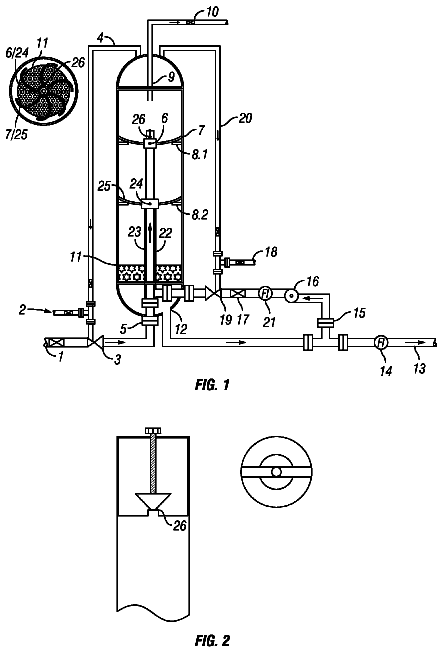
1 of 14 drawing sheets so far from the published document, cropped to the drawing. Every sheet is in the USPTO PDF.
What the patent claimed, word for word. All of it is now free to use.
The present invention relates to a separation method. More particularly, the present invention relates to a method of separating a mixture containing a plurality of compounds that reversibly react with each other.
Distillation is generally used for separating a gas composition composed of a plurality of components. Distillation is an operation of condensing a specific component of a mixture utilizing the difference in vapor pressure between the component substances. By heating a mixture to be distilled, each component is gradually evaporated from the surface, and boiling starts when the sum of vapor pressures of the components is consistent with the pressure of the system. The composition of the generated vapor is then almost determined from both the component composition of the surface and the vapor pressures (partial pressures) of the components at that temperature according to the Raoult's law. Batch distillation and continuous distillation are known as industrial distillation methods.
The evaporation behavior does not involve reaction between the components to be separated. On the other hand, an evaporation behavior involving reaction between gas components, between liquid layer components or between gas-liquid layer components is a complex evaporation behavior.
For example, conventionally, when the equilibrium of an equilibrium reaction is not biased toward the system of formation, the reaction efficiency (equilibrium conversion rate) is generally increased by separating at least one of the products from the reaction system and biasing the equilibrium toward the system of formation. Various methods are known as methods for separating a product from the reaction system. Among these, distillation separation is one of the methods most commonly performed. A method of allowing the reaction to proceed by shifting the equilibrium reaction toward the system of formation while removing a product from the reaction system by distillation is called reactive distillation. For example, Non Patent Literature 1 describes the explanation of reactive distillation by presenting specific examples.
Reactive distillation is generally implemented using a distillation column such as a continuous multistage distillation column. When reactive distillation is performed in a distillation column, a higher-boiling component contained in the reaction liquid is distributed more in a lower stage of the distillation column and a lower-boiling component is distributed more in an upper stage of the distillation column in accordance with the progress of the reaction. Accordingly, in a distillation column, the temperature in the column (liquid temperature) decreases from the bottom to the top of the column. The reaction rate of an equilibrium reaction decreases as the temperature decreases. For this reason, when reactive distillation is performed in the distillation column, the reaction rate decreases from the bottom to the top of the column. Specifically, the reaction efficiency of the equilibrium reaction decreases from the bottom to the top of the column.
In this context, further raising the temperature in the column has been studied to improve the reaction efficiency (i.e., to increase the reaction rate). Patent Literature 1 discloses a method of allowing the reaction to advantageously proceed by supplying a solvent to a reactive distillation column to raise the temperature in the reactive distillation column as a method of efficiently performing an equilibrium reaction represented by Raw material (P)+Raw material (Q)<=>Product (R)+Product (S) (e.g., ester exchange reaction).
However, it is difficult to separate a raw material or a product by distillation while suppressing an undesired reversible reaction as much as possible in a system involving the above-described equilibrium reaction represented by Raw material (P)+Raw material (Q)<=>Product (R)+Product (S), or in a system involving an equilibrium reaction represented by Raw material (P)<=>Product (R)+Product (S). In general, distillation separation is often performed in a high temperature condition even under reduced pressure, and it is difficult to suppress an undesired reversible reaction. For example, it is often undesirable to apply the above-described method to separation by distillation of a mixture containing an active hydrogen-containing compound and a compound that reversibly reacts with the active hydrogen-containing compound, for example.
Examples involving such an undesired reversible reaction include separation of an unreacted monomer by distillation in a method of producing a trifunctional or higher functional polyisocyanate by polymerizing a difunctional isocyanate monomer. In contrast, for example, Patent Literature 1 describes the fact that an allophanated isocyanate was obtained by a method of reacting isophorone diisocyanate with a partially propoxylated glycerol and then removing the unreacted monomer using a thin film evaporator. Patent Literature 2 also describes the fact that an allophanated isocyanate was obtained by a method of reacting hexamethylene diisocyanate with 1-butanol and then removing the excess monomer by continuous distillation. CITATION LIST Patent Literature
Patent Literature 1:
WO 2009/071533
Patent Literature 2: U.S. Patent Application Publication No. 2003/0050424 Non Patent Literature
Non Patent Literature 1: “Kagaku Kogaku” [Chemical Engineering], Vol. 57, No. 1, pp. 77-79
SUMMARY OF INVENTION Technical Problem
In the methods described in Patent Literatures 1 and 2, the system is set at a temperature as low as possible under reduced pressure when the unreacted monomer is removed after allophanation reaction. However, in distillation separation, the system must be set at a temperature equal to or higher than that of allophanation reaction, because an isocyanate used for allophanation reaction or the like generally has a high boiling point. Therefore, allophanation reaction proceeds even during distillation separation, so that a compound may be prepared whose viscosity is higher than the viscosity initially intended, or a gel may be generated.
In this manner, it is often still difficult to perform distillation separation while suppressing an undesired reversible reaction as much as possible in a system involving the above-described equilibrium reaction, and there is a need for a solution to this problem.
An object of the present invention is to provide a separation method that enables at least one compound to be efficiently separated by distillation from a mixture containing a plurality of compounds that reversibly react with each other. Solution to Problem
As a result of extensive studies to achieve the above object, the present inventors have found that the above object can be achieved by a method of separating a mixture containing an active hydrogen-containing compound (A) and a compound (B) that reversibly reacts with (A) using a multistage distillation column by supplying the mixture to a specific region formed within the multistage distillation column and distilling (A) and (B) in the multistage distillation column, and this finding has led to the completion of the present invention.
Specifically, the present invention is as follows: [1] A separation method of separating (A) and (B), comprising:
a step of separating at least either an active hydrogen-containing compound (A) or a compound (B) that reversibly reacts with (A) from a mixture containing (A) and (B) by distillation in a multistage distillation column; and
a step of supplying the mixture to an inactive region formed within the multistage distillation column. [2] The separation method according to [1], wherein (A) is a compound having a hydrogen atom bonded to a heteroatom or a halogen atom. [3] The separation method according to [1] or [2], wherein (A) is a compound having at least one group selected from the group consisting of a group represented by the following formula (1), a group represented by the following formula (2), a group represented by the following formula
and a group represented by the following formula (4):
##STR00001## [wherein X.sup.1, X.sup.2, X.sup.3 and X.sup.4 each independently represent an oxygen atom or a sulfur atom, and R′ represents an organic group]. [4] The separation method according to any one of [1] to [3], wherein (B) is a compound having a carbonyl group. [5] The separation method according to any one of [1] to [4], wherein (B) is a compound having at least one group selected from the group consisting of a group represented by the following formula (5), a group represented by the following formula (6), a group represented by the following formula
and a group represented by the following formula (8):
##STR00002## [wherein Y.sup.1, Y.sup.2, Y.sup.3 and Y.sup.4 each independently represent an oxygen atom or a sulfur atom, R.sup.1 and R.sup.2 each independently represent an organic group having 1 to 30 carbon atoms, and R″ represents an organic group]. [6] The separation method according to any one of [1] to [5], wherein
the multistage distillation column is a plate column, and
the inactive region is a region in which the surface contacting with the mixture is formed of a material inactive to the reaction between (A) and (B). [7] The separation method according to any one of [1] to [5], wherein
the multistage distillation column is a packed column, and
the inactive region is a region in which the surface contacting with the mixture is packed with a packing material formed by a material inactive to the reaction between (A) and (B). [8] The separation method according to [6] or [7], wherein the inactive material is a material in which the Fe atom content, the Ni atom content and the Ti atom content are each 10 mass % or less. [9] The separation method according to any one of [1] to [8], wherein
(X) the area of the inner surface of the multistage distillation column contacting with the mixture (unit: m.sup.2) and
(Y) the volume of the mixture (unit: m.sup.3)
satisfy (X)/(Y)≤100. [10] The separation method according to any one of [1] to [9], wherein the step of distillation separation is performed in the presence of a compound (C) that has a normal boiling point between the normal boiling point of (A) and the normal boiling point of (B) and is chemically inactive to (A) and (B). [11] The separation method according to any one of [1] to [10], wherein (A) is a compound represented by the following formula (9):
##STR00003## [wherein R.sup.3 represents an organic group having 1 to 44 carbon atoms, X.sup.5 represents an oxygen atom or a sulfur atom, and a represents an integer of 1 to 6]. [12] The separation method according to any one of [1] to [11],
wherein (B) is a compound represented by the following formula (10):
##STR00004## [wherein R.sup.4 represents an organic group having 1 to 80 carbon atoms, Y.sup.5 represents an oxygen atom or a sulfur atom, and b represents an integer of 1 to 10]. Advantageous Effects of Invention
According to the present invention, an active hydrogen-containing compound or a compound that reversibly reacts with the active hydrogen-containing compound can be efficiently separated and recovered from a mixture containing the active hydrogen-containing compound and the compound that reversibly reacts with the active hydrogen-containing compound.
FIG. 1 is an illustration showing a distillation separation unit according to an embodiment;
FIG. 2 is an illustration showing a distillation separation unit according to an embodiment;
FIG. 3 is an illustration showing a distillation separation unit according to an embodiment;
FIG. 4 is an illustration showing a distillation separation unit according to an embodiment;
FIG. 5 is an illustration showing a distillation separation unit according to an embodiment;
FIG. 6 is an illustration showing a distillation separation unit according to an embodiment;
FIG. 7 is an illustration showing a distillation separation unit according to an embodiment;
FIG. 8 is an illustration showing a distillation separation unit according to an embodiment;
FIG. 9 is an illustration showing an N-substituted carbamic acid ester production unit according to an embodiment;
FIG. 10 is an illustration showing an N-substituted carbamic acid ester thermal decomposition and isocyanate separation unit according to an embodiment;
FIG. 11 is an illustration showing an N-substituted carbamic acid ester production unit according to an embodiment;
FIG. 12 is an illustration showing an N-substituted carbamic acid ester thermal decomposition and isocyanate separation unit according to an embodiment;
FIG. 13 is an illustration showing an N-substituted carbamic acid ester production unit according to an embodiment; and
FIG. 14 is an illustration showing an N-substituted carbamic acid ester thermal decomposition and isocyanate separation unit according to an embodiment.
Embodiments for implementing the present invention will be described in detail below. The present invention is not limited to the following embodiments, and various modifications can be implemented within the spirit of the present invention.
The separation method of the present embodiment is a separation method of separating (A) and (B), comprising:
a step of separating at least either an active hydrogen-containing compound (A) (herein also simply called “compound (A)” or “(A)”) or a compound (B) that reversibly reacts with (A) from a mixture containing (A) and (B) by distillation in a multistage distillation column; and a step of supplying the mixture to an inactive region formed within the multistage distillation column.
In general, the reversible reaction is a reaction where reaction from the original system (raw material) to the system of formation (product) (forward reaction) occurs together with reaction from the system of formation back to the original system (reverse reaction). In the present embodiment, the “compound (B) that reversibly reacts with the active hydrogen-containing compound (A)” (herein also simply called “compound (B)” or “(B)”) is a compound that can form a coupled product of (A) and (B) by reacting with the active hydrogen-containing compound (A). For example, it is a compound that establishes a reaction system represented by the following formula (11). [Chemical Formula 11] Active hydrogen-containing compound (A)+Compound (B) that reversibly reacts with the active hydrogen-containing compound.fwdarw.Coupled product of (A) and (B)
In general, if only forward reaction and reverse reaction of those compounds occur in a reaction system, the reaction system is eventually brought into an equilibrium state containing certain amounts of the substrates and the product. Such a reaction system that can form an equilibrium state is called equilibrium reaction. Specifically, the “compound (B) that reversibly reacts with the active hydrogen-containing compound (A)” may also be called “compound (B) that can form equilibrium reaction with the active hydrogen-containing compound (A)”. In the present embodiment, the mixture containing (A) and (B) is preferably such a mixture in which (A), (B), and a coupled product of (A) and (B) are in an equilibrium state represented by the following formula (12). [Chemical Formula 12] (A)+(B)⇄Coupled product of (A) and (B)
More preferably, (B) is a compound that can form thermal dissociation equilibrium with (A), and still more preferably, (A), (B), and a coupled product of (A) and (B) are in a thermal dissociation equilibrium state in the mixture. Thermal dissociation is a reaction in which a molecule or the like is decomposed by a rise in temperature and brought back to the original molecule by reverse reaction upon temperature decrease. In the formula (12), for example, it is a reaction in which a coupled product of (A) and (B) is decomposed by a rise in temperature to form (A) and (B), and (A) reacts with (B) upon temperature decrease to form a coupled product of (A) and (B). Although a catalyst may or may not exist in the reaction system, a reaction system in which a catalyst does not exist is preferred.
In the present embodiment, (B) may be a compound that can react with (A) to form a coupled product of (A) and (B) and that establishes a reaction system represented by the following formula (13). [Chemical Formula 13] Active hydrogen-containing compound (A)+Compound (B) that reversibly reacts with the active hydrogen-containing compound.fwdarw.Reaction product
of (A) and (B)+Reaction product
of (A) and (B)+
Examples of (A) that can form a reaction system represented by the formula
include compounds having a hydrogen atom bonded to a heteroatom or a halogen atom. The “heteroatom” herein refers to an atom other than a carbon atom which can form a heterocyclic compound, for example, an oxygen atom, a sulfur atom and a nitrogen atom.
Examples of the compounds having a hydrogen atom bonded to a heteroatom include compounds having at least one group selected from the group consisting of groups represented by the following formulas
to (4):
##STR00005## wherein X.sup.1, X.sup.2, X.sup.3 and X.sup.4 (X.sup.1 to X.sup.4) each independently represent an oxygen atom or a sulfur atom, and R′ represents an organic group.
Examples of such compounds include compounds represented by the following formula (14):
##STR00006## wherein R.sup.3 represents an organic group having 1 to 85 carbon atoms, X.sup.6 represents at least one group selected from the group consisting of groups represented by the formulas
to (4), and a represents an integer of 1 to 6.
Examples of R.sup.3 in the formula
include an aliphatic group, an aromatic group, or a group prepared by bonding an aliphatic group and an aromatic group to each other. More specific examples include an acyclic hydrocarbon group, a cyclic hydrocarbon group (e.g., a monocyclic hydrocarbon group, a fused polycyclic hydrocarbon group, a crosslinked cyclic hydrocarbon group, a spiro hydrocarbon group, a ring assembly hydrocarbon group, a cyclic hydrocarbon group with a side chain, a heterocyclic group, a heterocyclic spiro group, a hetero crosslinked ring group or a heterocyclic group), a group in which one or more groups selected from the group consisting of the acyclic hydrocarbon groups and the cyclic hydrocarbon groups are bonded to each other, or a group in which one or more groups selected from the above-described group are bonded to each other via a covalent bond with a specific non-metal atom (carbon, oxygen, nitrogen, sulfur or silicon).
R.sup.3 is particularly preferably a group selected from an aliphatic group, an aromatic group, and a group prepared by bonding an aliphatic group and an aromatic group to each other and having 1 to 44 carbon atoms, because a side reaction is less likely to occur. It is preferably a group having 1 to 30 carbon atoms, and more preferably a group having 1 to 13 carbon atoms, taking fluidity and the like into consideration.
When X.sup.6 is a group represented by the formula (1), the compound represented by the formula
is an organic primary amine. When X.sup.6 is a group represented by the formula (2), the compound represented by the formula
is a hydroxy compound (if X.sup.1 is an oxygen atom) or a thiol (if X.sup.1 is a sulfur atom). When X.sup.6 is a group represented by the formula (3), the compound represented by the formula
is an N-substituted carbamic acid ester (if X.sup.2 and X.sup.3 are oxygen atoms), an N-substituted O-substituted thiocarbamic acid ester (if X.sup.2 is a sulfur atom and X.sup.3 is an oxygen atom), an N-substituted S-substituted thiocarbamic acid ester (if X.sup.2 is an oxygen atom and X.sup.3 is a sulfur atom) or an N-substituted dithiocarbamic acid ester (if X.sup.2 and X.sup.3 are sulfur atoms). When X.sup.6 is a group represented by the formula (4), the compound represented by the formula
is an N-substituted ureido (if X.sup.4 is an oxygen atom) or an N-substituted thioureido (if X.sup.4 is a sulfur atom).
The organic primary amine represented by the formula
is 1) an aromatic organic primary monoamine where R.sup.3 is a group having 6 to 85 carbon atoms which contains one or more optionally aliphatically and/or aromatically substituted aromatic rings, the aromatic ring in R.sup.3 is substituted with an NH.sub.2 group, and a is 1, 2) an aromatic organic primary polyamine where R.sup.3 is a group having 6 to 44 carbon atoms which contains one or more optionally aliphatically and/or aromatically substituted aromatic rings, the aromatic ring in R.sup.3 is substituted with an NH.sub.2 group, and a is 2 or more, or 3) an aliphatic organic primary polyamine where R.sup.3 is an optionally aromatically substituted aliphatic group having 1 to 44 carbon atoms, and a is 2 or 3.
The organic primary amine where the atom (preferably a carbon atom) with an NH.sub.2 group bonded thereto is contained in an aromatic ring is described as an aromatic organic amine, and the organic primary amine where such an atom is bonded to an atom (mainly carbon) not in an aromatic ring is described as an aliphatic organic amine.
Examples of such R.sup.3 include linear hydrocarbon groups such as methylene, dimethylene, trimethylene, tetramethylene, pentamethylene, hexamethylene and octamethylene; groups derived from unsubstituted alicyclic hydrocarbons such as cyclopentane, cyclohexane, cycloheptane, cyclooctane and bis(cyclohexyl)alkane; groups derived from alkyl-substituted cyclohexanes such as methylcyclopentane, ethylcyclopentane, methylcyclohexane (each isomer), ethylcyclohexane (each isomer), propylcyclohexane (each isomer), butylcyclohexane (each isomer), pentylcyclohexane (each isomer) and hexylcyclohexane (each isomer); groups derived from dialkyl-substituted cyclohexanes such as dimethylcyclohexane (each isomer), diethylcyclohexane (each isomer) and dibutylcyclohexane (each isomer); groups derived from trialkyl-substituted cyclohexanes such as 1,5,5-trimethylcyclohexane, 1,5,5-triethylcyclohexane, 1,5,5-tripropylcyclohexane (each isomer) and 1,5,5-tributylcyclohexane (each isomer); groups derived from monoalkyl-substituted benzenes such as toluene, ethylbenzene and propylbenzene; groups derived from dialkyl-substituted benzenes such as xylene, diethylbenzene and dipropylbenzene; and groups derived from aromatic hydrocarbons such as diphenylalkane and benzene. Particular examples include groups derived from hexamethylene, phenylene, diphenylmethane, toluene, cyclohexane, xylenyl, methylcyclohexane, isophorone and dicyclohexylmethane.
The hydroxy compound is an alcohol or an aromatic hydroxy compound, and if the hydroxy compound is an alcohol, it is a compound represented by the following formula (15):
##STR00007## wherein R.sup.3 represents an aliphatic group having 1 to 44 carbon atoms, or a group having 7 to 44 carbon atoms and composed of an aliphatic group with an aromatic group bonded thereto, which is substituted with c hydroxy group(s), and c represents an integer of 1 to 6, provided that R.sup.3 is a group having active hydrogen only in the hydroxy group(s), and the —OH group of the alcohol represented by the formula
is an —OH group not bonded to the aromatic group.
Preferred examples of R.sup.3 in the formula
include a methyl group, an ethyl group, a propyl group, a butyl group, a pentyl group, a hexyl group, a heptyl group, an octyl group, a nonyl group, a decyl group, a dodecyl group, an octadecyl group, a cyclopentyl group, a cyclohexyl group, a cycloheptyl group, a cyclooctyl group, a methylcyclopentyl group, an ethylcyclopentyl group, a methylcyclohexyl group, an ethylcyclohexyl group, a propylcyclohexyl group, a butylcyclohexyl group, a pentylcyclohexyl group, a hexylcyclohexyl group, a dimethylcyclohexyl group, a diethylcyclohexyl group and a dibutylcyclohexyl group.
Specific examples of the alcohol having such R.sup.3 include methanol, ethanol, propanol, butanol, pentanol, hexanol, heptanol, octanol, nonanol, decanol, dodecanol, octadecanol, cyclopentanol, cyclohexanol, cycloheptanol, cyclooctanol, methylcyclopentanol, ethylcyclopentanol, methylcyclohexanol, ethylcyclohexanol, propylcyclohexanol, butylcyclohexanol, pentylcyclohexanol, hexylcyclohexanol, dimethylcyclohexanol, diethylcyclohexanol, dibutylcyclohexanol, trimethylolbutane, trimethylolpropane, trimethylolethane, pentaerythritol, glycerol, ditrimethylolpropane, dipentaerythritol, sorbitol, mannitol, diglycerol, threitol, erythritol, adonitol (ribitol), arabitol (lyxitol), xylitol and dulcitol (galactitol).
Examples of R.sup.3 also include a phenylmethyl group, a phenylethyl group, a phenylpropyl group, a phenylbutyl group, a phenylpentyl group, a phenylhexyl group, a phenylheptyl group, a phenyloctyl group and a phenylnonyl group.
Specific examples of the alcohol having such R.sup.3 include phenylmethanol, phenylethanol, phenylpropanol, phenylbutanol, phenylpentanol, phenylhexanol, phenylheptanol, phenyloctanol and phenylnonanol.
Among the above-described alcohols, an alcohol having 1 or 2 alcoholic hydroxy group(s) (hydroxy group(s) forming the hydroxy compound and directly added to a carbon atom not in the aromatic ring) is preferred due to a generally low viscosity, and a monoalcohol having one such alcoholic hydroxy group is more preferred, in terms of industrial use.
Among these, an alkyl alcohol having 1 to 20 carbon atoms is preferred in terms of availability, solubility of the raw material and the product, and the like.
If the hydroxy compound is an aromatic hydroxy compound, the hydroxy compound is a compound represented by the following formula (16):
##STR00008## wherein Ring A represents an organic group containing 6 to 44 carbon atoms which contains an aromatic group substituted with d hydroxy group(s) at any position(s) so that aromaticity is retained, and may be a single ring, a plurality of rings or a heterocycle, or may be substituted with other substituents, and d represents an integer of 1 to 6.
Ring A is preferably a structure containing at least one structure selected from the group consisting of a benzene ring, a naphthalene ring and an anthracene ring. More preferably, Ring A is a structure containing at least one benzene ring. Ring A is also preferably a group having active hydrogen only in the hydroxy group(s).
The hydroxy group bonded to the aromatic group in Ring A is a hydroxy group bonded to a carbon atom of the aromatic group in Ring A. The number of the hydroxy group(s) is 1 to 6, preferably 1 to 3, more preferably 1 to 2, and still more preferably 1 (i.e., d=1).
Specific examples include phenol, methylphenol (each isomer), ethylphenol (each isomer), propylphenol (each isomer), butylphenol (each isomer), pentylphenol (each isomer), hexylphenol (each isomer), octylphenol (each isomer), nonylphenol (each isomer), cumylphenol (each isomer), dimethylphenol (each isomer), methylethylphenol (each isomer), methylpropylphenol (each isomer), methylbutylphenol (each isomer), methylpentylphenol (each isomer), diethylphenol (each isomer), ethylpropylphenol (each isomer), ethylbutylphenol (each isomer), dipropylphenol (each isomer), dicumylphenol (each isomer), trimethylphenol (each isomer), triethylphenol (each isomer) and naphthol (each isomer).
The aromatic hydroxy compound is preferably an aromatic monohydroxy compound having one hydroxyl group directly bonded to the aromatic hydrocarbon ring forming the aromatic hydroxy compound. Although an aromatic hydroxy compound having two or more hydroxyl groups directly bonded to the aromatic hydrocarbon ring forming the aromatic hydroxy compound may be used as such an aromatic hydroxy compound, it is preferred that one hydroxyl group be directly bonded to the aromatic hydrocarbon ring, because the aromatic monohydroxy compound generally has a low viscosity.
The thiol is preferably a compound represented by the following formula (17):
##STR00009## wherein R.sup.3 represents an aliphatic group having 1 to 44 carbon atoms, or a group having 7 to 44 carbon atoms and composed of an aliphatic group with an aromatic group bonded thereto, which is substituted with e sulfhydryl group(s), the —SH group of the thiol represented by the formula
is an —SH group not bonded to the aromatic group, and e represents an integer of 1 to 3, provided that R3 is a group having active hydrogen only in the sulfhydryl group(s).
Examples of R.sup.3 include a methyl group, an ethyl group, a propyl group, a butyl group, a pentyl group, a hexyl group, a heptyl group, an octyl group, a nonyl group, a decyl group, a dodecyl group, an octadecyl group, a cyclopentyl group, a cyclohexyl group, a cycloheptyl group, a cyclooctyl group, a methylcyclopentyl group, an ethylcyclopentyl group, a methylcyclohexyl group, an ethylcyclohexyl group, a propylcyclohexyl group, a butylcyclohexyl group, a pentylcyclohexyl group, a hexylcyclohexyl group, a dimethylcyclohexyl group, a diethylcyclohexyl group and a dibutylcyclohexyl group.
Specific examples of the thiol having such R.sup.3 include methanethiol, ethanethiol, propanethiol, butanethiol, pentanethiol, hexanethiol, heptanethiol, octanethiol, nonanethiol, decanethiol, dodecanethiol, octadecanethiol, cyclopentanethiol, cyclohexanethiol, cycloheptanethiol, cyclooctanethiol, methylcyclopentanethiol, ethylcyclopentanethiol, methylcyclohexanethiol, ethylcyclohexanethiol, propylcyclohexanethiol, butylcyclohexanethiol, pentylcyclohexanethiol, hexylcyclohexanethiol, dimethylcyclohexanethiol, diethylcyclohexanethiol and dibutylcyclohexanethiol.
Examples of R.sup.3 also include a phenylmethyl group, a phenylethyl group, a phenylpropyl group, a phenylbutyl group, a phenylpentyl group, a phenylhexyl group, a phenylheptyl group, a phenyloctyl group and a phenylnonyl group.
Specific examples of the thiol having such R.sup.3 include phenylmethanethiol, phenylethanethiol, phenylpropanethiol, phenylbutanethiol, phenylpentanethiol, phenylhexanethiol, phenylheptanethiol, phenyloctanethiol and phenylnonanethiol.
Among the above-described thiols, a thiol having 1 or 2 thiolic sulfhydryl group(s) (sulfhydryl group(s) forming the thiol and directly added to a carbon atom not in the aromatic ring) is preferred due to a generally low viscosity, and a monothiol having one such thiolic sulfhydryl group is more preferred, in terms of industrial use.
Among these, an alkylthiol having 1 to 20 carbon atoms is preferred in terms of availability, solubility of the raw material and the product, and the like.
The aromatic thiol is preferably a compound represented by the following formula (18):
##STR00010## wherein Ring A represents an organic group containing 6 to 44 carbon atoms which contains an aromatic group substituted with f sulfhydryl group(s) at any position(s) so that aromaticity is retained, and may be a single ring, a plurality of rings or a heterocycle, or may be substituted with other substituents, and f represents an integer of 1 to 6.
Ring A is preferably a structure containing at least one structure selected from the group consisting of a benzene ring, a naphthalene ring and an anthracene ring, and more preferably, Ring A is a structure containing at least one benzene ring. Ring A is also preferably a group having active hydrogen only in the sulfhydryl group(s).
The sulfhydryl group bonded to the aromatic group in Ring A is a sulfhydryl group bonded to a carbon atom of the aromatic group in Ring A. The number of the sulfhydryl group(s) is 1 to 6, preferably 1 to 3, more preferably 1 to 2, and still more preferably 1 (i.e., f=1).
Specific examples include benzenethiol, methylbenzenethiol (each isomer), ethylbenzenethiol (each isomer), propylbenzenethiol (each isomer), butylbenzenethiol (each isomer), pentylbenzenethiol (each isomer), hexylbenzenethiol (each isomer), octylbenzenethiol (each isomer), nonylbenzenethiol (each isomer), cumylbenzenethiol (each isomer), dimethylbenzenethiol (each isomer), methylethylbenzenethiol (each isomer), methylpropylbenzenethiol (each isomer), methylbutylbenzenethiol (each isomer), methylpentylbenzenethiol (each isomer), diethylbenzenethiol (each isomer), ethylpropylbenzenethiol (each isomer), ethylbutylbenzenethiol (each isomer), dipropylbenzenethiol (each isomer), dicumylbenzenethiol (each isomer), trimethylbenzenethiol (each isomer), triethylbenzenethiol (each isomer) and naphthalenethiol (each isomer).
The aromatic thiol is preferably an aromatic monothiol compound having one sulfhydryl group directly bonded to the aromatic hydrocarbon ring forming the aromatic thiol. Although an aromatic thiol having two or more sulfhydryl groups directly bonded to the aromatic hydrocarbon ring forming the aromatic thiol may be used as such an aromatic thiol, an aromatic thiol having 1 or 2 such sulfhydryl groups is preferred because it generally has a low viscosity, and an aromatic monothiol having one such sulfhydryl group is more preferred.
When X.sup.6 in the formula
is a group represented by the formula (3), R′ is an organic group, and the compound represented by the formula
containing such an organic group may be a monomer or a polymer. In terms of distillation separation, R′ is preferably an organic group having 1 to 44 carbon atoms, and more preferably an alkyl group such as a methyl group, an ethyl group, a propyl group (each isomer), a butyl group (each isomer), a pentyl group (each isomer), a hexyl group (each isomer), a heptyl group (each isomer), an octyl group (each isomer), a nonyl group (each isomer), a decyl group (each isomer), an undecyl group (each isomer) or a dodecyl group (each isomer); a cycloalkyl group such as a cyclopentyl group, a cyclohexyl group, a cycloheptyl group, a cyclooctyl group, a cyclononyl group or a cyclodecyl group; or an aromatic group such as a phenyl group, a methyl-phenyl group (each isomer), an ethyl-phenyl group (each isomer), a propyl-phenyl group (each isomer), a butyl-phenyl group (each isomer), a pentyl-phenyl group (each isomer), a hexyl-phenyl group (each isomer), a heptyl-phenyl group (each isomer), an octyl-phenyl group (each isomer), a nonyl-phenyl group (each isomer), a decyl-phenyl group (each isomer), a dodecyl-phenyl group (each isomer), a phenyl-phenyl group (each isomer), a phenoxy-phenyl group (each isomer), a cumyl-phenyl group (each isomer), a dimethyl-phenyl group (each isomer), a diethyl-phenyl group (each isomer), a dipropyl-phenyl group (each isomer), a dibutyl-phenyl group (each isomer), a dipentyl-phenyl group (each isomer), a dihexyl-phenyl group (each isomer), a diheptyl-phenyl group (each isomer), a diphenyl-phenyl group (each isomer), a diphenoxy-phenyl group (each isomer), a dicumyl-phenyl group (each isomer), a naphthyl group (each isomer) or a methyl-naphthyl group (each isomer).
Examples of the N-substituted carbamic acid ester include N,N′-hexanediyl-bis-carbamic acid diphenyl ester, N,N′-hexanediyl-bis-carbamic acid di(methylphenyl)ester (each isomer), N,N′-hexanediyl-bis-carbamic acid di(ethylphenyl)ester (each isomer), N,N′-hexanediyl-bis-carbamic acid di(propylphenyl)ester (each isomer), N,N′-hexanediyl-bis-carbamic acid di(butylphenyl)ester (each isomer), N,N′-hexanediyl-bis-carbamic acid di(pentylphenyl)ester (each isomer), N,N′-hexanediyl-bis-carbamic acid di(cumylphenyl)ester (each isomer), diphenyl 4,4′-methylene-dicyclohexylcarbamate, di(methylphenyl) 4,4′-methylene-dicyclohexylcarbamate, di(ethylphenyl) 4,4′-methylene-dicyclohexylcarbamate, di(propylphenyl) 4,4′-methylene-dicyclohexylcarbamate (each isomer), di(butylphenyl) 4,4′-methylene-dicyclohexylcarbamate (each isomer), di(pentylphenyl) 4,4′-methylene-dicyclohexylcarbamate (each isomer), di(hexylphenyl) 4,4′-methylene-dicyclohexylcarbamate (each isomer), di(heptylphenyl) 4,4′-methylene-dicyclohexylcarbamate (each isomer), di(cumylphenyl) 4,4′-methylene-dicyclohexylcarbamate (each isomer), 3-(phenoxycarbonylamino-methyl)-3,5,5-trimethylcyclohexylcarbamic acid phenyl ester, 3-(methylphenoxycarbonylamino-methyl)-3,5,5-trimethylcyclohexylcarbamic acid (methylphenoxy) ester (each isomer), 3-(ethylphenoxycarbonylamino-methyl)-3,5,5-trimethylcyclohexylcarbamic acid (ethylphenyl)ester (each isomer), 3-(propylphenoxycarbonylamino-methyl)-3,5,5-trimethylcyclohexylcarbamic acid (propylphenyl)ester (each isomer), 3-(butylphenoxycarbonylamino-methyl)-3,5,5-trimethylcyclohexylcarbamic acid (butylphenyl)ester (each isomer), 3-(pentylphenoxycarbonylamino-methyl)-3,5,5-trimethylcyclohexylcarbamic acid (pentylphenyl)ester (each isomer), 3-(hexylphenoxycarbonylamino-methyl)-3,5,5-trimethylcyclohexylcarbamic acid (hexylphenyl)ester (each isomer), 3-(heptylphenoxycarbonylamino-methyl)-3,5,5-trimethylcyclohexylcarbamic acid (heptylphenyl)ester (each isomer), 3-(cumylphenoxycarbonylamino-methyl)-3,5,5-trimethylcyclohexylcarbamic acid (cumylphenyl)ester (each isomer), toluene-dicarbamic acid diphenyl ester (each isomer), toluene-dicarbamic acid di(methylphenyl)ester (each isomer), toluene-dicarbamic acid di(ethylphenyl)ester (each isomer), toluene-dicarbamic acid di(propylphenyl)ester (each isomer), toluene-dicarbamic acid di(butylphenyl)ester (each isomer), toluene-dicarbamic acid di(pentylphenyl)ester (each isomer), toluene-dicarbamic acid di(hexylphenyl)ester (each isomer), toluene-dicarbamic acid di(heptylphenyl)ester (each isomer), toluene-dicarbamic acid di(octylphenyl)ester (each isomer), N,N′-(4,4′-methanediyl-diphenyl)-biscarbamic acid diphenyl ester, N,N′-(4,4′-methanediyl-diphenyl)-biscarbamic acid di(methylphenyl)ester, N,N′-(4,4′-methanediyl-diphenyl)-biscarbamic acid di(ethylphenyl)ester, N,N′-(4,4′-methanediyl-diphenyl)-biscarbamic acid di(propylphenyl)ester, N,N′-(4,4′-methanediyl-diphenyl)-biscarbamic acid di(butylphenyl)ester, N,N′-(4,4′-methanediyl-diphenyl)-biscarbamic acid di(pentylphenyl)ester, N,N′-(4,4′-methanediyl-diphenyl)-biscarbamic acid di(hexylphenyl)ester, N,N′-(4,4′-methanediyl-diphenyl)-biscarbamic acid di(heptylphenyl)ester and N,N′-(4,4′-methanediyl-diphenyl)-biscarbamic acid di(octylphenyl)ester (each isomer).
The above-described N-substituted carbamic acid esters may be used singly or in a combination of two or more.
The description continues in the full USPTO document.
About 5,368 words. The USPTO PDF has it with every drawing.
Fees are due 3.5, 7.5 and 11.5 years after grant. This patent expired on April 24, 2026, so the fee marked "not paid" was the one that went unpaid.
Method of Separation
Filed Mar 2012 · published Nov 2014Method of separation
Filed Mar 2012 · granted Apr 2018Earlier publications, parents and continuations. None of them can still be enforced, or this patent would not be listed.
Prior art cited by the examiner or applicant. Useful when you check your own idea for novelty.
Everything on this page comes from the documents linked above.