Background of the invention
In the prior art the primary methods of communication are primarily voice based such as by means of a communication device such as the telephone, cellular telephone or other mobile devices augmented as needed by textual methods such as handwriting. In recent times the communication methods have expanded to include such digital and electronic methods as e-mail with the ability to receive files of voice, audio, video and data files as attachments and the means for recoding, playing and or viewing these files. In the prior art these files are discrete and separate and do not necessarily exist as one composite file thus limiting utility.
However, the primary means of communication in the prior art is not visual based whereas human beings by nature relate better to image based communication and visual stimuli. Hence, there is a need for a high quality visual web comprising of images and videos. There is a need for a plurality of mobile devices including smartphones and glasses to aid in acquisition and presentation of this information. The ability of human beings to recognize an image and respond to an image may be far superior to other cognitive senses and may be preferred by itself and or in combination with other methods such as voice. The communication systems of the prior art have a number of limitations making communication between individuals that have a physical limitation such as a hearing impairment or a language barrier difficult. Consequently, it is desirable to have a means for communicating primarily by means of images coupled as desired by the user with one or more other methods selected by the user, such as voice, audio, text and data and other methods as deemed appropriate for the desired application. In the prior art the means for interfacing with a mobile device such as cell phone has certain limitations for data entry being key stroke based, pen based for touch screens or voice based. There is a need for image based communication since the integration of image acquisition capabilities with a mobile device allow for the sending and receiving of images on a mobile device. However, the prior art just enables the viewing of the images and does not enable the image to be endowed with different types of related information thus rendering the images of the prior art to have limited utility and no functionality that could be associated with the image and or launched by touching an entire image or a subset of an image such as a photo.
Further the means of acquiring images in the prior art remain limited. There is a need for multimodal and multifunction mobile device including intelligent electronic glasses and discrete image acquisition sensors.
The present disclosure is intended to solve the problem enumerated above and other problems. The present disclosure teaches multifunction mobile devices including smartphones and glasses that allow for computing to be better integrated into everyday activities. As an example, glasses worn on the face may allow continuous access to an electronic display. These glasses may further allow for continuous capture of images, video, and audio. These glasses may bridge the physical and virtual worlds and provide an augmented reality experience.
The present disclosure describes and teaches a novel method for constructing image network/augmented reality network s for efficient and intelligent communication between one or more mobile devices/intelligent electronic glasses/headset, stationary devices, servers and individuals using images as a medium of communication with related device profiles and user profiles. The present disclosure additionally teaches novel means for associating the image with one or more attributes and characteristics coupled with other forms of communication such as text, voice, data and other methods. The present disclosure in a novel manner leverages the ability to digitize all types of data inclusive of images, voice, text, data and other information enabling the establishment of relationships with the different types of the data components coupled with the ability to use the mobile device/intelligent electronic glasses/headset by itself and one or more servers in conjunction with the mobile device/intelligent electronic glasses/headset to deliver unique and novel utility not offered by the prior art.
The image network/augmented reality networks of the present disclosure are constructed enabling secure and trusted communication by means of encryption and other novel security features. Images by their very nature require the processing and storage of a large amount of digital data. Additionally, when an image is coupled with various types of other data such as text, voice, and digital data, the resulting combination requires significant real time processing and storage. The present disclosure teaches a novel method for enabling the real time processing and storage of images by means of the mobile device/intelligent electronic glasses/headset acting by itself and or in conjunction with other mobile devices/intelligent electronic glasses/headsets, and local, central and or network servers.
The present disclosure additionally teaches the system level means for associating the image of an animate or inanimate aspect with collateral information relating to the aspect acquired by one or more means inclusive of, image sensors, NFC and RFID tags also known as radio frequency identification tags to enable intelligent image network/augmented reality network s that are capable of being integrated into a larger digital network existing locally or on the Internet.
The present disclosure teaches the system for using the image that is displayed on a standard display or the image that is displayed on a touch sensitive display to be associated with various profiles relating to the image comprising of audio, voice, text, data, function and other information; further providing the means for actuation and control of functions and applications based on images and or subsets of the images being displayed.
Summary of the invention
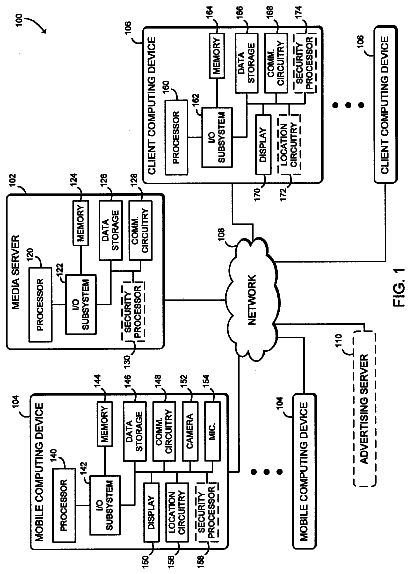
This disclosure generally relates to a plurality of multimodal and multifunction input and output mobile device including intelligent electronic glasses. It is an attribute of the present disclosure to enable mobile devices, advanced smartphones, cellular telephones, tablet computers, smart goggles, intelligent electronic glasses, cameras, smart projectors, smart watches, smart headgear, smart headphones, smart headsets, smart necklaces, smart earrings, and other accessories to provide digital media content acquisition, presentation, and interaction. These mobile device/intelligent electronic glasses/headset may allow for continuous and always-on acquisition of audio, image, video, location, and other content using a plurality of input methods including images sensors. Further, the mobile device/intelligent electronic glasses/headset may display content on a variety of displays and surfaces.
It is an aspect of the present disclosure to enable image based communication between mobile device/intelligent electronic glasses/headset, distributed image sensors, stationary devices, and servers by wired or wireless communication means.
The mobile device/intelligent electronic glasses/headset may enable device or server control including gesture control, retinal control, facial control, and other user interface activities for a variety of electronic devices. In this system, image sensors may be integrated into various mobile devices. Image sensors may also be coupled to a variety of traditional non-electronic devices. As an example, a camera may be integrated into a pair of sunglasses and a display may be affixed to the lens or area proximate to the lens of the glasses. Communication between the mobile devices/intelligent electronic glasses/headset and other devices including Internet or network servers may be completed using wireless transmit and receive radios integrated into the devices.
It is an embodiment in the system to have intelligent electronic glasses or headsets configured to be worn on the body. These intelligent electronic glasses or headsets may be enabled with the full or partial functions previously resident on a smartphone or stationary electronic device. The intelligent electronic glasses may leverage the processing capability of a smartphone or a local or network server and continuously acquire, transmit, and receive digital content.
The intelligent electronic glasses or headset may comprise a full set or subset of these components including: processor; multicore processor; graphics processor; display; high definition display; LCD, LED, see thru LED, see thru mirror display, see thru LCD/LED mirror display or other displays; dual displays for each eye; keyboard; projected keyboard; on screen keyboard; programmable buttons; microphone; noise isolation or noise cancellation; speakerphone; in-ear speaker; digital still camera; digital video camera; front facing camera; back facing camera; side facing camera; eye tracking camera; high definition (HD, 720p, 1020p) camera; light/flash; laser; projector; infrared or proximity sensor; vibration device; LEDs; light sensor; accelerometer; gyroscope; x-y-z positioning; GPS; compass including solid state compass; memory such as flash memory; buffer memory; power sources; battery; rechargeable battery; multiple data and video input and output ports such as audio, ethernet, USB, firewire, 1394, VGA, or HDMI; wireless transmit and receive units such as Bluetooth, WiFi (802.11a,b,c,n,x), Cellular (GSM, Edge, CDMA, others); transmission protocol software such as TCP/IP; one or more antennas including antennas fitted into the frame of the glasses; operating system; software such as image recognition software; access to an software application store; smartphone/tablet, server, cloud, or desktop synchronization software; audio, pictures, and video streaming software; Internet configuration; UI command and control such as gesture control, retinal control, face and expression control; lens; fingerprint resistant lens; replaceable lens; see thru lens; filters; audio and video playback; and various other components. Components may be integrated into ASICs, integrated housing, separated components, or swappable components.
The mobile device may comprise a full set or subset of these components including: processor; multicore processor; graphics processor; display; high definition display; LCD, LED, see thru LED, see thru mirror display, see thru LCD/LED mirror display or other displays; dual displays for each eye; keyboard; projected keyboard; on screen keyboard; programmable buttons; microphone; noise isolation or noise cancellation; speakerphone; in-ear speaker; digital still camera; digital video camera; front facing camera; back facing camera; side facing camera; eye tracking camera; high definition (HD, 720p, 1020p) camera; light/flash; laser; projector; infrared or proximity sensor; vibration device; LEDs; light sensor; accelerometer; gyroscope; x-y-z positioning; GPS; compass including solid state compass; memory such as flash memory; buffer memory; power sources; battery; rechargeable battery; multiple data and video input and output ports such as audio, Ethernet, USB, firewire, 1394, VGA, or HDMI; wireless transmit and receive units such as Bluetooth, WiFi (802.11x), Cellular (GSM, Edge, CDMA, others); transmission protocol software such as TCP/IP; one or more antennas including antennas fitted into the frame of the glasses; operating system; software such as image recognition software; access to an software application store; smartphone/tablet, server, cloud, or desktop synchronization software; audio, pictures, and video streaming software; Internet configuration; UI command and control such as gesture control, retinal control, face and expression control; lens; fingerprint resistant lens; replaceable lens; see thru lens; filters; audio and video playback; and various other components. Components may be housed in various integrated ASICs, integrated housing; separated components, or swappable components.
A watch may comprise a full set or subset of these components including: processor; multicore processor; graphics processor; display; high definition display; LCD, LED, see thru LED, see thru mirror display, see thru LCD/LED mirror display or other displays; dual displays for each eye; keyboard; projected keyboard; on screen keyboard; programmable buttons; microphone; noise isolation or noise cancellation; speakerphone; in-ear speaker; digital still camera; digital video camera; front facing camera; back facing camera; side facing camera; eye tracking camera; high definition (HD, 720p, 1020p) camera; light/flash; laser; projector; infrared or proximity sensor; vibration device; LEDs; light sensor; accelerometer; gyroscope; x-y-z positioning; GPS; compass including solid state compass; memory such as flash memory; buffer memory; power sources; battery; rechargeable battery; multiple data and video input and output ports such as audio, ethernet, USB, firewire, 1394, VGA, or HDMI; wireless transmit and receive units such as Bluetooth, WiFi (802.11x), Cellular (GSM, Edge, CDMA, others); transmission protocol software such as TCP/IP; one or more antennas including antennas fitted into the frame of the glasses; operating system; software such as image recognition software; access to an software application store; smartphone/tablet, server, cloud, or desktop synchronization software; audio, pictures, and video streaming software; Internet configuration; UI command and control such as gesture control, retinal control, face and expression control; audio and video playback; and various other components. Components may be housed in various integrated ASICs, integrated housing; separated components, or swappable components. The watch may function as a second screen or “n-th” screen device for another display such as a smartphone or television.
The cellular telephone, glasses, watch, and other electronic devices may communicate with each other and with local or network servers.
The glasses can be used to take a single picture, a series of pictures, or full motion video through the use of a camera that is mounted on the housing of the glasses frame or integrated into the lens. In the integrated camera model, the camera electronics may be integrated into the frame of the glasses and the lens of the glasses is used as the lens for the camera. Image and video data can be wirelessly uploaded to a remote server or alternatively stored locally on the glasses.
In another aspect of the invention, the glasses may project text on to a physical object.
In another aspect, the intelligent electronic glasses may record an individual touching of an object and classify the object in a data and the object is connected to various meta-data including location, time of day, temperature, proximity to people and other factors.
In another aspect, the intelligent electronic glasses may present in a first lens an advertising or product purchase placement that is viewed in the second lens.
In another aspect, one lens of the intelligent electronic glasses may display all of the prior history associated with an object, such as how many times that object was touched, whether the product is under warranty or not, what the current price of the product is on a used market, what the price of the product.
In another aspect, the user can access an inventory database consisting of all objects in the room or loaned out to a third party. This information may be displayed on the mobile device including intelligent electronic glasses or watch.
In another aspect, a user can trace whether an object is broken based upon how many times an object was used by that member. As an example, an older child may blame this on the younger child if he is accused of breaking something. A camera may record usage of a device, store the history of this usage, analyze the usage, and present recommended view periods of the potential breaking incident.
In another aspect, one lens can browse the internet and the other lens of the glass can present image, video, or text.
In another aspect, the glasses can change from one tint to another to decrease exposure to the eye.
In another aspect, the glasses have a wireless transmit and receive radio built-into the device for continuous and real-time streaming to a local or network server.
In another aspect, the wire frame may be configured as one or more antennas for one or more wireless radios.
In another aspect, the glasses record conversations and auto playback for repeating conversations and agreements of conversations. This may be useful for auditing of contracts, agreements, or events. Alternatively, it may be useful in recording a person's life events.
In another aspect, dual cameras may be used simultaneously. For example, one camera may take a picture and the other camera may acquire video while a microphone captures audio. Alternatively, multiple cameras may be used simultaneously to provide a 360 degree experience. Alternatively, one camera may be a 3D camera.
In another aspect, the camera may work in conjunction with the specific displays on the mobile device, glasses, or watch. For example, a user may select to activate a rear camera so that it is displayed in the left or right lens.
In another aspect, the camera can provide magnification of content by allowing for a zoom function. This may be useful in experiments and thereby obviate the need for a microscope. It may be useful in the driving context to identify road hazards. It may be useful outside to identify stars, clouds, and other items.
In another aspect, the zoom function is done through interpolation thereby providing optical and digital zoom capabilities.
In another aspect, glasses include a micro-projector so that they can display content on to a hand, wall, pavement.
In another aspect, the projected content may be obtained in real time from another set of glasses, video, internet site, or stored media on a server.
In another aspect, a first camera on the glasses captures movement and the second glasses captures movement so as to provide a touch like interface without a surface.
Alternatively, a sensor may send a light pulse to gauge the distance between the hand and the projected image so as to identify where contact was made on the projected image.
Alternatively, a sound may sound may be used to detect distance from the hand to the glasses or may be used to track the send and receive of the signal.
Alternatively, a laser may be used to track and identify gestures.
Alternatively, the glasses may leverage the processing power resident on a second device including a cellular phone, watch or other mobile device.
In another aspect, content acquired from the glasses may be displayed on a TV, watch, or mobile phone.
In another aspect, the glasses may include a flash for pictures or a light and may be integrated into the device or be an attachment.
In another aspect, the resolution of the images may be modified using various lenses varying distance between the eye and the lens or other approaches.
Alternatively, a mobile device may be used and may display on the screen images acquired from a separate camera such as those on a pair of glasses where the images are annotated with content acquired from an internet server or local object. In turn each object may broadcast using RFID or other means information about itself to glasses, phones, server, or other devices. This RFID may be a label and can affix it to other devices.
Alternatively, the label may be a bar code or other image. This label may be a physical or virtual label and may include a barcode or other identifier. A table stored on a server or other device may map the label to data about the object. An owner, gifter, seller, or other person or system may create a data table including object location and other meta data, including purchase data, purchase price, ownership, useful life, willingness to sell object at an offer price. The data set may also pull in real time data including current price used on various exchanges. These objects may be automatically placed on an internet auction for immediate sale. A user may set an aspiration price including for family heirlooms. This obviates the need for the owner to manually post these items on an online exchange.
A user may then use their interface component such as glasses or mobile phone to assess the value of all objects within a home or environment.
The camera mounted on the glasses, smartphone, vacuum cleaner, or other robot may automatically scan home environment. For example, a robotic vacuum cleaner of a hotel may constantly scan a room to determine whether any objects are missing. This map of objects and paths may also be posted to an Internet server or database.
In another embodiment, a user may move a virtual object in a display and have the object move in the physical world by a robot. For example, a chef may move virtual images of objects such as a tomato and a robot may move the tomato in the physical world. This may enable remote cooking for elderly people or friends.
In another embodiment, it may be that one eye or multiple eyes may be impaired. The display may alter resolution, magnification, and other factors by lens to compensate for physical deficiencies.
In another aspect, the mobile device/intelligent electronic glasses/headset/watch may be able to convert spoken audio to text in real time and post the information on one or more displays. As an example, a conversation may appear in the left lens of the glasses as a person is speaking. In the right lens, a set of conversation topics or Internet search terms related to the spoken content may appear.
In another aspect, distance may be measured by modifying one lens and another lens to focus on different focal areas.
In another aspect, a camera at the top of the glasses may zoom in on a hands and a projector may display an image of a keyboard so as to allow typing on the air. A laser may be used to track the gestures. Alternatively an inward facing camera may be used to track eye movement to understand the focus areas of the individual and map these focus areas to the gestures or control activities.
In another aspect, eye-tracking may be enabled on a camera focused on an individuals eyes. This camera may be integrated into the intelligent electronic glasses. Alternatively, it may be a second camera on a mobile phone. This may be used to measure advertising effectiveness such as when an individual watches television or when an individual walks down a street and sees billboards.
Alternatively, eye tracking may be used for fatigued drivers and they may measure pupil dilation, eye strain redness and other factors to assess exhaustion and the potential of falling asleep at the wheel. Alternatively, the glasses may measure physiological problems for medical diagnosis such as glaucoma and cataracts.
In another aspect, the glasses may be used for gaming including scavenger hunts or other activities.
In yet another aspect, the mobile device/intelligent electronic glasses/headset may be used to control actions in a different area. As an example, a person may be at the office and wish to control appliances at home. The display may show the inside of the person's house and allow the individual to make gestures such as turn off and on lights in the virtual reality view. These actions and commands may be recorded by mobile device/intelligent electronic glasses/headset, sent to a server, and in turn sent to a home server or the home device to implement the action. This may allow full home automation and control using the mobile devices/intelligent electronic glasses/headset from remote locations.
The glasses may be part of a network and allow a first individual to take control of another person's glasses. Glasses may be identified by IP address or another unique numeric or alphanumeric ID. In this instance, a user or system may login to the glasses device, update configurations and software, and change the camera acquisition activities and display. As an example, an individual wearing glasses that enters a retail store, may not find a retail store employee to help with a purchase. The store may allow for virtual retail assistants or avatars that can be activated on the display of the glasses or external display. This may allow for automated sales without the need for people. Other payment mechanisms including RFID, NFC, and cloud based storage of credit card information may be used to allow for immediate purchases of products.
In yet another embodiment, digital content may be recorded, streamed, or viewed on a time lapsed basis.
In yet another embodiment, objects and items may be automatically tagged with location, context, purchase, and other related data. For example this may aid a person in identifying where the person left their keys. Information about the last known location of the keys may be automatically recorded by the camera or tagged by the device. This content may be indexed and searched. Alternatively, it may allow a person to run a search query such as identifying all the items in house that were touched.
In yet another embodiment, various statistical, behavioral, and predictive models may be built based on the large or big data obtained from the input devices. As an example, a prediction function may suggest to a concerned family member the likely activities of a relative. Alternatively, a prediction may be made by a server on which types of people tend to look at certain objects and which types tend to ignore certain objects. This could be helpful for a real-estate ad-network.
In yet another object, the mobile device/intelligent electronic glasses/headsets and distributed camera arrays may be used as a security system. Multiple people may opt their devices into a centralized sharing server that may be searched and used for various predictions. This may be helpful in identifying erratic behavior.
In yet another embodiment, various micro-expressions and emotions may be detected by the facial expressions of a person.
In yet another embodiment, a camera may perform lip reading to understand spoken words when audio is not available. This may enable a person wearing intelligent electronic glasses to read the lips of a person far across a room.
Example: Variants of Glasses
In yet another embodiment, the glasses may be manufactured with various versions that account for design, cost, weight, brand, and other factors. One variant of the glasses may include a full helmet or goggles which provide a housing to encompass additional processors, memory, wireless radios, antennas, cameras, GPS, multiple displays, microphone, speakerphone, and battery. Another version of the glasses may only require a low-power processor, battery, memory, camera, Bluetooth, and WiFi radio without a display. Yet another version may be sold with a display. Other versions may be sold with various protocols.
In another embodiment, multiple displays may be provided targeted at both the left and the right eye.
In yet another embodiment, the lens may be split into a multiple areas, where one area may comprise an display, such as an LCD display, and a second area may be clear to provide traditional viewing. In one instance this may be a bifocal lens where one area of the lens is an electronic display and another area of the lens is a traditional non-electronic lens.
In another embodiment, the device may include an over the ear clip, microphone, in-ear speaker, battery, and display configured to wrap around the forehead and positioned in front of the left or right eye. This item may include a rotatable hinge located above the over the ear component to allow for the display in front of the eye to be moved up or down. It is anticipated that the electronics including sensors and memory will continue to improve in efficiency and capabilities so as to increase the features offered in a smaller lighter package.
In yet another aspect, the functions of the glasses may also integrated into earnings, headsets and necklaces. These devices may be configured with one or more antennas, one or more wireless or wired transmit and receive radios, one or more processors, one or more buttons, one or more cameras, one or more lasers, one or more microphones, one or more speakerphones, one or more touch or non-touch screen displays, a miniaturized projector, battery, and power input and output.
In another variation of the glasses, the glasses may be configured with multiple cameras including a front facing camera and a back-facing camera.
In another variation of the system is for the glasses to be configured with replaceable frames and lenses. It is another variation for the lenses to be configured with varying levels of polarization. The polarized may enable the frames to reduce glare. These polarized lenses may have a variety of filters associated with them. The filters may be integrated into the lens. Alternatively, the frames may be equipped with several lenses that may be attached to the device simultaneously. A lens may be moved from an active position and rotated 90 degrees up to an inactive position. Alternatively, a lens may be configured with multiple filters.
In yet another embodiment, a contact lens may be configured into an electronic contact lens enabled with a display, transmit and receive component, antenna, and micro battery. The battery may be charged or the lens transmission may be powered by natural fluid movement in the eye or by blinking the eye.
In another variation of the glasses, the polarization may be modified by physical replacement of the lens. The glasses may provide an easy pop-in and pop out of the lenses. Alternatively the frame may also be easily replaceable, where the side frames of the glasses may be affixed to the center frame of the glasses using screws or clips.
In another variation of the glasses, the polarization may be modified by a physical dial on the glasses. Alternatively, the polarization may be modified automatically using a light sensor integrated into the glasses, a CT/MD, a watch, or other proximate or remote device.
In another variation of the glasses, the polarization may be modified by a cellular telephone or mobile device. An application configured to run on the cellular telephone or mobile device may present various settings to the control the glasses. The application may provide various configuration settings for a user to manage their glasses. As an example, the application may provide a calibration setting where the CT/MD, glasses, watch, or other device captures the ambient light including wavelengths, and appropriate determines a filter to apply to the glasses.
In yet another embodiment of the lenses, the may be configured with anti-reflective lens or progressive lens and other glare reduction means.
In yet another embodiment, the lens may be include prescription lens or sunglass lens.
In yet another embodiment, the lens may be configured with a wide field of view.
In yet another embodiment, reflected light may be removed when displayed.
Example: Glasses for Physical Activities and Sports
It is another aspect, the system may allow for a user to be able to define the activity that is currently being performed and match the filter on the glasses to the activity. As an example, an individual that is playing tennis may desire for the filter to provide more clarity on a yellow tennis ball and the white markings on the court.
In yet another variation the mobile device/intelligent electronic glasses/headset may be enabled with training specific software. A laser configured on the housing of the glasses, headband, necklace or other external device may be used to assess the speed of objects or people. A laser on the glasses may target a tennis ball. A camera may image the tennis ball. A specialized miniaturized radio transmitter and receiver such as a radar gun including various radar forms could be used to determine the speed of the ball by transmitting a signal focused on the object, measuring the return signal, and calculating the frequency of the signal. The data captured associated with the device may be processed in real time by a local device or a remote server to predict the movement of the object. The predicted position of the object may be used to allow an individual more time to react to the object. For example, the tennis ball may be shown in glasses in a virtual representation as being closer to the individual than in the physical world so that a user may react more quickly to the ball if the user is shown to be responding slow to the tennis balls. Alternatively, the perception may be a calibration setting that can be configured on the glasses, a CT/MD, or a server. The speed of the ball may be displayed on the glasses, a CT/MD, posted to an Internet web page, or stored on a server.
In yet another embodiment, the mobile device/intelligent electronic glasses/headset may also be used in other sports such as golf. In this embodiment, a camera may image the golf ball, stroke, and distance of the ball from the tee.
Alternatively, the mobile device/intelligent electronic glasses/headset may be used in a football context where the ball may be measured for the appropriate spin, speed, and distance. In yet another embodiment, a biker may use the mobile device/intelligent electronic glasses/headset while biking on city streets or through nature. In this embodiment, the glasses may identify cars around the biker. The mobile device/intelligent electronic glasses/headset may further provide a speedometer, acceleration, and various other statistics about the movement of the individual.
Example: Transportation and Glasses in Moving Vehicles
In yet another variation, the intelligent electronic glasses may be used in a car. The glasses may image the cars in front, on the side and/or behind the vehicle that an individual is presently in. The glasses may send the data to the CT/MD for further processing, a watch, wireless processor enabled necklace, server located in the car, or a remote server. The glasses may acquire the images of the vehicles in close proximity to the current vehicle, measure the speed of the neighboring vehicles, and track the trajectory of the vehicle. If a vehicle is moving closer than predicted by the system to the present user, the glasses may present a warning indicator on the screen of the classes; a spoken audio through the speakerphone of the CT/MD or car; a vibration of the phone or the glasses. A camera may further be integrated a car vehicle on the top and/or sides of the car. These images may further be sent to the displays in the car, on the mobile device, or the intelligent electronic glasses/headset.
The glasses when used by a driver may also be a tool to give feedback on the driving experience, potential for road hazards or incorrect driver behavior. The glasses may image the road ahead of the vehicle. The images may highlight potholes, sharp turns, obstructions in the roadway, animals, and other objects. The glasses may send the images acquired using the camera to the CT/MD or server for further processing or the glasses may optionally be configured with a higher end processor to perform some level of processing. The CT/MD may assess the danger of the object such as a pothole and suggest a corrective action to the driver. The corrective action may be a synthesized spoken audio command indicating the action to take or it may be a visual message that appears on the lens of the glasses or projected from the glasses onto the windshield of the car.
In yet another embodiment, the mobile device/intelligent electronic glasses/headset may be enabled with thermal imaging capabilities or with radiation scanner which identifies radiation such as terahertz radiation. This may be used by TSA personnel to scan a person in an airport or by local police to scan individuals in a crowd for illicit objects.
Example: Electronic Earnings, Necklace, and Shoes
In another embodiment, a variety of other items including earrings, necklaces, and shoes may be enabled with electronic components to provide I/O and control. Alternatively, a camera and microphone may be clipped onto a shirt or object to capture images and video.
In another variation, a see thru LED, LCD, or other type of mirror may function as a display.
Example: Location Positioning Using Networks and Cameras
In yet another variation, a camera network may continuously capture data about people, objects, and environmental factors. As an example, a location of an individual may be obtained by a reading from image and facial recognition of a picture obtained from a camera.
In yet another variation, the song and music information may be shown in the display. A song played in a coffee shop may be recognized and the meta information about the song may be shown in the display of the glasses or mobile device.
In yet another embodiment, the mobile device/intelligent electronic glasses/headsets may be used in academic or science environment. This may allow a student to use the camera as a microscope or telescope.
In yet another embodiment, the mobile device/intelligent electronic glasses/headsets may allow for complete video acquisition of an event and then subsequent replay of that event. For example, a person with the camera may record a full 360 immersive show and then allow the show to be replayed on another display in real time or time shifted. As an example, a music concert may be recorded using the mobile device/intelligent electronic glasses and then replayed later. Alternatively, meta data about the songs and the concert may be added in real time. Content may be magnified or zoomed in.
In yet another embodiment, a person wearing the mobile device/intelligent electronic glasses/headset may have a room automatically imaged. In this situation, the people may be recognized either by the spoke audio using voice recognition or facial recognition. A list of all the people and social data about the people may be displayed on a screen or the lens of the glasses. The system may further suggest conversation topics for each person in the room.
In yet another embodiment, a person's activities may be automatically posted to a public or private web pages, social network, data storage server, or synchronized across devices.
In yet another embodiment, the mobile device/intelligent electronic glasses/headset may be used to scan and ISBN, QR, barcode, or recognize an image of a product based on the design or label and provide reviews, ratings, comparison shopping data, or other information about the recognized product.
In yet another embodiment, an advertiser may be able to bid on all the advertisements associated with a specific person's view in the intelligent electronic glasses.
In yet another embodiment, a person wearing the glasses may patch in avatars, images, and objects into the environment. As an example, absent family member may be patched in for dinner. The person may be connected to an audio of that individual or pre-recorded messages from the individual. These pre-recorded messages may have been obtained from a database or recorded audio.
In a related embodiment, a camera may scan a person's iris for retinal data and perform a match between the retinal scan and a stored image in a server. The match can identify the location of a user as being proximate to the image sensor that acquired the iris shot. Alternatively, an image or video or related content may be projected on to the retina or displayed in very close proximity to the retina.
It is an aspect of the present disclosure to enable the construction and implementation of virtual image based networks.
The description continues in the full USPTO document.
 Lapsed, fee not paid5 drawings