Cross reference to related applications
This application is the National Phase of PCT/JP2014/051795, filed Jan. 28, 2014, which claims priority to Japanese Application No. 2013-016664, filed Jan. 31, 2013.
Technical field
The present invention is related to an electrode for a lithium battery capable of being used for e.g., a positive electrode plate for a lithium battery, and its production process, as well as a lithium battery including said electrode for a lithium battery.
Background art
Lithium batteries, which are repeatedly useable by charging, have been attracting much attention with recent expectation for environment conservation and carbon reduction. The lithium batteries have many benefits such as having higher energy density, being more lightweight and having longer life span as compared with conventional secondary batteries including nickel hydrogen batteries and lead storage batteries. For these reasons, they are widely used as power sources for electric devices such as mobile phones and notebook computers and electric power tools, and moreover they are focused also as a power source for hybrid automobiles and electric automobiles.
However, automobiles having a lithium battery mounted therein present a significant problem in its safety. A technique for enhancing the safety of the lithium battery that has been reported is the use of maleimide-based polymers (Patent Document 1). CITATION LIST Patent Literature
Patent Document 1: JP-A-2012-138359 SUMMARY OF THE INVENTION Technical Problem
A binder in the above technique is PVDF (polyvinylidene fluoride), which is soluble in a pyrrolidone-based solvent. Therefore, coating electrode plates with the maleimide-based polymer, which is also soluble in a pyrrolidone-based solvent, can thus cause the pyrrolidone-based solvent to infiltrate and swell a positive electrode plate and/or a negative electrode plate, possibly having an adverse effect on, e.g., battery performance.
The present invention has been made to solve such a problem as described above associated with conventional art. It is thus an object of the present invention to provide a process for producing an electrode for a lithium battery, in which a positive electrode plate and/or a negative electrode plate, even when coated with a thermal activation material dissolved in an organic solvent such as a pyrrolidone-based solvent, is prevented from swelling. The present invention further provides an electrode for a lithium battery that is capable of providing a lithium battery having both high safety and high battery properties; and provides a lithium battery including said electrode for a lithium battery. Technical Solution
The present inventors earnestly studied to solve the above problem, and have found out that the above problem can be solved by using an electrode for a lithium battery (particularly, positive electrode plate for a lithium battery) produced by a process including specific production steps; and by using a lithium battery obtained from components including said electrode (particularly, said positive electrode plate). Also, the present inventors also have found out that the above problem can be solved by using an electrode for a lithium battery containing a specific kind of adhesive as an adhesive (or binder) used at a specific position.
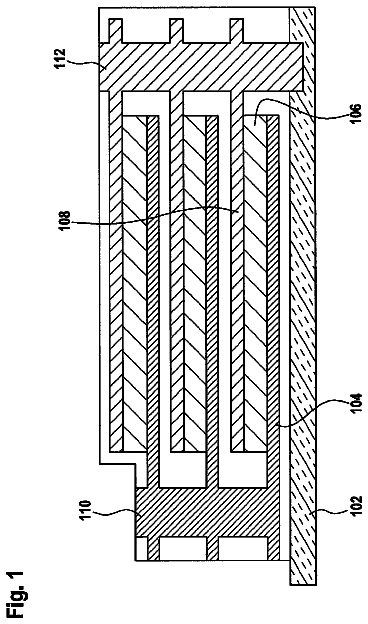
An electrode for a lithium battery of the present invention includes an electrode plate, a mix layer and a heat insulating layer in this order, wherein the mix layer includes at least an aqueous adhesive and an active material; the heat insulating layer includes at least a thermal activation material; and at least part of the mix layer is in contact with at least part of the heat insulating layer.
Preferably, the thermal activation material is a nitrogen-containing polymer that is soluble in an organic solvent and does not swell in water.
Preferably, the nitrogen-containing polymer contains at least one kind of component selected from the group consisting of amines, amides, imides, maleimides and imines and contains a component derived from diones.
Preferably, the aqueous adhesive is an adhesive obtained by dispersing or dissolving in water at least one of an olefin resin and an acrylic resin.
A process for producing an electrode for a lithium battery includes a mix layer formation step of applying a mix slurry that contains an active material and an aqueous adhesive onto a surface of an electrode plate to form a mix layer; and a heat insulating layer formation step of forming a heat insulating layer that contains a thermal activation material on a surface of the mix layer, the steps being carried out in this order.
Preferably, the heat insulating layer formation step is a step of applying a thermal activation material dissolved in an organic solvent onto the surface of the mix layer to form the heat insulating layer.
Further, the present invention also provides a lithium battery including the electrode for a lithium battery. Effects of the Invention
The inventive electrode for a lithium battery is capable of reducing swelling of electrode plates, thus being able to provide lithium batteries having both high safety and high battery properties. Further, according to the production process of the present invention, even when an electrode, in its preparation, has a thermal activation material dissolved in an organic solvent such as a pyrrolidone-based solvent, particularly even when a positive electrode plate, in its preparation, has a thermal activation material dissolved in an organic solvent such as a pyrrolidone-based solvent, that electrode, particularly that positive electrode plate, does not swell. This leads to obtaining lithium batteries having both high stability and high battery properties. Such lithium batteries are suited for a power source for hybrid automobiles and electric automobiles. Embodiments of the Invention
The lithium battery of the present invention includes an electrode for a lithium battery which will be described later.
A lithium battery generally has a structure containing a positive electrode, a negative electrode, a separator and an electrolyte solution, and in its typical embodiment has a structure containing a positive electrode plate (a), a negative electrode plate (b), a separator (c), an electrolyte solution (d) and an outer package material (e), wherein the positive electrode plate is opposite to the negative electrode plate via the separator, and an entirety of the battery is filled with the electrolyte solution.
As will be described later, the lithium battery of the present invention uses the inventive electrode for a lithium battery, which will be described later, as the positive electrode and/or the negative electrode, e.g., as the positive electrode plate (a) and/or the negative electrode plate (b). The inventive electrode for a lithium battery can be used particularly preferably as the positive electrode, e.g., as the positive electrode plate (a). An exemplary lithium battery according to a particularly preferred embodiment of the present invention includes the positive electrode plate (a) obtained by a method including the production process of the present invention (that is, a process for producing an electrode for a lithium battery of the present invention which will be described later); the negative electrode plate (b); the separator (c); the electrolyte solution (d); and the outer package material (e). The positive electrode plate is opposite to the negative electrode plate via the separator, and an entirety of the battery is filled with the electrolyte solution.
Hereinafter, the present invention will be described in detail.
[Electrode for Lithium Battery]
The electrode for a lithium battery according to the present invention includes an electrode plate, a mix layer, and a heat insulating layer, in this order.
In the inventive electrode for a lithium battery, the mix layer contains at least an aqueous adhesive and an active material; and the heat insulating layer contains at least a thermal activation material. At least part of the mix layer is in contact with at least part of the heat insulating layer.
The inventive electrode for a lithium battery described above may be a positive electrode or may be a negative electrode. That is, the inventive electrode for a lithium battery, in the lithium battery, may constitute the positive electrode plate (a), or may constitute the negative electrode plate (b). In a preferred embodiment of the present invention, the inventive electrode for a lithium battery is used as the positive electrode, in which case the inventive electrode for a lithium battery constitutes the positive electrode plate (a) in the lithium battery.
Hereinafter, constituent elements that constitute the inventive electrode for a lithium battery will be described.
[Positive Electrode Plate]
The positive electrode plate (a) is obtained by a process including a step of preparing a mix slurry (also referred to as an electrode slurry) containing at least a positive electrode active material and an aqueous adhesive and then applying the slurry onto a surface of an electrode plate to form an electrode mix layer; and a step of forming a thermal activation material on a surface of the electrode mix layer.
[Mix Layer]
The mix layer, which constitutes the inventive electrode for a lithium battery, contains at least the aqueous adhesive and the active material. The mix layer used in the present invention, because of containing the active material, functions as a site where electrode reaction occurs.
The inventive electrode for a lithium battery is employable both as the positive electrode and as the negative electrode. Specifically, when the active material constituting the mix layer is a positive electrode active material described later, the inventive electrode for a lithium battery functions as the positive electrode and is capable of being used as the positive electrode plate (a). On the other hand, when the active material constituting the mix layer is a negative electrode active material described later, the inventive electrode for a lithium battery functions as the negative electrode, and is capable of being used as the negative electrode plate (b).
In a preferred embodiment of the present invention, the inventive electrode for a lithium battery is an electrode for a lithium battery in which the active material constituting the mix layer is the positive electrode active material. In this embodiment, the inventive electrode, due to functioning as the positive electrode, is used the positive electrode plate (a).
The mix layer as used herein is sometimes called an “electrode mix layer”.
(Positive Electrode Active Material)
In the present invention, the positive electrode active material capable of constituting the mix layer may be the one known as being used for electrochemical cells. Examples of positive electrode active materials employable in the present invention include composite oxides composed of lithium and a transition metal, such as LiMnO.sub.2, LiMn.sub.2O.sub.4, LiCoO.sub.2, Li.sub.2Cr.sub.2O.sub.7, Li.sub.2CrO.sub.4, LiNiO.sub.2, LiFeO.sub.2, LiNi.sub.xCo.sub.1-xO.sub.2 (0<x<1), LiMPO.sub.4 (e.g., a transition metal defined by M being Fe), LiMn.sub.0.5Ni.sub.0.5O.sub.2, LiNi.sub.xCo.sub.yMn.sub.zO.sub.2 (x+y+z=1) LiNi.sub.xCo.sub.yAl.sub.zO.sub.2 (x+y+z=1), LiM.sub.0.5Mn.sub.1.5O.sub.4 (M=a divalent metal); as well as organic polymer materials such as polyaniline, polythiophene, polypyrrole, polyacetylene, polyacene and dimercaptothiadiazole/polyaniline composites.
(Negative Electrode Active Material)
As the negative electrode active material, known materials capable of doping and dedoping lithium ions may be used with no particular limitation. Examples thereof include carbides, lithium alloys and metal oxides. Examples of the carbides include carbon powder, graphite, carbon fibers and carbon nanotube. Examples of the lithium alloys are alloys formed by lithium together with any of a silicon atom, a tin atom and a germanium atom, or with any of oxides, carbides, nitrides, carbonitrides and the like which contain any one of these atoms. Examples of negative electrode material containing a silicon atom include silicon alloys and compounds formed by silicon together with any of boron, nitrogen, oxygen and carbon, as well as silicon compounds containing any of tin, nickel, copper, iron, cobalt, manganese, zinc, indium, silver, titanium, germanium, bismuth, antimony and chromium. Examples of the silicon alloys or compounds include SiB.sub.4, SiB.sub.5, Mg.sub.2Si, Ni.sub.2Si, TiSi.sub.2, MoSi.sub.2, CoSi.sub.2, NiSi.sub.2, CaSi.sub.2, CrSi.sub.2, Cu.sub.5Si, FeSi.sub.2, MnSi.sub.2, NbSi.sub.2, TaSi.sub.2, VSi.sub.2, WSi.sub.2, ZnSi.sub.2, SiC, Si.sub.3N.sub.4, Si.sub.2N.sub.2O, SiO.sub.x (0<x≤2) and LiSiO. Examples of negative electrode active materials containing a tin atom include tin alloys and compounds containing any of silicon, nickel, copper, iron, cobalt, manganese, zinc, indium, silver, titanium, germanium, bismuth, antimony and chromium; as well as compounds formed by tin together with any of oxygen, carbon and nitrogen. Examples of negative electrode active materials containing a germanium atom include germanium alloys and compounds containing any of silicon, nickel, copper, iron, cobalt, manganese, zinc, indium, silver, titanium, germanium, bismuth, antimony and chromium; as well as compounds formed by germanium together with any of oxygen, carbon and nitrogen. Other examples include LiAl, Li.sub.3Cd, Li.sub.4.4Pb, In.sub.2O, In.sub.2O.sub.3, PbO, PbO.sub.2, Pb.sub.2O.sub.3, Pb.sub.3O.sub.4, Ag.sub.2O, AgO, Ag.sub.2O.sub.3, ZnO, CoO, NiO, FeO, TiO.sub.2, and Li.sub.3Ti.sub.5O.sub.12. These negative electrode active materials may be used singly, or in combination of two or more kinds.
In the specification, the term “active material” is sometimes used as a concept collectively referring to the positive electrode active material and the negative electrode active material.
(Aqueous Adhesive)
The aqueous adhesive is, for example, an adhesive using water as a solvent or an emulsion adhesive using water as a dispersion medium. In the present invention, the aqueous adhesive is used as a binder for disposing the active material on a surface of the electrode plate (collector). Adopting the mix layer containing the aqueous adhesive in the inventive electrode for a lithium battery provides an advantageous effect that, even when an organic solvent, e.g., a pyrrolidone-based solvent, is used to form the heat insulating layer which will be described later, the resultant electrode, when used as the positive electrode plate and/or as the negative electrode plate, does not swell. Such an advantageous effect is accomplished particularly when the inventive electrode for a lithium battery having the mix layer containing the aqueous adhesive is adopted in the positive electrode, e.g., the positive electrode plate (a).
In the present invention, the aqueous adhesive is given by dissolving an adhesive component in water, or by dispersing particles of an adhesive component in water. The dispersing as used herein refers to an act providing a state in which particles when visually observed are dispersed without being agglomerated in the adhesive, wherein part of the particles may be dissolved. Examples of the adhesive component are polymers of olefin resins and acrylic resins.
A polymer contained in the aqueous adhesive is not particularly limited as long as it functions as an adhesive component, is capable of being dissolved or dispersed in water, and does not impair performance of the mix layer. Examples of such a polymer include polymers composed of one kind of monomer or two or more kinds of monomers selected from olefin-based monomers, acrylic monomers, diene-based monomers, halogen-based monomers, vinyl-based monomers, silicone-based monomers, halogenated olefin-based monomers, urethane-based monomers, amide-based monomers and imide-based monomers. Preferred are olefin monomers, acrylic monomers and diene-based monomers.
Examples of the olefin monomers capable of constituting the polymer described above include ethylene, propylene and 1-butene. Examples of the acrylic monomers include acrylic acid, methacrylic acid, crotonic acid, itaconic acid, fumaric acid, maleic acid, hydroxyethyl acrylate, hydroxypropyl acrylate, methyl acrylate, ethyl acrylate, n-butyl acrylate, iso-butyl acrylate, 2-ethylhexyl acrylate, lauryl acrylate, methyl methacrylate, ethyl methacrylate, n-butyl methacrylate, iso-butyl methacrylate, 2-ethylhexyl methacrylate, lauryl methacrylate, acrylonitrile, methacrylonitrile, acrylamide, methacrylamide, and acrylic sulfonic acid. Examples of the diene-based monomers include butadiene. Examples of the silicone-based monomers include diorganosiloxanes or organosiloxanes having e.g., a vinyl group, an allyl group, a propenyl group, an isopropenyl group or a butenyl group. Examples of the halogen-based monomers include ethylene tetrafluoride and chlorotrifluoroethylene. Examples of the vinyl-based monomers include vinyl alcohol, vinyl acetate, divinylbenzene, styrene and vinyl stearate.
Examples of preferred embodiments of the aqueous adhesive described above are olefin resins having constituent units corresponding to the olefin monomers as well as acrylic resins having constituent units corresponding to the acrylic monomers, at least one of these resins being dispersed or dissolved in water. For example, the aqueous adhesive is preferably a polyolefin adhesive having as a constituent unit at least one kind of olefin monomer.
The synthesis of the aqueous adhesive, given by dispersing or dissolving in water, is not particularly limited in its production process, as long as the polymer is dispersed or dissolved in water. An exemplary adoptable method for synthesis of and dispersing or dissolving such an aqueous adhesive in water may be a known polymerization method, such as emulsification polymerization method, suspension polymerization method, dispersion polymerization method, or solution polymerization method. Other adoptable methods include a method in which a polymer is previously prepared and the polymer is turned into a molten resin, and then the resin is forcibly torn apart in water by stirring; and a method of adding water to a resin that has been molten and kneaded with an extruder.
In the aqueous adhesive of the present invention, another solvent may be mixed with water as long as the effects of the present invention are achieved. Examples of the solvent to be mixed with water include aliphatic alcohols such as ethanol and isopropyl alcohol; ketone-based solvents such as acetone, methyl isobutyl ketone and methyl ethyl ketone; ester-based solvents such as ethyl acetate, butyl acetate, γ-butyrolactone, ϵ-caprolactone; and amide-based solvents such as N,N-dimethylacetamide and N,N-dimethylformamide. These may be used singly or in combination of two or more kinds at the time of mixing.
In use of the inventive electrode for a lithium battery as a positive electrode, an amount ratio between the positive electrode active material and the aqueous adhesive at the time of preparing the mix slurry is not particularly limited, but is preferably 1 to 20 parts by mass (in terms of solid content) of the aqueous adhesive based on 100 parts by mass of the positive electrode active material.
On the other hand, in use of the inventive electrode for a lithium battery as a negative electrode, an amount ratio between the negative electrode active material and the aqueous adhesive at the time of preparing the mix slurry is not particularly limited, but is preferably 0.5 to 20 parts by mass (in terms of solid content) of the aqueous adhesive based on 100 parts by mass of the negative electrode active material.
(Other Component)
The mix layer used in the present invention, in addition to containing the active material and the aqueous adhesive, may contain appropriate components for producing the mix layer. For example, when the mix layer used in the present invention is formed from the mix slurry, the mix layer contains in some cases various blending components derived from the mix slurry. Examples of such various blending components derived from the mix slurry include known conductive assistants such as thickening agents, and (conductive) carbon black and graphite, as well as other additives such as surfactants, dispersing agents, wetting agents and defoaming agents. Specific examples of these various blending components will be provided in the section “Process for Forming Mix Layer” described below.
(Process for Forming Mix Layer)
The mix layer, which constitutes the electrode for a lithium battery according to the present invention, is producible by preparing an aqueous mix slurry (also referred to as a “mix slurry” herein) and then applying the slurry onto a surface of a collector (electrode plate) and its drying. In this case, the mix slurry contains, as essential components, the active material and the aqueous adhesive. In the inventive process for producing an electrode for a lithium battery which will be described later, the step of applying the mix slurry onto the surface of the electrode plate to form the mix layer is sometimes called a mix layer formation step.
The mix slurry, in addition to containing the essential components which are the active material and the aqueous adhesive, may contain a thickening agent. As the thickening agent, known thickening agents may be used which are used for electrochemical cells. Examples thereof include cellulose-based polymers such as carboxymethyl cellulose, methylcellulose and hydroxypropyl cellulose as well as their ammonium salts and alkali metal salts; (modified) poly(meth)acrylic acids and their ammonium salts and alkali metal salts; (modified) polyvinyl alcohols, copolymers of a vinyl alcohol and acrylic acid or an acrylic acid salt, and polyvinyl alcohols including copolymers of a vinyl alcohol and maleic anhydride or maleic acid or fumaric acid; and polyethylene glycol, polyethylene oxide, polyvinyl pyrrolidone, modified polyacrylic acid, oxide starches, phosphoric acid starch, casein, and various modified starches.
The mix slurry may contain known conductive assistants such as (conductive) carbon black and graphite.
As needed, an additive may be added to the mix slurry. The additive is not particularly limited as long as the effects of the present invention are achieved. Examples thereof include surfactants, dispersing agents, wetting agents and defoaming agents.
The mix slurry, in its preparation, is obtained by adding water, the positive electrode active material, the conductive assistant, the aqueous adhesive, the thickening agent, an additive to be added as needed, and a solvent other than water to be added as needed, to a stirring device and stirring them. As the solvent other than water, for example, solvents listed for the aqueous adhesive may be used. The preparation of the mix slurry is not limited in terms of type of stirring devices. Examples thereof include a ball mill, a sand mill, a pigment dispersing machine, a grinding machine, an ultrasonic dispersing machine, a homogenizer, a planetary mixer, a Hobart mixer, and a high-speed stirring machine.
In applying the mix slurry onto a collector and drying the mix slurry, its application and drying methods are not particularly limited. Exemplary methods include slot-die coating, slide coating, curtain coating and gravure coating. Exemplary drying methods include drying using warm air, hot air or low-humidity air, vacuum drying, and drying using (far) infrared ray. Drying time and drying temperature are not particularly limited, but drying time is usually 1 to 30 minutes, and drying temperature is usually 40 to 180° C.
It is preferred in the production process of the present invention that the step of applying the mix slurry onto a collector and drying the mix slurry be followed by a step of pressure application treatment using a pressing mold, a pressing roll or the like which is aimed at reducing porosity of the active material layer.
[Heat Insulating Layer]
In the present invention, the heat insulating layer contains at least the thermal activation material. In the inventive electrode for a lithium battery, at least part of the mix layer is in contact with at least part of the heat insulating layer. In other words, in the inventive electrode for a lithium battery, the heat insulating layer exists in such a manner that at least part thereof is in contact with at least part of the mix layer. In a typical embodiment of the present invention, the heat insulating layer containing the thermal activation material is formed on a surface of the electrode mix layer (i.e., the mix layer).
In the present invention, the thermal activation material, which constitutes the heat insulating layer, is a material which, with increase of temperature of the lithium battery, comes to be activated to cause crosslinking reaction. By the thermal activation material being converted to a polymer, lithium ions are prevented from diffusing, which lowers conductivity of the electrolyte solution. The thermal activation material, which through its crosslinking reaction inhibits oxygen molecules from being released from the positive electrode, inhibits exothermic reaction from taking place between the positive electrode and the electrolyte solution, thereby playing a part also in improving the safety of the lithium battery.
(Thermal Activation Material)
As long as exhibiting such performance as described above and maintaining the performance of the present invention, the thermal activation material is not particularly limited in its ingredient, but is preferably a nitrogen-containing polymer which is soluble in an organic solvent and does not swell in water.
The phrase “soluble in an organic solvent” described for the thermal activation material refers to a situation where a residue given when 1 g of the thermal activation material put in an organic solvent is stirred at room temperature for 1 hour and filtered through a 100-mesh filter weighs not more than 0.5 g. The “organic solvent” is preferably an organic solvent having a solubility parameter (SP value) of 22 to 26 (MPa).sup.1/2. ASP value of a solvent can be determined, for example, by a method described in “Polymer Handbook”, Fourth edition, VII-page 675 to VII-page 711, the method being specifically described in Table 1 (VII-page 683) and Tables 7 to 8 (VII-page 688 to VII-page 711). ASP value of a mixed solvent composed of multiple solvents can be determined by known method. For example, a SP value of a mixed solvent can be determined, assuming that additivity is established, as a sum of all of products, each product of a SP value of each solvent and a volume proportion of each solvent.
The phrase “not swell in water” described for the thermal activation material means that a swell percentage as determined by a method described below is not more than 100%. Swell percentage (%)=[( Y−X )/ X]× 100
(wherein, when X g of the thermal activation material is added to water at room temperature, and this is followed by stirring and filtration, a weight of the resultant residue is defined as Y g.)
As the thermal activation material described above, for example, thermal activation materials described, for example, in JP-A-2012-134149 and JP-A-2012-138359, may be used. Specifically, preferred nitrogen-containing polymers employable in the present invention include nitrogen-containing compounds having a number average molecular weight of at least 1500, or nitrogen-containing oligomers having a number average molecular weight of about 200 to 2999. In an embodiment, the thermal activation material may be the one containing a nitrogen-containing polymer wherein the nitrogen-containing polymer is a hyper branched polymer formed by reaction of at least one component selected from the group consisting of amines, amides, imides, maleimides and imines with a dione. That is, the nitrogen-containing polymer according to a preferred embodiment of the present invention contains at least one component selected from the group consisting of amines, amides, imides, maleimides and imines and contains a component derived from diones. Specific examples of amines, amides, imides, maleimides and imines, any of which constitutes the nitrogen-containing polymer, are those described in JP-A-2012-134149. In more detail, diones include barbituric acid, derivatives of barbituric acid, acetylacetone, and derivatives of acetylacetone. Among them, preferred are nitrogen-containing polymers obtained from components including both a bismaleimide monomer such as N,N′-bismaleimide-4,4′-diphenylmethane (BMI) and barbituric acid (BTA).
A molar ratio of a necessary amount of a dione to a necessary amount of a monomer of amine, amide, imide, maleimide or imine ranges between about 1:20 and 4:1. The molar ratio more preferably ranges between about 1:5 and 2:1. The molar ratio still more preferably ranges between about 1:3 and 1:1.
The thermal activation material, before its thermal activation, is usually dispersed uniformly within the heat insulating layer. Notably, the thermal activation material, before its thermal activation, is a macromolecular material, and therefore does not affect diffusion of lithium ions in the lithium battery. Increase in temperature of the lithium battery, meanwhile, causes crosslinking reaction to take place in the thermal activation material, which causes the thermal activation material to be converted to a polymer. This delays the diffusion of lithium ions, which in turn decreases conductivity of the electrolyte solution, thereby being able to enhancing safety. In other words, at the time temperature of the lithium battery is elevated, crosslinking reaction takes place at terminal groups of the thermal activation material, which inhibits the diffusion of lithium ions. This makes it possible to suppress the release of oxygen molecules from heated plates, and to prevent exothermic reaction from taking place between the plates and the electrolyte solution in the lithium battery, leading to enhanced safety of the lithium battery. Temperature of the crosslinking reaction of the thermal activation material is an onset temperature. For example, when a nitrogen-containing polymer is formed as a result of reaction between bismaleimide and barbituric acid, the terminal groups of the thermal activation material having an ethenyl group (derived from bismaleimide) and an amino group (derived from barbituric acid), the thermal activation temperature is a temperature of the crosslinking reaction between an ethenyl group and an amino group that takes place when a temperature of the battery is elevated. In the present invention, the thermal activation temperature is about 80 to 280° C. The thermal activation temperature is more preferably about 100 to 220° C. The thermal activation temperature is still more preferably about 130 to 200° C.
(Other Component)
The heat insulating layer, not only containing the thermal activation material, but also may contain according to purpose inorganic materials such as Al, Mg, Si, Zr, Ti, Zn, Li and Co, or its oxides, its hydroxides, its sulfides, its nitrides or its halides; lithium-containing salts such as Li.sub.2CO.sub.3; and oxides, hydroxides, sulfides, nitrides, carbonates, halides each of which contains lithium. Further, the heat insulating layer may contain an adhesive: for example, polyvinylidene fluoride dissolved or dispersed in a Brønsted base solvent such as N-methylpyrrolidone (NMP), dimethylformamide (DMF), dimethylacetamide (DMAC), pyrrolidone, and N-dodecylpyrrolidone; or a Brønsted neutral solvent such as γ-butyrolactone (GBL); or a solvent given by combining any of these solvents.
(Process for Forming Heat Insulating Layer)
In the present invention, a process for forming the heat insulating layer on a surface of the electrode mix layer (i.e., the mix layer) is not particularly limited, but is preferably done by way of coating. In a typical embodiment of the present invention, the heat insulating layer can be formed by applying the thermal activation material dissolved in an organic solvent onto the mix layer surface. In this case, by the organic solvent contained in the slurry applied evaporating, the application of the thermal activation material and other components to be optionally used is completed, so that the heat insulating layer containing at least the thermal activation material is formed on the mix layer surface.
As coating method, slot-die coating, slide coating, curtain coating, or gravure coating is preferable. Another employable method other than the coating is by way of spray coating. A coating liquid is usually a liquid containing the thermal activation material and an appropriate organic solvent. Examples of a preferred organic solvent that constitutes such a coating liquid include Brønsted base solvents such as N-methylpyrrolidone (NMP), dimethylformamide (DMF), dimethylacetamide (DMAC), pyrrolidone, N-dodecylpyrrolidone, or solvents given by combining any of these. In order to control an acidity-base value, to the Brønsted base described above, another solvent, for example, a Brønsted neutral solvent, e.g., γ-butyrolactone (GBL), may be added.
In the inventive process for producing an electrode for a lithium battery, which will be described below, the step of forming the heat insulating layer containing the thermal activation material on the surface of the mix layer is sometimes called a heat insulating layer formation step.
A thickness of the heat insulating layer, which is not particularly limited, is preferably about 0.1 to 50 μm.
[Process for Producing Electrode for Lithium Battery]
The present invention provides, as a second invention, a process for producing an electrode for a lithium battery.
The process for producing an electrode for a lithium battery according to the present invention includes
a mix layer formation step of applying the mix slurry that contains the active material and the aqueous adhesive onto a surface of an electrode plate to form the mix layer; and
a heat insulating layer formation step of forming the heat insulating layer that contains the thermal activation material on the surface of the mix layer, the steps being carried out in this order.
The production process of the present invention described above gives the electrode for a lithium battery having the electrode plate, the mix layer, and the heat insulating layer in this order. According to the production process of the present invention, the mix layer formed contains at least the aqueous adhesive and the active material, and the heat insulating layer formed contains at least the thermal activation material.
Specific positive electrode active materials and negative electrode active materials that are used as active materials in the mix layer formation step may be examples listed in the sections “Positive Electrode Active Material” and “Negative Electrode Active Material”, respectively, set forth in the “Mix Layer” section. The aqueous adhesives, and other various blending components capable of constituting the mix slurry, may be examples listed in the sections “Aqueous Adhesive” and “Other Component”, respectively, set forth in the “Mix Layer” section.
On the other hand, in the heat insulating layer formation step, the thermal activation material and other components capable of constituting the heat insulating layer may be the above-described examples listed as the “Thermal Activation Material” and “Other component”, respectively, set forth in the section “Heat Insulating Layer”.
Specific procedures conducted in the mix layer formation step are as described in the section “Process for Forming Mix Layer” set forth in the section “Mix Layer”. Specific procedures conducted in the heat insulating layer formation step are as described in the section “Process for Forming Heat Insulating Layer” set forth in the section “Heat Insulating Layer”.
[Lithium Battery]
The present invention provides, as a third invention, a lithium battery.
The lithium battery according to the present invention includes the above-described electrode for a lithium battery.
As described above, a lithium battery generally has a structure of containing a positive electrode, a negative electrode, a separator and an electrolyte solution, the lithium battery in a typical embodiment having a structure of containing a positive electrode plate (a), a negative electrode plate (b), a separator (c), an electrolyte solution (d) and an outer package material (e), wherein the positive electrode plate is opposite to the negative electrode plate via the separator, and an entirety of the battery is filled with the electrolyte solution. The lithium battery of the present invention includes the above-described electrode for a lithium battery in the form of the positive electrode and/or the negative electrode, for example, in the form of the positive electrode plate (a) and/or the negative electrode plate (b).
In a particularly preferred embodiment of the present invention, the positive electrode, e.g., the positive electrode plate (a), is the inventive electrode for a lithium battery whose active material is a positive electrode active material, or an electrode for a lithium battery which is obtained by the production process of the present invention and whose active material is a positive electrode active material.
[Positive Electrode (Positive Electrode Plate)]
In the lithium battery according to the present invention, the above-described electrode for a lithium battery according to the present invention is preferably used as a positive electrode, e.g., as the positive electrode plate (a). In this case, the lithium battery according to the present invention has the above-described electrode for a lithium battery whose active material is a positive electrode active material and which functions as the positive electrode, e.g., as the positive electrode plate (a).
The above-described electrode for a lithium battery which functions as the positive electrode described above, e.g., as the positive electrode plate (a) is obtained suitably by the above-described process for producing an electrode for a lithium battery with the use of the positive electrode active material as an active material. Specifically, in a preferred embodiment of the present invention, the positive electrode, e.g., the positive electrode plate (a), is obtained by a process which includes a step of preparing the mix slurry that contains at least the positive electrode active material and the aqueous adhesive (also referred to as the electrode slurry) and then applying the slurry onto an electrode plate surface to form the electrode mix layer, and a step of forming the heat insulating layer containing the thermal activation material on a surface of the electrode mix layer.
[Negative Electrode (Negative Electrode Plate)]
In the lithium battery according to the present invention, the negative electrode, e.g., the negative electrode plate (b), may be a negative electrode (or negative electrode plate) having publicly known configurations, or may be the above-described electrode for a lithium battery according to the present invention.
When the negative electrode, e.g., the negative electrode plate (b), is the above-described electrode for a lithium battery according to the present invention, the negative electrode, e.g., the negative electrode plate (b), can be produced in accordance with the above-described “Process for Producing Electrode for Lithium Battery”, using the negative electrode active material as an active material.
The description continues in the full USPTO document.
 Lapsed, fee not paid2 drawings