Lapsed, fee not paid5 drawings
Medical Devices · US 9,937,074 B2
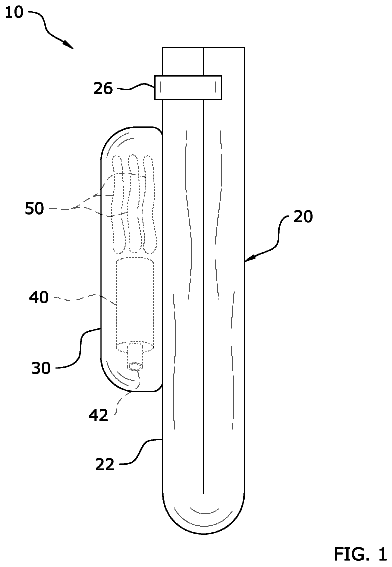
Iontophoretic contact lens
Contact lenses are provided for ocular iontophoretic therapy.
US 9,937,084 B2 · Assignee: LIVEDO CORPORATION · Inventors: Ota; Yoshihisa et al.
Sheet 1 of 7 from the published document. All sheets in the USPTO PDF
[Object] To provide an absorbent article and an absorbent body having excellent absorption performance. [Solution] The present invention provides an absorbent body having at least two or more layers, the absorbent body comprising: a water absorption layer having a water absorption region where a water absorbent resin powder is disposed and a thickness-direction-penetrating opening region; and a layer having a diffusion region where a diffusibility improvement material having an under-load liquid passing rate of 15 seconds or less is disposed, as a lower layer of the water absorption layer, wherein the lower layer has the diffusion region disposed at least a part of a portion located below the opening region.
Absorbent articles such as incontinence pads, disposable diapers, and sanitary napkins include an absorbent body for absorbing and retaining body fluid excreted from body such as urine and menstrual blood. The absorbent body generally includes a water absorbent resin powder, and body fluid or the like is absorbed and retained in the water absorbent resin powder inside the absorbent body. There have been proposals of water absorbent articles having an absorbent body with improved absorption rate of body fluid or the like. For example, Patent Literature 1 proposes an absorbent article comprising a liquid permeable top sheet, a liquid impermeable back sheet, and an absorbent core interposed therebetween, wherein a second sheet formed from a nonwoven fabric having a hollow fiber is interposed between the top sheet and the absorbent core. Patent Literature 2 proposes an absorption product com
All 7 drawing sheets from the published document, cropped to the drawing.
What the patent claimed, word for word. All of it is now free to use.
The present invention relates to an absorbent body used in absorbent articles such as incontinence pads, disposable diapers, and sanitary napkins; and the present invention particularly relates to an improvement technology regarding absorption performance of an absorbent body.
Absorbent articles such as incontinence pads, disposable diapers, and sanitary napkins include an absorbent body for absorbing and retaining body fluid excreted from body such as urine and menstrual blood. The absorbent body generally includes a water absorbent resin powder, and body fluid or the like is absorbed and retained in the water absorbent resin powder inside the absorbent body. There have been proposals of water absorbent articles having an absorbent body with improved absorption rate of body fluid or the like.
For example, Patent Literature 1 proposes an absorbent article comprising a liquid permeable top sheet, a liquid impermeable back sheet, and an absorbent core interposed therebetween, wherein a second sheet formed from a nonwoven fabric having a hollow fiber is interposed between the top sheet and the absorbent core.
Patent Literature 2 proposes an absorption product comprising: (a) a top sheet comprising an aperture polymeric film web having a first surface, and a second surface generally parallel to and spaced from the first surface, and a plurality of fluid passageways extending between the first surface and the second surface in fluid communication with one another, the web being formed of a polymeric film comprising at least one bulk modified layer, the bulk modified layer comprising a substantially homogeneous stabilized dispersion of a hydrophobic additive in a polymer material; (b) a back sheet peripherally joined with the top sheet; and (c) an absorbent core positioned between the second surface of the top sheet and the back sheet.
Patent Literature 3 proposes an absorbent article comprising: a top sheet; a back sheet; and an intermediate layer between the top sheet and the back sheet; wherein at least one of the top sheet, back sheet, and intermediate layer comprises a three-dimensional vacuum formed film with a male side void volume of at least 350 cc/m.sup.2; and the absorbent article having a first minute decrease in temperature of at least 8 degrees F. in a Third Insult Test. CITATION LIST Patent Literature
Japanese Patent Publication No. 2011-055959
Japanese Patent Publication No. 2002-528302
Japanese Patent Publication No. 2006-524112 SUMMARY OF INVENTION Technical Problem
The under-load liquid passing properties have been found to be inferior in all of the nonwoven fabric, the polymeric film web and the three-dimensional vacuum formed film with a void volume (cf. Patent Literature 1 to 3), which have been used conventionally for improving a water absorbent article's absorption rate of body fluid or the like. Thus, the absorption rate of body fluid or the like has been insufficient when a load is applied on the water absorbent article. Furthermore, in particular, films having holes such as those used in Patent Literature 2 and 3 have a problem that liquid may easily remain in the voids within the film and cause rashes.
The present invention has been made in view of the above described circumstances; and an objective of the present invention is to provide an absorbent body having an excellent absorption rate of body fluid or the like and excellent dryness after absorbing the body fluid or the like, and an absorbent article using the absorbent body. Solution to Problem
The present invention is directed to an absorbent body having at least two or more layers, the absorbent body comprising:
a water absorption layer having a water absorption region where a water absorbent resin powder is disposed and a thickness-direction-penetrating opening region; and
a layer having a diffusion region where a diffusibility improvement material having an under-load liquid passing rate of 15 seconds or less is disposed, as a lower layer of the water absorption layer,
wherein the lower layer has the diffusion region disposed at least a part of a portion located below the opening region.
Since the water absorption layer has the opening region and the diffusion region is formed at least partially below the opening region, a portion of body fluid or the like passes through the opening region and is taken into the diffusion region. The body fluid or the like taken into the diffusion region is diffused within the diffusion region in a planar direction, and is absorbed from a bottom surface (external surface) side of the water absorption layer. Thus, since the body fluid or the like is absorbed from both the top surface and the bottom surface of the water absorption layer, the absorption area increases. As a result, the absorbent body of the present invention has a fast absorption rate. In addition, the body fluid or the like absorbed from the bottom surface side of the water absorption layer does not pass through the water absorption layer and return to the top surface (skin surface) side. Therefore, the absorbent body of the present invention has excellent dryness after absorbing the body fluid or the like.
A suitable planar view shape of the diffusion region of the lower layer is a circular shape, an elliptical shape, a polygonal shape, a polygonal shape having rounded corners, or a slit shape. In addition, the lower layer is preferably a diffusion layer only having the diffusion region. Preferably, the opening region is formed in a slit shape. The water absorption layer preferably includes a water absorbent resin powder satisfying the following requirements:
Absorption ratio: 50 g/g or more; and
Water retention amount: 25 g/g or more.
The present invention also includes an absorbent article having the above absorbent body. Advantageous Effects of the Invention
The absorbent body and the absorbent article of the present invention have excellent absorption rate of body fluid or the like, and excellent dryness after absorbing the body fluid or the like.
FIG. 1 is a schematic perspective view of an absorbent body according to a preferable Embodiment 1 of the present invention.
FIG. 2 is a cross sectional view along line X-X in FIG. 1 .
FIG. 3 is a schematic perspective view of an absorbent body according to a preferable Embodiment 2 of the present invention.
FIG. 4 is a cross sectional view along line Y-Y in FIG. 3 .
FIG. 5 is a schematic perspective view of an absorbent body according to a preferable Embodiment 3 of the present invention.
FIG. 6 is a cross sectional view along line Z-Z in FIG. 5 .
FIG. 7 is a plan view showing how an opening region is formed in a water absorption layer.
FIG. 8 is a schematic plan view of an absorbent article according to a preferable embodiment of the present invention.
FIG. 9 is a cross sectional view along line V-V in FIG. 8 .
FIG. 10 is a schematic diagram for describing a method for measuring an under-load liquid passing rate of a diffusibility improvement material.
FIG. 11 is a schematic sectional view of an absorbent body No. 1 in an example.
FIG. 12 is a schematic sectional view of an absorbent body No. 2 in an example.
The present invention provides an absorbent body having at least two or more layers, the absorbent body comprising:
a water absorption layer having a water absorption region where a water absorbent resin powder is disposed and a thickness-direction-penetrating opening region; and
a layer having a diffusion region where a diffusibility improvement material having an under-load liquid passing rate of 15 seconds or less is disposed, as a lower layer of the water absorption layer,
wherein the lower layer has the diffusion region disposed at least a part of a portion located below the opening region.
Since the water absorption layer has the opening region and the diffusion region is formed at least partially below the opening region, a portion of body fluid or the like passes through the opening region and is taken into the diffusion region. The body fluid or the like taken into the diffusion region is diffused within the diffusion region in a planar direction, and is absorbed from a bottom surface (external surface) side of the water absorption layer. In other words, since the body fluid or the like is absorbed from both the top surface and the bottom surface of the water absorption layer, the absorption area increases. As a result, the absorbent body of the present invention has a fast absorption rate. In addition, the body fluid or the like absorbed from the bottom surface side of the water absorption layer does not pass through the water absorption layer and return to the top surface (skin surface) side. Therefore, the absorbent body of the present invention has absolutely excellent dryness after absorbing body fluid or the like. Thus, the absorbent body of the present invention is suitable for an absorbent article for sensitive skin, since the absorbent body of the present invention can improve dryness on the skin surface side of a user in a water absorption layer.
Water Absorbent Resin Powder
First, description will be provided for a water absorbent resin powder used in the present invention. The water absorbent resin powder is at least included in the water absorption layer, and may be contained in the layer having the diffusion region. The water absorbent resin powder used in the present invention is preferably a crosslinked polymer (A) mainly composed of acrylic acid having carboxy groups thereof being at least partially neutralized. The percentage content of the acrylic acid component forming the crosslinked polymer is preferably 90 mass % or more and more preferably 95 mass % or more, and is preferably 99 mass % or less and more preferably 97 mass % or less. If the percentage content of the acrylic acid component is within the above described range, the obtained water absorbent resin powder can easily express a desired absorption performance.
Examples of cations for neutralizing at least a part of the carboxyl groups of the crosslinked polymer (A) include, but not particularly limited to, alkali metal ions such as lithium, sodium, and potassium; and alkaline earth metal ions such as magnesium and calcium. Of those described above, at least a part of the carboxyl groups of the crosslinked polymer is preferably neutralized with the sodium ion. It should be noted that, with regard to neutralization of the carboxyl groups of the crosslinked polymer, neutralization may be conducted on the carboxyl groups of the crosslinked polymer which has been obtained by polymerization or neutralization may be conducted in advance on a monomer which is then used for forming the crosslinked polymer.
The degree of neutralization of the carboxyl groups of the crosslinked polymer is preferably 60 mole % or more, and more preferably 65 mole % or more. This is because there are cases where the absorption performance of the obtained water-absorbent resin powder deteriorates if the degree of neutralization is too low. Furthermore, there is no particular limitation on the upper limit of the degree of neutralization, and all the carboxyl groups may be neutralized. It should be noted that the degree of neutralization is obtained by the following formula. Degree of neutralization (mole %)=100×[Number of moles of neutralized carboxyl groups in the crosslinked polymer]/[Total number of moles of the carboxyl groups in the crosslinked polymer (including neutralized and unneutralized groups)]
The crosslinked polymer (A) preferably includes those obtained by polymerization of the unsaturated monomer composition containing a water-soluble ethylenically unsaturated monomer (a1)) and/or a hydrolyzable monomer (a2) producing the water-soluble ethylenically unsaturated monomer (a1)) by hydrolysis and an internal crosslinking agent (b).
The water-soluble ethylenically unsaturated monomer (a1)) is not particularly limited, but a monomer having at least one water-soluble substituent and an ethylenically unsaturated group, or the like can be used. The water-soluble monomer means a monomer having a property of being dissolved in an amount of at least 100 g in 100 g of water at 25 degrees centigrade. In addition, the hydrolyzable monomer (a2) is hydrolyzed with water at 50 degrees centigrade, by the action of a catalyst (an acid, a base, or the like) where necessary, to produce the water-soluble ethylenically unsaturated monomer (a1). The hydrolysis of the hydrolyzable monomer (a2) may be conducted during or after the polymerization of the crosslinked polymer (A) or both during and after the polymerization of the crosslinked polymer (A). However, the hydrolysis of the hydrolyzable monomer (a2) is preferably conducted after the polymerization of the crosslinked polymer (A) in light of the molecular weight of the obtained water-absorbent resin powder and the like.
Examples of the water-soluble substituent include a carboxyl group, a sulfo group, a sulfoxy group, a phosphono group, a hydroxyl group, a carbamoyl group, an amino group, or salts thereof and an ammonium salt. A salt of a carboxyl group (a carboxylate), a salt of a sulfo group (a sulfonate), and an ammonium salt are preferred. In addition, examples of the salts include salts of alkali metal such as lithium, sodium, and potassium and salts of alkaline earth metal such as magnesium and calcium. The ammonium salt may be any of salts of primary to tertiary amines or a quaternary ammonium salt. Of these salts, in light of absorption properties, alkali metal salts and ammonium salts are preferred, and alkali metal salts are more preferred, and sodium salts are further preferred.
As the water-soluble ethylenically unsaturated monomer having a carboxyl group and/or a salt thereof, an unsaturated carboxylic acid having 3 to 30 carbon atoms and/or a salt thereof are preferred. Specific examples of the water-soluble ethylenically unsaturated monomer having a carboxyl group and/or a salt thereof include unsaturated monocarboxylic acids and/or salts thereof such as (meth)acrylic acid, (meth)acrylic acid salt, crotonic acid, and cinnamic acid; unsaturated dicarboxylic acids and/or salts thereof such as maleic acid, maleate, fumaric acid, citraconic acid, and itaconic acid; and monoalkyl (1 to 8 carbon atoms) esters of unsaturated dicarboxylic acids and/or salts thereof such as maleic acid monobutyl ester, fumaric acid monobutyl ester, ethylcarbitol monoester of maleic acid, ethylcarbitol monoester of fumaric acid, citraconic acid monobutyl ester, and itaconic acid glycol monoester. It is noted that in the description of the present invention, “(meth)acrylic” means “acrylic” and/or “methacrylic”.
As a water-soluble ethylenically unsaturated monomer having a sulfo group and/or a salt thereof, a sulfonic acid having 2 to 30 carbon atoms and/or a slat thereof are preferred. Specific examples of the water-soluble ethylenically unsaturated monomer having a sulfo group and/or a salt thereof include aliphatic or aromatic vinyl sulfonic acids such as vinyl sulfonic acid, (meth)allyl sulfonic acid, styrene sulfonic acid, and alpha-methyl styrene sulfonic acid; (meth)acryloyl-containing alkyl sulfonic acids such as (meth)acryloxy propyl sulfonic acid, 2-hydroxy-3-(meth)acryloxy propyl sulfonic acid, 2-(meth)acryloylamino-2,2-dimethylethane sulfonic acid, 3-(meth)acryloxyethane sulfonic acid, 2-(meth)acrylamide-2-methylpropane sulfonic acid, and 3-(meth)acrylamide-2-hydroxypropane sulfonic acid; and alkyl(meth)allyl sulfosuccinate.
Examples of a water-soluble ethylenically unsaturated monomer having a sulfoxy group and/or a salt thereof include sulfate ester of hydroxyalkyl(meth)acrylate; and sulfate ester of polyoxyalkylene mono(meth)acrylate.
Examples of a water-soluble ethylenically unsaturated monomer having a phosphono group and/or a salt thereof include phosphate monoesters of (meth)acrylic acid hydroxyalkyl, phosphate diesters of (meth)acrylic acid hydroxyalkyl, and (meth)acrylic acid alkylphosphonic acids.
Examples of a water-soluble ethylenically unsaturated monomer having a hydroxyl group include mono-ethylenically unsaturated alcohols having 3 to 15 carbon atoms such as (meth)allyl alcohol and (meth)propenyl alcohol; mono-ethylenically unsaturated carboxylates or mono-ethylenically unsaturated ethers of bivalent to hexavalent polyols such as alkylene glycol having 2 to 20 carbon atoms, glycerin, sorbitan, diglycerin, pentaerythritol, and polyalkylene (2 to 4 carbon atoms) glycol (weight average molecular weight: 100 to 2000). Specific examples of them include hydroxyethyl(meth)acrylate, hydroxypropyl(meth)acrylate, triethyleneglycol(meth)acrylate, and poly-oxyethylene-oxypropylene mono(meth)allyl ether.
Examples of a water-soluble ethylenically unsaturated monomer having a carbamoyl group include (meth)acrylamide; N-alkyl (1 to 8 carbon atoms) (meth)acrylamides such as N-methyl acrylamide; N,N-dialkyl (alkyl having 1 to 8 carbon atoms) acrylamides such as N,N-dimethyl acrylamide and N,N-di-n- or i-propyl acrylamide; N-hydroxyalkyl (1 to 8 carbon atoms) (meth)acrylamides such as N-methylol(meth)acrylamide and N-hydroxyethyl(meth)acrylamide; and N,N-dihydroxyalkyl (1 to 8 carbon atoms) (meth)acrylamides such as N,N-dihydroxyethyl(meth)acrylamide. As an unsaturated monomer having a group composed of an amide, in addition to them, vinyl lactams having 5 to 10 carbon atoms (N-vinyl pyrrolidone, etc.) and the like can also be used.
Examples of a water-soluble ethylenically unsaturated monomer having an amino group include an amino group-containing ester of a mono-ethylenically unsaturated mono- or di-carboxylic acid and an amino group-containing amide of a mono-ethylenically unsaturated mono- or di-carboxylic acid. As the amino group-containing ester of a mono-ethylenically unsaturated mono- or di-carboxylic acid, dialkylaminoalkyl(meth)acrylate, di(hydroxyalkyl)aminoalkyl ester, morpholinoalkyl ester, and the like can be used, and examples thereof include dimethylaminoethyl(meth)acrylate, diethylamino(meth)acrylate, morpholinoethyl(meth)acrylate, dimethylaminoethyl fumarate, and dimethylaminoethyl malate. As the amino group-containing amide of a mono-ethylenically unsaturated mono- or di-carboxylic acid, monoalkyl(meth)acrylamide is preferred, and examples thereof include dimethylaminoethyl(meth)acrylamide and diethylaminoethyl(meth)acrylamide. As the water-soluble ethylenically unsaturated monomer having an amino group, in addition to them, vinylpyridines such as 4-vinylpyridine and 2-vinylpyridine can also be used.
The hydrolyzable monomer (a2) producing the water-soluble ethylenically unsaturated monomer (a1) by hydrolysis is not particularly limited, but an ethylenically unsaturated monomer having at least one hydrolyzable substituent that becomes a water-soluble substituent by hydrolysis is preferred. Examples of the hydrolyzable substituent include a group containing an acid anhydride, a group containing an ester linkage, and a cyano group.
As an ethylenically unsaturated monomer having a group containing an acid anhydride, an unsaturated dicarboxylic anhydride having 4 to 20 carbon atoms is used, and examples thereof include maleic anhydride, itaconic anhydride, and citraconic anhydride. Examples of an ethylenically unsaturated monomer having a group containing an ester linkage include lower alkyl esters of mono-ethylenically unsaturated carboxylic acids such as methyl(meth)acrylate and ethyl(meth)acrylate; and esters of mono-ethylenically unsaturated alcohols such as vinyl acetate and (meth)allyl acetate. Examples of an ethylenically unsaturated monomer having a cyano group include vinyl group-containing nitrile compounds having 3 to 6 carbon atoms such as (meth)acrylonitrile and 5-hexenenitrile.
As the water-soluble ethylenically unsaturated monomer (a1)) and the hydrolyzable monomer (a2), those described in Japanese Patent No. 3648553, Japanese Patent Publication No. 2003-165883, Japanese Patent Publication No. 2005-75982, and Japanese Patent Publication No. 2005-95759 can be further used. The water-soluble ethylenically unsaturated monomer (a1)) and the hydrolyzable monomer (a2) may be used alone or as a mixture of two or more kinds of monomers, respectively.
In addition to the water-soluble ethylenically unsaturated monomer (a1)) and the hydrolyzable monomer (a2), another vinyl monomer (a3) that is copolymerizable with these monomers can be used. As the copolymerizable other vinyl monomer (a3), hydrophobic vinyl monomers and the like can be used, but it is not limited to them. As the other vinyl monomer (a3), the following vinyl monomers (i) to (iii) and the like are used.
(i) Aromatic ethylenically unsaturated monomers having 8 to 30 carbon atoms;
Styrenes such as styrene, alpha-methylstyrene, vinyltoluene, and hydroxystyrene; vinylnaphthalene; and halogen substitutions of styrene such as dichlorostyrene.
(ii) Aliphatic ethylenically unsaturated monomers having 2 to 20 carbon atoms;
Alkenes such as ethylene, propylene, butene, isobutylene, pentene, heptene, diisobutylene, octene, dodecene, and octadecene; and alkadienes such as butadiene, and isoprene.
(iii) Alicyclic ethylenically unsaturated monomers having 5 to 15 carbon atoms;
Mono-ethylenically unsaturated monomers such as pinene, limonene, and indene; and polyethylenic vinyl-polymerizable monomers such as cyclopentadiene, bicyclopentadiene, and ethylidene norbornene.
As the other vinyl monomer (a3), those described in Japanese Patent No. 3648553, Japanese Publication No. 2003-165883, Japanese Patent Publication No. 2005-75982, and Japanese Patent Publication No. 2005-95759 can be further used.
From the aspect of providing the crosslinked polymer mainly composed of acrylic acid, as the water-soluble ethylenically unsaturated monomer (a1)) and/or the hydrolyzable monomer (a2) producing the water-soluble ethylenically unsaturated monomer (a1)) by hydrolysis, acrylic acid or a salt of acrylic acid (a1), or a hydrolyzable monomer (a2) producing acrylic acid or the salt of acrylic acid is preferable. The content of acrylic acid or the salt of acrylic acid (a1), or the hydrolyzable monomer (a2) producing acrylic acid or the salt of acrylic acid in the unsaturated monomer composition constituting the crosslinked polymer is preferably 90 mass % or more, more preferably 95 mass % or more, and is preferably 99 mass % or less, more preferably 97 mass % or less.
Examples of the internal crosslinking agent (b) can include an internal crosslinking agent (b1) having two or more ethylenically unsaturated groups, an internal crosslinking agent (b2) having: at least one functional group that can react with a water-soluble substituent of the water-soluble ethylenically unsaturated monomer (a1) and/or a water-soluble substituent produced by hydrolysis of the hydrolyzable monomer (a2); and at least one ethylenically unsaturated group, and an internal crosslinking agent (b3) having at least two functional groups that can react with a water-soluble substituent of the water-soluble ethylenically unsaturated monomer (a1) and/or a water-soluble substituent produced by hydrolysis of the hydrolyzable monomer (a2).
Examples of the internal crosslinking agent (b1) having two or more ethylenically unsaturated groups include bis(meth)acrylamides having 8 to 12 carbon atoms, poly(meth)acrylates of polyols having 2 to 10 carbon atoms, polyallylamines having 2 to 10 carbon atoms, and poly(meth)allyl ethers of polyols having 2 to 10 carbon atoms. Specific examples of them include N,N′-methylene bis(meth)acrylamide, ethylene glycol di(meth)acrylate, poly (polymerization degree of 2 to 5) ethylene glycol di(meth)acrylate, propylene glycol di(meth)acrylate, glycerol (di or tri)acrylate, trimethylol propane triacrylate, diallylamine, triallylamine, triallylcyanurate, triallylisocyanurate, tetraallyloxyethane, pentaerythritol diallyl ether, pentaerythritol triallyl ether, pentaerythritol tetraallyl ether, and diglycerin di(meth)acrylate.
Examples of the internal crosslinking agent (b2) having at least one functional group that can react with a water-soluble substituent of the water-soluble ethylenically unsaturated monomer (a1) and/or a water-soluble substituent produced by hydrolysis of the hydrolyzable monomer (a2) and at least one ethylenically unsaturated group include ethylenically unsaturated compounds having 6 to 8 carbon atoms and an epoxy group, ethylenically unsaturated compounds having 4 to 8 carbon atoms and a hydroxyl group, and ethylenically unsaturated compounds having 4 to 8 carbon atoms and an isocyanato group. Specific examples of them include glycidyl(meth)acrylate, N-methylol(meth)acrylamide, hydroxyethyl(meth)acrylate, and isocyanato ethyl(meth)acrylate.
Examples of the internal crosslinking agent (b3) having at least two functional groups that can react with a water-soluble substituent of the water-soluble ethylenically unsaturated monomer (a1) and/or a water-soluble substituent produced by hydrolysis of the hydrolyzable monomer (a2) can include polyhydric alcohols, polyvalent glycidyls, polyvalent amines, polyvalent aziridines, and polyvalent isocyanates. Examples of polyvalent glycidyl compounds include ethylene glycol diglycidyl ether and glycerin diglycidyl ether. Examples of polyvalent amine compounds include ethylenediamine, diethylenetriamine, triethylenetetramine, tetraethylenepentamine, pentaethylenehexamine, and polyethyleneimine. Examples of polyvalent aziridine compounds include Chemitite PZ-33 {2,2-bishydroxymethylbutanol-tris(3-(1-aziridinyl)propionate)}, Chemitite HZ-22 {1,6-hexamethylenediethyleneurea}, and Chemitite DZ-22 {diphenylmethane-bis-4,4′-N,N′-diethyleneurea}, available from Nippon Shokubai Co., Ltd. Examples of polyvalent polyisocyanate compounds include 2,4-tolylene diisocyanate and hexamethylene diisocyanate. These internal crosslinking agents may be used singly or two or more of them may be used in combination.
As the internal crosslinking agent (b), in light of absorbing performance (in particular, an absorption amount, an absorption speed, etc.), the internal crosslinking agent (b1) having two or more ethylenically unsaturated groups is preferred, poly(meth)allyl ethers of polyols having 2 to 10 carbon atoms are more preferred, triallylcyanurate, triallylisocyanurate, tetraallyloxyethane, or pentaerythritol triallyl ether is further preferred, and pentaerythritol triallyl ether is most preferred.
As the internal crosslinking agent (b), those described in Japanese Patent No. 3648553, Japanese Patent Publication No. 2003-165883, Japanese Patent Publication No. 2005-75982, and Japanese Patent Publication No. 2005-95759 can be further used.
As the method for polymerizing the crosslinked polymer (A), a conventionally known method and the like can be used, and a solution polymerization method, an emulsion polymerization method, a suspension polymerization method, and a reversed-phase suspension polymerization method can be used. In addition, a polymerization liquid at the polymerization may be in the form of a thin film, mist, or the like. As the method for controlling the polymerization, an adiabatic polymerization method, a temperature-controlled polymerization method, an isothermal polymerization method, and the like can be used. As the polymerization method, the solution polymerization method is preferred, and an aqueous solution polymerization method is more preferred since an organic solvent and the like are not used and it is advantageous in terms of production cost.
A water-containing gel {consisting of the crosslinked polymer and water} obtained by the polymerization can be chopped where necessary. The size (largest diameter) of the chopped gel is preferably from 50 micrometers to 10 cm, more preferably from 100 micrometers to 2 cm, and even more preferably from 1 mm to 1 cm. If the size falls within this range, dryability during a drying process becomes further favorable.
The chopping can be conducted by a known method, and can be conducted, for example, by using a conventional chopping apparatus such as a Bexmill, a rubber chopper, a Pharma Mill, a mincing machine, an impact type mill, and a roll type mill.
When a solvent (an organic solvent, water, etc.) is used for the polymerization, it is preferred to remove the solvent by distillation after the polymerization. When the solvent contains water, the water content (mass %) with respect to the mass (100 mass %) of the crosslinked polymer after the removal by distillation is preferably from 0 mass % to 20 mass %, more preferably from 1 mass % to 10 mass %, even more preferably from 2 mass % to 9 mass %, and most preferably from 3 mass % to 8 mass %. When the water content (% by mass) falls within the above range, the absorbing performance and the breakability of the water-absorbent resin powder after drying become further favorable.
It is noted that the content of the organic solvent and the water content are obtained based on a decrease in the mass of a measurement sample from before heating to after heating by an infrared moisture measuring instrument {JE400 manufactured by Kett Electric Laboratory or the like: 120 plus or minus 5 degrees centigrade, 30 minutes, an atmospheric humidity before heating of 50 plus or minus 10% RH, lamp specifications of 100 V and 40 W}.
As the method for removing the solvent (including water) by distillation, a method in which removal by distillation (drying) is conducted by hot air at a temperature in a range from 80 degrees centigrade to 230 degrees centigrade, a thin film drying method with a drum dryer or the like heated at the temperature in a range from 100 degrees centigrade to 230 degrees centigrade, a (heating) reduced-pressure drying method, a freeze-drying method, a drying method with infrared rays, decantation, filtration, and the like can be used.
The crosslinked polymer (A) can be pulverized after being dried. The pulverizing method is not particularly limited, and, for example, an ordinary pulverizing apparatus such as a hammer type pulverizer, an impact type pulverizer, a roll type pulverizer, and a jet streaming type pulverizer can be used. The particle size of the pulverized crosslinked polymer (A) can be adjusted by sieving or the like where necessary.
The weight average particle size (micrometer) of the crosslinked polymer (A) that is sieved where necessary is preferably from 100 micrometers to 800 micrometers, more preferably from 200 micrometers to 700 micrometers, even more preferably from 250 micrometers to 600 micrometers, particularly preferably from 300 micrometers to 500 micrometers, and most preferably from 350 micrometers to 450 micrometers. When the weight average particle size (micrometer) of the crosslinked polymer (A) falls within the above range, the absorbing performance becomes further favorable.
It is noted that the weight average particle size is measured with a ro-tap test sieve shaker and standard sieves (JIS Z8801-1: 2006) according to the method described in Perry's Chemical Engineers Handbook, Sixth Edition (The McGraw-Hill Companies, 1984, Page 21). In other words, as JIS standard sieves, for example, sieves of 1000 micrometers, 850 micrometers, 710 micrometers, 500 micrometers, 425 micrometers, 355 micrometers, 250 micrometers, 150 micrometers, 125 micrometers, 75 micrometers, and 45 micrometers, and a tray are combined in order from above. About 50 g of a measurement particle is placed into the uppermost sieve, and shaken with the ro-tap test sieve shaker for 5 minutes. The weights of the measurement particles on each sieve and the tray are measured, and the weight fraction of the particles on each sieve is obtained with the total weight regarded as 100% by weight. The values are plotted in a log probability paper {the horizontal axis is used for the opening of the sieve (particle size) and the vertical axis is used for the weight fraction}, then a line is drawn so as to connect each point, and a particle size corresponding to 50% by mass of the mass fraction is obtained and regarded as a weight average particle size.
The surface of the crosslinked polymer (A) may be treated with the surface modifier (B). Examples of the surface modifier (B) include polyvalent metal compounds such as aluminum sulfate, potassium alum, ammonium alum, sodium alum, (poly) aluminum chloride, and hydrates thereof; polycation compounds such as polyethyleneimine, polyvinylamine, and polyallylamine; inorganic fine particles; a surface modifier (B1) containing a hydrocarbon group; a surface modifier (B2) containing a hydrocarbon group having a fluorine atom; and a surface modifier (B3) having a polysiloxane structure.
Examples of the inorganic fine particles include oxides such as silicon oxide (silica), aluminum oxide (alumina), iron oxide, titanium oxide, magnesium oxide, and zirconium oxide, carbides such as silicon carbide and aluminum carbide, nitrides such as titanium nitride, and complexes thereof (e.g., zeolite, talc, etc.). Among them, oxides are preferred, and silicon oxide is further preferred. The volume average particle size of the inorganic fine particles is preferably from 10 nm to 5000 nm, more preferably from 30 nm to 1000 nm, even more preferably from 50 nm to 750 nm, and most preferably from 90 nm to 500 nm. It is noted that the volume average particle size is measured in a solvent by a dynamic light scattering method. Specifically, the volume average particle size is measured in cyclohexane as a solvent at a temperature of 25 degrees centigrade by using the nano track particle size distribution measuring instrument UPA-EX150 (light source: He—Ne laser) manufactured by Nikkiso Co., Ltd.
Examples of the surface modifier (B1) containing a hydrocarbon group include polyolefin resins, polyolefin resin derivatives, polystyrene resins, polystyrene resin derivatives, waxes, long-chain fatty acid esters, long-chain fatty acids and salts thereof, long-chain aliphatic alcohols, and mixtures of two or more of them.
Examples of the surface modifier (B2) containing a hydrocarbon group having a fluorine atom include perfluoroalkanes, perfluoroalkenes, perfluoroaryls, perfluoroalkyl ethers, perfluoroalkylcarboxylic acids or salts thereof, perfluoroalkyl alcohols, and mixtures of two or more of them.
Examples of the surface modifier (B3) having a polysiloxane structure include polydimethylsiloxane; polyether-modified polysiloxanes such as polyoxyethylene-modified polysiloxane and poly(oxyethylene/oxypropylene)-modified polysiloxane; carboxy-modified polysiloxanes; epoxy-modified polysiloxanes; amino-modified polysiloxanes; alkoxy-modified polysiloxanes; and mixtures thereof.
As the surface modifier (B), in light of absorption properties, the surface modifier (B3) having a polysiloxane structure and inorganic fine particles are preferred, and amino-modified polysiloxanes, carboxy-modified polysiloxanes, and silica are more preferred.
The method for treating the crosslinked polymer (A) with the surface modifier (B) is not particularly limited, as long as treatment is conducted such that the surface modifier (B) is present on the surface of the crosslinked polymer (A). However, from the standpoint that the amount of the surface modifier (B) on the surface is controlled, it is preferred that the surface modifier (B) is mixed with a dried product of the crosslinked polymer (A), not with a water-containing gel of the crosslinked polymer (A) or a polymerization liquid that is prior to polymerization of the crosslinked polymer (A). It is noted that it is preferred that the mixing is uniformly conducted.
The shape of the water-absorbent resin powder is not particularly limited, and examples thereof include an indefinite crushed shape, a scale shape, a pearl shape, a rice grain shape, or the like. Among them, the indefinite crushed shape is preferred from the standpoint that the powder in such a shape can be well entangled with fibrous materials in applications such as a disposable diaper and there is little possibility of the powder falling off from the fibrous materials.
The water-absorbent resin powder can be subjected to surface crosslinking where necessary. As a crosslinking agent for conducting the surface crosslinking (a surface crosslinking agent), the same ones as the internal crosslinking agent (b) can be used. In light of absorption performance and the like of the water-absorbent resin powder, the surface crosslinking agent is preferably the crosslinking agent (b3) having at least two functional groups that can react with a water-soluble substituent of the water-soluble ethylenically unsaturated monomer (a1) and/or a water-soluble substituent produced by hydrolysis of the hydrolyzable monomer (a2), more preferably a polyvalent glycidyl, even more preferably ethylene glycol diglycidyl ether and glycerin diglycidyl ether, and most preferably ethylene glycol diglycidyl ether.
In the case of conducting the surface crosslinking, the content (mass %) of the surface crosslinking agent with respect to the total mass (100 mass %) of the water-soluble ethylenically unsaturated monomer (a1) and/or the hydrolyzable monomer (a2), the internal crosslinking agent (b), and the other vinyl monomer (a3) used where necessary is preferably from 0.001 mass % to 7 mass %, more preferably from 0.002 mass % to 5 mass %, and even more preferably 0.003 mass % to 4 mass %. In other words, in this case, the upper limit of the content of the surface crosslinking agent based on the total mass of (a1) and/or (a2), (b), and (a3) is preferably 7 mass %, more preferably 5 mass %, and even more preferably 4 mass %. Similarly, the lower limit is preferably 0.001 mass %, more preferably 0.002 mass %, and even more preferably 0.003 mass %. If the content of the surface crosslinking agent falls within the above range, the absorption performance becomes further favorable. The surface crosslinking can be achieved by, for example, a method of spraying an aqueous solution containing the surface crosslinking agent to the water-absorbent resin powder or impregnating the water-absorbent resin powder with the aqueous solution containing the surface crosslinking agent, followed by heating treatment (100 to 200 degrees centigrade) on the water-absorbent resin powder.
The water-absorbent resin powder can contain additives such as an antiseptic, a fungicide, an antibacterial, an antioxidant, a ultraviolet absorber, a coloring agent, a perfuming agent, a deodorizer, an inorganic powder, and an organic fibrous material. Examples of such additives include those exemplified in Japanese Patent Publication No. 2003-225565 and Japanese Patent Publication No. 2006-131767. When these additives are contained, the content (mass %) of the additives with respect to the crosslinked polymer (A) (100 mass %) is preferably from 0.001 mass % to 10 mass %, more preferably from 0.01 mass % to 5 mass %, even more preferably from 0.05 mass % to 1 mass %, and most preferably from 0.1 mass % to 0.5 mass %.
The absorption ratio of the water absorbent resin powder is preferably 50 g/g or more, more preferably 53 g/g or more, and further preferably 55 g/g or more, and is preferably 70 g/g or less, more preferably 65 g/g or less, and further preferably 60 g/g or less. When the absorption ratio is 50 g/g or more, absorptive capacity can be maintained at a predetermined level with a small amount of the water absorbent resin powder, and it becomes easy to manufacture a thin absorbent body. From a standpoint of preventing liquid leakage, an absorption ratio is preferably as large as possible. However, when the absorption ratio is 70 g/g or less, the stability of the water absorbent resin powder against urine is improved.
The description continues in the full USPTO document.
About 5,932 words. The USPTO PDF has it with every drawing.
Fees are due 3.5, 7.5 and 11.5 years after grant. This patent expired on April 10, 2026, so the fee marked "not paid" was the one that went unpaid.
ABSORBENT BODY AND ABSORBENT ARTICLE USING THE SAME
Filed Aug 2013 · published Aug 2015Absorbent body and absorbent article using the same
Filed Aug 2013 · granted Apr 2018Earlier publications, parents and continuations. None of them can still be enforced, or this patent would not be listed.
Prior art cited by the examiner or applicant. Useful when you check your own idea for novelty.
Everything on this page comes from the documents linked above.