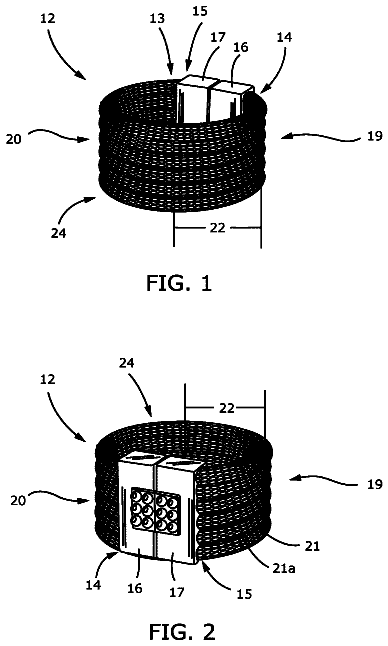
Lapsed, fee not paid2 drawings
Lapsed, fee not paidSolo inventor
Towel/absorptive arm sleeve and means of hands free toweling
US 9,936,751 B1 · Inventors: Mignone; Francesco
Overview
Sheet 1 of 18 from the published document. All sheets in the USPTO PDF
Abstract From the patent
A sleeve having an absorptive surface, comprising a tubular structure having an exterior moisture absorptive surface, configured to fit around a wearer's arm, from shoulder to at least forearm, having an adjustable diameter to selectively control a snugness of the tubular structure on the upper arm area and the lower arm area, while permitting free flexion of the elbow, having at least three elastic bands having a non-slip surface against a wearer's skin to prevent movement of the tubular structure.
Why it's free to use
- The USPTO Official Gazette of June 9, 2026 lists it as expired on April 10, 2026 for an unpaid maintenance fee.
- It isn't on any reinstatement notice published since.
- It has no other US patents or pending applications in its family.
- We check US rights only. Check foreign counterparts before selling abroad.
FiledMarch 14, 2014
GrantedApril 10, 2018
Expired (fee)April 10, 2026
Application number14/211139
Classification (CPC)A41D27/10 +2 more
Length16 claims · 26 pages
Background From the patent
It's commonly known that towels are used to wipe away and absorb sweat, bodily fluids, and water while working out, running, and performing other strenuous activities. The towel/absorptive material is effective in absorbing these bodily fluids for multiple reasons. These reasons for removing sweat can range from comfort to the person sweating to functionally removing sweat for grip or for visibility purposes. Towels are used for all different sports, gym activities, and running/cross fit work outs. Some sports that use towels are basketball, football, baseball, soccer and on and on. The majority of these sports and many more would benefit the use of a towel to be available at all times and not only available during certain breaks or time outs during the course of play. In some sports like football, quarterbacks, running backs, wide receivers, and certain specialty lineman wear towels dur
Drawings 18
8 of 18 drawing sheets so far from the published document, cropped to the drawing. Every sheet is in the USPTO PDF.
Figures as described
- FIGS. 1A and 1B show an inner and outer view of towel sleeve, respectively, with pocket and elastic draw strings and spring loaded locks fasteners
- FIGS. 2A and 2B show an inner and outer view of towel sleeve, respectively, with pocket and nylon Velcro straps fasteners
- FIGS. 3A and 3B show an inner and outer view of towel sleeve, respectively, with pocket and nylon strap side locks fasteners
- FIGS. 4A and 4B show an inner and outer view of towel sleeve, respectively, with pocket and spandex polyester mix breathable mesh dri-fit arm warming support sleeve inner lining
- FIGS. 5A and 5B show an inner and outer view of towel sleeve, respectively, with pocket, folding towel glove and spandex polyester mix elastic interlayer sleeve support
- FIGS. 7A and 7B show an inner and outer view of towel sleeve, respectively, with pocket, folding towel mitten and spandex polyester mix elastic interlayer sleeve support
- FIGS. 9A and 9B show shows an inner and outer view of Velcro seam fastening towel sleeve, respectively, with pocket and interior elastic arm support bands
- FIGS. 10A and 10B show an inner and outer view of snap button seam fastening towel sleeve, respectively, with pocket and interior elastic arm support bands
- FIGS. 11A and 11B show an inner and outer view of magnetic seam fastening towel sleeve, respectively, with pocket and interior elastic arm support bands
- FIG. 12 shows a front view of towel flap T-shirt with terminal underside Velcro fasteners
- FIG. 13 shows a front view of towel torso T-shirt
- FIG. 14 shows a front view of towel thigh and hamstring pants
Claims 16 total, 2 independent
What the patent claimed, word for word. All of it is now free to use.
- 1Independent claimA sleeve having a tubular structure, comprising: a planar sheet having an openable seam along its length, the planar sheet having an exterior moisture absorptive surface, and the planar sheet is configured to fit around a wearer's arm, from the wearer's shoulder to at least the wearer's forearm, the openable seam having a fastener to selectively close the planar sheet to define the tubular structure, the tubular structure having a cutout disposed along the length of the tubular structure; and a set of at least three selectively tensionable elastic loops through which the arm of the wearer is insertable, the at least three selectively tensionable elastic loops each having an adjustable diameter configured to selectively and independently control a movement of the tubular structure with respect to at least a portion of the wearer's upper arm area and a portion of the wearer's lower arm area, the at least three selectively tensionable elastic loops each having a non-slip surface disposed on an interior surface of the tubular structure which is adapted to press against skin of the wearer's arm and maintain the tubular structure in a position on a wearer without slippage, wherein one of the at least three selectively tensionable elastic loops is located at approximately the same distance as the cutout along the length of the tubular structure, wherein the tubular structure is further configured to permit free flexion of the elbow of the wearer.
- 2The sleeve according to claim 1, wherein the absorptive surface comprises terry cloth.
- 3The sleeve according to claim 1, wherein the adjustable diameter is controlled by a respective drawstring associated with each of the at least three elastic loops.
- 4The sleeve according to claim 1, wherein the adjustable diameter is controlled by a tensionable strap associated with each of the at least three elastic loops.
- 5The sleeve according to claim 1, wherein the adjustable diameter is controlled by an adjustable tension buckle associated with each of the at least three elastic loops.
- 6The sleeve according to claim 1, wherein the openable seam comprises a closure.
- 7The sleeve according to claim 1, wherein the openable seam comprises a snap closure.
- 8The sleeve according to claim 1, wherein the openable seam comprises a magnetic closure.
- 9Independent claimA sleeve comprising: a planar sheet having an openable seam along its length, the openable seam having a fastener to selectively close the planar sheet to define a tubular structure having a cloth exterior moisture absorptive surface, and the planar sheet is configured to fit around a wearer's arm, from a wearer's shoulder to at least a wearer's forearm, and the tubular structure having a cutout disposed along its length at an area corresponding to a wearer's elbow area, when worn by a wearer; and a set of at least three independently tensionable loops attached to an interior surface of the tubular structure, through which the wearer's arm is insertable, and when worn, the at least three independently tensionable loops being respectively located at an upper arm area, the elbow area, and a lower arm area of the wearer, one of the at least three selectively tensionable elastic loops being located at approximately the same distance as the cutout along the length of the tubular structure, and wherein the at least three independently tensionable loops are configured to adjust a diameter of the tubular structure and to selectively control a pressure of an interior non-slip surface of the set of at least three independently tensionable loops, to selectively control a slippage of the tubular structure and to prevent movement of the tubular structure on the wearer's skin in at least the upper arm area and the lower arm area, while permitting free flexion of the elbow of the wearer when the tubular structure is worn and disposed at the elbow area of the wearer.
- 10The sleeve according to claim 9, wherein the absorptive surface comprises terry cloth.
- 11The sleeve according to claim 9, wherein the adjustable diameter is controlled by a respective drawstring associated with each of the at least three elastic loops.
- 12The sleeve according to claim 9, wherein the adjustable diameter is controlled by a tensionable strap associated with each of the at least three elastic loops.
- 13The sleeve according to claim 9, wherein the adjustable diameter is controlled by an adjustable tension buckle associated with each of the at least three elastic loops.
- 14The sleeve according to claim 9, wherein the openable seam comprises a closure.
- 15The sleeve according to claim 9, wherein the openable seam comprises a snap closure.
- 16The sleeve according to claim 9, wherein the openable seam comprises a magnetic closure.
Description
Field of invention
The present invention relates to the field of clothing, and more particularly to functional athletic clothing.
Background of invention
It's commonly known that towels are used to wipe away and absorb sweat, bodily fluids, and water while working out, running, and performing other strenuous activities. The towel/absorptive material is effective in absorbing these bodily fluids for multiple reasons. These reasons for removing sweat can range from comfort to the person sweating to functionally removing sweat for grip or for visibility purposes.
Towels are used for all different sports, gym activities, and running/cross fit work outs. Some sports that use towels are basketball, football, baseball, soccer and on and on. The majority of these sports and many more would benefit the use of a towel to be available at all times and not only available during certain breaks or time outs during the course of play. In some sports like football, quarterbacks, running backs, wide receivers, and certain specialty lineman wear towels during the active course of the game. This serves as a disadvantage because these towels are usually worn hanging from the waistline from a belt or tucked into the pants. This can be slightly cumbersome, restricting, and plain annoying and interfering with sports play. In this instance the use of a hands free towel would be a major benefit and advantage to the game. In basketball you find this same problem. Players need the towel during play but have to wait until breaks and time outs to “towel off”. This poses a problem for grip on the ball and visibility along as poses a hazard to the players as when their sweat flops onto the court it creates a slippery and dangerous condition.
Towels are also used during work outs in all different settings such as in the gym, outdoors, and indoors at home. Many times working out in a gym setting a towel is used in addition to wiping sweat to lay on workout equipment such as benches and stools to keep the users sweat from getting on the equipment and to also keep the user from contacting the equipment which may be dirty from a previous persons use along with just laying the towel some place while performing work out moves and activities. This poses a problem because the towel is now tainted and dirt from the equipment and in turn transfers the dirt and germs to the towels' user. Seeing how the towel is primarily used to wipe the users face, this poses a significant threat of getting germs and dirt directly into key germ spreading areas such as the mouth, eyes, nose, and ears, along with directly into the overly open pores of the skin due to perspiration and heat release.
Another common problem with gym work outs and towel use is the unavoidable touching of work out equipment and handle grips such as dumb bells, bar bells, pulley grips, machine grips (weights and cardio, e.g., elliptical machine, treadmills, stationary bikes, and climbers), etc., with the user's hands and then touching the towel with the dirty sweaty hands that were just in contact with the dirty work out equipment/grips. The towel is now tainted and dirty from the users' hands. Again the towel now transfers the dirt and germs from the equipment to the user's face and body being “toweled off”. The use of work out gloves may prevent the users' hands from getting directly dirty or infected by pathogens that cause warts and other skin contact diseases, but do not prevent those same germs and dirt from being transferred from the surface of the gloves to the towel just as they would from the hand.
Lastly there are some situations where a towel is just not accessible, feasible, or just plain inconvenient to use while working out. Running outdoors poses an inaccessible setting as many people do not carry a towel with themselves while running. Even if a backpack is used the runner would have to inconveniently stop to open the backpack take the towel out, wipe off the sweat, then place the towel back in the bag and continue on. Even worse is the runner doing that same scenario while trying to maintain the running pace. That would be difficult and dangerous. This would be the same as if a runner would try to stuff a towel in their waistband and just as improbable for a runner to hold a towel in their hand throughout the duration of their entire run. This similar problem can be found in the gym on a treadmill or other piece of cardio equipment (e.g., elliptical, stationary bike, and climber, etc.). The runner doesn't have the means to hold or carry a towel while performing their work out. It may be argued that the runner can just place the towel on the treadmill/equipments arm supports or control board but then they also pose the same problem with tainting the towel with dirt and germs as previously stated. It also is awkward and possibly dangerous for the runner to constantly look away from what they are doing, to locate, reach out, and grab the towel off the equipment to towel off. This could cause the runner to misstep, stumble, trip, and ultimately fall.
Other situations where a towel is beneficial can be for persons gardening and cooking. Many times these people cannot grab and use a towel because their hands are soiled with cooking material, or contaminated raw ingredients, or are full of dirt or wearing dirty gloves and can't grab a towel. Likewise, the towel will first contact the soiled hands before the other body parts, e.g., forehead, which are less soiled but perhaps have perspiration.
Summary of the invention
The present technology therefore provides a garment or item of apparel which is specially designed to provide a hands free absorbing surface to wipe away and absorb sweat and other bodily fluids.
The most natural and ergonomic way to wipe away sweat without the use of one's hands is to use the inlet of one's arm from shoulder to forearm and to the back of the hand.
The regions of contact can consist of the shoulder, deltoid, bicep, a portion or the tricep, inner and outer forearm, and back of hand. The Towel/absorptive material sleeve can be made from a variety of absorptive materials. The primary absorptive material for this towel sleeve design is a terry cloth. The design can also utilize any other flexible absorptive materials, including sponge material, absorptive paper, microfiber cloth, woven and non-woven fabrics and sheets, reusable or disposable absorptive pads, and the like.
The design may encompass a variety of embodiments.
A first embodiment, of the design provides a single towel/absorptive material formed into a continuous tubular hollow structure open end at both ends. The structure may have a convenience pocket on the upper triceps region, which may be made from the same or a different material from the hollow structure. The pocket may have a Velcro closure or other type of fastener. This structure can be secured in a number of ways in place snuggly to the wearers' body. A couple of these fastening systems are as follows:
1. Three (or more) elastic draw strings with spring loaded locks or wheel drawstring locks can be provided, in the seam at the upper and lower opening, as well as near the elbow. The drawstrings restraint the tubular structure against slippage up or down the arm and also rotationally about the arm. The seams in which the drawstrings are located may have a rubber strips lining against the wearer's skin, to help prevent the sleeve from slipping and remaining in place on the wears' arm. The upper end of the structure is preferably at the upper bicep and lower deltoid region of the arm, the lower end of the structure is at the wrist. The spring loaded locks may have securing strings to secure them to the towel sleeve.
2. Three (or more) nylon Velcro fastening straps along with rubber strips on the inside surface of the hollow structure, located at each end of the structure and mid range, to help prevent the sleeve from slipping and holding the tubular structure in place on the wears' arm. One end of the structure is at the upper bicep and lower deltoid the other end of the structure is at the wrist.
3. Three (or more) buckles with side locks, which retain adjustable fastening straps, along with rubber strips on the inside surface of the hollow structure at each end of the structure and mid range, to help prevent the sleeve from slipping and remaining in place on the wears' arm. The locations of the adjusting side lock straps are at both ends of the tubular structure and at the mid range of the tubular structure. One end of the structure is at the upper bicep and lower deltoid the other end of the structure is at the wrist.
A second embodiment of the design provides a planar towel/absorptive material sheet which is wrapped around the wearer's arm, formed into a continuous tubular hollow structure with two open ends. The structure may have a convenience at the upper bicep end which is also made from the towel/absorptive material or another material, with a fastener which may be Velcro or other fastener type. The tubular structure may have an inner lining formed of a spandex polyester mix breathable mesh moisture wicking material, such as Nike Dri-Fit, to provide an arm warming support sleeve used to aid muscles and tendons with strains and tendinitis (or other tight snug fitting material) inner lining to secure the towel sleeve tightly snug to the wearers arm. One end of the structure is at the upper bicep and lower deltoid the other end of the structure is at the wrist. Alternately, instead of a liner formed of a different material, the liner may also be formed of a terry cloth or other absorptive material. The tubular structure in that case comprises a double layer of towel material with an elastic layer attached in between for tightness and snug fit to the wearers' arm.
A third embodiment of the design consists of a single towel/absorptive material with fasteners in fixed position along each seam to form the towel into a tubular structure with an open end at both ends of the structure. The towel material has three terry cloth elastic bands attached to the inner surface at each end of the structure and mid range to prevent the sleeve from slipping and remaining in place tightly on the wear's arm until the wearer secures the permanent fasteners. The permanent may be, for example, Velcro strips, Snap buttons, strong magnets, and buttons with elastic bands.
A fourth embodiment of the design provides an auxiliary wiping portion in the form of a folding towel glove/mitten/pouch attached to the bottom seam of the inner or outer wrist end, to provide supplemental wiping surface. This glove/mitten/pouch is stored to the inner or outer wrist either by a terry cloth elastic band, or towel pocket which the glove/mitten/pouch is tucked away into. Another auxiliary wiping portion is configured as a folding towel flap with terry cloth elastic palm strap slip attached to the bottom seem of the outer wrist end, to add extra wiping surface to the back of the wearer's hand. This flap is held to the outer wrist either by a terry cloth elastic band or towel pocket in which the flap is tucked into.
An inner lining for the sleeve may be provided as a moisture absorbing inner lining to draw the sweat/fluid from the surface of the towels' outer material to the inner layer and into the moisture absorbing inner layer, to give the towel more capacity and a rejuvenating ability to prolong the use of the towel. This lining can also include a breathable inner lining which helps to evaporate or wick the moisture from the towel like found in skiing and cold weather apparel.
The design may also incorporate a wrist support brace on the interior of the towel material with the tightening strap fasteners protruding through the terry cloth on the far side (underside) of the towel sleeve.
A further design option provides an arm/elbow support brace on the interior of the towel material with the tightening strap fasteners protruding through the terry cloth on the far side (underside) of the towel sleeve.
The terry material may be provided as flaps or an inlet portion formed of terry cloth or other absorbent material extending from the chest to abdomen.
Brief description of the drawings
FIGS. 1A and 1B show an inner and outer view of towel sleeve, respectively, with pocket and elastic draw strings and spring loaded locks fasteners.
FIGS. 2A and 2B show an inner and outer view of towel sleeve, respectively, with pocket and nylon Velcro straps fasteners.
FIGS. 3A and 3B show an inner and outer view of towel sleeve, respectively, with pocket and nylon strap side locks fasteners.
FIGS. 4A and 4B show an inner and outer view of towel sleeve, respectively, with pocket and spandex polyester mix breathable mesh dri-fit arm warming support sleeve inner lining.
FIGS. 5A and 5B show an inner and outer view of towel sleeve, respectively, with pocket, folding towel glove and spandex polyester mix elastic interlayer sleeve support.
FIGS. 6A and 6B show an inner and outer view of towel sleeve, respectively, with pocket, folding towel glove in tuck away storage pocket and spandex polyester mix elastic interlayer sleeve support.
FIGS. 7A and 7B show an inner and outer view of towel sleeve, respectively, with pocket, folding towel mitten and spandex polyester mix elastic interlayer sleeve support.
FIGS. 8A and 8B show an inner and outer view of towel sleeve respectively, with pocket, folding towel back hand towel flap with elastic palm strap and spandex polyester mix elastic interlayer sleeve support.
FIGS. 9A and 9B show shows an inner and outer view of Velcro seam fastening towel sleeve, respectively, with pocket and interior elastic arm support bands.
FIGS. 10A and 10B show an inner and outer view of snap button seam fastening towel sleeve, respectively, with pocket and interior elastic arm support bands.
FIGS. 11A and 11B show an inner and outer view of magnetic seam fastening towel sleeve, respectively, with pocket and interior elastic arm support bands.
FIG. 12 shows a front view of towel flap T-shirt with terminal underside Velcro fasteners.
FIG. 13 shows a front view of towel torso T-shirt.
FIG. 14 shows a front view of towel thigh and hamstring pants.
FIG. 15 shows a rear view of towel thigh and hamstring pants.
FIG. 16 shows a front view of towel thigh and hamstring shorts.
FIG. 17 shows a rear view of towel thigh and hamstring shorts.
FIG. 18 shows a skull cap with fold down cuff made from towel/absorptive material.
Description of the preferred embodiments
Towel Arm Sleeve with Draw String Fasteners
As shown in FIGS. 1A and 1B , a single layer of towel/absorptive material 1 , such as terry cloth, formed into a continuous tubular hollow structure with openings at both ends of the structure, is provided. The structure has a pocket 2 at the upper bicep end, which may also be made from the towel/absorptive material, with a Velcro or other suitable material fastener 3 . The pocket is for convenience, and may be designed to hold a music player, phone, keys, or the like. Three elastic draw strings 4 with spring loaded locks 5 are provided within guide tubes 7 to lock the draw string 4 tightly in place, to apply a pressure to rubber strips 22 on the inside surface of the hollow structure, at each end of the structure and mid range, to help prevent the sleeve from slipping and remaining in place on the wearer's arm. The locations of the draw strings are at both ends of the tubular structure and at the mid range of the tubular structure. One end of the structure is at the upper bicep and lower deltoid the other end of the structure is at the wrist. The spring loaded locks have securing strings 6 to secure them to the towel sleeve.
Towel Arm Sleeve with Adjusting Nylon Velcro Fastening Straps
As shown in FIGS. 2A and 2B , a single layer of towel/absorptive material 1 formed into a continuous tubular hollow structure with an open end at both ends of the structure. The structure has a pocket 2 at the upper bicep end which is also made from the towel/absorptive material with a fastening closer 3 primarily Velcro but can be any form or a fastener. Three nylon fastening straps 10 along with rubber strips 22 on the inside surface of the hollow structure at each end of the structure and mid range to help prevent the sleeve from slipping and remaining in place on the wears' arm. The locations of the nylon straps 10 are at both ends of the tubular structure and at the mid range of the tubular structure. A Velcro patch 12 and anchor 14 is used to adjust the tension and size of the strap. One end of the structure is at the upper bicep and lower deltoid the other end of the structure is at the wrist. The Velcro strap may be held in position by a rectangular O-ring 13 .
Towel Arm Sleeve with Adjusting Nylon Side Lock Fastening Straps
As shown in FIGS. 3A and 3B , a layer of single towel/absorptive material 1 formed into a continuous tubular hollow structure with an open end at both ends of the structure. The structure has a pocket 2 at the upper bicep end which is also made from the towel/absorptive material with a fastening closer 3 which may be made of Velcro or formed in another manner as another type of fastener. Three adjusting side lock 32 fastening straps 15 , 16 along with rubber strips 22 on the inside surface of the hollow structure at each end of the structure and mid range to help prevent the sleeve from slipping and remaining in place on the wears' arm. The locations of the adjusting side lock 32 straps 15 , 16 are at both ends of the tubular structure and at the mid range of the tubular structure. One end of the structure is at the upper bicep and lower deltoid the other end of the structure is at the wrist.
Towel Arm Sleeve with Spandex Polyester Mix Breathable Mesh Dri-Fit Arm Support
As shown in FIGS. 4A and 4B , a single layer towel/absorptive material formed into a continuous tubular hollow structure with an open end at both ends of the structure. The structure has a pocket 2 at the upper bicep end which is also made from the towel/absorptive material with a fastening closer 3 . The tubular structure has a spandex polyester mix breathable mesh dri-fit arm warming support sleeve 17 used to aid muscles and tendons with strains and tendinitis (or other tight snug fitting material) inner lining to secure the towel sleeve tightly snug to the wearers arm. This forms a dual layer structure with a terry nap 1 on the outside and a dri-fit type material 17 on the inside. One end of the structure is at the upper bicep and lower deltoid the other end of the structure is at the wrist.
Towel Arm Sleeve with Spandex Polyester Mix Elastic Interlayer Sleeve Support
As shown in FIGS. 5A and 5B , a layer single towel/absorptive material 1 formed into a continuous tubular hollow structure with an open end at both ends of the structure. The structure has a pocket 2 at the upper bicep end which is also made from the towel/absorptive material with a fastening closer 3 . The tubular structure is comprised of a double layer of towel material with an elastic layer attached in between for tightness and snug fit to the wearer's arm, so that the towel material is held against the wearer's arm on the inner surface as well on the outer surface. The sleeve also consists of a folding towel glove/mitten 18 attached to the bottom seam of the inner or outer wrist end, to add extra wiping surface. This glove/mitten 18 is held to the inner or outer wrist either by a terry nap exterior elastic band 19 or towel pocket 20 shown in FIGS. 6A and 6B which the glove/mitten 18 is tucked away into. As shown in FIGS. 8A and 8B , the sleeve may also consist of a folding towel back hand flap 25 with towel wrapped elastic palm strap slip 26 attached to the bottom seam of the outer wrist end, to add extra wiping surface to the back of the wearers' hand. This flap 25 is stored at the outer wrist either by a towel wrapped elastic band 19 or towel pocket (not shown) in which the flap may be tucked away.
Seam Fastening Towel Sleeve
As shown in FIGS. 9A, 9B, 10A, 10B, 11A, and 11B , a single towel/absorptive material 1 with fasteners 9 , 23 , 24 along each seam to form the towel into a tubular structure, with open ends at both ends of the structure. The towel material 1 has three towel wrapped elastic bands 8 attached to the inner surface at each end of the structure and mid range, to prevent the sleeve from slipping and remaining in place tightly on the wears' arm until the wearer secures the permanent fasteners 9 . The permanent fasteners 9 are but not limited to the following types: velcro strips 9 , snap buttons 23 , strong magnets 24 , and buttons with elastic bands (not shown). The diameter of the sleeve may be adjusted by lacing (such as on a shoe or girdle), an elastic region on the back of the arm, or the like.
Towel Sleeve with Wrist Support Brace
A single towel/absorptive material 1 may be formed into a continuous tubular hollow structure with an open end at both ends of the structure. The structure may have a pocket 2 at the upper bicep end which is also made from the towel/absorptive material with a fastening closer 3 such as Velcro. Three elastic draw strings 4 with spring loaded locks 5 to lock the draw string tightly in place along with rubber strips 22 on the inside surface of the hollow structure at each end of the structure and mid range to help prevent the sleeve from slipping and remaining in place on the wear's arm. The locations of the draw strings 4 are at both ends of the tubular structure and at the mid range of the tubular structure. One end of the structure is at the upper bicep and lower deltoid the other end of the structure is at the wrist. The spring loaded locks 5 have securing strings 6 to secure them to the towel sleeve. A wrist support brace (not shown, but similar to the nylon anchor strap 10 of FIGS. 2A and 2B ) is attached at the wrist end of the tubular towel structure on the inner surface/lining of the structure. The wrist support braces' adjustment region, having a Velcro fastener 12 and Velcro anchor 14 protrudes through the tubular towel structure on the underside of the wrist of the structure for tightening the support brace.
Towel Sleeve with Arm/Elbow Support Brace
A single layer of towel/absorptive material 1 formed into a continuous tubular hollow structure with an open end at both ends of the structure.
The structure may have a pocket at the upper bicep end which is also made from the towel/absorptive material with a fastening closure, which can be Velcro or another form of fastener. The pocket may be separable from the sleeve, for example held in place by strong magnets, e.g., samarium cobalt magnets or other rare earth types. These permit the pocket to be modular, for different devices, to bear logos, and the like.
Three elastic draw strings 4 with spring loaded locks 5 to lock the draw string tightly in place along with rubber strips 22 on the inside surface of the hollow structure at each end of the structure and mid range to help prevent the sleeve from slipping and remaining in place on the wear's arm. The locations of the draw strings 4 are at both ends of the tubular structure and at the mid range of the tubular structure. One end of the structure is at the upper bicep and lower deltoid the other end of the structure is at the wrist. The spring loaded locks 5 have securing strings 6 to secure them to the towel sleeve. An arm/elbow support brace (not shown) is attached on the inner surface/lining of the tubular towel structure. The arm/elbow support braces' adjusting nylon Velcro strap protrudes through the tubular towel structure on the underside of the wrist, elbow, and tricep/bicep of the structure for tightening the support brace.
Towel Flap Shirt
As shown in FIG. 12 , a shirt (long or short sleeve) comprises two or more Towel/absorptive material flaps 27 attached to the shirt. The towel flaps 27 are attached to the shirt at the upper end of the towel flap 27 above the wearers' chest. The other unfixed lower end of the towel flap 27 is secured to the torso (mid or lower) by a fastener. The fastener may be, for example, velcro strips, snap buttons, magnets, or buttons with elastic bands.
Towel Torso Shirt
As shown in FIG. 13 , a shirt (long or short sleeve) comprises a towel/absorptive material area 28 attached or infused to the torso section of the shirt.
Towel Thigh and Hamstring Pants and Shorts:
As shown in FIGS. 14, 15, 16 and 17 , a pair of pants ( FIGS. 14 and 15 ) or shorts ( FIGS. 16 and 17 ) which comprise a towel/absorptive material area attached or infused to the thigh 29 , buttocks 30 , and hamstring 31 regions of the garment are provided.
Towel Skull Cap and Scarf
As shown in FIG. 18 , a skull cap (beanie) which is made of towel/absorptive material is provided. Alternately, an inner liner of the skull cap may be formed of a towel/absorptive material.
In this description
About 4,399 words. The USPTO PDF has it with every drawing.
Timeline & family
Timeline From USPTO dates
Maintenance fees
Fees are due 3.5, 7.5 and 11.5 years after grant. This patent expired on April 10, 2026, so the fee marked "not paid" was the one that went unpaid.
3.5-year feeDue October 10, 2021Paid
7.5-year feeDue October 10, 2025Not paid
11.5-year feeDue October 10, 2029Never came due
US family 1 document, by filing date
This documentUS 9,936,751 B1
Towel/absorptive arm sleeve and means of hands free toweling
Filed Mar 2014 · granted Apr 2018Lapsed, fee not paid
Earlier publications, parents and continuations. None of them can still be enforced, or this patent would not be listed.
US patents it cites 40
US 4,356,570US 4,646,366US 5,010,597US 5,014,360US 5,033,118US 5,063,919US 5,090,060US 5,143,762US 5,398,343US 5,414,867US 5,555,564US 5,582,583US 5,614,302US 5,638,546US 5,658,324US 5,740,556US 5,787,503US 5,836,904US 5,867,826US 5,887,279US 5,924,130US 5,974,586US 6,006,362US 6,018,819US 6,047,403US 6,049,908US 6,092,235US 6,107,538US 6,148,445US 6,210,352US 6,243,867US 6,272,888US 6,332,221US 6,372,953US 6,403,216US 6,426,445US 6,530,090US 6,570,057US 6,590,136US 6,591,425
Prior art cited by the examiner or applicant. Useful when you check your own idea for novelty.
Sources & verification
Verification
- The USPTO Official Gazette of June 9, 2026 lists it as expired on April 10, 2026 for an unpaid maintenance fee.
- It isn't on any reinstatement notice published since.
- It has no other US patents or pending applications in its family.
- Rechecked against USPTO records every day.
- We check US rights only. Check foreign counterparts before selling abroad.
Confirm it yourself
- Open the file history on Patent Center.
- The status should read "Patent Expired Due to NonPayment of Maintenance Fees Under 37 CFR 1.362".
- Check the documents for any later petition to revive or reinstate.
Official USPTO records
USPTO Official GazetteNotice of Expiration of Patents Due to Failure to Pay Maintenance Fee, issue of June 9, 2026.Where this listing came fromMaintenance fee recordEnter the patent number to see its fee history.USPTO FeesFull published documentText and every drawing sheet as a PDF.USPTOFile historyStatus, office actions, notices, fee records and petitions.USPTO Patent CenterPatent Public Search recordSearchable full text and bibliographic data.USPTO
Everything on this page comes from the documents linked above.