Lapsed, fee not paid2 drawings
Biotech & Lab · US 9,933,421 B2
Catalytic marking nanoparticles for ultrasensitive bioassay applications
Disclosed herein is a composition for ultrasensitive bioassay applications.
US 9,933,679 B2 · Assignee: LC Vision, LLC · Inventors: Sasou; Naoki et al.
Sheet 1 of 2 from the published document. All sheets in the USPTO PDF
A main object of the present invention is to provide a birefringence improving agent that can realize a satisfactory white display even in a liquid crystal display device in which a ferroelectric liquid crystal composition is used and which can reduce the birefringence and has a large cell gap; a ferroelectric liquid crystal composition and a liquid crystal display device that use the birefringence improving agent; and a compound that can be used in a ferroelectric liquid crystal composition.
With the features of being thin and capable of consuming less electric power, liquid crystal display devices have a wide variety of applications ranging from large-sized displays to portable information terminals, and thus development of the liquid crystal display devices is inactive progress. In regard to liquid crystal display devices developed thus far, multiplex drive for the TN mode and STN, active matrix drive using a thin film transistor (TFT) for TN, and the like have been developed and put to practical use. However, since these drive modes use nematic liquid crystals, the response speeds of the liquid crystal materials are as slow as several milliseconds (ms) to several ten milliseconds (ms), and it cannot be said that the liquid crystal materials are sufficiently capable of coping with moving video image displays. Ferroelectric liquid crystals are liquid crystals which have res
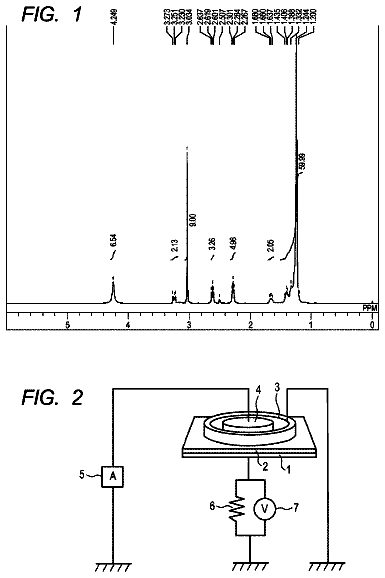
All 2 drawing sheets from the published document, cropped to the drawing.
What the patent claimed, word for word. All of it is now free to use.
The present application is a U.S. National Stage application under 35 U.S.C. 371 of International Application Number PCT/US2013/050783, filed in English on Jul. 17, 2013, the entirety of which is incorporated herein by reference.
The present invention relates to a ferroelectric liquid crystal composition and a liquid crystal display device, both of which have low birefringence, and a compound which can be used in a ferroelectric liquid crystal composition.
With the features of being thin and capable of consuming less electric power, liquid crystal display devices have a wide variety of applications ranging from large-sized displays to portable information terminals, and thus development of the liquid crystal display devices is inactive progress. In regard to liquid crystal display devices developed thus far, multiplex drive for the TN mode and STN, active matrix drive using a thin film transistor (TFT) for TN, and the like have been developed and put to practical use. However, since these drive modes use nematic liquid crystals, the response speeds of the liquid crystal materials are as slow as several milliseconds (ms) to several ten milliseconds (ms), and it cannot be said that the liquid crystal materials are sufficiently capable of coping with moving video image displays.
Ferroelectric liquid crystals are liquid crystals which have response speeds that are very short in the order of microseconds (μs), and are appropriate for high speed devices. Since ferroelectric liquid crystals have superiority such as wide viewing angles, it is expected that high performance liquid crystal display devices can be provided.
Since ferroelectric liquid crystals have high birefringence, in a liquid crystal display device which uses a ferroelectric liquid crystal, in order to suppress the occurrence of color shift and thereby obtain a satisfactory white display, it is necessary to make the cell gap very narrow to less than 2 μm. However, with a narrow cell gap, there is a problem that due to the occurrence of thickness unevenness, and to the occurrence of color unevenness or display unevenness caused by thickness unevenness, the yield in production is decreased.
Thus, a ferroelectric liquid crystal which can realize satisfactory white display even in a liquid crystal display device having a large cell gap is desired.
For the purpose of providing a liquid crystal display device which enables a black-and-white display with high visibility by preventing coloration caused by a birefringence effect, for example, Patent Document 1 suggests that a substrate is made to exhibit birefringence, and also, the principal optical axis of the substrate is disposed to be slanting by 30° from the normal line of the smectic layer of the ferroelectric liquid crystal, to thereby adjust the difference in retardation of the substrate and the liquid crystal layer to a predetermined range.
Furthermore, although not related to ferroelectric liquid crystals, in regard to nematic liquid crystals, it is known to add a liquid crystal material in order to improve display characteristics. For example, Patent Document 2 suggests adding a liquid crystal material having a desired birefringence or a liquid crystal material having a relatively high birefringence.
Furthermore, in Patent Document 3, although not related to ferroelectric liquid crystals, in regard to nematic liquid crystals, a tetracyclic ester compound and an ether compound, both of which have a predetermined structure having a benzene ring and three cyclohexane rings in total introduced into the main chain, are disclosed for the purpose of providing a liquid crystalline compound which is suitable for super-twist displays.
FIG. 1 is a schematic diagram illustrating an example of the alignment state of liquid crystal molecules in the present invention.
FIG. 2 is a schematic cross-sectional diagram illustrating an example of the liquid crystal display device of the present invention.
FIG. 3 is a chromaticity diagram of the liquid crystal display devices of Examples. CITATION LIST Patent Literature
Patent Literature 1: Japanese Patent No. 3225084
Patent Literature 2: Japanese Patent Application Publication Laid-Open (JP-A) No. 2001-034197
Patent Literature 3: JP-A No. H02-279649 SUMMARY OF INVENTION Technical Problem
In Patent Literature 1, birefringence is improved by adjusting the difference in retardation between the substrate and the liquid crystal layer of a liquid crystal display device to a predetermined range, and the invention is not intended to reduce the birefringence of a ferroelectric liquid crystal itself.
Furthermore, in Patent Literature 2, a liquid crystal material which exhibits high birefringence is used.
Furthermore, Patent Literature 3 has no description regarding the reduction of birefringence of a ferroelectric liquid crystal composition.
The present invention was achieved in view of the problems described above, and it is a principal object of the present invention to provide a birefringence improving agent that can reduce birefringence in a liquid crystal display device in which a ferroelectric liquid crystal composition is used, and is capable of realizing a satisfactory white display even in a liquid crystal display device having a large cell gap; a ferroelectric liquid crystal composition and a liquid crystal display device that use the agent; and a compound that can be used in a ferroelectric liquid crystal composition. Solution to Problem
The inventors of the present invention repeatedly conducted investigations on the birefringence of liquid crystal display devices in which ferroelectric liquid crystals are used, and as a result, the inventors found that when a compound having a particular structure is used in a ferroelectric liquid crystal composition, birefringence can be reduced, and when the ferroelectric liquid crystal composition is used in a liquid crystal display device, the occurrence of color shift is suppressed, and a satisfactory white display is obtained. Thus, the inventors eventually completed the present invention based on such findings.
That is, the present invention provides a birefringence improving agent having a structure represented by the following general formula (1):
wherein in the formula (1), R.sup.1 and R.sup.2 each represent a linear or branched alkyl group having 3 to 9 carbon atoms, provided that at least one of R.sup.1 and R.sup.2 has 5 or more carbon atoms;
A.sup.1 represents —CH.sub.2—CH.sub.2—, —O—CH.sub.2— or —CH.sub.2—O—; and
Z.sup.1 and Z.sup.2 each independently represent a fluorine atom or a hydrogen atom.
The birefringence improving agent of the present invention, which has a structure represented by the above formula (1), can reduce birefringence when added to a ferroelectric liquid crystal composition. In a liquid crystal display device in which the ferroelectric liquid crystal composition is used, even if the cell gap is relatively large, the occurrence of color shift is suppressed, and a satisfactory white display can be realized.
Furthermore, the present invention provides a ferroelectric liquid crystal composition containing a birefringence improving agent represented by the formula (1).
The ferroelectric liquid crystal composition of the present invention, which contains a birefringence improving agent represented by the formula (1), can reduce birefringence.
Furthermore, the present invention provides a liquid crystal display device comprising: a first alignment treatment substrate comprising a first base material, a first electrode layer formed on the first base material, and a first alignment layer formed on the first electrode layer; a second alignment treatment substrate comprising a second base material, a second electrode layer formed on the second base material, and a second alignment layer formed on the second electrode layer; and a liquid crystal layer that is formed between the first alignment layer and the second alignment layer and contains a ferroelectric liquid crystal composition, wherein the ferroelectric liquid crystal composition containing a birefringence improving agent represented by the formula
Since the liquid crystal display device of the present invention uses a ferroelectric liquid crystal composition containing a birefringence improving agent represented by the formula (1), birefringence of the ferroelectric liquid crystal composition can be reduced, and a satisfactory white display can be realized.
Furthermore, the present invention provides a compound having a structure represented by the following general formula (2):
wherein in the formula (2), R.sup.3 and R.sup.4 each represent a linear or branched alkyl group having 3 to 9 carbon atoms, provided that at least one of R.sup.3 and R.sup.4 has 5 or more carbon atoms; and
A.sup.2 represents —O—CH.sub.2— or —CH.sub.2—O—.
The compound of the present invention, which has a structure represented by the above formula (2), can reduce birefringence when the compound is added to a ferroelectric liquid crystal composition. In a liquid crystal display device in which the ferroelectric liquid crystal composition is used, even if the cell gap is relatively large, the occurrence of color shift is suppressed, and a satisfactory white display can be realized. Advantageous Effects of Invention
The birefringence improving agent represented by the formula
of the present invention can reduce birefringence when used in a ferroelectric liquid crystal composition. Furthermore, when the ferroelectric liquid crystal composition is used in a liquid crystal display device, there is provided an effect that the occurrence of color shift is suppressed and a satisfactory white display can be realized.
Hereinafter, the birefringence improving agent, ferroelectric liquid crystal composition, liquid crystal display device, and compound of the present invention will be described in detail.
A. Birefringence Improving Agent
The birefringence improving agent of the present invention has a structure represented by the following general formula (1):
wherein in the formula (1), R.sup.1 and R.sup.2 each represent a linear or branched alkyl group having 3 to 9 carbon atoms, provided that at least one of R.sup.1 and R.sup.2 has 5 or more carbon atoms;
A.sup.1 represents —CH.sub.2—CH.sub.2—, —O—CH.sub.2— or —CH.sub.2—O—; and
Z.sup.1 and Z.sup.2 each independently represent a fluorine atom or a hydrogen atom.
That is, the birefringence improving agent of the present invention is represented by any one of the following general formulae (1-1) to (1-3):
wherein in the formulae (1-1) to (1-3), R.sup.1, R.sup.2, Z.sup.L and Z.sup.2 have the same meanings as those defined in the above formula (1), respectively.
In general, a liquid crystalline compound has a structure composed of a core section, terminal chain sections, and spacer sections that links the core section and the terminal chain sections, and has a rod-like shape. It is general that a liquid crystalline compound which constitutes a ferroelectric liquid crystal composition also has such a structure and such a shape. Particularly, a liquid crystalline compound which constitutes a ferroelectric liquid crystal composition has a plural number of aromatic rings such as a benzene ring and a pyrimidine ring at the core section, and tends to have a linear shape, so that anisotropy of the refractive index, that is, birefringence increases.
Furthermore, it is known that as there are more conjugates based on unsaturated bonds, birefringence increases.
On the other hand, since the birefringence improving agent represented by the formula
has not a rod shape but a bent shape, anisotropy of the refractive index decreases. Furthermore, since the birefringence improving agent represented by the formula
only has one benzene ring at the core section and does not have plural aromatic rings, there are fewer conjugates based on unsaturated bonds. Accordingly, it is speculated that birefringence is reduced thereby.
Therefore, birefringence can be reduced by adding a birefringence improving agent represented by the formula
to a ferroelectric liquid crystal composition. Therefore, when the ferroelectric liquid crystal, composition is used in a liquid crystal display device having a relatively large cell gap, the occurrence of color shift is suppressed, and thereby a satisfactory white display can be obtained.
1. Birefringence Improving Agents Represented by Formulae (1-1) to (1-3)
In the formulae (1-1) to (1-3), R.sup.1 represents a linear or branched alkyl group.
It is acceptable if the number of carbon atoms of R.sup.1 is 3 to 9, but above all, the number of carbon atoms is preferably 5 to 7, and particularly preferably 5. If the number of carbon atoms is larger than the range described above, when the birefringence improving agent is added to a ferroelectric liquid crystal composition, there is a risk that the ferroelectric liquid crystal composition may become likely to exhibit a liquid crystalline phase which is close to a crystalline phase such as the smectic B phase. When a liquid crystalline phase which is close to a crystalline phase such as the smectic B phase is exhibited, the regularity of the molecular arrangement increases excessively, and impact resistance may decrease, or the phase sequences may become complicated, so that it may be difficult for liquid crystal molecules to align themselves. Furthermore, the tilt angle of the liquid crystal molecules may become extremely small, and there is a risk that the drive performance may deteriorate, such as that sufficient brightness may not be obtained. On the other hand, if the number of carbon atoms is smaller than the range described above, there is a risk that the temperature range of the chiral smectic C phase of the ferroelectric liquid crystal composition may be narrowed, or there is a risk that the chiral smetic C phase may not be exhibited. If the temperature range of the chiral smectic C phase is narrowed, the tilt angle of the liquid crystal molecules may become extremely small, or the alignment of the liquid crystal molecules may be adversely affected. When the number of carbon atoms is within the range described above, the tilt angle of the liquid crystal molecules becoming extremely small can be suppressed, and satisfactory drive performance can be obtained.
Incidentally, the number of carbon atoms of at least one of R.sup.1 and R.sup.2 that will be described below is 5 or greater. The reason for this is the same as that in the case where the number of carbon atoms of R.sup.1 described above is in a predetermined range.
In the formulae (1-1) to (1-3), R.sup.2 represents a linear or branched alkyl group.
It is acceptable if the number of carbon atoms of R.sup.2 is 3 to 9, and above all, the number of carbon atoms is preferably 5 to 7, and particularly preferably 5. Since the reason why the number of carbon atoms of R.sup.2 is preferably in the range described above, is the same as the reason for the number of carbon atoms of R.sup.1 described above, further description will not be repeated herein.
In the formulae (1-1) to (1-3), Z.sup.1 and Z.sup.2 each independently represent a fluorine atom or a hydrogen atom. Among others, it is preferable that at least one of Z.sup.1 and Z.sup.2 be a fluorine atom. When at least one of Z.sup.1 and Z.sup.2 is a fluorine atom, the tilt angle of the liquid crystal molecules can be made large, and therefore, the transmittance of the liquid crystal display device can be increased. Furthermore, since the range of the phase transition temperature of the chiral smectic C phase is broadened, in the case where a ferroelectric liquid crystal composition having a compound represented by any one of the formulae (1-1) to (1-3) is used in a liquid crystal display device, the liquid crystal display device can be driven in a stable manner at low temperatures and at high temperature.
Specific examples of the birefringence improving agents represented by the formulae (1-1) to (1-3) include birefringence improving agents represented by the following formulae:
2. Synthesis method
The birefringence improving agents of the present invention can be synthesized from an arbitrary raw material compound, using a generally known organic synthesis method. Hereinafter, the methods for synthesizing birefringence improving agents represented by the formulae (1-1) to (1-3) will be described.
Birefringence Improving Agent Represented by Formula (1-1)
The birefringence improving agent represented by the formula (1-1) can be synthesized by, for example, the method described in JP-A No. H02-279649.
Birefringence Improving Agent Represented by Formula (1-2)
As an example of the method for synthesizing a birefringence improving agent represented by the formula (1-2), a method for synthesizing a birefringence improving agent represented by the following formula (1-4) will be described in divided sections of from a first process to a fifth process.
(a) First process
First, in a nitrogen atmosphere, LiAlH.sub.4 is added to ice-cooled anhydrous THF, and the mixture is stirred. A 4-trans-pentylcyclohexanecarboxylic acid solution dissolved in anhydrous THF is added dropwise thereto, and subsequently, the mixture is returned to room temperature and stirred. Next, water and an aqueous NaOH solution are added to this solution, the mixture is stirred, and insoluble materials are removed by performing Celite filtration. Subsequently, the mixture is subjected to extraction, washing with water, drying, concentration, and drying under reduced pressure, and thereby colorless, oily 4-trans-n-pentylcyclohexanemethanol can be obtained.
(b) Second process
In a nitrogen atmosphere, a solution in which 2,3-difluorophenol and the compound obtained in the above-described “(a) First process” are dissolved in anhydrous THF is prepared, triphenylphosphine is added thereto, and the mixture is ice-cooled. Diisopropyl azodicarboxylate is added dropwise thereto, and the mixture is stirred. Thereafter, the mixture is returned to room temperature and stirred, and the mixture is subjected to extraction, washing with water, drying, and concentration. Thereby, a yellow oily substance can be obtained. Subsequently, N-hexane is added to the oily substance, and a white solid that has precipitated out at this time is removed by filtration and concentrated. Thereafter, the white solid is subjected to purification, and thereby 4-trans-n-pentyl-1-(2,3-difluorophenoxymethyl)cyclohexane as a white solid can be obtained.
(c) Third process
In an Ar atmosphere, a solution in which the compound obtained in the “(b) Second process” is dissolved in anhydrous THF is stirred at or below −40° C., a butyllithium hexane solution is added dropwise thereto, and the mixture is stirred. Next, trimethoxyborane is added dropwise to the solution thus obtained, and the mixture is stirred. Next, this solution is returned to room temperature, and a dilute aqueous hydrochloric acid solution is added thereto to acidify the solution. This solution is stirred, and is subjected to extraction, drying, and concentration under reduced pressure. Thereafter, N-hexane is added to the residue thus obtained, the mixture is ice-cooled, and crystals precipitated therefrom are collected by filtration. Thereby, 4-(4-trans-n-pentylcyclohexylmethyloxy)-2,3-difluorophenylboronic acid as a white powder can be obtained.
(d) Fourth process
Acetic acid is added to the compound obtained in the “(c) Third process”, and subsequently, an aqueous hydrogen peroxide solution is added thereto at room temperature. Next, this solution is stirred, water is added thereto, and crystals precipitated therefrom are collected by filtration. Thereby, 4-(4-trans-n-pentylcyclohexylmethyloxy)-2,3-difluorophenol as a pale yellow powder can be obtained.
(e) Fifth process
In a nitrogen atmosphere, triethylamine is added to a solution in which the compound obtained in the “(d) Fourth process” is dissolved in anhydrous methylene chloride, and the mixture is ice-cooled. To this solution, a solution prepared by dissolving 4-trans-4-(trans-4-n-pentylcyclohexyl)cyclohexylcarbonyl chloride in methylene chloride is added dropwise, and the mixture is stirred. Next, this solution is returned to room temperature and stirred, and the solution is subjected to extraction, washing with water, drying, and concentration under reduced pressure. Thereafter, methanol is added to the residue thus obtained, the mixture is stirred at room temperature, and crystals precipitated therefrom are collected by filtration. Thereby, a birefringence improving agent represented by the formula (1-4) as a white solid, which is the final product, can be obtained.
Birefringence improving agent represented by formula (1-3)
As an example of the method for synthesizing a birefringence improving agent represented by the formula (1-3), a method for synthesizing a birefringence improving agent represented by the following formula (1-5) will be described in divided sections of from a first process to a seventh process.
(a) First process
First, 2,3-difluorophenol and potassium carbonate are added to DMF in the presence of benzyl bromide, and the mixture is heated in an Ar atmosphere and then stirred. Next, the mixture is subjected to extraction, washing with water, drying, concentration, and drying under reduced pressure, and thereby oily 2,3-difluorophenyl benzyl ether can be obtained.
(b) Second process
In an Ar atmosphere, the compound obtained in the “(a) First process” is added to THF, and the mixture is stirred at or below −40° C. A butyllithium hexane solution is added dropwise thereto. Subsequently, this solution is stirred, and then dry ice is added thereto. The mixture is stirred overnight. Thereafter, the mixture is subjected to extraction, drying, concentration, and recrystallization, and thereby 4-benzyloxy-2,3-difluorobenzoic acid as a white solid can be obtained.
(c) Third process
In an Ar atmosphere, the compound obtained in the “(b) Second process” is added to THF and trimethoxyborane, and the mixture is stirred under ice cooling. Subsequently, to this solution, a THF solution of a borane-dimethyl sulfide complex is added dropwise, and the mixture is stirred overnight at room temperature. Thereafter, this solution is poured into ice water, and a precipitate thus obtained is collected by filtration and dried under reduced pressure. Thereby, 4-benzyloxy-2,3-difluorobenzyl alcohol as a white solid can be obtained.
(d) Fourth process
In an Ar atmosphere, the compound obtained in the “(c) Third process” is added to dichloromethane, and the mixture is stirred at room temperature. To this solution, a dichloromethane solution of phosphorus tribromide is added dropwise, the mixture is stirred overnight at room temperature, and ice water is poured thereinto to perform separation. Thereafter, the resultant is subjected to washing with water, drying, concentration, and drying under reduced pressure, and thereby, 4-benzyloxy-2,3-difluorobenzyl bromide as a white solid can be obtained.
(e) Fifth process
In an Ar atmosphere, the compound obtained in the “(d) Fourth process”, trans-pentylcyclohexanol and sodium hydride are added to THF and DMF, and the mixture is heated and then stirred overnight. Next, the mixture is subjected to extraction, washing with water, drying, concentration, and purification, and thereby 2,3-difluoro-4-(trans-pentylcyclohexyl)oxymethylphenyl benzyl ether as a white solid can be obtained.
(f) Sixth process
In a hydrogen atmosphere, the compound obtained in the “(e) Fifth process”, palladium carbon, and concentrated hydrochloric acid are added to THE and ethanol, and the mixture is heated and then stirred overnight. Thereafter, the mixture is subjected to filtration, concentration, and purification, and thereby 2,3-difluoro-4-(trans-pentylcyclohexyl)oxymethylphenol as a white solid can be obtained.
(g) Seventh process
In an Ar atmosphere, the compound obtained in the “(f) Sixth process”, trans, trans-4-(4′-pentylcyclohexyl)cyclohexylcarbonyl chloride, and triethylamine are added to dichloromethane, and the mixture is stirred overnight at room temperature. Next, the mixture is subjected to extraction, washing with water, drying, concentration, purification, and recrystallization, and thereby a birefringence improving agent represented by the formula (1-5) as a white solid can be obtained.
3. Use
The birefringence improving agent represented by the formula
is such that as the birefringence improving agent is contained in the ferroelectric liquid crystal composition described above, when the ferroelectric liquid crystal composition is used in a liquid crystal display device, the occurrence of color shift is suppressed, and a satisfactory white display can be obtained.
Here, in the case where a ferroelectric liquid crystal composition containing a birefringence improving agent represented by the formula
is used in a liquid crystal display device, regarding the birefringence improving agent represented by the formula (1), one kind may be used singly, or two or more kinds may be used in mixture.
B. Ferroelectric Liquid Crystal Composition
The ferroelectric liquid crystal composition of the present invention comprises a birefringence improving agent represented by the formula (1).
According to the ferroelectric liquid crystal composition of the present invention, as the composition contains a birefringence improving agent represented by the formula (1), birefringence can be reduced while the drive performance is maintained.
Hereinafter, various components for the ferroelectric liquid crystal composition of the present invention will be described.
1. Birefringence Improving Agent Represented by Formula
The birefringence improving agent represented by the formula
will be described.
The birefringence improving agent represented by the formula
that is used in the ferroelectric liquid crystal composition of the present invention may be of only one kind, or may include two or more kinds.
The content of the birefringence improving agent represented by the formula
in the ferroelectric liquid crystal composition of the present invention is not particularly limited as long as the birefringence improving agent can reduce birefringence. However, the content is preferably in the range of 5% by mass to 60% by mass in the ferroelectric liquid crystal composition of the present invention, and above all, the content is preferably in the range of 10% by mass to 50% by mass, and particularly preferably in the range of 10% by mass to 30% by mass. If the content of the birefringence improving agent represented by the formula
is small, the effect of reducing birefringence may not be sufficiently obtained. On the other hand, if the content of the birefringence improving agent represented by the formula
is large, viscosity increases, and the response speed may decrease, or the driving voltage may increase. Furthermore, if the content of the birefringence improving agent is large, the temperature range of the chiral smectic C phase may shift toward the higher temperature side, and thereby the phase transition temperature on the lower temperature side may approach room temperature. Alternatively, a single component in the ferroelectric liquid crystal composition may increase, and thereby crystallization may easily occur.
Incidentally, since the details of the birefringence improving agent represented by the formula
are the same as described in the section “A. Birefringence improving agent represented by formula (1)”, further explanation will not be repeated here.
2. Chiral compound
The ferroelectric liquid crystal composition of the present invention usually contains a chiral compound.
Regarding the chiral compound that is used in the present invention, compounds that are generally used as chiral compounds for ferroelectric liquid crystal compositions can be used. Incidentally, it is neither necessary for the chiral compound to have smectic properties, nor to exhibit liquid crystallinity.
Among others, the chiral compound is preferably such that two or more benzene rings are directly linked together, and more preferably such that three or more benzene rings are directly linked together. Since a benzene ring adopts a planar structure, a chiral compound in which two or more benzene rings are directly linked has a tendency that the benzene ring planes are aligned to be laminated. For this reason, the refractive index in a direction parallel to the benzene ring plane and the refractive index in a direction perpendicular to the benzene ring plane differ greatly from each other, and birefringence is easily increased. On the other hand, with regard to the present invention, since birefringence can be reduced, it is effective in the case where such a chiral compound is used.
Furthermore, the chiral compound in which three or more benzene rings are directly linked is preferably at least one of a chiral compound A represented by the following general formula
and a chiral compound B represented by the following general formula (4). When such a chiral compound is contained, in the case of using the ferroelectric liquid crystal composition of the present invention in a liquid crystal display device, impact resistance can be enhanced. Since ferroelectric liquid crystals have higher orderliness of molecules compared with nematic liquid crystals, if the regularity of molecular orientation is disordered by impact, the molecular orientation does not easily return to the original state, that is, the liquid crystals are very vulnerable to external impact. Therefore, it, is preferable that impact resistance be satisfactory.
In the present invention, as described above, when a ferroelectric liquid crystal composition contains such a chiral compound that improves impact resistance, birefringence can be reduced while impact resistance is maintained.
Incidentally, since the chiral compound A and the chiral compound B have three or more benzene rings at the core section, birefringence is especially likely to increase. However, as explained in the above, since at least one compound of the birefringence improving agents represented by the formula
is contained in the present invention, the birefringence of the ferroelectric liquid crystal composition can be reduced.
Hereinafter, the chiral compound according to the present invention will be described separately in terms of the chiral compound A and the chiral compound B.
Chiral compound A
The chiral compound A that is used in the present invention is a compound represented by the following general formula (3):
wherein in the formula (3), R.sup.10 is a non-chiral group and represents a saturated or unsaturated alkyl group or alkoxyalkyl group which may be substituted with a halogen atom.
The number of carbon atoms is desirably 4 to 18, but above all, the number of carbon atoms is preferably 6 to 1.8, and more preferably 6 to 12. It is because if the number of carbon atoms is larger than the range described above, synthesis of the chiral compound A becomes difficult, and the cost increases. On the other hand, it is because if the number of carbon atoms is smaller than the range described above, the ferroelectric liquid crystal composition may not exhibit the smectic phase. The alkyl group or alkoxyalkyl group may be substituted with a halogen atom, or may not be substituted with a halogen atom.
The alkyl group or alkoxyalkyl group is linear or branched.
R.sup.20 is a chiral group and represents a group represented by the following general formula (5):
In the formula (5), R.sup.30 represents a saturated or unsaturated linear, branched or cyclic alkyl group or alkoxyalkyl group having 1 to 10 carbon atoms, which may be substituted with a halogen atom.
In the formula (5), Y.sup.1 represents —CH.sub.3 or a fluorine atom. Y.sup.1 may be —CH.sub.3 or may be a fluorine atom, but above all, Y.sup.1 is preferably —CH.sub.3. It is because, as described above, synthesis of the chiral compound A is feasible, the chiral compound A can be produced in a stable manner, and a ferroelectric liquid crystal composition can be obtained inexpensively.
In the formula (5), “m” represents 0 or 1, and “n” represents 0 or 1.
Furthermore, in the formula (5), symbol * represents the chiral center. When m=0, the carbon atom at the 1-position serves as the chiral center, and when m=1, the carbon atom at the 2-position serves as the chiral center.
Also, since R.sup.20 in the formula
is a chiral group, in the formula (5), when Y.sup.1 is —CH.sub.3 and n=0, R.sup.30 is not —CH.sub.3.
In the formula (3), X.sup.1 to X.sup.8 each independently represent —CH.sub.3, —CF.sub.3, a halogen atom, or a hydrogen atom. However, one or more of X.sup.1 to X.sup.8 each independently represent —CH.sub.3, —CF.sub.3, or a halogen atom.
When all of X.sup.1 to X.sup.8 are hydrogen atoms, since the solubility of the chiral compound A decreases, synthesis and purification of the chiral compound A become difficult, and there is a risk that the cost may increase. On the contrary, when one or more of X.sup.1 to X.sup.8 represent —CH.sub.3, —CF.sub.3 or a halogen atom as in the case of the present invention, the solubility of the chiral compound A in a solvent increases, and synthesis and purification in large quantities are enabled. Furthermore, it is speculated that since a strain occurs in the steric structure of the chiral compound A, and this strain loosens the molecular arrangement that is excessively regular, high impact resistance can be obtained.
Above all, it is preferable that any one or more of X.sup.1 to X.sup.3 and X.sup.5 to X.sup.7 be each independently —CH.sub.3, —CF.sub.3 or a halogen atom. It is because when the compound has substituents at the positions of X.sup.1 to X.sup.3 and X.sup.5 to X.sup.7, the chiral compound has superior solubility than in the case of the positions of X.sup.4 and X.sup.8. This is speculated to be because the case of the positions of X.sup.4 and X.sup.8 involves less strain caused by substituents as compared with the case of other positions.
One benzene ring may have 1 to 4 substituents, but among others, it is preferable that a benzene ring have one or two substituents. When there is one substituent, the substituent is preferably —CH.sub.3, a fluorine atom or a chlorine atom, and above all, the substituent is preferably —CH.sub.3 or a fluorine atom. On the other hand, when there are two substituents, it is preferable that both substituents be fluorine atoms in this case, regarding the positions of the two substituents, for example, it is preferable that adjoining carbon atoms of a benzene ring be each substituted by a fluorine atom, as in the case where X.sup.1 and X.sup.2, or X.sup.3 and X.sup.4 are fluorine atoms. When adjoining carbon atoms of a benzene ring are respectively substituted by two fluorine atoms, and the benzene ring is symmetrically substituted, the chiral smectic C phase is stabilized, and the tilt angle of the liquid crystal molecules can be made large. Therefore, the transmittance of the liquid crystal display device can be increased. Furthermore, since two substituents are bonded to carbon atoms that are located closer to each other, the regularity of the molecular arrangement can be loosened, and crystallization can be suppressed.
Furthermore, it is preferable that the chiral compound represented by the formula
have one to two substituents in total.
In regard to the chiral compound represented by the formula (3), it is preferable that one benzene ring between the benzene rings to which X.sup.1 to X.sup.8 are bonded, have substituents, and above all, it is preferable that the benzene ring to which X.sup.1, X.sup.2, X.sup.5 and X.sup.6 are bonded have substituents. It is because if the benzene ring that is located in the middle among the three benzene rings that are directly linked, has a substituent, it is difficult for the ferroelectric liquid crystal composition to be crystallized.
Particularly, in the case where the total number of substituents is 1, it is preferable that any one of X.sup.1, X.sup.2, X.sup.5 and X.sup.6 be —CH.sub.3, a fluorine atom or a chlorine atom, and more preferably, —CH.sub.3 or a fluorine atom. Furthermore, when one benzene ring has two substituents, and the total number of substituents is two, it is preferable that X.sup.1 and X.sup.2, or X.sup.5 and X.sup.6 be fluorine atoms.
Specific examples of the chiral compound A represented by the formula
include chiral compounds A represented by the following general formulae (3-1) to (3-4):
wherein in the formulae (3-1) to (3-4), R.sup.11 represents a saturated or unsaturated linear, branched or cyclic alkyl group having 1 to 10 carbon atoms, and above all, R.sup.11 is preferably a linear or branched saturated alkyl group, or a phenylalkyl group. Symbol * represents a chiral center, and “m” represents 0 or 1. “p” is 4 to 18, preferably 6 to 18, and more preferably 6 to 12. In the formulae (3-1) and (3-2), X.sup.21 and X.sup.22 each independently represent —CH.sub.3, —CF.sub.3 or a halogen atom, and among them, —CH.sub.3, a fluorine atom or a chlorine atom is preferred. The positions of X.sup.21 and X.sup.22 are the same as the positions of X.sup.1 to X.sup.8 described above. “j” and “k” are such that one of them is 0, while the other is 1.
Specific examples of the chiral compound A represented by the formulae (3-1) to (3-4) include chiral compounds A represented by the following formulae:
TABLE-US-00001 TABLE 1 X.sup.1 X.sup.2 X.sup.3 R — Cl — —C*H(CH.sub.3)COOC.sub.4H.sub.9 — CH.sub.3 — —C*H(CH.sub.3)COOC.sub.4H.sub.9 — CH.sub.3 — —C*H(CH.sub.3)C.sub.6H.sub.13 — Cl — —C*H(CH.sub.3)COOCH.sub.2CH(CH.sub.3).sub.2 — Cl — —CH.sub.2C*H(CH.sub.3)C.sub.2H.sub.5 — Cl — —C*H(CH.sub.3)COOCH.sub.2C(CH.sub.3).sub.3 — Cl — —C*H(CH.sub.3)COOCH.sub.2C.sub.6H.sub.5 — Cl — —C*H(CH.sub.3)COOC.sub.2H.sub.5 — CH.sub.3 — —C*H(CH.sub.3)COOC.sub.2H.sub.5 — CH.sub.3 — —C*H(CH.sub.3)COOC.sub.3H.sub.7 — CH.sub.3 — —C*H(CH.sub.3)COOC.sub.6H.sub.13 — CH.sub.3 — —C*H(CH.sub.3)COOC.sub.8H.sub.17 — — CH.sub.3 —C*H(CH.sub.3)COOC.sub.2H.sub.5 F F — —C*H(CH.sub.3)COOC.sub.2H.sub.5 F F — —C*H(CH.sub.3)COOC.sub.4H.sub.9 F F — —C*H(CH.sub.3)COOC(CH.sub.3).sub.3 — F — —C*H(CH.sub.3)COOC.sub.4H.sub.9
Regarding such chiral compounds A, one kind may be used singly, or two or more kinds may be used in mixture.
A chiral compound A can be synthesized by, for example, the method described in the pamphlet of WO 2010/031431.
Chiral Compound B
The chiral compound B that is used in the present invention is a compound represented by the following general formula (4):
In the formula (4), K.sup.2 represents a single bond or a cyclohexane ring. When K.sup.2 is a single bond, as shown in the following general formula (4-1), the chiral compound B becomes a compound in which four benzene rings are directly linked. When K.sup.2 is a cyclohexane ring, as shown in the following general formula (4-2), the chiral compound B becomes a compound in which four benzene rings and one cyclohexane ring are directly linked.
Among others, it is preferable that K.sup.2 be a single bond.
In the formula (4), R.sup.40 is a non-chiral group and represents a saturated or unsaturated alkyl group or alkoxyalkyl group having 4 to 18 carbon atoms which may be substituted with a halogen atom. Incidentally, since R.sup.40 has the same meaning as R.sup.10 in the formula (3), further description will not be repeated here.
In the formula (4), R.sup.50 is a chiral group having one or more chiral centers and is a group represented by the formula (5). Incidentally, since the group represented by the formula
has the same meaning as in the case of the chiral compound A, further description will not be repeated here.
The description continues in the full USPTO document.
About 6,134 words. The USPTO PDF has it with every drawing.
Fees are due 3.5, 7.5 and 11.5 years after grant. This patent expired on April 3, 2026, so the fee marked "not paid" was the one that went unpaid.
BIREFRINGENCE IMPROVING AGENT, FERROELECTRIC LIQUID CRYSTAL COMPOSITION AND LIQUID CRYSTAL DISPLAY DEVICE USING THE AGENT, AND COMPOUND
Filed Jul 2013 · published Jun 2016Birefringence improving agent, ferroelectric liquid crystal composition and liquid crystal display device using the agent, and compound
Filed Jul 2013 · granted Apr 2018Earlier publications, parents and continuations. None of them can still be enforced, or this patent would not be listed.
Prior art cited by the examiner or applicant. Useful when you check your own idea for novelty.
Everything on this page comes from the documents linked above.