 Lapsed, fee not paid5 drawings
Software & Apps · US 9,924,339 B2
Real-time notification of toll-free data service usage
A device may receive first information.
US 9,924,364 B2 · Assignee: HUAWEI TECHNOLOGIES CO., LTD. · Inventors: Wang; Shuo
Sheet 1 of 6 from the published document. All sheets in the USPTO PDF
A user management method of a shared network, where the method includes acquiring user management information from a user access management device, where the user management information includes identification information of a participant operator and invalid user information/valid user information, the invalid user information is used to indicate a user equipment that has been detached from a network of the participant operator but a user context is still retained in the user access management device, and the valid user information is used to indicate a user equipment attached to the network of the participant operator, and updating access user information of the participant operator according to the user management information. In addition, another user management method of a shared network, and a corresponding device and system are further provided.
Network sharing refers to a network operating mode in which multiple different operators use a same mobile network. Compared with a case in which a conventional mobile network operator (MNO) needs to input huge amounts of money to build and upgrade a network, in this mode, costs input by an operator can be greatly reduced. The network sharing may be network sharing between operators, or may be network sharing between an operator and a mobile virtual network operator (MVNO). The MVNO generally refers to an operator that is not licensed or whose development scale is limited, and therefore needs to use a network of an existing basic MNO to cultivate users of the operator, and provide services to the users. A licensed MNO may also rent a network of another MNO to cultivate users of the licensed MNO and provide services. Such a licensed MNO may also be considered as a MVNO. With enhancement o
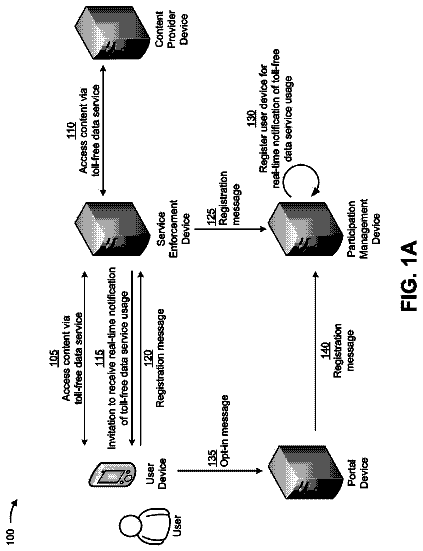
1 of 6 drawing sheets so far from the published document, cropped to the drawing. Every sheet is in the USPTO PDF.
What the patent claimed, word for word. All of it is now free to use.
The present disclosure relates to the field of communications technologies, and in particular, to a user management method of a shared network, and a corresponding device and system.
Network sharing refers to a network operating mode in which multiple different operators use a same mobile network. Compared with a case in which a conventional mobile network operator (MNO) needs to input huge amounts of money to build and upgrade a network, in this mode, costs input by an operator can be greatly reduced.
The network sharing may be network sharing between operators, or may be network sharing between an operator and a mobile virtual network operator (MVNO). The MVNO generally refers to an operator that is not licensed or whose development scale is limited, and therefore needs to use a network of an existing basic MNO to cultivate users of the operator, and provide services to the users. A licensed MNO may also rent a network of another MNO to cultivate users of the licensed MNO and provide services. Such a licensed MNO may also be considered as a MVNO. With enhancement of a network sharing capability, a network of one MNO may serve multiple participant MNO (PMNO) (that is, basic mobile operators or MVNOs). The MNO serving the multiple participant operators, that is, a primary operator, needs to manage and control network resources for each participant operator. For example, the MNO allocates different radio access resources, different maximum user quantities, different maximum bearer/Packet Data Protocol (PDP) resources, and the like to different participant operators in order to ensure that there are sufficient network resources available for all the participant operators that are served by the MNO. In other approaches, a primary operator generally uses a home subscriber server (HSS) to collect statistics about and monitor a total quantity of access users of each participant operator in order to avoid an infringement on interests of the primary operator because a quantity of users of a participant operator that access a network of the operator exceeds a total quantity of subscribed access users.
During research and practice of other approaches, it is found that that in other approaches, when a user equipment executes a detach procedure, even though a mobility management entity (MME) has been detached from the user equipment, the HSS cannot know the detachment. Therefore, in the network, a quantity of actual access users of a participant operator may be less than a quantity of access users of a related participant operator that is obtained through statistics collection by the HSS, affecting accuracy of controlling the quantity of the access users, even affecting normal access of a user, and reducing network performance.
Embodiments of the present disclosure provide a user management method of a shared network, and a corresponding device and system, which can improve accuracy of controlling a quantity of access users, and improve network performance.
According to a first aspect, an embodiment of the present disclosure provides a user information management device of a shared network, including an acquiring unit configured to acquire user management information from a user access management device, where the user management information includes identification information of a participant operator and invalid user information/valid user information, the invalid user information is used to indicate a user equipment that has been detached from a network of the participant operator but a user context of the user equipment is still retained in the user access management device, and the valid user information is used to indicate a user equipment attached to the network of the participant operator, and an updating unit configured to update access user information of the participant operator according to the user management information.
With reference to the first aspect, in a first possible implementation manner, the acquiring unit includes a first receiving subunit, a first determining subunit, and a first sending subunit, where the first receiving subunit is configured to receive an authentication request that is initiated by the user access management device according to an access request sent by a user equipment, where the authentication request carries the identification information of the participant operator. The first determining subunit is configured to determine, according to the identification information of the participant operator, the participant operator to which the user equipment belongs, and determine a quantity of access users of the participant operator. The first sending subunit is configured to send a notification to multiple user access management devices that carry a service of the participant operator when the quantity of the access users exceeds a preset threshold, where the notification instructs the user access management device to report the user management information, and the first receiving subunit is further configured to receive the user management information sent by the multiple user access management devices.
With reference to the first aspect, in a second possible implementation manner, the acquiring unit includes a second receiving subunit, a second determining subunit, and a second sending subunit, where the second receiving subunit is configured to receive an authentication request that is initiated by the user access management device according to an access request sent by a user equipment, where the authentication request carries the identification information of the participant operator. The second determining subunit is configured to determine, according to the identification information of the participant operator, the participant operator to which the user equipment belongs, and determine a quantity of access users of the participant operator. The second sending subunit is configured to send an authentication response message to the user access management device, where the authentication response message carries the quantity of the access users, and the second receiving subunit is further configured to receive the user management information sent by the user access management device, where the user management information is sent by the user access management device when the quantity of the access users exceeds a preset threshold.
With reference to the first aspect or the first or the second possible implementation manner of the first aspect, in a third possible implementation manner, the updating unit is further configured to delete, from an access user information list of the participant operator, a record of access user information corresponding to the invalid user information, where the access user information list of the participant operator is used to record access user information of the participant operator.
With reference to the first aspect or the first or the second possible implementation manner of the first aspect, in a fourth possible implementation manner, the updating unit is further configured to delete, from an access user information list of the participant operator, a record other than access user information corresponding to the valid user information, where the access user information list of the participant operator is used to record access user information of the participant operator.
According to a second aspect, an embodiment of the present disclosure further provides a user access management device, including a first receiving unit configured to receive an access request sent by a user equipment, where the access request carries a user identifier, a first determining unit configured to determine, according to the user identifier, a participant operator to which the user equipment belongs, and a first sending unit configured to send an authentication request to a user information management device according to the access request, where the authentication request carries identification information of the participant operator such that the user information management device determines, according to the identification information of the participant operator, the participant operator to which the user equipment belongs, and determines a quantity of access users of the participant operator, where the first receiving unit is further configured to receive a notification that is sent by the user information management device when the user information management device determines that the quantity of the access users exceeds a preset threshold, where the notification instructs the access management device to report user management information, and the first sending unit is further configured to send the user management information to the user information management device such that the user information management device updates access user information of the participant operator according to the user management information, where the user management information includes the identification information of the participant operator and invalid user information/valid user information, the invalid user information is used to indicate a user equipment that has been detached from a network of the participant operator but a user context of the user equipment is still retained in the user access management device, and the valid user information is used to indicate a user equipment attached to the network of the participant operator.
According to a third aspect, an embodiment of the present disclosure further provides a user access management device, including a second receiving unit configured to receive an access request sent by a user equipment, where the access request carries a user identifier, a second determining unit configured to determine, according to the user identifier, a participant operator to which the user equipment belongs, and a second sending unit configured to send an authentication request to a user information management device according to the access request, where the authentication request carries identification information of the participant operator such that the user information management device determines, according to the identification information of the participant operator, the participant operator to which the user equipment belongs, and determines a quantity of access users of the participant operator, where the second receiving unit is further configured to receive an authentication response message returned by the user information management device, where the authentication response message carries the quantity of the access users, and the second sending unit is further configured to send user management information to the user information management device when the quantity of the access users exceeds a preset threshold such that the user information management device updates access user information of the participant operator according to the user management information, where the user management information includes the identification information of the participant operator and invalid user information/valid user information, the invalid user information is used to indicate a user equipment that has been detached from a network of the participant operator but a user context of the user equipment is still retained in the user access management device, and the valid user information is used to indicate a user equipment attached to the network of the participant operator.
According to a fourth aspect, an embodiment of the present disclosure further provides a communications system, including any user information management device of a shared network according to the embodiments of the present disclosure.
With reference to the fourth aspect, in a first possible implementation manner, the communications system further includes any user access management device according to the embodiments of the present disclosure.
According to a fifth aspect, an embodiment of the present disclosure further provides a user management method of a shared network, including acquiring user management information from a user access management device, where the user management information includes identification information of a participant operator and invalid user information/valid user information, the invalid user information is used to indicate a user equipment that has been detached from a network of the participant operator but a user context of the user equipment is still retained in the user access management device, and the valid user information is used to indicate a user equipment attached to the network of the participant operator, and updating access user information of the participant operator according to the user management information.
With reference to the fifth aspect, in a first possible implementation manner, acquiring user management information from a user access management device includes receiving an authentication request that is initiated by the user access management device according to an access request sent by a user equipment, where the authentication request carries the identification information of the participant operator, determining, according to the identification information of the participant operator, the participant operator to which the user equipment belongs, and determining a quantity of access users of the participant operator, sending a notification to multiple access management devices that carry a service of the participant operator when the quantity of the access users exceeds a preset threshold, where the notification instructs the access management device to report the user management information, and receiving the user management information sent by the multiple access management devices.
With reference to the fifth aspect, in a second possible implementation manner, acquiring user management information from a user access management device includes receiving an authentication request that is initiated by the user access management device according to an access request sent by a user equipment, where the authentication request carries the identification information of the participant operator, determining, according to the identification information of the participant operator, the participant operator to which the user equipment belongs, and determining a quantity of access users of the participant operator, sending an authentication response message to the user access management device, where the authentication response message carries the quantity of the access users, and receiving the user management information sent by the access management device, where the user management information is sent by the access management device when the quantity of the access users exceeds a preset threshold.
With reference to the fifth aspect or the first or the second possible implementation manner of the fifth aspect, in a third possible implementation manner, updating access user information of the participant operator according to the user management information includes deleting, from an access user information list of the participant operator, a record of access user information corresponding to the invalid user information, where the access user information list of the participant operator is used to record access user information of the participant operator, or deleting, from an access user information list of the participant operator, a record other than access user information corresponding to the valid user information, where the access user information list of the participant operator is used to record access user information of the participant operator.
According to a sixth aspect, an embodiment of the present disclosure further provides a user management method of a shared network, including receiving an access request sent by a user equipment, where the access request carries a user identifier, determining, according to the user identifier, a participant operator to which the user equipment belongs, sending an authentication request to a user information management device according to the access request, where the authentication request carries identification information of the participant operator such that the user information management device determines, according to the identification information of the participant operator, the participant operator to which the user equipment belongs, and determines a quantity of access users of the participant operator, receiving a notification that is sent by the user information management device when the user information management device determines that the quantity of the access users exceeds a preset threshold, where the notification instructs an access management device to report user management information, and sending the user management information to the user information management device such that the user information management device updates access user information of the participant operator according to the user management information.
According to a seventh aspect, an embodiment of the present disclosure further provides a user management method of a shared network, including receiving an access request sent by a user equipment, where the access request carries a user identifier, determining, according to the user identifier, a participant operator to which the user equipment belongs, sending an authentication request to a user information management device according to the access request, where the authentication request carries identification information of the participant operator such that the user information management device determines, according to the identification information of the participant operator, the participant operator to which the user equipment belongs, and determines a quantity of access users of the participant operator, receiving an authentication response message returned by the user information management device, where the authentication response message carries the quantity of the access users, and sending user management information to the user information management device when the quantity of the access users exceeds a preset threshold such that the user information management device updates access user information of the participant operator according to the user management information, where the user management information includes the identification information of the participant operator and invalid user information/valid user information, the invalid user information is used to indicate a user equipment that has been detached from a network of the participant operator but a user context of the user equipment is still retained in the user access management device, and the valid user information is used to indicate a user equipment attached to the network of the participant operator.
According to an eighth aspect, an embodiment of the present disclosure further provides a user information management device of a shared network, including a memory configured to store data, a transceiving interface configured to send and receive data, and a processor, where the processor is configured to acquire user management information from a user access management device, where the user management information includes identification information of a participant operator and invalid user information/valid user information, the invalid user information is used to indicate a user equipment that has been detached from a network of the participant operator but a user context of the user equipment is still retained in the user access management device, and the valid user information is used to indicate a user equipment attached to the network of the participant operator, and update access user information of the participant operator according to the user management information.
With reference to the eighth aspect, in a first possible implementation manner, the processor is further configured to receive, using the transceiving interface, an authentication request that is initiated by the user access management device according to an access request sent by a user equipment, where the authentication request carries the identification information of the participant operator, determine, according to the identification information of the participant operator, the participant operator to which the user equipment belongs, and determine a quantity of access users of the participant operator, send, using the transceiving interface, a notification to multiple access management devices that carry a service of the participant operator when the quantity of the access users exceeds a preset threshold, where the notification instructs the access management device to report the user management information, and receive, using the transceiving interface, the user management information sent by the multiple access management devices.
With reference to the eighth aspect, in a second possible implementation manner, the processor is further configured to receive, using the transceiving interface, an authentication request that is initiated by the user access management device according to an access request sent by a user equipment, where the authentication request carries the identification information of the participant operator, determine, according to the identification information of the participant operator, the participant operator to which the user equipment belongs, and determine a quantity of access users of the participant operator, send, using the transceiving interface, an authentication response message to the user access management device, where the authentication response message carries the quantity of the access users, and receive, using the transceiving interface, the user management information sent by the access management device, where the user management information is sent by the access management device when the quantity of the access users exceeds a preset threshold.
With reference to the eighth aspect or the first or the second possible implementation manner of the eighth aspect, in a third possible implementation manner, the processor is further configured to delete, from an access user information list of the participant operator, a record of access user information corresponding to the invalid user information, where the access user information list of the participant operator is used to record access user information of the participant operator, or the processor is further configured to delete, from an access user information list of the participant operator, a record other than access user information corresponding to the valid user information, where the access user information list of the participant operator is used to record access user information of the participant operator.
In the embodiments of the present disclosure, a user information management device acquires user management information from a user access management device, where the user management information includes identification information of a participant operator and invalid user information/valid user information, and then updates access user information of the participant operator according to the user management information in order to ensure that user information, such as a quantity of access users, stored in the user information management device can be consistent with a quantity of actual access users in a shared network. Therefore, the user information management device can subsequently control access of a user based on the quantity of the access users. That is, accuracy of controlling a quantity of access users can be improved by means of the solution such that network resources can be fully used, and normal access of a user is ensured, thereby greatly improving network performance.
To describe the technical solutions in the embodiments of the present disclosure more clearly, the following briefly describes the accompanying drawings required for describing the embodiments. The accompanying drawings in the following description show merely some embodiments of the present disclosure, and a person of ordinary skill in the art may still derive other drawings from these accompanying drawings without creative efforts.
FIG. 1A is a schematic network structure diagram of a shared network according to an embodiment of the present disclosure;
FIG. 1B is a schematic structural diagram of a user information management device of a shared network according to an embodiment of the present disclosure;
FIG. 2 is a schematic structural diagram of a user access management device of a shared network according to an embodiment of the present disclosure;
FIG. 3 is a schematic structural diagram of a user access management device of a shared network according to an embodiment of the present disclosure;
FIG. 4 is a flowchart of a user management method of a shared network according to an embodiment of the present disclosure;
FIG. 5 is another flowchart of a user management method of a shared network according to an embodiment of the present disclosure;
FIG. 6 is still another flowchart of a user management method of a shared network according to an embodiment of the present disclosure;
FIG. 7 is still another flowchart of a user management method of a shared network according to an embodiment of the present disclosure;
FIG. 8 is still another flowchart of a user management method of a shared network according to an embodiment of the present disclosure; and
FIG. 9 is still another flowchart of a user management method of a shared network according to an embodiment of the present disclosure.
The following clearly describes the technical solutions in the embodiments of the present disclosure with reference to the accompanying drawings in the embodiments of the present disclosure. The described embodiments are merely some but not all of the embodiments of the present disclosure. All other embodiments obtained by a person skilled in the art based on the embodiments of the present disclosure without creative efforts shall fall within the protection scope of the present disclosure.
The embodiments of the present disclosure provide a user management method of a shared network, and a corresponding device and system, which are separately described in detail below.
To better describe the embodiments of the present disclosure, the following briefly describes a network structure of the shared network.
As shown in FIG. 1A , multiple participant operators, for example, a participant operator 1 , a participant operator 2 , . . . , and a participant operator n, exist in the shared network. The multiple operators serve a user equipment using a core network. The user equipment may access the core network using an access network. The access network may have multiple network structures, for example, an evolved universal terrestrial radio access network (E-UTRAN), an Enhanced Data rate for Global System for Mobile communications Evolution radio access network (also known as GSM EDGE Radio Access Network (GERAN)), or a universal mobile communications network terrestrial radio access network (also known as UMTS Territorial Radio Access Network (UTRAN)). The shared network may further include multiple user access management devices, for example, a user access management device 1 , a user access management device 2 , . . . , and a user access management device m. The multiple user access management devices may be MMEs, which are mainly used for mobility management of a control plane, such as user context management, mobile state management, or user temporary identity allocation. Certainly, the user access management device may be another device. For example, in a roaming scenario in a shared network, if a participant operator deploys a roaming support system in a visited location, where the roaming support system may also be referred to as a customer relationship management (CRM) system, the user access management device may be a CRM. In addition to the user access management device, the shared network may further include a user information management device, such as an HSS, which is mainly used to store user subscription information. One user information management device may correspond to multiple user access management devices. After receiving an access request from a user equipment, a user access management device may send an authentication request to the user information management device according to the received access request such that the user information management device performs authentication. Moreover, the user information management device may further control access of a user of each participant operator according to a limit value of a quantity of access users that subscribe to each participant operator and a primary operator. It should be noted that for ease of description, multiple network elements are omitted in FIG. 1A . It should be understood that in an actual network structure, in addition to network elements shown in FIG. 1A , another network element, such as an access gateway, a serving gateway, or a packet data gateway, may also be included.
Based on a structure of the foregoing shared network, detailed descriptions are provided below. Embodiment 1
As shown in FIG. 1B , a user management apparatus of a shared network includes an acquiring unit 101 and an updating unit 102 .
The acquiring unit 101 is configured to acquire user management information from a user access management device.
The user management information includes identification information of a participant operator and invalid user information/valid user information, or other information. That is, the user management information includes the identification information of the participant operator and the invalid user information, or other information, or the user management information includes the identification information of the participant operator and the valid user information, or other information.
The invalid user information is used to indicate a user equipment that has been detached from a network of the participant operator but a user context of the user equipment is still retained in the user access management device, and the valid user information is used to indicate a user equipment attached to the network of the participant operator.
The identification information of the participant operator may include information such as a participant operator identifier (PMNO ID) or an access point name (APN).
The updating unit 102 is configured to update access user information of the participant operator according to the user management information.
For example, the updating unit 102 may determine the corresponding participant operator according to the identification information of the participant operator that is carried in the user management information, and then update the access user information of the determined participant operator according to the invalid user information or the valid user information.
The user information management device may store and maintain the access user information in multiple forms, for example, in a form of a data table, or using another data structure. If the access user information is in the form of a data table, the user information management device may delete, from the data table, a record of access user information corresponding to the invalid user information, or delete, from the data table, a record other than access user information corresponding to the valid user information, and so on. That is the updating unit 102 may be further configured to delete, from an access user information list of the participant operator, a record of access user information corresponding to the invalid user information, or the updating unit 102 may be further configured to delete, from an access user information list of the participant operator, a record other than access user information corresponding to the valid user information.
For ease of description, in this embodiment of the present disclosure, the data table is referred to as the access user information list, and the access user information list may be used to record the access user information of the participant operator.
The acquiring unit 101 may acquire the user management information in multiple manners. For example, the user information management device may instruct the user access management device to report the user management information when perceiving that a quantity of access users exceeds a preset threshold, or the user information management device may inform the user access management device of a quantity of access users, and the user access management device reports the user management information to the user information management device when perceiving that the quantity of the access users exceeds a preset threshold. The preset threshold may be set according to a requirement of an actual application, for example, may be set to a quantity of access users that subscribe to the participant operator and a primary operator, or may be set to a value slightly less than a quantity of access users that subscribe to the participant operator and a primary operator, which is not described in detail herein. That is, the acquiring unit 101 may include either of the following structures.
A first manner: The acquiring unit 101 may include a first receiving subunit (not shown), a first determining subunit (not shown), and a first sending subunit (not shown), which are as follows.
The first receiving subunit may be configured to receive an authentication request that is initiated by the user access management device according to an access request sent by a user equipment. The authentication request carries the identification information of the participant operator, or other information.
The first determining subunit may be configured to determine, according to the identification information of the participant operator, the participant operator to which the user equipment belongs, and determine a quantity of access users of the participant operator.
The first sending subunit may be configured to send a notification to multiple access management devices that carry a service of the participant operator when the quantity of the access users exceeds a preset threshold. The notification instructs the access management device to report the user management information or other information.
The first receiving subunit may further be configured to receive the user management information sent by the multiple access management devices.
The preset threshold may be set according to a requirement of an actual application, for example, may be set to a quantity of access users that subscribe to the participant operator and a primary operator, or may be set to a value slightly less than a quantity of access users that subscribe to the participant operator and a primary operator, which is not described in detail herein.
A second manner: The acquiring unit 101 may include a second receiving subunit (not shown), a second determining subunit (not shown), and a second sending subunit (not shown), which are as follows.
The second receiving subunit is configured to receive an authentication request that is initiated by the user access management device according to an access request sent by a user equipment. The authentication request carries the identification information of the participant operator, or other information.
The second determining subunit is configured to determine, according to the identification information of the participant operator, the participant operator to which the user equipment belongs, and determine a quantity of access users of the participant operator.
The second sending subunit is configured to send an authentication response message to the user access management device, where the authentication response message carries the quantity of the access users, or other information.
The second receiving subunit is further configured to receive the user management information sent by the access management device. The user management information is sent by the access management device when the quantity of the access users exceeds a preset threshold.
The preset threshold may be set according to a requirement of an actual application, for example, may be set to a quantity of access users that subscribe to the participant operator and a primary operator, or may be set to a value slightly less than a quantity of access users that subscribe to the participant operator and a primary operator, which is not described in detail herein.
The user information management device may be a device such as an HSS.
In a specific implementation, the foregoing units may be implemented as independent entities, or may be combined arbitrarily, or may be implemented as a same entity or several entities, which is not described in detail herein.
It can be learned from the above that in this embodiment, the acquiring unit 101 of the user information management device may acquire user management information from the user access management device, where the user management information includes identification information of a participant operator and invalid user information/valid user information, and then the updating unit 102 updates access user information of the participant operator according to the user management information in order to ensure that user information, such as a quantity of access users, stored in the user information management device can be consistent with a quantity of actual access users in a shared network. Therefore, the user information management device can subsequently control access of a user based on the quantity of the access users. That is, accuracy of controlling a quantity of access users can be improved by means of the solution such that network resources can be fully used, and normal access of a user is ensured, thereby greatly improving network performance. Embodiment 2
Correspondingly, this embodiment of the present disclosure further provides a user access management device. As shown in FIG. 2 , the user access management device includes a first receiving unit 201 , a first determining unit 202 , and a first sending unit 203 .
The first receiving unit 201 is configured to receive an access request sent by a user equipment, where the access request carries a user identifier.
The user identifier may be an international mobile subscriber identity (IMSI), a mobile subscriber identification number (MSIN), or the like. An identifier such as an identifier of a corresponding participant operator can be found according to the user identifier, and accordingly, the participant operator to which the user equipment belongs is determined.
The access request may be represented in multiple message forms, for example, may be an attach request.
The first determining unit 202 is configured to determine, according to the user identifier, the participant operator to which the user equipment belongs.
The first sending unit 203 is configured to send an authentication request to a user information management device according to the access request, where the authentication request carries identification information of the participant operator such that the user information management device determines, according to the identification information of the participant operator, the participant operator to which the user equipment belongs, and determines a quantity of access users of the participant operator.
The first receiving unit 201 is further configured to receive a notification that is sent by the user information management device when the user information management device determines that the quantity of the access users exceeds a preset threshold. The notification instructs the access management device to report user management information.
The description continues in the full USPTO document.
About 6,033 words. The USPTO PDF has it with every drawing.
Fees are due 3.5, 7.5 and 11.5 years after grant. This patent expired on March 20, 2026, so the fee marked "not paid" was the one that went unpaid.
User Management Method of Shared Network, and Corresponding Device and System
Filed Jan 2017 · published Apr 2017User management method of shared network, and corresponding device and system
Filed Jan 2017 · granted Mar 2018Earlier publications, parents and continuations. None of them can still be enforced, or this patent would not be listed.
Prior art cited by the examiner or applicant. Useful when you check your own idea for novelty.
Everything on this page comes from the documents linked above.


