The present invention relates to nonaqueous coating material compositions comprising at least one polyhydroxyl group-containing compound (A) and at least one compound (B) having at least two alkylidene-1,3-dioxolan-2-one groups. The present invention further provides the coatings produced from these coating material compositions, and the use thereof, more particularly for automotive OEM finishing, automotive refinish, and the coating of parts for installation in or on vehicles, and also of plastics.
Coating material compositions based on polyurethanes (PU) find use in countless fields, more particularly for automotive OEM finishing and automotive refinish. Common to all such polyurethanes is that they are prepared by polyaddition reaction of polyamines or polyols with polyfunctional isocyanates. Through skilled selection of the polyamine and/or polyol component it is possible to tailor the profile of properties of the polyurethane obtained.
A disadvantage found is the high reactivity of the polyfunctional isocyanates, leading to a high sensitivity to moisture. While polyfunctional isocyanates can be stored for some considerable time under water-free conditions, the reaction with water occurs in the course of curing, hence necessitating very dry operation. Beyond the sensitivity to moisture, the aromatic isocyanates in particular tend toward discolorations. Another problem is the health concerns raised by certain diisocyanates. Thus it is known that diisocyanates may trigger allergies on skin contact or inhalation. For this reason, oligomers of diisocyanates have been developed that are easier to handle on account of their lower volatility. Nevertheless, there is a fundamental demand for alternatives to the polyisocyanates known from the prior art.
Alkylidene-1,3-dioxolan-2-ones, also referred to below as exo-vinylene carbonates, have been described at various points in the literature, as for example in DE 1098953, DE 3433403, EP 837062, JP 2006137733, JP 2008222619, J. Org. Chem. 2007, 72, 647-649, Angew. Chem. 2009, 121, 4258-4261, Eur. J. Org. Chem. 2007, 2604-2607, Eur. J. Org. Chem. 2008, 2309-2312, and Org. Lett. 2006, 8, 515-518. Alkylidene-1,3-dioxolan-2-ones are proposed therein as synthesis building blocks for the preparation of active ingredients and effect substances.
WO 2011/157671 describes the use of alkylidene-1,3-dioxolan-2-ones together with aminic hardeners as additives in epoxy resin compositions.
WO 96/26224 describes the copolymerization of 4-vinyl-1,3-dioxolan-2-ones with ethylenically unsaturated comonomers. The polymers obtained in this reaction have 1,3-dioxolan-2-one groups and are used together with amino-functional crosslinkers for the production of coatings.
EP-B-1 448 619 disclose 4-(meth)acryloyloxyalkyl-1,3-dioxolan-2-ones which are polymerized with ethylenically unsaturated comonomers to form copolymers which have 1,3-dioxolane-2-one groups bonded via alkyloxycarbonyl units. The polymers are reacted with aminic compounds, giving graft polymers which have urethane groups and hydroxyl groups. The graft polymers are used in coating materials, more particularly clearcoats, which are cured by means of customary compounds having reactive groups, such as hydroxyl groups, amino groups, isocyanate groups, epoxy groups, silane groups, acetoacetate groups, vinyl groups, and acrylate groups, at elevated temperatures.
WO 2012/130718, moreover, discloses polymers based on (2-oxo-1,3-dioxolan-4-yl)methyl acrylate and (2-oxo-1,3-dioxolan-4-yl)methyl methacrylate, which are used together with diamines or polyamines in coating material compositions.
However, the reactivity of the polymers with 1,3-dioxolan-2-one groups that are known from the prior art is unsatisfactory, particularly in the context of the reaction with alcohols. In the reaction of 1,3-dioxolan-2-ones with, for example, amines or alcohols, moreover, hydroxyl groups are formed, which may prove disadvantageous in a variety of applications.
The as yet unpublished international patent application PCT/EP2013/056716 describes polymerizable alkylidene-1,3-dioxolan-2-one monomers, their preparation, and their use for producing the corresponding homopolymers or copolymers, and also the use thereof as crosslinker component in 2K [two-component] coating material compositions. For the crosslinking of these carbonate group-containing polymers, amino group-containing compounds, in particular, are used besides hydroxyl group-containing compounds. Alcoholic curing agents specified therein are alcohols such as propanediol, butanediol, pentanediol, hexanediol, ethylene glycol, diethylene and triethylene glycol, neopentyl glycol, glycerol, diglycerol, pentaerythritol, dipentaerythritol, and sugar alcohols such as sorbitol and mannitol, whereas hydroxyl group-containing compounds of higher molecular mass are not described.
Object
It was an object of the present invention, therefore, to provide coating material compositions which for curing require no addition of polyisocyanates and no addition of melamine-formaldehyde resins. Furthermore, the coating material compositions ought to have a good reactivity, thus ensuring sufficient crosslinking of the resultant coating under the curing conditions customary in the automotive OEM finishing and automotive refinish segments and also in the segment of the finishing of commercial vehicles and of parts for installation in and on automobiles.
Furthermore, the coating material compositions ought to lead to coatings which have as little inherent coloring as possible—particularly in the case of overbaking. Furthermore, the coating material compositions ought also to meet the requirements typically imposed on the clearcoat film in automotive OEM finishing and automotive refinish.
Lastly, the coating material compositions ought to be able to be produced easily and extremely reproducibly, and ought not to give rise to any environmental problems during coating-material application.
Achievement of the object
In the light of the above-stated objective, nonaqueous coating material compositions have been found, comprising (A) at least one oligomeric and/or polymeric compound (A) having at least two hydroxyl groups, (B) at least one oligomeric and/or polymeric compound (B) having at least two alkylidene-1,3-dioxolan-2-one groups, and (D) at least one catalyst (D) for the crosslinking, wherein
the compound (B) contains at least two alkyliden-1,3-dioxolan-2-one groups of the formula (I′)
##STR00002## where # stands for the attachment to the polymer backbone and R.sup.1, R.sup.2 independently of one another are hydrogen, C.sub.1-C.sub.6 alkyl, C.sub.1-C.sub.4 alkoxy-C.sub.1-C.sub.4 alkyl, C.sub.5-C.sub.6 cycloalkyl, phenyl or phenyl-C.sub.1-C.sub.4 alkyl; R.sup.3 is hydrogen, C.sub.1-C.sub.6 alkyl, C.sub.1-C.sub.4 alkoxy-C.sub.1-C.sub.4 alkyl, C.sub.5-C.sub.6 cycloalkyl, phenyl, or phenyl-C.sub.1-C.sub.4 alkyl, R.sup.3 more particularly being hydrogen; A is a chemical bond or C.sub.1-C.sub.4 alkanediyl, A more particularly being C.sub.1-C.sub.4 alkanediyl; X is O or NR.sup.7; Z is a chemical bond, PO.sub.2, SO.sub.2, or C═O, Z more particularly being C═O; Y is a chemical bond, CH.sub.2, or CHCH.sub.3, Y more particularly being a chemical bond; and R.sup.7 where present is C.sub.1-C.sub.6 alkyl.
The present invention additionally provides multistage coating methods using these coating material compositions, and also the use of the coating material compositions as clearcoat and application of the coating method for automotive OEM finishing, for automotive refinishing and/or for the coating of parts for installation in or on automobiles, of plastics substrates and/or of commercial vehicles.
It has now surprisingly been found that the compounds (B) which have at least two alkylidene-1,3-dioxolan-2-one groups of the formula (I′) have a reactivity which is increased so markedly relative to the prior-art polymers with 1,3-dioxolan-2-one groups that with hydroxyl group-containing curing agents, under the curing conditions customary in the segment of automotive OEM finishing and OEM automotive refinish, and also in the segment of the finishing of parts for installation in or on automobiles, and commercial vehicles, they ensure sufficient crosslinking of the resultant coating.
A further feature of the coating material compositions of the invention is that for curing they require no addition of polyisocyanates and no addition of melamine-formaldehyde resins, and therefore that the environmental problems associated with these toxic and/or irritant compounds, particularly during coating-material application, can be avoided.
In addition, the coating material compositions lead to coatings which have an extremely slight inherent color—especially in the case of overbaking. Furthermore, the coating material compositions also meet the requirements typically imposed on the clearcoat film in automotive OEM finishing and automotive refinish.
Lastly, the coating material compositions can be produced easily and with very good reproducibility.
Description of the invention
The Coating Materials of the Invention
For the purposes of the present invention, unless otherwise indicated, constant conditions were selected in each case for the determination of nonvolatile fractions (NVF, solids). To determine the nonvolatile fraction, an amount of 1 g of the respective sample is applied to a solid lid and heated at 130° C. for 1 h, then cooled to room temperature and weighed again (in accordance with ISO 3251). Determinations were made of the nonvolatile fraction of, for example, corresponding polymer solutions and/or resins present in the coating composition of the invention, in order thereby to adjust the weight fraction of the respective constituent in a mixture of two or more constituents, or of the overall coating composition, and allow it to be determined.
For the purposes of the invention, the hydroxyl number or OH number indicates the amount of potassium hydroxide, in milligrams, which is equivalent to the molar amount of acetic acid bound during the acetylation of one gram of the constituent in question. For the purposes of the present invention, unless otherwise indicated, the hydroxyl number is determined experimentally by titration in accordance with DIN 53240-2 (Determination of hydroxyl value—Part 2: Method with catalyst).
For the purposes of the invention, the acid number indicates the amount of potassium hydroxide, in milligrams, which is needed to neutralize 1 g of the respective constituent. For the purposes of the present invention, unless otherwise indicated, the acid number is determined experimentally by titration in accordance with DIN EN ISO 2114.
The mass-average (Mw) and number-average (Mn) molecular weight is determined for the purposes of the present invention by means of gel permeation chromatography at 35° C., using a high-performance liquid chromatography pump and a refractive index detector. The eluent used was tetrahydrofuran containing 0.1 vol % acetic acid, with an elution rate of 1 ml/min. The calibration is carried out by means of polystyrene standards.
For the purposes of the invention, the glass transition temperature Tg is determined experimentally on the basis of DIN 51005 “Thermal Analysis (TA)—Terms” and DIN 53765 “Thermal Analysis—Differential Scanning Calorimetry (DSC)”. This involves weighing out a 10 mg sample into a sample boat and introducing it into a DSC instrument. The instrument is cooled to the start temperature, after which a 1.sup.st and 2.sup.nd measurement run is carried out under inert gas flushing (N.sub.2) at 50 ml/min with a heating rate of 10 K/min, with cooling to the start temperature again between the measurement runs. Measurement takes place typically in the temperature range from about 50° C. lower than the expected glass transition temperature to about 50° C. higher than the glass transition temperature. The glass transition temperature recorded for the purposes of the present invention, in line with DIN 53765, section 8.1, is the temperature in the 2.sup.nd measurement run at which half of the change in the specific heat capacity (0.5 delta cp) is reached. This temperature is determined from the DSC plot (plot of the thermal flow against the temperature), and is the temperature at the point of intersection of the midline between the extrapolated base lines, before and after the glass transition, with the measurement plot.
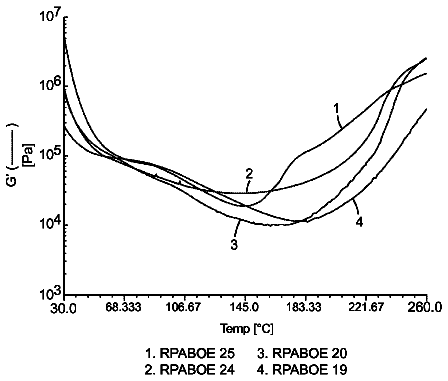
The crosslinking onset temperature of the binder mixtures (A) plus (B) plus optionally (C) plus catalyst (D) is determined experimentally for the purposes of the invention, by means of Dynamic-Mechanical Analysis (DMA). This method is described, for example, in DIN EN ISO 6721-1, the method in this standard being elucidated in the context of determination of dynamic mechanical properties of plastics. In DMA, an oscillating force is applied to the sample for the purpose of detecting, as a function of frequency and of temperature, the viscoelastic properties of the sample (i.e., the stiffness, expressed by the measured storage modulus E′, and the work dissipated per swing, expressed by the measured loss modulus E″). The stiffer a material, the greater the amount of the storage modulus—that is, the material presents a greater resistance to its elastic deformation. For a composition of crosslinkable polymer chains, as for example the binder mixture (A), (B), optionally (C), and (D) of the invention, the stiffness rises when the individual polymer chains begin to crosslink with one another and thus a complex network or a film is formed from a mixture of individual polymer chains. For the purposes of the present invention, the storage modulus is determined by DMA, by loading the sample with a sinusoidal vibration of constant amplitude and frequency while continuously raising the temperature. The temperature at which the storage modulus begins to climb is identified for the purposes of the present invention as the crosslinking onset temperature of the binder mixture. The measurements were carried out using a Triton 2000D instrument from Triton Technology. In this case, 1 g of the respective binder mixtures for measurement of (A) plus (B) plus optionally (C) plus catalyst (D) (solids 50%, adjusted with butyl acetate), to a glass fiber mesh that is clamped into the measuring instrument, and the storage modulus E′ is measured with continuous temperature increase of 2° C. per minute under sinusoidal sample loading (constant frequency, constant amplitude in the linear measurement range). The measurement takes place usually in a temperature range relevant to the sample, of around 2 to 200° C. The crosslinking onset temperature is then determined by graph from the storage modulus/temperature diagram, and is the temperature of the point of intersection of the extrapolated baseline of the storage modulus before the onset of crosslinking, and the extrapolated straight line resulting from the quasilinear ascending range of the storage modulus after the onset of crosslinking. In this way, the crosslinking onset temperature can be determined readily to an accuracy of +/−2° C.
The Polyhydroxyl Group-Containing Compound (A)
As polyhydroxyl group-containing compound (A) it is possible to use all compounds known to the skilled person which have at least two hydroxyl groups per molecule and are oligomeric and/or polymeric. As component (A) it is also possible to use mixtures of different oligomeric and/or polymeric polyols.
The preferred oligomeric and/or polymeric polyols (A) have number-average molecular weights Mn>=300 daltons, preferably Mn=400-30 000 daltons, more preferably Mn=500-15 000 daltons, and mass-average molecular weights Mw>500 daltons, preferably between 800 and 100 000 daltons, more particularly between 900 and 50 000 daltons, measured by means of gel permeation chromatography (GPC) against a polystyrene standard.
Preferred are polyester polyols, polyacrylate polyols and/or polymethacrylate polyols, and also copolymers thereof—referred to hereinafter as polyacrylate polyols; polyurethane polyols, polysiloxane polyols, and mixtures of these polyols.
The polyols (A) preferably have an OH number of 30 to 400 mg KOH/g, more particularly between 70 and 300 mg KOH/g. In the case of the poly(meth)acrylate copolymers, the OH number may also be determined with sufficient precision by calculation on the basis of the OH-functional monomers employed.
The polyols (A) preferably have an acid number of between 0 and 30 mg KOH/g. Since surprising it has been found that the lower the acid number of the polyol (A), the lower the temperature at which the crosslinking reaction commences (onset temperature), use is made more particularly of polyols (A) which have an acid number of between 0 and 10 mg KOH/g, preferably between 0 and 5 mg KOH/g, and very preferably of less than 1 mg KOH/g.
The glass transition temperatures, measured by means of DSC measurements in accordance with DIN-EN-ISO 11357-2, of the polyols are preferably between −150 and 100° C., more preferably between −120° C. and 80° C.
Polyurethane polyols are prepared preferably by reaction of oligomeric polyols, more particularly of polyester polyol prepolymers, with suitable di- or polyisocyanates, and are described in EP-A-1 273 640, for example. Use is made more particularly of reaction products of polyester polyols with aliphatic and/or cycloaliphatic di- and/or polyisocyanates.
The polyurethane polyols used with preference in accordance with the invention have a number-average molecular weight Mn>=300 daltons, preferably Mn=700-2000 daltons, more preferably Mn=700-1300 daltons, and also preferably a mass-average molecular weight Mw>500 daltons, preferably between 1500 and 3000 daltons, more particularly between 1500 and 2700 daltons, in each case measured by means of gel permeation chromatography (GPC) against a polystyrene standard.
Suitable polysiloxane polyols are described in WO-A-01/09260, for example, and the polysiloxane polyols recited therein can be employed preferably in combination with further polyols, more particularly those having relatively high glass transition temperatures.
As polyhydroxyl group-containing compound (A), use is made with particular preference of polyester polyols, polyacrylate polyols, polymethacrylate polyols, polyurethane polyols, or mixtures thereof, and very preferably of polyester polyols or of mixtures of polyester polyols with poly(meth)acrylate polyols.
The polyester polyols used with preference in accordance with the invention have a number-average molecular weight Mn>=300 daltons, preferably Mn=400-10 000 daltons, more preferably Mn=500-5000 daltons, and also preferably a mass-average molecular weight Mw>500 daltons, preferably between 800 and 50 000 daltons, more particularly between 900 and 10 000 daltons, in each case measured by means of gel permeation chromatography (GPC) against a polystyrene standard.
The polyester polyols used with preference in accordance with the invention preferably have an OH number of 30 to 400 mg KOH/g, more particularly between 100 and 300 mg KOH/g.
The polyester polyols (A) used with preference in accordance with the invention preferably have an acid number of between 0 and 30 mg KOH/g. Since surprisingly it has been found that the lower the acid number of the polyol (A), the lower the temperature at which the crosslinking reaction commences (onset temperature), use is made more particularly of polyester polyols (A) which have an acid number of between 0 and 25 mg KOH/g, preferably between 0 and 5 mg KOH/g, and very preferably of less than 1 mg KOH/g.
A polyester, generally speaking, is a polymeric organic compound which is prepared using polyhydric organic polyols and polybasic organic carboxylic acids. These polyols and polycarboxylic acids are linked to one another by esterification, in other words by condensation reactions. Accordingly, the polyesters are generally assigned to the group of the polycondensation resins. Depending on the nature, functionality, proportions employed, and ratios of the starting components, for example, linear or branched products are obtained. While linear products come about primarily when using difunctional starting components (diols, dicarboxylic acids), branching is achieved through the use, for example, of higher polyfunctional alcohols (with an OH functionality, i.e., number of OH groups per molecule, of more than 2). Also possible in the preparation, of course, is the proportional use of monofunctional components, such as monocarboxylic acids, for example. As is known, the polyesters may also be prepared using the anhydrides of the carboxylic acids instead of or in addition to the corresponding organic carboxylic acids, and more particularly using the anhydrides of the dicarboxylic acids. Likewise possible is the preparation through the use of hydroxycarboxylic acids or of lactones derived from the hydroxycarboxylic acids by intramolecular esterification.
Fully generally, in the preparation of polyesters, it is possible to employ polycarboxylic acids and polyols, examples being aliphatic polycarboxylic acids and aliphatic polyols.
Aliphatic compounds are, as is known, acyclic or cyclic hydrocarbon compounds which are saturated or unsaturated. The term “aliphatic compound” therefore encompasses acyclic and cyclic aliphatics and is also valid as a corresponding generic term in the context of the present invention. For the purposes of the present invention, the noncyclic aliphatics are referred to as acyclic aliphatics, and the cyclic aliphatics as cycloaliphatics. The acyclic aliphatics may be linear or branched. Linear means, as is known, that the compound in question has no branching in terms of the carbon chain, but that, instead, the carbon atoms are arranged exclusively in linear sequence in a chain. Branched or nonlinear therefore means, for the purposes of the present invention, that the particular compound under consideration has branching in the carbon chain—that is, at least one carbon atom in the respective compound is a tertiary carbon atom. Cycloaliphatics are, as is known, those compounds in which at least some of the carbon atoms present are linked in the molecule in such a way as to form one or more rings. In addition to the one or more rings, of course, there may be other acyclic linear or branched aliphatic groups present.
The term “aliphatic polycarboxylic acid” is applied, therefore, to those polycarboxylic acids which in addition to their carboxylic acid groups have aliphatic groups, i.e., consist of carboxylic acid groups and aliphatic groups. This form of the term is also valid for all other classes of compound identified in the context of the present invention, examples being the polyols already stated.
Likewise possible is the use of aromatic polycarboxylic acids and aromatic polyols, or else of polycarboxylic acids and polyols which as well as the functional groups that identify their class of compound have both (linear, branched and/or cyclic) aliphatic and aromatic groups. Also possible is the use of linear, branched and/or cyclic aliphatic and/or aromatic hydroxycarboxylic acids and also lactones—that is, then, hydroxycarboxylic acids and lactones which in addition to the functional groups identifying their class of compound, have linear, branched and/or cyclic aliphatic and/or aromatic groups.
Suitable diols are, for example, glycols such as ethylene glycol, propylene glycol, butylene glycol, butane-1,4-diol, hexane-1,6-diol, neopentyl glycol, and other diols, such as 1,4-dimethylolcyclohexane or 2-butyl-2-ethyl-1,3-propanediol. When the polyester used in accordance with the invention comprises diols as synthesis components, the stated diols are preferably the only diols present.
Suitable higher polyfunctional alcohols (OH functionality greater than 2) are, for example, trimethylolpropane, glycerol, pentaerythritol, dipentaerythritol, and tris(2-hydroxyethyl)-isocyanurate. The stated higher polyfunctional alcohols are preferably the only higher polyfunctional alcohols present. With particular preference the polyester used in accordance with the invention comprises tris(2-hydroxyethyl)isocyanurate and/or pentaerythritol.
The acid component of a polyester generally comprises dicarboxylic acids or their anhydrides with 2 to 44, preferably 4 to 36, carbon atoms in the molecule. Examples of suitable acids are o-phthalic acid, isophthalic acid, terephthalic acid, tetrahydrophthalic acid, cylcohexanecarboxylic acid, succinic acid, adipic acid, azelaic acid, sebacic acid, maleic acid, fumaric acid, glutaric acid, hexachloroheptanedicarboxylic acid, tetrachlorophthalic acid and/or dimerized fatty acids. In place of these acids it is also possible to use their anhydrides, where they exist.
Use may also be made of higher polyfunctional carboxylic acids, having 3 or more carboxyl groups (and/or the corresponding anhydrides) an example being trimellitic anhydride.
It is also possible optionally to make proportional use of monocarboxylic acids, such as unsaturated fatty acids, for example. It is likewise possible, proportionally, to use glycidyl esters of saturated aliphatic monocarboxylic acids in which the carboxyl group is bonded to a tertiary C atom. Contemplated more particularly here is the glycidyl ester of Versatic acid. This ester is available commercially, for example, under the Cardura® E10 designation. These glycidyl esters of saturated aliphatic monocarboxylic acids are used more particularly to lower the acid number of the polyester polyols (A) used in accordance with the invention. The acid number of the polyester polyols (A) used in accordance with the invention may likewise be lowered in a manner known to the skilled person by reaction of the residual carboxyl groups with other monofunctional compounds that are reactive with carboxyl groups, such as, for example, other epoxy compounds, alcohols, or amines.
Examples of hydroxycarboxylic acids which can be used are hydroxycaproic acid, hydroxybutyric acid, hydroxydecanoic acid and/or 12-hydroxystearic acid. Lactones which can be used are, for example, the beta-, gamma-, delta-, and epsilon-lactones that are known per se.
As well as the monomeric compounds described above it is also possible, for example, to use starting products that are already polymeric, examples, as diols, being the polyester diols that are known per se and are obtained by reaction of a lactone with a dihydric alcohol.
The polyester (A) used in accordance with the invention comprises with particular preference, as synthesis components, tris(2-hydroxyethyl)isocyanurate and/or pentaerythritol, the anhydride of a cycloaliphatic dicarboxylic acid and/or the anhydride of an aromatic dicarboxylic acid and/or the glycidyl ester of Versatic acid.
The preparation of polyesters has no procedural peculiarities and is generally accomplished using the polymerization processes, more particularly polycondensation processes, that are customary per se and known, as for example in bulk or in solution at temperatures of preferably 50 to 300° C., with optional use of the catalysts typical for such processes, such as, for example, acids (concentrated sulfuric acid, for example), dibutyltin laurate, or other tin-based catalysts available, for example, under the trade name Fascat (for example, Fascat 4100). The water produced from the condensation reaction is typically removed by means of a water separator.
Suitable polyester polyols are also described in EP-A-0 994 117 and EP-A-1 273 640, for example.
The poly(meth)acrylate polyols used in accordance with the invention are generally copolymers and preferably have a number-average molecular weight Mn>=300 daltons, preferably Mn=500-15 000 daltons, more preferably Mn=900-10 000 daltons, and also, preferably, mass-average molecular weights Mw between 500 and 20 000 daltons, more particularly between 1000 and 15 000 daltons, measured in each case by means of gel permeation chromatography (GPC) against a polystyrene standard.
The glass transition temperature of the copolymers is generally between −100 and 100° C., more particularly between −60 and <20° C. (measured by means of DSC measurements in accordance with DIN-EN-ISO 11357-2).
The poly(meth)acrylate polyols preferably have an OH number of 60 to 300 mg KOH/g, more particularly between 70 and 200 mg KOH/g, and an acid number of between 0 and 30 mg KOH/g.
The hydroxyl number (OH number) and the acid number are determined as described above (DIN 53240-2 and DIN EN ISO 2114).
Hydroxyl group-containing monomer building blocks used are preferably hydroxyalkyl acrylates and/or hydroxyalkyl methacrylates, such as, more particularly, 2-hydroxyethyl acrylate, 2-hydroxyethyl methacrylate, 2-hydroxypropyl acrylate, 2-hydroxypropyl methacrylate, 3-hydroxypropyl acrylate, 3-hydroxypropyl methacrylate, 3-hydroxybutyl acrylate, 3-hydroxybutyl methacrylate, and also, in particular, 4-hydroxybutyl acrylate and/or 4-hydroxybutyl methacrylate.
Further monomer building blocks used for the poly(meth)acrylate polyols are preferably alkyl acrylates and/or alkyl methacrylates, such as, preferably, ethyl acrylate, ethyl methacrylate, propyl acrylate, propyl methacrylate, isopropyl acrylate, isopropyl methacrylate, butyl acrylate, butyl methacrylate, isobutyl acrylate, isobutyl methacrylate, tert-butyl acrylate, tert-butyl methacrylate, amyl acrylate, amyl methacrylate, hexyl acrylate, hexyl methacrylate, ethylhexyl acrylate, ethylhexyl methacrylate, 3,3,5-trimethylhexyl acrylate, 3,3,5-trimethylhexyl methacrylate, stearyl acrylate, stearyl methacrylate, lauryl acrylate or lauryl methacrylate, cycloalkyl acrylates and/or cycloalkyl methacrylates, such as cyclopentyl acrylate, cyclopentyl methacrylate, isobornyl acrylate, isobornyl methacrylate, or, in particular, cyclohexyl acrylate and/or cyclohexyl methacrylate.
As further monomer building blocks for the poly(meth)acrylate polyols it is possible to use vinylaromatic hydrocarbons, such as vinyltoluene, alpha-methylstyrene, or, in particular, styrene, amides or nitriles of acrylic or methacrylic acid, vinyl esters or vinyl ethers, and also, in minor amounts, in particular, acrylic acid and/or methacrylic acid.
The coating material of the invention preferably comprises from 10 to 69.99 wt %, preferably from 20 to 59.9 wt %, of
at least one hydroxyl-containing polyester (A) or
at least one hydroxyl-containing poly(meth)acrylate (A) or
at least one hydroxyl-containing polyurethane (A) or
a mixture of at least one hydroxyl-containing polyester (A) and at least one hydroxyl-containing poly(meth)acrylate (A) or
a mixture of at least one hydroxyl-containing polyester (A) and at least one hydroxyl-containing polyurethane (A), or
a mixture of at least one hydroxyl-containing poly(meth)acrylate (A) and at least one hydroxyl-containing polyurethane (A), or
a mixture of at least one hydroxyl-containing polyester (A) and at least one hydroxyl-containing poly(meth)acrylate (A) and at least one hydroxyl-containing polyurethane (A),
the quantity figures being based in each case on the binder fraction of the coating material [in other words based on the total weight of the binder fraction of the compounds (B) of the invention with functional groups of the formula I′, plus the binder fraction of the polyol (A), plus the binder fraction of component (C), plus weight of the catalyst (D)].
Hydroxyl-containing Compounds (C)
In addition to the polyhydroxyl group-containing component (A), the coating material compositions of the invention may optionally further comprise one or more monomeric, hydroxyl-containing compounds (C), which are different from component (A). These compounds (C) preferably account for a fraction of 0 to 20 wt %, more preferably of 0 to 10 wt %, based in each case on the binder fraction of the coating material [in other words based on the total weight of the binder fraction of the compounds (B) of the invention with functional groups of the formula I′, plus the binder fraction of the polyol (A), plus the binder fraction of component (C), plus weight of the catalyst (D)].
Low molecular mass polyols are employed as hydroxyl-containing compound (C).
Low molecular mass polyols used are, for example, diols, such as preferably ethylene glycol, di- and triethylene glycol, neopentyl glycol, 1,2-propanediol, 2,2-dimethyl-1,3-propanediol, 1,4-butanediol, 1,3-butanediol, 1,5-pentanediol, 2,2,4-trimethyl-1,3-pentanediol, 1,6-hexanediol, 1,4-cyclohexanedimethanol, and 1,2-cyclohexanedimethanol, and also polyols, such as preferably trimethylolethane, trimethylolpropane, trimethylolhexane, 1,2,4-butanetriol, pentaerythritol, and dipentaerythritol. Such low molecular mass polyols are preferably admixed in minor fractions to the polyol component (A).
The Compounds (B) Having at Least Two Alkylidene-1,3-dioxolan-2-one Groups of the Formula (I′)
It is essential to the invention that the compounds (B) used in accordance with the invention contain at least two alkylidene-1,3-dioxolan-2-one groups of the formula (I′):
##STR00003## where # stands for the attachment to the polymer backbone and R.sup.1, R.sup.2 independently of one another are hydrogen, C.sub.1-C.sub.6 alkyl, C.sub.1-C.sub.4 alkoxy-C.sub.1-C.sub.4 alkyl, C.sub.5-C.sub.6 cycloalkyl, phenyl or phenyl-C.sub.1-C.sub.4 alkyl; R.sup.3 is hydrogen, C.sub.1-C.sub.6 alkyl, C.sub.1-C.sub.4 alkoxy-C.sub.1-C.sub.4 alkyl, C.sub.5-C.sub.6 cycloalkyl, phenyl, or phenyl-C.sub.1-C.sub.4 alkyl, R.sup.3 more particularly being hydrogen; A is a chemical bond or C.sub.1-C.sub.4 alkanediyl, A more particularly being C.sub.1-C.sub.4 alkanediyl; X is O or NR.sup.7; Z is a chemical bond, PO.sub.2, SO.sub.2, or C═O, Z more particularly being C═O; Y is a chemical bond, CH.sub.2, or CHCH.sub.3, Y more particularly being a chemical bond; and R.sup.7 where present is C.sub.1-C.sub.6 alkyl.
In combination with the hydroxyl-containing compounds (A), such compounds (B) have a high reactivity, without possessing the disadvantages associated with isocyanates. They are therefore particularly suitable as replacements for polyfunctional isocyanates in numerous applications, more particularly for coating material compositions for automotive OEM finishing, for automotive refinish, and for the coating of parts for installation in or on vehicles, and of plastics.
It has surprisingly been found that the compounds (B), described in more detail below, can be prepared by polymerization using ethylenically unsaturated monomers which have an alkylidene-1,3-dioxolane-2-one group and a further ethylenically unsaturated double bond, with retention of the alkylidene-1,3-dioxolan-2-one group. This is surprising since at various points in the literature it is described how the methylene group in methylene-1,3-dioxolan-2-ones undergoes polymerization under radical conditions—see, for example, Journal of Network Polymer, Japan 2005, 26, 132-137, Makromol. Chem., Rapid Commun. 1989, 10, 453-456.
Here and below, the prefix “C.sub.n-C.sub.m” used for defining substituents and chemical compounds indicates the number of possible C atoms in the substituent or compound, respectively.
Unless indicated otherwise, the following general definitions are valid, for the purposes of the present invention, for the terms used in connection with the substituents:
“Alkyl” stands for a linear or branched alkyl radical having for example 1 to 4 (C.sub.1-C.sub.4 alkyl), 1 to 6 (C.sub.1-C.sub.6 alkyl), or 1 to 20 carbon atoms (C.sub.1-C.sub.20 alkyl). Examples of C.sub.1-C.sub.4 alkyl are methyl, ethyl, n-propyl, isopropyl, n-butyl, 2-butyl, isobutyl and tert-butyl (2-methylpropan-2-yl). Examples of C.sub.1-C.sub.6 alkyl, in addition to the definitions stated for C.sub.1-C.sub.4 alkyl, are also n-pentyl, 1-methylbutyl, 2-methylbutyl, 3-methylbutyl, 1,1-dimethylpropyl, 1,2-dimethylpropyl, 2,2-dimethylpropyl, 1-ethylpropyl, n-hexyl, 1-methylpentyl, 2-methylpentyl, 3-methylpentyl, 4-methylpentyl, 1,1-dimethylbutyl, 1,2-dimethylbutyl, 1,3-dimethylbutyl, 2,2-dimethylbutyl, 2,3-dimethylbutyl, 3,3-dimethylbutyl, 1-ethylbutyl, 2-ethylbutyl, 1,1,2-trimethylpropyl, 1,2,2-trimethylpropyl, 1-ethyl-1-methylpropyl, and 1-ethyl-2-methylpropyl. Examples of C.sub.1-C.sub.20 alkyl, in addition to the definitions stated for C.sub.1-C.sub.6 alkyl, are also heptyl, octyl, 2-ethylhexyl, nonyl, decyl, undecyl, dodecyl, tridecyl, tetradecyl, pentadecyl, hexadecyl, heptadecyl, octadecyl, nonadecyl, eicosyl, and their constitutional isomers.
“C.sub.1-C.sub.4 Alkoxy-C.sub.1-C.sub.4 alkyl” stands for an alkyl group which has 1 to 4 carbon atoms and is bonded via an oxygen atom, such as, for example, methoxy, ethoxy, n-propoxy, 1-methylethoxy (isopropoxy), n-butoxy, 1-methylpropoxy (sec-butoxy), 2-methylpropoxy (isobutoxy) or 1,1-dimethylethoxy (tert-butoxy), which is bonded in the form of an ether bond via the oxygen to a C.sub.1-C.sub.4 alkyl group as defined above. Examples are methoxymethyl, 2-methoxyethyl, ethoxymethyl, 3-methoxy-propyl, and 3-ethoxypropyl.
“C.sub.5-C.sub.6 Cycloalkyl” stands for a cyclic alkyl radical having 5 to 6 carbon atoms. Examples are cyclopentyl and cyclohexyl.
“Phenyl-C.sub.1-C.sub.4 alkyl” stands for a phenyl group which is bonded to a C.sub.1-C.sub.4 alkyl group as defined above. Examples are benzyl, phenylethyl, phenylpropyl, and phenylbutyl.
“C.sub.1-C.sub.4 Alkanediyl” stands for an alkanediyl having 1 to 4 carbon atoms. Examples are methanediyl, 1,1-ethanediyl, 1,2-ethanediyl, 1-methyl-1,1-ethanediyl, 1-methyl-1,2-ethanediyl, 1,3-propanediyl, 1,4-butanediyl, 1,1-dimethyl-1,2-ethanediyl, and 1,2-dimethyl-1,2-ethanediyl.
“C.sub.1-C.sub.8 Alkoxy” stands for an alkoxy group which has 1 to 8 carbon atoms and is bonded via an oxygen atom. Examples are methoxy, ethoxy, n-propoxy, 1-methylethoxy (isopropoxy), n-butoxy, 1-methylpropoxy (sec-butoxy), 2-methylpropoxy (isobutoxy), 1,1-dimethylethoxy (tert-butoxy), n-pentoxy, 1-methylbutoxy, 2-methylbutoxy, 3-methylbutoxy, 1,1-dimethylpropoxy, 1,2-dimethylpropoxy, 2,2-dimethylpropoxy, 1-ethylpropoxy, 2-ethylpropoxy, n-hexoxy, 1-methylpentoxy, 2-methylpentoxy, 3-methylpentoxy, 4-methylpentoxy, 1-ethylbutoxy, 2-ethylbutoxy, 3-ethylbutoxy, 1,2-dimethylbutoxy, 1,3-dimethylbutoxy, 2,3-dimethylbutoxy, 1-ethyl-2-methylpropoxy, and 1-isopropylpropoxy.
“C.sub.1-C.sub.4 Alkylcarbonyl”, stands for a C.sub.1-C.sub.4 alkyl radical as defined above that is bonded via a carbonyl group—for example, for acetyl, propionyl, butyryl, pivaloyl, etc.
With regard to preferred embodiments of the invention, the radicals or groups R.sup.1, R.sup.2, R.sup.3, R.sup.4, R.sup.5, R.sup.6, R.sup.7, R.sup.8, A, X, Z, and Y in the compounds of the formula I and in the groups of the formula I′ preferably have, independently of one another, one or more, or all, of the following definitions:
R.sup.1 stands for hydrogen or C.sub.1-C.sub.6 alkyl, more particularly for hydrogen or C.sub.1-C.sub.4 alkyl, and especially for methyl or ethyl;
R.sup.2 stands for hydrogen or C.sub.1-C.sub.6 alkyl, more particularly for C.sub.1-C.sub.4 alkyl, and especially for methyl or ethyl;
R.sup.3 stands for hydrogen;
A stands for C.sub.1-C.sub.4 alkanediyl, more particularly for methanediyl, 1,2-ethanediyl, or 1,3-propanediyl, more preferably 1,2-ethanediyl;
X stands for O;
Z stands for C═O;
Y stands for a chemical bond;
R.sup.4 stands for hydrogen or C.sub.1-C.sub.4 alkyl, more particularly for hydrogen or methyl;
R.sup.5 stands for hydrogen;
R.sup.6 stands for hydrogen;
R.sup.7 where present stands for C.sub.1-C.sub.4 alkyl;
R.sup.8 where present stands for C.sub.1-C.sub.4 alkyl.
The compounds of the formula I are prepared in general by the process elucidated in more detail hereinafter, in which a compound of the general formula II is reacted with a compound of the general formula III:
##str00004##
The description continues in the full USPTO document.