 Lapsed, fee not paid4 drawings
Industrial Equipment · US 9,914,299 B2
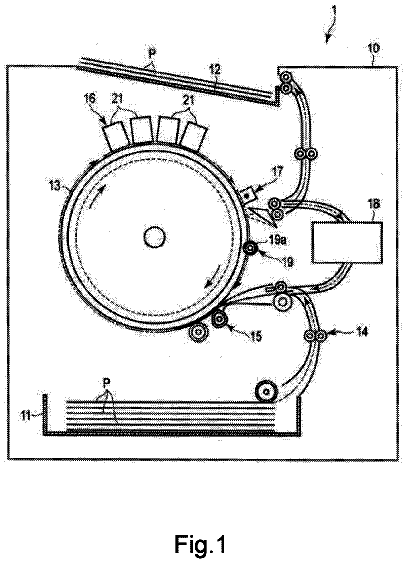
Inkjet head and inkjet recording apparatus
According to an embodiment, an inkjet head includes nozzles.
US 9,914,317 B2 · Assignee: TOPPAN PRINTING CO., LTD. · Inventors: Fukunaga; Godai et al.
Sheet 1 of 1 from the published document. All sheets in the USPTO PDF
There is provided a heat-sensitive transfer recording medium which is able to better suppress the occurrence of abnormal transfer during high-speed printing using a high-speed printer of sublimation transfer type and is able to improve transfer sensitivity in high-speed printing. The heat-sensitive transfer recording medium includes a base ( 10 ), a heat-resistant lubricating layer ( 20 ) formed on one surface of the base ( 10 ), an underlying layer ( 30 ) formed on the other surface of the base ( 10 ), and a dye layer ( 40 ) formed on a surface of the underlying layer ( 30 ), which is on the other side of a surface facing the base ( 10 ). In the heat-sensitive transfer recording medium, the underlying layer ( 30 ) has a major component that is a copolymer of polyester having a sulfonic group on a side chain and acrylic having at least one of a glycidyl group and a carboxyl group.
Technical Field The present invention relates to a heat-sensitive transfer recording medium used for a heat-sensitive transfer type printer. Background Art Heat-sensitive transfer recording media, which are generally used in many cases in the form of ink ribbons in heat-transfer type printers, are also called thermal ribbons. Such a heat-sensitive transfer recording medium has a structure that includes a base having one surface provided with a heat-sensitive transfer layer and the other surface provided with a heat-resistant lubricating layer (back coat layer). The heat-sensitive transfer layer is a layer of an ink, and the ink of the layer is transferred to an object by sublimation (sublimation transfer method) or melting (melt transfer method) by means of heat generated at a thermal head of a printer. Of these methods, the sublimation transfer method enables relatively easy full-color
All 1 drawing sheet from the published document, cropped to the drawing.
What the patent claimed, word for word. All of it is now free to use.
Technical Field
The present invention relates to a heat-sensitive transfer recording medium used for a heat-sensitive transfer type printer.
Background Art
Heat-sensitive transfer recording media, which are generally used in many cases in the form of ink ribbons in heat-transfer type printers, are also called thermal ribbons. Such a heat-sensitive transfer recording medium has a structure that includes a base having one surface provided with a heat-sensitive transfer layer and the other surface provided with a heat-resistant lubricating layer (back coat layer). The heat-sensitive transfer layer is a layer of an ink, and the ink of the layer is transferred to an object by sublimation (sublimation transfer method) or melting (melt transfer method) by means of heat generated at a thermal head of a printer.
Of these methods, the sublimation transfer method enables relatively easy full-color formation of various images in combination with a sophisticated printer and thus has been widely used such as for self-prints of digital cameras, cards such as for identification, or output materials for amusement. As the usage of the heat-sensitive transfer recording media is diversified, there arises an increasing need for the media to reduce size, increase speed, reduce cost or enhance durability of the obtained printed materials. For this reason, predominantly prevailing heat-sensitive transfer recording media of recent years include a plurality of heat-sensitive transfer layers which are provided on one surface of a base sheet so as not to be overlaid such as on a protective layer that imparts durability to the photo prints.
Under such circumstances, as printing speed of printers is increasing in association with the diversified and predominantly prevailing usage of heat-sensitive transfer recording media, there arises a problem that the heat-sensitive transfer recording media of the conventional art cannot achieve a sufficient print density. In order to enhance the transfer sensitivity in printing, an attempt has been made to reduce the thickness of such a heat-sensitive transfer recording medium. However, this leads to a problem of causing wrinkles or sometimes a problem of being torn due to the heat, pressure or the like in manufacturing the heat-sensitive transfer recording media or in performing printing using the heat-sensitive transfer recording medium.
Further, in another attempt that has been made, the ratio of dye/binder is increased in the dye layer of a heat-sensitive transfer recording medium to enhance the print density and the transfer sensitivity in printing. However, the increase of dye raises not only a problem of increasing cost, but also a problem of partial transition (offset) of the dye into the heat-resistant lubricating layer of the heat-sensitive transfer recording medium in a state of being taken up in the course of the manufacture. When the heat-sensitive transfer recording medium is rolled again, the dye that has transitioned into the heat-resistant lubricating layer again transitions into a dye layer of a different color or into a protective layer (re-offset). If the smudged layers are heat-transferred to an object to be transferred, the resultant hue may be different from a specified color, or may cause so-called scumming.
Further, in still another attempt that has been made, energy in forming an image is increased on a printer side, not on a heat-sensitive transfer recording medium side. However, in this case, power consumption is increased. In addition, the load imposed on a thermal head of the printer is increased and thus the life of the thermal head is shortened. Further, increase of the load tends to cause uneven thermal conduction of the thermal head and uneven color development in printing, or transfer failure of the heat transferable protective layer. In addition to that, increase of the load tends to cause so-called abnormal transfer that is a fusion between the dye layer and an object to be transferred. In order to prevent the occurrence of the abnormal transfer, the adhesiveness between the base and the dye layer is required to be enhanced. For the purpose of enhancing the adhesiveness between the base and the dye layer, some measures have been taken, such as using a base given an easy-adhesion treatment or providing an adhesive layer (underlying layer) on the base.
The easy-adhesion treatment includes, for example, corona treatment, flame treatment, ozone treatment, ultraviolet treatment, radiation treatment, rough surface treatment, plasma treatment or primer treatment. However, although use of a base given the easy-adhesion treatment can ensure adhesiveness, use of such a base raises a problem of incurring high cost in obtaining the base and of not ensuring sufficient print density.
In order to solve such a problem, for example, Patent Literature 1 or 2 proposes to provide a heat transfer sheet between a base and a dye layer, the heat transfer sheet having an adhesive layer (underlying layer) that contains a polyvinylpyrrolidone resin and a modified polyvinylpyrrolidone resin.
Further, in order to solve the insufficient transfer sensitivity, Patent Literature 3 proposes a heat transfer sheet having an underlying layer which is comprised of polyvinylpyrrolidone/polyvinyl alcohol and colloidal inorganic pigment fine particles.
Patent Literature 1:
Patent Literature 2:
Patent Literature 3: JP-A-2006-150956 SUMMARY OF THE INVENTION Technical Problem
However, when printing was performed using an existing high-speed printer of a sublimation transfer type and using the heat-sensitive transfer recording medium proposed in Patent Literature 1 or 2, the transfer sensitivity was low in the print, not reaching a sufficient level, although no abnormal transfer was observed.
Further, when printing was performed using a high-speed printer of sublimation transfer type and using the heat-sensitive transfer recording medium proposed in Patent Literature 3, an abnormal transfer was observed, although the transfer sensitivity was high, reaching a sufficient level.
Thus, in the conventional art, no heat-sensitive transfer recording medium that satisfies both of prevention of abnormal transfer and high transfer sensitivity has been developed, for use in a high-speed printer of sublimation transfer type.
The present invention has been made in light of the problems set forth above and has as its object to provide a heat-sensitive transfer recording medium which is able to better suppress the occurrence of the abnormal transfer and enhance transfer sensitivity in the print in the case where high-speed printing is performed using a high-speed printer of sublimation transfer type (i.e. in the case where printing is performed by increasing energy applied to the thermal head of the printer). Solution to Problem
In order to solve the above problems, a heat-sensitive transfer recording medium related to an aspect of the present invention includes a base; a heat-resistant lubricating layer formed on one surface of the base; an underlying layer formed on the other surface of the base; and a dye layer formed on a surface of the underlying layer, the surface being on the other side of a surface facing the base, in which the underlying layer has a major component that is a copolymer of polyester having a sulfonic group on a side chain and acrylic having at least one of a glycidyl group and a carboxyl group.
Preferably, in the heat-sensitive transfer recording medium related to the aspect of the present invention, a copolymerization ratio of the polyester and the acrylic is in a range of not less than about 20:80 to not more than about 40:60 in terms of weight ratio.
Preferably, in the heat-sensitive transfer recording medium related to the aspect of the present invention, a dry coating amount of the underlying layer is in a range of not less than about 0.05 g/m.sup.2 to not more than about 0.30 g/m.sup.2.
A heat-sensitive transfer recording medium related to another aspect of the present invention includes a base; a heat-resistant lubricating layer formed on one surface of the base; an underlying layer formed on the other surface of the base; and a dye layer formed on a surface of the underlying layer, the surface being on the other side of a surface facing the base, in which: the dye layer contains at least a dye, a resin and a release agent; the release agent is non-reactive polyether-modified silicone having a viscosity of not less than about 800 mm.sup.2/s at 25° C., and an HLB value of not more than about 10; and the non-reactive polyether-modified silicone is contained in the dye layer within an amount ranging from not less than about 0.5 wt % to not more than about 10 wt % relative to the resin.
Preferably, in the heat-sensitive transfer recording medium related to the aspect of the present invention, the dye layer contains at least a dye, a resin and a release agent; the release agent is non-reactive polyether-modified silicone having a viscosity of not less than about 800 mm.sup.2/s at 25° C., and an HLB value of not more than about 10; and the non-reactive polyether-modified silicone is contained in the dye layer within an amount ranging from not less than about 0.5 wt % to not more than about 10 wt % relative to the resin.
Preferably, in the heat-sensitive transfer recording medium related to the aspect of the present invention, a dry coating amount of the underlying layer is in a range of not less than about 0.05 g/m.sup.2 to not more than about 0.30 g/m.sup.2.
Preferably, in the heat-sensitive transfer recording medium related to the aspect of the present invention, the dye layer is formed containing polyvinyl acetal resin having a glass-transition temperature of not less than about 100° C. and polyvinyl butyral resin having a glass-transition temperature of not more than about 75° C.
Preferably, in the heat-sensitive transfer recording medium related to the aspect of the present invention, a content ratio of the polyvinyl acetal resin having a glass-transition temperature of not less than about 100° C. and the polyvinyl butyral resin having a glass-transition temperature of not more than about 75° C. is in a range of 97:3 to 50:50.
A heat-sensitive transfer recording medium related to another aspect of the present invention includes a base; a heat-resistant lubricating layer formed on one surface of the base; and a dye layer formed on the other surface of the base, in which: the heat-resistant lubricating layer contains at least a binder comprised of a thermoplastic resin or a reactant of a thermoplastic resin and a polyisocyanate, an inorganic material having cleavage, and spherical particles; a ratio of a true specific gravity of the inorganic material and a true specific gravity of the binder is in a range of not less than about 2.1 to not more than about 3; a ratio of a true specific gravity of the spherical particles and a true specific gravity of the binder is not more than about 1.4; and a ratio of an average particle size of the spherical particles and a thickness of the heat-resistant lubricating layer is in a range of not less than about 0.4 folds to not more than about 2 folds.
Preferably, in the heat-sensitive transfer recording medium related to the aspect of the present invention, a content of the inorganic material is in a range of not less than about 2 mass % to not more than about 10 mass %.
Preferably, in the heat-sensitive transfer recording medium related to the aspect of the present invention, a content of the spherical particles is in a range of not less than about 0.5 mass % to not more than about 2 mass %.
Preferably, in the heat-sensitive transfer recording medium related to the aspect of the present invention, the inorganic material is an inorganic material having a perfect cleavage in one direction.
Preferably, the heat-sensitive transfer recording medium related to the aspect of the present invention includes a heat transferable protective layer in at least a part on a base, and a release layer that turns to an outermost layer after transfer of the heat transferable protective layer, contains polymethylmethacrylate resin by not less than about 95% in terms of solid weight ratio, inorganic fine particles by not less than about 1.0% in terms of solid weight ratio, with an average particle size of not more than about 100 nm, a refractive index of not less than about 1.4 but not more than about 1.6 and a Mohs hardness of not less than about 4, and polyether-modified silicone oil by not less than about 0.5% in terms of solid weight ratio.
Preferably, in the heat-sensitive transfer recording medium related to the aspect of the present invention, the heat transferable protective layer is formed of a plurality of layers of two or more.
Preferably, in the heat-sensitive transfer recording medium related to the aspect of the present invention, the inorganic fine particles are anhydrous silica.
Preferably, in the heat-sensitive transfer recording medium related to the aspect of the present invention, the polyether-modified silicone oil with a solid content of 100% has a kinetic viscosity of not less than about 200 mm.sup.2/s at 25° C.
Preferably, in the heat-sensitive transfer recording medium related to the aspect of the present invention, a release layer that turns to an outermost layer after transfer of the heat transferable protective layer has a dry coating thickness in a range of not less than about 0.5 μm to not more than about 1.5 μm. Advantageous Effects of the Invention
A heat-sensitive transfer recording medium related to an aspect of the present invention includes an underlying layer that uses a copolymer as a major component, the copolymer being of polyester having a sulfonic group on a side chain and acrylic having at least one of a glycidyl group and a carboxyl group. Thus, under the condition that high-speed printing is performed with the increase of the energy applied to the thermal head of a high-speed printer of sublimation transfer type, the adhesion between the underlying layer and a dye layer is prevented from being lowered in the high-speed printing. Accordingly, the heat-sensitive transfer recording medium is able to suppress the occurrence of an abnormal transfer and improve transfer sensitivity in high-speed printing.
FIG. 1 is a diagram illustrating a schematic configuration of a heat-sensitive transfer recording medium of a first, second and third embodiments of the present invention;
FIG. 2 is a diagram illustrating a schematic configuration of a heat-sensitive transfer recording medium of a fourth embodiment of the present invention; and
FIG. 3 is a diagram illustrating a schematic configuration of a heat-sensitive transfer recording medium of a fifth embodiment of the present invention. DETAILED DESCRIPTION First Embodiment
With reference to the drawings, hereinafter are described embodiments of the present invention (hereinafter each referred to as “the present embodiment”), which is to be understood as one representative embodiment of the present invention. The present invention should not be construed as being limited to any of the following examples.
(General Configuration)
FIG. 1 is a diagram illustrating a schematic configuration of a heat-sensitive transfer recording medium of the present embodiment, the diagram being a cross-section view of the heat-sensitive transfer recording medium as viewed from a lateral side.
As shown in FIG. 1 , a heat-sensitive transfer recording medium 1 includes a base 10 , a heat-resistant lubricating layer 20 , an underlying layer 30 and a dye layer 40 .
(Configuration of Base 10 )
The base 10 is a member that is required to have heat resistance and strength, which do not allow softening and deformation by the application of a thermal pressure during heat transfer.
The base 10 that can be used is constituted, for example, of: a synthetic resin film such as of polyethylene terephthalate, polyethylene naphthalate, polypropylene, cellophane, acetate, polycarbonate, polysulphone, polyimide, polyvinyl alcohol, aromatic polyamide, aramid or polystylene; or paper, such as condenser paper or paraffin paper. These films or papers are used singly or in combination as a composite.
Among them, the polyethylene terephthalate film is preferable in particular as a material of the base 10 , particularly taking account such as of the physical properties, processability or cost.
When operability or processability is concerned, the base 10 can have a thickness within a range of not less than about 2 μm to not more than about 50 μm. However, when handleability, such as transferability or processability, is concerned, a thickness of about not less than about 2 μm but not more than about 9 μm is preferred.
(Configuration of Heat-Resistant Lubricating Layer 20 )
The heat-resistant lubricating layer 20 is formed on one surface of the base 10 (lower surface in FIG. 1 ).
Further, the heat-resistant lubricating layer 20 can be formed using publicly-known materials. For example, the heat-resistant lubricating layer 20 can be formed by blending a resin serving as a binder (binder resin), a functional additive for imparting releasability or lubricity, a filler, a curative, a solvent, and the like to prepare a coating solution for forming the heat-resistant lubricating layer, followed by coating and drying.
Further, a proper dry coating amount of the heat-resistant lubricating layer 20 is about not less than about 0.1 g/m.sup.2 but not more than about 2.0 g/m.sup.2.
The dry coating amount of the dry heat-resistant lubricating layer 20 refers to a solid content that has remained after coating and drying a coating solution for forming the heat-resistant lubricating layer. Similarly, the dry coating amount of the underlying layer 30 and the dry coating amount of the dye layer 40 each refer to the solid content that has remained after coating and drying the coating solution.
Further, of the materials that form the heat-resistant lubricating layer 20 , the binder resin used can include a polyvinyl butyral resin, polyvinyl acetoacetal resin, polyester resin, vinyl chloride-vinyl acetate copolymer, polyether resin, polybutadiene resin, acrylic polyol, polyurethane acrylate, polyester acrylate, polyether acrylate, epoxy acrylate, nitrocellulose resin, cellulose acetate resin, polyamide resin, polyimide resin, polyamide-imide resin or polycarbonate resin.
Of the materials forming the heat-resistant lubricating layer 20 , the functional additive used can include a surfactant: such as of a natural wax including an animal series wax, or a plant series wax; a synthetic wax including a synthetic hydrocarbon series wax, an aliphatic alcohol and acid series wax, an aliphatic ester and glycerite series wax, a synthetic ketone series wax, an amine- and amide series wax, a chlorinated hydrocarbon series wax, or an alpha olefin series wax; a higher fatty acid ester including butyl stearate, or ethyl oleate; a higher fatty acid metallic salt including sodium stearate, zinc stearate, calcium stearate, kalium stearate, or magnesium stearate; phosphate ester including long chain alkyl phosphate ester, polyoxyalkylene alkylaryl ether phosphate ester, or polyoxyalkylene alkyl ether phosphate ester.
Of the materials forming the heat-resistant lubricating layer 20 , the filler used can include talc, silica, magnesium oxide, zinc oxide, calcium carbonate, magnesium carbonate, kaolin, clay, silicone particles, polyethylene resin particles, polypropylene resin particles, polystyrene resin particles, polymethylmethacrylate resin particles, or polyurthane resin particles.
Further, of the materials forming the heat-resistant lubricating layer 20 , the curative used can include isocyanates, such as tolylene diisocyanate, triphenylmethane triisocyanate, and tetramethyl xylene diisocyanate, and derivatives of these materials.
It should be noted that the constitutions of the binder resin, the functional additive, the filler and the curative should not be construed as being limited to the ones mentioned above.
(Configuration of Underlying Layer 30 )
The underlying layer is formed on the other surface of the base 10 (upper surface in FIG. 1 ). Specifically, the underlying layer 30 is formed on a surface of the base 10 opposite to the surface on which the heat-resistant lubricating layer 20 is formed. The underlying layer 30 and the heat-resistant lubricating layer 20 are opposed to each other being interposed by the base 10 .
The underlying layer 30 is required to have adhesiveness with the base 10 and the dye layer 40 , and dye barrier properties for improving the transfer sensitivity, or further required to have solvent resistance in order to stack the dye layer 40 , which is normally comprised of a solvent series, onto the underlying layer 30 .
In the present invention, the major component of the underlying layer 30 is a copolymer of polyester having a sulfonic group on the side chain, and acrylic having at least one of a glycidyl group and a carboxyl group.
The major component of the underlying layer 30 herein refers to a copolymer, as far as the advantageous effects of the present invention are not impaired, which includes polyester having a sulfonic group on the side chain, and acrylic having at least one of a glycidyl group and a carboxyl group, and which may further additionally include other components. In other words, this means that the underlying layer 30 contains the above copolymer by more than 50 mass % relative to the entirety of the underlying layer 30 when it is formed, but preferably by not less than about 80 mass %.
The polyester component having a sulfonic group is essential to obtaining adhesiveness with the base 10 and the dye layer 40 and solvent resistance.
Further, the acrylic component having at least one of a glycidyl group and a carboxyl group is essential to obtaining dye barrier properties and solvent resistance.
When the individual components are simply blended, good compatibility is not obtained between the acrylic component and the polyester component. This leads to not only loss of the stability as materials, but also loss of the adhesiveness possessed by the polyester component with respect to the base 10 and the dye layer 40 , as well as loss of solvent resistance and dye barrier properties possessed by the acrylic component. Thus, the obtained performance is lowered compared to the case where the individual components are used singly.
This is considered to be due to the formation of a non-compatible sea-island structure that is ascribed to the blending of the polymers having bad compatibility, which leads to local presence of the polyester component having adhesiveness and the acrylic component having dye barrier properties (but there are portions having bad adhesiveness and portions having bad barrier properties when the underlying layer 30 is viewed as a whole).
On the other hand, when the acrylic component and the polyester component are copolymerized, the bad compatibility is considered to be improved to prevent the occurrence of phase separation, allowing the acrylic component and the polyester component to be present throughout the underlying layer 30 , thereby effectively developing the functions possessed by the individual components (adhesiveness, solvent resistance and dye barrier properties).
A dicarboxylate component used, that is a copolymer component of the polyester having a sulfonic group on the side chain, can include, for example: an ester-forming sulfonic acid alkali metallic salt compound as an essential component; aromatic dicarboxylic acid, such as phthalic acid, terephthalic acid, dimethyl terephthalate, isophthalic acid, dimethyl isophthalate, 2,5-dimethyl terephthalic acid, 2,6-naphthalene dicarboxylic acid, biphenyl dicarboxylic acid, and orthophthalic acid; aliphatic dicarboxylic acid, such as succinic acid, adipic acid, azelaic acid, sebacic acid, and dodecane dicarboxylic acid; and alicyclic dicarboxylic acid, such as cyclohexane dicarboxylic acid.
Preferably, the dicarboxylate component other than the ester-forming sulfonic acid alkali metallic salt compound is aromatic dicarboxylic acid. The aromatic dicarboxylic acid, which has an aromatic nucleus having a good affinity with hydrophobic plastic, has an advantage of improving adhesiveness or being excellent in hydrolysis resistance. In particular, terephthalic acid and isophthalic acid are preferable.
The ester-forming sulfonic acid alkali metallic salt compound used includes: alkali metallic salt (alkali metallic salt of sulfonic acid), such as sulfo terephthalic acid, 5-sulfo isophthalic acid, 4-sulfo isophthalic acid, and 4-sulfo naphthalene acid-2,7-dicarboxylic acid; and ester-forming derivatives of these compounds. Further, a sodium salt of 5-sulfo isophthalic acid and ester-forming derivatives thereof can be more preferably used. It should be noted that, by possessing a sulfonic group, the solvent resistance can be improved.
Further, the diglycol component used, that is a copolymer component of the polyester, can include, for example, diethylene glycol, and an aliphatic series having 2 to 8 carbons or an alicyclic glycol having 6 to 12 carbons.
Specific examples of the aliphatic series having 2 to 8 carbons or the alicyclic glycol having 6 to 12 carbons that can be used include ethylene glycol, 1,3-propanediol, 1,2-propylene glycol, neopentyl glycol, 1,4-butanediol, 1,4-cyclohexanedimethanol, 1,3-cyclohexanedimethanol, 1,2-cyclohexanedimethanol, 1,6-hexanediol, p-xylene glycol, and triethylene glycol. These can be used singly or in combination of two or more.
The polyester having a sulfonic group can be essential to obtaining adhesiveness between the base 10 and the underlying layer 30 and between the underlying layer 30 and the dye layer 40 , however, when used singly, no high transfer sensitivity is obtained and thus an acrylic component is required to be copolymerized.
The acrylic component used can include a glycidyl group-containing radical polymerizable unsaturated monomer used singly, or carboxyl group-containing radical polymerizable unsaturated monomer used singly, or other radical polymerizable unsaturated monomers that can be copolymerized with the above monomers.
In the present invention, the glycidyl group-containing radical polymerizable unsaturated monomer or the carboxyl group-containing radical polymerizable unsaturated monomer is required as the acrylic component. This is because the glycidyl group and the carboxyl group have dye barrier properties owing to the bad compatibility with dyes. In other words, this is because transfer sensitivity is improved owing to the possession of the glycidyl group and the carboxyl group. Further, this is because the solvent resistance is improved against ketone series solvents, such as acetone and methyl ethyl ketone, and ester series solvents, such as ethyl acetate and butyl acetate.
The glycidyl group-containing radical polymerizable unsaturated monomer used can include glycidyl ethers, such as acrylate glycidyl, methacrylate glycidyl, and aryl glycidyl ether.
The carboxyl group-containing radical polymerizable unsaturated monomer used can include acrylic acid, methacrylic acid, crotonic acid, itaconic acid, maleic acid, fumaric acid, 2-carboxyethyl(meth)acrylate, 2-carboxypropyl(meth)acrylate, and 5-carboxypentyl(meth)acrylate.
The radical polymerizable unsaturated monomers that can be copolymerized with the glycidyl group- or carboxyl group-containing radical polymerizable unsaturated monomer can include vinyl esters, unsaturated carboxylate esters, unsaturated carboxylate amides, unsaturated nitriles, acrylic compounds, nitrogen-containing vinyl monomers, hydrocarbon vinyl monomers, or vinylsilane compounds.
The vinyl esters used can include vinyl propionate, vinyl stearate, high-grade tertiary vinyl ester, vinyl chloride, and vinyl bromide.
The unsaturated carboxylate esters used can include methyl acrylate, ethyl acrylate, butyl acrylate, 2-ethylhexyl acrylate, methyl methacrylate, ethyl methacrylate, butyl methacrylate, butyl maleate, octyl maleate, butyl fumarate, octyl fumarate, hydroxyethyl methacrylate, hydroxyethyl acrylate, hydroxypropyl methacrylate, hydroxypropyl acrylate, dimethylaminoethyl methacrylate, dimethylaminoethyl acrylate, ethylene glycol dimethacrylate ester, ethylene glycol diacrylate ester, polyethylene glycol dimethacrylate ester, and polyethylene glycol diacrylate ester.
The unsaturated carboxylate amides used can include acrylamide, methacrylamide, methylol acrylamide, and butoxy methylol acrylamide.
The unsaturated nitriles used can include acrylonitril.
The acrylic compounds used can include allyl acetate, allyl methacrylate, allyl acrylate, and diaryl itaconate.
The nitrogen-containing vinyl monomers used can include vinylpyridine, and vinylimidazole.
The hydrocarbon vinyl monomers used can include ethylene, propylene, hexene, octane, styrene, vinyltoluene, and butadiene.
The vinylsilane compounds used can include dimethyl vinyl methoxy silane, dimethyl vinyl ethoxy silane, methyl vinyl dimethoxy silane, methyl vinyl diethoxy silane, γ-methacryloxy propyl tri-methoxy silane, and γ-methacryloxy propyl dimethoxy silane.
Preferably, the copolymerization ratio of polyester and acrylic is in a range of not less than about 20:80 to not more than about 40:60 in terms of weight ratio.
This is because, if the polyester component is less than about 20%, adhesiveness tends to be insufficient, although high print density is obtained, and, if the polyester component exceeds about 40%, print density tends to be lowered, although sufficient adhesiveness is obtained.
Polyester can be obtained using a technique of subjecting dicarboxylic acid and diglycol to esterification or ester exchange reaction, followed by polycondensation reaction, i.e. can be obtained using a known manufacturing technique. The manufacturing method should not be construed as being particularly limited.
Copolymerization of polyester and acrylic can also be achieved using a known manufacturing technique. The manufacturing method should not be construed as being particularly limited. Accordingly, for example, emulsion polymerization can be achieved by means of a method of emulsifying an acrylic monomer using a polyester fluid dispersion or solution, or a method of dropped an acrylic monomer into a polyester fluid dispersion or solution.
The dry coating amount of the underlying layer 30 should not be necessarily limited but is preferably be in a range of not less than about 0.05 g/m.sup.2 to not more than about 0.30 g/m.sup.2.
This is because, if the dry coating amount of the underlying layer 30 is less than about 0.05 g/m.sup.2, the underlying layer 30 is deteriorated in a state where the dye layer 40 is stacked and thus the transfer sensitivity in high-speed printing becomes insufficient, leading to a concern of creating a problem in the adhesiveness with the base 10 or the dye layer 40 .
On the other hand, if the dry coating amount of the underlying layer 30 exceeds 0.30 g/m.sup.2, the sensitivity of the heat-sensitive transfer recording medium 1 itself remains unchanged and the print density is saturated. Thus, when cost is concerned, the dry coating amount of the underlying layer 30 is preferably not more than about 0.30 g/m.sup.2.
Further, as long as the advantageous effects of the present invention are not impaired, a known additive may be used, the additive including colloidal inorganic pigment ultrafine particles, an isocyanate compound, a silane coupling agent, a dispersant, a viscosity improver, or a stabilizer. It should be noted that the colloidal inorganic pigment ultrafine particles that can be used include, for example, as known ones in the conventional art, silica (colloidal silica), alumina or alumina hydrate (e.g., alumina sol, colloidal alumina, cationic aluminum oxide or its hydrate, or pseudoboehmite), aluminum silicate, magnesium silicate, magnesium carbonate, magnesium oxide, or titanium oxide.
(Configuration of Dye Layer 40 )
The dye layer 40 is formed on a surface of the underlying layer 30 (upper surface in FIG. 1 ), the surface being on the other side of the surface facing the base 10 . Specifically, the dye layer 40 and the base 10 are opposed to each other being interposed by the underlying layer 30 . Thus, the underlying layer 30 and the dye layer 40 are formed being successively stacked on the other surface of the base 10 (upper surface in FIG. 1 ).
The dye layer 40 can be formed using known materials. For example, the dye layer 40 is formed by blending a heat transferrable dye, a binder, a solution and the like to thereby prepare a coating solution for forming a dye layer, followed by coating and drying.
A proper dry coating amount of the dye layer 40 is about 1.0 g/m.sup.2. It should be noted that the dye layer 40 may be configured by a single layer of a single color or, alternatively, may be configured by successively and repeatedly forming a plurality of dye layers that contain dyes of different hues on one surface of a base.
The heat transferable dye is a dye that is melted, diffused, or sublimated and transferred by heat.
A yellow component used for the heat transferrable dye can include, for example, Solvent Yellows 56, 16, 30, 93 and 33, and Disperse Yellows 201, 231 and 33.
A magenta component used for the heat transferrable dye can include, for example, C.I. Disperse Violet 31, C.I. Disperse Red 60, C.I. Disperse Violet 26, C.I. Solvent Red 27, or C.I. Solvent Red 19.
A cyan component used for the heat transferrable dye can include, for example, Disperse Blue 354, C.I solvent Blue 63, C.I. Solvent Blue 36, C.I. Solvent Blue 266, C.I. Disperse Blue 257, or C.I. Disperse Blue 24. Further, in general, the dyes set forth above are combined and toned as a dye of black.
As s resin contained in the dye layer 40 , a known resin binder can be used and there should not be any particular limitation. Accordingly, as a resin contained in the dye layer 40 , mention is made, for example, of: a cellulosic series resin, such as ethyl cellulose, hydroxylethyl cellulose, ethyl hydroxyl cellulose, hydroxylpropyl cellulose, methyl cellulose, or cellulose acetate; a vinyl series resin, such as polyvinyl alcohol, polyvinyl acetate, polyvinyl butyral, polyvinyl acetal, polyvinylpyrrolidone, or polyacrylamide; a polyester resin; a styrene-acrylonitrile copolymer resin; or a phenoxy resin.
Preferably, the formulation ratio of a dye and a resin in the dye layer 40 is in a range of (die)/(resin)=not less than about 10/100 to not more than about 300/100 in terms of a mass standard.
This is because, if the ratio of (die)/(resin) becomes less than about 10/100, the dye is too little and thus the color development sensitivity becomes insufficient and good heat transfer image is not obtained but, if the ratio of (die)/(resin) exceeds about 300/100, the solubility of the dye for the resin is relatively extremely lowered and thus, in the form of the heat-sensitive transfer recording medium is formed, the preservation stability is worsened to easily allow deposition of the dye.
Further, as far as the performance is not impaired, the dye layer 40 may contain a known additive, such as an isocyanate compound, a silane coupling agent, a dispersant, a viscosity improver, or a stabilizer.
(Matters Common to Heat-Resistant Lubricating Layer 20 , Underlying Layer 30 and Dye Layer 40 )
The heat-resistant lubricating layer 20 , the underlying layer 30 and the dye layer 40 can all be formed by performing coating using a known coating method, followed by drying. As an example of the coating method, mention is made of gravure coating, screen printing, spray coating or reverse roll coating. Example 1
Referring to FIG. 1 , hereinafter are shown some examples of manufacture of the heat-sensitive transfer recording medium 1 described in the first embodiment, and some comparative examples. The present invention should not be construed as being limited to the following examples.
First, the materials used for the heat-sensitive transfer recording media of the respective examples of the present invention and of the respective comparative examples are shown. It should be noted that the term “part” in the following description refers to a mass standard as far as no particular mention is made.
(Preparation of Base Having Heat-Resistant Lubricating Layer)
A surface-untreated polyethylene terephthalate film of 4.5 μm was used as the base 10 . A heat-resistant lubricating layer coating solution having the following composition was coated onto one surface of the film by means of gravure coating so that a dry coating amount was 0.5 g/m.sup.2, followed by drying at 100° C. for one minute, thereby preparing the base 10 on which the heat-resistant lubricating layer 20 was formed (base having a heat-resistant lubricating layer).
Heat-Resistant Lubricating Layer Coating Solution
TABLE-US-00001 Silicon acrylate (US-350 of Toagosei Co., Ltd.) 50.0 parts MEK 50.0 parts (Method of Preparing Sulfonic Group-Containing Polyester/Glycidyl Group-Containing Acryl Copolymer)
A four-necked flask having a distillation tube, a nitrogen inlet tube, a thermometer and an agitator was charged with dimethyl terephthalate by 854 mass, 5-sodium sulfo isophthalic acid by 355 mass, ethylene glycol by 186 mass and diethylene glycol 742 mass, as well as zinc acetate by 1 mass as a reactive catalyzer. The flask with the content was heated over two hours to 130° C. to 170° C. and then antimony trioxide was added by 1 mass, followed by heating over two hours to 170° C. to 200° C. for esterification reaction.
Then, the flask with the content was gradually heated up, decompressed, followed by finally performing polycondensation over 1 to 2 hours at a reaction temperature of 250° C. and a vacuum of not more than 1 mmHg, thereby obtaining sulfonic group-containing polyester. Then, the resultant sulfonic group-containing polyester was dissolved into pure water, followed by adding glycidyl methacrylate, as a glycidyl group-containing acrylic monomer, so that a weight ratio of 30:70 in terms of polyester was achieved, further followed by adding potassium persulfate, as a polymerization initiator, thereby preparing a monomer emulsified liquid.
Then, a reaction container having a cooling tube was charged with pure water and the above monomer emulsified liquid, followed by blowing a nitrogen gas for 20 minutes for sufficient deoxidization. After that, the reaction container with the content was gradually heated over one hour, followed by three-hour reaction retaining 75° C. to 85° C., thereby obtaining a copolymer of sulfonic group-containing polyester and glycidyl group-containing acrylic. Further, the similar method was used for obtaining a copolymer of sulfonic group-containing polyester and carboxyl group-containing acrylic, as well as polyester/acrylic copolymers of respective polymerization ratios. Example 1-1
The underlying layer 30 was formed by coating an underlying layer coating solution 1-1 of the following composition onto an untreated surface of a base having a heat-resistant lubricating layer by means of gravure coating, so that a dry coating amount was 0.20 g/m.sup.2, followed by drying for two minutes at 100° C. Further, the dye layer 40 was formed by coating a dye layer coating solution of the following composition onto the underlying layer 30 formed as above by means of gravure coating, so that a dry coating amount was 0.70 g/m.sup.2, followed by drying for one minute at 90° C. Thus, the heat-sensitive transfer recording medium 1 of Example 1-1 was obtained.
Underlying Layer Coating Solution 1-1
TABLE-US-00002 Sulfonic group-containing polyester/glycidyl 5.00 parts group-containing acrylic copolymer (30:70) Pure water 47.5 parts Isopropyl alcohol 47.5 parts
Dye Layer Coating Solution
The description continues in the full USPTO document.
About 6,194 words. The USPTO PDF has it with every drawing.
Fees are due 3.5, 7.5 and 11.5 years after grant. This patent expired on March 13, 2026, so the fee marked "not paid" was the one that went unpaid.
HEAT-SENSITIVE TRANSFER RECORDING MEDIUM
Filed Jan 2015 · published May 2015Heat-sensitive transfer recording medium
Filed Jan 2015 · granted Jan 2018HEAT-SENSITIVE TRANSFER RECORDING MEDIUM
Filed Sep 2016 · published Jan 2017Heat-sensitive transfer recording medium
Filed Sep 2016 · granted Mar 2018Earlier publications, parents and continuations. None of them can still be enforced, or this patent would not be listed.
Prior art cited by the examiner or applicant. Useful when you check your own idea for novelty.
Everything on this page comes from the documents linked above.


