Technical field
The present invention relates to a bed system controlling a user's sleeping posture.
Background art
Many bedridden patients cannot turn over in bed and have blood circulation disorders with the risk of developing pressure ulcers (also called “bed sores”). Pressure ulcers deteriorate the health status of patients sometimes crucially. To avoid this problem, home caregivers need to help to change patients posture about every two hours, which is a heavy burden for the home caregivers.
Meanwhile, in today's stressful society, more and more people are unconsciously suffering from sleep disorders such as sleep apnea syndrome, snoring, and teeth grinding. A severe form of sleep apnea syndrome is a life-threatening disease, and even a milder form of it reduces the quality of sleep, possibly causing affected people to fall asleep on duty. For example, if pilots and drivers of trains and buses are affected with sleep disorders, they may cause a catastrophic accident involving human lives. For these people to lead a normal social life, it has been hoped to develop measures for easily preventing or reducing sleep disorders of which people are unaware themselves, such as sleep apnea syndrome, snoring, and teeth grinding.
Patent Literatures 1 and 2 have proposed care bed techniques which help a patient to change his/her posture in bed. In Patent Literature 1, the bed is automatically rotated along the circumference of a circular slider so as to turn over a patient in bed.
In Patent Literature 2, the bed includes a bottom board having a lower surface from which a semicircular body protrudes so as to form a semicircular orbit in the width direction of the bed; and a bed frame which holds the bottom board in a tiltable manner while supporting the semicircular body so as to rotate it in a half circle along its circumference. When the bottom board is driven, the semicircular body rotates in a half circle along the semicircular orbit, allowing a bottom surface of the bottom board to tilt in the width direction of the bed. CITATION LIST Patent Literatures
Patent Literature 1: Japanese Unexamined Patent Publication No. 2005-168554
Patent Literature 2: Japanese Unexamined Patent Publication No. 2004-16387
According to the techniques of Patent Literatures 1 and 2, the beds are tilted by caregivers to help patients to change their posture in bed. SUMMARY OF THE INVENTION Problems to be Resolved by the Invention
Patients and aged people who are bedridden often cannot change their posture in bed by themselves. Therefore, they are likely to have blood circulation disorders at a contact area between the body and the surface of the bed that supports the body and then to suffer from pressure ulcers. Meanwhile, those who suffer from sleep apnea syndrome causing the cessation of breathing or hypopnea, snoring, or teeth grinding are in a state of chronic sleep deprivation due to a continuous lack of quality sleep and may even die suddenly.
Furthermore, those who suffer from low-back pain and shoulder pain, and patients who have just undergone surgery are often unable to fall asleep unless they are in a comfortable posture. Even if they get to sleep, they may involuntary change their posture during sleep and be woken up by a sudden pain.
Chronic sleep deprivation due to these causes may prevent affected people from having a healthy life, and possibly cause a catastrophic accident involving human lives. Nevertheless, most of these people are unaware of having such sleep disorders themselves.
An object of the present invention is to provide a bed system capable of being tilted in multiple directions. The bed system can tilt its bottom surface regularly, discontinuously, or whenever necessary to prevent a bedridden patient from developing pressure ulcers. The bed system can also detect the user's parasomnias such as apnea, hypopnea, snoring, and teeth grinding, and upon detection of a parasomnia, induce the user to change his/her sleeping posture so as to reduce the parasomnia.
To achieve the above object, the present invention has the following aspects.
First Aspect
A sleeping-posture-control bed system includes: a bed floor including a back-lifting portion for lifting the user's back; a bed-floor support body supporting the bed floor; and a back-lifting driver for lilting the head side of the back-lifting portion to tilt the back-lifting portion, wherein the back-lifting portion includes a back-receiving surface and a head-receiving surface tiltable at different angles; and the back-lifting driver lifts the back-receiving surface and the head-receiving surface so as to satisfy Mathematical Formula (1): 0°<θ x≦ 70°,−45°≦θ y< 0°, and −30°≦θ x+θy
where θx is the tilt angle of the back-receiving surface when tilted, and the tilt angle of the back-receiving surface when the back-receiving surface is not lifted is set to be 0°; and θy is the tilt angle of the head-receiving surface when the angle of an extended line of the back-receiving surface at the tilt angle θx is referred to as 0°.
In the first aspect, the tilt angle θx is an angle of elevation (positive angle) of the back-receiving surface with reference to the tilt angle 0° at which the back-receiving surface is not lifted, whereas the tilt angle θy is a negative angle of elevation (positive angle of depression) when the angle of an extended line of the back-receiving surface at the tilt angle θx is referred to as 0°.
In the range 0°<θx≦70°, the user's head is held higher than the low-back of the body when he/she is lying supine on the sleeping-posture-control bed system. In addition, in the range −45°≦θy<0°, the user's head changes from the state of being thrown back up to a maximum angle of 45° to substantially the same angle as his/her back. Furthermore, in the range of −30°≦θx+θy, the angle of elevation of the user's head with respect to the back-receiving surface that is not lifted is up to a maximum of −30°. Thus, the tilt of the head with respect to the horizontal surface is up to a maximum of −30°, provided that the bed floor of the sleeping-posture-control bed of the present invention is placed perpendicular to the direction of gravity (parallel to the horizontal surface).
Assume, for example, that the user's head is thrown back 10° with respect to the center line passing through the head and the body (the angle of elevation θy is −10°) in order to widen his/her airway. In this case, even if the user's head remains horizontal, the head can be thrown back 10° with respect to the center line passing through the head and the body by tilting the back-receiving surface at an angle of 10°. As a result, the user's airway is widened. Thus, this posture allows the user's airway to be widened without putting a load on his/her heart or rushing too much blood to his/her head.
Second Aspect
In the sleeping-posture-control bed system of the first aspect, the back-lifting driver lifts the back-receiving surface and the head-receiving surface so as to satisfy Mathematical Formula (2): 0°<θ x≦ 70°,−45°≦θ y< 0°, and 0°≦θ x+θy
Third Aspect
A sleeping-posture-control bed system includes: a bed floor including a back-lifting portion for lifting the user's back; a bed-floor support body supporting the bed floor; and a back-lifting driver for lilting the head side of the back-lifting portion to tilt the back-lifting portion, wherein the back-lifting portion includes a back-receiving surface and a head-receiving surface tiltable at different angles; and the back-lifting driver lifts the back-receiving surface and the head-receiving surface so as to satisfy Mathematical Formula (3): 2°≦θ x≦ 85°,−45°≦θ y≦− 2°, and 0°≦θ x+θy
where θx is the tilt angle of the back-receiving surface when tilted, and the tilt angle of the back-receiving surface when back-receiving surface is not lifted is set to be 0°; and θy is the tilt angle of the head-receiving surface when the angle of an extended line of the back-receiving surface at the tilt angle θx is referred to as 0°.
In the third aspect, the head-receiving surface is made tilted down by not more than 2° (−2° as the angle of elevation) with respect to the back-receiving surface, while the angle of the head-receiving surface (angle of elevation) with respect to the horizontal surface (perpendicular to the vertical line) is made not less than 0°. In other words, in the third aspect, the user's head can be tilted down at not less than 2° with respect to the human body center line passing through the body by tilting the back-receiving surface by 2° or more while maintaining the condition that the head is not made lower than the horizontal surface. The lower limit of θx only needs to be not less than 2°, but in order to increase the effect of widening the airway, it can be not less than 3°, 5°, 7°, or 10°.
Fourth Aspect
In the sleeping-posture-control bed system of the first aspect, the bed-floor support body includes a bed-floor tilt driver for tilting the bed floor.
Bedridden patients and the like cannot change their posture in bed by themselves or can have a very few number of body movements. The bedridden patients have the risk of developing pressure ulcers (bed sores) at a certain body part when it is compressed for a long time. To avoid pressure ulcers, the patients need to be changed in their posture regularly (for example, about every two hours). In the fourth aspect, the user's center of gravity can be changed by tilting the bed floor so as to induce the user to turn over downward, thereby preventing pressure ulcers.
Furthermore, in the fourth aspect, the user's body is bent into an inverted “V” shape at his/her neck with the head down by bending the back- and head-receiving surfaces. In addition, the bed-floor tilt driver is driven to tilt the bed floor so that the user's face can be up. For example, when the user lying on his/her side has a hypopnea or is snoring, these problems can be eliminated by inducing the user to turn his/her face up and to be bent into an inverted “V” shape at his/her neck, thereby directly widening his/her airway.
Fifth Aspect
The sleeping-posture-control bed system of any one of the first to fourth aspects further includes: a sleep monitor for monitoring sleep of the user sleeping on the bed floor; a parasomnia detector for detecting the presence or absence of parasomnias on the basis of monitoring data of the sleep monitor; and a back-lifting tilt controller for determining the θx and θy on the basis of the determination result of the parasomnia detector and for driving the back-lifting driver so as to satisfy the determined conditions.
People cannot know their sleeping conditions such as the presence of sleep apnea, snoring, and teeth grinding. The bedridden patients and the like have a very small number of body movements, which they cannot improve themselves. Those with chronic low-back pain or stiff shoulders and those who have just undergone surgery are awakened by a sudden pain when unconsciously changing their posture in bed. In the fifth aspect, however, the sleep monitor, the parasomnia detector, the tilt driving controller, and the back-lifting driver and/or the bed-floor tilt driver act in cooperation with each other to improve the quality of sleep of the user regularly, intermittently, or arbitrarily.
The following is a description of technical and medical significance of the sleeping-posture-control bed system described above. Apnea and hypopnea are mainly caused when the tongue root or the soft palate is lowered due to muscle relaxation during sleep and closes the airway. The airway is likely to be closed by the tongue root or the soft palate especially when people are lying supine, thereby causing apnea or hypopnea. In contrast, when people are lying on their side, their airway is unlikely to be closed by the tongue root or the soft palate. Therefore, sleep apnea or hypopnea may be reduced by making people lying on their side, or throwing their head back when sleep apnea or hypopnea appears.
Snoring is caused when the tongue root or the soft palate is lowered due to muscle relaxation during sleep and partially closes the airway. Therefore, snoring can be often reduced in the same manner as the case of sleep apnea when snoring appears. Teeth grinding, on the other hand, is often caused when people are lying on their side or with their face down, and is unlikely to be caused when they are lying with their face up. Therefore, it is often the case that teeth grinding can be reduced by making people lie supine when teeth grinding appears. When people have both teeth grinding and snoring, it is often the case that both can be reduced by making them lie supine and throwing their head back.
In the fifth aspect, the sleep monitor monitors the user, and the parasomnia detector determines the presence or absence of parasomnias (such as apnea, hypopnea, snoring, and teeth grinding). If the parasomnia detector detects the presence of parasomnia, the back-lifting tilt controller controls the back-lifting driver on the basis of the information so as to lift the back-receiving surface and the head-receiving surface or to tilt the bed floor under Mathematical Formulas
to (3). This can widen the airway of the user lying on the bed floor or induce the user to change his/her posture into a posture unlikely to cause parasomnias.
Sixth Aspect
The sleeping-posture-control bed system of the fourth aspect further includes: a sleep monitor for monitoring sleep of the user sleeping on the bed floor; a parasomnia detector for detecting the presence or absence of parasomnias on the basis of monitoring data of the sleep monitor; and a back-lifting tilt controller for determining the θx and θy on the basis of the determination result of the parasomnia detector and for driving the back-lifting driver so as to satisfy the determined conditions, wherein on the basis of the determination result of the parasomnia detector, the back-lifting tilt controller determines the tilt direction and angle of the bed floor as well as the θx and θy, and then drives the back-lifting driver and/or the bed-floor tilt driver so as to satisfy each of the determined conditions.
In the sixth aspect, the back-lifting tilt controller drives the back-lifting driver and the bed-floor tilt driver on the basis of information from the parasomnia detector so that the lifting of the back-lifting portion and the tilting of the bed floor in the lateral or longitudinal direction can act together on the user. This allows these drivers to be driven more sensitively depending on the clinical condition of the user. For example, the back-receiving surface and head-receiving surface are moderately lifted and tilted (for example, at an angle of 2° to 15°, or 3° to 30°), so that the back and head of the user can be bent into an inverted “V” shape at his/her neck. Next, the bed floor is tilted either to the right or left at, for example, 2° to 8°, and preferably 2.5° to 5°, thereby inducing his/her face to be up. As a result, the user's parasomnias can be reduced without disturbing the user's sleep or bringing discomfort or burden to the user.
Seventh Aspect
The sleeping-posture-control bed system of any one of the first to sixth aspects further includes a head detector for detecting whether the user's head is located on the head-receiving surface or not.
When the user's head is not on the head-receiving surface, tilting the head-receiving surface does not have the effect of widening the airway. Therefore, it is essential to determine whether the user's head is on the head-receiving surface or not. To achieve this, it is preferable to display the detection results of the head detector on a display screen or to sound a warning beeper when the user's head is not on the head-receiving surface, thereby correcting the user's sleeping posture. When the user's head is not on the head-receiving surface, it is alternatively preferable that the back-lifting tilt controller be configured to drive the back-lifting driver so as to make the tilt angle of the head-receiving surface equal to that of the back-receiving surface (θy=0°).
Eighth Aspect
The sleeping-posture-control bed system of any one of the first to seventh aspects further includes a face direction detector for detecting whether the user's face is up, tilted to the right, tilted to the left, or down with respect to the head-receiving surface.
As described above, the types of parasomnias are closely related to whether the user is lying supine or on his/her side. It is necessary to determine the tilt direction of the bed floor depending on the user's sleeping posture, or not to tilt the head-receiving surface when the user is not lying supine. Since the face direction clearly shows the sleeping posture, the bed system can be appropriately controlled by finding the user's face direction with respect to the head-receiving surface (up, tilted to the right, tilted to the left, down).
Thus, it is preferable that the back-lifting tilt controller be configured to drive the back-lifting driver and the bed-floor tilt driver on the basis of the information from the face direction detector. For example, when the user's face is tilted to the right, the bed floor is tilted to lower the user's left shoulder. This induces the user to be supine or to be tilted to the left.
The head detector or the face direction detector can be formed of a pressure sensing sheet with a grid pattern composed of a plurality of sections. This sheet is placed on the head-receiving surface to detect the pressure distribution. As a result, the presence and direction of the head on the surface can be determined from the shape of the pressure distribution pattern.
Ninth Aspect
The sleeping-posture-control bed system of the fifth or sixth aspect further includes: a head detector for detecting whether the user's head is located on the head-receiving surface or not; and a face direction detector for detecting whether the user's face is up, tilted to the right, tilted to the left, or down with respect to the head-receiving surface, wherein the head detector further has the head position detecting function of detecting in which region of the head-receiving surface the user's head is located, and the back-lifting tilt controller determines the tilt angle of the head-receiving surface and the tilt direction of the bed floor on the basis of head position information obtained from the head detector and face direction information obtained from the face direction detector, and then drives the back-lifting driver and/or the bed-floor tilt driver.
Particular effects of the present invention are unlikely to be obtained if the back-lifting driver and the bed-floor tilt driver are driven when the user's head is not on the head-receiving surface due to his/her unbalanced posture on the bed floor. In the ninth aspect, however, the back-lifting driver and/or the bed-floor tilt driver can be properly driven to obtain the particular effects of the present invention.
Assume, for example, when the user's head is on the right side of the head-receiving surface due to his/her unbalanced posture on the bed floor. In this case, if the bed floor is tilted to the right, the user's head may go outside the head-receiving surface. Therefore, tilting to the right is restricted. When the head is protruding toward the head frame (the side far from the back-receiving surface), if [θx+θy] has a large negative value (for example, over −10° or over −20°), the user's neck is subjected to a large stress, which can result in neck sprain or other injury. Furthermore, if the bed floor is tilted in the longitudinal direction to lower the head when the head is protruding toward the head frame, the head may protrude in the longitudinal direction of the bed. Therefore, in such a case, it is preferable to restrict the tilting to lower the head.
In order to be detected by the head detector, the head-receiving surface can be divided into three regions: “right”, “center”, and “left” (divided in the lateral direction of the bed floor), or “top”, “center”, and “bottom” (divided in the longitudinal direction of the bed floor). Alternatively, the head-receiving surface can be divided into nine regions, that is, three regions 1 to 3 in each of the left, center, and right (for example, 3 represents the lower side, and 1 represents the upper side). In this case, when the center of gravity of the user's head is located in the “center 2 ” including the center of the area, the user is in an optimum sleeping posture.
Tenth Aspect
A sleeping-posture-control bed system includes: a bed body including a bottom surface; a bed-floor tilt driver for tilting the bottom surface; a sleep monitor for monitoring sleep of the user sleeping on the bottom surface; a parasomnia detector for detecting the presence or absence of parasomnias on the basis of monitoring data of the sleep monitor; and a tilt driving controller for controlling the bed-floor tilt driver on the basis of the determination result of the parasomnia detector so that the bottom surface is tilted.
The tenth aspect is substantially identical to the sixth aspect except for not including the back-lifting portion. The tenth aspect has substantially the same effect as the fourth and sixth aspects except for the effect of widening the airway by means of the back-lifting portion.
The bed body of the tenth aspect can employ a well-known suspended structure (Japanese Unexamined Patent Publication No. 2009-89860) or other well-known framework structure. The structure of the bed-floor tilt driver is not particularly limited. For example, the driver can be composed of a driving means for tilting the bottom surface by means of a hydraulic pressure or a motor, and a holding means for holding the tilt by means of a hydraulic pressure or a stopper (locking member).
The sleep monitor monitors and detects at least one of the following monitoring elements, which are indicators of parasomnias, and the face direction of the user lying. Examples of the monitoring elements include heart rate, blood pressure, body temperature, body surface temperature, brain waves, blood oxygen levels, the number of body movements, changes in body posture, the amount of CO.sub.2 in the atmosphere around the user, the gas flow rate around the mouth and nose of the user, snoring sound, and teeth-grinding sound. In order to detect these monitoring elements, the sleep monitor can include the following: a monitoring camera for monitoring the face direction of the user lying, a pressure-sensitive sheet placed on the portion of the bottom surface on which the user's head is positioned, or on a mattress pad or a mattress covering the portion, or on a pillow, or a triaxial sensor attached to the user's head; and a sensor for monitoring some monitoring elements, which are indicators of parasomnias, the sensor including an overnight polysomnography, a brain wave sensor, a biosensor for measuring and recording electrocardiogram/heartbeat/body surface temperature/triaxial acceleration of the trunk of the body in real time; a pulse oximeter for monitoring pulse rate and saturation of pulse oximetry oxygen (SpO.sub.2), a sheet-like multipoint pressure sensor for monitoring body movements, a radio frequency sensor for body movements, a monitoring camera, an air-flow sensor, a gas component sensor, a sound sensor, and a vibration sensor.
The parasomnia detector includes a processing unit such as a central processing unit, and a storage device. The parasomnia detector determine the presence or absence of parasomnias and/or the types of parasomnias by comparing information obtained from the sleep monitor and criteria information stored in the storage device. The types of the parasomnias include apnea, hypopnea, snoring, teeth grinding, abnormal body movement (too many or too few), abnormal body temperature (too low or too high), abnormal blood pressure (too high or too low), and abnormal heart rate (too high or too low). The criteria information is reference information determined by the relationship with the above-mentioned monitoring elements, such as an average person's heart rate, the number of body movements per unit time, body surface temperature, and blood oxygen levels. The storage device only needs to be accessible from the processing unit via a wired or wireless circuit and does not need to be present near the bed. Meanwhile, the processing unit only needs to be configured to acquire monitoring information of the sleep monitor and to perform a determination process, and does not need to be present near the bed.
The tilt driving controller determines the user's face direction from the monitoring information of the sleep monitor, and controls the bed-floor tilt driver on the basis of this determination information and the determination result of the parasomnia detector so that the bottom surface can be tilted. To achieve these functions, the tilt driving controller includes a processing unit such as a central processing unit, and a storage device for storing the information to determine the user's face direction and software information to control the bed-floor tilt driver. The tilt driving controller determines the face direction by comparing the information to determine the face direction stored in the storage device of the tilt driving controller with the monitoring information of the sleep monitor. The software information is software information for which the bed needs to be tilted in a direction to allow the bed-floor tilt driver to reduce apnea (to induce the user to a lateral sleeping posture) when the determination result of the parasomnia detector is apnea.
When the user lying on his/her side, not lying supine, is detected to have apnea or hypopnea, first of all, the user is induced to a different posture (lying supine or lying on his/her other side), and then the apnea or hypopnea is monitored. If the apnea or hypopnea is not reduced, the user is induced to a different posture. If the user's apnea or hypopnea is still not reduced (the presence of apnea or hypopnea is detected) even in the different posture, a beeper can be sounded to wake up the user. Thus, the tilting procedure can be made arbitrarily, and can be achieved by making the storage device of the tilt driving controller store software information to drive the bed-floor tilt driver. In the same manner, an appropriate procedure can be made also for teeth grinding or snoring, and software information for tilting can be stored in the storage device of the tilt driving controller.
Similar to the parasomnia detector, the storage device only needs to be accessible from the processing unit via a wired or wireless circuit. Furthermore, the processing unit of the parasomnia detector may also serve as the processing unit of the tilt driving controller, and the storage device of the parasomnia detector may also serve as the storage device of the tilt driving controller. The tenth aspect may be provided with a display screen, a red light, or a beeper. When the parasomnia detector determines that the user has a small number of body movements, this is informed by showing a message on the display screen, lighting up the red light, or sounding the beeper, so that the caregiver can arbitrarily tilt the bed bottom surface.
Eleventh Aspect
The sleeping-posture-control bed system of the tenth aspect further includes a barycentric position detector for detecting the user's center of gravity, wherein the tilt driving controller controls the bed-floor tilt driver so that when the parasomnia detector has detected the presence of parasomnias, the position of the user's center of gravity on the bottom surface is made located higher in the tilt direction than the center line of the tilted bottom surface, the center line being perpendicular to the tilt direction of the bottom surface and including the center point of the area of the bottom surface.
The barycentric position detector can be achieved by installing a gravity sensor or a multipoint pressure sensor on the bed body or on a bed mat placed on the bed body. It can alternatively be achieved by providing an image capture device above the bed, and calculating the center of gravity through image analysis. The provision of the barycentric position detector can prevent the user from falling off the bed due to a change in his/her posture.
Twelfth Aspect
In the sleeping-posture-control bed system of the eleventh aspect, if the position of the user's center of gravity after the bottom surface is tilted is moved above a threshold with reference to the position of the user's center of gravity when a parasomnia is detected, the tilt driving controller controls the bed-floor tilt driver so as to reduce the tilt of the bottom surface.
Assume that the tilting of the bottom surface has caused the user's center of gravity to move over the threshold with reference to the user's center of gravity when the presence of parasomnia is determined. In this case, if the tilt angle of the bed bottom surface is maintained or increased, the user may fall off the bed or have other troubles. In contrast, in the twelfth aspect, when the user's center of gravity moves over the threshold, the tilt of the bed bottom surface is reduced so as to prevent the user from falling off the bed or having other troubles. The above-mentioned threshold is determined in consideration of the user's physical strength and clinical condition, the size of the bed bottom area, characteristics of the mat (smoothness of texture, compression-rebound characteristics, compression ratio) etc.
Thirteenth Aspect
In the sleeping-posture-control bed system of the tenth aspect, the bottom surface is configured to be tilted around a first axis of tilt corresponding to a direction opposite to the longitudinal direction of the bed body, and also to be tilted around a second axis of tilt perpendicular to the first axis of tilt.
The user generally lies supine with his/her head on one side and legs on the other side in the longitudinal direction of the bed. Therefore, the position of the user's center of gravity with respect to the bottom surface can be changed by tilting the bottom surface about the first axis of tilt. For example, the user's posture can be changed from supine to side lying. In this case, it is made easy to change the position of the user's center of gravity or posture in bed by tilting the bed bottom surface in lateral and longitudinal directions, for example, about both the second axis of tilt and the first axis of tilt. Tilting the bed bottom surface about the second axis of tilt allows the user to raise upper body and to take a meal. The phrase “the direction opposite to the longitudinal direction of the bed body” means the direction of a line segment connecting an arbitrary point on one side (the head side) and an arbitrary point on the other side (the foot side) of the rectangular bottom surface. Consequently, the first axis of tilt is not necessarily parallel to the center line (the longitudinal center line) which laterally divides the area of the bed bottom surface into two equal parts. It is, of course, possible to make the first axis of tilt agree with the longitudinal center line.
Fourteenth Aspect
The sleeping-posture-control bed system of the thirteenth aspect further includes a barycentric position detector for detecting the user's center of gravity, wherein if the position of the user's center of gravity after the bottom surface is tilted is moved above a threshold with reference to the position of the user's center of gravity when a parasomnia is detected, the tilt driving controller controls the bed-floor tilt driver so as to reduce the tilt of the bottom surface.
In the fourteenth aspect, the bed-floor tilt driver can be properly controlled in relation to the position of the user's center of gravity and the threshold. If the bed bottom is kept tilted or tiled further even after the user has changed his/her posture, the user may become unstable in posture and may fall off the bed. In the fourteenth aspect, however, the tilt of the bed bottom surface can be properly controlled to prevent such problems.
The barycentric position detector for detecting the user's center of gravity can include, for example, a center-of-gravity sensor, a multipoint pressure sensor, a radio frequency sensor for body movements, and a monitoring camera. In the case of employing a multipoint pressure sensor, the point at which the highest pressure is detected is determined to be the center of gravity. In the case of employing a monitoring camera, the center of gravity can be determined through image analysis.
Fifteenth Aspect
The sleeping-posture-control bed system of any one of the tenth to fourteenth aspects further includes a bed mat to be placed on the bottom surface, the bed mat having a recess formed from both ends of the mat in the width direction thereof toward the center along the longitudinal direction of the bed.
In the fifteenth aspect, the bed mat, which is placed on the bottom surface, has a depressed portion extending from both ends in the width direction of the mat toward the center along the longitudinal direction of the bed. In the bed mat in this shape, when the bed bottom surface is tilted in the lateral direction perpendicular to the longitudinal direction, both ends of the bed mat having the depressed portion prevent the user from slipping down the bed mat. Both ends in the width direction of the mat means the opposite long sides in the case that the mat has four sides.
Sixteenth Aspect
In the sleeping-posture-control bed system of the fifteenth aspect, the recess of the bed mat is elliptic arc in a cross section perpendicular to the longitudinal direction of the bed.
When the depressed portion has an elliptic arc cross section, the curvature gradually increases from the bottom of the depressed portion toward the right and left ends of the mat. This prevents the user from feeling uncomfortable and from slipping down the bed mat when the bed bottom surface is tilted in the lateral direction perpendicular to the longitudinal direction. Furthermore, when the depressed portion has an elliptic arc cross section, the user can be changed in his/her posture by tilting in the lateral direction.
Seventeenth Aspect
The sleeping-posture-control bed system of any one of the tenth to fourteenth aspects further includes a bed mat to be placed on the bottom surface, the bed mat having a higher compressibility in the center thereof than in both ends thereof.
In the seventeenth aspect, when the user lies on the bed mat, the central portion of the bed mat sinks deeper to hold the user, preventing the user from slipping down the bed mat when the bed bottom surface is tilted laterally. In the seventeenth aspect, the bed mat may be configured to have a depressed portion, and the depressed portion may be configured to have an elliptic arc cross section. Advantageous Effect of the Invention
The present invention provides a sleeping-posture-control bed system which can control the user's sleeping posture automatically or arbitrarily depending on the user's body condition. The present invention further provides a sleeping-posture-control bed system which can automatically monitor body movements or abnormal behaviors of the user during sleep, and upon detection of a parasomnia, can automatically lift the back- and head-receiving surfaces and/or tilt the bed floor.
The bed system of the present invention helps users incapable of turning over by themselves to change their posture in bed or to shift their center of gravity. This prevents bedridden people from developing pressure ulcers (bed sores), or eliminates or reduces their parasomnias such as apnea, hypopnea, snoring, and teeth grinding. The bed system of the present invention can allow people with pain whose intensity varies depending on their sleeping posture to be kept in a comfortable posture during sleep. These people include those who have just undergone surgery, those with stiff shoulders due to age or low-back pain, and those with pain in one side of the body or in one arm.
Thus, the present invention has the effect of improving the quality of sleep of people with various sleep disorders and also allowing patients with heart problems to be kept in a posture in which the load on the heart is low.
Brief description of drawings
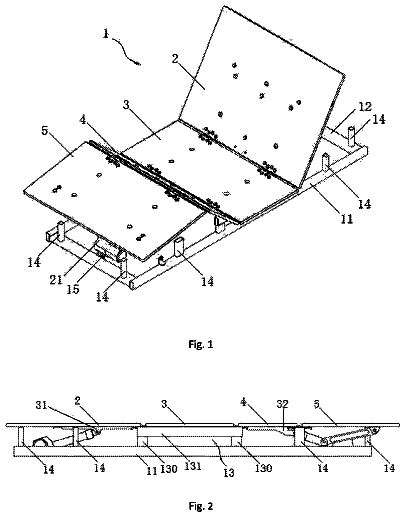
FIG. 1 is a perspective view of a sleeping-posture-control bed system of a first embodiment when a bed floor is in a flat position.
FIG. 2 is a perspective view of a bed body in the first embodiment when a back-receiving surface portion, a head-receiving surface portion, an upper-leg-receiving surface portion, and a lower-leg-receiving surface portion are in a raised position.
FIG. 3( a ) is a front view of the bed body in the first embodiment as seen from a foot frame, and FIG. 3( b ) is a partial plan view of a foot frame as seen from above.
FIGS. 4( a ) and 4( b ) are front views of the bed body in the first embodiment as seen from the foot frame when a suspension member 15 is tilted in the lateral direction.
FIG. 5 is an explanatory drawing showing the tilts of the back-receiving surface portion and the head-receiving surface portion of the bed floor and the up and down movements of the user's head.
FIG. 6 is a block diagram of the overall structure of the sleeping-posture-control bed system of the first embodiment.
FIG. 7 is a flowchart showing the operation of the sleeping-posture-control bed system of the first embodiment.
FIG. 8 is a modified flowchart showing the operation of the sleeping-posture-control bed system of the first embodiment.
FIG. 9 is a flowchart of the determination of the presence or absence of parasomnias by the sleeping-posture-control bed system of the first embodiment.
FIG. 10 is a perspective view of a bed body in a second embodiment.
FIG. 11 is a block diagram of the overall structure of the sleeping-posture-control bed system of the second embodiment.
FIG. 12 is a partially enlarged perspective view of the sleeping-posture-control bed system of the second embodiment.
FIG. 13( a ) is a plan conceptual view showing columnar mat units laid on the bottom surface of the bed body in the second embodiment, and FIG. 13( b ) is a sectional view taken along arrows A-A of FIG. 13( a ) .
FIG. 14 is a flowchart showing the operation of the sleeping-posture-control bed system of the second embodiment.
FIG. 15 is a block diagram of the overall structure of the sleeping-posture-control bed system of a third embodiment.
FIG. 16 is a flowchart showing an operation of the sleeping-posture-control bed system of the third embodiment.
FIG. 17 is a flowchart showing operation 2 of the sleeping-posture-control bed system of the third embodiment.
FIG. 18 is a flowchart showing operation 3 of the sleeping-posture-control bed system of the third embodiment.
FIG. 19 is a perspective view of a bed body of a sleeping-posture-control bed system of a fourth embodiment.
FIG. 20 is a front perspective view of a bed body of a sleeping-posture-control bed system of a fifth embodiment.
FIG. 21 is a flowchart of the determination of the presence or absence of parasomnias by a sleeping-posture-control bed system of a sixth embodiment.
FIG. 22 is a cross sectional view of a bed mat of a modified example in a sleeping-posture-control bed system of a seventh embodiment.
FIG. 23 is a cross sectional view of a bed mat of a modified example in a sleeping-posture-control bed system of an eighth embodiment.
FIG. 24 is a perspective view of a longitudinally stretchable back-receiving surface portion as a modified example of the back-receiving surface portion used in the first embodiment.
The description continues in the full USPTO document.
 Lapsed, fee not paid4 drawings