Technical field
The present invention relates to an electrostatic developing toner (hereinafter may be referred to as “toner”) used for a so-called electrophotographic image forming (e.g., an electrostatic copier or a laser beam printer); and an image forming apparatus, an image forming method, and a process cartridge using the toner.
Background art
Conventionally, in an electrophotographic device or an electrostatic recording device, an electric latent image or a magnetic latent image is visualized with a toner. For example, in electrophotography, an electrostatic latent image formed on a photoconductor is developed with a toner to form a toner image. The toner image is typically transferred onto a transfer material (e.g., paper), and then fixed upon application of heat.
In recent years, toners have been demanded to be fixed at lower temperatures. This demand results from energy saving achieved by reducing energy for fixing and also from requirements for increasing process speed and image quality of image forming apparatus. In addition, as a result of diversification of usage purposes of image forming apparatus, requirements for low-temperature fixing have been being increasing.
A toner can be fixed at lower temperatures by decreasing its softening temperature. However, decreasing the softening temperature decreases its glass transition temperature to impair heat resistance storage ability. In addition, hot offset resistance is also impaired due to a drop in the lower-limit fixing temperature (i.e., the lower-limit temperature at which fixing can be performed without causing problems on image quality) and to a drop in the upper-limit fixing temperature (i.e., the upper-limit temperature at which fixing can be performed). Therefore, it is difficult to achieve a toner that is satisfactory in all of low-temperature fixing property, heat resistance storage stability, and hot-offset resistance only by controlling a thermal property of the resin itself. There is a demand for providing a toner that is satisfactory in all of low-temperature fixing property, heat resistance storage stability, and hot-offset resistance and that allows to form a high-quality image for a long period of time.
For the purpose of achieving satisfactory low-temperature fixing property, heat resistance storage stability, and hot-offset resistance, for example, there is disclosed a toner containing a crystalline polyester, a non-crystalline polyester, and an inorganic nucleating agent (e.g., see PTL 1).
There is also disclosed a toner which contains a binder resin and has a molecular weight distribution having at least one peak in a range of 1,000 to 10,000 and a half value width of 15,000 or less, where the molecular weight distribution is obtained by GPC of THF soluble matter of the toner (e.g., see PTL 2).
Furthermore, there is disclosed a toner which contains a crystalline polyester resin and has a molecular weight distribution having a main peak in a range of 1,000 to 10,000 and a half value width of 15,000 or less, where the molecular weight distribution is obtained by GPC of THF soluble matter of the toner (e.g., see PTL 3).
Meanwhile, there is disclosed a toner containing 0.01% by weight to 20% by weight of calcium carbonate (e.g., see PTLs 4 and 5). However, it has not been described that a combination with the above-described specific molecular weight distribution results in satisfactory low-temperature fixing property, heat resistance storage stability, and hot-offset resistance or that the calcium carbonate has an elasticity enhancing effect.
It is practically problematic that a manufacturing cost is increased in our rage for high quality. There is a practical demand for ensuring good quality while keeping the cost low, that is, for providing a toner which is satisfactory in low cost and high quality.
However, the above-disclosed methods cannot achieve a toner which is satisfactory in terms of practical use, that is, in economical and qualitative aspects (i.e., satisfactory in all of low-temperature fixing property, heat resistance storage stability, and hot-offset resistance), so that there is a room for further improvement in the methods. CITATION LIST Patent Literature
PTL 1 Japanese Patent Application Laid-Open (JP-A) No. 2007-33773
PTL 2 JP-A No. 2002-82484
PTL 3 JP-A No. 2013-231945
PTL 4 JP-A No. 2006-259312
PTL 5 JP-A No. 2006-47743 SUMMARY OF INVENTION Technical Problem
The present invention has been made in view of the related art: That is, the first object of the present invention is to provide a toner being excellent in low-temperature fixing property, hot-offset resistance, and heat resistance storage stability. Solution to Problem
Means for solving the above problems is as follows.
A toner, including:
a binder resin; and
calcium carbonate,
wherein the toner has a molecular weight distribution having a main peak in a range of 1,000 to 10,000, and a half value width of the main peak is 8,000 to 30,000, where the molecular weight distribution is obtained by GPC (gel permeation chromatography) of THF soluble matter of the toner, and
wherein the toner contains the calcium carbonate in an amount of 5% by mass to 35% by mass. Advantageous Effects of Invention
The present invention can solve the above existing problems and achieve the above object. Accordingly, the first object of the present invention can be achieved, that is, a toner being excellent in low-temperature fixing property, hot-offset resistance, and heat resistance storage stability can be provided.
Brief description of drawings
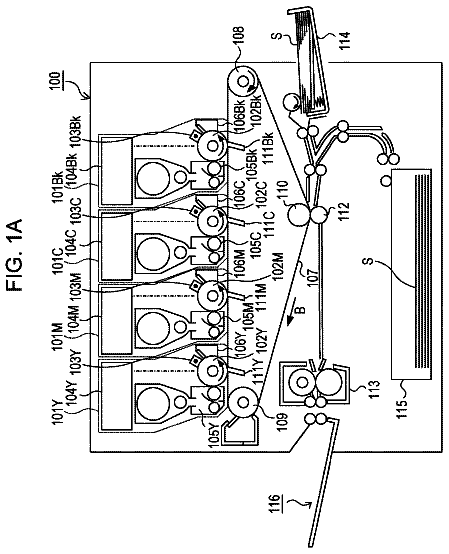
FIG. 1 is a schematic, structural view of one exemplary image forming apparatus of the present invention.
FIG. 2 is a schematic, structural view of another exemplary image forming apparatus of the present invention.
FIG. 3 is a schematic, structural view of another exemplary image forming apparatus of the present invention.
FIG. 4 is an enlarged view of a part of the image forming apparatus shown in FIG. 3 .
FIG. 5 is a schematic, structural view of one exemplary process cartridge of the present invention.
Description of embodiments
(Toner)
The first object of the present invention is to provide a toner being excellent in low-temperature fixing property, hot-offset resistance, and heat resistance storage stability. The second object of the present invention is to provide a toner having an improved low-temperature fixing property and being excellent in charging property. The below-described toner of the present invention is a toner achieving the first object and the second object.
A toner of the present invention includes a binder resin and calcium carbonate; and, if necessary, further includes a colorant, a release agent, and other ingredients.
Example of the other ingredients includes a charging controlling agent for assisting the charging property.
The present inventors have been found that, based on a technical idea in which a sharpening of a molecular weight distribution of a toner is useful for improving low-temperature fixing property, a toner can achieve excellent low-temperature fixing property through having a molecular weight distribution having a main peak in a range of 1,000 to 10,000, and a half value width of the main peak is 8,000 to 30,000, where the molecular weight distribution is obtained by GPC (gel permeation chromatography) of THF soluble matter of the toner.
When the main peak is in less than 1,000, hot-offset property and heat resistance storage stability are degraded. When the main peak is in more than 10,000, low-temperature fixing property is degraded. When the half value width is less than 8,000, hot-offset property is degraded. When the half value width is more than 30,000, low-temperature fixing property is degraded.
The half value width of the main peak is more preferably 8,000 to 20,000.
The main peak, as used herein, refers to a peak having the highest intensity.
The GPC (gel permeation chromatography) is performed as follows.
[Measurement of Molecular Weight Distribution]
A column is stabilized in a heat chamber at 40° C. As a solvent, THF is streamed into the column at this temperature at a flow velocity of 1 mL per minute, and a THF sample solution of a toner or resin in which a sample concentration has been adjusted to 0.05% by mass to 0.6% by mass, is injected at 50 μL to 200 μL for measurement.
In order to measure the molecular weight of the sample, the molecular weight distribution of the sample was calculated from the correlation between the logarithmic values and the number of counts of the standard curve that is prepared from the standard samples of various monodisperse polystyrenes.
As the standard polystyrene samples used for the standard curve, it is appropriate to use those with a molecular weight of 6×10.sup.2, 2.1×10.sup.3, 4×10.sup.3, 1.75×10.sup.4, 5.1×10.sup.4, 1.1×10.sup.5, 3.9×10.sup.5, 8.6×10.sup.5, 2×10.sup.6 and 4.48×10.sup.6 manufactured by, for instance, Pressure Chemical Co. or TOSOH CORPORATION, and to use at least about ten standard polystyrene samples. An RI (refractive index) detector is used as a detector therefor.
A particle diameter of the toner is preferably 3 μm to 15 μm in terms of a volume average particle diameter. When the volume average particle diameter is smaller than 3 μm, there may be a problem in cleaning during a development process and transfer efficiencies during a transfer process, thus deteriorating image quality. When the volume average particle diameter is larger than 15 μm, the image quality may deteriorate.
The volume average particle diameter of the toner can be measured by various methods. For example, it can be measured using COULTER COUNTER TAII (manufactured by U.S. COULTER ELECTRONICS Co.).
<Binder Resin>
The binder resin is not particularly limited and may be appropriately selected from conventionally known materials, as long as the toner has a molecular weight distribution having a main peak in a range of 1,000 to 10,000, and a half value width of the main peak is 8,000 to 30,000, where the molecular weight distribution is obtained by GPC (gel permeation chromatography) of THF soluble matter of the toner. The binder resin is more preferably a combination of a resin (A), a resin (B), and a composite resin (C) as described below.
<<Resin (A)>>
A resin (A) used in the present invention is not particularly limited and may be appropriately selected from conventionally known materials, as long as a toner which contains a binder resin containing the resin (A) in combination with the below-described resin (B) and composite resin (C) has the above desired molecular weight distribution.
The resin (A) effectively functions to develop good hot-offset resistance.
When the resin (A) is contained in an excessively large amount, low-temperature fixing property is degraded. When the resin (A) is contained in an excessively small amount, satisfactory hot-offset resistance cannot be achieved. Therefore, the resin (A) should be incorporated in view of a balance with other binder resins.
The resin (A) has preferably a softening temperature (T½) higher than that of the below-described resin (B). The softening temperature (T½) of the resin (A) is preferably in a range of 120° C. to 180° C.
Herein, the softening temperature (T½) of a resin is measured as follows.
[Measurement of Softening Temperature (T½)]
The softening temperature (T½) of the resin can be measured using an elevated flow tester CFT-500 (manufactured by Shimadzu Corporation, Ltd.) by melting and flowing a sample of 1 cm.sup.2 under the conditions: the diameter of a die hole: 1 mm, the pressure applied: 20 kg/cm.sup.3 and the temperature raising rate: 6° C./min. The softening temperature (T½) is a temperature corresponding to ½ of the range between a flow start point and a flow end point.
<<Resin (B)>>
The resin (B) is not particularly limited and may be appropriately selected, as long as the toner has a molecular weight distribution having a main peak in a range of 1,000 to 10,000, and a half value width of the main peak is 8,000 to 30,000, where the molecular weight distribution is obtained by GPC of THF soluble matter of the toner. Preferable is that the resin (B) has preferably a molecular weight distribution having a main peak in a range of 1,000 to 10,000, and a half value width of the main peak is 8,000 to 30,000, where the molecular weight distribution is obtained by GPC of THF soluble matter of the resin (B). More preferable is that the half value width of the main peak is 8,000 to 20,000.
The resin (B) effectively functions to develop good fixing property.
When the main peak is in less than 1,000, hot-offset property and heat resistance storage stability are degraded. When the main peak is in more than 10,000, low-temperature fixing property is degraded. When the half value width is less than 8,000, hot-offset property is degraded. When the half value width is more than 30,000, low-temperature fixing property is degraded.
In a toner produced by combining the resin (A), the resin (B) and the composite resin (C) together, when the proportion of the resin (B) is increased, the best balance thereamong is obtained; i.e., the respective resins effectively exhibit their functions without accompanying adverse effects of the composite resin (C) on a lower-limit fixing temperature of the toner, so that the toner becomes good in low-temperature fixing property, heat resistance storage stability and hot offset resistance. However, when the resin (B) is contained in an excessively large amount, the resin oozes out during heat resistance storage, leading to poor heat resistance storage stability.
More preferably, the resin (B) has the softening temperature (T½) of 10° C. or more lower than that of the resin (A). The softening temperature (T½) of the resin (B) is preferably in a range of 70° C. to 120° C.
In the present invention, the resin (A) and the resin (B) have separate functions. For example, the resin (B) contributes to low-temperature fixing property (i.e., the lower limit fixing temperature), and the resin (A) contributes to hot-offset resistance (i.e., the upper limit fixing temperature).
The resin (A) and the resin (B) may be conventionally known materials, as long as the above functions can be exerted.
Examples thereof include styrene resins (homopolymers or copolymers including styrene or styrene-substituted products), vinyl chloride resins, styrene-vinyl acetate copolymers, rosin-modified maleic acid resins, phenol resins, epoxy resins, polyethylene resins, polypropylene resins, ionomer resins, polyurethane resins, silicone resins, ketone resins, ethylene-ethyl acrylate copolymers, xylene resins, polyvinyl butyral resins, petroleum resins and hydrogenated petroleum resins.
Examples of the styrene resins (homopolymers or copolymers including styrene or styrene-substituted products) include polystyrenes, polychiorostyrenes, poly(α-methylstyrenes), styrene-chlorostyrene copolymers, styrene-propylene copolymers, styrene-butadiene copolymers, styrene-vinyl chloride copolymers, styrene-vinyl acetate copolymers, styrene-maleic acid copolymers, styrene-acrylic acid ester copolymers (e.g., styrene-methyl acrylate copolymers, styrene-ethyl acrylate copolymers, styrene-butyl acrylate copolymers, styrene-octyl acrylate copolymers and styrene-phenyl acrylate copolymers), styrene-methacrylic acid ester copolymers (e.g., styrene-methyl methacrylate copolymers, styrene-ethyl methacrylate copolymers, styrene-butyl methacrylate copolymers and styrene-phenyl methacrylate copolymers), styrene-α-chloromethyl acrylate copolymers and styrene-acrylonitrile-acrylic acid ester copolymers.
Methods for producing these resins are not particularly limited may be appropriately selected. Examples thereof include mass polymerization, solution polymerization, emulsion polymerization and suspension polymerization.
These resins may be used alone or in combination.
The resin (A) and the resin (B) used in the present invention are more preferably a polyester resin from the viewpoint of development of low-temperature fixing property. The polyester resin usable is, for example, one generally obtained through condensation polymerization between an alcohol component and a carboxylic acid component.
Examples of the alcohol component include glycols; ethylated bisphenols such as 1,4-bis(hydroxymethyl)cyclohexane and bisphenol A; and other divalent alcohol monomers and tri- or higher-hydric alcohol monomers.
Examples of the glycols include ethylene glycol, diethylene glycol, triethylene glycol and propylene glycol.
Examples of the carboxylic acid component include divalent organic acid monomers and tri- or higher-valent carboxylic acid monomers.
Examples of the divalent organic acid monomers include maleic acid, fumaric acid, phthalic acid, isophthalic acid, terephthalic acid, succinic acid and malonic acid.
Examples of the tri- or higher-valent carboxylic acid monomers 1,2,4-benzenetricarboxylic acid, 1,2,5-benzenetricarboxylic acid, 1,2,4-cyclohexanetricarboxylic acid, 1,2,4-naphthalenetricarboxylic acid, 1,2,5-hexanetricarboxylic acid, 1,3-dicarboxyl-2-methylenecarboxypropane and 1,2,7,8-octanetetracarboxylic acid.
The polyester resin preferably has a glass transition temperature Tg of 55° C. or higher, more preferably 60° C. or higher, from the viewpoint of heat resistance storage stability.
The DSC for measuring an endothermic peak and the glass transition temperature Tg in the present invention is performed by raising the temperature at 10° C./min from 20° C. to 150° C. using a differential scanning calorimeter (“DSC-60”; manufactured by Shimadzu Corporation, Ltd.).
<<Composite Resin (C)>>
The composite resin (C) is a resin where a condensation polymerization monomer and an addition polymerization monomer are chemically bonded together (hereinafter may be referred to as “hybrid resin”).
That is, the composite resin (C) contains a condensation polymerization unit and an addition polymerization unit.
The composite resin (C) can be obtained by allowing a mixture containing a condensation polymerization monomer and an addition polymerization monomer serving as raw materials to simultaneously undergo condensation polymerization reaction and addition polymerization reaction in the same reaction vessel, or to sequentially undergo condensation polymerization reaction and addition polymerization reaction in this order, or to sequentially undergo addition polymerization reaction and condensation polymerization reaction in this order.
Examples of the condensation polymerization monomer in the composite resin (C) include: polyhydric alcohol components and polyhydric carboxylic acid components forming polyester resin units; and multivalent carboxylic acid components, and amine components or amino acid components forming polyamide resin units or polyester-polyamide resin units.
Examples of dihydric alcohol components among the polyhydric alcohol components include 1,2-propanediol, 1,3-propanediol, ethylene glycol, propylene glycol, 1,3-butanediol, 1,4-butanediol, 2,3-butanediol, diethylene glycol, triethylene glycol, 1,5-pentanediol, 1,6-hexanediol, neopentyl glycol, 2-ethyl-1,3-hexanediol, hydrogenated bisphenol A, and diols obtained through polymerization of cyclic ethers.
Examples of the diols obtained through polymerization of cyclic ethers include diols obtained through polymerization between bisphenol A and cyclic ethers (e.g., ethylene oxide and propylene oxide).
Examples of tri- or higher-hydric alcohol components among the polyhydric alcohol components include sorbitol, 1,2,3,6-hexanetetrol, 1,4-sorbitan, pentaerythritol, dipentaerythritol, tripentaerythritol, 1,2,4-butanetriol, 1,2,5-pentatriol, glycerol, 2-methylpropanetriol, 2-methyl-1,2,4-butanetriol, trimethylolethane, trimethylolpropane and 1,3,5-trihydroxybenzene.
Among them, from the viewpoint of providing the resin with heat resistance storage stability and mechanical strength, hydrogenated bisphenol A and alcohol components each having the bisphenol A skeleton such as diols obtained through polymerization between bisphenol A and cyclic ethers (e.g., ethylene oxide and propylene oxide) can be suitably used.
Examples of the multivalent carboxylic acid components include benzene dicarboxylic acids or anhydrides thereof, alkyl dicarboxylic acids or anhydrides thereof; unsaturated dibasic acids; and unsaturated dibasic acid anhydrides.
Examples of the benzene dicarboxylic acids or anhydrides thereof include phthalic acid, isophthalic acid and terephthalic acid.
Examples of the alkyl dicarboxylic acids or anhydrides thereof include succinic acid, adipic acid, sebacic acid and azelaic acid.
Examples of the unsaturated dibasic acids include maleic acid, citraconic acid, itaconic acid, alkenylsuccinic acid, fumaric acid and mesaconic acid.
Examples of the unsaturated dibasic acid anhydrides include maleic anhydride, citraconic anhydride, itaconic anhydride and alkenylsuccinic anhydride.
Examples of tri- or higher-valent carboxylic acid components among the multivalent carboxylic acid components include trimellitic acid, pyromellitic acid, 1,2,4-benzenetricarboxylic acid, 1,2,5-benzenetricarboxylic acid, 2,5,7-naphthalenetricarboxylic acid, 1,2,4-naphthalenetricarboxylic acid, 1,2,4-butanetricarboxylic acid, 1,2,5-hexanetricarboxylic acid, 1,3-dicarboxyl-2-methyl-2-methylenecarboxypropane, tetra(methylene carboxy)methane, 1,2,7,8-octanetetracarboxylic acid, Enpol trimer acid, or anhydrides thereof and partial lower alkyl esters of thereof.
Among them, from the viewpoints of heat resistance storage stability and mechanical strength of the resin, aromatic multivalent carboxylic acid compounds such as phthalic acid, isophthalic acid, terephthalic acid and trimellitic acid are suitably used.
Examples of the amine components or the amino acid components include diamines (D1), tri- or higher-valent polyamines (D2), amino alcohols (D3), aminomercaptans (D4), amino acids (D5), and amino-blocked products (D6) of the amines (D1) to (D5).
Examples of the diamines (D1) include aromatic diamines (e.g., phenylenediamine, diethyltoluenediamine and 4,4′-diaminodiphenylmethane), alicyclic diamines (e.g., 4,4′-diamino-3,3′-dimethyldicyclohexylmethane, diaminocyclohexane and isophoronediamine), and aliphatic diamines (e.g., ethylenediamine, tetramethylenediamine and hexamethylenediamine).
Examples of the tri- or higher-valent polyamines (D2) include diethylenetriamine and triethylenetetramine.
Examples of the amino alcohols (D3) include ethanolamine and hydroxyethylaniline.
Examples of the aminomercaptans (D4) include aminoethyl mercaptan and aminopropyl mercaptan.
Examples of the amino acids (D5) include aminopropionic acid, aminocaproic acid and ε-caprolactam.
Examples of the amino-blocked products (D6) of the amines (D1) to (D5) include ketimine compounds and oxazolidine compounds derived from the amines (D1) to (D5) and ketones (e.g., acetone, methyl ethyl ketone and methyl isobutyl ketone).
The ratio by mole of the condensation polymerization monomer component in the composite resin (C) is preferably 5 mol % to 40 mol %, more preferably 10 mol % to 25 mol %.
When the ratio by mole thereof is less than 5 mol %, dispersibility of the composite resin (C) in the polyester resin may be degraded. When it is more than 40 mol %, dispersibility of a release agent may tend to be degraded.
An esterification catalyst may be used in the condensation polymerization reaction. Any well-known and commonly used catalyst can be used therein.
The addition polymerization monomer in the composite resin (C) is not particularly limited and may be appropriately selected depending on the intended purpose. Preferred examples thereof include vinyl monomers.
Examples of the vinyl monomer include styrene vinyl monomers, vinyl acrylate monomers, vinyl methacrylate monomers, and other monomers forming other vinyl monomers or copolymers.
Examples of the styrene vinyl monomers include styrene, o-methylstyrene, m-methylstyrene, p-methylstyrene, p-phenylstyrene, p-ethylstyrene, 2,4-dimethylstyrene, p-n-amylstyrene, p-tert-butylstyrene, p-n-hexylstyrene, p-n-4-dichlorostyrene, m-nitrostyrene, o-nitrostyrene and p-nitrostyrene.
Examples of the vinyl acrylate monomers include acrylic acid, methyl acrylate, ethyl acrylate, propyl acrylate, n-butyl acrylate, isobutyl acrylate, n-octyl acrylate, n-dodecyl acrylate, 2-ethylhexyl acrylate, stearyl acrylate, 2-chloroethyl acrylate, and phenyl acrylate.
Examples of the vinyl methacrylate monomers include methacrylic acid, methyl methacrylate, ethyl methacrylate, propyl methacrylate, n-butyl methacrylate, isobutyl methacrylate, n-octyl methacrylate, n-dodecyl methacrylate, 2-ethylhexyl methacrylate, stearyl methacrylate, phenyl methacrylate, dimethylaminoethyl methacrylate and diethylaminoethyl methacrylate.
Examples of the other monomers forming other vinyl monomers or copolymers include monoolefins, polyenes, halogenated vinyls, vinyl esters, vinyl ethers, vinyl ketones, N-vinyl compounds, vinylnaphthalenes, acrylic or methacrylic acid derivatives, unsaturated dibasic acids, unsaturated dibasic acid anhydride, unsaturated dibasic acid monoesters, unsaturated dibasic acid esters, α,β-unsaturated acids, α,β-unsaturated acid anhydride, carboxyl group-containing monomers, (meth)acrylic acid hydroxyalkyl esters, and hydroxy group-containing monomers.
Examples of the monoolefins include ethylene, propylene, butylene and isobutylene.
Examples of the polyenes include butadiene and isoprene.
Examples of the halogenated vinyls include vinyl chloride, vinylidene chloride, vinyl bromide and vinyl fluoride.
Examples of the vinyl esters include vinyl acetate, vinyl propionate and vinyl benzoate.
Examples of the vinyl ethers, include vinyl methyl ether, vinyl ethyl ether and vinyl isobutyl ether.
Examples of the vinyl ketones include vinyl methyl ketone, vinyl hexyl ketone and methyl isopropenyl ketone.
Examples of the N-vinyl compounds include N-vinylpyrrole, N-vinylcarbazole, N-vinylindole and N-vinylpyrrolidone.
Examples of the acrylic or methacrylic acid derivatives include acrylonitrile, methacrylonitrile and acrylamide.
Examples of the unsaturated dibasic acids include maleic acid, citraconic acid, itaconic acid, alkenylsuccinic acid, fumaric acid and mesaconic acid.
Examples of the unsaturated dibasic acid anhydride include maleic anhydride, citraconic anhydride, itaconic anhydride and alkenylsuccinic anhydride.
Examples of the unsaturated dibasic acid monoesters include maleic acid monomethyl ester, maleic acid monoethyl ester, maleic acid monobutyl ester, citraconic acid monomethyl esters, citraconic acid monoethyl esters, citraconic acid monobutyl esters, itaconic acid monomethyl esters, alkenylsuccinic acid monomethyl, fumaric acid monomethyl esters and mesaconic acid monomethyl esters.
Examples of the unsaturated dibasic acid esters include dimethyl maleate and dimethyl fumarate.
Examples of the α,β-unsaturated acids include crotonic acid and cinnamic acid.
Examples of the α,β-unsaturated acid anhydride include crotonic anhydride and cinnamic anhydride.
Examples of the carboxyl group-containing monomers include acid anhydrides formed between the α,β-unsaturated acids and lower fatty acids; and alkenylmalonic acid, alkenylglutaric acid and alkenyladipic acid, acid anhydrides or monoesters thereof.
Examples of the (meth)acrylic acid hydroxyalkyl esters include 2-hydroxyethyl acrylate, 2-hydroxyethyl methacrylate and 2-hydroxypropyl methacrylate.
Examples of the hydroxy group-containing monomers include 4-(1-hydroxy-1-methylbutyl)styrene and 4-(1-hydroxy-1-methylhexyl)styrene.
Among them, styrene, acrylic acid, n-butyl acrylate, 2-ethylhexyl acrylate, methacrylic acid, n-butyl methacrylate and 2-ethylhexyl methacrylate are more preferable. When they are used in combination with at least styrene and acrylic acid, dispersibility of a release agent is remarkably excellent, which is particularly preferred.
If necessary, a crosslinking agent for the addition polymerization monomer may be further added.
Examples of the crosslinking agent include aromatic divinyl compounds, diacrylate compounds having an alkyl chain as a linking moiety, diacrylate compounds having, as a linking moiety, an alkyl chain containing an ether bond, and polyester diacrylates.
Examples of the aromatic divinyl compounds include divinyl benzene and divinyl naphthalene.
Examples of the diacrylate compounds having an alkyl chain as a linking moiety include ethylene glycol diacrylate, 1,3-butylene glycol diacrylate, 1,4-butanediol diacrylate, 1,5-pentanediol diacrylate, 1,6-hexanediol diacrylate, neopentyl glycol diacrylate, and methacrylate compounds where the acrylates of the above-listed compounds are changed to methacrylates.
Examples of the diacrylate compounds having, as a linking moiety, an alkyl chain containing an ether bond include: diethylene glycol diacrylate, triethylene glycol diacrylate, tetraethylene glycol diacrylate, polyethylene glycol #400 diacrylate, polyethylene glycol #600 diacrylate, dipropylene glycol diacrylate, and methacrylate compounds where the acrylates of the above-listed compounds are changed to methacrylates.
Further examples include di(meth)acrylate compounds having, as a linking moiety, a chain containing an aromatic group and an ether bond.
Examples of the polyester diacrylates include MANDA (trade name) (manufactured by NIPPON KAYAKU CO., LTD.).
Examples of multifunctional crosslinking agents include pentaerythritol triacrylate, trimethylolethane triacrylate, trimethylolpropane triacrylate, tetramethylolmethane tetraacrylate, oligoester acrylate, methacrylate compounds where the acrylates of the above-listed compounds are changed to methacrylates, triallyl cyanurate and triallyl trimellitate.
The crosslinking agent is added in an amount of preferably 0.01 parts by mass to 10 parts by mass, more preferably 0.03 parts by mass to 5 parts by mass, relative to 100 parts by mass of the addition polymerization monomer used.
A polymerization initiator used in polymerizing the addition polymerization monomer is not particularly limited and may be appropriately selected depending on the intended purpose. Examples thereof include azo polymerization initiators and peroxide polymerization initiators.
Examples of the azo polymerization initiators include 2,2′-azobisisobutylonitrile, 2,2′-azobis(4-methoxy-2,4-dimethylvaleronitrile) and 2,2′-azobis(2,4-dimethylvaleronitrile).
Examples of the peroxide polymerization initiators include methyl ethyl ketone peroxide, acetylacetone peroxide, 2,2-bis(tert-butylperoxy)butane, tert-butyl hydroperoxide, benzoyl peroxide and n-butyl-4,4-di-(tert-butylperoxy)valerate.
These may be used in combination for the purpose of adjusting the resin in terms of molecular weight and molecular weight distribution.
The polymerization initiator is added in an amount of preferably 0.01 parts by mass to 15 parts by mass, more preferably 0.1 parts by mass to 10 parts by mass, relative to 100 parts by mass of the addition polymerization monomer used.
In order to chemically binding the condensation polymerization unit with the addition polymerization unit, for example, a monomer reactive in both condensation polymerization and addition polymerization (i.e., a condensation-addition polymerization-reactive monomer) is used.
Examples of the condensation-addition polymerization-reactive monomer include unsaturated carboxylic acids such as acrylic acid and methacrylic acid, unsaturated dicarboxylic acids such as fumaric acid, maleic acid, citraconic acid and itaconic acid, or anhydrides thereof, and vinyl monomers containing a hydroxyl group.
The condensation-addition polymerization-reactive monomer is added in an amount of preferably 1 part by mass to 25 parts by mass, more preferably 2 parts by mass to 20 parts by mass, relative to 100 parts by mass of the addition polymerization monomer used.
When the composite resin (C) is produced in one reaction vessel, both the condensation polymerization reaction and the addition polymerization reaction are allowed to proceed and/or complete at the same time. Alternatively, both the reactions may be completed independently by selecting the reaction temperature and time for each of the reactions.
In one exemplary method, a mixture of the addition polymerization monomer and the polymerization initiator is added dropwise to a mixture of the condensation polymerization monomer in a reaction vessel, followed by mixing in advance. After that, the addition polymerization is first completed through radical polymerization reaction, and then the condensation polymerization is allowed to proceed by raising the reaction temperature.
In this manner, when two independent reactions are allowed to proceed in the reaction vessel, two different kinds of resin units can be effectively dispersed or bound together.
The composite resin (C) is preferably a composite resin containing a polyester resin unit as the condensation polymerization unit and a vinyl resin as the addition polymerization unit, which allows the composite resin (C) to exhibit its function more effectively.
The softening temperature (T½) of the composite resin (C) is preferably 90° C. to 130° C., more preferably 100° C. to 120° C.
When the softening temperature (T½) thereof is lower than 90° C., there may be degradation in heat resistance storage stability and hot offset resistance. When it is higher than 130° C., there may be degradation in low-temperature fixing property.
Also, the glass transition temperature of the composite resin (C) is preferably 45° C. to 80° C., more preferably 50° C. to 70° C., particularly preferably 53° C. to 65° C. from the viewpoints of fixing property, storage stability and durability.
The acid value of the composite resin (C) is preferably 5 mgKOH/g to 80 mgKOH/g, more preferably 15 mgKOH/g to 40 mgKOH/g, from the viewpoints of charging property and environmental stability.
An amount of the resin (A) contained in the toner is preferably 20% by mass to 80% by mass, an amount of the resin (B) contained in the toner is preferably 80% by mass to 20% by mass, and an amount of the composite resin (C) contained in the toner is preferably 1% by mass to 10% by mass.
In the present invention, in order to achieve a toner having the desired main peak and half value width, a resin (B) having various main peaks and half value widths is used. For example, in the case of producing a toner having a main peak and a half value width in a high molecular weight region, a resin (B) having a main peak and a half value width in the high molecular weight region is preferably used.
<Calcium Carbonate>
An amount of the calcium carbonate contained in the toner is 5% by mass to 35% by mass.
The present inventors have been found that, when the calcium carbonate is contained in the toner, hot-offset resistance and heat resistance storage stability can be achieved due to internal aggregation force of the calcium carbonate.
When the amount of the calcium carbonate contained in the toner is less than 5% by mass, hot-offset resistance and heat resistance storage stability are degraded due to small aggregation force of the calcium carbonate. When the amount of the calcium carbonate contained in the toner is more than 35% by mass, low-temperature fixing property is degraded due to excessively large internal aggregation force.
The amount of the calcium carbonate contained in the toner is more preferably 10% by mass to 30% by mass.
A proportion of calcium carbonate existing on a surface of a toner can be confirmed by measuring contents of elements C, O, and Ca using EDS (energy dispersive X-ray spectrometry) and detecting the proportion of the Ca content relative to the total thereof. The Ca content may be preferably 1% by mass to 60% by mass, more preferably 5% by mass to 30% by mass when the contents of the elements C, O, and Ca is measured using EDS. When the Ca exists on the surface of the toner in the proportion falling within the above preferable range, both effects of adhesion of toner to each other and charging property contributing to the lower limit fixing temperature can be achieved, which is preferable.
The “surface of toner,” as used herein, means a region from an outermost surface to about 1 μm deep of the toner. In the EDS measurement, Ca derived from calcium carbonate existing in the region from the outermost surface to about 1 μm deep of the toner is detected. Note that, the calcium carbonate may exist on the surface of the toner in any positional relationship with the toner, as long as the desired Ca content is given by the measurement with EDS. The calcium carbonate is preferably embedded in the toner, but any aspect in which a part of the calcium carbonate is protruded from the surface of the toner is also included.
The Ca content measured with EDS can be allowed to fall within the range defined in the present invention by selectively devising in terms of formulation and a step as follows.
—Formulation—For example, the particle diameter of the calcium carbonate is set to 0.1 μm to 10 μm, which prevents the calcium carbonate from protruding from the surface of the toner.
For example, a preferable resin (e.g., polyester) is used, resulting in an improved binding property of the resin to the calcium carbonate because the polyester is likely to bind to the calcium carbonate in terms of polarity.
For example, inclusion of wax improves wettability. The dispersibility in and the wettability on the resin are improved by containing the wax in the percentage of 1% by mass to 10% by mass (preferably 2% by mass to 5% by mass) in combination with the calcium carbonate.
For example, fine powder (i.e., powder having a particle diameter of about 3 μm or less and produced during manufacture of the toner) is contained in the percentage of 0% by mass to 30% by mass. The fine powder improves the dispersibility in and the wettability on the resin by covering the calcium carbonate due to its higher specific surface area than other particles.
—Step—
For example, the calcium carbonate is subjected to surface treatment, which improves the dispersibility in and the wettability on the resin.
Aminosilane, titanate silane, or fatty acids are used, which allows surface tension of the calcium carbonate to approach critical surface tension of the resin to thereby improve the dispersibility in and the wettability.
For example, particle size distribution of the calcium carbonate is adjusted in advance, which prevents the calcium carbonate from aggregating due to its dispersion failure.
For example, the calcium carbonate is crushed in advance, which prevents initial aggregation thereof.
The initial aggregation is prevented by crushing the calcium carbonate in advance. It also prevents aggregates from having fracture surfaces during pulverization.
For example, the wettability is improved by kneading at a high temperature (e.g., 120° C. to 180° C., preferably 120° C. to 150° C.), which softens the resin and improves the wettability of the calcium carbonate on the resin (anchor effect).
For example, the calcium carbonate is embedded in the toner by melting the toner with METEORAINBOW. That is, the resin component of the toner is melted under a high temperature to thereby enclose the calcium carbonate protruding from the surface of the toner.
For example, the calcium carbonate is embedded by allowing the resin to collide with the toner through hybridization.
The resin is collided with the surface of the toner by mixing with the toner to thereby embed the calcium carbonate.
The description continues in the full USPTO document.
 Lapsed, fee not paid4 drawings