Lapsed, fee not paid7 drawings
Vehicles & Drones · US 9,890,716 B2
Method and system for pre-ignition control
Methods and systems are provided for addressing pre-ignition by mechanically varying a piston displacement within a combustion chamber.
US 9,890,720 B2 · Assignee: MTU FRIEDRICHSHAFEN GMBH · Inventors: Flohr; Andreas et al.
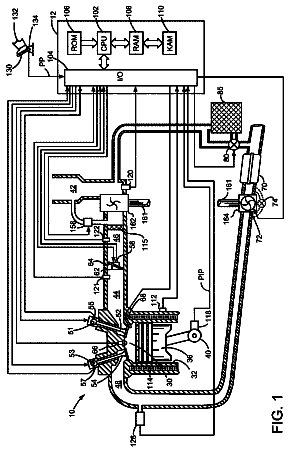
Sheet 1 of 3 from the published document. All sheets in the USPTO PDF
A method for operating an internal combustion engine, which has: an intake section and an engine with an number of cylinders and a receiver which is arranged upstream of the cylinders wherein the intake section has: a supercharging system with a compressor and a bypass for bypassing the supercharging system, and wherein the receiver is assigned an engine throttle, and the bypass is assigned a compressor bypass throttle; and a setting of the engine throttle and/or of the compressor bypass throttle is set as a function of the operation in order to influence a charge fluid. The intake section is assigned an intake section model by which at least a mass flow and/or state of the charge fluid upstream of the engine are/is determined and on the basis of a determination result the compressor bypass throttle is set as a function of the engine throttle.
The invention relates to a method for operating an internal combustion engine, in particular a gas internal combustion engine, having an intake section and an engine with a number of cylinders. The invention also relates to a closed-loop control system for the internal combustion engine, and to an internal combustion engine. The internal combustion engine has, in the intake section, a supercharging system and a bypass for bypassing the supercharging system. It is known generally to use throttle elements for load closed-loop control in internal combustion engines. Internal combustion engines are increasingly subjected to transient, that is to say in a most general way non-steady-state, operating modes even in the case of non-mobile applications, with the result that the load closed-loop control assumes increasing importance. This proves comparatively complex, in particular, in gas interna
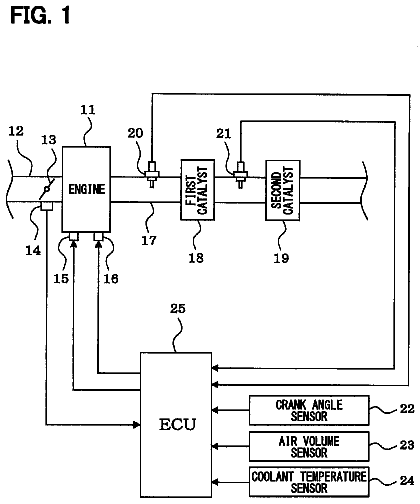
1 of 3 drawing sheets so far from the published document, cropped to the drawing. Every sheet is in the USPTO PDF.
What the patent claimed, word for word. All of it is now free to use.
The present application is a 371 of International application PCT/EP2014/000140, filed Jan. 20, 2014, which claims priority of DE 10 2013 205 725.3, filed Mar. 28, 2013, the priority of these applications is hereby claimed and these applications are incorporated herein by reference.
The invention relates to a method for operating an internal combustion engine, in particular a gas internal combustion engine, having an intake section and an engine with a number of cylinders. The invention also relates to a closed-loop control system for the internal combustion engine, and to an internal combustion engine. The internal combustion engine has, in the intake section, a supercharging system and a bypass for bypassing the supercharging system.
It is known generally to use throttle elements for load closed-loop control in internal combustion engines. Internal combustion engines are increasingly subjected to transient, that is to say in a most general way non-steady-state, operating modes even in the case of non-mobile applications, with the result that the load closed-loop control assumes increasing importance.
This proves comparatively complex, in particular, in gas internal combustion engines. Application fields of gas internal combustion engines are mobile applications, such as, for example, in the field of shipping or in the field of utility vehicles and heavy-duty motor vehicles, as well as stationary applications such as in block power stations, which are to be advantageously configured, in particular, for a fluctuating gas supply.
U.S. Pat. No. 6,131,552 generally discloses a fuel control system which can regulate the supply of gas to a mixture chamber as a function of a measured operating state of the engine. The control method in U.S. Pat. No. 6,131,552 A or other only load-dependent gas-metering systems also proves inadequate in the case of complex regulating systems.
Volumetric efficiency is usually a measure of the gaseous fresh charge of charge air which is supplied to an internal combustion engine in a charge mixture, wherein the volumetric efficiency also permits conclusions to be drawn about the quality of the intake system and of the intake process. The actual volumetric efficiency generally represents the ratio of the mass of fresh air in a charge mixture, which is actually fed to the engine or cylinder thereof during a working cycle. This real mixture mass is determined, with respect to the theoretical fresh charge mass, from the geometric swept volume and the theoretical charge density in the environmental state (in the case of freely aspirating engines), and in the case of supercharged engines the state of the fresh charge downstream of the compressor or downstream of the charge air cooler is taken into account here.
A series of factors, for example, the valve control times or the opening cross section of the valves, influence the fresh charge which is fed to a cylinder. Generally, these factors can be determined from a module for determining the supercharging of the engine to which an intake section model is stored. However, the fresh charge fed to the engine in a charge mixture actually corresponds to the theoretical only in exceptional cases. The volumetric efficiency is not a constant number for an engine but instead is dependent to a large degree on the rotational speed and the geometric conditions of an intake section and a combustion chamber which are present; to overcome this dependence it is possible to take into account, for example, a suitable characteristic diagram.
Intake section models are, in turn, known in engine regulators, basically in general internal combustion engines such as, for example, from EP 1 398 490 A2. These engines have in common the fact that by modeling the intake section—in the simplest case as a homogeneous pressure vessel in order to sense the dynamic processes in the air path—as a widespread basic concept, the storage behavior of the intake section (also referred to as intake manifold) is modeled by means of the filling and emptying method. In this context, the intake manifold is treated as a pressure vessel which is continuously filled with air through a throttle valve and from which the engine sucks air via the inlet valve through its intake behavior corresponding to the working cycle.
However, it becomes apparent that a fuel supply of a gas internal combustion engine, in particular in the transient operating range of the internal combustion engine and with variable fuel qualities is much more complex. In addition, in the case of gas internal combustion engines it becomes apparent, in particular with respect to the formation of a spark-ignition gas internal combustion engine, that generally a load regulation, in particular the operation in the low load range and/or in the transient load range, can be problematic. Therefore, generally in the case of internal combustion engines, but in particular in the case of gas internal combustion engines, in the case of load shedding and when the throttle valves close, compressor pumping can occur when the compressor of the exhaust gas turbocharger is operated briefly outside its operating range as a result of a rapid reduction in the gas mass flow which is being fed by it. Furthermore, a load cut-in potential of a gas engine is very limited if said potential is opened in the steady-state mode.
At the same time, the intake section between the compressor outlet and the combustion chamber inlet is composed, in some cases, of large volumes which, as a result, store or output significant mixture masses. This applies, in particular, when pressure changes and/or temperature changes occur in the individual partial volumes when there are changes in load and/or rotational speed of the engine. As a consequence of mixture mass formation in a gas internal combustion engine which is, however, adapted only to a restricted degree to the operating point, and which is inprecise owing to the, in some cases, large volumes, high hydrocarbon emissions (HC emissions) or other increased emissions (NOx, CO or particles etc.) as well as poor efficiency levels as a result of unburnt combustion gas are to be expected.
During operation of gas engines, the mixture formation usually takes place upstream of the compressor of the exhaust gas turbocharging system; the present problem relates, in respect of the gas engine, not only to gas engines with central mixture formation but also to those with cylinder-specific mixture formation.
It is desirable to make operation of an internal combustion engine, in particular gas operation of a gas internal combustion engine, more advantageous, in particular in the transient, preferably low-load range, in accordance with the load requirements and emission conditions.
At this point, the invention comes in, the object of which is to specify a method and a device by means of which improved operation of an internal combustion engine, in particular as a gas internal combustion engine, is achieved. In particular, it is an object of the invention to make available improved load closed-loop control during operation. In particular it is an object of the invention to achieve an improvement in the transient and/or steady-state operating mode. In the transient operating mode, jumps in torque of an engine should preferably be avoided. Within the scope of an improved operating method, improved actuation of throttles, in particular of an engine throttle and/or of a compressor bypass throttle is preferably to be provided; in particular, excessive emissions are to be avoided even in the case of changing load requirements.
In particular am improved internal combustion engine which can be operated in a transient and/or steady-state fashion, in particular as a gas internal combustion engine, should be made available. In particular, a load cut-in capability needs to be configured more advantageously—preferably on the basis of a steady-state operating mode. In particular, compressor pumping needs to be avoided—preferably on the basis of a transient operating mode. In particular, situations to be preferably avoided are those in which a turbocharger has to be operated outside its configured operating range. The object of the invention is also to address at least one of the problems described above. At least one alternative solution is to be proposed.
In this context the basis used is a method of the type mentioned at the beginning for operating an internal combustion engine, having an intake section and an engine with a number of cylinders and a receiver which is arranged upstream of the cylinders, wherein
the intake section has: a supercharging system having a compressor and a bypass for bypassing the supercharging system, and wherein the receiver is assigned an engine throttle, and the bypass is assigned a compressor bypass throttle.
In the method, a setting of the engine throttle and/or of the compressor bypass throttle is set as a function of the operation in order to influence a charge fluid.
In an optional first aspect, the invention provides that at least one mass flow and/or state of the charge fluid upstream of the engine is determined, in particular in that the intake section is assigned an intake section model, by means of which at least one mass flow and/or state of the charge fluid upstream of the engine is determined.
In a second aspect, the invention provides that—in particular on the basis of a determination result—according to the invention the compressor bypass throttle is set as a function of the engine throttle.
In respect of a particularly advantageous application in a gas internal combustion engine, a mixture portion of a gas-air mixture is correspondingly influenced by setting the engine throttle and/or the compressor bypass throttle in an operationally dependent fashion. In accordance with one development, with respect to the first aspect in the method the intake section is assigned an intake section model by means of which at least one mixture mass flow and/or a mixture state of the mixture portion is determined. In accordance with the concept of the invention, with respect to the second aspect in the method, in particular, the compressor bypass throttle is set as a function of the engine throttle, in particular on the basis of a determination result.
The implementation of the first and/or second aspects is preferably achieved within the scope of an open-loop and/or a closed-loop control dependence.
An intake section model advantageously provides, in particular, the simulation of an intake section within the scope of a closed-loop control of the internal combustion engine, in particular of the gas internal combustion engine. Although intake section models in engine regulators are basically known, the development in this respect is based on the idea that the conventional modeling mentioned at the beginning is already insufficient at the outset—even for using the gas engine, in particular with mixture formation upstream of a compressor and/or throttle valve regulation at a compressor bypass and/or at an engine supply section. In particular, it is apparent that a required gas mass flow such as is determined directly from the mixture mass flow for steady-state operation and which is determined merely from volumetric efficiency at the engine is inadequate.
The development optionally takes into account, in this respect for the first aspect of the invention, the idea that a distance between the location of sucking in the charge fluid and the location of a combustion chamber inlet can be comparatively long, and therefore per se comprises a comparatively large volume which can hardly be realistically described in a steady state. In particular, in the case of a gas engine a distance between the location of the mixture formation, e.g. upstream of the compressor of the exhaust gas supercharging system and the location of a combustion chamber inlet proves to be comparatively long, and therefore comprises per se a comparatively large volume which can hardly be described realistically in a steady state. The partially large volumes can in fact store or output significant mixture masses if pressure and/or temperature changes occur in the individual partial volumes when there is a change in the load and/or rotational speed of the engine.
In the optional first aspect it has been recognized that as a result the mass flow and/or state of the charge fluid or—especially in the case of a gas engine the mixture mass flow and/or mixture state at the outlet of the gas mixer—is temporally decoupled from that of the combustion chamber inlet. This state has hitherto not been sufficiently taken into account in intake section models, whether for a gas engine or any other internal combustion engine. In particular, conventional steady-state considerations of a gas engine in which only the mixture pressure upstream of a cylinder is considered therefore, as is recognized by the optional first aspect of the invention, is not expedient in ensuring compliance with defined combustion air conditions.
The concept of the invention provides, stated simply, that, after at least one mass flow and/or state of the charge fluid—in particular at least one mixture mass flow and/or mixture state of the mixture portion—upstream of the engine is determined in the first aspect preferably on the basis of an intake section model, according to the invention in the second aspect, in particular on the basis of a determination result, the compressor bypass throttle (VDBK) is set as a function of the engine throttle (DK). Additionally or alternatively to a setting of a throttle, in particular an opening cross section thereof is determined. In this context it is to be borne in mind that this applies, in particular, to a transient operating mode of the internal combustion engine. This is preferably implemented either with a first relatively fast timescale or one of the of a second relatively slow timescale, in particular for the transient operating mode. For a steady-state operating mode, the transient compressor bypass throttle actuation can, in this respect, be insignificant since the latter is inactive. The selection of a compressor bypass throttle actuation as a function of the engine throttle is therefore subject to a validity value which shows that the compressor bypass throttle and/or the engine throttle is opened.
Overall, the invention has the advantage that—in particular in the case of a transient operating mode—a setting of the compressor bypass throttle (VDBK) as a function of the engine throttle (DK) can be selected such that the turbocharger is relieved of loading. This also has the advantage that, in particular in the case of an operating mode which is based on a steady-state operating mode—a setting of the compressor bypass throttle (VDBK) can be selected as a function of the engine throttle (DK) in such a way that the turbocharger can already build up a better load cut-in potential in or on the basis of a steady-state operating mode.
Basically the concept of the invention extends, as claimed, generally to any type of charged internal combustion engine with a combustion engine which has a first and a second throttle element, in particular throttle valve, which are used for load closed-loop control. The engine throttle is formed, in particular, as a first throttle valve. The compressor bypass throttle is formed, in particular, as a second throttle valve.
However, the concept has proven particularly expedient for use in a gas internal combustion engine; in particular since this should additionally take into account the mixture formation in a central or cylinder-specific fashion. In particular, the concept can also particularly advantageously be applied for gas internal combustion engines with central mixture formation upstream of a compressor, i.e. preferably with a gas mixer and/or with cylinder-specific mixture formation, i.e. upstream of a cylinder. In particular, this can relate to spark-ignited gas internal combustion engines. Basically, the concept of the invention is, furthermore, also suitable for pilot injection internal combustion engines, i.e. in particular diesel gas internal combustion engines or other dual-fuel internal combustion engines, and this is also the case with central and also cylinder-specific mixture formation.
In this respect, neither a gas mixer nor an injection system for liquid fuel are necessary for implementing the concept of the invention in an internal combustion engine; however, they can be provided in a preferred developments.
As a result, the concept of the invention provides for the first time independent and chronologically optimized actuation of a throttle system with metered reaction times depending on the operating state of a gas internal combustion engine, since the compressor bypass throttle (VDBK), in particular an opening cross section thereof, is set on the basis of a determination result of a mass flow and/or of a state of the charge fluid upstream of the engine, as a function of the engine throttle (DK), in particular of an opening cross section thereof. In particular, this relates to the actuation of the compressor bypass throttle, in particular compressor bypass valve, as a function of the engine throttle, in particular engine throttle valve.
The actuation does not require complex characteristic diagram data or additional sensors. A mixture mass flow across a throttle, in particular a valve, can be determined in a spatially model-based fashion and be implemented in a chronologically differential manner or in finite time steps in a transient fashion with a certain step rate and be adapted to a configuration of the internal combustion engine according to requirements. As a result, a virtual valve sensor or throttle sensor, for example in the case of VBP valve or engine valve can be made available.
The object relating to the device is achieved by means of a closed-loop control system for an internal combustion engine.
The concept of the invention for achieving the object with respect to the device also leads to an internal combustion engine.
In particular, it has proven advantageous to provide the internal combustion engine, in particular gas internal combustion engine, with a supercharging system in the intake system, in particular with a supercharging system comprising a charge-type heat exchanger. Depending on the dimensioning of the internal combustion engine or gas internal combustion engine, in particular on the basis of a large engine, a supercharging system can be provided in a single-stage or two-stage fashion, preferably with exhaust gas recirculation. In particular, a bypass section is also be provided to the intake section of the intake system for bypassing the supercharging system. It has proven advantageous to provide corresponding actuators for influencing the charge pressure such as, for example, plates, valves, throttles, in particular a throttle valve upstream of the receiver volume and/or upstream of a compressor bypass valve in the bypass section. Thus throttling of the engine can therefore be carried out depending on a SETPOINT and/or ACTUAL charge pressure of the intake section.
In particular, an internal combustion engine can have an intake system with an intake section—preferably with a gas mixer or a cylinder-specific gas mixture—and the engine with a number of cylinders. In one modification, an injection system can also be provided which is advantageously embodied as a common rail injection system. Furthermore, it has proven advantageous to arrange a receiver volume to the number of cylinders upstream of the cylinders, in particular in the intake section model which can be embodied, for example, in the form of a manifold or a mixing section or the like, or describes a manifold or a mixing section in the intake section model.
As is shown, in particular, in circular process simulations and trials on gas engines, the invention improves the stability of the combustion air ratio, in particular, in the case of transient engine operation (load cut-in/shut-off operations) with the result that, on the one hand, relatively large load jumps can be displayed and, on the other hand, simpler adjustment of the load switching operation, also on a test bench, becomes possible.
This and other advantageous developments of the invention can be found in the dependent claims and provide in particular advantageous possible ways of implementing the concept of the invention within the scope of developments and by specifying further advantages. The dependent claims relate largely to a gas internal combustion engine and specify in this sense a mass flow of the charge fluid upstream of the engine already as a mixture mass flow of a gas-air mixture upstream of the engine and the state of the charge fluid upstream of the engine as a mixture state of a gas-air mixture upstream of the engine. Nevertheless, it should be understood that the concept of the dependent claims is not limited to a gas internal combustion engine but instead can basically be extended to a general supercharged internal combustion engine on the basis of claim 1 ; in this respect, the following description relating to a mixture state of a gas-air mixture can be understood generally as referring to a state of the charge fluid and relating to a mixture mass flow can be generally understood as referring to a mass flow of a charge fluid. A charge fluid is preferably to be understood in this respect as referring to charge air or to a charge air/exhaust gas mixture, in particular in the case of a generally supercharged internal combustion engine, or charge air in the case of a cylinder-specific gas mixture formation in the case of a gas internal combustion engine. A gas-air mixture is to be understood, in particular, as a combustion gas-air mixture in a gas internal combustion engine with central mixture formation, in particular in a gas mixer, but is not limited thereto.
In one particularly preferred development relating to the first aspect, there is also provided: a division of the intake section—i.e. between the gas mixer and engine—into a plurality, in particular at least two, volumes, preferably precisely two large volumes, one of which is the receiver volume, and/or the use of the filling and emptying method and/or the use of pressure information and temperature information of measuring points which are already present. The filling and emptying method, in particular using pressure information and temperature information, of measuring points which are already present can be used for the intake section model. Within the scope of the first aspect, the mixture mass flow and/or mixture state of the mixture portion in the receiver volume can therefore already be particularly advantageously taken into account.
One development in the second aspect is based on the idea that in internal combustion engines generally and gas engines in particular which are operated as spark ignition engines, the improved regulated use of the throttle valves for closed-loop load control assumes increased significance, for example within the scope of quantity closed-loop control. Accordingly, in the second aspect the model-based throttle valve control is firstly ensured from the outset, specifically the setting of the compressor bypass throttle (VDBK) is ensured as a function of the engine throttle (DK), in particular the intake-section-model-based control of an engine throttle valve and/or of a compressor bypass valve.
Preferably, this can be implemented within the scope of a simultaneous real-time determination. By means of the concept of the second aspect, an intake-section-model-based actuation of the compressor bypass throttle (VDBP) and/or of the engine throttle valve (DK) is provided in the case of transient load changes. In particular, the concept serves to bring about, for actuation of the compressor bypass, differential changes in the mixture mass flow which is determined in a model-based fashion, via at least one throttle valve, preferably via the engine throttle valve (DK) and/or the compressor bypass valve (VBP).
Within the scope of one particularly preferred development in a third aspect there is also provision that the mass flow and/or state of the charge fluid—specifically the mixture mass flow and/or mixture state of the mixture portion in the case of a gas engine—is determined on a first relatively slow timescale and a second relatively fast timescale, and the compressor bypass throttle (VDBK) is set as a function of the engine throttle (DK), optionally on the basis of one of the timescales. An operating mode of a steady-state operation or of transient operation is preferably selected by forming at least one differential value across the engine throttle (DK) relating to the mixture mass flow and/or the mixture state of the mixture portion. For example, one of the operating modes of steady operation or of transient operation can be detected by means of a differential value of a mass flow difference and/or a pressure difference or some other mixture state across the engine throttle (DK).
The development is based on the idea that an advantageous transient operation of a gas internal combustion engine should take place as far as possible taking into account a charge pressure of the intake section, in particular taking into account throttling of the charge air—in the engine throttle valve and/or in the compressor bypass valve. This can be advantageous, in particular, also when switching over between gas operation and diesel operation. In both cases, the particularities of a gas engine are to be taken into account.
Therefore, even in the case of highly dynamic processes a turbocharger can be relieved of loading. For example, compressor pumping or generally an operating mode of a turbocharger outside its defined operating range can be avoided. In a steady-state operating mode, the dependence can be used to improve a load cut-in potential. The development provides, in the third aspect, a basis for selecting, as a function of the operating mode of the internal combustion engine, a closed-loop control system whose timescale is matched to the dynamics. It is therefore possible, in one particularly preferred embodiment, for the compressor bypass valve to be actuated by using a fast, less precise signal for the mass flow via throttle valves on the basis of a flow equation and a slow more precise signal from the intake section model.
In particular, it has proven advantageous that the mass flow and/or state of the charge fluid—in particular the mixture mass flow and/or mixture state of the mixture portion—is determined on a first relatively slow timescale and on a second relatively fast timescale simultaneously in real time—i.e. in real time at the actual operating sequence. Data on the mass flow and/or state of the charge fluid, in particular mixture mass flow and/or mixture state of the mixture portion, corresponding to the operating state is made available in an up-to-date fashion. A virtual sensor is advantageously provided which supplies, in real time, values on the mass flow and/or state of the charge fluid, in particular mixture mass flow and/or mixture state of the mixture portion.
Additionally or alternatively, it has proven advantageous that the mass flow and/or state of the charge fluid, in particular mixture mass flow and/or mixture state of the mixture portion are/is determined parallel to one another on a first relatively slow timescale and on a second relatively fast timescale. This results in preferred possibilities of an adjustment of operating states which are determined in a virtual fashion; with this development a selectable basis is provided for enabling closed-loop control to be performed. In particular, the closed-loop control can optionally be developed on a first database as on the relatively slow timescale or on a second database as on the relatively fast timescale. The first possibility can provide advantages with respect to precision. The second possibility can provide advantages with respect to a reaction time of the closed-loop control with respect to transiently changing operating conditions.
A mass flow, in particular mixture mass flow, is advantageously determined via the engine throttle (DK) for the setting of the engine throttle in a directive fashion, i.e. in a first closed-loop and/or open-loop control stage; and this is done optionally on a first or on a second timescale or parallel to one another on both timescales, in particular in such a way that comparison values from each of the timescales can be available in an assignable way and/or can be adjusted. Additionally or alternatively, a state, in particular mixture state, in the receiver can be taken into account in a controlling fashion, i.e. in a first closed-loop and/or open-loop control stage, on a first and/or second timescale, in particular in such a way that comparison values are made available and/or adjusted. It is therefore possible to close closed-loop control on an advantageous timescale or coefficients of a fast and slow closed-loop and/or open-loop control stage can be adjusted. Preferably, in the case of steady-state operation of the internal combustion engine, computation results relating to a first relatively slow timescale relating to the steady-state operation and computational results relating to a second relatively fast timescale relating to the transient operation can be related to one another. For example, results of a comparison for scaling coefficients of a time-dependent flow equation can be used. This leads to a learning function which results automatically during the operation of the internal combustion engine, and can be used for improved operational adaptation of coefficients of individual closed-loop control units.
For example, the setting of the compressor bypass throttle (VDBK), in particular an opening cross section thereof, can be carried out on the basis of a determination result for steady-state operation, as a function of the engine throttle (DK), in particular a setting thereof and/or an opening cross section thereof, by means of a first relatively slow timescale, and/or on the basis of a determination result for transient operation the setting of the compressor bypass throttle (VDBK) can be carried out as a function of the engine throttle (DK) by means of a second relatively slow timescale.
The setting of the compressor bypass throttle (VDBK) can be carried out as a function of the engine throttle (DK) simultaneously for the first case of a first relatively slow timescale and the second case of a second relatively fast timescale. In particular, within the scope of one particularly preferred development, there can be provision for actuation of the compressor bypass throttle by using a fast—if appropriate less precise—signal for the mass flow via throttle valves on the basis of a flow equation and a slow—if appropriate more precise—signal from the intake section model.
In particular, a comparison of the fast, if appropriate less precise, signal with the, if appropriate more precise, slow signal can be provided in steady-state operation (“autolearn function”).
The compressor bypass throttle (VDBK) can be set as a function of the engine throttle (DK) simultaneously for the first case of a first relatively slow timescale and the second case of a second relatively fast timescale. In particular, within the scope of a particularly preferred development, there can be provision for actuation of the compressor bypass throttle by using a fast—if appropriate, less precise—signal for the mass flow via throttle valves on the basis of a flow equation and a slow—if appropriate, more precise—signal on the basis of the intake section model.
The setting of the compressor bypass throttle (VDBK) can particularly preferably be carried out as a function of the engine throttle (DK) by determining a quasi-steady-state mixture mass flow for at least the receiver volume, in particular in addition to the charge-type heat exchanger, preferably by means of the filling/emptying method. In particular, this can be carried out on a first relatively slow timescale.
Particularly preferably the setting of the compressor bypass throttle (VDBK) can be carried out as a function of the engine throttle (DK) by determining a transient mixture mass flow for the engine throttle (DK), in particular by means of at least one time-dependent flow equation. In particular, this can be carried out on a second relatively fast timescale. In particular, in the first case the setting of the compressor bypass throttle (VDBK) is therefore carried out on a fast timescale, preferably as a standard variant for transient operating conditions, and in the second case the setting of the compressor bypass throttle (VDBK) can be carried out on a slow timescale, preferably for transient operating conditions during which the fast timescale cannot be used for numerical reasons. Within the scope of this particularly preferred development, for both variants of the compressor bypass actuation (fast and slow timescales) conceived only for transient operating conditions. The fast timescale is preferably the standard variant which is not used only in cases in which the underlying calculations become invalid or insufficient for numerical reasons. In these cases, the relatively slow timescale is used as an equivalent variant.
Therefore, within the scope of a first partial problem it has been recognized, for example, that—in particular in the case of gas engines—loading shedding and accordingly compressor pumping in the case of closing of the throttle valves can occur; this is the case, in particular, when the compressor of the exhaust gas turbocharger has been operated briefly outside its operating range as a result of a rapid reduction in the gas mass flow which is fed through it. The development has also recognized that by opening a compressor bypass valve (VBP valve) which should be used for controlling the compressor bypass mass flow, the compressor pumping can be avoided. In particular, transient operation can comprise: load shedding, a load cut-in, fuel change. For such cases and for other cases it is possible to provide, for example, that the closing of the engine throttle DK and virtually simultaneous opening of the compressor bypass throttle; in particular with a possible fast closed-loop control reaction within the scope of the concept, avoidance of compressor pumps in the case of load shedding can therefore be avoided.
Furthermore, within the scope of a solution to a second partial problem there can be provision to improve the load cut-in potential of a gas engine by closing the VPB valve; in particular if the latter was open in the steady-state operating mode. It is therefore also possible, for example, to use closing of the compressor bypass throttle in the case of steady-state operation and subsequent opening thereof to increase the load cut-in potential.
In the implementation it is preferably possible to detect an operating mode of steady-state or transient operation in that at least one differential value across a throttle, in particular the engine throttle (DK) relating to the mixture mass flow and/or mixture state of the mixture portion is formed. In particular, for this purpose a mass flow difference and/or pressure difference can be formed and in one of the operating modes can be detected by means of this differential value. This uses in approximately a threshold value closed-loop control which can be carried out in a particularly time-efficient fashion.
It is therefore possible, for example, to detect in an operating mode of transient operation if a differential value across a throttle, in particular across the engine throttle (DK) relating to the mixture mass flow and/or mixture state of the mixture portion is above a limiting value (GW) and/or has a change of sign. These are pieces of information which can be used within the scope of actuation closed-loop control with transient VBP actuation.
Conversely, in an operating mode of the steady-state operation it can be detected if a differential value across a throttle, in particular across the engine throttle (DK) relating to the mixture mass flow and/or mixture state of the mixture portion is below a limiting value (GW) and/or does not have a change of sign.
Furthermore, for actuating a manipulated variable of a throttle it has proven generally advantageous that a first and second throttle, in particular the engine throttle (DK), is assigned a first throttle characteristic diagram and/or the compressor bypass throttle (VDPK) is assigned a second throttle characteristic diagram. Within the scope of a further, particularly preferred development, use of a throttle characteristic diagram is appropriate for bringing about a change in the mass flow over time as a function of a pressure ratio of the VBP section or VBP valve setting (dm/dt=f(pressure ratio across VBP section, VBP valve setting)). For the compressor bypass section, the determination of the SETPOINT-VBP valve opening angle is provided. In particular, a throttle characteristic diagram can specify a quasi-steady-state mass flow.
A throttle characteristic diagram advantageously has a first dependence of a pressure upstream and/or downstream of the throttle. Additionally or alternatively, a throttle characteristic diagram can specify, in a second dependence, a throttle setting. The first and/or second throttle characteristic diagram has, in particular, a quasi-steady-state mass flow in a first dependence of a pressure upstream and/or downstream of the throttle and/or in a second dependence of a throttle setting.
Furthermore, the use of a virtual gas sensor promotes the fulfillment of present and future exhaust gas standards. In particular, a real-time calculation of the mixture mass flows can occur at various points on the intake section in the engine regulator. This can preferably also be used to carry out admixture of those gas mixers by means of the existing gas metering unit, which brings about the mixture mass, determined in a virtual fashion, in the desired combustion air ratio.
In particular, the intake section model can specify at least one mass flow and/or state of the charge fluid, in particular at least one mixture mass flow and/or mixture state of the mixture portion, in the receiver volume and at least one further large volume of the intake section, can take into account, in particular, at least one further large volume of one or more charge-type heater exchangers and/or of the bypass section and/or of the compressor or compressors.
Within the scope of one particularly preferred expansion variant it is possible to form an input mixture portion, assigned to an earlier mixture state, of the gas-air mixture, by means of an output mixture portion, assigned to at least one later mixture state, of the gas-air mixture. In this context it has proven advantageous that the input mixture portion in the earlier mixture state is determined in a closed-loop control system by means of the output mixture portion in the later mixture state, and the determination is carried out by means of the intake section model which serves as a basis of a computational model for the intake section. In particular, the output mixture portion can be determined at an engine feed, and the input mixture portion can be determined at the gas mixer, in particular within the scope of a simultaneously real-time determination. This can be considered to be a specification of a virtual mixture mass sensors between the cylinder input and the gas mixer output.
The description continues in the full USPTO document.
About 6,339 words. The USPTO PDF has it with every drawing.
Fees are due 3.5, 7.5 and 11.5 years after grant. This patent expired on February 13, 2026, so the fee marked "not paid" was the one that went unpaid.
METHOD AND DEVICE FOR OPERATING AN INTERNAL COMBUSTION ENGINE
Filed Jan 2014 · published Feb 2016Method and device for operating an internal combustion engine
Filed Jan 2014 · granted Feb 2018Earlier publications, parents and continuations. None of them can still be enforced, or this patent would not be listed.
Prior art cited by the examiner or applicant. Useful when you check your own idea for novelty.
Everything on this page comes from the documents linked above.