This application is based on and claims the benefit of priority from Japanese Patent Application No. 2016-136319, filed on 8 Jul. 2016, the content of which is incorporated herein by reference. BACKGROUND OF THE INVENTION Field of the Invention
The present invention is a laser apparatus including a light source which is used as a laser light source or an excitation light source for laser oscillation, which is a laser apparatus that can accurately calculate an effective driving time for which the magnitude of the influence imparted on the lifetime of the light source is equivalent in a case of driving so that the temperature of the light source is the standard temperature and the optical output is a standard optical output, or a case of driving with the driving current of the light source at a standard driving current, even if the temperature of the light source changes, and even if the optical output from the light source or the magnitude of the driving current of the light source changes, the laser apparatus being able to accurately calculate the accumulation of effective driving time since the moment starting counting of lifetime, i.e. the remaining lifetime by deducting the effective cumulative driving time from an estimated whole lifetime of the light source, and is capable of displaying or outputting the effective cumulative driving time and remaining lifetime as necessary.
Although the temperature variation of a light source is relatively small in a laser apparatus which water-cools the light source, in a laser apparatus which air-cools the light source, the temperature of the light source varies considerably from the influence of environmental temperature. Therefore, in a laser apparatus which is air-cooling the light source in particular, it is not possible to ignore the difference in the rate of lifetime consumption due to the temperature of the light source, similarly to the difference in rate of lifetime consumption due to the differences in magnitude of optical output and driving current. Therefore, it is necessary for effective driving time to be calculatable taking account of the influences on lifetime consumption of both temperature and the optical output or driving current.
The effective cumulative driving time is important information relevant to the warranty or maintenance of the light source. In addition, when the remaining lifetime enters the late stage of lifetime of the light source in particular, it is necessitated to accurately know the remaining lifetime for preparing a light source to replace or measuring the timing of light source replacement; however, there are individual variations in the lifetime of the light sources in addition, and thus it has be difficult to accurately estimate.
An object of the present invention is to provide a laser apparatus which can always calculate accurately the effective cumulative driving time of the light source, even in a case of driving the light source being used in the laser apparatus at conditions at which the temperature of the light source differs, and in a case of driving at various optical output conditions, and which can always calculate accurately the remaining lifetime of the light source by taking account of the individual variations between light sources by referencing cumulative data, even in the case of there being individual variations between the light sources, and which can display or output the effective cumulative driving time and remaining lifetime as required.
The laser apparatus described in the present disclosure is used as a laser beam machine mainly for sheet-metal cutting or welding, in the field of machining. Related Art
Conventionally, a method for measuring the effective cumulative driving time or remaining lifetime of a light source or the like of a laser apparatus have been described in several publications as mentioned below; however, a publication has not been disclosed that calculates the effective driving time or effective cumulative driving time accurately by taking into consideration both an acceleration factor on the life consumption by the temperature of the light source and an acceleration factor on the life consumption by drive conditions such as optical output and driving current. In addition, for the remaining lifetime estimated as a time subtracting the effective cumulative driving time from the estimated whole lifetime, the originally accurate estimation is difficult when the effective cumulative driving time is not calculated accurately; thereby, there is no publication disclosing a method of accurately estimating the remaining lifetime by taking account of individual variation in light sources based on the characteristics or the change rate of the characteristic of the light source at the moment when a predetermined effective cumulative driving time elapses. In addition, although it goes without saying, since the change rate of characteristic is calculated by dividing the variation range of the characteristic by the effective driving time, unless an accurate effective driving time can be calculated, an accurate change rate of the characteristic cannot be obtained.
For example, Japanese Unexamined Patent Application, Publication No. 2004-335030 discloses technology that measures the temperature of a semiconductor laser and operation time, corrects the operation time by a temperature correction factor corresponding to the temperature at the time as necessary, cumulatively counts the operation time or corrected operation time, compares the counted cumulative operation time with a predetermined threshold, and displays a message as to whether to inhibit recording of data and establish as read only on a display unit when the cumulative operation time exceeds the threshold; however, there is no mention of correction on the optical output or driving current. In addition, the estimation accuracy of the remaining lifetime is low due to not taking consideration of the individual variation in semiconductor lasers.
In addition, Japanese Unexamined Patent Application, Publication No. 2014-212234 discloses technology that calculates, from the current value and the operation time of laser diode, the variation in bias current relative to the operation time thereof, and predicts the lifetime of the light emitter based on the variation thereof, and discloses technology that compares, based on the ambient temperature of the light emitter, the current value of the driving current at a predetermined operation time with a current value stored in association with the ambient temperature of the light emitter, and calculates the variation in bias current relative to the operation time thereof; however, there is no mention of an effective cumulative driving time taking consideration of the temperature and driving current. In addition, the estimation accuracy of the remaining lifetime is low due to not taking consideration of the individual variation of laser diodes.
Although Japanese Unexamined Patent Application, Publication No. 2005-243089 discloses technology that derives a weighting coefficient for correcting the influence on the lifetime of the usage environment temperature and accumulates the corrected driving time for an electronic device such as a semiconductor laser, even if the usage environment temperature is the same, the lifetime of the semiconductor laser greatly changes according to the optical output or driving current, including the matter of the temperature of a pn junction changing in the case of a semiconductor laser according to the driving current, etc.; however, only the influence of the actual usage environment temperature is corrected. Therefore, in a case of the driving current or optical output not being stable, correction is not possible, and accurate effective cumulative driving time is not possible; therefore, including the fact that the individual variation in semiconductor lasers is not taken into account, an accurate remaining lifetime cannot be estimated.
Japanese Unexamined Patent Application, Publication No. 2003-173559 discloses technology that measures the peripheral temperature and operation time of a light pickup of disk playback equipment, computes a damage index arrived at by multiplying a first parameter that increases accompanying a rise in temperature, and a second parameter that increases accompanying the elapse of operation time, using the measured peripheral temperature and operation time, and records an accumulated value of damage indices arrived at by accumulating the computed damage indices; however, there is no mention of differences in the size of damage in the case of the drive condition other than peripheral temperature differing, and in the case of the driving current, etc. not being stable, an accurate effective cumulative driving time cannot be calculated. Therefore, including the fact that the individual variation in light pickups is not taken into consideration, it is not possible to estimate an accurate remaining lifetime.
Japanese Unexamined Patent Application, Publication No. 2004-070349 discloses, with regard to a display panel to which pixels including light emitters are equipped, technology that stores the temperature characteristic of a light emitter and time-dependent change characteristic, calculates a lighting period of each pixel using the temperature around the light emitter, temperature characteristic of the light emitter and video signal, obtains a cumulative lighting period of each pixel, and corrects the video image inputted to each pixel using the time-dependent change characteristic of the light emitter and the cumulative lighting period of each pixel and supplies to a display panel. However, since it only obtains the cumulative lighting period by calculating the product of the acceleration factor and data of the lighting period of each pixel provided from a video signal, and nonetheless makes no mention of an acceleration factor in the case of driving current (supply current) differing, the accuracy is not desirable even when applying to a device requiring to variously change drive conditions such as the optical output and driving current as in a laser apparatus for laser machining.
Patent Document 1: Japanese Unexamined Patent Application, Publication No. 2004-335030
Patent Document 2: Japanese Unexamined Patent Application, Publication No. 2014-212234
Patent Document 3: Japanese Unexamined Patent Application, Publication No. 2005-243089
Patent Document 4: Japanese Unexamined Patent Application, Publication No. 2003-173559
Patent Document 5: Japanese Unexamined Patent Application, Publication No. 2004-070349 SUMMARY OF THE INVENTION
For a light source that is an essential component of a laser apparatus, the effective cumulative driving time and remaining lifetime are important information from the viewpoint of warranty and maintenance. If the effective cumulative driving time is not known, for example, problems arise such as the characteristic of the light source degrading, and when the lifetime has exhausted, it is not known from the average light source whether degradation is fast or the lifetime is short, and it is not possible to feed back to the reliability control of the light source, and to judge the lifetime from the viewpoint of lifetime assurance. In addition, if the accurate remaining lifetime is not known, problems occur such as preparation for replacement of the light source being delayed, and disorder arising in the production schedule for maintenance work.
If configuring to be driven so that the temperature of the light source is constant, and the light source outputs only a constant standard optical output, or only a constant standard driving current is applied to the light source, although it is easy to obtain the cumulative driving time, in the case of a laser apparatus for laser machining or the like, it is often used in practice at various optical output conditions from low output to high output, and from continuous laser output to pulse laser beam output. In addition, although keeping the temperature condition of the light source almost constant is relatively easy in the case of the light source being water cooled, in the case of being air-cooled, which has merits in the point of portability or weight, size, etc., it is difficult to avoid the temperature condition of the light source from changing by the influence of the environmental temperature. For this reason, the drive conditions such as optical output and driving current, or temperature condition of the light source are not necessarily constant, and it has been necessary to accurately calculate the effective driving time and effective cumulative driving time which is the cumulative value thereof, which are equivalent to the driving time and lifetime consumption of the light source driven at the standard drive conditions and standard temperature condition; however, with the conventional technology, for the light source of the laser apparatus for which the drive conditions including the temperature of the light source are not constant, it has not been possible to calculate an accurate effective driving time or effective cumulative driving time.
In addition, it is desirable to be able to grasp the remaining lifetime also at the lifetime early stage prior to degradation of the light source starting from the purpose such as ensuring the estimate by advanced anticipation of the replacement period of the light source, and when entering the lifetime late stage of the light source, it is demanded to specifically know with accuracy the remaining lifetime for preparing a replacement light source and measuring the timing of light source replacement.
However, with the conventional technology, for the light source of a laser apparatus for which the drive conditions including the temperature of the light source are not constant, it may not be possible to calculate the originally accurate effective cumulative driving time, and for the light source driven at such conditions, it has not been possible to estimate the remaining lifetime if degradation has not manifested. Furthermore, there is individual variation in the degradation rate of the characteristic of light sources, and moreover, degradation rate varies along with the elapse of effective cumulative driving time, and thus the matter of there being individual variation also in the way of change thereof makes accurate estimation of the remaining lifetime increasingly difficult.
As mentioned above, it is problem to develop a laser apparatus that, even when using by variously changing the drive conditions including the temperature of the light source, can always calculate an accurate effective cumulative driving time of the light source, can always accurately derive the remaining lifetime, by considering the individual variation of the light source within the lifetime period from the lifetime early stage of the light source at which degradation of the light source has not manifested until the lifetime late stage at which the influence of degradation on the light source has become remarkable, and can derive a higher accuracy remaining lifetime particularly for the lifetime late stage which requires accuracy in the remaining lifetime.
A first aspect of the present invention provides a laser apparatus including: at least one light source that functions as a laser beam source or excitation light source; at least one power supply unit that supplies driving current to the light source; at least one optical output detection unit that detects optical output from the light source; at least one temperature detection unit that detects temperature of the light source or a member that is thermally connected with the light source; a first calculation unit that defines, as a standard, a case of a temperature detected by the temperature detection unit or the temperature of the light source obtained from the temperature detected by the temperature detection unit being a standard temperature, and optical output from the light source or at least one drive condition value of the light source deciding the optical output being a standard condition value, and calculates an acceleration factor of life consumption of the light source which depends on the temperature and the drive condition value; a second calculation unit that calculates at least one lifetime among a whole lifetime of the light source and a remaining lifetime of the light source relative to at least one characteristic of the light source, among at least one performance index of the light source that changes accompanying driving of the light source and can be obtained from an optical output characteristic of the light source, and a change rate of the performance index; a computation unit that computes a time integral of the acceleration factor as an effective driving time of the light source; a recording unit that records the time integral of the acceleration factor from a certain setting time that was set until an arbitrary time that is later than the setting time, which was computed by the computation unit, as an effective cumulative driving time until the arbitrary time, and can record the whole lifetime and the remaining lifetime calculated by the second calculation unit with the optical output characteristic; and a control unit that controls each of the units.
According to the laser apparatus as described in the first aspect, even if the drive conditions such as the temperature of the light source and the optical output or driving current change, since the effective driving time converted to the driving time for the case of driving the light source at the standard temperature and the standard drive condition value, and effective cumulative driving time can be calculated, it comes to be possible to quantitatively evaluate the lifetime or reliability of the light source. In addition, it is possible to estimate with high accuracy the whole lifetime or remaining lifetime of the light source due to calculating the whole lifetime or remaining lifetime of the light source by considering the characteristic individual variations in the performance index of the light source or change rate of the performance index. Furthermore, since it is possible to record the calculated whole lifetime or remaining lifetime, and optical output characteristic of the light source, along with recording the effective cumulative driving time, in a case of leaving the whole lifetime or remaining lifetime, or optical output characteristic in the recording, it is possible to verify the calculation accuracy of the first calculation unit or second calculation unit, and thus it is possible to use as information for further improving the calculation accuracy.
According to a second aspect of the present invention, in the laser apparatus as described in the first aspect, the dependency on the effective cumulative driving time may be considered in the acceleration factor calculated by the first calculation unit.
According to the laser apparatus as described in the second aspect, when reaching the lifetime late stage, for the acceleration factor F (P,T) larger than 1 being the reference value, even if the drive condition value P and temperature T are the same, there is a tendency for the acceleration factor F (P,T) to gradually increase; however, even in the case of the acceleration factor differing according to the effective cumulative driving time, an accurate effective driving time or effective cumulative driving time can be calculated.
According to a third aspect of the present invention, in the laser apparatus as described in the first or second aspect, the remaining lifetime of the light source may be calculated by the second calculation unit subtracting the effective cumulative driving time until the arbitrary time recorded in the recording unit from a whole lifetime of the light source calculated relative to at least one characteristic of the light source among the performance index of the light source and a change rate of the performance index.
According to the laser apparatus as described in the third aspect, the second calculation unit can calculate the remaining lifetime by subtracting the effective cumulative driving time from the whole lifetime of the light source calculated from the initial characteristic of the performance index, e.g., performance index at the setting time. In this case, since the individual variations in light sources such as the initial characteristic of the performance index is being taken into consideration, an accurate remaining lifetime can be calculated. In addition, an accurate remaining lifetime can be calculated from the lifetime initial stage prior to characteristic degradation of the light source manifesting.
According to a fourth aspect of the present invention, in the laser apparatus as described in any one of the first to third aspects, the power supply unit may output driving current for optical output measurement to the light source according to a command from the control unit following a predetermined schedule, the control unit may measure an optical output characteristic of the light source expressing a relationship between the driving current and optical output detected by the optical output detection unit, and the recording unit may add or record the optical output characteristic in the recording unit to be associated with the effective cumulative driving time at a corresponding time.
According to the laser apparatus as described in the fourth aspect, by adding or recording the optical output characteristic in the recording unit to be associated with the effective cumulative driving time, for the performance index that can be obtained from the optical output characteristic, it is possible to know the variation range, and since the change rate of the performance index is obtained by dividing the variation range by the difference in effective cumulative driving time, a remaining lifetime that takes into account the individual variation including the degradation rate in characteristic of the light source comes to be calculatable.
In addition, by performing by adding the optical output characteristic, it is possible to leave a history of the optical output characteristic and change in performance index accompanying the elapse of effective cumulative driving time, and thus it is possible to use as information for further improving the calculation accuracy of the first calculation unit and second calculation unit. By updating the optical output characteristic of the light source obtained from the optical output detected by changing the driving current, there is an effect of accurate optical output relative to the optical output command becoming possible.
According to a fifth aspect of the present invention, the laser apparatus as described in any one of the first to fourth aspects may include a plurality of the light sources for which the driving current is independently controllable, and may include at least one of the optical output detection units capable of detecting optical output relative to each of the light sources for which the driving current is independently controllable.
According to the laser apparatus as described in the fifth aspect, since it is possible to simultaneously measure the optical output characteristic of a plurality of light sources, the optical output characteristic can be measured in a short time.
According to a sixth aspect of the present invention, in the laser apparatus as described in any one of the first to fifth aspects, the dependency on the effective cumulative driving time may also be considered in the remaining lifetime of the light source calculated by the second calculation unit relative to a performance index of the light source and the change rate of the performance index.
According to the laser apparatus as described in the sixth aspect, for example, even with the same performance index and the change rate of the performance index, for a light source having a short effective cumulative driving time, it means that degradation started from early on, and there are more degradation factors than usual; therefore, from thereon the degradation advances rapidly and the remaining lifetime is estimated as short. Therefore, calculation of a higher accuracy remaining lifetime becomes possible by calculating the remaining lifetime by also taking consideration of the effective cumulative driving time in addition to the performance index of the light source and the change rate of the performance index.
According to a seventh aspect of the present invention, in the laser apparatus as described in any one of the first to sixth aspects, in a case of the change rate or a variation range of the performance index obtained from the optical output characteristic recorded or added in the recording unit to be associated with the effective cumulative driving time exceeding a predetermined value that exceeds measurement error for the optical output characteristic, the whole lifetime calculated by the second calculation unit based on the performance index of the light source or the change rate of the performance index may be replaced with a value arrived at by adding the effective cumulative driving time to the remaining lifetime of the light source calculated from the performance index of the light source obtained from the optical output characteristic of the light source newly measured and the change rate of the performance index.
According to the laser apparatus as described in the seventh aspect, when characteristic degradation of the light source, i.e. change in performance index, manifests, since the remaining lifetime directly calculated from the most recent performance index of the light source and change rate of the performance index is higher accuracy than the remaining lifetime obtained by subtracting the effective cumulative driving time from the whole lifetime calculated in the past, it is possible to update to a high accuracy whole lifetime.
According to an eighth aspect of the present invention, in the laser apparatus as described in any one of the first to seventh aspects, the recording unit may record or add the remaining lifetime of the light source at the effective cumulative driving time, calculated by the second calculation unit, along with the optical output characteristic recorded or added to be associated with the effective cumulative driving time, in the recording unit.
According to the laser apparatus as described in the eighth aspect, the accuracy of the remaining lifetime calculated from the performance index calculated from the optical output or the change rate of the performance index can be verified at the moment at which the lifetime is exhausted, by leaving history of the optical output relative to the elapse of effective cumulative driving time and the remaining lifetime calculated by the second calculation unit. Furthermore, it is possible to use as information for improving the calculation accuracy of the first calculation unit or second calculation unit.
According to a ninth aspect of the present invention, in the laser apparatus as described in any one of the first to eighth aspects, the recording unit may have a function of recording or adding information related to at least one drive condition of the light source among a temperature detected by the temperature detection unit or the temperature of the light source obtained from the temperature detected by the temperature detection unit, and the drive condition value of the light source, over a time period from a measurement time of the optical output characteristic until a subsequent measurement time of the optical output characteristic, together with the optical output characteristic recorded or added to be associated with the effective cumulative driving time in the recording unit.
According to the laser apparatus as described in the ninth aspect, since information related to drive conditions of the light source from a measurement time of the optical output characteristic until a subsequent measurement of the optical output characteristic is recorded, it is possible to verify that the acceleration factor relative to the drive condition during this time is not an overestimation or underestimation, and it is possible to use as information for improving the calculation accuracy of the first calculation unit. If the calculation accuracy of the first calculation unit improves, since the calculation accuracy of the effective cumulative driving time improves, it is possible to also improve the calculation accuracy of the second calculation unit.
According to a tenth aspect of the present invention, in the laser apparatus as described in any one of the first to ninth aspects, it may be configured to be able to output data recorded in the recording unit by a recording medium or by a communication means.
According to the laser apparatus as described in the tenth aspect, by collecting history data recorded in the recording unit, also including the effective cumulative driving time at the moment at which the lifetime of the light source actually is exhausted, it is possible to compare the whole lifetime or remaining lifetime calculated by the first calculation unit or second calculation unit with the actual whole lifetime or remaining lifetime, and thus it is possible to revise and update the reference data referenced by the first calculation unit or second calculation unit upon calculation so that the difference therebetween decreases. As a result thereof, it is possible to further improve the calculation accuracy of the effective cumulative driving time, whole lifetime and remaining lifetime.
According to an eleventh aspect of the present invention, in the laser apparatus as described in any one of the first to tenth aspects, since it is desirable for the data referenced by the first calculation unit or second calculation unit upon calculating to be the latest version of data, at least one set of data among data referenced by the first calculation unit upon calculation of the acceleration factor and data referenced by the second calculation unit upon calculating the whole lifetime or the remaining lifetime of the light source can be substituted for data by way of a recording medium or communication means, at a moment at which the effective cumulative driving time of the laser apparatus elapses, and a recording may be left in the recording unit of at which moment of the effective cumulative driving time the data to be referenced was substituted, so that data recorded in the recording unit can be analyzed.
According to the laser apparatus as described in the eleventh aspect, by replacing data referenced by the first calculation unit or second calculation unit upon calculation with the latest version, it is possible to improve the calculation accuracy of the effective cumulative driving time, whole lifetime, and remaining lifetime thereafter. By leaving as a recording which version of the data was referenced to perform calculation of the effective cumulative driving time, whole lifetime and remaining lifetime, the data recorded in the recording unit of the laser apparatus produced by updating the data referenced in the middle of use can also be used as data for updating the data referenced upon calculation.
According to a twelfth aspect of the present invention, in the laser apparatus as described in any one of the first to eleventh aspects, the first calculation unit may calculate the acceleration factor as a product of a first acceleration factor depending on optical output from the light source or at least one drive condition value of the light source deciding the optical output, and a second acceleration factor depending on temperature detected by the temperature detection unit or a temperature of the light source obtained from the temperature detected by the temperature detection unit.
According to the laser apparatus as described in the twelfth aspect, in a case of the data to be referenced upon the first calculation unit calculating the acceleration factor being a two-dimensional data table that gives the acceleration factor relative to the two parameters of the drive condition value and temperature, the data volume required to be acquired from the past results data is large, and time is required in data acquisition; however, if expressing the acceleration factor by the product of the first acceleration factor depending on the drive condition value and the second acceleration depending on the temperature, it is possible to drastically reduce the data to be acquired, and thus possible to create the required data to be referenced in comparatively few man-hours.
According to a thirteenth aspect of the present invention, in the laser apparatus as described in the twelfth aspect, the first acceleration factor may be an acceleration factor at a condition fixing the temperature of the light source to the standard temperature, at which an acceleration effect on lifetime consumption caused by the temperature of the light source changing due to heat generation amount of the light source changing concomitant with the drive condition value changing is excluded; and the second acceleration factor may be an acceleration factor by the temperature of the light source.
According to the laser apparatus as described in the thirteenth aspect, for example, in the case of the drive condition value giving the acceleration factor being the driving current, since the first acceleration factor by the driving current will differ in accordance with the temperature, data for calculating each first acceleration factor relative to a plurality of temperatures is required for each; however, when detaching the influence on the acceleration of lifetime consumption due the change in temperature accompanying the change in drive condition, there is no need to provide data of acceleration factors by the driving current relative to a plurality of temperatures, and thus the required data volume further decreases, and the effect of the laser apparatus as described in the twelfth aspect in being able to create the data required to be referenced upon calculation with little workload becomes more remarkable.
According to a fourteenth aspect of the present invention, in the laser apparatus as described in the twelfth or thirteenth aspect, in a case of the light source being a laser diode or a laser diode module configured from a plurality of laser diodes, the temperature detection unit may be installed so as to detect temperature at any position on a thermal path from a pn junction of the laser diode until a cooling unit absorbing heat generated by the pn junction, and the first calculation unit may calculate the second acceleration factor relative to the temperature of the pn junction which is calculated from the temperature detected by the temperature detection unit, thermal resistance from a temperature detection position until the pn junction, and a heat generation amount of the pn junction calculated from an optical output characteristic of the light source.
According to the laser apparatus as described in the fourteenth aspect, in the case of the light source being a laser diode or a laser diode module configured from a plurality of laser diodes, if the temperature of the pn junction is known as the temperature of the light source, it is possible to use the Arrhenius model equation which is widely used in accelerated life testing, etc. in the calculation of the second acceleration factor. Although the temperature of the pn junction can be measured from a laser wavelength, etc., in many cases it is difficult to detect the temperature always, according to the above-mentioned method; however, it is possible to calculate the temperature of the pn junction according to the heat generation amount obtained from the optical output characteristic, and the thermal resistance from the temperature detection position until the pn junction, which can be estimated as constant.
According to a fifteenth aspect of the present invention, in the laser apparatus as described in any one of the twelfth to fourteenth aspects, in a case of the light source being a laser diode or a laser diode module configured from a plurality of laser diodes, the first calculation unit may calculate the first acceleration factor as an exponential function of an equation arrived at by dividing the drive condition value by a standard drive condition value, or an equation arrived at by dividing a value arrived at by subtracting a certain positive integer from the drive condition value, by a value arrived at by subtracting the certain positive integral from the standard drive condition value.
According to the laser apparatus as described in the fifteenth aspect, by way of configuring so as to also calculate the first acceleration factor with a mathematical formula, the data referenced upon calculation of the acceleration factor decreases, and the time required in data acquisition referenced upon calculation of the first acceleration factor is reduced. For the drive condition value for which the temperature of the pn junction changes as in optical output or driving current, by using a formula eliminating the influence of temperature accompanying the change in drive condition value, even if the temperature changes, the first acceleration factor can be calculated with the same formula; therefore, the reference data required upon calculation of the acceleration factor can be further decreased.
According to the laser apparatus according to the present invention, by calculating the effective driving time and effective cumulative driving time by time integrating an acceleration factor of the lifetime consumption taking into the consideration of the temperature of the light source in addition to the optical output or driving current, an effect is exerted in making so that evaluation of the length of the lifetime and the reliability of the light source as compared with the light source driven at the standard driving conditions can be carried out even in a case of the drive conditions including the temperature of the light source not being constant. In addition, it exerts an effect in making so that, if the effective cumulative driving time can be accurately calculated, it is possible to accurately estimate the remaining lifetime by comparison with data showing a relationship between a performance index derivable from an optical output characteristic corresponding to the effective cumulative driving time and the change rate of the performance index, and the remaining lifetime. The data showing the relationship between the performance index and the change rate of the performance index, and the remaining lifetime, corresponding to the effective cumulative driving time can be accumulated by leaving data of the performance index and the change rate of the performance index corresponding to the effective cumulative driving time as recordings, and can improve accuracy.
Brief description of the drawings
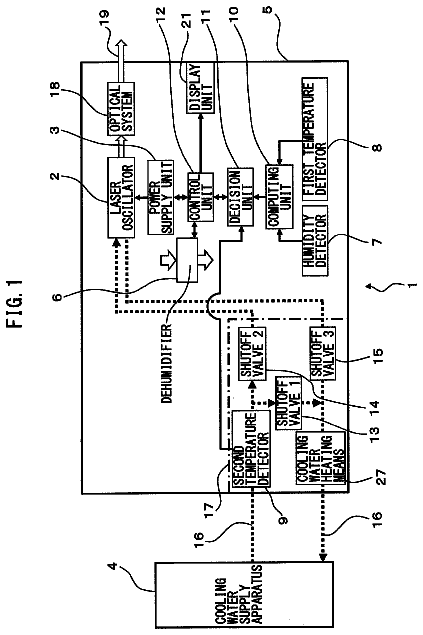
FIG. 1 is a schematic view showing the structure of a laser apparatus according to a first embodiment of the present invention;
FIG. 2 is a schematic view of an organizational example of data referenced upon a first calculation unit of the laser apparatus according to the first embodiment of the present invention calculating an acceleration factor;
FIG. 3 is a schematic view of an organizational example of data referenced upon a second calculation unit of the laser apparatus according to the first embodiment of the present invention calculating a whole lifetime;
FIG. 4 is a schematic view of an organizational example of data referenced upon a first calculation unit of the laser apparatus according to a second embodiment of the present invention calculating an acceleration factor;
The description continues in the full USPTO document.
 Lapsed, fee not paid3 drawings