Field of the invention
Embodiments of the present invention are generally related to gaming and more specifically to systems and processes that provide gambling events to a user for a gambling hybrid game.
Background of the invention
The gaming machine manufacturing industry provides a variety of gaming machines to enable wagering for interested parties whilst providing an entertainment experience. An exemplary gaming machine is a slot machine. As the demographic of eligible players has shifted with time to newer generations who have grown accustomed to highly sophisticated graphics and interactive video games, a need has arisen to increase the entertainment content present on a gaming machine to keep it relevant, at least to a growing portion of a casino's patronage. The subject design is a form of gaming machine, designed for use in a physical or virtual casino environment, which provides players an environment in which to play for cash, prizes and points, either against the casino or in head to head modes in a controlled and regulated manner while being allowed to use their skills and adeptness at a particular type of game. An example of such a game would be a challenging word spelling game, or an interactive action game such as is found on video game consoles popular today, such as a PlayStation®, an Xbox®, a Wii® or a PC.
Summary of the invention
Systems and methods in accordance with embodiments of the invention provide a gambling hybrid game system that provides delayed gambling based upon an accumulated trigger in an entertainment game. In accordance with embodiments of the invention, the gambling hybrid game system includes a controller constructed to execute the entertainment game and present the entertainment game to a player. The controller is constructed to maintain a record of an amount of an activating element accumulated during play of the entertainment game, and generate a status update regarding play of the entertainment game over a specific period where the status update includes information about the amount of the activating element accumulated over the specific period. The controller is further constructed to communicate, to a game world server, the status update regarding play of the entertainment game over the specific period where the status update includes information about the amount of the activating element accumulated over the specific period, receive, from the game world server, a result of a gambling event, and present the result of the gambling event to the player. In accordance with embodiments of the invention, the gambling hybrid game system includes a real world server constructed to receive, from the game world server, instructions to execute the gambling event based on the status update upon the amount of the activating element accumulated over the specific period, determine the result of the gambling event in a gambling game and to resolve a wager of credits on an outcome of the gambling event and communicate, to the game world server, the result of the gambling event. In accordance with embodiments of the invention, the gambling hybrid game system includes a game world server, connected to the controller via a controller and connected to the real world server via a communication link, where the game world server is constructed to manage the entertainment game executed by the controller and receive, from the controller, the status update about the entertainment game that includes the amount of the activating element accumulated over the specific period. The game world server is further constructed to determine a gambling event in the gambling game is to occur based upon the amount of the activating element accumulated over the specific period, communicate, to the real world server, instructions to execute the gambling event based on a determination of whether to execute the gambling event based upon the amount of the activating element accumulated over the specific period, receive, from the real world server, the result of the gambling event, and communicate, to the controller, the result of the gambling event.
In many embodiments, the game world server is constructed further to determine the amount of Quanta available to the player based on the result of the gambling event wherein Quanta is a currency that may be exchanged to change an entertainment game characteristic.
In various embodiments, the game world server is further constructed to provide the entertainment game characteristic that the player may change by expending a particular amount of the Quanta, receive a request from the player to change the entertainment game characteristic, deduct the particular amount of Quanta from the amount available to the player, and provide update information to the controller including the change in the game characteristic for use in the entertainment game.
In many embodiments, the game world server is constructed to determine a pay table for the gambling game based on a total accumulation of activating elements during game play and provide the pay table to the real world server for use in determining the results of the gambling event.
In various embodiments, the game world server is constructed to determine the amount of real world credit to be wagered on the gambling event in the gambling game based on an accumulation of activating elements during the specific period and provide the wager amount to the real world server.
In numerous embodiments, the game world server is further constructed to select one of plurality of gambling games to be used for the gambling event based upon the activating elements accumulated and indicate to the real world server that the selected gambling game is to be used for the gambling event.
In many embodiments, the communications link is the communications network.
Brief description of the drawings
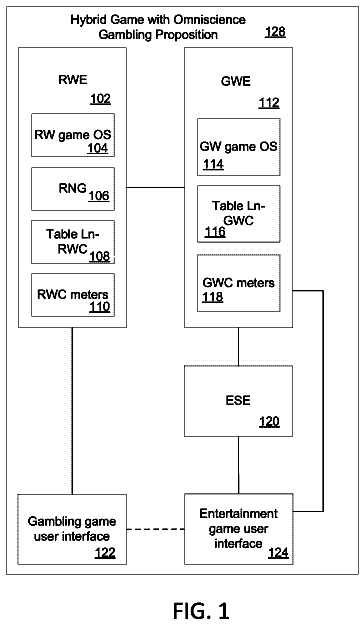
FIG. 1 illustrates a conceptual diagram of components of a gambling hybrid game in accordance with an embodiment of the invention.
FIG. 2 illustrates a conceptual diagram of aspects of a Real World Engine (RWE) of a gambling hybrid game in accordance with some embodiments of the invention.
FIG. 3 illustrates a conceptual diagram of aspects of a Real World Engine of a gambling hybrid game in accordance with some other embodiments of the invention.
FIG. 4 illustrates a signaling diagram of communications between a Real World Engine (RWE) and an external system to provide various functions in accordance with embodiments of the invention.
FIG. 5 illustrates a conceptual diagram of a process flow and signaling in a Real World Engine to provide various functions in accordance with embodiments of the invention.
FIG. 6 illustrates a conceptual diagram of aspects of an Entertainment System Engine in accordance with embodiments of the invention.
FIG. 7 illustrates a conceptual diagram of interactions between a user and a gambling hybrid game in accordance with embodiments of the invention.
FIG. 8 illustrates a conceptual diagram of the interplay between aspects of a gambling hybrid game in accordance with some embodiments of the invention using Real World Currency (RC).
FIG. 9 illustrates a conceptual diagram of illustrates the interplay between aspects of a gambling hybrid game in accordance with other embodiments of the invention using Virtual Real World Currency (VRC).
FIG. 10 illustrates a system diagram of an implementation of a network based gambling hybrid game in accordance with another embodiment of the invention.
FIG. 11 illustrates a system diagram of an implementation of an Internet based gambling hybrid game in accordance with an embodiment of the invention.
FIG. 12 illustrates a system diagram of an implementation of a cloud based gambling hybrid game in accordance with an embodiment of the invention.
FIG. 13 illustrates a block diagram of components of a device implementing a gambling hybrid game in accordance with an embodiment of the invention.
FIG. 14 illustrates a timing diagram of information passed between components of a gambling hybrid game that provides delayed gambling with an accumulated trigger in accordance with embodiments of the invention.
FIG. 15 illustrates a flow diagram of a process performed by an Entertainment System Engine to generate a gambling hybrid game that provides delayed gambling with an accumulated trigger in accordance with embodiments of the invention.
FIG. 16 illustrates a flow diagram of a process performed by a Game World Engine to generate a gambling hybrid game that provides delayed gambling with an accumulated trigger in accordance with embodiments of the invention.
FIG. 17 illustrates a flow diagram of a process performed by Real World Engine to generate a gambling hybrid game display that provides delayed gambling with an accumulated trigger in accordance with embodiments of the invention.
Detailed disclosure of the invention
Turning now to the drawings, systems and methods for providing a gambling hybrid game with an accumulated trigger and deferred gambling are disclosed. In many gambling hybrid games, an event in a provided entertainment game, such as but not limited to, the consumption of an Enabling Element (EE) or the occurrence of an Actionable Element (AE) immediately causes a gambling event in a gambling game to be initiated. Further, the result of the gambling event or events in the gambling game provides feedback to the entertainment game in some form including, but not limited to, the awarding of virtual credits or replenishment of an EE.
Gambling hybrid games in accordance with many embodiments of this invention involve a player collecting, scoring, or undertaking actions that lead to the accumulation of some activating element including, but not limited to, EEs, AEs, Common Enabling Elements (CEE), or the like while playing the entertainment game. At an appropriate point subsequent to the accumulation during play of the entertainment game, one or more gambling games are actuated as a function of the amount of the activating element accumulated and/or the amount of Real Credit (RC) committed to the gambling game by the player.
Gambling Hybrid Games
In accordance with many embodiments of this invention, a gambling hybrid game integrates high-levels of entertainment content with a game of skill (entertainment game) and a gambling experience with a game of chance (gambling game). A gambling hybrid game provides for random outcomes independent of player skill while providing that the user's gaming experience (as measured by obstacles/challenges encountered, time of play and other factors) is shaped by the player's skill. The outcome of a gambling proposition that is determined by a Random Number Generator (RNG) or other such device that provides a random outcome in response to a request. In accordance with some embodiments, the wager game may be initiated in response to a game object related player action. A gambling hybrid game in accordance with an embodiment of the invention is illustrated in FIG. 1 . The gambling hybrid game 128 includes a Real World Engine (RWE) 102 , a Game World Engine (GWE) 112 , an Entertainment System Engine (ESE) 120 , a gambling game user interface 122 and an entertainment game user interface 124 . The two user interfaces can be part of the same user interface but are separate in the illustrated embodiment. The RWE 102 is connected with the GWE 112 and the gambling game user interface 122 . The ESE 120 is connected with the GWE 112 and the entertainment game user interface 124 . The GWE 112 is connected also with the entertainment game user interface 124 .
In accordance with several embodiments, the RWE 102 is the operating system for the gambling game of the gambling hybrid game 128 and controls and operates the gambling game. The operation of a gambling game is enabled by Real World Currency (RC), such as money or other real world funds. A gambling game can increase or decrease an amount of RC based on random gambling outcomes, where the gambling proposition of a gambling game is typically regulated by gaming control bodies. In many embodiments, the RWE includes a Real World (RW) operating system (OS) 104 , RNG 106 , level n real-world credit pay tables (Table Ln-RC) 108 , RC meters 110 and other software constructs that enable a game of chance to offer a fair and transparent gambling proposition, and to contain the auditable systems and functions that can enable the game to obtain gaming regulatory body approval.
A random number generator (RNG) 106 includes software and/or hardware algorithms and/or processes, which are used to generate random outcomes. A level n real-world credit pay table (Table Ln-RC) 108 is a table that can be used in conjunction with a Random Number Generator (RNG) 106 to dictate the RC earned as a function of sponsored gameplay and is analogous to the pay tables used in a conventional slot machine. Table Ln-RC payouts are independent of player skill. There can be one table or multiple tables included in Ln-RC pay tables 108 contained in a gambling game, the selection of which can be determined by factors including (but not limited to) game progress that a player has earned, and/or bonus rounds for which a player can be eligible. RCs are credits analogous to slot machine game credits, which are entered into a gambling game by the user, either in the form of money such as hard currency or electronic funds. RCs can be decremented or augmented based on the outcome of a random number generator according to the table Ln-RC real world credits pay table 108 , independent of player skill. In certain embodiments, an amount of RC can be used as criteria in order to enter higher ESE game levels. RC can be carried forward to higher game levels or paid out if a cash out is opted for by a player. The amount of RC used to enter a specific level of the game level n need not be the same for each level.
In accordance with some embodiments of this invention, the GWE 112 manages the overall gambling hybrid game operation, with the RWE 102 and the ESE 120 effectively being support units to the GWE 112 . In accordance with some of these embodiments, the GWE 112 contains mechanical, electronic, and software systems for an entertainment game. The GWE 112 includes an Operating System (OS) 114 that provides control of the entertainment game. The GWE additionally contains a level n game world credit pay table (table Ln-GWC) 116 from where to take input from this table to affect the play of the entertainment game. The GWE 112 can further couple to the RWE 102 to determine the amount of RC available on the game and other metrics of wagering on the gambling game (and potentially affect the amount of RC in play on the RWE). The GWE additionally contains various audit logs and activity meters (such as the GWC meter) 118 . The GWE 112 can also couple to a centralized server for exchanging various data related to the player and their activities on the game. The GWE 112 furthermore couples to the ESE 120 .
In accordance with some embodiments, a level n game world credit pay table (Table Ln-GWC) 116 dictates the Game World Credit (GWC) earned as a function of player skill in the nth level of the game. The payouts governed by this table are dependent upon player skill and sponsored gameplay at large and can or cannot be coupled to a RNG. In accordance with some embodiments, GWCs are player points earned or depleted as a function of player skill, specifically as a function of player performance in the context of the game. GWC is analogous to the score in a typical video game. Each entertainment game has one or more scoring criterion, embedded within the table Ln-GWC 116 that reflects player performance against the goal(s) of the game. GWCs can be carried forward from one level of sponsored gameplay to another, and ultimately paid out in various manners such as directly in cash, or indirectly such as by earning entrance into a sweepstakes drawing, or earning participation in, or victory in, a tournament with prizes. GWCs can be stored on a player tracking card or in a network-based player tracking system, where the GWCs are attributed to a specific player.
In accordance with certain embodiments, the operation of the GWE does not affect the RWE's gambling operation except for player choice parameters that are allowable in slot machines, including but not limited to, wager terms such as, but not limited to, a wager amount, how fast the player wants to play (by pressing a button or pulling the handle of a slot machine), and/or agreement to wager into a bonus round. In this sense, the RWE 102 provides a fair and transparent, non-skill based gambling proposition co-processor to the GWE 112 . In the illustrated embodiment, the communication link shown between the GWE 112 and the RWE 102 allows the GWE 112 to obtain information from the RWE 102 as to the amount of RC available in the gambling game. The communication link can also convey a status operation of the RWE (such as on-line or tilt). The communication link can further communicate the various gambling control factors which the RWE 102 uses as input, such as the number of RC consumed per game or the player's election to enter a jackpot round. In FIG. 1 , the GWE 112 is also shown as connecting to the player's user interface directly, as this can be utilized to communicate certain entertainment game club points, player status, control the selection of choices and messages which a player can find useful in order to adjust the entertainment game experience or understand their gambling status in the RWE 102 .
In accordance with various embodiments of this invention, the ESE 120 manages and controls the visual, audio, and player control for the entertainment game. In accordance with certain embodiments, the ESE 120 accepts input from a player through a set of hand controls, and/or head, gesture, and/or eye tracking systems and outputs video, audio and/or other sensory output to a user interface. In accordance with many embodiments, the ESE 120 can exchange data with and accept control information from the GWE 112 . In accordance with some of these embodiments, an ESE 120 can be implemented using a Personal Computer (PC), a Sony PlayStation® (a video game console developed by Sony Computer Entertainment of Tokyo Japan), or Microsoft Xbox® (a video game console developed by Microsoft Corporation of Redmond, Wash.) running a specific entertainment game software program. In accordance with some of these embodiments, ESE 120 can be an electromechanical game system of a draw certificate based gambling hybrid game that is an electromechanical hybrid game. An electromechanical hybrid game executes an electromechanical game for player entertainment. The electromechanical game can be any game that utilizes both mechanical and electrical components, where the game operates as a combination of mechanical motions performed by at least one player or the electromechanical game itself. Various electromechanical hybrid games are discussed in Patent Cooperation Treaty Application No. PCT/US12/58156, filed Sep. 29, 2012, the contents of which are hereby incorporated by reference in their entirety.
The ESE 120 operates mostly independently from the GWE 112 , except that via the interface, the GWE 112 can send certain entertainment game control parameters and elements to the ESE 120 to affect its play, such as (but not limited to) what level of character to be using, changing the difficulty level of the game, changing the type of gun or car in use, and/or requesting potions to become available or to be found by the character. These game control parameters and elements can be based on a gambling outcome of a gambling game that was triggered by an element in the entertainment game being acted upon by the player. The ESE 120 can accept this input from the GWE 112 , make adjustments, and continue entertainment game gameplay all the while running seamlessly from the player's perspective. The ESE's operation is mostly skill based, except for where the ESE's processes can inject complexities into the game by chance in its normal operation to create unpredictability in the entertainment game. Utilizing this interface, the ESE 120 can also communicate player choices made in the game to the GWE 112 , such as but not limited to selection of a different gun, and/or the player picking up a special potion in the GW environment. The GWE's function in this architecture, being interfaced with the ESE 120 , is to allow the transparent coupling of entertainment software to a fair and transparent random chance gambling game, providing a seamless perspective to the player that they are playing a typical popular entertainment game (which is skill based). In accordance with certain embodiments, the ESE 120 can be used to enable a wide range of entertainment games including but not limited to popular titles from arcade and home video games, such as but not limited to Gears of War (a third person shooter game developed by Epic Games of Cary, N.C.), Time Crisis (a shooter arcade game developed by Namco Ltd of Tokyo, Japan), or Madden Football (an American football video game developed by EA Tiburon of Maitland, Fla.). Providers of such software can provide the previously described interface by which the GWE 120 can request amendments to the operation of the ESE software in order to provide seamless and sensible operation as both a gambling game and an entertainment game.
In accordance with some embodiments, the RWE 102 can accept a trigger to run a gambling game in response to actions taken by the player in the entertainment game as conveyed by the ESE 120 to the GWE 112 , or as triggered by the GWE 112 based on its algorithms, background to the overall game from the player's perspective, but can provide information to the GWE 112 to expose the player to certain aspects of the gambling game, such as (but not limited to) odds, amount of RC in play, and amount of RC available. The RWE 102 can accept modifications in the amount of RC wagered on each individual gambling try, or the number of gambling games per minute the RWE 102 can execute, entrance into a bonus round, and other factors, all the while these factors can take a different form than that of a typical slot machine. An example of a varying wager amount that the player can choose can include, but is not limited to, gameplay with a more powerful character, a more powerful gun, or a better car. These choices can increase or decrease the amount wagered per individual gambling game, in the same manner that a standard slot machine player can decide to wager more or less credits for each pull of the handle. In accordance with some of these embodiments, the RWE 102 can communicate a number of factors back and forth to the GWE 112 , via an interface, such increase/decrease in wager being a function of the player's decision making as to their operational profile in the entertainment game (such as but not limited to the power of the character, gun selection or car choice). In this manner, the player is always in control of the per game wager amount, with the choice mapping to some parameter or component that is applicable to the entertainment game experience of the hybrid game. In accordance with a particular embodiment, the RWE 102 operation can be a game of chance as a gambling game running every 10 seconds where the amount wagered is communicated from the GWE 112 as a function of choices the player makes in the operation profile in the entertainment game.
In many embodiments, a gambling hybrid game integrates a video game style gambling machine, where the gambling game (including an RWE 102 and RC) is not player skill based, while at the same time allows players to use their skills to earn club points which a casino operator can translate to rewards, tournament opportunities and prizes for the players. The actual exchange of monetary funds earned or lost directly from gambling against a game of chance in a gambling game, such as a slot machine, is preserved. At the same time, a rich environment of rewards to stimulate gamers can be established with the entertainment game. In accordance with some of these embodiments, the gambling hybrid game can leverage very popular titles with gamers and provides a sea change environment for casinos to attract players with games that are more akin to the type of entertainment that a younger generation desires. In accordance with various embodiments, players can use their skill towards building and banking Game World Credit (GWC) that in turn can be used to win tournaments and various prizes as a function of their gamer prowess. Numerous embodiments minimize the underlying changes needed to the aforementioned entertainment software for the hybrid game to operate within an entertainment game construct, thus making a plethora of complex game titles and environments, rapid and inexpensive to deploy in a gambling environment.
In accordance with some embodiments, gambling hybrid games also allow players to gain entry into subsequent competitions through the accumulation of Game World Credits (GWC) as a function of the user's demonstrated skill at the game. These competitions can pit individual players or groups of players against one another and/or against the casino to win prizes based upon a combination of chance and skill. These competitions can be either asynchronous events, whereby players participate at a time and/or place of their choosing, or they can be synchronized events, whereby players participate at a specific time and/or venue.
In accordance with some embodiments, one or more players engage in playing an entertainment game, resident in the ESE, the outcomes of which are dependent at least in part on skill. The gambling hybrid game can include an entertainment game that includes head to head play between a single player and the computer, between two or more players against one another, or multiple players playing against the computer and/or each other, as well as the process by which players bet on the outcome of the entertainment game. The entertainment game can also be a game where the player is not playing against the computer or any other player, such as in games where the player is effectively playing against himself or herself (such as but not limited to Solitaire and Babette).
The components provided by the RWE for a gambling hybrid game in accordance with embodiments of the invention are shown in FIG. 2 . In accordance with embodiments of the invention, the RWE includes an internal bus 225 that connects an operating system OS 221 , a Random Number Generator (“RNG”) 220 , one or more pay tables (Table Ln-RC) 223 which would control the functions of the RWE, a Random Number Generator (“RNG”) 220 to produce random numbers, one or more pay tables (Table Ln-RC) 223 , a wagering control module 222 , an authorization access module 224 , and a RC credit meter 226 that are included in the RWE 204 . The RW OS 221 controls the functions of the RWE. The RNG 220 includes one or more RNGs that are used to produce random numbers for use in resolving gambling events and other process requiring a random number to determine an outcome. The one or more pay tables (Table Ln-RC) 223 contain a plurality of factors indexed by the random number to be multiplied with the RC wagered to determine the payout on a successful wager. A wagering control module 222 performs the processes to resolve a wager on a proposition of a gambling event. The resolution process includes, but is not limited to, pulling random numbers, looking up factors in Pay Tables, multiplying the factors by the amount of RC wagered, and administering a RC credit meter 226 . A repository (a credit meter) 926 maintains a record of the amount of RC which player has deposited in the game and has been accumulated by the player.
An external connection allows the RWE 204 to interface to another system or device, which is shown in FIG. 2 as the internet 205 but may be any other network and/or device. The authorization access module 224 of RWE 204 is connected to the external connection and provides a method to permit access and command exchange between an external system and the RWE 204 . The RWE 204 also contains storage for statuses, wagers, wager outcomes, meters and other historical events in a storage device 116 .
In some embodiments, the RWE communicates with external systems to provide various functions of a gambling hybrid game in accordance with embodiments of the invention. The components of an RWE that communicate with an external system to provide a component of the RWE in accordance with embodiments of the invention are shown in FIG. 3 . The RWE 204 shown in FIG. 3 is similar to the RWE shown in FIG. 2 . However, the RNG 220 which is an external system connected to the RWE 204 by the internet 905 in accordance with embodiments of the invention. The RNG 220 could be a central deterministic system, such as a regulated and controlled random numbered ball selection device, or some other system which provides random or pseudo random numbers to one or a plurality of connected RWEs 204 . One skilled in the art will recognize that only RNG 220 is an external system in the shown embodiments. However, any of the components could be external systems without departing from the invention and RNG 220 is shown as an example only.
In FIGS. 2 and 3 , the RWE 204 interfaces with other systems/devices or to an external RNG 220 using the Internet 205 . However, one skilled in the art will note that nothing would preclude using a different interface than the internet 205 in other embodiments of the invention. Other examples of interfaces include, but are not limited to, a LAN, a USB interface, or some other method by which two electronic and software constructs could communicate with each other.
The RWE and an external system typically communicate to provide the resolution of gambling events to resolve wagers on the events. The signals between the RWE and an external system to provide some process related to resolving gambling events in accordance with embodiments of the invention are shown in FIG. 4 . In accordance with embodiments of the invention, the primary function of the RWE 204 is to manage wagering events and to provide random (or pseudo random) numbers from an RNG. At the top of the figure, a 6 component communication exchange grouped by the “1” box is shown for a wager on a proposition in a gambling event during a gambling hybrid game in accordance with embodiments of the invention. An external system 450 that is requesting wagering support from the RWE 204 instructs the RWE 204 as to the pay table (Table Ln-RC) to use ( 410 ), followed by the amount of RC to wager on the proposition of the gambling event ( 412 ). Next, the external system 450 signals the RWE to trigger a wager or perform the gambling event ( 414 ). The RWE 204 resolves the gambling event. The RWE 204 then informs external system 450 as to the outcome of the wager ( 416 ), the amount of RC won ( 418 ), and the amount of RC in the player's account (in the credit repository) ( 420 ).
A second communication exchange between the RWE 204 and an external system 450 in accordance with embodiments of the invention that is shown in FIG. 4 is grouped by the “2” box in FIG. 4 and relates to the external system 450 needing an RNG result support from the RWE 204 . In this exchange, the external system 450 requests an RNG result from the RWE 204 ( 430 ). The RWE 204 returns an RNG result to the external 450 in response to the request ( 432 ). The result may be generated as a function of the internal RNG in the RWE 204 , or from an RNG external to the RWE 204 to which the RWE 204 is connected.
A third communication exchange between the RWE 204 and the external system 405 in accordance with embodiments of the invention that is shown in FIG. 4 is grouped by the “3” box in the figure and relates to the external system 450 wanting support on coupling an RNG result to a particular Pay Table contained in the RWE 204 . In this exchange, the external system 450 instructs the RWE as to the pay table (Table Ln-RC) to use 450 ( 440 ). The external system then requests a result whereby the RNG result is coupled to the requested Pay Table ( 442 ). The result is returned to the external system 405 by RWE 204 ( 444 ). Such an aspect is different from the first exchange shown by the box “1” sequence in that no actual RC wager is conducted. However, such a process might be useful in coupling certain non-RC wagering entertainment game behaviors and propositions to the same final resultant wagering return which is understood for the gambling hybrid game to conduct wagering.
In regards to FIG. 4 , one skilled in the art will note that the thrust of the FIG. 4 is to convey overall functional exchanges between an RWE 204 and an external system 450 . As such, various protocol layers necessary for error free and secure communication, and other status, setup, and configuration commands which one might expect in any protocol between two connected systems have been omitted for clarity. Furthermore, some or all of the various commands and responses illustrated could be combined into one or more communication packets without departing from the invention.
The process flow for functional communication exchanges, such as communication exchanges described above with reference to FIG. 4 , between a RWE and an external system in accordance with embodiments of the invention are shown in FIG. 5 . The process begins by a RWE 204 receiving signals from an external system requesting a connection to RWE 204 ( 502 ). The Access Authorization Module determines that the external system authorized to connect to RWE 204 ( 504 ) and transmits an authorization response to the external system. The external systems that made the request to connect then signals a request for a gambling event is to be performed to RWE 294 ( 506 ). The request may include an indication of a wager amount on a proposition in the gambling event, and a proper pay table to use to resolve the wager. The external system then sends a signal to trigger the gambling event ( 508 ).
The OS 221 instructs the Wager Control Module 222 as to the RC wager and the Pay Table to select as well as to resolve the wager execute ( 510 ). In response to the request to execute the gambling event, the wager control module 222 requests an RNG result from the RNG 220 ( 512 ); retrieves a proper pay table or tables from the pay tables 223 ( 514 ); adjusts the RC of the player in the RC repository 226 as instructed ( 516 ); applies the RNG result to the particular pay table or tables ( 518 ); and multiplies the resultant factor from the Pay Table by the amount of RC to determine the result of the wager ( 518 ). Wager Control Module 222 then adds the amount of RC won by the wager to the RC repository 426 ( 520 ); and provides he outcome of the wager, and the amount of RC in the RWE and the RC won ( 522 ). One skilled in the art will recognize that there may be many embodiments of an RWE 204 which could be possible, including forms where many modules and components of the RWE are located in various servers and locations, so the foregoing is not meant to be exhaustive or all inclusive, but rather provide information about an RWE 204 in accordance with some embodiments of the invention.
A block diagram of components an ESE being provided by an ESE host for a gambling hybrid game in accordance with embodiments of the invention are shown in FIG. 6 . An ESE 610 may be part of the entertainment game itself, may be a software module that is executed by the entertainment game, or may provide an execution environment for the entertainment game for a particular host. The ESE 610 and associated entertainment game are hosted by an ESE host 600 . The ESE host 600 is a computing device that is capable of hosting the ESE 610 and the entertainment game. Exemplary hosts include video game consoles, smart phones, personal computers, tablet computers, or the like. The entertainment game includes a game engine 612 that generates a player interface 605 for interaction with by a player. The player interface includes a player presentation 635 that is presented to a player through the player interface. The player presentation 635 may be audio, visual or tactile, or any combination of such. The player interface 635 further includes one or more Human Input Devices (HIDs) 630 that the player uses to interact with the entertainment game. Various components or sub-engines of the game engine read data from a game state in order to implement the features of the game. Components of the game engine include a physics engine 640 used to simulate physical interactions between virtual objects in the game state, a rules engine 645 for implementing the rules of the game, an RNG that may be used for influencing or determining certain variables and/or outcomes to provide a randomizing influence on game play, a graphics engine 650 used to generate a visual representation of the game state to the player, an audio engine to generate audio outputs for the player interface, and any other engine needed to provide the entertainment game. The game engine 612 reads and writes game resources 615 stored on a data store of the ESE host. The game resources 615 include game objects 655 having graphics and/or control logic used to implement game world objects of the game engine. The game resources 615 also include video files 675 that are used to generate cut-scenes for the entertainment game. The game resources 615 may also include audio files 660 used to generate music, sound effects, etc. within the entertainment game. The game resources 615 may also include configuration files 670 used to configure the features of the entertainment game. The game resources 615 may also include scripts 665 or other types of control code used to implement various game play features of the entertainment game. The game resources 615 may also include graphics resources 680 including, but not limited to, textures, and objects that are used by the game engine to render objects displayed in the entertainment game.
In operation, components of the game engine 612 read portions of the game state 625 and generate the player presentation for the player which is presented to the player using the player interface 605 . The player perceives the presentation 635 and provides player inputs using the HIDs 630 . The corresponding player inputs are received as player actions or inputs by various components of the game engine 612 . The game engine translates the player actions into interactions with the virtual objects of the game world stored in the game state 625 . Components of the game engine 612 use the player interactions with the virtual objects of the game and the game state 625 to update the game state 625 and update the presentation 635 presented to the user. The process loops in a game loop continuously while the player plays the game.
In some embodiments, the ESE is a host running a browser that communicates with a server serving documents in a markup language, such as Hypertext Markup Language 5 (HTML 5) or the like, and the functions of the game engine are performed by the browser on the basis of the markup language found in the documents. In some embodiments, the ESE is a host hosting a specialized software platform, such as Adobe Flash or the like, used to implement games or other types of multimedia presentations, and the functions of the game engine are performed by the specialized platform.
The description continues in the full USPTO document.
 Lapsed, fee not paid25 drawings