Cross-reference to related applications
This application is based on and claims priority under 35 USC 119 from Japanese Patent Application No. 2016-062253 filed Mar. 25, 2016. BACKGROUND Technical Field
The present invention relates to a dispersant for liquid development, a liquid developer, a liquid developer cartridge, an image forming apparatus, and an image forming method.
Summary
According to an aspect of the invention, there is provided a dispersant for liquid development represented by general formula
below:
##str00003##
In general formula (1), R.sup.1 represents a monovalent organic group having a polar group, A.sup.1 and A.sup.2 each independently represent an oxygen atom or a sulfur atom, L.sup.1 and L.sup.2 each independently represent a divalent organic linking group, X represents a (m+n)-valent organic linking group having an alkyleneoxy group, P.sup.1 represents a polymer chain that contains a unit represented by general formula
below, m represents a number of 1 or more and 9 or less, n represents a number of 1 or more and 9 or less, and m+n is an integer of 2 or more and 10 or less:
##str00004##
In general formula (2), R.sup.2 and R.sup.3 each independently represent a hydrogen atom or a methyl group, L.sup.3 represents a carbonyloxy group, an oxycarbonyl group, a carbonyl group, an ether bond, or a phenylene group, and R.sup.4 represents a monovalent organic group that has at least one selected from a carboxy group and a salt thereof, a polyoxyalkylene group, an amino group, a sulfo group and a salt thereof, and derivatives of the foregoing.
Brief description of the drawings
Exemplary embodiments of the present invention will be described in detail based on the following figures, wherein:
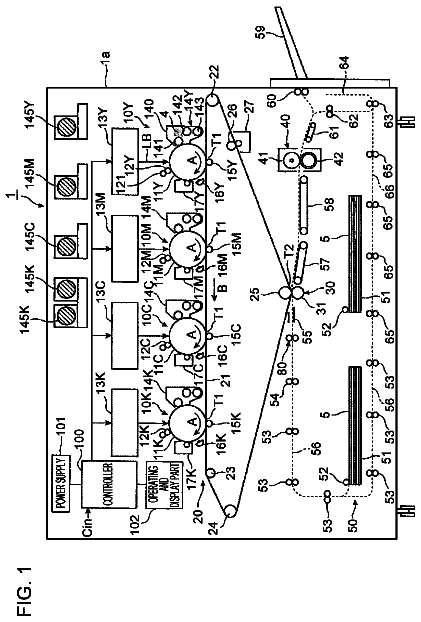
FIG. 1 is a schematic diagram illustrating one example of an image forming apparatus of an exemplary embodiment; and
FIG. 2 is a schematic diagram illustrating another example of an image forming apparatus of an exemplary embodiment.
Detailed description
Exemplary embodiments, which are illustrative examples of the present invention, will now be described.
Dispersant for Liquid Development
The dispersant for liquid development according to an exemplary embodiment (hereinafter may be simply referred to as a dispersant) is a dispersant represented by general formula
below:
##str00005##
In general formula (1), R.sup.1 represents a monovalent organic group having a polar group, A.sup.1 and A.sup.2 each independently represent an oxygen atom or a sulfur atom, L.sup.1 and L.sup.2 each independently represent a divalent organic linking group, X represents an (m+n)-valent organic linking group having an alkyleneoxy group, P.sup.1 represents a polymer chain that contains a unit represented by general formula
below, m represents a number of 1 or more and 9 or less, n represents a number of 1 or more and 9 or less, and m+n is an integer of 2 or more and 10 or less.
##str00006##
In general formula (2), R.sup.2 and R.sup.3 each independently represent a hydrogen atom or a methyl group, L.sup.3 represents a carbonyloxy group, an oxycarbonyl group, a carbonyl group, an ether bond, or a phenylene group, R.sup.4 represents a monovalent organic group that has at least one selected from a carboxy group and a salt thereof, a polyoxyalkylene group, an amino group, a sulfo group and a salt thereof, and derivatives of the foregoing.
When the dispersant having the features described above is used in a liquid developer, a liquid developer that enhances adhesion of a fixed image to a resin recording medium is obtained. The reason for this is not clear but is presumed to be as follows.
That is, the polar group contained in the organic group represented by R.sup.1 in general formula
is presumed to have high affinity to toner particles and the terminal group of a side chain of the polymer chain represented by P.sup.1 (that is, “at least one selected from a carboxy group and a salt thereof, a polyoxyalkylene group, an amino group, a sulfo group and a salt thereof, and derivatives of the foregoing” contained in the organic group represented by R.sup.4 in general formula (2)) is presumed to have high affinity to the resin that constitutes the recording medium. In other words, the dispersant according to this exemplary embodiment contains both a group that has high affinity to toner particles and a group that has high affinity to the resin that constitutes the recording medium. Thus, presumably, high adhesion between the fixed image and the recording medium is obtained even when the dispersant comes between the fixed image and the recording medium.
The at least one group “selected from a carboxy group and a salt thereof, a polyoxyalkylene group, an amino group, a sulfo group and a salt thereof, and derivatives of the foregoing” contained in the organic group represented by R.sup.4 in general formula
may be simply referred to as an “adhesive functional group”.
A dispersant according to an exemplary embodiment will now be described.
The organic group represented by R.sup.1 in general formula
is a monovalent organic group having a polar group. When m in general formula
is 2 or more, m R.sup.1 groups may be the same or different, and, from the viewpoint of ease of synthesis, may represent the same group.
The number of polar groups contained in the organic group represented by R.sup.1 in general formula
is not particularly limited and may be 1 or more than 1. When 2 or more polar groups are contained in the organic group represented by R.sup.1 in general formula (1), the two or more polar groups may be the same or different.
The number of polar groups contained in the organic group represented by R.sup.1 in general formula
is, for example, 1 or more and 7 or less, 2 or more and 7 or less, or 2 or more and 4 or less.
The total number of polar groups contained in m organic groups represented by R.sup.1 in general formula
(hereinafter this number may be referred to as the “total number of polar groups of m R.sup.1 groups”) may be 2 or more from the viewpoint of affinity to toner particles.
The “total number of polar groups of m R.sup.1 group” is expressed by m×total number of polar groups contained in one R.sup.1 group. Specifically, when one organic group represented by R.sup.1 in general formula
contains 2 polar groups and m represents 3.5, the “total number of polar groups of m R.sup.1 group” is 7.
For example, the “total number of polar groups of m R.sup.1 group” is 2 or more and 20 or less, and may be 4 or more and 15 or less or 6 or more and 8 or less from the viewpoint of affinity to the toner particles.
When the “total number of polar groups of m R.sup.1 group” is 2 or more, the two or more polar groups contained in all m organic groups represented by R.sup.1 may be the same group or different groups.
The polar group contained in the organic group represented by R.sup.1 in general formula
may be an acidic polar group, a neutral polar group, or a basic polar group.
Examples of the acidic polar group include acid radicals such as a carboxy group, a carboxylate group, a sulfo group, a sulfonate group, a phosphoric acid group, a phosphate group, a formyl group, and a phenol group (phenolic hydroxyl group).
Examples of the neutral polar groups include neutral groups such as a hydroxy group, an amide group, and a cyano group.
Examples of the basic polar group include basic groups such as an amino group, an imino group, and a quaternary ammonium group.
From the viewpoint of affinity to the toner particles, the polar group may be an acidic polar group, in particular, a carboxy group.
Examples of the organic group represented by R.sup.1 in general formula
include groups represented by general formulae (R1-1) to (R1-3) below: F.sup.R11-L.sup.R11-* General formula (R1-1)
In general formula (R1-1), F.sup.R11 represents a polar group, L.sup.R11 represents a divalent organic linking group, and * indicates the position at which the group is bonded to A.sup.1 in general formula (1).
##str00007##
In general formula (R1-2), F.sup.R12 and F.sup.R13 each independently represent a polar group, L.sup.R12 represents a trivalent organic linking group having 2 or more carbon atoms, and * indicates the position at which the group is bonded to A.sup.1 in general formula (1).
##str00008##
In general formula (R1-3), F.sup.R14, F.sup.R15, and F.sup.R16 each independently represent a polar group, L.sup.R13 represents a tetravalent organic linking group having 3 or more carbon atoms, and * indicates the position at which the group is bonded to A.sup.1 in general formula (1).
Specific examples of the polar group represented by F.sup.R11, F.sup.R12, or F.sup.R13 in general formula (R1-1), (R1-2), or (R1-3) are as described above.
The polar group represented by F.sup.R11 in general formula (R1-1) is directly bonded to a carbon atom of the organic linking group represented by L.sup.R11.
The polar groups represented by F.sup.R12 and F.sup.R13 in general formula (R1-2) are directly bonded to different carbon atoms among the carbon atoms of the organic linking group represented by L.sup.R12.
The polar groups represented by F.sup.R14, F.sup.R15, and F.sup.R16 in general formula (R1-3) are also directly bonded to different carbon atoms among the carbon atoms of the organic linking group represented by L.sup.R13.
Examples of the divalent organic linking group represented by L.sup.R11 in general formula (R1-1) include a straight alkylene group, a branched alkylene group, a cycloalkylene group having 3 to 10 carbon atoms, an arylene group having 6 to 10 carbon atoms, a hydrocarbon group containing a combination of any of these groups, and a hydrocarbon group containing a combination of any of these groups with some of carbon atoms being substituted with non-carbon atoms.
Examples of the non-carbon atoms that substitute the carbon atoms of the hydrocarbon group include an oxygen atom, a sulfur atom, and a nitrogen atom. The hydrocarbon group with some of carbon atoms being substituted with non-carbon atoms may be, for example, a hydrocarbon group in which “—CH.sub.2—” is substituted with “—O—”, “—S—”, or “—NH—” or a hydrocarbon group in which “—CH<” is substituted with “—N<”. The carbon atoms to be substituted by the non-carbon atoms are carbon atoms other than the carbon atom to which the polar group represented by F.sup.R11 is directly bonded. The number of carbon atoms substituted with the non-carbon atoms may be 1 or more than 1. For example, two or more carbon atoms may be substituted with atoms of the same element or with atoms of different elements.
When the divalent organic linking group represented by L.sup.R11 is the hydrocarbon group described above, the total number of carbon atoms in the hydrocarbon group is, for example, 1 or more and 20 or less, 1 or more and 10 or less, or 1 or more and 6 or less. When the divalent organic linking group represented by L.sup.R11 is a hydrocarbon group having some of carbon atoms being substituted with non-carbon atoms, the number of carbon atoms is at least 1, and the total number of carbon atoms and the non-carbon atoms substituting the carbon atoms may be 2 or more and 20 or less, 2 or more and 10 or less, or 2 or more and 6 or less.
Examples of L.sup.R11 include hydrocarbon groups in which no carbon atoms are substituted with non-carbon atoms. Among these, straight or branched alkylene groups having 1 to 10 carbon atoms are preferable and straight alkylene groups having 1 to 6 carbon atoms are more preferable.
Specific examples of the divalent organic linking group represented by L.sup.R12 in general formula (R1-2) include divalent organic linking groups having 2 or more carbon atoms selected from among the above-described specific examples of the divalent organic linking group represented by L.sup.R11 in general formula (R1-1).
Examples of L.sup.R12 include hydrocarbon groups having 2 or more carbon atoms in which no carbon atoms are substituted with non-carbon atoms. Among these, straight or branched alkylene groups having 2 to 20 carbon atoms are preferable, straight alkylene groups having 2 to 10 carbon atoms are more preferable, and straight alkylene groups having 2 to 6 carbon atoms are yet more preferable.
Specific examples of the divalent organic linking group represented by L.sup.R13 in general formula (R1-3) include divalent organic linking groups having 3 or more carbon atoms selected from among the above-described specific examples of the divalent organic linking groups represented by L.sup.R11 in general formula (R1-1).
Examples of L.sup.R13 include hydrocarbon groups having 3 or more carbon atoms in which no carbon atoms are substituted with non-carbon atoms. Among these, straight or branched alkylene groups having 3 to 20 carbon atoms are preferable, straight alkylene group having 3 to 10 carbon atoms are more preferable, and straight alkylene groups having 3 to 6 carbon atoms are yet more preferable.
Examples of the group represented by general formula (R1-1) include groups in which the polar group represented by F.sup.R11 is a carboxy group and the organic linking group represented by L.sup.R11 is a straight alkylene group having 1 to 6 carbon atoms.
Examples of the group represented by general formula (R1-2) include groups in which the polar group represented by F.sup.R12 and the polar group represented by F.sup.R13 are both a carboxy group and the organic linking group represented by L.sup.R12 is a straight alkylene group having 2 to 6 carbon atoms.
Examples of the group represented by general formula (R1-3) include groups in which the polar group represented by F.sup.R14 the polar group represented by F.sup.R15, and the polar group represented by F.sup.R16 are all a carboxy group and the organic linking group represented by L.sup.R13 is a straight alkylene group having 3 to 6 carbon atoms.
Specific examples (example organic groups of R.sup.1) of the group represented by general formula (R1-1), the group represented by general formula (R1-2), and the group represented by general formula (R1-3) are described below. These examples are not limiting. In the description of the specific examples (example organic groups of R.sup.1) below, “*” indicates the position at which the group is bonded to A.sup.1 in general formula (1).
##str00009## ##str00010## ##str00011##
In general formula (1), A.sup.1 and A.sup.2 each independently represent an oxygen atom or a sulfur atom.
In general formula (1), m A.sup.1 atoms and n A.sup.2 atoms may be the same atoms or may contain different atoms. From the viewpoint of ease of synthesis, all of m A.sup.1 atoms and n A.sup.2 atoms may be the same atoms. From the viewpoints of availability of the raw material and ease of synthesis, all of m A.sup.1 and n A.sup.2 atoms may be sulfur atoms.
Examples of the divalent organic linking group represented by L.sup.1 in general formula
and the divalent organic linking group represented by L.sup.2 in general formula
include a straight alkylene group, a branched alkylene group, a cycloalkylene group having 3 to 10 carbon atoms, an arylene group having 6 to 10 carbon atoms, a hydrocarbon group containing a combination of any of these groups, and a hydrocarbon groups containing a combination of any of these groups with some of carbon atoms being substituted with non-carbon atoms.
Examples of the non-carbon atoms substituting the carbon atoms of the hydrocarbon group include an oxygen atom, a sulfur atom, and a nitrogen atom. The hydrocarbon group in which some of carbon atoms are substituted with non-carbon atoms may be a hydrocarbon group in which “—CH.sub.2—” is substituted with “—O—”, “—S—”, or “—NH—” or in which “—CH<” is substituted with “—N<”. The organic linking group represented by L.sup.1 and the organic linking group represented by L.sup.2 each have at least one carbon atom. The number of carbon atoms substituted with non-carbon atoms may be 1 or more than 1, and two or more carbon atoms may be substituted with atoms of the same element or different elements.
When the divalent organic linking group represented by L.sup.1 is the hydrocarbon group described above, the total number of carbon atoms in the hydrocarbon group is, for example, 1 or more and 20 or less, 1 or more and 10 or less, or 1 or more and 6 or less.
When the divalent organic linking group represented by L.sup.1 is a hydrocarbon group in which some of carbon atoms are substituted with non-carbon atoms, the number of carbon atoms is at least one and the total number of carbon atoms and the non-carbon atoms substituting the carbon atoms may be 2 or more and 20, 2 or more and 10 or less, or 2 or more and 6 or less.
The total number of carbon atoms and non-carbon atoms substituting the carbon atoms in the divalent organic linking group represented by L.sup.2 is the same as that for L.sup.1 described above.
Examples of L.sup.1 include a hydrocarbon group in which no carbon atoms are substituted with non-carbon atoms and a hydrocarbon group in which “—CH.sub.2—” is substituted with “—NH—”. L.sup.1 may be a straight or branched alkylene group having 1 to 20 carbon atoms or a straight or branched alkylene groups having 1 to 20 carbon atoms in which “—CH.sub.2—” directly bonded to the carbonyl group in general formula
among the carbon atoms in the alkylene group is substituted with “—O—” or “—NH—”. A straight alkylene group having 1 to 10 carbon atoms is more preferable.
Examples of L.sup.2 include a hydrocarbon group in which no carbon atoms are substituted with non-carbon atoms and a hydrocarbon group in which “—CH.sub.2—” is substituted with “—NH—”. L.sup.2 may be a straight or branched alkylene group having 1 to 20 carbon atoms or a straight or branched alkylene group having 1 to 20 atoms in which “—CH.sub.2—” directly bonded to the carbonyl group in general formula
among carbon atoms in the alkylene group is substituted with “—O—” or “—NH—”. A straight alkylene group having 1 to 10 carbon atoms is more preferable.
In general formula (1), m L.sup.1 and n L.sup.2 groups may be the same groups or may contain different groups. From the viewpoint of ease of synthesis, m L.sup.1 and n L.sup.2 groups may be the same groups.
In general formula (1), m indicates the average of the number of the “R.sup.1-A.sup.1-L.sup.1-CO—” groups bonded to one m+n-valent organic linking group represented by X. In the case of an equal mixture of molecules in which two “R.sup.1-A.sup.1-L.sup.1-CO—” groups are bonded to one organic linking group represented by X and molecules in which three “R.sup.1-A.sup.1-L.sup.1-CO—” groups are bonded to one organic linking group represented by X, m is 2.5. While m may be an integer or a decimal number, m may be a number 1 or more and 9 or less, 2 or more and 7 or less, or 3 or more and 5 or less.
In general formula (1), n indicates the average of the number of “P.sup.1-A.sup.2-L.sup.2-CO—” groups bonded to one m+n-valent organic linking group represented by X. As with m, n may be an integer or a decimal number, but n may be a number of 1 or more and 9 or less, 2 or more and 7 or less, or 3 or more and 6 or less.
The sum, m+n, is an integer of 2 or more and 10 or less or may be an integer of 5 or more and 9 or less or an integer of 6 or more and 8 or less.
The organic linking group represented by X in general formula
is an (m+n)-valent organic linking group having an alkyleneoxy group. The alkyleneoxy group is a group formed of an alkylene group and an ether bond (—O—) directly bonded to the alkylene group.
The organic linking group represented by X is to have at least the alkyleneoxy group and may further contain a group (for example, an arylene group) in addition to the alkylene group and the ether bond. However, the organic linking group represented by X is preferably a group constituted by an alkylene group and an ether bond only.
The organic linking group represented by X may contain two or more alkylene groups and/or two or more ether bonds. In other words, two or more alkylene groups may be bonded to one another through ether bonds, or two or more ether bonds may be bonded to two or more carbon atoms in one alkylene group. Alternatively, one ether bond may be bonded two or more carbon atoms in one alkylene group so as to form a ring.
Examples of the alkylene group include straight alkylene groups, branched alkylene groups, and cyclic alkylene groups (that is, cycloalkylene groups).
The organic linking group represented by X may contain at least a branched alkylene group, specifically, a branched alkylene group having a quaternary carbon atom, more specifically a branched alkylene group having a neopentyl structure. In the organic linking group represented by X, at least some of ether bonds may directly bond to the carbonyl group in general formula (1). More preferably, all of the atoms directly bonded to the carbonyl group in general formula
are the oxygen atoms of the ether bonds.
The total number of carbon atoms of the organic linking group represented by X is, for example, 1 or more and 20 or less, and may be 1 or more and 10 or less or 5 or more and 10 or less.
The total number of ether bonds in the organic linking group represented by X (the sum of the number of ether bonds directly bonded to the carbonyl group in general formula
and the number of other ether bonds) may be 1 to 20, 1 to 10, or 3 to 7.
Specific examples (example linking groups of X) of the organic linking group represented by X are described below. These examples are not limiting. In the specific examples (example linking groups of X) described below, “*” indicates the position at which the group is bonded to the carbonyl group of general formula (1).
##str00012##
The polymer chain represented by P.sup.1 in general formula
contains at least a unit represented by general formula
##str00013##
In general formula (2), R.sup.2 and R.sup.3 each independently represent a hydrogen atom or a methyl group, L.sup.3 represents a carbonyloxy group, an oxycarbonyl group, a carbonyl group, an ether bond, or a phenylene group, and R.sup.4 represents a monovalent organic group that has at least one selected from a carboxy group and a salt thereof, a polyoxyalkylene group, an amino group, a sulfo group and a salt thereof, and derivatives of the foregoing.
The amino group contained in the organic group represented by R.sup.4 in general formula
is a monovalent functional group obtained by removing hydrogen from ammonia, a primary amine, or a secondary amine.
Examples of the salt of the carboxy group contained in the organic group represented by R.sup.4 in general formula
include carboxylates such as sodium carboxylate, potassium carboxylate, and lithium carboxylate. Examples of the derivatives of a carboxy group (COOH) or a salt thereof contained in the organic group represented by R.sup.4 in general formula
include carboxylate esters such as methyl carboxylate and ethyl carboxylate.
Examples of the derivatives of the polyoxyalkylene group and the amino group contained in the organic group represented by R.sup.4 in general formula
include polyoxyalkylene groups and amino groups in which at least one hydrogen atom is substituted with a halogen atom.
Examples of the salt of the sulfo group contained in the organic group represented by R.sup.4 in general formula
include sulfonate salts such as sodium sulfonate, potassium sulfonate, lithium sulfonate, and ammonium sulfonate. Examples of the derivatives of the sulfo group or a salt thereof contained in the organic group represented by R.sup.4 in general formula
include sulfonate esters such as methyl sulfonate and ethyl sulfonate.
The polymer chain represented by P.sup.1 in general formula
may contain one unit represented by general formula
or two or more different units represented by general formula (2). When the polymer chain represented by P.sup.1 in general formula
contains two or more different units represented by general formula (2), such units may be units represented by general formula
that contain different adhesive functional units. When the polymer chain represented by P.sup.1 in general formula
contains two or more different units represented by general formula (2), R.sup.2, R.sup.3, and L.sup.3 in the units represented by general formula
may be the same from the viewpoint of ease of synthesis.
Examples of the unit represented by general formula
include those units which are formed by polymerizing (radically polymerizing, for example, monomers represented by general formula (2-1) below:
##str00014##
In general formula (2-1), R.sup.2, P.sup.3, R.sup.4, and L.sup.3 are the same as R.sup.2, R.sup.3, R.sup.4, and L.sup.3 in general formula (2), respectively.
Examples of the monomers represented by general formula (2-1) include acrylate esters, methacrylate esters, crotonate esters, vinyl esters, vinyl ethers, vinyl ketones, styrenes, acrylamides, and methacrylamides.
When the monomer represented by general formula (2-1) is an acrylate ester, R.sup.2 and R.sup.3 each represent a hydrogen atom, L.sup.3 represents a carbonyloxy group, and R.sup.4 represents a monovalent organic group having at least one selected from a carboxy group, a polyoxyalkylene group, an amino group, a sulfo group and a salt thereof, and derivatives of the foregoing.
When the monomer represented by general formula (2-1) is a methacrylate ester, the definitions of the symbols are the same as those for the acrylate ester except that R.sup.2 represents a methyl group.
When the monomer represented by general formula (2-1) is a crotonate ester, the definitions of the symbols are the same as those for the acrylate ester except that R.sup.2 represents a methyl group.
When the monomer represented by general formula (2-1) is a vinyl ester, the definitions of the symbols are the same as those for the acrylate ester except that L.sup.3 represents an oxycarbonyl group.
When the monomer represented by general formula (2-1) is a vinyl ether, the definitions of the symbols are the same as those for the acrylate ester except that L.sup.3 represents an ether bond.
When the monomer represented by general formula (2-1) is a vinyl ketone, the definitions of the symbols are the same as those for the acrylate ester except that L.sup.3 represents a carbonyl group.
When the monomer represented by general formula (2-1) is a styrene, the definitions of the symbols are the same as those for the acrylate ester except that L.sup.3 represents a phenylene group.
When the monomer represented by general formula (2-1) is an acrylate ester, a methacrylate ester, a crotonate ester, a vinyl ester, a vinyl ether, a vinyl ketone, or a styrene, the monovalent organic group represented by R.sup.4 is as follows.
Examples of the monovalent organic group represented by R.sup.4 include organic groups that contain, as an adhesive functional group, a carboxy group or a salt thereof. Examples of such organic groups include groups represented by general formulae (R4-1) and (R4-2) below and salts thereof. *-L.sup.R41-COOH General formula (R4-1) *L.sup.R42-OCO-L.sup.R43-COOH General formula (R4-2)
In general formula (R4-1) and (R4-2), L.sup.R41, L.sup.R42, and L.sup.R43 each independently represent a divalent organic linking group and * indicates the position at which the group is bonded to L.sup.3 in general formula (2-1).
Examples of the divalent organic linking group represented by L.sup.R41, L.sup.R42, or L.sup.R43 in general formula (R4-1) and general formula (R4-2) include a straight alkylene group, a branched alkylene group, a cycloalkylene group having 3 to 20 carbon atoms, an arylene group having 6 to 20 carbon atoms, a hydrocarbon group containing a combination of any of these groups, and a hydrocarbon groups containing a combination of any of these groups with some of carbon atoms being substituted with non-carbon atoms.
Examples of the non-carbon atoms substituting the carbon atoms of the hydrocarbon group include an oxygen atom, a sulfur atom, and a nitrogen atom. The hydrocarbon group containing some of carbon atoms substituted with non-carbon atoms may be, for example, a hydrocarbon group in which “—CH.sub.2—” is substituted with “—O—”, “—S—”, or “—NH—” or a hydrocarbon group in which “—CH<” is substituted with “—N<”. The carbon atoms to be substituted with the non-carbon atoms are carbon atoms other than the carbon atoms to which L.sup.3 in general formula (2-1) is directly bonded. The number of carbon atoms substituted with the non-carbon atoms may be 1 or more than 1. For example, two or more carbon atoms may be substituted with atoms of the same element or with atoms of different elements.
In general formula (R4-2), L.sup.R42 and L.sup.R43 may represent the same group or different groups.
When the divalent organic linking group represented by L.sup.R41, L.sup.R42, or L.sup.R43 is the hydrocarbon group described above, the total number of carbon atoms in the hydrocarbon group is, for example, 1 or more and 20 or less, and may be 1 or more and 15 or less or 1 or more and 10 or less. When the divalent organic linking group represented by L.sup.R41, L.sup.R42, or L.sup.R43 is the hydrocarbon group described above with some of carbon atoms being substituted with non-carbon atoms, the number of carbon atoms is at least 1 and the total number of carbon atoms and non-carbon atoms substituting the carbon atoms may be 2 or more and 20 or less, 2 or more and 15 or less, or 2 or more and 10 or less.
Examples of L.sup.R41 include hydrocarbon groups in which no carbon atoms are substituted with non-carbon atoms. Among these, a straight or branched alkylene group having 1 to 20 carbon atoms, a phenylene group, or a hydrocarbon group having 7 to 15 carbon atoms in which an alkylene group is combined with a phenylene group is preferable, and a straight alkylene group having 1 to 10 carbon atoms is more preferable.
Examples of L.sup.R42 include hydrocarbon groups in which no carbon atoms are substituted with non-carbon atoms. Among these, a straight or branched alkylene group having 1 to 20 carbon atoms is more preferable, a straight alkylene group having 1 to 10 carbon atoms is yet more preferable, and a straight alkylene groups having 1 to 6 carbon atoms is particularly preferable.
Examples of L.sup.R43 include hydrocarbon groups in which no carbon atoms are substituted with non-carbon atoms. Among these, a straight or branched alkylene group having 1 to 20 carbon atoms, a phenylene group, or a hydrocarbon group having 7 to 10 carbon atoms in which a phenylene group is combined with an alkylene group is more preferable, a straight alkylene group having 1 to 10 carbon atoms or a phenylene group is more preferable, and a straight alkylene group having 1 to 6 carbon atoms or an o-phenylene group is particularly preferable.
An example of the monovalent organic group represented by R.sup.4 having, as an adhesive functional group, a “salt of a carboxy group” is any of the “organic groups having a carboxy group as the adhesive functional group” with some of hydrogen atoms being substituted with a sodium atom, a potassium atom, or a lithium atom. Of these, a preferable example of the monovalent organic group represented by R.sup.4 having, as an adhesive functional group, a “salt of a carboxy group” is any of the “organic groups having a carboxy group as the adhesive functional group” with some of hydrogen atoms being substituted with a sodium atom (sodium carboxylate).
Of the monovalent organic groups represented by R.sup.4, examples of the organic group having a carboxy group or a salt thereof include groups represented by general formula (R4-2). Among these, organic groups in which L.sup.R42 represents a straight alkylene group having 1 to 20 carbon atoms and L.sup.R43 represents a straight alkylene group having 1 to 10 carbon atoms or an o-phenylene group are more preferable, organic groups in which L.sup.R42 represents a straight alkylene group having 1 to 10 carbon atoms and L.sup.R43 represents a straight alkylene group having 1 to 6 carbon atoms or an o-phenylene group are yet more preferable, and organic groups in which L.sup.R42 represents a straight alkylene group having 1 to 6 carbon atoms and L.sup.R43 represents a straight alkylene group having 1 to 6 carbon atoms or an o-phenylene group are particularly preferable.
Among the monovalent organic groups represented by R.sup.4, an example of the organic group that contains “a derivative of a carboxy group or a salt thereof” as an adhesive functional group is the above-described “organic group having a carboxy group as an adhesive functional group” in which a hydrogen atom is substituted with an alkyl group (for example, a methyl group or an ethyl group) (alkyl carboxylate ester).
Examples of the monovalent organic group represented by R.sup.4 containing a polyoxyalkylene group as the adhesive functional group include groups represented by general formula (R4-3) below.
##str00015##
In general formula (R4-3), L.sup.R44 represents a straight or branched alkylene group having 1 to 20 carbon atoms, R.sup.R41 represents a straight or branched alkyl group having 1 to 10 carbon atoms, p represents an integer of 1 or more and 50 or less, and * indicates the position at which the group is bonded to L.sup.3 in general formula (2-1).
Examples of L.sup.R44 include straight alkylene groups having 1 to 20 carbon atoms. Of these, straight alkylene groups having 10 or less carbon atoms are preferable and straight alkylene groups having 1 to 6 carbon atoms are more preferable.
Examples of R.sup.R41 include straight alkyl groups having 1 to 20 carbon atoms. Of these, straight alkyl groups having 10 or less carbon atoms are more preferable and straight alkyl groups having 1 to 6 carbon atoms are yet more preferable.
For example, p is in the range of 1 to 30, preferably 1 to 20, more preferably 5 to 20, and yet more preferably 5 to 15.
The group represented by general formula (R4-3) may be an organic group in which L.sup.R44 represents a straight alkylene group having 1 to 20 carbon atoms, R.sup.P41 represents a straight alkyl group having 1 to 10 carbon atoms, and p represents an integer of 5 or more and 20 or less, or may be an organic group in which L.sup.R44 represents a straight alkylene group having 1 to 10 carbon atoms, R.sup.R41 represents a straight alkyl group having 1 to 6 carbon atoms, and p represents an integer of 5 or more and 15 or less.
An example of the monovalent organic group represented by R.sup.4 that contains a “derivative of a polyoxyalkylene group” as the adhesive functional group is the above-described “organic group having a polyoxyalkylene group as the adhesive functional group” in which at least one hydrogen atom is substituted with a halogen atom.
Examples of the halogen atom include a fluorine atom, a chlorine atom, a bromine atom, and an iodine atom. The number of hydrogen atoms substituted with halogen atoms may be 1 or more than 1. All hydrogen atoms of the polyoxyalkylene group may be substituted with halogen atoms.
Examples of the monovalent organic group represented by R.sup.4 that contains an amino group as the adhesive functional group include groups represented by general formula (R4-4) below:
##str00016##
In general formula (R4-4), L.sup.R45 represents a single bond or a divalent organic linking group, R.sup.R42 and R.sup.R43 each independently represent a hydrogen atom or a straight or branched alkyl group having 1 to 20 carbon atoms, and * indicates the position at which the group is bonded to L.sup.3 in general formula (2-1).
Examples of the divalent organic linking group represented by L.sup.R45 in general formula (R4-4) include a straight alkylene group, a branched alkylene group, a cycloalkylene group having 3 to 20 carbon atoms, an arylene group having 6 to 20 carbon atoms, a hydrocarbon group containing a combination of any of these groups, and a hydrocarbon group containing a combination of any of these groups with some of carbon atoms being substituted with non-carbon atoms.
Examples of the non-carbon atoms that substitute the carbon atoms of the hydrocarbon group include an oxygen atom, a sulfur atom, and a nitrogen atom. The hydrocarbon group in which some of carbon atoms are substituted with non-carbon atoms may be, for example, a hydrocarbon group in which “—CH.sub.2—” is substituted with “—O—”, “—S—”, or “—NH—” or a hydrocarbon group in which “—CH<” is substituted with “—N<”. The carbon atoms to be substituted by the non-carbon atoms are carbon atoms other than the carbon atoms to which L.sup.3 in general formula (2-1) is directly bonded. The number of carbon atoms substituted with the non-carbon atoms may be 1 or more than 1. For example, two or more carbon atoms may be substituted with atoms of the same element or with atoms of different elements.
When the divalent organic linking group represented by L.sup.R45 is the above-described hydrocarbon group, the total number of carbon atoms in the hydrocarbon group is, for example 1 or more and 20 or less, may be 1 or more and 15 or less, or may be 1 or more and 10 or less. When the divalent organic linking group represented by L.sup.R45 is the above-described hydrocarbon group in which some of carbon atoms are substituted with non-carbon atoms, the number of carbon atoms is at least 1 and the total number of carbon atoms and the non-carbon atoms substituting the carbon atoms may be 2 or more and 20 or less, 2 or more and 15 or less, or 2 or more and 10 or less.
Examples of L.sup.R45 include a single bond and hydrocarbon groups in which no carbon atoms are substituted with non-carbon atoms. Among these, a single bond and a straight or branched alkylene group having 1 to 15 carbon atoms are preferable, a single bond and a straight alkylene group having 1 to 10 carbon atoms are more preferable, and a single bond and a straight alkylene group having 1 to 6 carbon atoms are particularly preferable.
In general formula (R4-4), R.sup.R42 and R.sup.R43 may represent the same group or different groups.
Examples of R.sup.R42 and R.sup.R43 include, independently, a hydrogen atom and straight or branched alkyl groups having 1 to 20 carbon atoms. Straight alkyl groups having 1 to 10 carbon atoms are more preferable and straight alkyl groups having 1 to 6 carbon atoms are yet more preferable.
The group represented by general formula (R4-4) may be an organic group in which L.sup.R45 represents a single bond or a straight alkylene group having 1 to 20 carbon atoms and R.sup.R42 and R.sup.R43 both represent a straight alkyl group having 1 to 10 carbon atoms, or may be an organic group in which L.sup.R45 represents a single bond or a straight alkylene groups having 1 to 10 carbon atoms and R.sup.R42 and R.sup.R43 both represent a straight alkyl group having 1 to 6 carbon atoms.
Examples of the monovalent organic group represented by R.sup.4 that has a “derivative of an amino group” as the adhesive functional group include the above-described examples of the “organic group having an amino group as the adhesive functional group” but with at least one hydrogen atom being substituted with a halogen atom.
Examples of the halogen atom include a fluorine atom, a chlorine atom, a bromine atom, and an iodine atom. The number of hydrogen atoms substituted with halogen atoms may be 1 or more than 1. When the amino group contains at least one selected from an alkyl group and an alkylene group, hydrogen atoms in the at least one selected from an alkyl group and an alkylene group may be substituted with halogen atoms and a hydrogen atom directly bonded to the nitrogen atom of the amino group may be substituted with a halogen atom.
Examples of the monovalent organic group represented by R.sup.4 that has a sulfo group or a salt thereof as the adhesive functional group include groups represented by general formulae (R4-5) and (R4-6) below. *-L.sup.R46-SO.sub.3H General formula (R4-5) *L.sup.R47-SO.sub.3M General formula (R4-6)
The description continues in the full USPTO document.
 Lapsed, fee not paid8 drawings