Cross-reference to related applications
This application claims priority from Japanese Patent Application No. 2016-065471 filed on Mar. 29, 2016, the entire subject-matters of which are incorporated herein by reference.
Technical field
The disclosure relates to an image processing apparatus configured to sequentially execute a plurality of operations in response to an instruction from a server, thereby receiving a supply of services from the server.
Background
There has been disclosed a server configured to transmit definition data to an image processing apparatus, to receive an execution result of an operation defined in the definition data from the image processing apparatus, and to transmit next definition data to the image processing apparatus in accordance with the received execution result, thereby supplying services such as scan upload, download print or the like to the image processing apparatus, for example. According to the method, it is possible to supply a new service to the image processing apparatus without updating a program installed in the image processing apparatus.
However, since the server provided on the Internet is accessed by a plurality of unspecified image processing apparatuses, the server can just transmit the same definition data to all the image processing apparatuses. That is, the related-art system is unable to supply a service customized for each of the image processing apparatuses.
Summary
Illustrative aspects of the disclosure to provide an image processing apparatus capable of customizing a service that can be received by executing an operation in accordance with definition data received from a server.
According to one illustrative aspect, there may be provided an image processing apparatus comprising: a communication interface; a display; an operation interface; a memory; an image processing device; and a controller configured to: obtain data identification information; receive definition data, which is identified by the obtained data identification information, from a server through the communication interface; in response to the received definition data being screen definition data, display a definition screen defined in the screen definition data on the display; in response to the definition screen comprising a plurality of parameters, receive a designation operation of designating at least one of the plurality of parameters through the operation interface; in response to receiving the designation operation in the receiving of the designation operation, further obtain the data identification information defined in the screen definition data in the obtaining of the data identification information; and in response to the received definition data being operation definition data, control the image processing device to execute an image processing defined in the operation definition data in accordance with the designated parameter, wherein the data identification information is first identification information for identifying first definition data stored in a first server or second identification information for identifying second definition data stored in a second server, wherein the memory stores therein specific identification information, which is one of a plurality of the first identification information, and the second identification information with associating the specific identification information and the second identification information, wherein in response to the obtained data identification information being the first identification information, the controller is configured to determine whether the first identification information coincides with the specific identification information, prior to receiving the definition data, wherein in response to determining that the first identification information does not coincide with the specific identification information, the controller is configured to receive the first definition data identified by the first identification information from the first server, and wherein in response to determining that the first identification information coincides with the specific identification information, the controller is configured to receive the second definition data identified by the second identification information associated with the specific identification information from the second server.
According to the above configuration, when the first identification information different from the specific identification information is obtained, the first definition data identified by the first identification information is received from the first server, and when the first identification information, which is the same as the specific identification information, is obtained, the second definition data identified by the second identification information associated with the specific identification information is received from the second server. In this way, the first identification information, which corresponds to the definition data for customizing the processing, of the plurality of first identification information to be sequentially obtained is registered in advance in the memory, so that it is possible to receive the second definition data customized for each image processing apparatus.
According to another illustrative aspect of the disclosure, there may be provided a non-transitory computer-readable medium having a computer program stored thereon and readable by a computer of an image processing apparatus, the image processing apparatus comprising a communication interface, a display, an operation interface, a memory and an image processing device, the computer program, when executed by the computer, cause the image processing apparatus to perform: obtaining data identification information; receiving definition data, which is identified by the obtained data identification information, from a server through the communication interface; in response to the received definition data being screen definition data, displaying a definition screen defined in the screen definition data on the display; in response to the definition screen including a plurality of parameters, receiving a designation operation of designating at least one of the plurality of parameters through the operation interface; in response to receiving the designation operation in the receiving of the designation operation, further obtaining the data identification information defined in the screen definition data in the obtaining of the data identification information; in response to the received definition data being operation definition data, controlling the image processing device to execute image processing defined in the operation definition data in accordance with the designated parameter, wherein the data identification information is first identification information for identifying first definition data stored in a first server or second identification information for identifying second definition data stored in a second server, wherein the memory stores therein specific identification information, which is one of a plurality of the first identification information, and the second identification information with associating the specific identification information and the second identification information, wherein in response to the obtained data identification information being the first identification information, the computer program, when executed by the processor, causes the image processing apparatus to perform determining whether the first identification information coincides with the specific identification information, prior to receiving the definition data, wherein in response to determining that the first identification information does not coincide with the specific identification information, the computer program, when executed by the processor, causes the information processing apparatus to perform receiving the first definition data identified by the first identification information from the first server, and wherein in response to determining that the first identification information coincides with the specific identification information, the computer program, when executed by the processor, causes the information processing apparatus to perform receiving the second definition data identified by the second identification information associated with the specific identification information from the second server.
Brief description of the drawings
FIG. 1 depicts an outline of a system 100 in accordance with an illustrative embodiment;
FIGS. 2A and 2B depict an example of a condition list that is to be stored in a memory 32 ;
FIGS. 3A-3E depict examples of an XML file for implementing scan upload, in which FIGS. 3A to 3C depict standard XMLs and FIGS. 3D and 3E depict custom XMLs;
FIGS. 4A-4E depict examples of an XML file for implementing download print, in which FIGS. 4A to 4C depict standard XMLs and FIGS. 4D and 4E depict custom XMLs;
FIG. 5 is a flowchart of main processing;
FIG. 6 is a flowchart of custom processing A;
FIG. 7 is a flowchart of custom processing B;
FIGS. 8A and 8B depict display examples of a display 23 , in which FIG. 8A depicts a service selection screen and FIG. 8B depicts a security notification screen;
FIGS. 9A and 9B depict display examples of the display 23 , in which FIG. 9A depicts a server selection screen and FIG. 9B depicts a format selection screen defined in the custom XML;
FIGS. 10A and 10B depict display examples of the display 23 , in which FIG. 10A depicts a format selection screen defined in a standard XML and FIG. 10B depicts a toner replacement notification screen; and
FIGS. 11A and 11B display examples of the display 23 , in which FIG. 11A depicts a data selection screen defined in the custom XML and FIG. 11B depicts a data selection screen defined in the standard XML.
Detailed description
Hereinafter, an illustrative embodiment of the disclosure will be described with reference to the drawings. In the meantime, the illustrative embodiment to be described later is just an example of the disclosure and the illustrative embodiment of the disclosure can be appropriately changed without departing from the gist of the disclosure. For example, an execution sequence of each processing to be described later can be appropriately changed without departing from the gist of the disclosure.
FIG. 1 depicts an outline of a system 100 in accordance with the illustrative embodiment. The system 100 shown in FIG. 1 includes a multi-function device 10 and servers 50 , 60 . Also, the system 100 may include a single function machine of a printer, a single function machine of a scanner and the like, instead of the multi-function device 10 . The multi-function device 10 and the servers 50 , 60 are configured to perform communication via a communication network. The communication network may be the Internet 101 , a wired LAN, a wireless LAN 102 or a combination thereof.
The multi-function device 10 and the server 60 belong to the wireless LAN 102 . That is, the multi-function device 10 and the server 60 can perform communication with each other via an access point (not shown) of the wireless LAN 102 . Also, the wireless LAN 102 is connected to the Internet 101 via a router 102 A. Also, the server 50 is connected to the Internet 101 . That is, the multi-function device 10 can perform communication with the server 50 via the Internet 101 from the router 102 A. Both the servers 50 , 60 may also be connected to the Internet 101 or the wireless LAN 102 .
In the system 100 , the multi-function device 10 is configured to receive a supply of services from the servers 50 , 60 by executing processing defined in each of a plurality of definition data sequentially received from the servers 50 , 60 . The services that are to be supplied by servers 50 , 60 include a scan upload service of enabling a scanner 12 to upload generated image data to a storage server (not shown), a download print service of enabling a printer 11 to execute a print operation for image data downloaded from a storage server (not shown), and the like. Meanwhile, in the illustrative embodiment, the image data is not limited to a JPEG format, a TIFF format, a bitmap format and the like, and may have a PDF format, a text format or the like.
[Multi-Function Device 10 ]
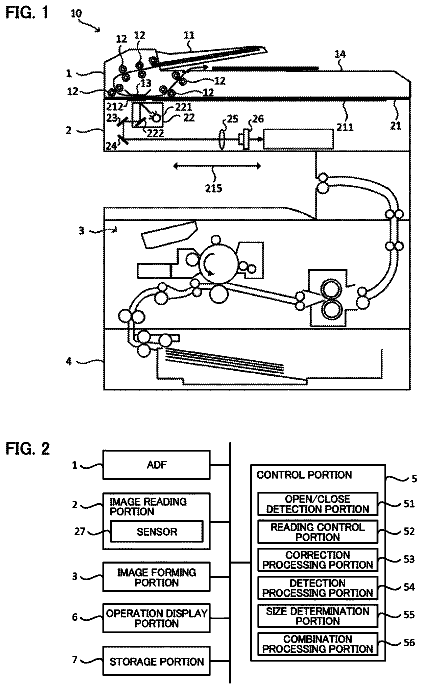
As shown in FIG. 1 , the multi-function device 10 mainly has the printer 11 , the scanner 12 , a display 23 , an operation interface 24 , a communication interface 25 , a CPU 31 , a memory 32 , and a communication bus 33 . The respective constitutional elements of the multi-function device 10 are connected each other through the communication bus 33 . The multi-function device 10 is an example of the image processing apparatus.
The printer 11 is configured to execute a print operation of recording an image expressed by image data onto a sheet. As a recording method of the printer 11 , a well-known method such as an inkjet method and an electrophotographic method can be adopted. The scanner 12 is configured to execute a scan operation of reading an image recorded on a document and to generate image data. Also, the printer 11 may have a FAX unit configured to execute a FAX transmission operation of FAX-transmitting image data to an external apparatus and a FAX reception operation of FAX-receiving image data from the external apparatus, and the like. The print operation, the scan operation, the FAX transmission operation and the FAX reception operation are examples of an operation for the image data, and the printer 11 , the scanner 12 and the FAX unit are examples of the operating device such as the image processing device.
The display 23 is a liquid crystal monitor, an organic EL display or the like, and has a display surface for displaying a variety of information.
The operation interface 24 is a user interface configured to receive a user's input operation. Specifically, the operation interface 24 has buttons, and is configured to output a variety of operation signals associated with the pushed buttons to the CPU 31 . Also, the operation interface 24 may have a film-shaped touch sensor superimposed on the display surface of the display 23 . An operation of designating an object displayed on the display surface of the display 23 and an operation of inputting a character string or a number string are examples of the user operation. The “object” indicates a character string, an icon, a button, a link, a radio button, a check box, a pull-down menu and the like displayed on the display 23 .
The operation interface 24 implemented as a touch sensor is configured to output position information, which indicates a position on the display surface touched by the user. Meanwhile, in the specification, the term “touch” includes all operations of enabling an input medium to contact the display surface. Also, even when the input medium is not in contact with the display surface, “hover” or “floating touch” of bringing the input medium close to a position at which a distance to the display surface is very small may be included in the concept of the “touch”. Also, the input medium may be a user's finger, a touch pen or the like. A user operation of tapping a position of an icon displayed on the display 23 is an example of the designation operation of designating the icon.
The communication interface 25 is an interface for performing communication with the external apparatus through the communication network. That is, the multi-function device 10 is configured to transmit a variety of information to the servers 50 , 60 through the communication interface 25 and to receive a variety of data or information from the servers 50 , 60 through the communication interface 25 . The specific communication protocol of the communication interface 25 is not particularly limited but Wi-Fi (a registered trademark of Wi-Fi Alliance) may be adopted, for example.
The CPU 31 is configured to control an overall operation of the multi-function device 10 . The CPU 31 is configured to obtain and execute a variety of programs (which will be described later) from the memory 32 , based on diverse signals to be output from the operation interface 24 , a variety of information obtained from the external apparatus through the communication interface 25 , and the like. That is, the CPU 31 and the memory 32 configure an example of the controller.
In the memory 32 , an OS 34 and an apparatus program 35 are stored. In the meantime, the apparatus program 35 may be a single program or a combination of a plurality of programs. Also, in the memory 32 , data or information necessary to execute the apparatus program 35 is stored. The memory 32 may be a RAM, a ROM, an EEPROM, a HDD, a portable storage medium such as a USB memory to be detachably mounted to the multi-function device 10 , a buffer of the CPU 31 or a combination thereof.
The memory 32 may be a computer-readable storage medium. The computer-readable storage medium is a non-transitory medium. The non-transitory medium includes a recording medium such as a CD-ROM and a DVD-ROM, in addition to the above-described medium. Also, the non-transitory medium is a tangible medium. In the meantime, an electric signal for carrying a program to be downloaded from the server on the Internet 101 is a computer-readable signal medium, which is one of the computer-readable media, but is not included in the non-transitory computer-readable storage medium.
The memory 32 may be configured to store therein a condition list, as shown in FIGS. 2A and 2B , for example. The condition list includes one or more condition records. The condition record includes a part or all of specific identification information, state information, type information and custom URL associated with each other. One or both of the state information and the type information may be omitted. The condition record indicates that when a condition indicated by the specific identification information and the state information is satisfied, a custom XML indicated by a corresponding custom URL is to be obtained and processing defined in the obtained custom XML is to be executed. The specific identification information, the state information, the type information, and the custom URL will be described in detail later.
Upon shipment of the multi-function device 10 , the condition record may not be stored in the memory 32 . The apparatus program 35 is configured to transmit an HTML file defining a screen for prompting an input of information to be included in the condition record to the external apparatus (for example, a PC) through the communication interface 25 , for example. Then, the apparatus program 35 is configured to receive the condition record from the external apparatus through the communication interface 25 . This processing is an example of the second reception processing. Then, the apparatus program 35 is configured to register the received condition record in the condition list. This processing is an example of the third storing processing.
Also, although not shown, the memory 32 may be configured to associate and store therein a custom XML, and date and time information, which will be described later. The date and time information is information indicative of update date and time of a corresponding custom XML. The apparatus program 35 stores in the memory 32 the custom XML and the date and time information received from the server 60 , in S 24 (which will be described later), for example.
[Servers 50 , 60 ]
The servers 50 , 60 are configured to store therein the XML files. When a request for transmission of the XML file is received from the multi-function device 10 , the servers 50 , 60 transmit the requested XML file to the multi-function device 10 . The servers 50 , 60 may be Web servers configured to transmit the XML file by HTTP, for example. In the illustrative embodiment, the server 50 is identified by server identification information “www.server-std.com”, and the server 60 is identified by server identification information “www.server-ctm.com”.
The XML file is an example of the definition data for defining processing to be executed by the multi-function device 10 . That is, in the XML file, processing to be executed by the multi-function device 10 is described by an XML. The XML file is largely classified into a screen definition XML, which is an example of the screen definition data, and an operation definition XML, which is an example of operation definition data. The screen definition XML defines a screen that is to be displayed on the display 23 of the multi-function device 10 . The operation definition XML defines an operation (e.g., image processing) that is to be executed by the operating device (e.g., image processing device) of the multi-function device 10 . The XML file is identified by data identification information such as “scan-upload1.xml”, “download-print3.xml” and the like.
The server 50 is an example of the first server, which is provided by a manufacturing maker of the multi-function device 10 , for example. The server 50 is configured to store therein standard XMLs shown in FIGS. 3A to 3C or standard XMLs shown in FIGS. 4A to 4C , for example. The standard XML stored in the server 50 is an example of the first definition data. The data identification information for identifying the standard XML is an example of the first identification information. The server 50 is configured to supply a uniform service to all the multi-function devices 10 manufactured by the manufacturing maker.
The server 60 is an example of the second server, which is provided by an organization (for example, a company, a school and the like) using the multi-function device 10 , for example. The server 60 is configured to store therein custom XMLs shown in FIGS. 3D and 3E or custom XMLs shown in FIGS. 4D and 4E , for example. The custom XML stored in the server 60 is an example of the second definition data. The data identification information for identifying the custom XML is an example of the second identification information. The server 60 is configured to supply a customized service to the multi-function device 10 that is to be used by the organization having equipped the same.
Operations of the system 100 in accordance with the illustrative embodiment are described with reference to FIGS. 5 to 7 .
A flowchart of the specification basically indicates processing of the CPU 31 , which is to be executed in accordance with commands described in the program. That is, in the below descriptions, processing such as “determination”, “extraction”, “selection”, “calculation”, “decision”, “specifying”, “control” and the like indicates processing of the CPU 31 . The processing that is to be executed by the CPU 31 includes hardware control via the OS 34 , too. Also, in the specification, the term “data” is expressed by a computer-readable bit string. It is assumed that the data having the substantially same meaning and a different format is to be handled as the same data. This also applies to the “information” in the specification.
First, the apparatus program 35 is configured to display a service selection screen shown in FIG. 8A on the display 23 . The service selection screen is a screen for prompting a user to select a service that is to be used through the multi-function device 10 . The service selection screen includes a service icon 111 corresponding to the scan upload and a service icon 112 corresponding to the download print. The apparatus program 35 is configured to receive a user operation on the service selection screen through the operation interface 24 .
Also, in the memory 32 , a next operation URL “www.server-std.com/scan-upload1.xml” associated with the service icon 111 and a next operation URL “www.server-std.com/download-print1.xml” associated with the service icon 112 are stored. The next operation URL is information indicative of the XML file for defining processing that is to be executed next. The next operation URL includes the server identification information and the data identification information. The next operation URL is a standard URL including the server identification information of the server 50 and the data identification information of the standard XML or a custom URL including the server identification information of the server 60 and the data identification information of the custom XML.
[Scan Upload]
For example, when a designation of the service icon 111 is received through the operation interface 24 , the apparatus program 35 receives a supply of the scan upload service. The processing of enabling the multi-function device 10 to execute the scan upload is described with reference to FIGS. 5 and 6 . Meanwhile, it is assumed that the condition list shown in FIG. 2A is registered in the memory 32 of the multi-function device 10 , the standard XMLs shown in FIGS. 3A to 3C are stored in the server 50 and the custom XML shown in FIGS. 3D and 3E are stored in the server 60 .
In the condition list of FIG. 2A , the specific identification information is the first identification information for identifying one of the plurality of standard XMLs stored in the server 50 . The state information is information indicative of a specific state of the multi-function device 10 . In the illustrative embodiment, the specific state indicates a state logged in with a login ID “Guest”.
In the illustrative embodiment, the multi-function device 10 can change a state from a login state to a non-login state. The login state indicates a state where a combination of a valid login ID and a valid password is input through the operation interface 24 . The multi-function device 10 at the login state can execute only an operation allowed with being associated with the input login ID and cannot execute the other operations. The non-login state indicates a state where a combination of a valid login ID and a valid password has not been input. The multi-function device 10 at the non-login state can execute only a basic operation allowed to all users.
The login ID “Guest” is a login ID, for which the number of operations allowed with being associated is smallest, of the login IDs registered in the multi-function device 10 , for example. The login ID “Guest” is a login ID issued for a plurality of unspecified users, for example. In the multi-function device 10 , a login ID (hereinafter, referred to as “login ID of a registered user”) different from the login ID “Guest” is also registered.
The apparatus program 35 can obtain the login ID input to the multi-function device 10 at the login state by executing an API provided by the OS 34 , for example. The state logged in with the login ID “Guest” is an example of the specific state where the multi-function device 10 is used by a user different from a registered user registered in advance. Alternatively, the state logged in with the login ID “Guest” may also indicate the non-login state.
First, the apparatus program 35 reads out the next operation URL “www.server-std.com/scan-upload1.xml” stored with being associated with the service icon 111 from the memory 32 . This processing is an example of the obtaining processing. Then, the apparatus program 35 determines whether the next operation URL conforms to the conditions indicated by the condition records registered in the condition list (S 11 ). The processing of S 11 is an example of the first determination processing.
More specifically, the apparatus program 35 executes following processing for each of the condition records registered in the condition list. First, the apparatus program 35 reads out one of the condition records from the memory 32 . Then, the apparatus program 35 determines whether the data identification information included in the obtained next operation URL and the specific identification information included in the read condition record coincide with each other. When the data identification information and the specific identification information coincide with each other, the apparatus program 35 determines that the obtained next operation URL conforms to the condition indicated by the read condition record. On the other hand, when the data identification information and the specific identification information do not coincide with each other, the apparatus program 35 determines that the obtained next operation URL does not conform to the condition indicated by the read condition record.
Also, when the state information is included in the read condition record, the apparatus program 35 further determines whether a current state of the multi-function device 10 and a specific state indicated by the state information included in the read condition record coincide with each other. When the data identification information and the specific identification information coincide with each other and the current state of the multi-function device 10 is the specific state, the apparatus program 35 determines that the obtained next operation URL conforms to the condition indicated by the read condition record. On the other hand, when the current state of the multi-function device 10 is not the specific state, the apparatus program 35 determines that the obtained next operation URL does not conform to the condition indicated by the read condition record.
In the illustrative embodiment, the data identification information “scan-upload1.xml” coincides with the specific identification information of the condition record in a first line of FIG. 2A . That is, when the multi-function device 10 is logged in with the login ID “Guest”, the apparatus program 35 determines that the obtained next operation URL conforms to the condition indicated by the condition record. On the other hand, when the multi-function device 10 is not logged in with the login ID “Guest”, the apparatus program 35 determines that the obtained next operation URL does not conform to the conditions indicated by all the condition records.
When it is determined that the obtained next operation URL conforms to the condition indicated by the condition record in the first line of FIG. 2A (S 11 : Yes), the apparatus program 35 executes custom processing A by using the custom URL “www.server-ctm.com/scan-upload0.xml” included in the condition record (S 12 ). On the other hand, when it is determined that the obtained next operation URL does not conform to the condition indicated by the condition record (S 11 : No), the apparatus program 35 executes processing of S 13 and thereafter without executing the custom processing A. The custom processing A of the illustrative embodiment is described in detail with reference to FIG. 6 .
First, the apparatus program 35 determines whether the custom XML identified by the data identification information “scan-upload0.xml” of the obtained custom URL has been updated in the server 60 (S 21 ). Specifically, the apparatus program 35 determines whether the custom XML is stored in the memory 32 . Also, the apparatus program 35 transmits date and time information request information for requesting transmission of date and time information of the custom XML to the server 60 through the communication interface 25 . Then, the apparatus program 35 receives the date and time information, which is transmitted by the server 60 as a response to the date and time information request information, through the communication interface 25 . Then, the apparatus program 35 compares the date and time information stored in the memory 32 with being associated with the custom XML and the date and time information of the custom XML received from the server 60 . The processing of S 21 is an example of the third determination processing.
When it is determined that the custom XML is not stored in the memory 32 or the two date and time information does not coincide with each other (S 21 : Yes), the apparatus program 35 transmits custom XML request information to the server 60 identified by the server identification information “www.server-ctm.com” of the custom URL through the communication interface 25 (S 22 ). The custom XML request information is an example of the transmission request information for requesting transmission of the custom XML indicated by the data identification information of the custom URL. That is, the custom XML request information includes the data identification information “scan-upload0.xml” of the custom XML for which transmission is requested. The processing of S 22 is an example of the transmission processing.
Then, the apparatus program 35 receives the custom XML shown in FIG. 3D from the server 60 through the communication interface 25 , as a response to the custom XML request information (S 23 ). Also, the apparatus program 35 associates and stores the date and time information received in S 21 and the custom XML received in S 23 in the memory 32 (S 24 ). The processing of S 23 is an example of the first reception processing, and the processing of S 24 is an example of the second storing processing. On the other hand, when it is determined that the custom XML is stored in the memory 32 and the two date and time information coincides with each other (S 21 : No), the apparatus program 35 reads out the custom XML indicated by the data identification information “scan-upload0.xml” of the custom URL from the memory 32 (S 25 ), instead of executing the processing of S 22 and S 23 . The processing of S 25 is an example of the readout processing.
Then, the apparatus program 35 displays a custom screen defined in the custom XML received in S 23 or in the custom XML read out in S 25 on the display 23 (S 26 ). In the illustrative embodiment, as the custom screen defined in the custom XML of FIG. 3D , a security notification screen shown in FIG. 8B is displayed on the display 23 . Then, the apparatus program 35 receives a user operation on the security notification screen through the operation interface 24 (S 27 ). The processing of S 26 is an example of the display processing, and the processing of S 27 is an example of the reception processing.
The security notification screen is an example of the definition screen for notifying the user of the scan upload service of a security precaution. The security notification screen includes a message “It is to be uploaded to a cloud server! Please, do not scan a security document!”, and a [next] icon 121 and a [return] icon 122 . Then, when a designation of the [next] icon 121 is received through the operation interface 24 (S 27 : Yes), the apparatus program 35 obtains the next operation URL www.server-std.com/scan-upload1.xml defined in the custom XML received in S 23 or in the custom XML read out in S 25 (S 28 ).
More specifically, the apparatus program 35 obtains an element of a <NextURL> tag included in the custom XML, as the next operation URL. The processing of S 28 is an example of the obtaining processing. Then, the apparatus program 35 determines whether the next operation URL obtained in S 28 is any one of the standard URL and the custom URL (S 29 ). Specifically, when the next operation URL obtained in S 28 includes the server identification information of the server 50 , the apparatus program 35 determines that the next operation URL is the standard URL, and when the next operation URL includes the server identification information of the server 60 , the apparatus program 35 determines that the next operation URL is the custom URL.
When it is determined that the custom URL is obtained in S 28 (S 29 : custom), the apparatus program 35 re-executes the processing of S 21 and thereafter by using the custom URL. On the other hand, when it is determined that the standard URL is obtained in S 28 (S 28 : standard), the apparatus program 35 ends the custom processing A. Also, although not shown, when a designation of the [return] icon 122 on the security notification screen is received through the operation interface 24 , the apparatus program 35 ends the processing relating to the scan upload service.
Thereafter, returning to FIG. 5 , the apparatus program 35 transmits standard XML request information, which includes the data identification information “scan-upload1.xml” of the standard URL, to the server 50 identified by the server identification information “www.server-std.com” of the standard URL obtained in the immediately preceding obtaining processing, through the communication interface 25 (S 13 ). The standard XML request information is an example of the transmission request information for requesting transmission of the standard XML indicated by the data identification information of the standard URL. The processing of S 13 is an example of the transmission processing.
Then, the apparatus program 35 receives the standard XML shown in FIG. 3A from the server 50 through the communication interface 25 , as a response to the standard XML request information (S 14 ). The processing of S 14 is an example of the reception processing. Then, the apparatus program 35 determines whether the received standard XML is any one of the screen definition XML and the operation definition XML (S 14 ). The determination method in S 14 is not particularly limited. However, the apparatus program 35 may determine the XML file including a <NextURL> tag as the screen definition XML, and may determine the XML file including a <scan_upload> tag or <download_print> tag, as the operation definition XML.
Then, when it is determined that the standard XML shown in FIG. 3A is the screen definition XML (S 14 : screen definition), the apparatus program 35 displays a standard screen defined in the standard XML on the display 23 (S 15 ). In the illustrative embodiment, as the standard screen defined in the standard XML shown in FIG. 3A , a server selection screen shown in FIG. 9A is displayed on the display 23 . Then, the apparatus program 35 receives a user operation on the server selection screen through the operation interface 24 (S 16 ). The processing of S 15 is an example of the display processing, and the processing of S 16 is an example of the reception processing.
The server selection screen is an example of the definition screen for prompting the user to designate a server of an upload destination of image data generated in the scan operation. The server selection screen includes server icons 131 , 132 corresponding to server identification information of servers A, B (not shown) on the Internet 101 . The server identification information associated with the server icons 131 , 132 is an example of the parameter. In the standard XML, a candidate of the parameter to be designated by the user is defined as an element of a <option> tag. This also applies to the other XML files. However, the specific definition method in the XML file is not limited thereto.
When a designation of the server icon 131 is received through the operation interface 24 (S 16 : Yes), for example, the apparatus program 35 temporarily stores the server identification information “server A” associated with the server icon 131 in the memory 32 , as a parameter designated by the user. Then, the apparatus program 35 obtains the next operation URL “www.server-std.com/scan-upload2.xml” defined in the standard XML received in S 14 (S 17 ). More specifically, the apparatus program 35 obtains the element of the <NextURL> tag of the standard XML, as the next operation URL. The processing of S 17 is an example of the obtaining processing. Then, the apparatus program 35 re-executes the processing of S 11 and thereafter by using the obtained next operation URL.
The description continues in the full USPTO document.
 Lapsed, fee not paid10 drawings