Lapsed, fee not paid2 drawings
Medical Devices · US 9,849,280 B2
Coronary venous pacing lead and anchoring screw system
A system implantable in the coronary venous system, including a pacing lead with an anchoring screw is disclosed.
US 9,849,300 B2 · Assignee: Children's Medical Center Corporation · Inventors: Pascual-Leone; Alvaro et al.
Sheet 1 of 15 from the published document. All sheets in the USPTO PDF
Method and devices are provided for treating subjects with Transcranial Magnetic Stimulation (TMS). According to some approaches, the methods and devices are configured for the treatment of ongoing seizures. Other approaches relate to the use of TMS as an antiepileptogenic or for use in determining preferential placement of intracranial probes.
Transcranial magnetic stimulation (TMS) provides a non-invasive procedure for generating fluctuating magnetic fields to induce stimulating intracranial electric current to desired areas of the human body, typically targeted areas of the brain. In general, TMS procedures involve identifying a discrete region of the brain and focusing fluctuating magnetic fields generated by one or more coils positioned proximate the head at a location that induces electric current in the identified region of the brain. The type and character of the fluctuating magnetic field deposition, and the location of the targeted region of the brain typically depends on the type of therapeutic and/or diagnostic application that is to be achieved. A growing understanding of TMS techniques has led to the development of numerous diagnostic and therapeutic applications in neurology, cognitive neuroscience, clinical neur
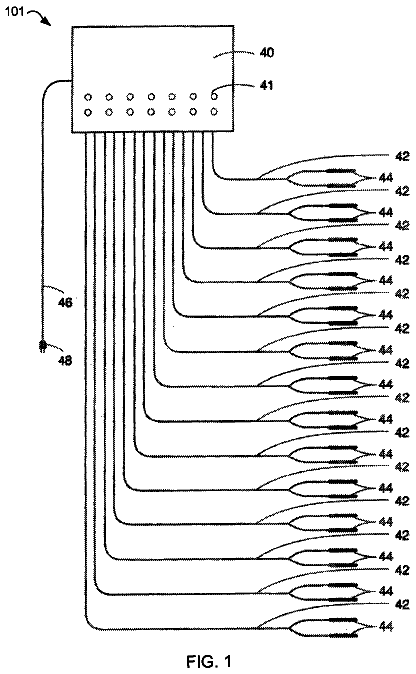
1 of 15 drawing sheets so far from the published document, cropped to the drawing. Every sheet is in the USPTO PDF.
What the patent claimed, word for word. All of it is now free to use.
The present invention relates to transcranial magnetic stimulation (TMS).
Transcranial magnetic stimulation (TMS) provides a non-invasive procedure for generating fluctuating magnetic fields to induce stimulating intracranial electric current to desired areas of the human body, typically targeted areas of the brain. In general, TMS procedures involve identifying a discrete region of the brain and focusing fluctuating magnetic fields generated by one or more coils positioned proximate the head at a location that induces electric current in the identified region of the brain. The type and character of the fluctuating magnetic field deposition, and the location of the targeted region of the brain typically depends on the type of therapeutic and/or diagnostic application that is to be achieved.
A growing understanding of TMS techniques has led to the development of numerous diagnostic and therapeutic applications in neurology, cognitive neuroscience, clinical neurophysiology, psychiatry, neurorehabilitation, etc. Repetitive Transcranial Magnetic Stimulation (rTMS) has been used as noninvasive treatment for a variety of medical conditions. Applications for rTMS include, but are not limited to, psychiatric disorders, such as depression, hallucinations, obsessions, and drug craving; neurologic diseases such as Parkinson's disease, or dystonia; rehabilitation of aphasia or of hand function after stroke; and pain syndromes, such as caused by migraine, neuropathies, low back pain, or internal visceral diseases such as chronic pancreatitis or cancer. As used herein, the term TMS refers generically to both TMS and rTMS.
For many conventional applications, effective rTMS has included routine stimulation according to a prescribed schedule. For example, a particular therapeutic application may have the best results when repeated for several days (e.g., ten to twenty days) on a daily or even bi-daily regimen. Other applications may require more or less frequent stimulation and/or require different lengths of time over which the stimulation is repeated. For example, the prescribed length of time may vary from a couple of days, to several weeks, months or years. In some circumstances, the most effective treatment may involve an indefinite stimulation regimen. In particular, after the initial treatment (referred to as the induction phase), a subject may require (or respond more positively) by continuing with maintenance therapy for many months, and possibly indefinitely.
According to one aspect of the invention, a system for applying transcranial magnetic stimulation to a subject is disclosed. The system comprises an electromagnetic coil configured to deliver a fluctuating magnetic field to a subject's brain to induce an electric current therein. An interface is configured to position the electromagnetic coil in proximity to the brain of the subject. A controller controls operation of the electromagnetic coil according to an operating protocol. The operating protocol comprises delivering an initial fluctuating magnetic field having an intensity and a duration and delivering a subsequent fluctuating magnetic field after delivering the initial fluctuating magnetic field. At least one of intensity and duration of the subsequent fluctuating magnetic field is greater than the intensity and duration of the initial fluctuating magnetic field, respectively.
Another aspect of the invention relates to a portable device for applying transcranial magnetic stimulation to a subject. The device comprises a portable power source, an electromagnetic coil that receives power from the power source to produce a fluctuating magnetic field that may induce an electric current in a subject's brain. A controller controls operation of the electromagnetic coil according to an operating protocol. A housing houses the electromagnetic coil and positions the electromagnetic coil to deliver the fluctuating magnetic field to a subject's brain.
Another aspect of the invention relates to a device for treating an ongoing seizure. The device comprises an electromagnetic coil that receives power from a power source to produce a fluctuating magnetic field. A controller controls operation of the electromagnetic coil according to an operating protocol. A plurality of electrodes receive a signal indicative of brain activity in the subject and provide the electrical signal to the controller. The device also comprises an interface that includes the plurality of electrodes and the electromagnetic coil. The interface is configured to position the plurality of electrodes to receive the signal and to position the electromagnetic coil to deliver the fluctuating magnetic field to a subject's brain.
Another aspect of the invention relates to a method of non-invasively assessing intracranial electrode positioning or similarly, guiding placement of intracranial electrodes. The method comprises positioning an electromagnetic coil at an initial external position about a subject's brain. A fluctuating magnetic field is applied from the electromagnetic coil positioned at the initial external position about the subject's brain. Any effects exhibited by the subject subsequent to applying the first fluctuating magnetic field from the electromagnetic coil at the initial external position are identified. The electromagnetic coil is repositioned at a subsequent external position, different than the initial external position, about the subject's brain. A subsequent fluctuating magnetic field is applied from the electromagnetic coil positioned at the subsequent external position about the subject's brain. Any effects exhibited by the subject subsequent to applying the subsequent fluctuating magnetic field from the electromagnetic coil at the subsequent external position are identified. Any effects associated with applying the fluctuating magnetic field from the first external position of the electromagnetic coil and any effects associated with applying the fluctuating magnetic field from the subsequent external position and then compared to identify a preferential position among the initial and subsequent external positions. The effects that are assessed may be intended, desirable therapeutic effects or may be unintended and undesirable side effects. This procedure may be repeated multiple times, effectively probing for desirable and undesirable effects associated with multiple scalp (and thus brain) regions. A detailed map may be generated of the likelihood of brain stimulation to induce desirable and undesirable effects in the subject when targeting different regions of the brain.
Another aspect of the invention relates to a method of terminating an ongoing seizure. The method comprises identifying a subject for treatment and positioning an electromagnetic coil about the seizing subject's brain. The electromagnetic coil is energized to direct a fluctuating magnetic field from the electromagnetic coil to the seizing subject's brain.
Another aspect of the invention relates to a method of preventing epilepsy. The method comprises identifying an epilepsy precipitating occurrence or predisposition (genetic or acquired) and exposing a brain of the subject to rTMS.
Further features and advantages of the present invention, as well as the structure of various embodiments of the present invention are described in detail below with reference to the accompanying drawings.
The accompanying drawings are not intended to be drawn to scale. In the drawings, each identical or nearly identical component that is illustrated in various figures is represented by a like numeral. For purposes of clarity, not every component may be labeled in every drawing. Various embodiments of the invention will now be described, by way of example, with reference to the accompanying drawings, in which:
FIG. 1 illustrates, schematically, components that are common to several embodiments of the present invention;
FIG. 2A-2C illustrate various embodiments of portable devices configured to administer TMS;
FIGS. 3A-3E illustrate various components of a portable TMS device, in accordance with some embodiments of the present invention;
FIG. 4 illustrates a portable TMS device, in accordance with some embodiments of the present invention;
FIG. 5 illustrates a portion of a TMS device, in accordance with some embodiments of the present invention;
FIG. 6 illustrates a portable TMS device adapted to communicate over a network, in accordance with some embodiments of the present invention;
FIGS. 7A-7B illustrates a side-view and a bottom-view of a portable TMS device having a communications port, in accordance with some embodiments of the present invention;
FIG. 8 illustrates a flow chart of a method for positioning a TMS coil, in accordance with some embodiments of the present invention;
FIG. 9 illustrates a flow chart of another method for positioning a TMS coil, in accordance with some embodiments of the present invention;
FIG. 10 illustrates a portable TMS device having EEG feedback, in accordance with some embodiments of the present invention;
FIGS. 11A-11E illustrate one example of application of TMS methods to seizing rats;
FIGS. 12A-12B illustrate reduced TMS artifacts with a slew-rate limited pre-amplifier;
FIGS. 13-15 illustrate a spontaneous seizure in a rat being recognized and terminated with TMS;
FIG. 16 illustrates EEG-guided TMS to enable when a seizure was stopped and when no further stimulation was required; and
FIG. 17 shows the combination of TMS with EEG methods.
As discussed herein, the applicants have appreciated that TMS may provide benefits in some emergent settings, such as in the treatment of an ongoing seizure.
Aspects of the invention relate to novel uses for TMS, and devices that facilitate the use of TMS in particular settings. Embodiments of the TMS device may comprise electromagnetic coil(s) that, when energized, emit a magnetic field either as a single pulse of magnetic energy or as magnetic energy that fluctuates in intensity or polarity. The magnetic field may be applied to the brain of a subject to induce an electric current therein, which, in turn, may stop an ongoing seizure (as used herein, the term “magnetic field” refers generally to the stimulation that may be applied to a subject's brain in TMS). The electromagnetic coil may be housed in an interface that facilitates quick and easy positioning of the coil proximate to a subject's brain. A controller may be provided that runs the electromagnetic coil according to a defined, operating protocol that further simplifies use of the device.
One aspect of the invention relates to the treatment of an ongoing seizure with TMS. Generally speaking, during a seizure, electric signals are transmitted about the brain in an abnormal, systematic manner, unlike the more chaotic signals that typify normal brain activity. The applicants have appreciated that inducing an electric current in a subject's brain during a seizure may disrupt systematic signal transmission and, in doing so, may cause termination of the ongoing seizure.
Another aspect of the invention relates to an apparatus for performing TMS according to an escalating, operating protocol. It may be difficult to define, a priori, the intensity, duration and/or frequency of magnetic field(s) that may be required to stop a seizure in a given subject, without also over-exposing the subject. In this regard, the applicants have appreciated that applying a magnetic field in an escalating manner can minimize the subject's exposure to the magnetic field having the intensity, duration and/or frequency that is necessary to stop the seizure. It is to be appreciated, however, that an escalating protocol may be used in conjunction with TMS for purposes other than stopping an ongoing seizure, such as treating epilepsy or preventing the onset of epilepsy, or other therapeutic applications of TMS in neurology, psychiatry, or rehabilitation.
Another aspect of the invention relates to an apparatus configured to perform TMS in an emergent setting. As may be appreciated, subjects may begin seizing unexpectedly, even when under the care of a doctor or other healthcare professional. Embodiments of the TMS apparatus may be portable and/or readily deployable to facilitate use in such situations. Some embodiments may be configured for placement in highly trafficked, public venues, such as airports, malls, and the like, such as where defibrillator devices are now commonly found. Illustrative embodiments may include other features, such as a portable power source, that further facilitate ready deployment and use. It is to be appreciated, however, that the use of such devices is not limited to emergent settings, and that such devices may be used for other purposes, such as administering TMS as an antiepileptogenic, or applying TMS for treatment of a variety of other diseases in the field.
Yet another aspect of the invention relates to methods of non-invasively assessing positions of a subject's brain for the placement of stimulating intracranial electrodes, and identifying preferential or optimal position(s). Candidate positions for the invasive placement of intracranial electrodes may first be identified. The fluctuating magnetic field (i.e., the stimulation) from embodiments of the TMS device may be focused to the candidate positions to induce current at the candidate positions one at a time in a systematic manner. The subject may be observed for the presentation of any desirable and undesirable (intended and unintended) effects associated with focusing the induced current at each of the candidate positions. Candidate positions may then be compared, based on the existence or extent of effects (desirable or undesirable), such that preferred positions may be identified for further consideration. The effectiveness of stopping ongoing seizures by applying fluctuating magnetic fields to each of the preferred positions, as well as the potential risk of undesirable effects and adverse effects of the stimulation may then be evaluated prior to performing an invasive procedure to implant an intracranial electrode at one or more of the preferred positions. In this manner, a noninvasive method may serve to guide and optimize the placement of invasive electrode(s), thus increasing the efficacy and reducing the risk of adverse effects for the subject.
Yet another aspect of the invention relates to methods of using TMS as an antiepileptogenic to prevent the onset of epilepsy. A healthcare profession may prescribe rTMS after identifying an event, such as a head trauma, or diagnosing a condition that predisposes a subject to epilepsy, such as autism or tuberous sclerosis, or finding a genetic predisposition that might precipitate or will eventually result in the onset of epilepsy or epileptogenesis in a particular subject. TMS may then be administered according to a variety of protocols, as discussed herein, to prevent the onset of epilepsy.
Turn now to the figures, and initially FIG. 1 , which shows components that are common to many embodiments of the TMS device. An electromagnetic coil, typically in the shape of a “figure-eight”, is connected to a power supply that, when activated, energizes the coil. Operation of the electromagnetic coil may be governed by a controller that is programmable or that includes a single, operating protocol that defines how, when, and to what extend the coil is energized.
FIG. 1 also shows electrodes that may be placed about a subject's head to detect electric signals indicative of brain activity, in the same manner as an electroencephalogram (EEG), as is discussed in greater detail herein. The electrodes and the electromagnetic coil may be incorporated into an interface configured for placement about a subject's head to facilitate rapid placement of both the coil and electrodes, as may be required in an emergent setting.
The applicant has appreciated that a generally portable TMS device may facilitate more convenient application of and/or completion of TMS treatment. For example, a portable TMS device may facilitate the use of TMS treatment in an emergent situation, whereas systems constructed of independent components might involve additional set up that can delay the application of TMS treatment and the termination of an ongoing seizure. As discussed herein, seizures may cause brain damage and the risk of brain damage may increase with the duration of a seizure. A TMS device with features that reduce the time required for deployment and use may prevent or reduce the extent of brain damage that occurs in a seizing subject.
Seizures are often characterized by the abnormal, systematic transmission of electric signals in a subject's brain. Often, a seizure begins with the systematic transmissions of signals in a discrete portion of the subject's brain, such as a discrete portion of the cerebral cortex. As the seizure progresses, larger portions of the subject's brain experience the systematic transmission of electric signals. This process often leads to the entire brain being overcome with abnormal, systematic transmissions of electric signals. In this respect, focusing of a fluctuating magnetic field may not be required for the fluctuating magnetic field to be incident on an affected portion of a subject's brain. Electromagnetic coils may simply be positioned to subject a portion or all of a subject's brain to the fluctuating magnetic field.
Illustrative embodiments may include a portable power source to facilitate rapid deployment of the TMS device. As shown in FIG. 1 , the portable power source may include a battery pack that is incorporated directly into the TMS device. The battery pack may provide a primary source of power to the electromagnetic coil, controller, and other components of the device. Such a configuration may prove useful for TMS devices that are made available in high traffic areas, like shopping malls, airports, and the like; or that are made available in places were customary medical assistance is not readily available, like in airplanes, ferries, etc. It is to be appreciated, however, that not all embodiments of TMS devices require a portable power source, and that some embodiments may include portable power sources for secondary or backup power or no portable power sources at all.
The portable power source may be rechargeable, replaceable or disposable, as aspects of the invention are not limited in this respect. A rechargeable power source may facilitate using the TMS device multiple times. According to some embodiments, a TMS device positioned for public access may, while stored, be plugged into a wall outlet to ensure that the portable power source remains fully charged. Such embodiments may be removed from the stored position and unplugged for use, if necessary.
Illustrative embodiments may comprise a common power source to energize the electromagnetic coil(s) and to provide power to controls, displays, and other components of a TMS device. However, it is to be appreciated that the invention is not limited in this respect, as embodiments may include separate power supplies, portable or otherwise, for energizing the coil and providing power to other components of a TMS device.
An interface may incorporate one or more electromagnetic coils such that, during use, the coil(s) are positioned to deliver a magnetic field to a substantial portion of a seizing subject's brain. According to the embodiment illustrated in FIG. 2A , the interface includes a pliable hat-shaped device that can be fitted rapidly to most any subject's head.
Alternately, as shown in the embodiment of FIG. 2B , the interface may comprise a pliable envelope with flexible, resilient bands that, when worn by a subject, extend downward from the subject's crown toward the subjects hairline. These bands may be expanded so that the interface can slide over a subject's head, positioning the electromagnetic coil(s) to deliver a magnetic field to the subjects brain.
FIG. 2 c shows yet another embodiment of an interface that may be used to rapidly position an electromagnetic coil about a subject's head. As shown, the interface comprises a pliable envelope, such as might be made of cloth, plastic, and the like. The interface may be held in place by a healthcare professional, or other respondent, as the TMS device is activated to deliver a fluctuating magnetic field to the subject's brain to induce electrical currents therein. It is to be appreciated, however, that other embodiments may also be constructed for rapid positioning of a coil about a subjects brain, as aspects of the invention are not limited to those embodiments shown in FIGS. 2A-2C .
Embodiments of the TMS device may include a single electromagnetic coil, or a plurality of electromagnetic coils for delivering a fluctuating magnetic field to subject's brain to induce electric current or impulses therein. By way of example, the embodiment of FIG. 2 c shows four, electromagnetic, “figure-eight” shaped coils positioned within or on the envelope. The coils are positioned about the interface such that, during use, each of the coils is positioned roughly over one quadrant of the subject's head. It is to be appreciated that other configurations are possible, with any other number of coils incorporated into a particular interface, as aspects of the invention are not limited in this respect. It is also to be appreciated that other configurations of coils may also be employed by embodiments of TMS devices, as aspects of the invention are not limited to the use of figure-eight coils.
Different electromagnetic coils of a single interface may be energized and fired in different manners. According to some approaches, each the plurality of electromagnetic coils are fired in unison. Alternately, the various coils may be fired at different times than one another, yet still according to a systematic pattern. In other embodiments, the coils may be fired randomly with respect to one another, as aspects of the invention are not limited in this respect.
Components of the TMS device may be packaged to promote rapid deployment and ease of use. FIG. 2B shows one embodiment of a TMS device that has a control box to incorporate all of the components of the device, except the interface and a connection therebetween. This configuration may provide a reduced number of components for a respondent to handle when operating the TMS device. In an emergent situation, the respondent may place the interface about the subject's head, and then attend to the controls on the control box. In this respect, operation may be simplified by reducing the number of steps to ready the TMS device for use on a seizing subject. Other configurations are also possible for promoting rapid deployment and ease of use, such as the configuration of embodiment of FIG. 2A , where the control box is attached directly to the interface.
Controls of the TMS device may be configured for simplified operation, such that respondents may be qualified to operate the TMS device with minimal prior training, or no prior training at all. The illustrative embodiment of FIG. 2A includes only an activation control (i.e., a button in the illustrated embodiment) and a power indicator light. Once properly positioned about a subject's head, a respondent depresses the activation button to begin operation of the TMS device. Other control and indicator configurations are possible, as aspects of the invention are not limited to those that are illustrated. Moreover, as discussed herein, some embodiments of TMS devices may be configured for different types of applications, where additional controls and the ability to actively program a device may be desirable.
Once the activation control has been depressed, the controller of the TMS device may cause the electromagnetic coil(s) to be energized by current from the power source, such that a fluctuating magnetic field is emitted to induce electric current in a subject's brain or portions thereof. According to one operating protocol, after emitting a first fluctuating magnetic field or series of fields, the TMS device may turn off until the activation control is again actuated by the respondent. In such embodiments, the controller may limit the number of times that the fluctuating magnetic field may be emitted, or may require a predetermined length of time to pass, such as 0.1 seconds or more, 1 second or more, 5 seconds or more, 10 seconds or more, or 15 seconds or more before activating the control a subsequent time will produce a subsequent fluctuating magnetic field.
Once activated, the controller may then run the TMS device without further intervention by the respondent, according to some embodiments. Single pulses or pulse trains of magnetic stimulation may be emitted according to a predetermined sequence, such as every 0.01 second or more, every 0.1 seconds or more, every second or more, every 2 seconds or more, or every 5 seconds or more or according to any other timing scheme. Pulse trains may also include individual pulses that are fired irregularly, according to a predetermined pattern, or even stochastically, as aspects of the invention are not limited to any one configuration of pulse or pulse train. Once the respondent identifies termination of the seizure, the operating protocol may also be stopped by activating an appropriate control on the TMS device, or simply by removing the interface from the subject.
The treatment of ongoing seizures may include directing an initial magnetic field to the brain of a seizing subject as either a single pulse of magnetic energy or a series of pulses of fluctuating magnetic energy that fluctuate at a particular frequency or that fluctuate irregularly (i.e., a “pulse train”). If the seizure does not stop, subsequent fluctuating magnetic stimulation having greater intensity, duration and/or frequency may be applied to the subject's brain. In this manner, the extent of the subject's exposure to the fluctuating magnetic field may be minimized to the intensity, duration and/or frequency necessary to end the seizure.
As used herein, the term “duration”, when used with reference to the stimulation (i.e., fluctuating magnetic field) that is applied to a subject's brain, refers to the amount of time that elapses during the period of stimulation. Duration may be a short as 50 microseconds or shorter, such as for stimulation that comprises a single pulse of stimulation, or as long as several minutes, such as for long pulse trains of stimulation.
As used herein, the term “frequency” refers the rate at which individual pulses are emitted during a given duration of stimulation. Typically, low frequency pulse trains have frequencies that lie between 0.33 Hz and 1.0 Hz, although lower frequencies are also possible. Intermediate frequencies may range between 1 Hz and 20 Hz, and high frequency pulse trains often have frequencies between 20 Hz and 200 Hz, although greater frequencies are also possible. Additionally, it is to be appreciated that individual pulses emitted during a given duration may vary according to an irregular pattern, or even stochastically, as aspects of the invention are not limited in this respect. Frequency, as associated with such embodiments, may describe the average frequency at which pulses are fired, and should not be considered to be limited to rhythmic patterns of stimulation. Purposefully arrhythmic, asynchronous patterns of stimulation are also encompassed.
According to some embodiments, the magnetic field may increase in intensity, duration and/or frequency during a common operating protocol. For instance, an operation protocol may include emitting an initial magnetic field as a single, 200 microsecond pulse. Subsequent magnetic fields may comprise longer durations, such as 500 or more microseconds, 1000 or more microseconds, or even greater durations.
The intensity of the magnetic field (and induced intracranial electrical current) may be increased during the progression of an operating protocol. Typically, magnetic fields used during TMS range from 0.5 Tesla to 3.0 Tesla and the intensity required to stop an ongoing seizure may lie anywhere within this range for a given subject. As another technique to minimize the overall magnetic field exposure of a subject, embodiments of operating protocols comprise emitting magnetic fields of lower intensities during initial portions of the protocol, such as 0.5 Tesla or 1.0 Tesla, and emitting subsequent magnetic fields of greater intensities, as may be required if a subject's seizure persists.
The frequency of magnetic fields emitted during pulse trains may be altered during the progression of an operating protocol to help end a seizure. According to some embodiments, magnetic fields may comprise pulse trains of magnetic energy emitted anywhere between 0.33 Hz or lower and 200 Hz or higher. Frequencies may be altered anywhere among this range during a given operating protocol. Additionally, the time that elapses between pulse trains that are emitted by the electromagnetic coil may also be altered during a common operating protocol. By way of example, anywhere between 0.01 seconds and 30 seconds may elapse between emitting the first magnetic field of an operating protocol, either as a single pulse or a pulse train, and the second magnetic field of the operating protocol. The time elapsed between emitting the second and third magnetic fields may be increased or decreased relative to the time that is elapsed between the first and second fluctuating magnetic fields. This trend may continue throughout an entire operating protocol, or for portions of an operating protocol.
Embodiments of the TMS device may include electrodes configured to receive electric signals indicative of a subject's brain activity, much like an electroencephalogram (EEG). As illustrated, the electrodes may be incorporated directly into the interface of a TMS device. This may facilitate the rapid placement of the probes by a respondent in an emergent setting. The electric signals may be used to identify the onset of a seizure or to optimize the timing of the magnetic field emissions to coincide with ongoing activity in the subject's brain. Various TMS techniques guided by such electric signals received from the brain are discussed in U.S. Pat. No. 6,571,123 ('123), entitled “Method and Apparatus for Recording an Electroencephalogram During Transcranial Magnetic Stimulation,” and U.S. Pat. No. 6,266,556, which are each hereby incorporated by reference in their entirety.
As shown in FIG. 2B , electrodes may be incorporated directly into the interface of a TMS device. Fastening the interface in place may bring the electrodes into appropriate contact with the subject's head, such that measurement of electric signals being transmitted in the subject's head may be sensed without requiring any additional steps for a respondent or healthcare professional that is administering TMS therapy.
The output of an EEG, or equivalently, the electric signals measured by embodiments of the TMS device, can be used to detect the onset of a seizure before a subject presents visible symptoms of the seizure. One approach to identifying seizure onset is to monitor the root mean square (RMS) value of the electric signals received by the electrodes. A baseline RMS level may first be established during a period of normal brain activity. A threshold RMS value may then be set that, when reached by the subject, indicates the potential onset of a seizure. One threshold value includes the baseline RMS value of a subject plus two times the standard deviation of the baseline RMS value, although others are also possible. Other similar approaches may comprise applying a Fourier transform to the output of the electrodes, and identifying frequency domain characteristics that indicate the potential onset of a seizure.
Detecting subclinical seizures through electroencephalograph-like monitoring may prove particularly useful in acute healthcare settings. Subjects that have been known to experience seizures, or who have conditions that are expected to lead to seizures, may be monitored with embodiments of the TMS device, according to the present invention. The onset of a seizure may be detected early, via electroencephalogram-like monitoring, such that seizure may be stopped early, even before there is visible evidence of the seizure occurring.
A subject's brain activity may also by assessed by the controller to identify optimal timing for the emission of fluctuating magnetic fields. As is to be appreciated, brain activity is typically characterized by the transmission of electric impulses across a wide variety of frequencies and is sometimes described as comprising “spikes and waves”. The controller may process the electric signals received from the brain to quantify the type and amount of brain activity that is occurring. For instance, a Fourier transform may be applied to the output of the electrodes to identify various spectral components of the brain activity. This information can then be used to identify when, in time, a fluctuating magnetic field should begin to be applied to the subject. In this sense, the “phasing” of the operating protocol may be based on feedback from the subject.
Readings of electric signals being transmitted in the subject's brain may also determine the frequency at which fluctuating magnetic fields are applied to the subject's brain. Frequencies may be identified for magnetic fields that are directed to the subject's brains, particularly when the Fourier transform of signals received from a subject indicates that a seizing subject's brain activity is centered about one or more discrete frequencies. Directing a magnetic field of alternate frequency may better alter the brain's activity, and in doing so, end an ongoing seizure. It is to be appreciated, however, that not all embodiments are configured to emit fluctuating magnetic fields at specific frequencies, and that some may emit fluctuating magnetic fields characterized by a broad spectrum of frequencies, or even a single impulse of a magnetic field, as aspects of the invention are not limited in this respect. Additionally, in some embodiments, fluctuating magnetic fields are emitted stochastically.
The brain activity of a subject may also be monitored by embodiments of the TMS device to identify the end of a seizure. In some embodiments, the operating protocol may be terminated to reduce the overall magnetic field exposure of the subject, once there is confidence that an ongoing seizure has ended. As discussed herein, a baseline RMS value of the brain activity may be established along with a threshold value to identify the onset of a seizure. The baseline value may also be used to identify the termination of seizures, according to some embodiments. In other embodiments, a Fourier transform may be used to identify whether the systematic transmission of electric signals about the brain at particular frequencies, as is often associated with a seizure, has been replaced with more chaotic transmissions of varying frequency.
Embodiments of the TMS device may be configured for use in a healthcare facility or home, in addition to highly trafficked public venues. Embodiments may be configured differently for use in such settings. According to one embodiment, the controller may be mounted on stand that may be wheeled to a subject's bed who is in need of TMS therapy. The stand may position the controller at an appropriate height for the healthcare professional and subject undergoing TMS treatment. According to other embodiments, the TMS device may be incorporated into a portable case to facilitate transportation between medical facilities, to a subject's home, or anywhere else where a subject may use the device.
As discussed herein, another aspect of the invention relates to methods of non-invasively assessing positions of a subject's brain for the placement of intracranial electrodes. Such intracranial electrodes may be placed for long-term treatment of various conditions exhibited by a subject, including but not limited to Parkinson's disease, dystonia, and epilepsy. The permanent electrodes may include electrodes that provide electric current, heat, and/or cold, and the like, as aspects of the present invention are not limited in this respect.
According to one illustrative embodiment, candidate positions for the invasive placement of intracranial electrodes about a subject's brain are first identified. The fluctuating magnetic field of a TMS device is then, in turn, focused toward each of the candidate positions. The subject is observed for the presentation of intended and any unintended effects, such as partial paralysis or loss of speech, that might be associated with applying a fluctuating magnetic field in each candidate position. This process is repeated for all candidate positions. Each of the candidate positions may then be compared based on the existence or extent of unintended effects so that preferential positions, that exhibit minimal or no unintended effects, maybe identified for the potential placement of intracranial electrodes.
The extent to which applying a fluctuating magnetic field to each of the preferential positions causes an intended effect, such as stopping an ongoing seizure, may then be assessed so that a position can be chosen for the placement of an intracranial electrode. According to some embodiments, fluctuating magnetic field(s) are applied to each of the preferential positions during an ongoing seizure, or other event of interest, and the ability of the magnetic field to terminate the seizure is gauged. This process may be repeated for each of the preferential positions until one or more preferential positions are identified as optimal candidates for intracranial electrode placement.
As discussed herein, some applications of TMS may benefit by targeting specific areas of the brain. Once the appropriate area has been identified, it may be important that the same brain area is targeted across multiple TMS stimulations or sessions. TMS may be delivered via a hand-held or an articulated arm set by a physician or a properly trained technician so that the stimulation coil targets the desired part of the subject's brain. The specific area of the brain to be targeted is often determined using either scalp measurements (which are notably imprecise and introduce substantial inter-individual variability), or an MRI of the subject's brain in combination with a frameless stereotactic device.
After the identification of the brain area to be targeted, it may be beneficial to ensure that the same brain region is targeted throughout the treatment (e.g., throughout successive sessions), or that an alternate brain region may be targeted for subsequent TMS treatment or evaluation for the potential placement of an intracranial electrode. This may be achieved via monitoring using frameless stereotaxy and/or repeated adjustments by the physician or technician. Applicant has appreciated that a headpiece or helmet fitted to the subject's own head shape and that incorporates TMS coils positioned so as to target the desired brain region in the subject, would both facilitate portability and improve the consistency of coil positioning both during a session and between multiple sessions.
The description continues in the full USPTO document.
About 6,114 words. The USPTO PDF has it with every drawing.
Fees are due 3.5, 7.5 and 11.5 years after grant. This patent expired on December 26, 2025, so the fee marked "not paid" was the one that went unpaid.
Transcranial magnetic stimulation (TMS) methods and apparatus
Filed Dec 2007 · published Aug 2010TRANSCRANIAL MAGNETIC STIMULATION (TMS) METHODS AND APPARATUS
Filed Jan 2013 · published Dec 2013Transcranial magnetic stimulation (TMS) methods and apparatus
Filed Jan 2013 · granted Dec 2017Earlier publications, parents and continuations. None of them can still be enforced, or this patent would not be listed.
Prior art cited by the examiner or applicant. Useful when you check your own idea for novelty.
Everything on this page comes from the documents linked above.