Cross-reference to related application
This application is a Section 371 of International Application No. PCT/JP2012/063386, filed May 24, 2012, which was published in the Japanese language on Nov. 29, 2012, under International Publication No. WO 2012/161281 A1, and the disclosure of which is incorporated herein by reference.
Technical field
The present invention relates to a method for producing monocyclic aromatic hydrocarbons in which monocyclic aromatic hydrocarbons are produced from polycyclic aromatic hydrocarbons.
Priority is claimed on Japanese Patent Application No. 2011-115639, filed May 24, 2011, and Japanese Patent Application No. 2011-115641, filed May 24, 2011, the content of which is incorporated herein by reference.
Background art
Light cycle oil (hereinafter referred to as “LCO”), which is cracked light oil produced using a fluid catalytic cracking unit, contains a large amount of polycyclic aromatic hydrocarbon and has been used as diesel or fuel oil. However, in recent years, there has been a proposal to obtain high-value-added monocyclic aromatic hydrocarbons (for example, benzene, toluene, xylene, ethyl benzene and the like) which can be used as a high-octane gasoline base material or a petrochemical raw material from LCO (for example, refer to Patent documents 1 to 4). PRIOR ART DOCUMENTS Patent Documents
[Patent document 1] Japanese Unexamined Patent Application, First Publication No. H3-2128 [Patent document 2] Japanese Unexamined Patent Application, First Publication No. H3-52993 [Patent document 3] Japanese Unexamined Patent Application, First Publication No. H3-26791 [Patent document 4] Pamphlet of PCT International Publication No. WO2010/109899 DISCLOSURE OF INVENTION Technical Problem
However, methods disclosed in Patent documents 1 to 4 do not exhibit a sufficiently high yield of monocyclic aromatic hydrocarbons having 6 to 8 carbon atoms all the time. That is, in the above methods, a number of relatively-low-value-added byproducts other than the target monocyclic aromatic hydrocarbons having 6 to 8 carbon atoms are produced.
The invention has been made to solve the above problem, and an object of the invention is to provide a method for producing monocyclic aromatic hydrocarbons which can produce monocyclic aromatic hydrocarbons having 6 to 8 carbon atoms at a high yield from a feedstock oil containing a polycyclic aromatic hydrocarbon. Solution to Problem
The present inventors repeated comprehensive studies to achieve the above object and, consequently, obtained the following finding.
In order to increase the yield of monocyclic aromatic hydrocarbons having 6 to 8 carbon atoms, it is effective to circulate heavy fractions other than target products (monocyclic aromatic hydrocarbons having 6 to 8 carbon atoms) in reaction products to a cracking and reforming reaction step so as to make the heavy fractions mixed with a feedstock oil and undergo a cracking and reforming reaction again. Here, the cracking and reforming reaction refers to a reaction in which monocyclic aromatic hydrocarbons are produced through cracking and reforming using a fluidized bed.
As a result of additional studies based on the above finding, the inventors found that the yield of target products can be further increased by adjusting fractions being circulated, and completed the invention.
First Aspect:
[1] A method for producing monocyclic aromatic hydrocarbons according to a first aspect of the invention is a method for producing monocyclic aromatic hydrocarbons in which monocyclic aromatic hydrocarbons having 6 to 8 carbon atoms are produced from a feedstock oil having a 10 volume percent distillation temperature of 140° C. or higher and a 90 volume percent distillation temperature of 380° C. or lower, includes:
a cracking and reforming reaction step of obtaining products containing monocyclic aromatic hydrocarbons having 6 to 8 carbon atoms and a heavy fraction having 9 or more carbon atoms by bringing the feedstock oil into contact with a catalyst for producing monocyclic aromatic hydrocarbons containing crystalline aluminosilicate to cause a reaction,
a catalyst separation step of separating and removing the catalyst for producing monocyclic aromatic hydrocarbons together with tricyclic aromatic hydrocarbons contained in the products from a mixture of the products and a small amount of the catalyst for producing monocyclic aromatic hydrocarbons carried by the products, both of which are derived in the cracking and reforming reaction step, and
a purification and recovery step of purifying and recovering the monocyclic aromatic hydrocarbons having 6 to 8 carbon atoms which are separated from the products formed in the cracking and reforming reaction step.
[2] The method for producing monocyclic aromatic hydrocarbons according to [1], in which, in the catalyst separation step, a heavy fraction separated using a separation step of separating the products formed in the cracking and reforming reaction step into a plurality of fractions is brought into contact with the mixture of the products and the catalyst for producing monocyclic aromatic hydrocarbons carried by the products, both of which are derived in the cracking and reforming reaction step, thereby removing the catalyst for producing monocyclic aromatic hydrocarbons from the mixture.
[3] The method for producing monocyclic aromatic hydrocarbons according to [1] or [2], in which the heavy fraction separated using the separation step contains tricyclic aromatic hydrocarbons as a main component.
Second Aspect:
[4] A method for producing monocyclic aromatic hydrocarbons according to a second aspect of the invention is a method for producing monocyclic aromatic hydrocarbons in which monocyclic aromatic hydrocarbons having 6 to 8 carbon atoms are produced from a feedstock oil having a 10 volume percent distillation temperature of 140° C. or higher and a 90 volume percent distillation temperature of 380° C. or lower, includes:
a cracking and reforming reaction step of obtaining products containing monocyclic aromatic hydrocarbons having 6 to 8 carbon atoms and a heavy fraction having 9 or more carbon atoms by bringing the feedstock oil into contact with a catalyst for producing monocyclic aromatic hydrocarbons containing crystalline aluminosilicate to cause a reaction,
a catalyst separation step of separating and removing the catalyst for producing monocyclic aromatic hydrocarbons together with tricyclic aromatic hydrocarbons contained in the products from a mixture of the products and the catalyst for producing monocyclic aromatic hydrocarbons carried by the products, both of which are derived in the cracking and reforming reaction step,
a separation step of separating at least the monocyclic aromatic hydrocarbons having 6 to 8 carbon atoms and a heavy fraction having 9 or more carbon atoms from a derivative derived in the catalyst separation step,
a purification and recovery step of purifying and recovering the monocyclic aromatic hydrocarbons having 6 to 8 carbon atoms which are separated in the separation step, and
a recycling step of returning the heavy fraction having 9 or more carbon atoms which is separated in the separation step to the cracking and reforming reaction step.
[5] The method for producing monocyclic aromatic hydrocarbons according to [4], including a hydrogenation reaction step of hydrogenating the heavy fraction having 9 or more carbon atoms which is separated in the separation step before the recycling step, in which, in the recycling step, a hydrogenation reaction product of the heavy fraction having 9 or more carbon atoms obtained in the hydrogenation reaction step is returned to the cracking and reforming reaction step.
[6] The method for producing monocyclic aromatic hydrocarbons according to [5], including a hydrogen recovery step of recovering hydrogen which is generated as a by-product in the cracking and reforming reaction step from products obtained in the cracking and reforming reaction step, and a hydrogen supply step of supplying hydrogen recovered in the hydrogen recovery step to the hydrogenation reaction step.
[7] The method for producing monocyclic aromatic hydrocarbons according to any one of [4] to [6], in which the separation step includes a tricyclic aromatic hydrocarbon supply step of supplying tricyclic aromatic hydrocarbons separated from the derivative which is derived in the catalyst separation step to the catalyst separation step. Advantageous Effects of Invention
According to the method for producing monocyclic aromatic hydrocarbons of the invention, it is possible to produce monocyclic aromatic hydrocarbons having 6 to 8 carbon atoms at a high yield from a feedstock oil containing a polycyclic aromatic hydrocarbon.
Particularly, since the products derived in the cracking and reforming reaction step and a small amount of the catalyst for producing monocyclic aromatic hydrocarbons carried by the products are separated and removed in the catalyst separation step, it is possible to carry out subsequent treatments without causing a clogging problem or any adverse influence on devices.
Brief description of drawings
FIG. 1 is a view for describing an embodiment (first embodiment) of a method for producing monocyclic aromatic hydrocarbons according to a first aspect of the invention.
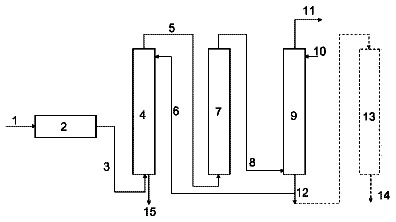
FIG. 2 is a schematic configuration view of a production plant for an embodiment (second embodiment) of a method for producing monocyclic aromatic hydrocarbons according to a second aspect of the invention.
FIG. 3 is a schematic configuration view of a production plant for an embodiment (third embodiment) of a method for producing monocyclic aromatic hydrocarbons according to a second aspect of the invention. BEST MODE FOR CARRYING OUT THE INVENTION First Embodiment
An embodiment of a method for producing monocyclic aromatic hydrocarbons according to a first aspect of the invention will be described.
The method for producing monocyclic aromatic hydrocarbons according to the present embodiment is a method for producing monocyclic aromatic hydrocarbons in which monocyclic aromatic hydrocarbons having 6 to 8 carbon atoms are produced from a feedstock oil including the following steps (a) to (f). In addition, FIG. 1 is a schematic configuration view of a production plant for describing the embodiment.
(a) A cracking and reforming reaction step of obtaining products containing monocyclic aromatic hydrocarbons having 6 to 8 carbon atoms and a heavy fraction having 9 or more carbon atoms by bringing a feedstock oil into contact with a catalyst for producing monocyclic aromatic hydrocarbons using a cracking and reforming reactor 10 to cause a reaction.
(b) A catalyst separation step of separating and removing the catalyst for producing monocyclic aromatic hydrocarbons together with tricyclic aromatic hydrocarbons contained in the products using a cleaning tower 12 and a catalyst separation apparatus 14 from a mixture of the products and the catalyst for producing monocyclic aromatic hydrocarbons carried by the products, both of which are derived in the cracking and reforming reaction step.
(c) A separation step of separating at least the monocyclic aromatic hydrocarbons (benzene/toluene/xylene) having 6 to 8 carbon atoms and a heavy fraction having 9 or more carbon atoms from a derivative derived in the catalyst separation step using a first separation apparatus 16 and a second separation apparatus 18 ,
(d) A purification and recovery step of purifying and recovering the monocyclic aromatic hydrocarbons having 6 to 8 carbon atoms which are separated in the separation step using a purification and recovery apparatus 20 .
(e) A tricyclic aromatic hydrocarbon supply step of supplying tricyclic aromatic hydrocarbons separated from the derivative which is derived in the catalyst separation step in the separation step to the catalyst separation step using returning lines 24 and 26 .
(f) A hydrogen recovery step of recovering hydrogen which is generated as a by-product in the cracking and reforming reaction step from gas components separated in the separation step using a hydrogen recovery apparatus 30 .
Among the steps (a) to (f), the steps (a), (b) and (d) are the essential steps of the first aspect, and the steps (c), (e) and (f) are arbitrary steps.
Hereinafter, the respective steps will be specifically described.
<Cracking and Reforming Reaction Step>
In the cracking and reforming reaction step (a), a feedstock oil is introduced into a cracking and reforming reactor 10 filled with a catalyst for producing monocyclic aromatic hydrocarbons, brought into contact with the catalyst for producing monocyclic aromatic hydrocarbons, and reacted with the catalyst. Then, using saturated hydrocarbons contained in the feedstock oil as a hydrogen donor, polycyclic aromatic hydrocarbons are partially hydrogenated through a hydrogen transfer reaction from the saturated hydrocarbons, and the rings are opened, thereby converting the polycyclic aromatic hydrocarbons into monocyclic aromatic hydrocarbons. In addition, the polycyclic aromatic hydrocarbons can be converted into monocyclic aromatic hydrocarbons by cyclizing and dehydrogenating saturated hydrocarbons that are contained in the feedstock oil or obtained in the cracking step. Furthermore, monocyclic aromatic hydrocarbons having 6 to 8 carbon atoms can also be obtained by cracking monocyclic aromatic hydrocarbons having 9 or more carbon atoms.
However, since tricyclic aromatic hydrocarbons have a low reactivity in the cracking and reforming reaction step in spite of being a hydrogenation reaction product, tricyclic aromatic hydrocarbons are rarely converted to monocyclic aromatic hydrocarbons, and, instead, derived together with other products. The products contain hydrogen, methane, ethane, LPG, a heavy fraction having 9 or more carbon atoms, and the like in addition to monocyclic aromatic hydrocarbons.
In addition, in the cracking and reforming reaction step, when the products are derived, a small amount of the catalyst for producing monocyclic aromatic hydrocarbons is derived due to the products carrying the catalyst. Therefore, in the cracking and reforming reaction step, a mixture of the products and the catalyst for producing monocyclic aromatic hydrocarbons is derived from the cracking and reforming reactor 10 .
(Feedstock Oil)
A feedstock oil used in the embodiment is an oil having a 10 volume percent distillation temperature of 140° C. or higher and a 90 volume percent distillation temperature of 380° C. or lower. When an oil having a 10 volume percent distillation temperature of lower than 140° C. is used, monocyclic aromatic hydrocarbons are produced from a light oil, and therefore the oil becomes unsuitable for the purpose of the embodiment that produces monocyclic aromatic hydrocarbons from the feedstock oil containing polycyclic aromatic hydrocarbons. In addition, in a case in which an oil having a 90 volume percent distillation temperature of higher than 380° C. is used, the yield of monocyclic aromatic hydrocarbons is lowered such that there is a tendency that the amount of coke sediment on the catalyst for producing monocyclic aromatic hydrocarbons increases and thus the activity of the catalyst abruptly decreases.
The 10 volume percent distillation temperature of the feedstock oil is preferably 150° C. or higher, and the 90 volume percent distillation temperature of the feedstock oil is preferably 360° C. or lower.
The 10 volume percent distillation temperature and the 90 volume percent distillation temperature mentioned herein refer to values measured based on JIS K 2254 “Petroleum Products-Determination of Distillation Characteristics”.
Examples of the feedstock oil having a 10 volume percent distillation temperature of 140° C. or higher and a 90 volume percent distillation temperature of 380° C. or lower include light cycle oils (LCO) produced in fluidized catalytic crackers, hydro-refined oils of LCOs, coal-liquefied oils, heavy oil hydrocracking purified oils, straight-run kerosene, straight-run light oils, coker kerosene, coker light oils, oil sand hydrocracking purified oils and the like.
A polycyclic aromatic hydrocarbon is a substance which has a low reactivity and is not easily converted to a monocyclic aromatic hydrocarbon in the cracking and reforming reaction step of the embodiment. However, on the other hand, when hydrogenated in the hydrogenation reaction step, a polycyclic aromatic hydrocarbon is converted to naphthenobenzene, and can be converted to monocyclic aromatic hydrocarbons when supplied back to the cracking and reforming reaction step again for recycling. Therefore, the upper limit of the content of polycyclic aromatic hydrocarbons in the feedstock oil is not particularly limited. However, among polycyclic aromatic hydrocarbons, tri- or more-cyclic aromatic hydrocarbons consume a large amount of hydrogen in the hydrogenation reaction step, and have a low reactivity in the cracking and reforming reaction step even in a hydrogenated form, and therefore the inclusion of a large amount of a polycyclic aromatic hydrocarbon is not preferable. Therefore, the content of tri- or more-cyclic aromatic hydrocarbons in the feedstock oil is preferably 25 volume percent or less, and more preferably 15 volume percent or less.
The feedstock oil which contains bicyclic aromatic hydrocarbons that are converted to naphthenobenzene in the hydrogenation reaction step and have an aim to reduce tri- or more-cyclic aromatic hydrocarbons preferably has a 90 volume percent distillation temperature of, for example, 330° C. or lower.
In addition, the polycyclic aromatic hydrocarbons mentioned herein refer to the total value of the content of bicyclic aromatic hydrocarbons (bicyclic aromatic components) and the content of tri- or more-cyclic aromatic hydrocarbons (tri- or more-cyclic aromatic components) which are measured based on JPI-5S-49 “Petroleum Products-Determination of Hydrocarbon Types-High Performance Liquid Chromatography” or analyzed using FID gas chromatography or two-dimensional gas chromatography. Hereinafter, in a case in which the contents of polycyclic aromatic hydrocarbons, bicyclic aromatic hydrocarbons and tri- or more-cyclic aromatic hydrocarbons are indicated using volume percent, the contents will be values measured based on JPI-5S-49, and, in a case in which the contents are indicated using mass percent, the contents will be values measured based on FID gas chromatography or two-dimensional gas chromatography.
(Reaction Type)
The reaction type when bringing the feedstock oil into contact with the catalyst for producing monocyclic aromatic hydrocarbons to cause a reaction, that is, the reaction type of the cracking and reforming reactor 10 can include a fixed bed type, a moving bed type, a fluidized bed type or the like.
In the embodiment, since a heavy component is used as the raw material, a fluidized bed type is preferable since a coke component deposited to the catalyst can be continuously removed and the reaction can be stably carried out, and a continuous regeneration-type fluidized bed is particularly preferable since the catalyst is circulated between the reactor and a regenerator and the reaction and the regeneration can be continuously repeated. Generally, there are a bed cracking-type fluidized bed and a riser cracking-type fluidized bed; however, in the case of the embodiment, the reaction is desirably carried out under mild conditions using a bed cracking-type fluidized bed. The feedstock oil when brought in contact with the catalyst for producing monocyclic aromatic hydrocarbons is preferably in a gaseous state. In addition, the raw material may be diluted using gas if necessary.
(Catalyst for Producing Monocyclic Aromatic Hydrocarbons)
The catalyst for producing monocyclic aromatic hydrocarbons contains crystalline aluminosilicate.
[Crystalline Aluminosilicate]
The crystalline aluminosilicate is preferably a middle-pore zeolite and/or a large-pore zeolite since the yield of monocyclic aromatic hydrocarbons can be further increased.
The middle-pore zeolite is a zeolite having a skeleton structure with a 10-membered ring, and examples of the middle-pore zeolite include zeolites having AEL type, EUO type, FER type, HEU type, MEL type, MFI type, NES type, TON type and WEI type crystal structures. Among the above zeolites, an MFI-type zeolite is preferable since the yield of monocyclic aromatic hydrocarbons can be further increased.
The large-pore zeolite is a zeolite having a skeleton structure with a 12-membered ring, and examples of the large-pore zeolite include zeolites having AFI type, ATO type, BEA type, CON type, FAU type, GME type, LTL type, MOR type, MTW type and OFF type crystal structures. Among the above zeolites, BEA-type, FAU-type and MOR-type zeolites are preferable due to their industrial applicability, and a BEA-type zeolite is preferable since the yield of monocyclic aromatic hydrocarbons can be further increased.
The crystalline aluminosilicate may contain a small-pore zeolite having a skeleton structure with a 10 or less-membered ring and an ultra large-pore zeolite having a skeleton structure with a 14 or more-membered ring in addition to the middle-pore zeolite and the large-pore zeolite.
Here, examples of the small-pore zeolite include zeolites having ANA type, CHA type, ERI type, GIS type, KFI type, LTA type, NAT type, PAU type and YUG type crystal structures.
Here, examples of the ultra large-pore zeolite include zeolites having CLO type and VPI type crystal structures.
In a case in which a fixed bed-type reaction is employed in the cracking and reforming reaction step, the content of the crystalline aluminosilicate in the catalyst for producing monocyclic aromatic hydrocarbons is preferably in a range of 60% by mass to 100% by mass, more preferably in a range of 70% by mass to 100% by mass, and particularly preferably in a range of 90% by mass to 100% by mass when the content of the entire catalyst for producing monocyclic aromatic hydrocarbons is set to 100% by mass. When the content of the crystalline aluminosilicate is 60% by mass or more, the yield of monocyclic aromatic hydrocarbons can be sufficiently increased.
In a case in which a fluidized bed-type reaction is employed in the cracking and reforming reaction step, the content of the crystalline aluminosilicate in the catalyst for producing monocyclic aromatic hydrocarbons is preferably in a range of 20% by mass to 60% by mass, more preferably in a range of 30% by mass to 60% by mass, and particularly preferably in a range of 35% by mass to 60% by mass when the content of the entire catalyst for producing monocyclic aromatic hydrocarbons is set to 100% by mass. When the content of the crystalline aluminosilicate is 20% by mass or more, the yield of monocyclic aromatic hydrocarbons can be sufficiently increased. When the content of the crystalline aluminosilicate exceeds 60% by mass, the content of a binder that can be incorporated into the catalyst decreases, and thus there are cases in which the catalyst becomes unsuitable for a fluidized bed-type reaction.
[Phosphorous and Boron]
The catalyst for producing monocyclic aromatic hydrocarbons preferably contains phosphorous and/or boron. When the catalyst for producing monocyclic aromatic hydrocarbons contains phosphorous and/or boron, it is possible to prevent the yield of monocyclic aromatic hydrocarbons from decreasing over time, and the generation of coke on the surface of the catalyst can be suppressed.
Examples of a method for adding phosphorous to the catalyst for producing monocyclic aromatic hydrocarbons include a method of supporting phosphorous in the crystalline aluminosilicate, crystalline gallo-aluminosilicate or crystalline zinco-aluminosilicate using an ion-exchange method, an impregnation method or the like, a method of adding a phosphorous compound during the synthesis of a zeolite so as to substitute some of the crystalline aluminosilicate in the skeleton with phosphorous, a method of using a crystallization accelerator containing phosphorous during the synthesis of a zeolite, and the like. A phosphate ion-containing aqueous solution used at this time is not particularly limited, but an aqueous solution prepared by dissolving phosphoric acid, ammonium phosphate dibasic, ammonium dihydrogen phosphate or other water-soluble phosphate at an arbitrary concentration can be preferably used.
Examples of a method for adding boron to the catalyst for producing monocyclic aromatic hydrocarbons include a method of supporting boron in the crystalline aluminosilicate, crystalline gallo-aluminosilicate or crystalline zinco-aluminosilicate using an ion-exchange method, an impregnation method or the like, a method of adding a boron compound during the synthesis of a zeolite so as to substitute some of the crystalline aluminosilicate in the skeleton with boron, a method of using a crystallization accelerator containing boron during the synthesis of a zeolite, and the like.
The content of phosphorous and/or boron in the catalyst for producing monocyclic aromatic hydrocarbons is preferably in a range of 0.1% by mass to 10% by mass, more preferably in a range of 0.5% by mass to 9% by mass, and particularly preferably in a range of 0.5% by mass to 8% by mass when the content of the entire catalyst for producing monocyclic aromatic hydrocarbons is set to 100% by mass. When the content of phosphorous and/or boron with respect to the total mass of the catalyst is 0.1% by mass or more, it is possible to prevent the yield of monocyclic aromatic hydrocarbons from decreasing over time, and, when the content is 10% by mass or less, the yield of monocyclic aromatic hydrocarbons can be increased.
[Gallium and Zinc]
The catalyst for producing monocyclic aromatic hydrocarbons can contain gallium and/or zinc as necessary. When the catalyst for producing monocyclic aromatic hydrocarbons contains gallium and/or zinc, it is possible to increase the generation proportion of monocyclic aromatic hydrocarbons.
Regarding the format of the inclusion of gallium in the catalyst for producing monocyclic aromatic hydrocarbons, the catalyst can contain gallium incorporated into the lattice skeleton of the crystalline aluminosilicate (crystalline aluminosilicate), can contain gallium supported in the crystalline aluminosilicate (gallium-supported crystalline aluminosilicate), or can contain gallium both incorporated into the lattice skeleton of the crystalline aluminosilicate and supported in the crystalline aluminosilicate.
Regarding the format of the inclusion of zinc in the catalyst for producing monocyclic aromatic hydrocarbons, the catalyst can contain zinc incorporated into the lattice skeleton of the crystalline aluminosilicate (crystalline zinco-aluminosilicate), can contain zinc supported in the crystalline aluminosilicate (zinc-supported crystalline aluminosilicate), or can contain zinc both incorporated into the lattice skeleton of the crystalline aluminosilicate and supported in the crystalline aluminosilicate.
The crystalline gallo-aluminosilicate and the crystalline zinco-aluminosilicate have a structure including SiO.sub.4, AlO.sub.4 and GaO.sub.4/ZnO.sub.4 structures in the skeletons. In addition, the crystalline gallo-aluminosilicate and the crystalline zinco-aluminosilicate can be obtained using, for example, gel crystallization through hydrothermal synthesis, a method of inserting gallium or zinc into the lattice skeleton of the crystalline aluminosilicate or a method of inserting aluminum into the lattice skeleton of the crystalline gallo-aluminosilicate or the crystalline zinco-aluminosilicate.
The gallium-supported crystalline aluminosilicate contains gallium supported in the crystalline aluminosilicate using a well-known method such as an ion-exchange method or an impregnation method. A gallium source used at this time is not particularly limited, and examples thereof include gallium salts such as gallium nitrate and gallium chloride, gallium oxides and the like.
The zinc-supported crystalline aluminosilicate contains zinc supported in the crystalline aluminosilicate using a well-known method such as an ion-exchange method or an impregnation method. A zinc source used at this time is not particularly limited, and examples thereof include zinc salts such as zinc nitrate and zinc chloride, zinc oxides and the like.
In a case in which the catalyst for producing monocyclic aromatic hydrocarbons contains gallium and/or zinc, the content of gallium and/or zinc in the catalyst for producing monocyclic aromatic hydrocarbons is preferably in a range of 0.01% by mass to 5.0% by mass, and more preferably in a range of 0.05% by mass to 2.0% by mass when the content of the entire catalyst is set to 100% by mass. When the content of gallium and/or zinc is 0.01% by mass or more, it is possible to increase the generation proportion of monocyclic aromatic hydrocarbons, and, when the content is 5.0% by mass or less, the yield of monocyclic aromatic hydrocarbons can be further increased.
[Shape]
The catalyst for producing monocyclic aromatic hydrocarbons is given, for example, a powder form, a grain form, a pellet form or the like depending on the reaction type. For example, the catalyst is given a powder form in the case of a fluidized bed as in the embodiment, and the catalyst is given a grain form or a pellet form in the case of a fixed bed as in another embodiment. The average grain diameter of the catalyst used in a fluidized bed is preferably in a range of 30 μm to 180 μm, and more preferably in a range of 50 μm to 100 μm. In addition, the bulk density of the catalyst used in a fluidized bed is preferably in a range of 0.4 g/cc to 1.8 g/cc, and more preferably in a range of 0.5 g/cc to 1.0 g/cc.
The average grain diameter refers to the grain diameter located at 50% by mass in a grain diameter distribution obtained by classification using a sieve, and the bulk density is a value measured using the method of Standard No. JIS R 9301-2-3.
In a case in which a grain-form or pellet-form catalyst is obtained, it is possible to incorporate an oxide that is inactive to the catalyst as a binder as necessary and then mold the catalyst using a variety of molding machines.
In a case in which the catalyst for producing monocyclic aromatic hydrocarbons contains an inorganic oxide such as a binder, a phosphorous-containing substance may be used as the binder.
(Reaction Temperature)
The reaction temperature when the feedstock oil is brought into contact with the catalyst for producing monocyclic aromatic hydrocarbons so as to react with the catalyst is not particularly limited, but the reaction temperature is preferably in a range of 400° C. to 650° C. When the lower limit of the reaction temperature is 400° C. or higher, it is possible to facilitate the reaction of the feedstock oil, and the lower limit is preferably 450° C. or higher. In addition, when the upper limit of the reaction temperature is 650° C., it is possible to sufficiently increase the yield of monocyclic aromatic hydrocarbons, and the upper limit is preferably 600° C. or lower.
(Reaction Pressure)
The reaction pressure when the feedstock oil is brought into contact with the catalyst for producing monocyclic aromatic hydrocarbons so as to react with the catalyst is preferably set to 1.5 MPaG or less, and more preferably set to 1.0 MPaG or less. When the reaction pressure is 1.5 MPaG or less, the generation of a byproduct of a light gas can be suppressed, and thus it is possible to use a reaction apparatus with a low pressure resistance.
(Contact Time)
The contact time between the feedstock oil and the catalyst for producing monocyclic aromatic hydrocarbons is not particularly limited as long as a substantially desired reaction proceeds, but is preferably in a range of 1 second to 300 seconds in terms of, for example, the time for gas to pass through the catalyst for producing monocyclic aromatic hydrocarbons, and, furthermore, it is more preferable to set the lower limit to 5 seconds and the upper limit to 150 seconds. When the contact time is 1 second or more, it is possible to ensure the reaction of all the feedstock oil, and, when the contact time is 300 seconds or less, the accumulation of carbonaceous substances on the catalyst due to excessive coking and the like can be suppressed. In addition, the amount of a light gas generated due to decomposition can be suppressed.
<Catalyst Separation Step>
In the catalyst separation step (b), the catalyst is removed from the mixture of the products and the catalyst for producing monocyclic aromatic hydrocarbons (hereinafter, sometimes, simply referred to as catalyst) carried by the products, both of which are derived in the cracking and reforming reaction step (cracking and reforming reactor 10 ). In addition, the tricyclic aromatic hydrocarbons contained in the products are also separated and removed.
That is, the catalyst separation step is configured to include the cleaning tower 12 to which the mixture is supplied and a catalyst separator 14 that separates a heavy fraction derived from the cleaning tower 12 into solid and liquid so as to separate and remove the catalyst.
The operation in the cleaning tower 12 will be described.
The vapor of the product from the cracking and reforming reactor 10 is supplied to a lower portion of the cleaning tower 12 . In the cleaning tower 12 , after a tower bottom liquid of the cleaning tower 12 leaks, the pressure is increased using a pump, and the liquid is cooled using a heat exchanger, circulated to the middle of the cleaning tower 12 . In the cleaning tower 12 , a reaction product of the vapor and the circulated liquid make a countercurrent contact so that catalyst particles which are contained in the reaction product in a small amount and carried from the cracking and reforming reactor 10 are trapped by the circulated liquid, whereby it is possible to remove the catalyst particles from the reaction product. However, the circulated liquid is also circulated, and therefore the circulated liquid in the middle of the cleaning tower 12 also contains a small amount of the catalyst. In a case in which gas and liquid are brought into countercurrent contact with each other, it is not possible to prevent liquid droplets from carrying the catalyst particles, and thus the liquid droplets also contain the catalyst, and therefore, consequently, an extremely small amount of the catalyst remains in the vapor of the reaction product. In order to trap and separate the liquid droplets containing the carried catalyst particles, a heavy fraction separated using the first separation apparatus 16 containing no catalyst and/or a heavy fraction (containing a large amount of tricyclic aromatic hydrocarbons) separated in the purification and recovery step are supplied to the top portion of the cleaning tower 12 . As such, the catalyst particles are removed using a two-step treatment in which a majority of the catalyst is removed using the circulated tower bottom liquid in the bottom portion of the cleaning tower 12 , and, furthermore, the reaction product of the vapor containing an extremely small amount of the catalyst and the heavy fraction from the first separation apparatus 16 which contains no catalyst are brought into countercurrent contact with each other in the top portion, thereby trapping the liquid droplets containing the catalyst.
The cleaning tower 12 , for example, includes a baffle tray in which approximately three theoretical plates are set, and is a machine that separates the catalyst from the product that is cooled and partially liquefied while circulating and cooling the mixture supplied at a high temperature state (for example, 550° C.) in an external cooling machine (not illustrated). In addition, tricyclic aromatic hydrocarbons are supplied to the cleaning tower 12 as a cleaning liquid from the separation step described below. The cleaning liquid cleans the product in a mixed gas-liquid state in the cleaning tower 12 and causes the catalyst contained in the product to be transferred to the cleaning liquid, thereby efficiently separating and removing the catalyst from the product.
In addition, the cleaning tower 12 derives hydrogen, gas components such as methane and ethane, light components such as LPG, monocyclic aromatic hydrocarbons having 6 to 8 carbon atoms, monocyclic aromatic hydrocarbons having 9 or more carbon atoms and some of a heavy fraction having 10 or more carbon atoms from a tower top portion, and also derives heavy fractions such as polycyclic aromatic hydrocarbons, mainly tricyclic aromatic hydrocarbons, or the catalyst from a tower bottom portion. However, since tricyclic aromatic hydrocarbons are supplied to the cleaning tower 12 as the cleaning liquid from the separation step described below, the heavy fraction derived from the tower bottom portion of the cleaning tower 12 contains not all but only some of the tricyclic aromatic hydrocarbons in the mixture in the cleaning tower 12 . That is, not all but only some of the tricyclic aromatic hydrocarbons in the mixture in the cleaning tower 12 are derived from the tower bottom portion. The heavy fraction derived from the tower bottom portion contains heavy fractions such as bicyclic aromatic hydrocarbons in addition to tricyclic aromatic hydrocarbons.
The catalyst separator 14 is configured to include, for example, a filter, and is a machine that separates the heavy fraction containing the catalyst derived from the cleaning tower 12 into solid and liquid, and separates and removes the catalyst from the heavy fraction. The separated catalyst may be, for example, sent to a catalyst regeneration tower (not illustrated), subjected to a regeneration treatment in the tower, and then recycled to the cracking and reforming reaction step, or, when significantly deteriorated, the catalyst may be disposed. The heavy fraction from which the catalyst has been removed, that is, polycyclic aromatic hydrocarbons, mainly tricyclic aromatic hydrocarbons, can be used as a fuel (torch oil) for, for example, heating the catalyst regeneration tower.
<Separation Step>
In the separation step (c), at least monocyclic aromatic hydrocarbons having 6 to 8 carbon atoms and a heavy fraction having 9 or more carbon atoms are separated from a derivative derived from the tower top portion of the cleaning tower 12 (catalyst separation step) using a plurality of separation apparatuses.
That is, the separation step is configured to include the first separation apparatus 16 and the debutanizer (second separation apparatus) 18 in the embodiment. However, the separation step of the embodiment does not necessarily include the above two separation apparatuses, and can also be made up of, for example, a sole distillation apparatus or the like. Therefore, it is also possible not to install the debutanizer (second separation apparatus) 18 . In addition, the separation step may be configured to include a third separation apparatus 22 described below as necessary.
The first separation step 16 separates hydrogen, gas components such as methane and ethane, and a liquid fraction from the derivative. A well-known gas-liquid separation apparatus can be used as the first separation apparatus 16 . Examples of the gas-liquid separation apparatus include an apparatus equipped with a gas-liquid separation tank, a production introduction tube through which a product is introduced into the gas-liquid separation tank, a gas component outflow tube provided in a top portion of the gas-liquid separation tank and a liquid component outflow tube provided in a bottom portion of the gas-liquid separation tank.
The description continues in the full USPTO document.
 Lapsed, fee not paid7 drawings