 Lapsed, fee not paid9 drawings
Cameras, Displays & Optics · US 9,823,614 B2
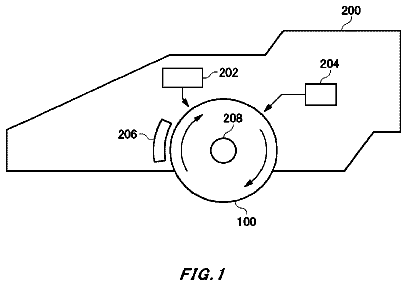
Photoreceptor drum having a flange
To reduce the influence of a coupling pin that fixes a shaft to a photoreceptor drum on rotation of a photoreceptor drum.
US 9,823,623 B2 · Assignee: CITY UNIVERSITY OF HONG KONG · Inventors: Tsang; Peter Wai Ming
Sheet 1 of 20 from the published document. All sheets in the USPTO PDF
Fast processing of information represented in digital holograms is provided to facilitate converting a complex Fresnel hologram into a phase-only hologram, which can be a localized error diffusion and redistribution (LERDR) hologram, for displaying 3-D holographic images representative of a 3-D object scene. For a complex Fresnel hologram representing a 3-D object scene, a holographic generator component (HGC) can directly apply an LERDR process to the complex hologram to facilitate converting the complex hologram into an LERDR hologram. As part of the LERDR process, the HGC can partition the complex hologram into segments, convert the complex values of the pixels in each segment to phase-only values, and apply error diffusion to each segment to facilitate generating the phase-only hologram. The HGC can apply error redistribution to the last pixel of each segment to produce the resulting LERDR hologram, which can be displayed on a phase-only display device.
With the advancement of computers, digital holography has become an area of interest and has gained popularity. Research findings derived from this technology can enable digital holograms to be captured optically or generated numerically, and to be displayed with holographic display devices such as a liquid crystal on silicon (LCoS) display device or a spatial light modulator (SLM) display device. Holograms generated in this manner can be in the form of numerical data that can be recorded, transmitted, and processed using digital techniques. On top of that, the availability of high capacity digital storage and wide-band communication technologies also lead to the emergence of real-time video holography, casting light on the future of, for example, a three-dimensional (3-D) television system. A Fresnel hologram of a 3-D scene can be generated numerically by computing the fringe patterns e
1 of 20 drawing sheets so far from the published document, cropped to the drawing. Every sheet is in the USPTO PDF.
What the patent claimed, word for word. All of it is now free to use.
The subject disclosure relates generally to holograms, e.g., to conversion of complex holograms to phase holograms.
With the advancement of computers, digital holography has become an area of interest and has gained popularity. Research findings derived from this technology can enable digital holograms to be captured optically or generated numerically, and to be displayed with holographic display devices such as a liquid crystal on silicon (LCoS) display device or a spatial light modulator (SLM) display device. Holograms generated in this manner can be in the form of numerical data that can be recorded, transmitted, and processed using digital techniques. On top of that, the availability of high capacity digital storage and wide-band communication technologies also lead to the emergence of real-time video holography, casting light on the future of, for example, a three-dimensional (3-D) television system.
A Fresnel hologram of a 3-D scene can be generated numerically by computing the fringe patterns emerged from each object point to the hologram plane. The Fresnel hologram of the 3-D scene can be used to reconstruct and display 3-D holographic images that can recreate or represent the original 3-D scene from various visual perspectives (e.g., various viewing angles).
A hologram can have a number of advantages. For instance, a hologram can present a true 3-D view of an object scene (e.g., commonly referred to as a reconstructed image) to observers. Also, the reconstructed image can be directly projected onto a display screen without the need of focusing lens. Further, a hologram can be resistant to damage and noise contamination.
A hologram is often considered to be the ultimate solution to 3-D display, as it can record the complex wavefront emitted from a 3-D object scene. A complex hologram can reproduce desirable (e.g., excellent quality) 3-D images that can be free from the unwanted images that can be present in other types of holograms (e.g., amplitude). A desirable scenario can be displaying the complex hologram with a single complex device, employing illumination with a coherent light source (e.g., a light-emitting diode (LED) source).
However, in reality, a conventional system for displaying a complex hologram can have some drawbacks. Since a complex hologram is a complex image, optical integration of a pair of displays to present the real and imaginary components of the complex image, or other pair of orthogonal components, such as magnitude and phase, can be required. Also, due to the fine resolution of a holographic display, precise alignment of a pair of displays can be a significant issue, and can be difficult to achieve in practice. As a result, a display system for displaying complex holograms can be expensive and difficult to construct.
The above-described description is merely intended to provide a contextual overview relating to digital holograms, and is not intended to be exhaustive.
The following presents a simplified summary of various aspects of the disclosed subject matter in order to provide a basic understanding of some aspects described herein. This summary is not an extensive overview of the disclosed subject matter. It is intended to neither identify key or critical elements of the disclosed subject matter nor delineate the scope of such aspects. Its sole purpose is to present some concepts of the disclosed subject matter in a simplified form as a prelude to the more detailed description that is presented later.
One or more embodiments, such as one or more systems, methods, computer readable storage mediums, and techniques disclosed herein, relate to processing and generating holograms. Disclosed herein is a system comprising at least one memory that stores computer-executable components, and at least one processor, coupled to the at least one memory, that facilitates execution of the computer-executable components stored in the at least one memory. The computer-executable components comprising a holographic generator component that receives or generates a complex hologram that represents an object scene, wherein the complex hologram comprises a set of pixels, and the complex hologram comprises a magnitude portion and a phase portion. The computer-executable components also comprising a hologram processor component that partitions the complex hologram into a set of hologram segments comprising a hologram segment, converts a complex value of a pixel of the hologram segment to a phase value, and performs an error diffusion process to facilitate diffusion of an error associated with the complex value being converted to the phase value to facilitate generation of a phase hologram that corresponds to the complex hologram.
Also disclosed herein is a method that comprises converting, by a system comprising a processor, a complex value of a member of a subset of members of a hologram portion of a complex hologram to a phase value, wherein the complex hologram represents an object scene, the complex hologram comprises a magnitude portion and a phase portion, and the complex hologram is partitioned into a set of hologram portions comprising the hologram portion. The method also comprises performing, by the system, an error diffusion process to facilitate diffusing an error associated with the converting of the complex value to the phase value to facilitate generating a phase hologram that corresponds to the complex hologram.
Further disclosed herein is a non-transitory computer-readable medium storing computer-executable instructions that, in response to execution, cause a system comprising a processor to perform operations. The operations comprise partitioning a complex hologram, comprising a set of members, into a set of hologram segments comprising a hologram segment that comprises a subset of members of the set of members, wherein the complex hologram comprises a magnitude portion and a phase portion and represents an object scene. The operations also comprise modifying a complex value of a member of the subset of members of the hologram segment to a phase-only value. The operations further comprise applying an error diffusion process to facilitate diffusing an error associated with the modifying of the complex value to the phase-only value to facilitate generating a phase-only hologram that corresponds to the complex hologram.
The disclosed subject matter also includes a system comprising means for partitioning a complex hologram, comprising a set of pixels, into a set of hologram portions comprising a hologram portion that comprises a subset of pixels of the set of pixels, wherein the complex hologram comprises a magnitude portion and a phase portion and represents an object scene. The system also comprises means for converting a complex value of a pixel of the subset of pixels of the hologram portion to a phase value. The system further comprises means for performing an error diffusion process in connection with the pixel to facilitate diffusing an error associated with the converting of the complex value to the phase value to facilitate generating a phase hologram that corresponds to the complex hologram.
The following description and the annexed drawings set forth in detail certain illustrative aspects of the disclosed subject matter. These aspects are indicative, however, of but a few of the various ways in which the principles of the disclosed subject matter may be employed, and the disclosed subject matter is intended to include all such aspects and their equivalents. Other advantages and distinctive features of the disclosed subject matter will become apparent from the following detailed description of the disclosed subject matter when considered in conjunction with the drawings.
FIG. 1 depicts a block diagram of a system that can efficiently and quickly (e.g., in real time or at least near real time) convert a complex 3-D hologram(s) (e.g., a complex full-parallax 3-D Fresnel hologram(s)) of a real or synthetic 3-D object scene(s) to a phase hologram(s), and display 3-D holographic images, based at least in part on the phase hologram(s), on a display component (e.g., a phase-only or phase-specific display component), in accordance with various aspects and embodiments of the disclosed subject matter.
FIG. 2 depicts a diagram of an example co-ordinate system that can illustrate vertical and horizontal axes of the co-ordinate system in connection with a hologram comprising pixels.
FIG. 3 illustrates a diagram of an example hologram portion that can illustrate the spatial relation between a pixel being processed and its neighbor pixels in the hologram and the diffusion of error associated with that pixel to its neighbor pixels, when the complex hologram is being scanned from left to right (e.g., for an odd row of the hologram), in accordance with various aspects and embodiments of the disclosed subject matter.
FIG. 4 presents a diagram of an example hologram portion that can illustrate the spatial relation between a pixel being processed and its neighbor pixels in the hologram and the diffusion of error associated with that pixel to its neighbor pixels, when the complex hologram is being scanned from right to left (e.g., for an even row of the hologram), in accordance with aspects and implementations of the disclosed subject matter.
FIG. 5 depicts a diagram of an example hologram segment comprising a subset of pixels, in accordance with various aspects and implementations of the disclosed subject matter.
FIG. 6 presents a diagram of an example hologram portion that can illustrate the spatial relation between a visited pixel in a hologram segment (when the pixel is not the last pixel in the segment) and its neighbor pixels for compensation of the error via localized error diffusion, in accordance with various aspects and embodiments of the disclosed subject matter.
FIG. 7 depicts a diagram of an example hologram portion that can illustrate the spatial relation between a visited pixel in the hologram segment (when the pixel is the last pixel in the segment) and its neighbor pixels for compensation of the error via localized error diffusion, in accordance with various aspects and embodiments of the disclosed subject matter.
FIG. 8 illustrates a diagram of an example hologram portion comprising dead pixels to facilitate illustrating how dead pixels can be managed during processing of pixels of a complex hologram, in accordance with various aspects and embodiments of the disclosed subject matter.
FIG. 9 presents an example binary image.
FIG. 10 presents an example grey level image.
FIG. 11 presents another example grey level image.
FIG. 12 presents a numerical reconstructed image of the respective hologram of the example binary image with the magnitude component removed, in accordance with various aspects and implementations of the disclosed subject matter.
FIG. 13 presents a numerical reconstructed image of the respective hologram of the example grey level image with the magnitude component removed, in accordance with various aspects and implementations of the disclosed subject matter.
FIG. 14 presents a numerical reconstructed image of the respective hologram of the other example grey level image with the magnitude component removed, in accordance with various aspects and implementations of the disclosed subject matter.
FIG. 15 presents a numerical reconstructed image of a phase hologram, representing the example binary image, that has been derived from converting the complex hologram of the example binary image to the phase hologram, based at least in part on performing the localized error diffusion and redistribution (LERDR) process on the complex hologram, in accordance with various aspects and embodiments of the disclosed subject matter.
FIG. 16 presents a numerical reconstructed image of a phase hologram, representing the example grey level image, that has been derived from converting the complex hologram of the example grey level to the phase hologram, based at least in part on performing the LERDR process on the complex hologram, in accordance with various aspects and Embodiments of the disclosed subject matter.
FIG. 17 presents a numerical reconstructed image of a phase hologram, representing the other example grey level image, that has been derived from converting the complex hologram of the other example grey level image to the phase hologram, based at least in part on performing the LERDR process on the complex hologram, in accordance with various aspects and embodiments of the disclosed subject matter.
FIG. 18 illustrates a block diagram of an example holographic generator component that can efficiently generate a 3-D phase hologram(s) based at least in part on a 3-D complex hologram(s) of a real or synthetic 3-D object scene(s), in accordance with various aspects and implementations of the disclosed subject matter.
FIG. 19 depicts a system that can employ intelligence to facilitate converting a complex 3-D hologram of a real or synthetic 3-D object scene to a phase hologram to facilitate generating holographic images based at least in part on the phase hologram, in accordance with various aspects and embodiments of the disclosed subject matter.
FIG. 20 illustrates a flow diagram of an example method that can efficiently and quickly convert a complex 3-D hologram(s) of a real or synthetic 3-D object scene(s) to generate a phase hologram(s), in accordance with various aspects and embodiments of the disclosed subject matter.
FIG. 21 depicts a flow diagram of another example method that can efficiently and quickly convert a complex 3-D hologram(s) of a real or synthetic 3-D object scene(s) to generate a phase hologram(s) based at least in part on a LERDR process, in accordance with various aspects and embodiments of the disclosed subject matter.
FIG. 22 is a schematic block diagram illustrating a suitable operating environment.
FIG. 23 is a schematic block diagram of a sample-computing environment.
The disclosed subject matter is described with reference to the drawings, wherein like reference numerals are used to refer to like elements throughout. In the following description, for purposes of explanation, numerous specific details are set forth in order to provide a thorough understanding of the various embodiments of the subject disclosure. It may be evident, however, that the disclosed subject matter may be practiced without these specific details. In other instances, well-known structures and devices are shown in block diagram form in order to facilitate describing the various embodiments herein.
Computer-generated holography (CGH) has undergone encouraging development in the past two decades. One of the major factors leading to the success in CGH can be attributed to the emergence of fast algorithms that can speed up the computation of the digital hologram by a significant amount. On top of that, the rapid advancement of computing and semiconductor technologies have enabled a medium size digital hologram to be generated numerically quickly using a relatively low cost commodity personal computer (PC) and hardware, such as a graphic processing unit (GPU) or a field programmable gate array (FPGA). Despite this somewhat favorable progress in the area of CGH, the display of a hologram can be a difficult problem that can impose, to a certain extent, a bottleneck to the practical realization of the holographic technology.
One problem is that high resolution devices that are capable of displaying holograms, such as Liquid Crystal on Silicon (LCoS) display devices, typically are only capable of displaying either the magnitude component or the phase component of a complex hologram (e.g., a complex amplitude hologram that comprises a magnitude component (e.g., an amplitude magnitude component or portion) (having a magnitude value) and a phase component or portion (having a phase value)). A straightforward solution to this problem is to employ two spatial light modulators (SLMs) to respectively display the real and imaginary components, or the amplitude and phase information, of a complex hologram, and combining the reconstructed images of each component using a certain optical means. Likewise, a complex hologram can be simulated with a double phase-only hologram, and displayed with a pair of phase-only SLMs. In some implementations, the pair of SLMs can be replaced by a single SLM device, displaying a pair of holograms and subsequently merging or integrating the reconstructed wavefront optically through a grating, such as a high-resolution grating.
Although such approaches can be somewhat effective, the optical setups of these conventional approaches can be rather complicated, with a precise alignment of the building blocks being desirable (e.g., required), and can limit their applications in practice. Also, for some conventional methods, such as the method relating to double phase-only holograms, the amount of computation that has to be performed to generate the hologram can make employing such an approach difficult or impractical. Further, when using an approach such as that with the double phase-only hologram, the area of the SLM allocated to each component of the hologram may be reduced to half of its original size.
Another approach can be to convert a complex hologram into an amplitude image by retaining only the real component of the hologram. However, the amplitude hologram is comprised of semi-transparent fringes that can lower optical efficiency, as the illumination beam can be attenuated by the opacity of the fringe patterns. Also, the removal of the imaginary part of the hologram can lead to the undesirable generation of a twin image. Although the twin image can be suppressed at least somewhat by using optical filtering, or by adding an inclined reference beam signal to the complex hologram prior to removing the imaginary component, the twin image can consume about half of the frequency spectrum.
Still another approach can be to generate a pure phase hologram (e.g., a phase-only hologram (POH)) for a 3-D scene (e.g., by converting a complex hologram to a phase-only hologram) and display the hologram on a single phase-only SLM display device. A POH can have a number of attractive features when compared with complex holograms or amplitude holograms. For instance, a reconstructed image of a POH can be inherently free from the zero order diffraction and the twin image. Also, a POH can be directly displayed with a phase-only display device (e.g., a single phase-only spatial SLM display device), and can exhibit higher optical efficiency and a fuller utilization of the frequency spectrum.
Despite these favorable features associated with a POH, there can be problems associated with generating a POH. For instance, using certain conventional techniques that remove the magnitude component can lead to relatively heavy and undesirable (e.g., unacceptable) distortion on or degradation of the reconstructed image. Further, this process can be computationally intensive.
To attempt to alleviate some problems associated with generating a POH, a Gerberg-Saxton algorithm, or an iterative Fresnel transform, often can be adopted to compute the phase hologram in an iterative manner, so that the reconstructed image can match with a target planar image. However, the phase hologram generated with such approaches can be computationally intensive, especially if the object scene is composed of many planar images each positioned at different axial distance from the hologram, and typically such a phase hologram is only applicable to represent a two-dimensional (2-D) image. One conventional method for generating a POH relatively fast can be the “One-Step Phase Retrieval (OSPR) process.” In this OSPR method, a complex hologram is generated from the points in an object space that has been perpetuated with a random phase signal that can be first added to the object points prior to the generation of the digital hologram. Subsequently, a POH can be obtained by retaining only the phase component of the complex hologram. The phase component of the hologram, which may be quantized with thresholding or error diffusion, can be displayed with a phase-only device. The reconstructed images of the holograms generated with the OSPR process generally can be noisy and consequently multiple sub-frames, each representing the same object scene added with different random phase patterns, typically have to be presented rapidly to the observers to try to average out the speckle noise. However, these sub-frames can involve more computation to generate, and also typically have to be displayed at a relatively high frame rate to avoid the visual problem of flickering.
Yet another method has been developed that can quickly convert a complex digital Fresnel hologram into a phase-only hologram, based on bidirectional error diffusion (BERD), to facilitate overcoming the intensive computation issue of conventional approaches and the issues regarding the quality of reconstructed images. Such method for quickly converting a complex digital hologram into a phase-only hologram can involve the associated computation being conducted in a sequential, pixel after pixel manner, for example. Experimental evaluation reveals that high fidelity can be preserved on the reconstructed image of a POH obtained using the BERD technique, as compared to one derived directly from the original complex hologram. With such method, the conversion time can increase as the size of hologram increases, so the conversion time may be undesirably long for larger sized holograms. With older SLM devices, this generally would not be an issue because the size of these older SLM devices can be within 2K-by-2K pixels. However, more recent display devices, such as a high-resolution LCoS display device, can be adopted as holographic display devices and can have a larger size of 4K-by-4K pixels, and it is possible that an even larger 8K-by-8K-sized holographic display will be produced in the near future. As a result, an even faster conversion speed can be desired. Also, the issue of conversion speed can be even more problematic with regard to the display of color holograms, wherein 3 independent phase-only holograms, each representing a different one of the primary colors, have to be generated.
To that end, presented are techniques for fast (e.g., at video rate in real-time or at least near real-time) processing of information represented in digital holograms to facilitate converting a complex Fresnel hologram into a single phase hologram (e.g., a POH, phase-specific hologram, or pure phase hologram), and displaying 3-D holographic images representative of a 3-D object scene on a display device based at least in part on the phase hologram. In accordance with various implementations, the phase hologram can be a localized error diffusion and redistribution (LERDR) hologram that can represent the 3-D object scene and preserve favorable visual quality of the reconstructed holographic image of the 3-D object scene. The LERDR hologram process also can have high optical efficiency, the LERDR hologram can be free from the problems of twin images and zero-order diffraction found in some conventional hologram generation methods.
A holographic generator component (HGC) can receive or generate a complex hologram (e.g., complex full-parallax 3-D Fresnel hologram) that can represent a 3-D object scene from a number of different visual perspectives (e.g., from a number of different viewing angles). In some implementations, the HGC can generate a complex hologram of the 3-D object scene at video rate (e.g., a standard video rate or a video rate of approximately 40 frames per second or faster) in real or near real time.
The HGC can comprise a hologram processor component that can facilitate generating complex holograms, converting complex holograms to phase holograms, and displaying of phase holograms on a display device at a desired rate (e.g., at video rate or faster than video rate, in real-time or at least near real-time). For a complex Fresnel hologram representing a 3-D object scene, the hologram processor component can facilitate directly applying the LERDR process to the complex hologram to facilitate converting the complex hologram into a phase hologram. As part of the LERDR process, the hologram processor component can partition the complex hologram into a set of segments (e.g., segments of the complex hologram), convert the pixels in each segment to respective phase values (e.g., phase-only values), and apply error diffusion to each of the segments to facilitate generating the phase hologram. The hologram processor component also can apply error redistribution to the phase hologram to produce the resulting LERDR hologram. For instance, the hologram processor component can apply error distribution to each segment of the phase hologram to facilitate redistributing the error associated with the last pixel of each segment, so that the error associated with the last pixel in each segment can be diffused to another segment adjacent to such segment in the hologram. In some implementations, the hologram processor component can apply low-pass filtering to a segment (e.g., to the error signal associated with the last pixel of the segment) to facilitate redistributing the error associated with the last pixel of each segment.
With the hologram processor component partitioning the complex hologram into respective segments of the set of segments, the hologram processor component can convert the respective segments of the complex hologram to respective phase hologram segments concurrently (e.g., in parallel), as the LERDR process can be decomposed into individual threads (e.g., associated with respective hologram segments) that can be handled concurrently by the hologram processor component. In some implementations, the hologram processor component can utilize a parallel computing component(s) or architecture, such as, for example, a GPU or FPGA, to facilitate concurrently performing the conversion (e.g., concurrently performing computations that facilitate conversion) of the hologram segments to phase hologram segments. Such parallel processing by the hologram processor component can facilitate significantly speeding up the conversion of a complex hologram to a phase hologram, as compared to conventional techniques for converting a complex hologram to a phase hologram. This can enable the hologram processor component to perform the hologram conversion process (e.g., complex-hologram-to-phase-hologram conversion process) at a relatively high speed even for larger sized holograms (e.g., holograms that are 4,000×4,000 pixels in size or larger), whether black-and-white holograms or color holograms. Also, the hologram processor component can generate or compute the phase hologram (e.g., LERDR hologram), as part of the conversion of the complex hologram to the phase hologram, without requiring the presence of the original object scene during the generation or computation of the phase hologram.
A display device (e.g., a single display device), such as an SLM or an LCoS display device can be used to facilitate displaying 3-D holographic images (e.g., full-parallax 3-D holographic images) that can be reconstructed using the phase hologram (e.g., the LERD hologram). In some implementations, the display device can be a phase-only or phase-specific display device (e.g., phase-only SLM display device or phase-only LCoS display device). With regard to an LERDR hologram, the reconstructed holographic images from the LERDR hologram can exhibit a desirably high fidelity as compared with reconstructed holographic images obtained using the original complex hologram. For instance, the reconstructed holographic images can be free or at least substantially free from zero-order diffraction, twin images, or other problems associated with conventional methods or techniques. Further, in contrast to conventional methods or techniques, no further processing (e.g., no further hologram generation processing, such as, for example, quantization or other type of hologram generation processing) is necessary after the hologram is generated, as the recorded 3-D holographic image can be reconstructed by illuminating the phase hologram (e.g., POH, phase-specific hologram, or pure phase hologram) via a display device using a coherent beam of light. In other implementations, the phase hologram also can be displayed using a static media (e.g., a single static media), such as a photographic film or a printout, comprising information relating to the phase hologram.
Turning to FIG. 1 , illustrated is a block diagram of an example system 100 that can efficiently and quickly (e.g., in real time or at least near real time) convert a complex 3-D hologram(s) (e.g., a complex full-parallax 3-D Fresnel hologram(s)) of a real or synthetic 3-D object scene(s) to a phase hologram(s), and display 3-D holographic images, based at least in part on the phase hologram(s), on a display component (e.g., a phase-only or phase-specific display component), in accordance with various aspects and embodiments of the disclosed subject matter. In an aspect, the system 100 can include a holographic generator component (HGC) 102 that can desirably generate a complex hologram (e.g., a complex hologram of a sequence of 3-D holographic images) that can represent a 3-D object scene (e.g., real or computer-synthesized 3-D object scene) from multiple different viewing perspectives that can correspond to multiple different viewing perspectives of the original 3-D object scene. A complex hologram (e.g., a complex amplitude hologram) is a hologram that can comprise a magnitude component or portion (e.g., an amplitude magnitude component or portion), which can have a magnitude value, and a phase component or portion, which can have a phase value. As more fully disclosed herein, the HGC 102 can convert the complex hologram to a phase hologram (e.g., a phase-only hologram (POH), phase-specific hologram, or pure phase hologram), wherein the phase hologram can be used to generate, reconstruct, or reproduce 3-D holographic images for display to one or more viewers, and wherein the 3-D holographic images can represent or recreate the original 3-D object scene from multiple visual perspectives.
In some embodiments, the HGC 102 and/or other components (e.g., display component 104 ) of the system 100 can be part of a multiple-view aerial holographic projection system (MVAHPS) that can generate and display a 3-D holographic image(s) of a 3-D real or synthetic, static or animated, object scene viewable from multiple perspectives (e.g., multiple angles in relation to the 3-D object scene), wherein the 3-D holographic image(s) can be viewed, for example, as a 3-D image(s) floating in mid-air in a desired display area (e.g., 3-D chamber) associated with the display component 104 . The HGC 102 and display component 104 (e.g., a SLM or LCoS display device, which can be a phase-only or phase-specific display device) can facilitate generating and displaying holograms (e.g., phase holograms) at video rate in real time or near real time (e.g., facilitate generating a complex hologram, converting the complex hologram to a phase hologram, and displaying, for example, 2048×2048-pixel holographic images (or larger-sized hologram), each of which can represent 4 million object points (or more), at approximately 40 frames per second or faster, in real time or near real time).
The HGC 102 can receive (e.g., obtain) a real 3-D object scene (e.g., captured 3-D object scene), or can generate or receive a synthetic 3-D object scene (e.g., computer generated 3-D object scene). In some implementations, the HGC 102 can generate or receive a computer generated 3-D object scene that can be realized (e.g., generated) using numerical means without the presence of a physical or real-world 3-D object scene. Based at least in part on the real or synthetic 3-D object scene, the HGC 102 can generate holograms, wherein the generated holograms (e.g., full-parallax 3-D Fresnel holographic images) can represent or recreate the original 3-D object scene from multiple visual perspectives (e.g., multiple viewing angles).
In some implementations, the HGC 102 can generate model data that can represent the 3-D object scene from a desired number of viewing perspectives, based at least in part on received or generated information regarding the original 3-D object scene from multiple visual perspectives. The HGC 102 also can convert the model data to generate digital holographic data for the 3-D hologram that can be used to facilitate generating and displaying 3-D holographic images that can represent or recreate the original 3-D object scene from multiple visual perspectives.
The HGC 102 can employ any of a variety of techniques or processes to facilitate generating complex 3-D holograms of a 3-D object scene at video rate (e.g., approximately 30 frames per second) or faster in real or near real time. For instance, in some implementations, the HGC 102 can generate holograms, such as digital mask programmable holograms (DMPHs) that can be complex holograms that can be different from the classical digital Fresnel holograms. A DMPH can mimic a high-resolution hologram, but also can be displayed using display devices that can have considerably lower resolution. The HGC 102 can produce a DMPH by the superposition of two images. For instance, the HGC 102 can produce a DMPH that can comprise a static, high-resolution grating (e.g., a static high-resolution image) and a lower-resolution mask (e.g., a lower-resolution image), wherein the lower-resolution mask can be overlaid onto or superpositioned with the high-resolution grating. The HGC 102 can generate a DMPH such that the reconstructed holographic image of the DMPH can be programmed to approximate a target image (e.g., planar target image), including both intensity and depth information, by configuring the pattern of the mask. Employing such fast hologram techniques relating to DMPHs, the HGC 102 can facilitate generating complex holograms at video rate in real or near time (e.g., facilitate generating and displaying, for example, a 2048×2048-pixel hologram, which can represent 4 million object points, at 40 frames per second or faster in real or near real time).
In certain implementations, the HGC 102 can facilitate quickly generating (e.g., at video rate of faster) complex holograms in part, for example, by downsampling information representing an object scene by a defined factor, generating an intermediate object wavefront recording plane (WRP) or an interpolative wavefront recording plane (IWRP) for a 3-D image of a 3-D object scene and/or using a look-up table(s) to store wavefront patterns of square regions of the 3-D image, and further processing (e.g., expanding, interpolating, etc.) the WRP or IWRP to facilitate generating holographic images that can represent the original object scene. Employing such fast hologram generation techniques or processes, the HGC 102 can facilitate generating a complex hologram (e.g., a 2048×2048-pixel complex hologram, which can represent 4 million object points) at 40 frames per second or better. The HGC 102 can efficiently generate complex full-parallax 3-D Fresnel holograms that can represent less than 4 million object points, 4 million object points, or more than 4 million object points, at less than 40 frames per second, 40 frames per second, or more than 40 frames per second. The fast hologram generation techniques or processes, as disclosed herein, are merely a few of a number of fast hologram generation techniques or processes that can be employed to facilitate generating a complex hologram (e.g., a 2048×2048-pixel hologram, which can represent 4 million object points) at 40 frames per second or faster in real or near real time.
To facilitate efficiently, generating, converting, and displaying phase holograms of desirable quality, the hologram processor component 106 can quickly (e.g., at video rate or a faster rate, in real-time or at least near real-time) process information represented in digital holograms to facilitate converting a complex hologram (e.g., a complex full-parallax 3-D digital Fresnel hologram) to a single phase hologram (e.g., a POH, phase-specific hologram, or pure phase hologram), and displaying 3-D holographic images representative of a 3-D object scene on a display component 104 based at least in part on the phase hologram. In accordance with various implementations, the hologram processor component 106 can convert a complex hologram to a phase hologram that can be, for example, a localized error diffusion and redistribution (LERDR) hologram, as more fully disclosed herein. In accordance with various implementations, the LERDR hologram produced by the hologram processor component 106 can represent the 3-D object scene and preserve favorable visual quality of the reconstructed holographic image of the 3-D object scene as compared to the visual quality of a reconstructed holographic image resulting from an original complex hologram. The LERDR hologram process employed by the hologram processor component 106 also can have high optical efficiency, and the LERDR hologram can be free from the problems of twin images and zero-order diffraction that can be found in holograms generated by some conventional hologram generation methods.
For clarity of explanation of the LERDR process, the bidirectional error diffusion (BERD) process and algorithm will now be briefly described. First, consider a complex Fresnel hologram with each pixel represented by P.sub.u;v, wherein u and v can be the vertical and horizontal axes of the co-ordinate system, respectively as shown in FIG. 1( a ) . To convert the hologram into a POH using the BERD process, the hologram processor component 106 can process the hologram sequentially in a row by row manner. For the odd rows and even rows of the hologram, the hologram processor component 106 can scan the pixels of the odd rows from the left-to-right direction, and can scan the pixels of the even rows from the right-to-left direction. The hologram processor component 106 can convert the value (e.g., complex value) of the pixel under evaluation (e.g., being scanned and processed) to a phase-only quantity H.sub.p(u,v) by modifying the magnitude value of the pixel to a “1” or transparent value (e.g., to make the pixel a transparent pixel which can only change the phase angle of the light passing through it), for example, in accordance with (e.g., by employing) Eq. (1), as follows: | H .sub.p( u,v )=1|, and arg ( H .sub.p( u,v ))= arg ( H ( u,v )).
If P.sub.uj;vj is the current pixel, modifying the magnitude value of such pixel to a “1” value (e.g., by the hologram processor component 106 ) can result in an error E(u.sub.j, v.sub.j) that, for example, can be given by Eq. (2), as follows: E ( u .sub.j ,v .sub.j)= H ( u .sub.j ,v .sub.j)− H .sub.p( u .sub.j ,v .sub.j).
The hologram processor component 106 can diffuse the error E(u.sub.j, v.sub.j) associated with that pixel to the neighbor pixels (e.g., other pixels in proximity to the pixel being scanned and processed) that have not been visited (e.g., scanned and processed) previously by the hologram processor component 106 . After the hologram processor component 106 applies Equation
The description continues in the full USPTO document.
About 6,139 words. The USPTO PDF has it with every drawing.
Fees are due 3.5, 7.5 and 11.5 years after grant. This patent expired on November 21, 2025, so the fee marked "not paid" was the one that went unpaid.
CONVERSION OF COMPLEX HOLOGRAMS TO PHASE HOLOGRAMS
Filed Jun 2014 · published Oct 2015Conversion of complex holograms to phase holograms
Filed Jun 2014 · granted Nov 2017Earlier publications, parents and continuations. None of them can still be enforced, or this patent would not be listed.
Prior art cited by the examiner or applicant. Useful when you check your own idea for novelty.
Everything on this page comes from the documents linked above.