Related applications
This application is a §371 application from PCT/EP2014/066423 filed Jul. 30, 2014, which claims priority from French Patent Application No. 13 57578 filed Jul. 31, 2013, each of which is herein incorporated by reference in its entirety.
Field of the invention
The present invention relates to the field of electronics and photography.
The present invention relates more specifically to a picture taking device comprising a plurality of camera modules and which can be connected to a mobile phone or to a digital tablet.
In the remainder of the document, the term “tablet” will be used to denote a digital tablet comprising a processor and a touchscreen. An example of such a tablet is an IPAD® (registered trademark of Apple Inc.) marketed by the Apple Inc., or alternatively the SAMSUNG GALAXY TAB® 2 (registered trademark of Samsung Electronics Co., Ltd.) marketed by the Samsung Electronics Co., Ltd.
The device according to the present invention has a picture taking quality equal to the quality of reflex or D-SLR (Digital Single Lens Reflex) type cameras, particularly in low lighting or very low lighting situations. The device according to the present invention is very compact (it fits into a pocket of a garment so that it is always readily available) and is lightweight. The device according to the invention can be attached by a rigid connector to a mobile phone or to a tablet so as to use the screen thereof by using one or two hands to hold the combination of the phone or tablet and the device according to the present invention. It also offers additional features, such as a large depth of field for example.
Background of the invention
The capture of well exposed images (elements with reflectance at 18% of the scene reaching the middle of the dynamic range in the captured visible image) in very low lighting situations in theory requires the use either of an additional source of light of the flash type, which changes the ambiance of the scene, or of photographic equipment equipped with a highly sensitive sensor and with a wide aperture objective lens so as to capture the maximum amount of light which is too bulky to fit into a pocket of a garment.
In both instances, this is supposed to allow the use of an exposure time that is short enough that it limits the movement blur in the image. The generally accepted rule for defining the maximum exposure time T that can be used as a function of the 35 mm equivalent focal length value f is T=1/f (Xiao, F. Pincenti J., John G. and Johnson K., “Camera motion and mobile imaging”, Proceeding of Electronic Imaging (2007)).
The 35 mm equivalent focal length value currently considered as a reference for fixed focus equipment is between 28 mm and 35 mm. The maximum useable exposure time is therefore between 1/28 s and 1/35 s.
The use of an additional source of light is usually unwelcome because it changes the low-lighting atmosphere of the scene and therefore does not allow the scene being experienced by the individual taking the photo to be recreated.
Photographic equipment equipped with a highly sensitive sensor and with a wide aperture objective lens generally means a reflex camera with interchangeable objective lens.
This type of equipment makes it possible to obtain very high quality images with low noise (high signal to noise ratio (SNR)), a high level of sharpness and texture (high SFR (spatial frequency response) edge and SFR texture values) and a very broad dynamic range.
The noise as used in calculating the SNR can be characterized as measured from the “visual noise” described in D. Baxter, F. Cao, H. Eliasson, J. Phillips. Development of I3A CPIQ spatial metrics. SPIE Conference on Electronic Imaging 2012. This evaluation of the noise allows the variations in luminance and in chrominance in the image to be taken into consideration simultaneously.
The SFR edge and the SFR texture are two measurements of sharpness and of texture. These two measurements are described in the same document under the headings “Edge acutance” and “Texture blur” respectively.
Nevertheless, this type of equipment is heavy and cumbersome, which means that it is not always possible to have it about one's person under all circumstances.
Moreover, the use of a very wide aperture combined with the use of a large sized sensor results in a reduced depth of field, something which on the one hand makes focusing more difficult and on the other hand reduces the number of sharp elements in the image.
Photographic equipment of the reflex camera or DSLR camera type is known in the prior art. This type of equipment has the disadvantage of being bulky and heavy. DSLR cameras make it possible to obtain an excellent quality of image (very good SNR, and very good texture levels) because of the large size of their sensor (diagonals greater than or equal to 22 mm) and the possibility of fitting them with objective lenses with apertures to f/2.0 or better. However, their bulk and weight do not allow them always to be carried about one's person. Furthermore, for most people, their cost is prohibitive.
Photographic equipment incorporated into mobile phones or tablets is also known in the prior art. Most mobile phones or tablets currently on sale now incorporate an image and video capture system. Because of their use, mobile phones or tablets are not very bulky, meaning that they can be carried around everywhere in a pocket of a garment or of a bag. However, because of their compactness, the inbuilt camera also needs to be small in size. The sensor is therefore small in size, its diagonal generally being less than 7 mm, and the optical system is small also, the aperture thereof being at most f/2.0. The small size of the sensor means low sensitivity but a greater depth of field, all of this in comparison with a reflex or DSLR camera. Because the optical system needs to be small in size, its aperture will be small. The camera built into the phone or the tablet will therefore be all the less able satisfactorily to record very low lighting scenes. The exposure time seen with this equipment is of the order of 1/15 s under these conditions. This is longer than the maximum time defined hereinabove that will allow a photo to be taken without movement blur. By default, in low lighting situations, the phone or the tablet will therefore have a tendency to use a flash in order to capture an image without movement blur. In the case of high resolution video recording (HD 1080p video format or better), this 1/15 s exposure time is not compatible with a refresh rate of at least 24 images per second.
Devices of the clip-on camera type are also known from the prior art. Before mobile phones were almost systematically fitted with cameras, some manufacturers offered external camera modules to be connected to the phone. These modules incorporated an optical view finder, a VGA camera and a flash. They allowed the camera functionality to be added to the phone but did not allow pictures to be taken with very high resolution under low lighting conditions.
Devices of the action camera type, such as for example the devices marketed by GOPRO® (registered trademark of Gopro, Inc.), are also known from the prior art. These devices are not intended to be carried around everywhere as they are and are not intended to be connected rigidly to a phone or a tablet. Devices of the action camera type are devices intended chiefly for making videos in so-called sports environments. They are designed to be used with a casing. They are not optimized for capturing stationary images in high resolution under low lighting conditions. They are designed to operate remote from their control screen.
Devices of the surveillance camera type connected to a phone or to a tablet via a wireless device are also known in the prior art. These devices are intended to be left at a fixed location, the phone or the tablet being used only for remote monitoring. As they are not physically attached to the phone or to the tablet, they cannot be used hand-held.
Picture taking systems using matrix cameras are also known in the prior art. By way of example, mention may be made of the systems marketed by the following companies: Lytro, Pelican, Raytrix and Toshiba. These systems have significant disadvantages. For example, the Lytro systems have a low-resolution output (1 MP or megapixel) and require post-capture processing in order to obtain a final image. The Pelican systems have a plurality of (sixteen) low-resolution monochrome sensors. The Raytrix ones are very bulky and need to be connected to a computer. They have a moderate resolution (3 megapixels), very high cost and are not widely available to the public. Finally, the Toshiba systems are mainly designed for detecting distance (3D estimation) and are not designed to output high-resolution images.
Summary of the invention
The problem addressed by the present invention is therefore that of creating a picture taking device which under very low lighting conditions provides a high resolution (13 Mpix or more) visible image, an image quality similar to or better than that obtained through the use of interchangeable objective lens reflex (D-SLR) cameras, while at the same time being small in bulk and weight, allowing it for example to fit into a pocket (of a garment or of a bag).
Within the meaning of the present invention, a low-lighting environment is understood to be scene lighting of below 10 lux.
Within the meaning of the present invention, a raw image is the name given to an image derived from a sensor prior to the demosaicing operation and prior to the application of a color matrix and tone curve. A raw image is made up of pixels of different colors and may be in the Bayer format (for example green and red pixels alternating on the even-numbered rows, with blue and green pixels alternating on the odd-numbered rows) or some other format (for example other combinations of white and/or green and/or red and/or blue pixels). In one alternative form, a raw image is made up of several, notably four, raw images taken consecutively, or a video sequence made up of a series of raw images.
Within the meaning of the invention, a visible image is the name given to a color image (using the YUV, RGB or other coding standard, which may or may not be compressed). A visible image is obtained by the digital processing of a raw image and comprises, at minimum, the operations of demosaicing and application of a color matrix and tone curve.
The digital processing of a raw image in order to obtain a visible image generally involves all or some of the following steps: blackening correction of defective pixels calculation of statistics and estimation of exposure, white balance and autofocus correction of the vignetting and colored vignetting correction of white balance reduction of noise by spatial filtering on a raw image reduction of noise by temporal filtering on raw images demosaicing color matrix tone curve YUV matrix sharpness filter colored fringe reduction filter reduction of noise by spatial filtering on a visible image reduction of noise by temporal filtering on visible images increase of dynamic range by compositing differently exposed images increase of contrast by local contrast algorithm (local tone mapping).
These steps are known to those skilled in the art and notably described in Robert D. Fiete, “ Modeling the Imaging Chain of Digital Cameras ”, SPIE Tutorial Text Vol. TT92.
The following parameters have been taken into consideration when designing the device according to the present invention: L: quantity of light needed to illuminate the scene; D: dimensions; and C: cost.
In the context of the present invention, the desire is to maximize parameter L and to minimize parameters D and C.
To this end, in its widest accepted sense, the present invention relates to a picture taking device which comprises at least three camera modules each comprising a sensor of resolution equal to or higher than thirteen megapixels, a diagonal of the photosensitive surface of the sensor of between 5 mm and 7 mm, an objective lens open at minimum to f/2.0 for at least one focal length value, which also has its own power supply means, which is also able to be connected by a rigid connector to a device of the mobile phone or tablet type comprising a screen, which also comprises means for communicating images and/or commands with said device of the mobile phone or tablet type, which also has dimensions meeting the following criteria: when the picture taking device is not connected to a device of the mobile phone or tablet type, the maximum of the height, of the width and of the depth of the smallest rectangular parallelepiped inside which the device can be inscribed is less than 65 mm, the minimum of these same height, width and depth being less than 25 mm, the volume of said device being less than 65 000 mm.sup.3, and which also comprises digital processing means for reducing noise while preserving the textures in at least one image captured by one of said sensors.
Thus, the picture taking device according to the present invention has a high image quality under low lighting conditions: on the captured subject, with a mean exposure in the final dynamic range, and with details and textures preserved and a low noise level.
Because of its higher aperture objective lenses and the plurality of sensors that it has which are as sensitive as or more sensitive than the objective lens and the sensor of said device of the mobile phone or tablet type, and because of the onboard image processing, the picture taking device has light sensitivity that is superior to that of said device of the mobile phone or tablet type.
According to one embodiment, said device comprises digital processing means comprising calculation means able to produce an image of resolution identical to that of said sensors by a spatial and temporal merger of P*N images captured using the sensors, where P and N are non-zero natural integers and where N denotes the number of camera modules and is greater than or equal to three.
Advantageously, said device comprises means implemented autonomously and/or in combination with means incorporated into said mobile phone or said tablet which in order to produce a visible image of at least thirteen megapixels, is exposed in such a way as to have elements of which the reflectance is 18% in the scene to be captured which reach the middle of the dynamic range in the visible image with an SNR (signal to noise ratio) midway through the dynamic range equal to or greater than 35.5 dB, SFR edge and SFR texture values which differ by less than 10% and which, at one quarter of the Nyquist frequency, are less than or equal to 120% and which, at half the Nyquist frequency, are greater than or equal to 50%, from a capture of images for exposure times of 1/30 s or less of a scene illuminated with light at a lighting level less than or equal to 10 lux.
These means allow the device according to the present invention to record a high resolution video (in the HD 1080p video format or superior) with a refresh rate greater than or equal to thirty images per second for a scene illuminated with ten lux or less, in which video each frame is exposed in such a way as to have elements of which the reflectance is 18% in the scene that is to be recorded which reach half the dynamic range in the video recording, with an SNR midway through the dynamic range of 35.5 dB or better, SFR edge and SFR texture values which differ by less than 10% and which, at one quarter of the Nyquist frequency, are less than or equal to 120% and which, at half the Nyquist frequency, are greater than or equal to 50%.
Advantageously, said merger is performed first of all in the spatial plane and then in the temporal plane.
According to one embodiment, said camera modules are arranged in a line and the number N thereof is equal to three.
According to another embodiment, said camera modules are arranged in a cross and the number N thereof is equal to five.
For preference, some of said camera modules use color sensors whereas others use monochrome sensors.
This allows more light to be captured.
For preference, the picture taking device has no screen to allow the previewing or post-viewing of an image.
The absence of a screen means that the size and cost of the device can be kept down.
According to one embodiment, said means for communicating images and/or commands with said device of the mobile phone or tablet type allow an image taken by said picture taking device to be previewed on the screen of said device of the mobile phone or tablet type.
Advantageously, said means for communicating images and/or commands with said device of the mobile phone or tablet type allow said picture taking device to be controlled using the screen of said device of mobile phone or tablet type.
For preference, said means for communicating images and/or commands with said device of mobile phone or tablet type allow parameters of said picture taking device to be set using the screen of said device of mobile phone or tablet type.
Advantageously, said device comprises noise reduction means which take said merger into consideration.
According to one embodiment, said calculation means used for the merger are hosted remotely on the device of mobile phone or tablet type.
According to one alternative form, said device further comprises means for recording raw images in addition to or in place of the recording of the visible images after digital processing operations have been performed.
According to one embodiment, said rigid connector of said picture taking device is positioned in a hinge allowing its orientation relative to said device to change.
For preference, said picture taking device comprises image processing means allowing digital image stabilization.
According to one alternative form, said picture taking device employs an autofocus function to maximize the sharpness of the subject being photographed and/or filmed.
According to one embodiment, the autofocus function operates continuously so as to keep the subject of interest permanently in focus.
This makes it possible to reduce the latency during the taking of the picture.
According to one embodiment, said device comprises means making it possible to reduce the depth of field in the image and to adjust the focus in the initial depth of field range after capture by modifying the parameters of the spatial merger of the images derived from the camera modules.
According to one embodiment, said device comprises means for exposing some of said camera modules differently so as to capture images with different exposures. The spatial merger is then set up to maintain, on the one hand, the high-light data from the images captured by the underexposed camera modules and, on the other hand, the low-light data from the images captured by the overexposed camera modules. This information is then merged to create an image with a high dynamic range (HDR).
According to one embodiment, said device comprises a button to start the recording.
The button is used to start the taking of the picture or initiate the start of the video recording.
According to one embodiment, said button to start the recording has two modes of operation: partially depressed and fully depressed.
For preference, said device comprises a programmable processor.
According to one embodiment, said device comprises means for transmitting at least one raw image to said device of mobile phone or tablet type in at least one mode of operation.
The present invention also relates to a picture taking method using the picture taking device described above, comprising a step of capturing at 1/30 s or under a scene comprising lighting of 10 lux or below, and a step of producing a visible image of a quality higher than thirteen megapixels, said image being exposed in such a way as to have elements of which the reflectance is 18% in the scene that is to be captured which reach the middle of the dynamic range, with an SNR midway through the dynamic range of 35.5 dB or higher, SFR edge and SFR texture values which differ by less than 10% and which, at a quarter of the Nyquist frequency, are less than or equal to 120% and which, at half the Nyquist frequency, are greater than or equal to 50%.
Brief description of the drawings
The invention will be better understood with the aid of the description, given hereinafter purely by way of explanation, of one embodiment of the invention, with reference to the figures in which:
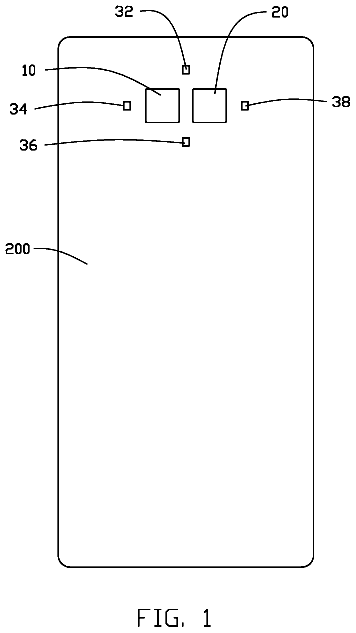
FIG. 1 illustrates the picture taking device according to the present invention, in an embodiment in which the camera modules are arranged in a cross and there are five thereof;
FIG. 2 depicts the picture taking device according to the present invention, in an embodiment in which the camera modules are arranged in a line and there are three of them;
FIG. 3 illustrates the signal to noise ratio midway through the dynamic range as a function of light for the picture taking device according to one embodiment of the present invention and for current mobile phones;
FIG. 4A depicts the device according to the present invention connected to a device of the mobile phone type;
FIG. 4B illustrates the device according to the present invention connected to a device of the digital tablet type;
FIGS. 4C and 4D are rear views of the device according to the present invention connected respectively to a device of the mobile phone type and to a device of the digital tablet type;
FIG. 5 illustrates a camera module comprising a sensor and an optical unit;
FIG. 6 illustrates the picture taking device according to the present invention connected to a device of the phone/tablet type being held by a person;
FIG. 7 depicts the picture taking device according to the present invention connected to a device of the phone/tablet type, held in the hand and with previewing on the screen of the device of phone/tablet type;
FIG. 8 depicts the spectral sensitivities of the color sensors;
FIG. 9 depicts the spectral sensitivity of a black and white sensor;
FIG. 10 illustrates the picture taking device connected to a device of the phone/tablet type in an exploded view of one embodiment of the picture taking device according to the present invention comprising five camera modules measuring 10×10×10 mm each having an objective lens and a sensor, a printed circuit containing the digital processing, a battery and a connector;
FIG. 11 illustrates the picture taking device according to the present invention in an embodiment in the form of a pebble;
FIG. 12 depicts the picture taking device according to the present invention in an embodiment connected to a device of the iPhone type (tradename of the Apple company) via a connector of the “lightning” type;
FIG. 13 illustrates the picture taking device according to the present invention in an embodiment connected to a mobile phone via a connector of the micro USB type;
FIG. 14A depicts the connector of the picture taking device according to the present invention in a hinge system and FIG. 14B illustrates the connector turned in the hinge;
FIG. 15 depicts the picture taking device according to the present invention in an embodiment in the form of a closed pebble;
FIG. 16 depicts the picture taking device according to the present invention in an embodiment in the form of an open pebble;
FIG. 17 illustrates an embodiment in which the device is provided with a removable cap to protect the connector; and
FIGS. 18A and 18B illustrate an embodiment in which the rigid connector is positioned in a hinge within the picture taking device according to the present invention.
Detailed description of the embodiments of the invention
The present invention relates to a picture taking device 10 comprising a plurality of camera modules 21 , 22 , 23 , 24 , 25 each comprising a sensor 30 with resolution equal to or better than thirteen megapixels, a diagonal of the photosensitive surface of the sensor measuring between 5 mm and 7 mm, an objective lens 40 open to the minimum to f/2.0 for at least one focal length value. The picture taking device 10 is able to be connected by a rigid connector 15 to a device 50 of the mobile phone or tablet type comprising a screen. The picture taking device according to the present invention furthermore has its own power supply means 12 and comprises means for communicating images and/or commands with said device of mobile phone or tablet type. It furthermore has digital processing means 14 for reducing noise while at the same time preserving the textures in at least one image captured by one of said sensors.
The picture taking device 10 according to the present invention comprises digital processing means for reducing the noise while preserving the textures. FIG. 10 illustrates the picture taking device connected to a device of the phone/tablet type in an exploded view of one embodiment of the picture taking device according to the present invention comprising five camera modules measuring 10×10×10 mm each having an objective lens 40 and a sensor 30 , a printed circuit containing the digital processing means 14 , a battery 12 and a connector 15 .
These digital processing means 14 for reducing the noise while preserving the textures may be of the non-local mean calculation type as described in A. Buades, B. Coll and J. Morel (2005b), ‘A review of image denoising algorithms, with a new one’, Multiscale Model. Simul. 4, 490-530 or in A. Buades, B. Coll and J. Morel (2008b), ‘Nonlocal image and movie denoising’, Internat. J. Computer Vision 76, 123-139 or of the “block-matching 3D” calculation type as described in K. Dabov, A. Foi, V. Katkovnik and K. Egiazarian (2007), ‘Image denoising by sparse 3D transform-domain collaborative filtering’, IEEE Trans. Image Processing 16, 2080-2095 or in K. Dabov, A. Foi, V. Katkovnik and K. Egiazarian (2009), BM3D image denoising with shape-adaptive principal component analysis. In Proc. Workshop on Signal Processing With Adaptive Sparse Structured Representations: SPARS 09, volume 49.
Said digital processing means comprise calculation means able to produce an image of resolution identical to that of said sensors using a spatial and temporal merger of P*N images captured using the sensors, where P and N are non-zero natural integers and where N denotes the number of camera modules and is greater than or equal to three.
Said device 10 preferably comprises noise reduction means that take said merger into consideration.
In one embodiment, said merger is performed first of all in the spatial plane and then in the temporal plane.
The spatial merger of the N images captured simultaneously by all of the camera modules of the device may be as described in Li Zhang, Sundeep Vaddadi, Hailin Jin, and Shree Nayar, Multiple View Image Denoising, In IEEE Computer Society Conference on Computer Vision and Pattern Recognition, June 2009.
The temporal merger of P images obtained consecutively as output from the spatial merger may be as described in A. Buades, Y. Lou, J. M Morel, Z. Tang, A note on multi-image denoising, Local and Non-Local Approximation in Image Processing, LNLA 2009, pp: 1-15, 2009.
The merger of M=P*N images allows a gain √{square root over (M)} in stops. 3 dB is gained in SNR for each stop gained. Thus, according to an embodiment using five sensors with a sensitive surface diagonal measurement of 6 mm in camera modules each having a volume of 1 cm.sup.3, a spatial merger of N=5 images and a temporal merger of P=4 images provides a gain of 7.5 dB, making it possible to reduce the size of the device according to the invention. Indeed, the sensitivity obtained is then the equivalent of that of a single sensor with a diagonal measurement of around 32 mm (namely a sensor and an objective lens which are 5 times larger in the x and y dimensions than a camera module of the invention) which would need an objective lens with a focal length 4 times longer in order to obtain the same field (namely 4 times greater in the z direction): in order to obtain the same performance under low light, the optical module (sensor+objective lens) would be bulkier by a factor of around 13 (approximately 64 cm.sup.3 rather than 5 cm.sup.3) for the same sensitivity, and would not allow the device to fit in a pocket.
Advantageously, the temporal merger uses what is known as an “antighost” mechanism that makes it possible to discriminate between the images elements which are different and thus avoid merging them. The temporal merger may be performed on the images before demosaicing or after demosaicing.
Advantageously, the separation between the center of one camera module and that of its nearest neighbor is less than 11 mm. When the objective lenses of the camera modules have a 35 mm equivalent focal length of 28 mm, that means that for objects situated more than 15 cm away from the device the disparity between the images captured by each of the camera modules can be limited to values of less than 10% of the width of the image captured by each sensor. As a result, that allows a better spatial merger of these images.
FIG. 1 illustrates the picture taking device 10 according to the present invention, in an embodiment in which said camera modules 21 , 22 , 23 , 24 , 25 are arranged in a cross and in which the number N thereof is equal to five.
FIG. 2 illustrates the picture taking device 10 according to the present invention, in an embodiment in which said camera modules 21 , 22 , 23 are arranged in a line and in which the number N thereof is equal to three.
According to one embodiment, said digital processing means for reducing the noise while preserving the textures are hosted remotely at least in part on the device of mobile phone or tablet type. In this embodiment, the preview digital processing (display of video prior to the picture taking for view finding) and the digital processing of the video for the video recording is performed in the device. In this embodiment, the still image processing is performed as follows. For preference, one or more successive raw images are transferred to the mobile phone or tablet which converts the raw image into a visible image involving noise reduction processing, for example spatial and/or temporal merger of several images and/or spatial noise reduction with the preservation of texture.
As an alternative, a preprocessing operation is performed in the device, for example a spatial merger of the raw images captured by the various sensors, a conversion of raw image to visible image of at least two images, and a post-processing operation of reducing the noise is performed in the phone or the tablet, for example a temporal merger of several images and/or a spatial denoising with the preservation of texture.
As an alternative, one or more successive raw or visible images are transferred to a personal computer or server which carries out a noise reduction processing operation and the conversion of the raw image to the visible image where appropriate.
The noise reduction processing may be carried out automatically with parameters that are predetermined as a function of the sensor gain, or that take account of user settings (denoising level, white balance, contrast, etc).
The processing in the phone or in the tablet may be carried out by software on the main processor and/or by software on the graphic processor and/or by using a component comprising wired or programmable calculation means suited to image processing.
In an alternative form, said device allows the raw images to be recorded in addition to or in place of the recording of the visible images that have undergone digital processing. The user of the device will then be able to apply the digital processing of his choice to the recorded raw images. He will for example be able to apply a spatial merger and a temporal merger involving more or fewer images than those applied in the device.
FIG. 8 depicts the spectral sensitivities of the color sensors and FIG. 9 depicts the spectral sensitivity of a black and white sensor.
Advantageously, some of said camera modules use color sensors while others use monochrome sensors. The monochrome sensors are at least three times as sensitive as the color sensors because each of their pixels collects the photons over the entire spectral band of the visible (390-700 nm) whereas, in the case of color sensors, each pixel collects photons only in the spectral band corresponding to the color that it records. This is illustrated in FIGS. 8 and 9 . The presence of a colored filter also leads to a reduction of the absorption in this same spectral band. Each pixel of a monochrome sensor therefore captures more light than a pixel of a color sensor.
The figures also illustrate the fact that, in one embodiment, the picture taking device 10 according to the present invention comprises a button 17 to start the recording.
The picture taking device 10 according to the present invention has dimensions meeting the following criteria: the maximum of the height, of the width and of the depth of the smallest rectangular parallelepiped inside which said device 10 can be inscribed must be less than 65 mm, the minimum of these same height, width and depth must be less than 25 mm, the volume of the device is less than 65 000 mm.sup.3. Thus, it easily fits into the pocket of a bag or of a garment. This allows the user always to have about his person a picture taking device of digital reflex camera quality allowing pictures to be taken under very low lighting conditions, which can be used in particular for indoor photographs or moving scenes, notably of children. It is possible within this volume and with these dimensions, for example as depicted in FIG. 10 , to house five camera modules each measuring around 1 cm.sup.3, each comprising a sensor with sensitive surface diagonal of 6 mm, an objective lens open to f/2.0 the 35 mm equivalent focal length of which is 28 mm, electronics comprising digital processing means that reduce noise while preserving the textures and communication means according to the invention (approximately 10 cm.sup.3 for the electronics), a battery (approximately 15 cm.sup.3 for 5 Wh using lithium-polymer technology), a rigid connector (approximately 1 cm.sup.3 with the hinge device) and mechanics (approximately 10 cm.sup.3).
FIG. 4A depicts the picture taking device 10 according to the present invention connected to a device 50 of the mobile phone type, in one embodiment. FIG. 4B depicts the picture taking device 10 according to the present invention connected to a device 50 of the digital tablet type, in one embodiment. This device 50 of the mobile phone or tablet type comprises a screen 51 . The picture taking device 10 according to the present invention is connected rigidly to said device 50 of the mobile phone or tablet type: this is not a connection using a flexible cable but rather a wireless connection of the Bluetooth, Wi-Fi or NFC type.
FIGS. 4C and 4D are rear views of the device according to the present invention connected respectively to a device of the mobile phone type and to a device of the digital tablet type.
The rigid connection may adopt a number of forms: a fixed connector fixed to the device according to the invention and that plugs into the corresponding connector belonging to the phone or tablet, and/or a fixed connector fixed to the device according to the invention and able to rotate so that the camera can be aimed in an adjustable direction by the user and that plugs into the corresponding connector belonging to the phone or to the tablet, and/or a mechanical attachment for example using clips it being possible for the connector to be a USB, micro USB, lightning or some other form of connector the connector allowing images to pass to the phone or the tablet during the previewing phase (display of video before the taking of pictures allowing view finding), and/or during the video recording and/or after still images have been captured, and/or allowing commands to pass from the phone or from the tablet to the device according to the invention.
The rigid connection 15 allows the picture taking device 10 /device 50 of the mobile phone or tablet type assembly to be held in one hand, holding the device 50 of the mobile phone or tablet type. The rigid connection allows the picture taking device 10 and device 50 of the mobile phone or tablet type to be held in two hands: one hand to hold the device 50 of mobile phone or tablet type and one hand to press the picture taking button 17 of the picture taking device 10 . Without this rigid connection, it would be very difficult to view find and take pictures using the camera in one hand and the phone or tablet in the other.
FIG. 5 illustrates a camera module comprising a sensor and an optical unit.
FIG. 6 illustrates the picture taking device according to the present invention in this embodiment, held by a person in their hand.
The rigid connection allows the device according to the invention and the phone or tablet to be secured together mechanically and also allows the passage of the electrical signals required for: transmitting images from the device according to the invention to the phone or tablet for previewing the images on the screen of the phone or of the tablet, it being possible for these images to be compressed and decompressed on the fly so as to reduce the bit rate to a format compatible with the phone or with the tablet, for example H264 or H265/CHVC or the like, and/or transmitting commands and/or controls from the phone or the tablet to the device according to the invention, notably: command to take a picture: taking a still image, starting/stopping a video recording, choice of resolution, choice of exposure: aperture, exposure time, sensitivity of the sensor, mode (priority on aperature, priority on exposure time, priority on sensitivity, manual, automatic, etc.) setting of the white balance, autofocus settings (deactivation, choice of area of interest, etc.), image stabilization settings, choice of the type of scene: automatic, landscape, portrait, etc., other camera settings, and/or transmitting commands and/or controls from the device according to the invention to the phone or the tablet, notably: command to take a picture or other commands situated on the device according to the invention and able to influence the application of to the mobile phone or the tablet data regarding the scene and calculated by the device according to the invention and/or by the mobile phone or by the tablet from statistics about the image which are supplied by the device according to the invention to the mobile phone or to the tablet, for example: illuminant determined by the white balance, exposure (exposure time, sensitivity, gain), underexposure alert, movement alert, presence and position of faces, type of scene, etc.
According to one embodiment, the means 13 for communicating images and/or commands to said device 50 of the mobile phone or tablet type allow an image taken by said picture taking device 10 to be previewed on the screen 51 of said device 50 of mobile phone or tablet type. Thus, the user can enjoy the benefit of a large screen, even though the device according to the invention is small in size without a large screen and can fit into a pocket.
FIG. 7 depicts a preview of the scene on the screen of the device of mobile phone type.
In one embodiment, these means 13 allow said picture taking device 10 to be controlled via the screen 51 of said device 50 of the mobile phone or tablet type. Thus, the user may enjoy the benefit of numerous commands and settings, even though the device according to the invention is small in size with a small number of buttons and can fit into a pocket.
The description continues in the full USPTO document.
 Lapsed, fee not paid14 drawings