Lapsed, fee not paid5 drawings
Telecom & Networks · US 9,813,966 B1
Sub-cell power adjustment
A first wireless device is served with an access node.
US 9,813,974 B2 · Assignee: Huawei Technologies Co., Ltd. · Inventors: Xu; Min et al.
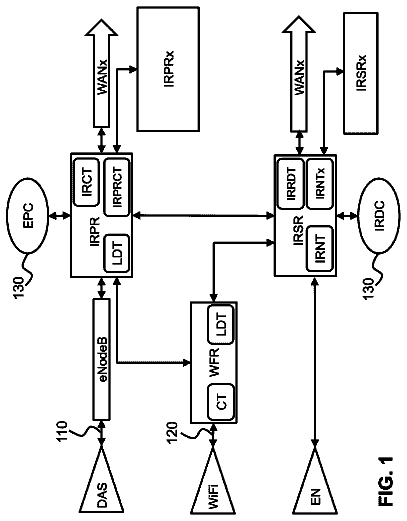
Sheet 1 of 3 from the published document. All sheets in the USPTO PDF
The present application relates to the field of communications technologies. In embodiments of the present application, the UE may first obtain information about a best cell on a secondary frequency and a list of information about cells whose frequency is the same as the secondary frequency. The UE may measure a cell on the secondary frequency, compare information about the cell with the information about the best cell on the secondary frequency, and determine, according to a comparison result, whether to report the event.
A capacity of a WCDMA (Wideband Code Division Multiple Access) system is limited by a downlink capacity; in view of this, a technology such as HSDPA (High Speed Downlink Packet Access) is introduced to WCDMA R5 (Wideband Code Division Multiple Access Release 5), thereby implementing high-speed downlink data transmission. However, in an HSDPA environment, a soft handover cannot be performed on UE (user equipment). Therefore, an MF (multiflow transmission) technology is introduced again, that is, in a soft handover area, multiple links may be configured for UE of HSDPA to send data. After an MF-HSDPA feature is applied, downlink throughput performance of the UE in the soft handover area can be improved, and network resource utilization is also improved. For the MF technology, currently, there may be multiple modes according to a quantity of frequencies and a quantity of cells: an SF-DC (si
All 3 drawing sheets from the published document, cropped to the drawing.
What the patent claimed, word for word. All of it is now free to use.
The present application relates to the field of communications technologies, and in particular, to an information reporting method, an information receiving method, UE, and a network device.
A capacity of a WCDMA (Wideband Code Division Multiple Access) system is limited by a downlink capacity; in view of this, a technology such as HSDPA (High Speed Downlink Packet Access) is introduced to WCDMA R5 (Wideband Code Division Multiple Access Release 5), thereby implementing high-speed downlink data transmission. However, in an HSDPA environment, a soft handover cannot be performed on UE (user equipment). Therefore, an MF (multiflow transmission) technology is introduced again, that is, in a soft handover area, multiple links may be configured for UE of HSDPA to send data. After an MF-HSDPA feature is applied, downlink throughput performance of the UE in the soft handover area can be improved, and network resource utilization is also improved. For the MF technology, currently, there may be multiple modes according to a quantity of frequencies and a quantity of cells: an SF-DC (single frequency-dual cell) mode, a DF-3C (dual frequency-three cells) mode, a DF-4C (dual frequency-four cells) mode, and the like. When a dual-frequency or multiple-frequency mode such as the DF-3C mode is used, the UE can receive downlink data simultaneously in cells on two or multiple frequencies, but the UE performs uplink feedback in a joint coding manner only on a primary frequency. In addition, a DC-HSDPA (dual-carrier High Speed Downlink Packet Access) feature is also introduced, and the UE can receive downlink data on two frequencies simultaneously if there are two inter-frequency co-coverage cells.
With the development of mobile communications technologies, users have increasingly higher requirements. A small cell is introduced to an existing macro network, so that a quantity of system cells can multiply. If a throughput of each cell remains unchanged, a system capacity may multiply (or even increase tenfold). A Hetnet (heterogeneous network) is formed after a small cell is introduced to a macro cell. A small-cell base station may include a home base station, or referred to as a femtocell, an AP (access point), a Pico (a picocell base station), and a Micro (a micro base station).
The introduction of a small-cell base station may have the following advantages: a coverage range is relatively small; a network device cost (small-scale integration), a network deployment cost (a site may not be needed), and a network transmission cost (an IP network may be used) are reduced; a network operation cost is reduced, where for a Small Cell in the Hetnet, contiguous coverage is not needed, and a small amount of planning and automatic network optimization may be achieved based on a SON (self-organizing network) feature; energy is conserved and radiation is low (transmit power of some Small Cells may be lower than transmit power of UE). The small-cell base station is applicable in a wide range of scenarios, such as a home scenario, an enterprise scenario, or a public place scenario; especially, in the scenarios, such as the enterprises scenario and the public place scenario, in which multiple small-cell base stations are needed for continuous networking, the introduction of the small-cell base station is aimed at enhancing coverage of these scenarios, and can also help the macro cell perform service offloading.
For example, in a networking scenario shown in FIG. 1 , a serving HS-DSCH cell (serving high speed downlink shared channel cell) of UE is a Cell 1 on a frequency F 1 . At a point A, a configuration of the UE is DC-HSDPA. When the UE moves from the point A to a point B (a dashed line with an arrow in FIG. 1 indicates a direction of movement of the UE), a Cell 3 interferes with a Cell 2 , where the Cell 3 and the Cell 2 are both on a frequency F 2 , causing that a link of the Cell 2 becomes worse, thereby affecting a throughput of the UE and user experience; at this time, the Cell 3 should be configured for the UE to perform a multiflow transmission operation.
In the scenario shown in FIG. 1, 1 x events, such as a is event, a 1 b event, a is event, and a 1 d event, for measurement of a cell need to be reported. The 1 x events are mainly used to maintain intra-frequency cell measurement and event reporting, mainly aimed at reporting for a cell; for example, the 1 d event indicates that a current best cell changes. To report a 1 x event, one best cell (best cell) needs to be initialized first, where the cell is a cell having the best measurement signal in an active set, and information about the best cell is stored in a 1 d event variable BEST_CELL_1D_EVENT (which is also indicated by TRIGGERED_1D_EVENT sometimes) of the UE; a subsequently measured cell is compared with the cell; if the subsequently measured cell is better than the cell, the UE is triggered to report a 1 d event, and a handover between downlink serving cells is triggered on a network side according to the 1 d event reported by the UE. A 2 x event is mainly aimed at inter-frequency measurement, used to estimate signal quality of all measured cells on a frequency, and is mainly applied to the frequency. For the scenario in FIG. 1 , obviously, the UE needs to report a 1 x event, especially, a 1 d event to enable a network to find the cell 3 and to perform a subsequent operation, such as an operation of changing the serving HS-DSCH cell of the UE to the cell 3 , configuring the UE to perform a DF-3C operation, or configuring an SF-DC operation on the frequency F 2 .
Currently, a DC-HSUPA (dual-carrier High Speed Downlink Packet Access) feature has been introduced, and the UE may send uplink data in two inter-frequency cells. This feature already supports a case in which the UE can use a cell on a secondary (second) frequency as an intra-frequency cell to perform intra-frequency measurement and report 1 x events, such as a 1 a event, a 1 b event, and a 1 c event; however, this feature does not support reporting of a 1 d event. This is because cells on a primary frequency and a secondary frequency appear in pairs, a 1 d event on the secondary frequency is not needed for triggering a handover between downlink serving cells, and only a 1 d event on the primary frequency is needed. However, macro and small cells in a Hetnet scenario are not co-coverage cells, that is, the macro and small cells do not appear in pairs, and therefore reporting of a 1 d event needs to be supported. If a 1 x event needs to be reported, an active set needs to be maintained, which requires all cells in the active set to be related to a soft handover, that is, uplink and downlink links need to be configured for all related cells in a UE active set; if a DC-HSUPA operation meets this condition, the UE simultaneously establishes uplink and downlink links in cells on the secondary frequency. When only an HSDPA-related operation, such as a DC-HSDPA operation, a DF-3C (dual frequency-three cells) operation, or a DF-4C (dual frequency-four cells) operation, is configured, and only a channel related to downlink data transmission, such as an HS-SCCH (high speed shared control channel) or an HS-PDSCH (high speed physical downlink shared channel), is configured on the secondary (second) frequency (such as the frequency F 2 in FIG. 1 ), but a channel such as a DPCH (dedicated physical channel) is not configured, these cells are inconsistent with a definition of an active set, and uplink and downlink data cannot be transmitted simultaneously.
That is, in the scenario shown in FIG. 1 , on the secondary frequency, there is only downlink data and only one serving cell of serving HS-DSCH cell, an active set cannot be maintained, and the UE cannot initialize information about one best cell and therefore cannot subsequently compare information about another cell with the information about the best cell; as a result, the UE cannot report, on the secondary frequency, a 1 d event for a cell.
Embodiments of the present invention provide an information reporting method, an information receiving method, UE, and a network device, which are used to solve a technical problem in the prior art that in an HSDPA environment, UE cannot report, on a secondary frequency, a 1 d event and other 1 x events for a cell.
According to a first aspect of the present invention, an information reporting method is provided. A user equipment (UE) obtains information about a best cell on a secondary frequency and a list of information about cells whose frequency is the same as the secondary frequency. The UE works on a first frequency and the secondary frequency, and the first frequency is different from the secondary frequency. If a report condition is met the UE reports a 1 d event of the secondary frequency to a network device, to notify the network device that the best cell on the secondary frequency changes.
In some embodiments, the obtaining, by UE, information about a best cell on a secondary frequency and a list of information about cells whose frequency is the same as the secondary frequency includes obtaining, by the UE, the information about the best cell on the secondary frequency and the list of the information about the cells whose frequency is the same as the secondary frequency that are sent by the network device.
In some embodiments, the obtaining, by the UE, the information about the best cell on the secondary frequency and the list of the information about the cells whose frequency is the same as the secondary frequency includes: receiving, by the UE, a measurement control message Measurement Control, or a Radio Resource Control protocol connection setup message RRC Connection Setup, or a physical channel reconfiguration message PHYSICAL CHANNEL RECONFIGURATION, or a radio bearer reconfiguration message RADIO BEARER RECONFIGURATION, or a radio bearer setup message RADIO BEARER SETUP that carries the information about the best cell on the secondary frequency and the list of the information about the cells whose frequency is the same as the secondary frequency and is sent by the network device, and obtaining the information about the best cell on the secondary frequency and the list of the information about the cells whose frequency is the same as the secondary frequency.
In some embodiments, the obtaining, by UE, information about a best cell on a secondary frequency and a list of information about cells whose frequency is the same as the secondary frequency includes: setting, by the UE, a cell on the secondary frequency as the best cell on the secondary frequency, and obtaining the information about the best cell on the secondary frequency; and obtaining, by the UE, the list of the information about the cells whose frequency is the same as the secondary frequency that is sent by the network device.
In some embodiments, the obtaining, by the UE, the list of the information about the cells whose frequency is the same as the secondary frequency that is sent by the network device includes: receiving, by the UE, Measurement Control, or RRC Connection Setup, or PHYSICAL CHANNEL RECONFIGURATION, or RADIO BEARER RECONFIGURATION, or RADIO BEARER SETUP that carries the list of the information about the cells whose frequency is the same as the secondary frequency and is sent by the network device, and obtaining the list of the information about the cells whose frequency is the same as the secondary frequency.
In some embodiments, the UE sets a cell on the secondary frequency as the best cell on the secondary frequency. If there is a serving high speed downlink shared channel cell secondary serving HS-DSCH cell that is configured for the UE, on the secondary frequency, the UE sets the secondary serving HS-DSCH cell as the best cell. If there is no secondary serving HS-DSCH cell that is configured for the UE, but an assisting secondary serving high speed downlink shared channel cell assisting secondary serving HS-DSCH cell, which is configured for the UE, on the secondary frequency, the UE sets the assisting secondary serving HS-DSCH cell as the best cell.
In some embodiments, the setting, by the UE, a cell on the secondary frequency as the best cell on the secondary frequency includes: if the UE has an active set, initializing a best cell in the active set to the best cell; and if the UE has no active set, initializing a best cell in a list of information about inter-frequency cells on the secondary frequency or the list of the information about the cells whose frequency is the same as the secondary frequency to the best cell.
In some embodiments, the list of the information about the cells whose frequency is the same as the secondary frequency is a list of information about intra-frequency cells on the secondary frequency, or a list of information about 1 d event of intra-frequency cells on the secondary frequency.
In some embodiments, before the obtaining, by UE, information about a best cell on a secondary frequency and a list of information about cells whose frequency is the same as the secondary frequency, the method further includes: reporting, by the UE to the network device, information about a capability of supporting measurement and reporting of the 1 d event of the secondary frequency.
According to a second aspect of the present invention, an information receiving method is provided. A network device sends information about a best cell on a secondary frequency and a list of information about cells whose frequency is the same as the secondary frequency to UE, or sends the list of the information about the cells whose frequency is the same as the secondary frequency to the UE. The network device receives a 1 d event of the secondary frequency that is reported by the UE when a report condition is met, to determine that the best cell on the secondary frequency changes, where the UE works on a first frequency and the secondary frequency, and the first frequency is different from the secondary frequency.
In some embodiments, in a first possible implementation manner, before the sending, by a network device, information about a best cell on a secondary frequency and a list of information about cells whose frequency is the same as the secondary frequency to UE, or sending, by the network device, the list of the information about the cells whose frequency is the same as the secondary frequency to the UE, the method further includes: receiving, by the network device, information that is about a capability of supporting measurement and reporting of the 1 d event of the secondary frequency and sent by the UE.
In some embodiments, the sending, by a network device, information about a best cell on a secondary frequency and a list of information about cells whose frequency is the same as the secondary frequency to UE, or sending, by the network device, the list of the information about the cells whose frequency is the same as the secondary frequency to the UE includes: sending, by the network device, the information about the best cell on the secondary frequency and the list of the information about the cells whose frequency is the same as the secondary frequency, or the list of the information about the cells whose frequency is the same as the secondary frequency to the UE by using Measurement Control, or RRC Connection Setup, or PHYSICAL CHANNEL RECONFIGURATION, or RADIO BEARER RECONFIGURATION, or RADIO BEARER SETUP.
In some embodiments, the list of the information about the cells whose frequency is the same as the secondary frequency is a list of information about intra-frequency cells on the secondary frequency, or a list of information about 1 d event of intra-frequency cells on the secondary frequency.
According to a third aspect of the present invention, UE includes a plurality of modules. An acquiring module is configured to obtain information about a best cell on a secondary frequency and a list of information about cells whose frequency is the same as the secondary frequency. The UE at least works on a first frequency and the secondary frequency, and the first frequency is different from the secondary frequency. A reporting module is configured to report a 1 d event of the secondary frequency to a network device if a report condition is met, to notify the network device that the best cell on the secondary frequency changes.
In some embodiments, in a first possible implementation manner, the acquiring module is specifically configured to obtain the information about the best cell on the secondary frequency and the list of the information about the cells whose frequency is the same as the secondary frequency that are sent by the network device.
In some embodiments, the acquiring module is specifically configured to receive Measurement Control, or RRC Connection Setup, or PHYSICAL CHANNEL RECONFIGURATION, or RADIO BEARER RECONFIGURATION, or RADIO BEARER SETUP that carries the information about the best cell on the secondary frequency and the list of the information about the cells whose frequency is the same as the secondary frequency and is sent by the network device, and obtain the information about the best cell on the secondary frequency and the list of the information about the cells whose frequency is the same as the secondary frequency.
In some embodiments, the acquiring module is specifically configured to set a cell on the secondary frequency as the best cell on the secondary frequency, and obtain the information about the best cell on the secondary frequency of the best cell on the secondary frequency; and obtain the list of the information about the cells whose frequency is the same as the secondary frequency that is sent by the network device.
In some embodiments, the acquiring module is specifically configured to obtain the list of the information about the cells whose frequency is the same as the secondary frequency that is sent by the network device is specifically: receiving Measurement Control, or RRC Connection Setup, or PHYSICAL CHANNEL RECONFIGURATION, or RADIO BEARER RECONFIGURATION, or RADIO BEARER SETUP that carries the list of the information about the cells whose frequency is the same as the secondary frequency and is sent by the network device, and obtaining the list of the information about the cells whose frequency is the same as the secondary frequency.
In some embodiments, the acquiring module is specifically configured to set a cell on the secondary frequency as the best cell on the secondary frequency is specifically: if there is a secondary serving HS-DSCH cell, which is configured for the UE, on the secondary frequency, setting the secondary serving HS-DSCH cell as the best cell on the secondary frequency; or if there is no secondary serving HS-DSCH cell, which is configured for the UE, but an assisting secondary serving HS-DSCH cell, which is configured for the UE, on the secondary frequency, setting the assisting secondary serving HS-DSCH cell as the best cell on the secondary frequency.
In some embodiments, the acquiring module is specifically configured to set a cell on the secondary frequency as the best cell on the secondary frequency is specifically: if the UE has an active set, initializing a best cell in the active set to the best cell; and if the UE has no active set, initializing a best cell in a list of information about inter-frequency cells on the secondary frequency or the list of the information about the cells whose frequency is the same as the secondary frequency to the best cell.
With reference to the third aspect or any possible implementation manner of the first possible implementation manner to the sixth possible implementation manner, in a seventh possible implementation manner, the list of the information about the cells whose frequency is the same as the secondary frequency is a list of information about intra-frequency cells on the secondary frequency, or a list of information about 1 d event of intra-frequency cells on the secondary frequency.
With reference to the third aspect or any possible implementation manner of the first possible implementation manner to the seventh possible implementation manner, in an eighth possible implementation manner, the reporting module is further configured to report, to the network device, information about a capability of supporting measurement and reporting of the 1 d event of the secondary frequency.
According to a fourth aspect of the present invention, a network device includes a number of modules. A sending module is configured to send information about a best cell on a secondary frequency and a list of information about cells whose frequency is the same as the secondary frequency to UE or to send the list of the information about the cells whose frequency is the same as the secondary frequency to the UE. A receiving module is configured to receive a 1 d event of the secondary frequency that is reported by the UE when a report condition is met, to determine that the best cell on the secondary frequency changes. The UE works on a first frequency and the secondary frequency, and the first frequency is different from the secondary frequency.
In some embodiments, the network device further includes a receiving module, configured to receive information that is about a capability of supporting measurement and reporting of the 1 d event of the secondary frequency and sent by the UE.
In some embodiments, the sending module is specifically configured to send the information about the best cell on the secondary frequency and the list of the information about the cells whose frequency is the same as the secondary frequency, or the list of the information about the cells whose frequency is the same as the secondary frequency to the UE by using Measurement Control, or RRC Connection Setup, or PHYSICAL CHANNEL RECONFIGURATION, or RADIO BEARER RECONFIGURATION, or RADIO BEARER SETUP.
In some embodiments, the list of the information about the cells whose frequency is the same as the secondary frequency is a list of information about intra-frequency cells on the secondary frequency, or a list of information about 1 d event of intra-frequency cells on the secondary frequency.
According to a fifth aspect of the present invention, UE includes a processor and a transmitter. The processor is configured to obtain information about a best cell on a secondary frequency and a list of information about cells whose frequency is the same as the secondary frequency. The UE at least works on a first frequency and the secondary frequency, and the first frequency is different from the secondary frequency. The transmitter is configured to if a report condition is met, report a 1 d event of the secondary frequency to a network device, to notify the network device that the best cell on the secondary frequency changes.
In some embodiments, in a first possible implementation manner, the UE further includes a receiver; and the processor is specifically configured to obtain, by using the receiver, the information about the best cell on the secondary frequency and the list of the information about the cells whose frequency is the same as the secondary frequency that are sent by the network device.
In some embodiments, in a second possible implementation manner, the processor is specifically configured to receive, by using the receiver, Measurement Control, or RRC Connection Setup, or PHYSICAL CHANNEL RECONFIGURATION, or RADIO BEARER RECONFIGURATION, or RADIO BEARER SETUP that carries the information about the best cell on the secondary frequency and the list of the information about the cells whose frequency is the same as the secondary frequency and is sent by the network device, and obtain the information about the best cell on the secondary frequency and the list of the information about the cells whose frequency is the same as the secondary frequency.
In some embodiments, the UE further includes a receiver; and the processor is specifically configured to set a cell on the secondary frequency as the best cell on the secondary frequency, and obtain the information about the best cell on the secondary frequency of the best cell on the secondary frequency; and obtain, by using the receiver, the list of the information about the cells whose frequency is the same as the secondary frequency that is sent by the network device.
In some embodiments, the processor is specifically configured to receive, by using the receiver, Measurement Control, or RRC Connection Setup, or PHYSICAL CHANNEL RECONFIGURATION, or RADIO BEARER RECONFIGURATION, or RADIO BEARER SETUP that carries the list of the information about the cells whose frequency is the same as the secondary frequency and is sent by the network device, and obtain the list of the information about the cells whose frequency is the same as the secondary frequency.
In some embodiments, the processor is specifically configured to set a cell on the secondary frequency as the best cell on the secondary frequency is specifically: if there is a secondary serving HS-DSCH cell, which is configured for the UE, on the secondary frequency, setting the secondary serving HS-DSCH cell as the best cell on the secondary frequency; or if there is no secondary serving HS-DSCH cell, which is configured for the UE, but an assisting secondary serving HS-DSCH cell, which is configured for the UE, on the secondary frequency, setting the assisting secondary serving HS-DSCH cell as the best cell on the secondary frequency.
In some embodiments, the processor is specifically configured to set a cell on the secondary frequency as the best cell on the secondary frequency is specifically: if the UE has an active set, initializing a best cell in the active set to the best cell; and if the UE has no active set, initializing a best cell in a list of information about inter-frequency cells on the secondary frequency or the list of the information about the cells whose frequency is the same as the secondary frequency to the best cell.
In some embodiments, the list of the information about the cells whose frequency is the same as the secondary frequency is a list of information about intra-frequency cells on the secondary frequency, or a list of information about 1 d event of intra-frequency cells on the secondary frequency.
In some embodiments, the transmitter is further configured to report, to the network device, information about a capability of supporting measurement and reporting of the 1 d event of the secondary frequency.
According to a sixth aspect of the present invention, a network device includes a transmitter and a receiver. The transmitter is configured to send information about a best cell on a secondary frequency and a list of information about cells whose frequency is the same as the secondary frequency to UE, or to send the list of the information about the cells whose frequency is the same as the secondary frequency to the UE. The receiver is configured to receive a 1 d event of the secondary frequency that is reported by the UE when a report condition is met, to determine that the best cell on the secondary frequency changes. The UE works on a first frequency and the secondary frequency, and the first frequency is different from the secondary frequency.
In some embodiments, the receiver is further configured to receive information that is about a capability of supporting measurement and reporting of the 1 d event of the secondary frequency and sent by the UE.
In some embodiments, the transmitter is specifically configured to send the information about the best cell on the secondary frequency and the list of the information about the cells whose frequency is the same as the secondary frequency, or the list of the information about the cells whose frequency is the same as the secondary frequency to the UE by using Measurement Control, or RRC Connection Setup, or PHYSICAL CHANNEL RECONFIGURATION, or RADIO BEARER RECONFIGURATION, or RADIO BEARER SETUP.
In some embodiments, the list of the information about the cells whose frequency is the same as the secondary frequency is a list of information about intra-frequency cells on the secondary frequency, or a list of information about 1 d event of intra-frequency cells on the secondary frequency.
In the embodiments of the present invention, UE may obtain information about a best cell on a secondary frequency and a list of information about cells whose frequency is the same as the secondary frequency, and therefore the UE may measure all cells on the secondary frequency according to the list of the information about the cells whose frequency is the same as the secondary frequency, and may compare information about other cells with the information about the best cell; if a report condition is met, the UE may report a 1 d event of the secondary frequency, and notify a network device that the best cell on the secondary frequency changes, so that the network device may perform, according to the 1 d event reported by the UE, a subsequent operation, such as an operation of changing a serving HS-DSCH cell of the UE to a cell 3 , configuring the UE to perform a DF-3C operation, or configuring a SF-DC operation on a frequency F 2 ; in addition, the UE may also report another 1 x event of the secondary frequency, thereby effectively solving a problem in the prior art.
FIG. 1 is a schematic diagram of a networking scenario in the prior art;
FIG. 2 is a main structural block diagram of UE according to an embodiment of the present invention;
FIG. 3 is a main structural block diagram of a network device according to an embodiment of the present invention;
FIG. 4 is a main schematic structural diagram of UE according to an embodiment of the present invention;
FIG. 5 is a main schematic structural diagram of a network device according to an embodiment of the present invention;
FIG. 6 is a main flowchart of an information reporting method according to an embodiment of the present invention; and
FIG. 7 is a main flowchart of an information receiving method according to an embodiment of the present invention.
To make the objectives, technical solutions, and advantages of the embodiments of the present invention clearer, the following clearly describes the technical solutions in the embodiments of the present invention with reference to the accompanying drawings in the embodiments of the present invention. Apparently, the described embodiments are some but not all of the embodiments of the present invention. All other embodiments obtained by a person of ordinary skill in the art based on the embodiments of the present invention without creative efforts shall fall within the protection scope of the present invention.
Technologies described in this specification may be applied to various communications systems, for example, current 2G and 3G communications systems and a next-generation communications system, for example, a Global System for Mobile Communications (GSM), a Code Division Multiple Access (CDMA) system, a Time Division Multiple Access (TDMA) system, a Wideband Code Division Multiple Access system, a Frequency Division Multiple Access (FDMA) system, an Orthogonal Frequency-Division Multiple Access (OFDMA) system, a single-carrier FDMA (SC-FDMA) system, a general packet radio service (GPRS) system, a Long Term Evolution (LTE) system, and other communications systems.
All aspects are described herein with reference to user equipment and/or a network device.
The user equipment may be a wireless terminal or a wired terminal. The wireless terminal may refer to a device that provides a user with voice and/or data connectivity, a handheld device with a radio connection function, or another processing device connected to a radio modem. The wireless terminal may communicate with one or more core networks through a radio access network (RAN). The wireless terminal may be a mobile terminal, such as a mobile phone (also referred to as a “cellular” phone) and a computer with a mobile terminal, for example, may be a portable, pocket-sized, handheld, computer built-in, or in-vehicle mobile apparatus, which exchanges voice and/or data with the radio access network. For example, it may be a device such as a personal communication service (PCS) phone, a cordless telephone set, a Session Initiation Protocol (SIP) phone, a wireless local loop (WLL) station, or a personal digital assistant (PDA). The wireless terminal may also be referred to as a system, a subscriber unit, a subscriber station, a mobile station, a mobile terminal (Mobile), a remote station, an access point, a remote terminal, an access terminal, a user terminal, a user agent, a user device, or user equipment.
The network device may be, for example, a base station, or may be an RNC (radio network controller), or may be a relay device, or may be another network device. The base station (for example, an access point) may refer to a device in communication with a wireless terminal via one or more sectors at an air interface in an access network. The base station may be configured to mutually convert a received over-the-air frame and an IP packet and serve as a router between the wireless terminal and a rest portion of the access network, where the rest portion of the access network may include an Internet protocol (IP) network. The base station may also coordinate attribute management of the air interface. For example, the base station may be a base station (BTS) in GSM or the CDMA, may also be a base station (NodeB) in WCDMA, and may further be an evolved NodeB (eNB, or e-NodeB) in the LTE, which is not limited in the present application.
In addition, the terms “system” and “network” may be used interchangeably in this specification. The term “and/or” in this specification describes only an association relationship for describing associated objects and represents that three relationships may exist. For example, A and/or B may represent the following three cases: Only A exists, both A and B exist, and only B exists. In addition, the character “/” in this specification generally indicates an “or” relationship between the associated objects.
The embodiments of the present invention are further described below in detail with reference to the accompanying drawings of the specification.
An embodiment of the present invention provides an information reporting method. The method includes obtaining, by UE, information about a best cell on a secondary frequency and a list of information about cells whose frequency is the same as the secondary frequency, where the UE at least works on a first frequency and the secondary frequency; and if a report condition is met, reporting, by the UE, a 1 d event of the secondary frequency to a network device, to notify the network device that the best cell on the secondary frequency changes. The network device described herein may be a base station, or may also be an RNC, or may also be a relay device, or may also be another network device.
In this embodiment of the present invention, UE may obtain information about a best cell on a secondary frequency and a list of information about cells whose frequency is the same as the secondary frequency, and therefore the UE may measure all cells on the secondary frequency according to the list of the information about the cells whose frequency is the same as the secondary frequency, and may compare information about other cells with the information about the best cell; if a report condition is met, the UE may report a 1 d event of the secondary frequency, and notify a network device that the best cell on the secondary frequency changes, so that the network device may perform, according to the 1 d event reported by the UE, a subsequent operation, such as an operation of changing a serving HS-DSCH cell of the UE to a cell 3 , an operation of configuring the UE to perform a DF-3C operation, or configuring an SF-DC operation on a frequency F 2 ; in addition, the UE may also report another 1 x event of the secondary frequency, thereby effectively solving a problem in the prior art.
Referring to FIG. 2 , an embodiment of the present invention provides UE. The UE may include an acquiring module 201 and a reporting module 202 .
The acquiring module 201 may be configured to obtain information about a best cell on a secondary frequency and a list of information about cells whose frequency is the same as the secondary frequency, where the UE at least works on a first frequency and the secondary frequency, and the first frequency is different from the secondary frequency.
The reporting module 202 may be configured to: if a report condition is met, report a 1 d event of the secondary frequency to a network device, to notify the network device that the best cell on the secondary frequency changes.
In this embodiment of the present invention, the first frequency is different from the secondary frequency, and the first frequency may be adjacent or may not be adjacent to the secondary frequency. That the UE at least works on a first frequency and the secondary frequency means that the UE receives downlink data at least on the first frequency and the secondary frequency and a network environment at this time is DC-HSDPA, and/or means that the UE performs uplink data transmission at least on the first frequency and the secondary frequency and a network environment at this time is DC-HSUPA (dual-carrier High Speed Uplink Packet Access); the UE may initialize and maintain a UE active set on the secondary frequency; for the 1 d event, a best cell in the active set may be set as a best cell of a 1 d event variable of the UE, and the best cell is stored.
Optionally, in this embodiment of the present invention, the first frequency may be a primary frequency or a Primary uplink frequency that is configured for the UE, and the secondary frequency may be a secondary frequency (second frequency) or a secondary uplink frequency (second uplink frequency) that is configured for the UE.
Optionally, in this embodiment of the present invention, the UE may work at least on the first frequency and the secondary frequency, or the UE may work in an environment of multiple frequencies. For example, if the UE works in an environment that includes at least three frequencies, the first frequency is the primary frequency, any other frequency except the primary frequency is a non-primary frequency, and each non-primary frequency may be referred to as the secondary frequency. At this time, the UE obtains information about a best cell on the non-primary frequency and a list of information about cells whose frequency is the same as the non-primary frequency.
Optionally, in this embodiment of the present invention, the acquiring module 201 may specifically be configured to obtain the information about the best cell on the secondary frequency and the list of the information about the cells whose frequency is the same as the secondary frequency that are sent by the network device.
There may be multiple cells on the secondary frequency, one of which is set as the best cell, and the information about the best cell is the information about the best cell on the secondary frequency. The best cell is a cell having the best signal quality on the secondary frequency or a cell having the least path loss on the secondary frequency.
The list of the information about the cells whose frequency is the same as the secondary frequency includes information about all cells on the secondary frequency, but may not include the information about the best cell on the secondary frequency.
The description continues in the full USPTO document.
About 6,651 words. The USPTO PDF has it with every drawing.
Fees are due 3.5, 7.5 and 11.5 years after grant. This patent expired on November 7, 2025, so the fee marked "not paid" was the one that went unpaid.
Information Reporting Method, Information Receiving Method, UE and Network Device
Filed Sep 2016 · published Dec 2016Information reporting method, information receiving method, UE and network device
Filed Sep 2016 · granted Nov 2017Earlier publications, parents and continuations. None of them can still be enforced, or this patent would not be listed.
Prior art cited by the examiner or applicant. Useful when you check your own idea for novelty.
Everything on this page comes from the documents linked above.