 Lapsed, fee not paid14 drawings
Industrial Equipment · US 9,808,957 B2
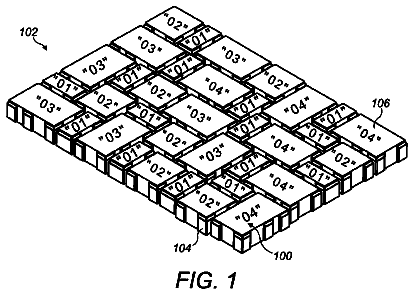
Mould filling method
A method of filling a mold with a settable material, such as a cementitious mixture, is disclosed.
US 9,808,964 B2 · Assignee: BOARD OF TRUSTEES OF MICHIGAN STATE UNIVERSITY · Inventors: Sakamoto; Jeffrey et al.
Sheet 1 of 21 from the published document. All sheets in the USPTO PDF
A method of forming a porous sol gel, including a dried porous sol gel, is provided comprising forming a sol gel from a sol gel-forming composition comprising a silane solution and a catalyst solution; and non-supercritically drying the sol gel to provide a dried porous sol gel having no springback. The dried porous sol gel can include dried macroporous or mesoporous sol gels or dried hybrid aerogels. The materials may contain open or filled pores. Such materials are useful as thermal insulators.
Insulating materials are used as a barrier to maintain a temperature gradient between two spaces. Such materials can be found in the walls, floors and ceilings of buildings, the linings of clothing and in numerous industrial applications, including in thermoelectric applications. Insulating materials have different properties and usages but generally work by preventing heat to be transferred by conduction, convection and/or radiation.
1 of 21 drawing sheets so far from the published document, cropped to the drawing. Every sheet is in the USPTO PDF.
What the patent claimed, word for word. All of it is now free to use.
Insulating materials are used as a barrier to maintain a temperature gradient between two spaces. Such materials can be found in the walls, floors and ceilings of buildings, the linings of clothing and in numerous industrial applications, including in thermoelectric applications. Insulating materials have different properties and usages but generally work by preventing heat to be transferred by conduction, convection and/or radiation.
The various embodiments provide methods of making porous sol gels, including dry porous sol gels such as dried macroporous sol gels and dried hybrid aerogels, as defined herein. The novel porous sol gels include solids which contain a repeating pattern of substantially spherically-shaped solids, such that there is no springback and minimal shrinkage. The dried porous of gels are useful as thermal insulators in a variety of applications.
FIG. 1A is a flow diagram showing a method of making open ambiently dried porous sol gels according to various embodiments.
FIG. 1B is a flow diagram showing a method of making filled ambiently dried porous sol gels according to various embodiments.
FIG. 2 is a flow diagram showing a method of making open ambiently dried hybrid aerogels according to various embodiments.
FIG. 3A is a perspective top view of a mold useful herein according to an embodiment.
FIG. 3B is a perspective bottom view of the mold of FIG. 3A according to an embodiment.
FIG. 3C is a top view of an ambiently dried porous sol gel sandwiched between two mica sheets and contained within the mold of FIGS. 3A and 3B according to an embodiment.
FIG. 3D is a top view of the dried porous sol gel of FIG. 3C after being removed from the mold according to an embodiment.
FIG. 3E is a side view of the dried porous sol gel of FIG. 3D according to an embodiment.
FIGS. 4A-4H are time lapse images of open porous sol gels and conventional aerogels being ambiently dried side-by-side according to an embodiment.
FIG. 5 is a nitrogen adsorption isotherm plot of an open ambiently dried porous sol gel according to an embodiment.
FIG. 6 is a nitrogen adsorption Horvath-Kawazoe Differential Pore Volume Plot of an open ambiently dried porous sol gel according to an embodiment.
FIG. 7 shows thermogravimetric data for an open ambiently dried porous sol gel according to an embodiment.
FIG. 8 is a graph showing thermal conductivity of open ambiently dried porous sol gels according to various embodiments.
FIG. 9A is a scanning electron microscope (SEM) image of a supercritically dried open aerogel which inadvertently includes mesoporous pores.
FIG. 9B is a scanning electron microscope (SEM) image of a supercritically dried open conventional aerogel.
FIG. 10 is a SEM image of an open ambiently dried porous sol gel according to an embodiment.
FIG. 11 are SEM images of open ambiently dried porous sol gels made using different rates of catalyst addition according to various embodiments.
FIGS. 12A-12H are time lapse images of open porous sol gels being ambiently dried according to an embodiment.
FIG. 13 is a graph showing average diameter changes and mass loss from a wet sol gel over time for open ambiently dried porous sol gels according to various embodiments.
FIG. 14 is a plot of thermogravimetric data for an open ambiently dried porous sol gel according to various embodiments.
FIG. 15 is FTIR spectrum showing loss of Si—C surface groups between 300 and 800° C. for open ambiently dried porous sol gels according to various embodiments.
FIG. 16A-16D are SEM images of open ambiently dried porous sol gels after heat treatments according to various embodiments.
FIG. 17 contains images of zirconia-filled (top) and quartz-filled (bottom) ambiently dried porous sol gels over increasing temperatures according to various embodiments.
FIGS. 18A-18D are SEM images of quartz-filled (A, B) and zircon (C, D) ambiently dried porous sol gels after various heat treatments according to various embodiments.
FIG. 19 is a graph showing average dimensional and mass changes from as cast to thy for filled ambiently dried porous sol gels according to various embodiments.
FIG. 20 is a graph showing thermal conductivity of filled ambiently dried porous sol gels in vacuum and in nitrogen atmosphere according to various embodiments.
FIGS. 21A-21C are SEM images of an open ambiently dried hybrid aerogel with surface modifications according to various embodiments.
FIG. 22 is an SEM image of an open dried hybrid aerogel without surface modifications according to an embodiment.
In the following detailed description of embodiments of the invention, embodiments are described in sufficient detail to enable those skilled in the art to practice them, and it is to be understood that other embodiments may be utilized and that chemical, structural and procedural changes may be made without departing from the spirit and scope of the present subject matter. The following detailed description is, therefore, not to be taken in a limiting sense, and the scope of embodiments of the present invention is defined only by the appended claims.
There is a need to develop cost-effective methods for making porous sol gels that can be dried for use as thermal insulators. Attempts to produce aerogels for such purposes, however, have not been successful, as the aerogels are either expensive (e.g., when supercritically dried) or otherwise suffer from shrinkage and/or springback.
The various embodiments described herein provide for methods of making porous sol gels, including non-supercritically dried (e.g., ambiently dried or dried at elevated temperatures and/or elevated or reduced pressures) macroporous or mesoporous sol gels and non-supercritically dried hybrid aerogels, having, the desired properties and/or which can be further processed to have the desired properties, for use in a variety of insulating products as described herein. Various embodiments further provide for dried porous sol gel thermal insulators and structures which include the thermal insulators.
The term “sol gel” as used herein refers to a porous solid network, formed from the solution phase via the hydrolysis and subsequent condensation of appropriate reactants, wherein the pores are filled with solvent. One example of an appropriate reactant is a metal-alkoxide, such as tetraethoxysilane or methyltrimethoxysilane.
The term “hydrolysis” as used herein refers to the chemical conversion of the reactant functional groups to hydroxide groups. One example is the conversion of an alkoxide group OCH.sub.3 to a hydroxide group —OH.
The term “condensation reaction” as used herein refers a condensation portion of a solution-based reaction which follows a hydrolysis reaction. During a condensation reaction water is produced as a byproduct of forming metal-oxide-metal bonds.
The term “aerogel” as used herein refers to a microporous or mesoporous sol gel (as this term is understood in the art) which has been dried under conditions adapted to preserve a majority of volume and porosity of a wet gel. When used without qualification, the term “aerogel” can refer to either an open aerogel or a filled aerogel as defined herein.
The term “springback” as used herein refers to reversible dimensional contraction in a sol gel during the wet to dry transition.
The term “ambiently dried porous sol gel” or “ADPSG” as used herein can refer to an ambiently dried macroporous or mesoporous sol gel (ADSG), as well as to an ambiently dried hybrid aerogel (ADHA). When used without qualification, the term “ambiently dried porous sol gel” can refer to either an open or filled ambiently dried porous sol gel.
The term “open ambiently dried porous sol gel” or “Open ADPSG” as used herein refers to an ambiently dried sol gel containing no fillers. Examples include open ambiently dried macroporous or mesoporous gels and open ambiently dried hybrid aerogels.
The term “filled ambiently dried porous sol gel” or “Filled ADPSG” as used herein refers to ambiently dried macroporous or mesoporous sol gels and ambiently dried hybrid aerogels in combination with fillers, such as powders and/or fibers.
The term “hybrid non-supercritically dried aerogel” as used herein refers to an aerogel made from at least two separately cast sol gels, i.e., a first one at least partially inside a second one, and which has been dried under conditions other than super-critical drying conditions. A hybrid non-supercritically dried aerogel includes at least one microporous or mesoporous sol gel and can further include a macroporous gel. Examples of a hybrid non-supercritically dried aerogel include a “hybrid ambiently dried aerogel” and a hybrid freeze-dried aerogel.
The term “ambiently dried hybrid aerogel” or “ADHA” as used herein refers to a hybrid aerogel that has been dried under ambient drying conditions.
The term “freeze-dried hybrid aerogel” as used herein refers to a hybrid aerogel that has been dried under freeze-dried conditions.
The term “open non-supercritically hybrid dried aerogel” as used herein refers to a non-supercritically dried hybrid aerogel containing no fillers.
The term “filled non-critically dried hybrid aerogel” as used herein refers to a non-critically dried hybrid aerogel in combination with fillers, such as powders and/or fibers.
The term “pore” as used herein refers to a depression, slit, or hole of any size or shape in a solid object. A pore can run completely or partially through an object. Pores can also intersect one another.
The term “macroporous” as used herein refers to a material containing pores with a diameter of greater than about 50 nanometers (nm).
The term “microporous” as used herein refers to a material containing pores with a diameter of less than about 2 nm.
The term “mesoporous” as used herein refers to a material containing pores with a diameter between about 2 and about 50 nm.
The term “solvent” or “pore fluid” as used herein refers to a liquid that can dissolve a solid, liquid, or gas.
The term “drying” as used herein refers to removal of a majority of pore liquid (i.e., solvent) from a porous material, such as a sol gel to produce an aerogel or other dried porous sol gel. Trace amounts of the pore liquid may remain in a porous material that has been dried.
The term “ambient” or “ambient conditions” as used herein refers to conditions under which a porous material is dried such that the pore fluid (i.e., solvent) Changes from liquid phase to a gas phase during removal. As such, ambient conditions can include any temperature between the freezing point and boiling point of the pore fluid, in combination with atmospheric or near-atmospheric pressure (e.g., about 0.9 to about 1.1 atm). Ambient conditions include, for example, room temperatures and ambient pressure. As such, ambient conditions include conditions that may be considered substantially natural, without added or reduced heat or pressure.
The term “supercritical drying conditions” as used herein refers to conditions under which a porous material is heated and pressurized up to or beyond a critical point of the pore fluid (i.e., solvent).
The term “freeze-dried” or “freeze-dried conditions” as used herein refers to conditions under Which a porous material is frozen and then evacuated under vacuum to sublimate away the frozen pore fluid (i.e., solvent).
The term “silica” as used herein refers to SiO.sub.xR.sub.y, wherein x can range from 1.5 to 2, and y can range from 0 to 1).
The term “silane” as used herein refers to a chemical compound with the formula SiR.sub.4, wherein each R is independently selected from any organic radical, including, for example, H, alkyl and/or alkoxy.
The term “insulator” as used herein refers to a material capable of reducing or preventing conduction and/or convection and/or radiation heat transfer.
When used without qualification the term “gel” when used as a noun is understood to refer to a “sol gel.” As noted above, the hybrid aerogels as well as the macroporous or mesoporous gels are all considered to be types of “sol gels.”
Conventional aerogels have insulating properties. Such aerogels are highly porous silica materials which retain a low thermal conductivity (i.e. less than about 0.1 Wm*K), even at temperatures in excess of about 300° C. Conventional aerogels are produced from a liquid mixture that solidifies at room temperature to form a sol gel, which can allow the aerogel to be cast in place on a structure or preformed using a mold. The sol gels are then supercritically dried to extract (i.e., remove) the solvent from the sol gel.
However, the supercritical drying used to extract the solvent from the sol gel to form the aerogel can be an expensive and energy intensive process. Alternative methods have not proven satisfactory, as conventional non-supercritical drying methods produce aerogels that shrink in volume to a significant degree upon being dried and then expand, a phenomenon known as “springback,” which results in an aerogel having a final volume which is larger than the smallest volume obtained by the gel during drying.
Excessive springback (e.g., more than about 20% linear shrinkage, which corresponds with an approximately 49% reduction in volume) can cause a number of problems. For example, excessive springback can cause a gap to form between the gel and the structure (e.g., solid object, encasement, further including any of the structures noted herein such as, but not limited to, heat engines, microelectronics, building, clothing, equipment, pipelines, etc.) in which the aerogel is in contact with. As such, the aerogel is not able to form a proper bond, seal or other connection with the structure, resulting in separation of the aerogel from the structure. Movement of a structure containing a separated aerogel can also cause damage to the structure or otherwise cause the structure to fail. Excessive springback can also cause an aerogel to crack at the interface between the aerogel and the object, a result that is highly undesirable in most applications and particularly with encapsulation of thermoelectrics. Excessive springback can also prevent the ability of an aerogel to be cast around or in a structure altogether.
As noted above, conventional aerogels made under ambient or near ambient conditions are known to shrink significantly upon drying (i.e., about 40% linear shrinkage, which corresponds to an 80% reduction in volume). Shrinkage of an aerogel during drying strains the gel structure which can lead to cracking. As a result, the aerogel can fragment into multiple pieces. A cracked aerogel is also unable to insulate to the same degree as an aerogel which is not cracked. Large amounts of shrinkage can further prevent casting of an aerogel around or in a structure altogether.
In contrast, the various embodiments described herein provide porous sol gels which do not need to be supercritically dried, yet which, upon drying, possess no springback and minimal linear shrinkage (i.e., less than 6%). The lack of springback is due to the morphology of the products described herein, all of which include macropores or mesopores.
Also, in contrast to conventional aerogels, some of which can have a rough, irregular substantially oblong or ellipsoid shape or can otherwise be a type of aggregate that forms an agglomerate, embodiments of the dried porous sol gels described herein have solids which are substantially spherical or “bead-like” in appearance. Specifically, the dried porous sol gels can form a repeating series of solids in a pattern that can be referred to as a “pearl necklace” Which can be oriented in a curved configuration (See, for example FIG. 1A ( 118 A, and FIG. 2, 218 ). In one embodiment, the solids in the macroporous or mesoporous sol gels have the “pearl necklace” appearance. In one embodiment, the solids in the outer larger macroporous or mesoporous sol gel of a hybrid aerogel can have this appearance.
In one embodiment, the dried porous sol gels are hydrophobic. The dried porous sol gels may also be super-hydrophobic. It is likely that heating of the dried porous sol gels to a temperature in excess of 800° C. however, may cause the dried porous sol gels to lose their hydrophobic nature. However, the dried porous sol gels are also stable at high temperatures (i.e., >300° C.) and can be molded in or around a structure without cracking or separating, while maintaining insulation properties as good as, if not better than, conventional aerogels.
The dried open porous sol gels also remain amorphous up to temperatures of at least 1000° C.
In various embodiments, the dried porous sol gel is a non-supercritically dried porous sol gel, such as a macroporous or mesoporous sol gel or a hybrid aerogel containing two separately cast sol gels. (While certain of the gels described in the '730 App were referred to therein as “aerogels,” given the size of the pores, those skilled in the art may instead consider those to be examples of “dried macroporous sol gels”).
In one embodiment, the aerogel is a hybrid aerogel containing at least two separately cast gels. In one embodiment, the hybrid aerogel is ambiently dried. Although ambient drying is a cost effective method, other methods of drying would work as well, including, but not limited to freeze-drying, drying under vacuum and/or drying at an elevated temperature and/or at an elevated pressure. As such, and in contrast to conventional methods, supercritical drying of either type of porous sol gel is not necessary, thus providing a highly cost effective manner for producing dried porous sol gels having properties as good as, if not better than, conventional aerogel. Any of the foregoing porous sol gels and dried porous sol gels can also be open or filled as defined herein.
Various embodiments relate to a method of forming a porous sol gel from a sol gel-forming composition. The sol gel-forming composition can include, in one embodiment, a silane having the chemical structure ASi(OX)(OY)(OZ), wherein A, X, Y, and Z are independently selected from C.sub.1-5 alkyl. The sol gel-forming composition can also include water and a base.
In the embodiment shown in FIG. 1A , a method 100 A for producing an open ambiently dried porous sol gel (Open ADPG) 118 A is provided. The method comprises mixing a catalyst solution 102 with a silane solution 104 to produce a catalyst/silane solution mixture 106 which can be cast in a mold 112 having spacers 113 and allowed to gel (convert from liquid to solid) to produce a wet gel 115 A. The wet gel 115 A is then aged (i.e., the reaction is allowed to go to completion) and dried under ambient conditions to produce the Open ADPG 118 A with no springback and minimal shrinkage, which is useful as a thermal insulator in a number of applications as described herein. While not wishing to be bound by this theory, it is possible that reduced capillary stresses within the open structure of the ambiently dried porous sol gels described herein allows them to dry ambiently without compression. The ambiently dried porous sol gels can be macroporous and/or mesoporous. Various other drying, conditions can also be used as described herein.
In the embodiment shown in FIG. 1B , a method 100 B for producing a filled ambiently dried porous sol gel (Filled ADPG) 118 B is provided. The method begins as in FIG. 1A and comprises mixing a catalyst solution 102 with a silane solution 104 to produce a catalyst/silane solution mixture 106 . However, in this embodiment, the catalyst/silane solution mixture 106 is then mixed with powders and/or fibers 108 to produce a wet mixture 110 which is cast in a mold 112 . In one embodiment (not shown), the powders and/or fibers 108 are alternatively or additionally added to the mold 112 prior to addition of the catalyst/silane solution mixture 106 to produce the wet mixture 110 within the mold 112 . In most embodiments, fibers may be added to the mold 112 directly. In some embodiments, not only has a wet mixture 110 been formed outside the mold 112 , but additional fibers are added to the mold 112 as described above. Once cast in the mold 112 , the wet mixture 110 is allowed to gel to produce a wet gel 115 B. The wet gel 115 B is then allowed to age, and in the embodiment shown, is dried under ambient conditions to produce the Filled ADPG 118 B with no springback and minimal shrinkage. Filled ADPG is useful as a thermal insulator in a number of applications as described herein. Addition of powders and/or fibers 116 in this manner can improve performance as compared to the Open ADPG 118 A of FIG. 1A .
In the embodiment shown in FIG. 2 , a method 200 for producing an open ambiently dried hybrid aerogel (Open ADHA) containing a combination of at least two separately cast porous sol gels including at least one microporous sol gel is provided. The method provides for sequential formation of at least two gels and comprises mixing a catalyst solution 202 with a silane solution 204 to produce a catalyst/silane solution mixture 206 . In the embodiment shown in FIG. 2 , the catalyst/silane solution mixture 206 is then mixed with the Open ADHA gel 118 A from FIG. 1A and cast in a mold 212 , where it gels to produce an open permeated hybrid gel 215 . The open permeated hybrid gel 215 is then allowed to age, and is then ambiently dried to produce the Open ADHA 218 . In this way, the large pores (e.g., macroporous or mesoporous) of the open ADHA 218 are at least partially filled with at least one microporous and/or mesoporous gel to further limit shrinkage, as compared with the open ambiently dried porous gel 118 A. In some embodiments, the open permeated hybrid gel 215 can undergo one or more solvent exchanges and surface modification (e.g., Example 8) to improve surface appearance. In one embodiment, the first porous sol gel (e.g., wet gel 115 A in the embodiment shown in FIG. 2 ) is not dried or is a partially dried wet gel.
The resulting open ADHA 218 comprises two inter-penetrating solid oxide networks which are useful as thermal insulators in a number of applications as described herein. Use of at least two porous sol gels in this manner enhances the ability of the aerogel to provide convective heat transport suppression. In one embodiment, more than two solid oxide networks are used. In one embodiment, at least three gels are cast together sequentially. In one embodiment, the open ambiently dried hybrid aerogel 218 comprises a microporous and/or a mesoporous gel cast inside a mesoporous and/or macroporous gel network. In contrast to gel networks Which rely on concurrent gelation of two different compositions to perform a desired function, the hybrid embodiments described herein comprise at least one silica gel cast inside another previously formed silica gel network. As such, and as noted in FIG. 2 , the open ADHA 218 is formed from two gels that are formed stepwise, i.e., at different times, rather than at substantially the same time.
As with the embodiment shown in FIG. 1B , powders and/or fibers can also be added during the process of FIG. 2 to form filled ambiently dried hybrid aerogels. In one embodiment (not shown), powders and/or fibers are added prior to the components being placed in the mold 212 and/or at the time the components are placed in the mold 212 . Addition of powders and/or fibers in this manner is expected to improve performance of the ambiently dried hybrid aerogel 215 even further.
In any of the above described embodiments, the catalyst solution ( 102 , 202 ) can be added relatively fast, e.g., faster than dropwise, to the silane solution 104 . Surprisingly, addition of the catalyst solution ( 102 , 202 ) quickly results in monolithic porous gels (e.g., 118 A) with improved properties (i.e., no springback, less shrinkage, and the like). In one embodiment, the catalyst solution 102 , 202 ) is added to the silane solution (e.g., 104 , 204 ) at a rate of about 0.01% up to about 0.1% up to about 1% up to about 10% to about 100% catalyst solution ( 102 , 202 ) volume per second, including any range there between, such as about 0.01 to about 50% or about 0.01 to about 20% catalyst solution ( 102 , 202 ) volume per second. In one embodiment, the catalyst solution ( 102 , 202 ) is added to the silane solution ( 104 , 204 ) at a rate of about 1% to about 50% catalyst solution ( 102 , 202 ) per volume, including any range there between. In one embodiment, the catalyst solution ( 102 , 202 ) is added at a rate Of at least 0.01% or at least 0.1% or at least 1% or at least 10% or at least 20% or at least 30% or at least 40% up to at least 50% catalyst solution ( 102 , 202 ) volume per second, including any range there between. In one embodiment, the catalyst solution ( 102 , 202 ) is added at a rate of between about 5% to about 15% catalyst solution ( 102 , 202 ) volume per second. In one embodiment, the catalyst solution ( 102 , 202 ) is added to the silane solution ( 104 , 204 ) at a rate of about 8% to about 12% catalyst solution ( 102 , 202 ) volume per second. In one embodiment, the rate is at least 10%, such as at least 9%, at least 8%, at least 7%, at least 6%, at least 5%, at least 4%, at least 3%, at least 2%, or at least 1% or lower, such as at least 0.1% catalyst solution volume per second.
Of note, addition of the catalyst solution ( 102 , 202 ) to the silane solution ( 104 , 204 ) quickly is in contrast to conventional thinking for producing dried porous gels from a sol gel, since an increased rate of catalyst addition normally leads to an increased amount of precipitates rather than monoliths. However, in the embodiments described herein, when the catalyst solution is added slowly (i.e., at a rate of less than 0.08 mL/sec, i.e., less than 0.01% catalyst solution volume per second), no monolith forms, resulting in a wet mass of material which dries into powders and “chunks.” However, addition of the catalyst solution 102 slowly remains a viable option.
In the various embodiments described above, the wet gel (e.g., FIG. 1A, 115A ) and the open permeated hybrid gel 215 can be removed from their respective molds (e.g., 112 , 212 ) prior to drying. This can allow for a more facile removal of the wet gel (e.g., 115 A) and open permeated hybrid gel ( 215 ) from the mold and can further minimize cracking of the resulting gels. In one embodiment, the porous sol gels dry more quickly when removed while wet or partially wet as more surface area can be exposed to the drying source, e.g., ambient conditions, heated and/or pressurized conditions and/or freeze drying conditions.
The methods described above can further include, in various embodiments, providing a sol gel-forming composition as described herein. In one embodiment, the method includes forming a sol gel from the gel-forming composition and can include drying the gel to produce a dried porous sol gel in conditions other than supercritical drying conditions.
In some embodiments, the dried porous sol gels can be cast in or around a solid object or solid enclosure. In casting a porous sol gel (which can be wet, dried or partially dried), the sol gel-forming composition is added into or around the solid object of solid enclosure and allowed to set. The set sol gel can be allowed to dry, forming the dried porous gel. In other embodiments, the porous sol gel can be cast into a mold, which differs from being cast in or around a solid object or solid enclosure in that the porous sol gel can be removed from the mold prior to, during, or after drying, i.e., when it is a dried porous sol gel. As noted above, the wet gel (e.g., 115 A, 115 B or the open permeated hybrid gel 215 ) can be removed from a mold before drying has completed, such as if there is concern that the porous sol gel may become fused, adhered, bonded, or otherwise stuck or attached to the mold, solid object, or encasement when this feature is not desirable or otherwise to speed the drying process.
Chemical bonding can occur between the porous sol gel and the structure to which it is attached as it dries, such as with some oxide surfaces. In some embodiments, such adherence or bonding can be advantageous. For example, in some embodiments, when the catalyst/silane mixture (e.g., 106 , 206 ) is set in or around a solid object or encasement, the mixture can bond (chemically or otherwise), adhere, stick, or otherwise become attached to the structure. In these instances, removing the catalyst/silane mixture (e.g., 106 , 206 ) from the mold (e.g., 112 , 212 ) prior to allowing the mixture to fully dry can minimize the difficulty associated with a dried porous sol gel sticking to the casting environment.
In some embodiments, the method includes adding a silane, a base, and water together in any suitable order, and in any suitable proportions, such that a sol gel-forming composition is formed. Any suitable optional ingredient can be added to the gel-forming composition. The sol gel can be allowed to set or age, and then the set sol gel can be allowed to thy to provide a dried porous gel. The order of addition of the water, base, and silane can be varied, as is suitable. Any suitable mixing technique can be used to combine the various components.
The mixing can take place for any suitable time, and at any suitable temperature, such as at room temperature. The wet mixture (e.g., 110 ) can be allowed to set for any suitable period. During setting of the wet mixture, the environment around the wet mixture can be kept saturated with particular solvents to prevent the wet mixture from drying out prematurely. Preventing the wet mixture from drying prematurely can allow the structure of the wet gel to form more completely, which can help to allow the wet mixture to experience minimal shrinkage during drying and formation of the dried porous sol gel. An open dish of solvent is one example of a method of keeping the environment around the wet mixture saturated with solvent. Other methods of saturating the air around the wet mixture with an organic solvent will be readily known to one of skill in the art and can include enclosing the wet mixture in plastic, such as a plastic bag.
hi some embodiments, the method includes forming a silane solution. Formation of the silane solution can include addition of the silane, such as methyltrimethoxysilane (MTMS), or such as another C.sub.1-5 alkyltri(C.sub.1-5 alkoxy)silane, to a solvent (e.g. “second solvent”), such as an alcohol (e.g., methanol). In some embodiments, the silane solution can be stirred and/or heated. The method can include formation of a catalyst solution, which, in one embodiment, can include mixing water, solvent (e.g. “second solvent”), and base, such as aqueous ammonium hydroxide. In some embodiments, the catalyst solution can be stirred and/or heated.
The method can include adding one or more fillers, which can include, but are not limited to, one or more powders and/or one or more fibers. The fibers can be sized in any suitable manner, such as by chopping. In one embodiment, the fibers are microscale to macroscale, such as from a few micrometers up to several meters long. In one embodiment, a felt having continuous fibers is used (e.g., silica mat). In some embodiments, the fibers can be placed in the mold or around the solid object or in the encasement and used as a filler to produce filled dried porous gels.
The method can include adding the catalyst mixture to the silane mixture in any suitable manner, with any degree of stirring, and with or without heating or with cooling. The catalyst and silane mixtures can be combined dropwise or quickly, as described herein. In one embodiment, the catalyst and silane mixtures are allowed to fully mix between each addition of the catalyst solution to the silane solution. In one embodiment, the resulting catalyst/silane mixture can be stirred after the addition is completed.
In one embodiment, the resulting catalyst/silane mixture can then be added to the one or more fillers. The resulting wet mixture can then be stirred in any suitable fashion, such that the powders and/or fibers are fully mixed. An example of a suitable stirring method can include, but is not limited to, sonication, or any other suitable stirring method.
In some embodiments, the wet mixture (e.g., 110 in FIG. 1B ) or the catalyst/silane solution mixture (e.g., 106 , 206 in FIGS. 1A and 2 ) can then be poured into a mold, or around or into a solid object or encasement. In addition, in some embodiments, sheets of material can be placed around the material that is not covered by the mold. In one embodiment, sheets of mica or other similar material can be placed around the material that is not covered by the mold. In one embodiment, the mixture can be sandwiched by mica sheets during drying (See, for example, FIGS. 3C and 3D ). The mica can improve handleability, make the dried porous gel easier to extract from the mold, and can provide an initial solid barrier to block the flow of hot gasses through the drying sol gel. After adding the wet mixture to a mold, or around or into a solid object or encasement, which can optionally contain ingredients such as a filler, solvent, or other optional ingredients, the wet mixture can be stirred for any suitable time and by any suitable means, such as with sonication, although the embodiments are not so limited.
The wet mixture can optionally be covered in any suitable fashion to prevent or reduce premature (trying, such as by trapping solvent vapors the exit the wet mixture to prevent additional solvent vapors from leaving the mixture. Any suitable cover material can be used. In one embodiment, the wet mixture can be covered with mica Sheets. Additional solvent can be used to saturate the air around the mixture to prevent solvent from evaporating from the mixture.
At this point, the wet mixture is allowed to gel, as noted above, to form a wet gel (e.g., 115 A, 115 B) or a permeated hybrid gel (e.g., 215 ). The rate of gelation can vary, such as from less than 1 min. to about one day, including any range there between. Longer gelation times can be used, although if shorter time periods produce the desired result, it can save time and expense. In one embodiment, the rate of gelation is no more than 30 min, or no more than 20 ruin, of no more than 15 min, of no more than 10 min, or no more than 8 min, or no more than 6 min. or no more than 4 min., or no more than one min., including any range there between. In one embodiment, gelation time is between about 5 and about 30 min., such as about 10 to 20 min., such as about 14 to 16 min.
The wet sol gel can then set (i.e., age) to allow the condensation reaction to go to completion. In some embodiments, after gelation, while drying is prevented and the gelled mixture sets, hydrolysis of the silane is allowed to proceed in the presence of the water and the base, causing a network to be formed that includes silicon-oxygen bonds. The setting can be allowed to occur for any suitable duration of time. For example, the gelled mixture can be allowed to set for about 1 min, about 5 min, about 10 min, about 15 min, about 20 min, about 30 min, about 40 min, about 50 min, about 1 hour, about 2 hours, about 4 hours, about 8 hours, about 16 hours, about 24 hours, about 48 hours, about 72 hours or higher, such as up to about four to about six days, or about one to three weeks if desired, including any range there between. In most embodiments, it is expected that the mixture ages (the reaction completes) in less than about one day and can be less than about 12 hours, such as no more than about six hours.
After being allowed to set, the set porous sol gel (not shown in figures) can be uncovered and allowed to dry to form the dried porous sol gel as described herein. Drying can occur at ambient temperature and ambient pressure or near-ambient conditions. In one embodiment, the drying can occur in a vacuum environment to facilitate the drying process. In one embodiment, the drying can occur in a, pressurized environment for any suitable reason, for example in environments that must be kept pressurized. In one embodiment, the porous sol gels can be dried, at any temperature between the freezing point and boiling point of the pore fluid. In one embodiment, freeze drying is used. In some embodiments, drying can occur in a slightly heated or in a very heated environment, which in some embodiments can hasten drying. The drying environment can additionally or alternatively be well-ventilated to hasten drying. Additionally, depending on the base and solvents used, for example, a well-ventilated environment can help to reduce exposure to fumes from the drying sol gel. Although one could supercritically dry the various porous sol gels described herein, that would only add to the cost and complexity of the process.
In some embodiments, before the set sol gel is fully dried it can be placed in, immersed in, or subjected to a solvent bath. In some examples, any method of contacting the drying sol gel and the solvent bath liquid can be used. In one example, the solvent bath is an ethanol bath. In some examples, the bath can help to wash materials out of the sol gel, including out of pores of the gel, such as unreacted liquids or other liquids, and such as soluble solids or suspended solids. The material washed out of the sol gel can include, but is not limited to, methanol, ammonia, water, or residual silane such as methyltrimethoxysilane (MTMS). The solvent can be any suitable solvent, such as an aqueous liquid, or an organic liquid such as any organic solvent given herein. In other embodiments, no washing or bath step occurs, and the drying gel is allowed to dry with natent liquid in the pores.
One of skill in the art will readily recognize that in certain embodiments, variations of this method can be performed without departing from the method described. For example, a variety of containers can be used for the mixing of ingredients, a variety of formulations are encompassed as acceptable compositions as described herein, a variety of mixing and heating or cooling conditions can be used during any of the stages of the method, a variety of molds, solid objects and encasements can be used including various shapes and sizes, and a variety of ventilation conditions can be employed.
In one embodiment, the molds ( 112 , 212 ) can be of any desired shape and size. FIG. 3A illustrates a perspective top view of a mold 312 containing post supports 311 and a mold container 325 which may be useful herein. As such. FIG. 3A can be considered the “negative mold” prior to casting. The bottom perspective view shown in FIG. 3B reveals the rigid posts or thermoelectric leg inserts 320 supported by the post supports 311 and contained within the mold container 325 . The thermoelectric leg inserts 320 are useful to create an opening (i.e., spacer) of a desired size into a sol gel which is poured into the mold 312 . The thermoelectric leg inserts 320 can be any suitable size and shape, such as on the order of millimeters or centimeters or larger or smaller.
A wet mixture (e.g., FIG. 1B, 110 ) can be added to the mold 312 and allowed to gel, age and, optionally, also dry in the mold 312 . In one embodiment, outer sheets, such as a lower mica sheet 317 A, can be added to the mold 312 prior to addition of the wet mixture (e.g., 110 ), with an upper mica sheet 317 B added after the wet mixture (e.g., 110 ) has been cast. Such outer layers can serve to provide an initial solid barrier to block the flow of hot gasses through the drying porous gel, i.e., block gas convection.
The description continues in the full USPTO document.
About 6,746 words. The USPTO PDF has it with every drawing.
Fees are due 3.5, 7.5 and 11.5 years after grant. This patent expired on November 7, 2025, so the fee marked "not paid" was the one that went unpaid.
POROUS SOL GELS AND METHODS AND STRUCTURES RELATED THERETO
Filed Jul 2012 · published Jun 2014Porous sol gels and methods and structures related thereto
Filed Jul 2012 · granted Nov 2017Earlier publications, parents and continuations. None of them can still be enforced, or this patent would not be listed.
Prior art cited by the examiner or applicant. Useful when you check your own idea for novelty.
Everything on this page comes from the documents linked above.


