 Lapsed, fee not paid6 drawings
Consumer Products · US 9,801,520 B2
Mop holder
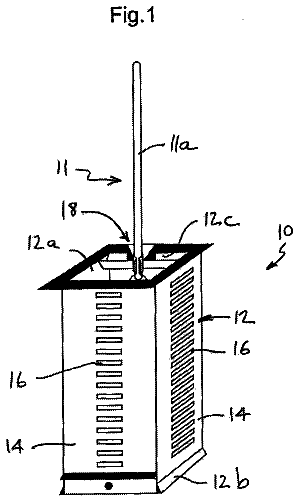
This unit is created to put the mop away and help it dry when is wet.
US 9,802,116 B2 · Assignee: Coast to Coast Entertainment LLC · Inventors: Balaban; Gary et al.
Sheet 1 of 6 from the published document. All sheets in the USPTO PDF
A system to rapidly set up new claw machines for different styles of prizes, while also providing an excellent player experience through dynamically changing claw machine behavior through machine learning algorithms. These systems can be readily installed on most any crane machine by replacing the controller card. The system is configured by means of a control wand physically connected to the controller. Teaching the machine about the prize is accomplished by physically inserting a sample prize into the grabber, and executed a command via control wand to tell the machine to learn. Once configured and taught the prize, the machine is autonomous, and will maintain its programmed profit margin throughout the prizes dispensed by learning player behavior and making adjustments after each play.
The present invention relates to the application of machine learning algorithms to skill-based entertainment machines, in particular to claw-style toy dispensing systems, hereby referred to as crane machines. Crane machines provide entertainment to players, chiefly through their ability to dispense toys under a combination of operator skill and machine capability. The general layout of such a crane machine is a collection of prizes to be dispensed which can be physically picked up by a claw or grabber attached to some style of multi-axis gantry. This multi-axis gantry is under direct player control, as is the grabber which can select the prize. Most crane machines set the grabber pickup strength to change how difficult it is to grab the prizes, and therefore provide some degree of control over how many prizes the machine dispenses. All current crane machines employ a fixed setting or loo
1 of 6 drawing sheets so far from the published document, cropped to the drawing. Every sheet is in the USPTO PDF.
What the patent claimed, word for word. All of it is now free to use.
Not Applicable SEQUENCE LISTING OR PROGRAM
Not Applicable TECHNICAL FIELD OF THE INVENTION
The present invention relates generally to game machines. More specifically, the present invention relates to game machines featuring an electronic circuit board controller to provide remote, wireless, machine monitoring.
The present invention relates to the application of machine learning algorithms to skill-based entertainment machines, in particular to claw-style toy dispensing systems, hereby referred to as crane machines. Crane machines provide entertainment to players, chiefly through their ability to dispense toys under a combination of operator skill and machine capability. The general layout of such a crane machine is a collection of prizes to be dispensed which can be physically picked up by a claw or grabber attached to some style of multi-axis gantry. This multi-axis gantry is under direct player control, as is the grabber which can select the prize.
Most crane machines set the grabber pickup strength to change how difficult it is to grab the prizes, and therefore provide some degree of control over how many prizes the machine dispenses. All current crane machines employ a fixed setting or lookup table based approach to determine just how much force is applied to the grabber, based on time or number of toys dispensed. This provides a limited experience to the player, as well as providing difficulty in configuring the machines for different prize weights and sizes.
The present invention covers the means and methods to apply machine-based learning for a truly interactive crane game prize dispensing system, whereby the machine varies its grabber strength through a machine learning algorithm which operates internally on prize machine data, while outputting intelligently controlled and continuously variable power output to the grabber mechanism. In addition, the system described herein allows machine operators to quickly and automatically teach the machine new prize types, without needing to experience with settings and confusion. The combined effect is a much more enjoyable crane machine experience, with easier setup required by the operators.
The prior art in such crane machine technology includes several patents which go to great lengths to describe new technology applied to make crane machines smarter. Watanabe, in US20060170164A1, goes to great length to describe an RFID based means to alleviate the burden of the difficulty of adjusting the machine, which includes databases and readers and further technology. The embodiment discussed here also alleviates such burdens, but with data that already exists on most prize dispensing machines. Peck, in US20090191931A1, discloses several embodiments of a crane machine that includes options for interactive video, and presents “prizes, such as bonus time, that affect the subsequent attempt to obtain a prize”. No mention is made of machine learning or the systems used to affect the subsequent attempts to obtain prizes.
The closest patent to what is described here is Stubben, U.S. Pat. No. 6,283,475 B1 which covers apparatus and method for crane game claw control. The closest claim is #36, which presents “A method of controlling a solenoid which controls gripping strength of a claw in a crane game machine comprising: selecting a desired gripping strength for the claw; creating an electrical signal representative of the desired gripping strength; and delivering and maintaining a current to the solenoid based on the signal”. No means is mentioned which originates the gripping strength command.
The embodiment hereafter known as “the system” provides a means to rapidly set up new claw machines for different styles of prizes, while also providing an excellent player experience through dynamically changing claw machine behavior through machine learning algorithms. These systems can be readily installed on most any crane machine by replacing the controller card.
The system is configured by means of a control wand physically connected to the controller. Teaching the machine about the prize is accomplished by physically inserting a sample prize into the grabber, and executed a command via control wand to tell the machine to learn. Once configured and taught the prize, the machine is autonomous, and will maintain its programmed profit margin throughout the prizes dispensed by learning player behavior and making adjustments after each play.
The accompanying drawings, which are incorporated herein an form a part of the specification, illustrate the present invention and, together with the description, further serve to explain the principles of the invention and to enable a person skilled in the pertinent art to make and use the invention.
FIG. 1 illustrates setup mode and mode operation.
FIG. 2 illustrates the grabber teach algorithm used to teach the machine about the prize that it dispenses.
FIG. 3 illustrates the grabber learn algorithm applied once through each game cycle, that allows the system to learn player behavior.
FIG. 4 illustrates the grabber power control algorithm, which uses the value derived from grabber learn to effect grabber behavior.
FIG. 5 illustrates the menu options relevant to the learn mode vs the manual configuration
FIG. 6 illustrates the cash menu options needed by the control algorithms to operate the machine learning algorithms.
In the following detailed description of the invention of exemplary embodiments of the invention, reference is made to the accompanying drawings (where like numbers represent like elements), which form a part hereof, and in which is shown by way of illustration specific exemplary embodiments in which the invention may be practiced. These embodiments are described in sufficient detail to enable those skilled in the art to practice the invention, but other embodiments may be utilized and logical, mechanical, electrical, and other changes may be made without departing from the scope of the present invention. The following detailed description is, therefore, not to be taken in a limiting sense, and the scope of the present invention is defined only by the appended claims.
In the following description, numerous specific details are set forth to provide a thorough understanding of the invention. However, it is understood that the invention may be practiced without these specific details. In other instances, well-known structures and techniques known to one of ordinary skill in the art have not been shown in detail in order not to obscure the invention. Referring to the figures, it is possible to see the various major elements constituting the apparatus of the present invention.
Device operation is divided into sections: the initial setup, and the playing of the machine As shown in FIG. 1 , the operator first configures machine up for the toys to be dispensed 101 , using options in the CASH OPTION MENU 102 FIG. 6 to tell the machine: Prize cash value; Cost per play of game; Bonus options and Desired profit margin.
Next, in FIG. 1 , the operator teaches the machine about the prize to be dispensed. FIG. 6 illustrates the grabber power menu options, wherein the grabber options can be automatically set. Automatic setting is covered in FIG. 2 , grabber teach, whereby: The grabber teach option is selected from the user interface. The toy is placed manually into the grabber, and teaching begins. The strength required to hold the toy is monitored by the machine. When the toy falls through the toy detector, machine stores how much force was recorded just before it dropped and the machine teaching is complete.
The process also determines the initial values of the machine learning algorithm, automatically populating the initial conditions for the control algorithm. Manual configuration is still possible via the manual configuration options of FIG. 5 .
The machine is now configured. FIG. 1 waits for the new game to start 104 , typically by insertion of payment means. Once payment is registered 105 , the player uses their skill to position the grabber over the desired prize 106 . Once the grabber is in physical contact with the prizes, the grabber power control algorithm 107 FIG. 4 is executed, whereby: The grabber opens 108 and then actuates with sufficient force to grab and hold prize; The grabber power ramps down by one power step; the algorithm waits a pseudorandom short interval; Steps 2 and 3 repeat until the claw is over the prize dispensing means; the grabber is released; and the prize, if still in the grabber when opened, falls by the prize detector 109 .
Now referring to FIG. 2 , the automatic learning process is taught. The process begins 201 and the learning mode is enabled 202 . The grabber opens 203 and waits for the operator to place the price grabber over the playing field 204 . If there is a prize in the grabber 205 , the grabber is closed with 100% force. The grabber force is measured and decreased by one step in step 207 . If a prize is triggered by the prize sensor 208 , the grabber force is again decreased by one step in step 207 . The grabber force is recorded when the claw is opened 209 and the process ends 210 .
After the player's game is complete 302 , the controller moves on to grabber learn process 301 presented in FIG. 3 . This algorithm is the internal machine learning algorithm which varies the players experience via its output variable, power step, used in FIG. 4 . This algorithm performs the following steps: Increments total cash in the machine 303 . Increments total plays by the machine. If a prize was dispensed 304 , adds the prize value to the total cash out counter 307 . The profit cumulative machine profit margin is calculated 305 . If the profit margin is greater than the desired profit margin 306 , the power step is increased 308 , making the machine harder to win, as the grabber power will decrease faster. If the profit margin is less than the desired profit margin 310 , the power step is decreased 309 , making the machine easier to win, as the grabber power will decrease slower. If the profit margin is near the desired, then power step is unchanged in the next play. The grabber power step is stored for the next play 311 and the process ends 312 .
Now referring to FIG. 4 , the internal machine learning algorithm which varies the players experience via its output variable, power step is shown. The process begins 4-1 with first determining if the grabber is in contact with prizes 402 . The grabber power is initially set near its maximum 403 . The grabber power is calculated by grabber power less the power step 404 . If the claw is over the chute 405 , the grabber power goes to zero 407 and the process ends. If the grabber is not over the chute 405 , the method waits for a pseudorandom short time 406 before repeating the grabber power level determination and checking to see if the claw is over the chute.
FIG. 5 illustrates the grabber options menu 501 , where the operating parameters of the grabber are either automatically set 502 or manually set 503 . The grabber can be manually set to how strong the grabber is to grab a prize 504 , how strong the grabber is to carry a prize 505 , and how strong a grabber is to win a prize 506 .
FIG. 6 illustrates the cash options menu 601 , which contains the set prize cash value 6 - 2 , set cost per play 603 , set bonus options 604 , and set desired profit margin 605 .
With each new game cycle, the machine uses the above data points to derive a new claw power profile for the next time the claw is used. The electrical control circuit for the grabber then uses that data to vary the amount of strength on the claw in a quasi-random continuous fashion during game play. This provides a much more challenging and skill-intense player experience, while also providing the profit margin required by the game operators. The game operators do not know when the game machine will win, as the claw strength is controller and varied internally, and can be different on every play, based on the output data from the learning algorithm.
In addition, as the toys are dispensed from the machine, the machine will change its settings automatically to maintain the desired profit margin. This allows a consistent player experience when the machine is new, and full, as well as when it is nearly empty, providing an exciting customer experience.
Thus, it is appreciated that the optimum dimensional relationships for the parts of the invention, to include variation in size, materials, shape, form, function, and manner of operation, assembly and use, are deemed readily apparent and obvious to one of ordinary skill in the art, and all equivalent relationships to those illustrated in the drawings and described in the above description are intended to be encompassed by the present invention.
Furthermore, other areas of art may benefit from this method and adjustments to the design are anticipated. Thus, the scope of the invention should be determined by the appended claims and their legal equivalents, rather than by the examples given.
About 2,191 words. The USPTO PDF has it with every drawing.
Fees are due 3.5, 7.5 and 11.5 years after grant. This patent expired on October 31, 2025, so the fee marked "not paid" was the one that went unpaid.
Machine Learning Controller for Prize Dispensing Entertainment Machines
Filed Sep 2015 · published Jan 2016Machine learning controller for prize dispensing entertainment machines
Filed Sep 2015 · granted Oct 2017Earlier publications, parents and continuations. None of them can still be enforced, or this patent would not be listed.
Prior art cited by the examiner or applicant. Useful when you check your own idea for novelty.
Everything on this page comes from the documents linked above.

