Cross-reference to related applications
This Application is a U.S. National Stage Application filed under 35 U.S.C. §371 of International Application PCT/JP2013/064751, filed May 28, 2013, designating the United States, which claims priority from Japanese Patent Application 2012-123090, filed May 30, 2012, the complete disclosures of which are hereby incorporated herein by reference in their entirety for all purposes.
Technical field
The present invention relates to a method for manufacturing a mold having a fine uneven structure composed of a plurality of micropores on a surface and a method for manufacturing a molded article having a fine uneven structure on a surface in which the mold is used.
The present application claims priority to Japanese Patent Application No. 2012-123090 which has been filed in Japan on May 30, 2012, and the content of which is incorporated herein by reference.
Background art
Recently, due to a progress in micro processing techniques, it becomes possible to form a fine uneven structure of nano scale on a surface of a molded article. The fine uneven structure of nano scale exhibits a structure-derived effect such as anti-reflection effect referred to as a moth-eye effect or a water repellant effect referred to as a lotus effect, and thus industrial use of a fine uneven structure of nano scale is actively made.
There are various techniques for forming a fine uneven structure on a surface of a molded article. Among them, a method of transferring a fine uneven structure formed on a surface of a mold to a surface of a main body of a molded article is suitable for industrial production because a fine uneven structure can be given to a surface of a molded article with few simple steps. Recently, as a method for simple manufacture of a large-area mold having a fine uneven structure on a surface, a method for forming an oxidized coating film having a plurality of micropores (anode oxidized porous alumina) by anodic oxidation of an aluminum substrate has drawn attention (see, Patent Documents 1 and 2, for example). The oxidized coating film formed by anodic oxidation has an increasing interval (pitch) between micropores in proportion to an applied voltage. From the viewpoint that the interval between micropores can be relatively simply controlled, the aforementioned method is suitable as a method for manufacturing a mold.
However, when a mold is manufactured by using anodic oxidation, a method by which anodic oxidation is performed in two divided steps is suitable to have both micropore depth and regular arrangement that are preferred for the mold (hereinbelow, it is also described as a “two-step oxidation method” in this specification). Specifically, by sequentially performing the following step
to step (3), micropores preferred for a mold are obtained.
Step (1): The surface of an aluminum substrate is subjected to anodic oxidation to have a regular arrangement of micropores while ignoring the micropore depth.
Step (2): A portion or all of the oxidized coating film formed by the step
is removed.
Step (3): The aluminum substrate is subjected again to anodic oxidation after the step
to form micropores with a certain depth while maintaining the regular arrangement.
When a mold is manufactured according to the two-step oxidation method, the thickness of an oxidized coating film that is formed by the step
(hereinbelow, also described as an “initially formed oxidized coating film”) is preferably neither too thick nor too thin. In other words, when the oxidized coating film is thin, macro size irregularities like remnants of mechanical processing of an aluminum substrate remain even after the step
(for example, wrinkles generated by cutting process). When a mold with remnants of mechanical processing is used, the remnants of mechanical processing are also transferred on a surface of a main body of a molded article, and they become the reason of poor appearance. On the other hand, when the oxidized coating film is thick, the macro size irregularities like a step in a grain boundary of an aluminum substrate, which occurs after the step (2), become so significant that they can be visually recognizable. When a mold with a significant step in a grain boundary is used, the macro size irregularities like a step in a grain boundary are also transferred on a surface of a main body of a molded article, and they become the reason of poor appearance.
As described above, neither too thick nor too thin oxidized coating film formed in the step
is appropriate for use in a mold.
Although it may vary depending on a size of a grain of an aluminum substrate used for anodic oxidation or a method for mechanical polishing, when the initially formed oxidized coating film has a thickness in the range of 0.5 to 10 μm, there is generally no problem of using it as a mold. Thus, in order for an oxidized coating film to be formed within such range, it is necessary to suitably adjust an integrated quantity of electricity generated by anodic oxidation by controlling time or current density for anodic oxidation.
In Patent Document 1, for example, the thickness of an oxidized coating film is controlled by suitably modifying the time for anodic oxidation when an oxidized coating film in which an interval between micropores is 100 nm is formed by using an oxalic acid electrolytic solution having a concentration of 0.3 M and a temperature of 17° C. and performing anodic oxidation with an applied voltage of 40 V. However, under such conditions, the current density significantly increases and the rate of forming an oxidized coating film is significantly fast when the voltage is high. As such, it is difficult to control the oxidized coating film at 10 μm or less. The applicable applied voltage is less than 70 V at most.
In Patent Document 2, anodic oxidation is performed by using an oxalic acid electrolytic solution having a concentration of 0.05 mol/L and a temperature of 3° C. and an applied voltage of 80 V. By suppressing the concentration or temperature of an electrolytic solution, the current density is lowered to enable anodic oxidation at an applied voltage of 80 V. There is no description in Patent Document 2 relating to the thickness of an oxidized coating film. However, although the thickness is suitable, special equipment for maintaining the electrolytic solution at a low temperature of 3° C. is required in order to make the condition be industrially feasible, and thus it is not economically feasible.
As a method for controlling current density while maintaining the applied voltage, a method of modifying an electrolytic solution may be considered. In principle, by suitably selecting various electrolytic solutions that are described in Patent Documents 1 and 2, it is possible to easily control the thickness of an oxidized coating film without using special equipment for maintaining an electrolytic solution at a low temperature.
However, when an oxidized coating film is formed by using phosphoric acid or the like as an electrolytic solution, it is possible to increase the applied voltage to 80 V or higher, but problems like uneven thickness of an oxidized coating film or extremely disordered diameter of a micropore are yielded, and thus it is difficult to form an oxidized coating film that is suitable for use in a mold. CITATION LIST Patent Document
Patent Document 1: Japanese Patent No. 4658129
Patent Document 2: Japanese Patent No. 4368415 DISCLOSURE OF THE INVENTION Problem to be Solved by the Invention
The present invention is devised under the circumstances described above, and is to provide a method for manufacturing a mold by which a current density can be controlled even when an applied voltage is high, the thickness of an initially formed oxidized coating film or oxidation time can be easily controlled without using special equipment, and a relatively homogenous diameter of a depression, which is formed on an aluminum substrate, can be obtained by removing the thickness of the initially formed oxidized coating film or at least a portion of an oxidized coating film; and a method for simple manufacture of a molded article which has a fine uneven structure composed of a plurality of protrusions on a surface. Means for Solving Problem
As a result of intensive studies, inventors of the present invention found that, by using an electrolytic solution having two or more kinds of acid mixed therein at a desirable ratio, the current density can be controlled even when an applied voltage is high, and the thickness of an initially formed oxidized coating film or oxidation time can be easily controlled without using special equipment, and also by removing the thickness of the initially formed oxidized coating film or at least a portion of the oxidized coating film, a relatively homogeneous diameter of a depression, which is formed on an aluminum substrate, can be obtained. The present invention is completed accordingly.
A method for manufacturing a mold according to a first embodiment of the present invention is a method for manufacturing a mold which has an oxidized coating film having a plurality of micropores formed on a surface of an aluminum substrate, the method including:
step (a): a step in which anodic oxidation of an aluminum substrate is performed at a voltage of 60 V to 120 V in an electrolytic solution having two or more kinds of acid mixed therein to form an oxidized coating film having a plurality of micropores on a surface of the aluminum substrate; and
step (b): a step in which at least a portion of the oxidized coating film which has been formed in the step (a) is removed,
in which, as the electrolytic solution having two or more kinds of acid mixed therein for use in the step (a), a solution satisfying the following condition (α) is used.
(Condition (α))
Upon D 1 is the current density when the aluminum substrate is subjected to anodic oxidation under the same conditions as in the step (a) in an electrolytic solution of only the acid A having the highest acid dissociation constant Ka of the two or more kinds of acid, and
D 2 is the current density when the aluminum substrate is subjected to anodic oxidation under the same conditions as in the step (a) in the same electrolytic solution as that of the step (a),
D 1 and D 2 satisfy the following formula (1). (D1)/2>D2
The method for manufacturing a mold of
above, in which the anodic oxidation of the aluminum substrate is performed at a voltage of more than 70 V but less than 120 V in the step (a), and
a solution further satisfying the following condition (β) is used as the electrolytic solution having two or more kinds of acid mixed therein for use in the step (a).
(Condition (β))
The ratio of the volume molar concentration of an acid other than the acid A to the volume molar concentration of the acid A (x=other acid/acid A×100) satisfies the following formula (2). 0.85V−60< x< 140
In the formula, V represents the voltage applied during anodic oxidation in the step (a).
The method for manufacturing a mold of
above, in which the anodic oxidation of the aluminum substrate is performed at a voltage of 75 V to 110 V in the step (a).
The method for manufacturing a mold of any one of
to
above, in which the initial temperature of the electrolytic solution having two or more kinds of acid mixed therein in the step (a) is 6° C. or higher.
The method for manufacturing a mold of any one of
to
above, in which the acid A used in the step (a) is oxalic acid.
The method for manufacturing a mold of any one of
to
above, in which the acid other than the acid A for use in the step (a) is phosphoric acid.
The method for manufacturing a mold of any one of
to
above, in which the electrolytic solution having two or more kinds of acid mixed therein for use in the step (a) consists of a mixture solution of oxalic acid and phosphoric acid.
The method for manufacturing a mold of any one of
to
above, further including the following steps (c) to (e),
step (c): a step in which the aluminum substrate is subjected to anodic oxidation after the step (b) or the following step (d) to form an oxidized coating film having a plurality of micropores,
step (d): a step in which a portion of the oxidized coating film is removed after the step (c) and the pore diameter of the micropores is enlarged, and
step (e): a step in which the step (c) and the step (d) are alternately repeated.
The method for manufacturing a mold of
above, in which the aluminum substrate is subjected to anodic oxidation in the step (c) at a voltage of 60 V to 120 V in an electrolytic solution having two or more kinds of acid mixed therein, and
a solution satisfying the following condition (α′) is used as the electrolytic solution having two or more kinds of acid mixed therein for use in the step (c).
(Condition (α′))
Upon D 1 ′ is the current density when the aluminum substrate is subjected to anodic oxidation under the same conditions as in the step (c) in an electrolytic solution of only the acid A′ having the highest acid dissociation constant Ka of the two or more kinds of acid, and
D 2 ′ is the current density when the aluminum substrate is subjected to anodic oxidation under the same conditions as in the step (c) in the same electrolytic solution as that of the step (c),
D 1 ′ and D 2 ′ satisfy the following formula (1′). (D1′)/2>D2′ (1′)
The method for manufacturing a mold of
above, in which the anodic oxidation of the aluminum substrate is performed at a voltage of more than 70 V but less than 120 V in the step (c), and
a solution further satisfying the following condition (β′) is used as the electrolytic solution having two or more kinds of acid mixed therein for use in the step (c).
(Condition (β′))
The ratio of the volume molar concentration of an acid other than the acid A′ to the volume molar concentration of the acid A′ (x′=other acid/acid A′×100) satisfies the following formula (2′). 0.85V′−60< x′< 140 (2′)
In the formula, V′ represents the voltage applied during anodic oxidation of the step (c).
The method for manufacturing a mold of
above, in which the anodic oxidation of the aluminum substrate is performed at a voltage of 75 V to 110 V in the step (c).
The method for manufacturing a mold of any one of
to
above, in which the initial temperature of the electrolytic solution having two or more kinds of acid mixed therein in the step (c) is 6° C. or higher.
A method for manufacturing a molded article having a fine uneven structure on a surface by transferring, to a surface of a main body of a molded article, a fine uneven structure composed of a plurality of micropores that is formed on a surface of a mold obtained by the method for manufacturing a mold of any one of
to
above.
An image display device in which a molded article having, on a surface, a fine uneven structure manufactured by the method of
above is used. Effect of the Invention
According to the method for manufacturing a mold as described in the present invention, the current density can be controlled even when an applied voltage is high, the thickness of an initially formed oxidized coating film or oxidation time can be easily controlled without using special equipment, and a relatively homogeneous diameter of a depression, which is formed on an aluminum substrate by removing the thickness of the initially formed oxidized coating film or at least a portion of an oxidized coating film, can be obtained. Because the thickness of the initially formed oxidized coating film can be adjusted to a range of 0.5 to 10 μm, an occurrence of macro size irregularities can be suppressed and a relatively homogeneous diameter of a depression, which is formed on an aluminum substrate, can be obtained. As such, when an oxidized coating film having a plurality of micropores is formed by using this aluminum substrate, a structure in which the micropores formed on the aluminum substrate are relatively evenly arranged can be obtained.
Further, according to the method for manufacturing a molded article having a fine uneven structure on a surface as described in the present invention, a molded article having, on a surface, a fine uneven structure consisting of a plurality of protrusions can be simply manufactured.
Brief description of drawings
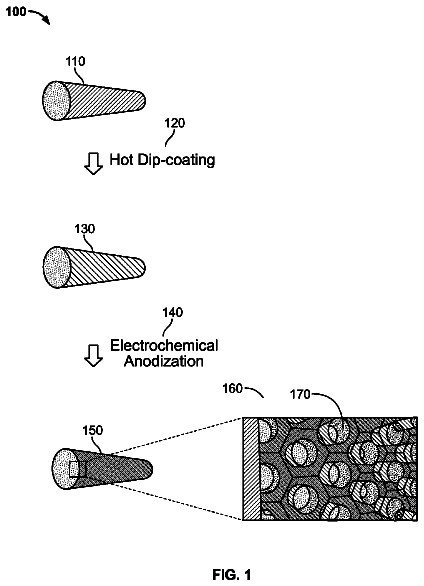
FIG. 1 is a cross-sectional view illustrating the process for manufacturing a mold which has an oxidized coating film with a plurality of micropores formed on a surface of an aluminum substrate.
FIG. 2 is a configuration diagram illustrating an exemplary apparatus for manufacturing a molded article having a fine uneven structure on a surface.
FIG. 3 is a cross-sectional view illustrating an exemplary molded article having a fine uneven structure on a surface.
Mode(s)
For carrying out the invention
Definition of the terms described below shall apply to the description and claims of the present invention.
The term “micropores” indicate a concave part of a fine uneven structure that is formed in an oxidized coating film on a surface of an aluminum substrate.
The term “interval between micropores” means a center-to-center distance between adjacent micropores.
The term “protrusions” means a convex part of a fine uneven structure formed on a surface of a molded article.
The term “fine uneven structure” means a structure in which the average interval of a convex part or a concave part is at nano scale.
The term “(meth)acrylate” is a general name for acrylate and methacrylate.
The term “active energy ray” means visible ray, ultraviolet ray, electron beam, plasma, heat ray (infrared ray or the like), or the like.
When the acid is a polybasic acid, the simple description of “acid dissociation constant Ka” means the first dissociation constant Ka 1 .
[Method for Manufacturing Mold]
The method for manufacturing a mold according to the present invention is a method including the following step (a) and step (b). Although the object of the present invention can be achieved with a method just having the step (a), from the viewpoint that the step (b) is required for evaluation of a manufactured mold, it is sufficient to have at least the step (a) and the step (b). Further, from the viewpoint of having both the desirable pore depth and regular arrangement in the mold, it is preferred to have the following step (c) and the step (d) after the step (b). Further, from the viewpoint of having a tapered shape of micropores in which diameter of the micropore gradually decreases in depth direction from the opening, it is preferred to have the following step (c) to the step (e) after the step (b).
Step (a): a step in which anodic oxidation of an aluminum substrate is performed at a voltage of 60 V to 120 V in an electrolytic solution having two or more kinds of acid mixed therein to form an oxidized coating film having a plurality of micropores on a surface of the aluminum substrate.
Step (b): a step in which at least a portion of the oxidized coating film which has been formed in the step (a) above is removed.
Step (c): a step in which the aluminum substrate is subjected to anodic oxidation after the step (b) or the following step (d) to form an oxidized coating film having a plurality of micropores.
Step (d): a step in which a portion of the oxidized coating film is removed after the step (c) and the pore diameter of the micropores is enlarged.
Step (e): a step in which the step (c) and the step (d) are alternately repeated.
Hereinbelow, detailed explanations of each step are given.
<Step (a)>
Step (a) is a step for forming a first oxidized coating film in which an aluminum substrate is subjected to anodic oxidation at a voltage of 60 V to 120 V in an electrolytic solution having two or more kinds of acid mixed therein to form an oxidized coating film having a plurality of micropores on a surface of the aluminum substrate.
By performing the step (a), the oxidized coating film 14 having a plurality of the micropore 12 is formed on a surface of the aluminum substrate 10 , as shown in FIG. 1 , for example.
According to anodic oxidation by which a portion or all of the surface of an aluminum substrate is immersed in an electrolytic solution, an oxidized coating film can be formed on a portion which has been immersed in an electrolytic solution. The oxidized coating film formed at initial stage of anodic oxidation has absolutely no regularity due to heterogeneous position or size of the micropores. However, in accordance with thickening of an oxidized coating film, regularity of the micropore arrangement is gradually improved.
The shape of the aluminum substrate is not particularly limited, and it may be a plate shape, a column shape, a cylinder shape, or the like which can be used as a mold.
It is preferable that the aluminum substrate has a surface polished by a known polishing method (for example, mechanical polishing, fabric polishing, chemical polishing, and electrolytic polishing) so that at least a portion for anodic oxidation is processed to have mirror finish.
Purity of the aluminum plate is preferably more than 99.0%, more preferably 99.5% or more, and most preferably 99.9% or more. If the purity of the aluminum plate is more than 99.0%, macro size irregularities that are generated by release of an intermetallic compound in impurities are not exceedingly high during the process for manufacturing a mold.
Average grain diameter of the aluminum substrate is preferably 100 μm or less, more preferably 80 μm or less, and even more preferably 60 μm or less. When the average grain diameter is 100 μm or less, the macro size uneven structure, which is generated by removing the first oxidized coating film when using a two-step oxidation method, is relatively not prominent so that it can be suitably used for a mold of a transparent material.
The average grain diameter of the aluminum substrate is an average value of the diameter of a hypothetical circle which is calculated from at least 100 grains selected arbitrarily from a processed surface of an aluminum substrate. Observation of the grains on a processed surface can be performed by using an optical microscope or the like. The average value of diameter of a hypothetical circle is obtained by using an image analysis software such as “Image-Pro PLUS” produced by Nippon Roper Co., Ltd.
In the step (a), an aluminum substrate is subjected to anodic oxidation which uses an electrolytic solution having two or more kinds of acid with different acid dissociation constant mixed therein. Examples of an acidic aqueous solution used as an electrolytic solution of the step (a) include an aqueous solution having two or more kinds of acid mixed therein, in which the acid is selected from inorganic acids (sulfuric acid (pKa=about −3), phosphoric acid (pKa=about 2.12), chromic acid (pKa=about 0.74), nitric acid (pKa=about −1.32) or the like) and organic acids (oxalic acid (pKa=about 1.27), malonic acid (pKa=about 2.85), tartaric acid (pKa=about 3), succinic acid (pKa=about 4.2), malic acid (pKa=about 3.4), citric acid (pKa=about 3.09) or the like). Meanwhile, even when it is not illustrated in the detailed description of the present invention, any acid can be used if it is capable of forming, on an aluminum surface, an oxidized coating film having a plurality of micropores by anodic oxidation.
As for the electrolytic solution having two or more kinds of acid mixed therein for use in the step (a), those satisfying the following condition (α) are used.
(Condition (α))
If D 1 is the current density (maximum value) when an aluminum substrate is subjected to anodic oxidation under the same conditions (same concentration of the acid A, same voltage, and same temperature) as in the step (a) in an electrolytic solution of only the acid A having the highest acid dissociation constant Ka of the two or more kinds of acid (hereinbelow, also referred to as a “first acid”), and
D 2 is the current density (maximum value) when the aluminum substrate is subjected to anodic oxidation under the same conditions (same voltage and same temperature) as in the step (a) in the same electrolytic solution as that of the step (a),
D 1 and D 2 satisfy the following formula (1). (D1)/2>D2
As for a method for determining the composition of an electrolytic solution which satisfies the formula (1), a method in which a first acid is firstly determined and type and ratio of other acid having lower acid dissociation constant than the first acid (hereinbelow, also referred to as a “second acid”) is determined based on the applied voltage is preferable.
An acid with high acid dissociation constant Ka (an acid with low pKa, which is negative logarithm of an acid dissociation constant) is generally a strong acid, and it tends to increase current density when used as an electrolytic solution. For example, when voltage near 25 V is applied, sulfuric acid having acid dissociation constant pKa of about −3 is known to yield anode oxidized porous alumina having a fine uneven structure in which the interval between micropores is 60 nm or so. However, when applied with higher voltage, the current density increases and thermal runaway is caused by Joule heating based on resistance of aluminum, thus fusing of aluminum is sometimes yielded. Further, in case of oxalic acid which has an acid dissociation constant pKa of about 1.27, it is known to yield anode oxidized porous alumina having a fine uneven structure in which the interval between micropores is 100 nm or so when voltage of approximately 40 V is applied. However, when applied with higher voltage, the current density increases to an extreme level and thermal runaway may be caused.
On the other hand, when anodic oxidation is performed by using phosphoric acid which has an acid dissociation constant pKa of about 2.12, it is known that anode oxidized porous alumina having a fine uneven structure with some regularity in which the interval between micropores is 350 nm or so is obtained when voltage near 160 V is applied. However, when anodic oxidation is performed by using an acid with a low acid dissociation constant such as phosphoric acid, malonic acid (pKa of about 2.85), or tartaric acid (pKa of about 3), there has been a problem that an oxidized coating film is formed very slowly, regularity of a fine uneven structure is much lower compared to a case in which anodic oxidation is performed by using an acid with high acid dissociation constant, and heterogeneity in film thickness easily occurs in an oxidized coating film to be formed. Further, as the interval between micropores is large in the fine uneven structure, it is not suitable for a mold which is used for manufacturing an anti-reflection product. In order to obtain a fine uneven structure in which the interval between micropores is about 100 to 300 nm, which is preferred in terms of manufacturing an anti-reflection product, it is necessary to perform anodic oxidation with application of a voltage at 60 V to 120 V. However, with an acid having low acid dissociation constant, an oxidized coating film hardly grows even when anodic oxidation is performed with application of a voltage at 60 V to 120 V, and thus a fine uneven structure with regularity is not obtained, either.
For such reasons, to obtain anode oxidized porous alumina having a fine uneven structure with relatively high regularity by applying a voltage of 60 V or more, anodic oxidation is conventionally performed at low temperature by using an acid with high acid dissociation constant as an electrolytic solution so that an excessive increase in current density can be suppressed. However, for performing anodic oxidation of aluminum by applying high voltage while maintaining, at low temperature, the aluminum which emits heat as Joule heating, special equipment is required, and it is particularly difficult to perform anodic oxidation of an aluminum substrate with large area.
The inventors of the present invention found that, by mixing an acid with high acid dissociation constant such as sulfuric acid or oxalic acid with an acid with low acid dissociation constant such as phosphoric acid, malonic acid, or tartaric acid, current density can be significantly lowered, and thus anode oxidized porous alumina can be obtained by simply applying a voltage of 60 V to 120 V. The present invention is completed accordingly. For example, when anodic oxidation is performed in an environment of 60 V and 15° C. by using a mixture solution of 0.3 M oxalic acid and 0.1 M phosphoric acid, the current density can be greatly lowered compared to a case in which anodic oxidation is performed by using oxalic acid only.
Thus, when the applied voltage is 80 V, for example, an anodic oxidation treatment can be performed by mixing oxalic acid, which is preferably used in a voltage range near 40 V, as a first acid with an acid having lower acid dissociation constant than oxalic acid, for example, phosphoric acid, malonic acid, and tartaric acid to relatively easily form an oxidized coating film of which micropores are arranged with high regularity and of which thickness heterogeneity is low. Meanwhile, it is more preferable that oxalic acid and phosphoric acid are used as a first acid and a second acid, respectively.
The ratio of mixing the first acid and the second is set such that the aforementioned D 1 and D 2 satisfy the formula
described above.
More specifically, molar ratio of the second acid relative to the first acid is preferably 10% to 150%, more preferably 12.5% to 140%, and even more preferably 15% to 135%. With the molar ratio of 10% or more, the current density can be reduced to less than half of a case in which anodic oxidation is performed by using the first acid only. With the molar ratio of 140% or lower, adverse effects caused by the second acid, that is, heterogeneous diameter of depression which is formed on an aluminum substrate by removing the thickness of an oxidized coating film or a portion of an oxidized coating film, can be sufficiently avoided.
Explanations of concentration of an electrolytic solution are given with an example in which oxalic acid is used as a first acid and phosphoric acid is used as a second acid.
The concentration of oxalic acid is preferably 0.3 to 1.5 M, more preferably 0.3 to 1.0 M, and even more preferably 0.3 to 0.8 M. When the concentration of oxalic acid is within this range, diameter of the micropore which is formed on an oxidized coating film or diameter of a depression which is formed on an aluminum substrate when anodic oxidation is performed in a voltage range of 60 V to 120 V can be maintained relatively homogeneously.
The concentration of phosphoric acid is preferably such that it is 10% to 150% in terms of molar ratio compared to oxalic acid. When the concentration of phosphoric acid is within this range, the current density during anodic oxidation can be sufficiently suppressed. Low current density is effective in that not only problems caused by high current density referred to as thermal runaway or thermal degradation can be prevented but also an oxidized coating film having homogeneous thickness can be formed.
Meanwhile, even with the same concentration and the same applied voltage, the current density can be significantly lowered when the temperature of an electrolytic solution is lowered. From the viewpoint of easy controlling and maintaining of the temperature of an electrolytic solution, the initial temperature of the electrolytic solution is preferably 6° C. or higher, more preferably 8° C. or higher, and even more preferably 10° C. or higher. Meanwhile, when an aqueous acid solution is used as an electrolytic solution, the initial temperature of the electrolytic solution is preferably 30° C. or lower from the viewpoint of suppressing a change in concentration which is caused by evaporation. The temperature of 30° C. or lower allows good environment for controlling the concentration of an electrolytic solution.
The thickness of an oxidized coating film formed in the step (a) is preferably 0.5 to 10 μm. When the thickness of the oxidized coating film is within this range, remnants of mechanical polishing on a surface of an aluminum substrate are fully removed when an oxidized coating film is removed during the step (b) described below, and also a step in a grain boundary is not large enough to be visually recognizable. Because the transfer of macro size irregularities derived from a mold onto a surface of a main body of a molded article can be avoided, it is suitable for use as a mold.
The thickness of the oxidized coating film is proportional to an integrated quantity of electricity, which is a product of current density and time for oxidation. By modifying the current density and time for oxidation, thickness of the oxidized coating film can be adjusted.
The applied voltage employed in the step (a) is 60 V to 120 V, and preferably higher than 70 V but lower than 120 V, considering that an electrolytic solution having two or more kinds of acid mixed therein is obstinately used. From the viewpoint of obtaining an oxidized coating film with high quality, that is, little deviation in diameter of a depression and little heterogeneity in film thickness, it is more preferably 75 V to 110 V. An electrolytic solution like sulfuric acid, oxalic acid, and phosphoric acid, which are conventionally used as an representative example, is known by experience with a preferred voltage range which allows relatively easy formation of an oxidized coating film of which micropores are arranged with high regularity and thickness heterogeneity is low. The voltage range of 60 V to 120 V is outside of any of those voltage ranges. In other words, it can be defined as a voltage range in which the effect by the electrolytic solution having two or more kinds of acid mixed therein can be most easily exhibited.
Meanwhile, since high applied voltage may easily lead to a huge increase in current density, a risk of having thermal runaway or thermal degradation tends to increase. Thus, it is preferable that the mixing ratio of the second acid is adjusted in accordance with the applied voltage. Specifically, as an electrolytic solution having two or more kinds of acid mixed therein for use in the step (a), it is preferred to further satisfy the following condition (β).
(Condition (β))
The ratio of the volume molar concentration of a second acid relative to the volume molar concentration of a first acid (x=second acid/first acid×100) satisfies the following formula (2). 0.85V−60< x< 140
In the formula, V represents the voltage applied during anodic oxidation in the step (a).
With the volume molar concentration ratio x of (0.85V−60)% or higher, anodic oxidation can be conveniently performed while suppressing an excessive increase in current density and also suppressing an occurrence of thermal runaway or thermal degradation. With the volume molar concentration ratio x of 140% or lower, extremely slow forming of an oxidized coating film can be suppressed and also the diameter of micropores that are formed in an oxidized coating film or the diameter of depression formed on an aluminum substrate can be maintained at a relatively homogeneous level.
<Step (b)>
The step (b) is a step for removing an oxidized coating film by which a portion or all of the oxidized coating film formed in the step (a) above is removed.
When the step (b) is performed, the entire oxidized coating film 14 is removed so that the depression 16 is exposed on a surface of the aluminum substrate 10 as shown in FIG. 1 , for example.
By removing a portion or all of the oxidized coating film, a depression consisting of a barrier layer of a bottom part of the oxidized coating film or a depression corresponding to the shape of the barrier layer is exposed on a surface of an aluminum substrate. By forming, in the step (a), the micropores that are arranged with regularity, a depression formed by removing a portion or all of the oxidized coating film in the step (b) can also have a regular arrangement.
As for the method for removing a portion or all of the oxidized coating film 14 , a method of immersing in a solution which can selectively dissolve alumina without dissolving aluminum can be mentioned. Examples of such solution include mixture liquid of chromic acid/phosphoric acid.
<Step (c)>
The step (c) is a step for forming, after the step (b) or the following step (d), a second oxidized coating film by which an oxidized coating film having a plurality of micropores is formed by immersing the aluminum substrate in an electrolytic solution and subjected again to anodic oxidation.
When the step (c) is performed after the step (b), the aluminum substrate 10 is subjected to anodic oxidation to form again the oxidized coating film 14 having a plurality of the micropore 12 , as shown in FIG. 1 , for example.
Further, when the step (c) is performed after the step (d), a new oxidized coating film is formed beneath the existing oxidized coating film so that new micropores which extend downward from the bottom part of the existing micropores are formed.
When the anodic oxidation is performed again while a depression has been formed on a surface of an aluminum substrate, the depression serves as a point for generating micropores and the micropores of a new oxidized coating film occur at a position which corresponds to the depression. When the depression is arranged with regularity, in particular, even at early stage of anodic oxidation, that is, a state in which newly formed oxidized coating film is thin, regularly-arranged micropores are formed and the pore depth is adjusted to submicron order, and thus it is possible to produce easily the micropores that are arranged with regularity.
Regarding the step (c), an aluminum substrate is subjected to anodic oxidation preferably by using an electrolytic solution in which two or more kinds of acid with different acid dissociation constant are mixed.
As for the electrolytic solution to be used in the step (c) in which two or more kinds of acid are mixed, it is preferable to use a solution satisfying the following condition (α′).
(Condition (α′))
If D 1 ′ is the current density (maximum value) when the aluminum substrate is subjected to anodic oxidation under the same conditions (same concentration of acid A′, same voltage, and same temperature) as in the step (c) in an electrolytic solution of only the acid A′ having the highest acid dissociation constant Ka of the two or more kinds of acid (hereinbelow, also referred to as a “first acid”), and
D 2 ′ is the current density (maximum value) when the aluminum substrate is subjected to anodic oxidation under the same conditions (same voltage and same temperature) as in the step (c) in the same electrolytic solution as that of the step (c), D 1 ′ and D 2 ′ satisfy the following formula (1′). (D1′)/2>D2′ (1′)
As for a method for determining the composition of an electrolytic solution satisfying the formula (1′), a method in which a first acid is firstly determined and type and ratio of other acid having lower acid dissociation constant than the first acid (hereinbelow, also referred to as a “second acid”) is determined based on the applied voltage is preferable.
The mixing ratio between the first acid and the second acid is determined such that the aforementioned D 1 ′ and D 2 ′ satisfy the formula (1′) described above.
Meanwhile, since high applied voltage may easily lead to a huge increase in current density, a risk of having thermal runaway or thermal degradation tends to increase. Thus, it is preferable that the mixing ratio of the second acid is adjusted in accordance with the applied voltage. Specifically, as an electrolytic solution having two or more kinds of acid mixed therein, which is used in the step (c), it is preferred to further satisfy the following condition (β′).
(Condition (β′))
The ratio of the volume molar concentration of a second acid to the volume molar concentration of a first acid (x′=second acid/first acid×100) satisfies the following formula (2′) 0.85V′−60< x′< 140 (2′)
The description continues in the full USPTO document.
 Lapsed, fee not paid1 drawing