Technical field
The present invention relates to a display element, a photosensitive composition and an electrowetting display.
Background art
An electrowetting phenomenon is a phenomenon which utilizes a change in contact angle of a hydrophobic surface against a polar liquid (and a non-polar liquid) that is induced by, for example, application of a voltage to the polar liquid and non-polar liquid (usually colored) that are immiscible with each other on an electrode having the hydrophobic surface.
Elements utilizing this electrowetting phenomenon show high brightness and high contrast ratio as well as large viewing angle, high switching rate and the like, and display elements utilizing this phenomenon have relatively low power consumption because they do not require front or backlight. Therefore, such elements are used in a variety of optical application fields, including optical switches for optical fibers, optical shutters or filters for cameras and guide devices, optical pickup elements, optical waveguide materials, video display pixels and the like.
For example, Patent Documents 1 to 3 disclose display elements utilizing such a phenomenon. PRIOR ART REFERENCES Patent Documents
[Patent Document 1]
Jp-a-2013-542465
[Patent Document 2]
Jp-a-2013-92701
[Patent Document 3] JP-T-2013-501259 SUMMARY OF THE INVENTION Problems to be Solved by the Invention
The above-described display elements display letters, figures and the like in response to a change in the state of a non-polar liquid based on the presence or absence of an applied voltage; therefore, it is desired that the change in the state of the liquid based on the presence or absence of an applied voltage be performed smoothly.
Further, along with the demand for an increase in the service life of display elements, it is also demanded that the change in the state of the liquid be performed stably over a prolonged period of time.
Conventional display elements, however, still have room for improvement to satisfy these demands.
The present invention was made in view of the above-described demands, and an object of the present invention is to provide a display element capable of smoothly and stably changing the state of a non-polar liquid contained therein over a prolonged period of time based on the presence or absence of an applied voltage. Technical Solution
Under such circumstances, in order to solve the above-described problems, the present inventors intensively studied and discovered that, in a display element comprising: a first electrode layer stack; a second electrode layer stack; a housing space which contains a polar liquid and a non-polar liquid that are immiscible with each other and is formed between the first and second electrode layer stacks; and a partition wall compartmentalizing the housing space, by allowing the non-polar liquid to have a static contact angle on the surface of the partition wall in a prescribed range, the above-described problems can be solved, thereby completing the present invention.
Examples of the constitution of the present inventions are described below.
[1] A display element, comprising: a first electrode layer stack; a second electrode layer stack; a housing space formed between the first and second electrode layer stacks; and a partition wall compartmentalizing the housing space, wherein
the housing space comprises at least a polar liquid and a non-polar liquid that are immiscible with each other,
at least the surface of the first or second electrode layer stack in contact with the housing space is hydrophobic, and
the non-polar liquid has a static contact angle in a range of from 15 to 85° on the surface of the partition wall.
[2] The display element according to [1], wherein the partition wall has a Martens hardness, which is measured using a microhardness tester, of not less than 110 N/mm.sup.2.
[3] The display element according to [1] or [2], wherein the partition wall is a film obtained from a photosensitive composition.
[4] The display element according to any one of [1] to [3], wherein the partition wall is a film obtained from a negative photosensitive composition.
[5] The display element according to [4], wherein the negative photosensitive composition comprises an alkali-soluble polymer, a cross-linking agent and a photoinitiator.
[6] The display element according to [5], wherein the cross-linking agent is at least one compound selected from the group consisting of ethylenically unsaturated group-containing compounds, epoxy group or oxetanyl group-containing compounds and alkoxyalkyl group-containing compounds.
[7] The display element according to [5] or [6], wherein the alkali-soluble polymer is a compound having at least one functional group selected from the group consisting of a carboxyl group, a phenolic hydroxyl group and a silanol group.
[8] The display element according to any one of [5] to [7], wherein the alkali-soluble polymer is at least one polymer selected from the group consisting of acrylic resins, polyimides, polybenzoxazoles, polysiloxanes, polyolefins, cardo skeleton-containing resins and novolac resins.
[9] The display element according to any one of [5] to [8], wherein the alkali-soluble polymer has a weight-average molecular weight of 1,000 to 100,000.
[10] A photosensitive composition for forming a partition wall, the partition wall compartmentalizing a first electrode layer stack, a second electrode layer stack and a housing space which is formed between the first and second electrode layer stacks and comprises a polar liquid and a non-polar liquid that are immiscible with each other, wherein the non-polar liquid has a static contact angle in a range of from 15 to 85° on the surface of the partition wall.
[11] The photosensitive composition according to [10], which is a negative composition comprising an alkali-soluble polymer, a cross-linking agent and a photoinitiator.
[12] An electrowetting display, comprising the display element according to any one of [1] to [9].
[13] The electrowetting display according to [12], comprising a color filter layer. Advantageous Effects of Invention
According to the present invention, a display element capable of smoothly and stably changing the state of a non-polar liquid contained therein over a prolonged period of time based on the presence or absence of an applied voltage can be provided.
Brief description of drawings
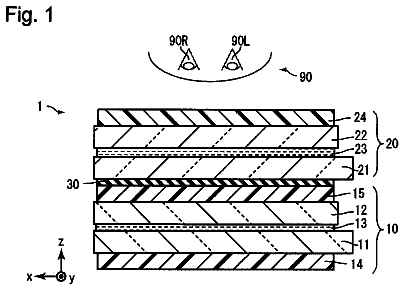
FIG. 1 is a schematic cross-sectional view showing one example of the display element of the present invention.
FIG. 2 is a schematic plan view showing a partition wall (lattice-patterned coating film) obtained in an Example.
Mode for carrying out the invention
<<Display Element>>
The display element according to the present invention is represented by, for example, FIG. 1 , and comprises: a first electrode layer stack 11 ; a second electrode layer stack 12 ; a housing space 16 which is formed between the first electrode layer stack 11 and the second electrode layer stack 12 ; and a partition wall 13 which compartmentalizes the housing space 16 , wherein the housing space 16 comprises at least a polar liquid 15 and a non-polar liquid 14 that are immiscible with each other, at least the surface of the first electrode layer stack 11 or the second electrode layer stack 12 that is in contact with the housing space 16 is hydrophobic, and the non-polar liquid 14 has a static contact angle in a range of 15 to 85° on the surface of the partition wall 13 .
In FIG. 1 , the surface of the first electrode layer stack 11 that is in contact with the housing space 16 is hydrophobic. Thus, in a display element 10 , when no voltage is applied (“turn off” in FIG. 1 ), the non-polar liquid (colored liquid) 14 exists evenly such that it covers the surface of the first electrode layer stack 11 . Meanwhile, when voltage is applied to this display element 10 (“turn on” in FIG. 1 ), the non-polar liquid 14 exists in a substantially hemispherical shape near the partition wall 13 .
In this manner, in the display element of the present invention, the state of the non-polar liquid changes based on the presence or absence of an applied voltage and, by using a colored non-polar liquid, the display element of the present invention is allowed to display, for example, a colored state and a transparent state.
The display element of the present invention may be an element comprising a single pixel region (cell) formed by compartmentalizing the housing space with four partition walls or the like; however, it is usually an element comprising plural pixel regions that are formed by compartmentalizing the housing space with plural partition walls, and each pixel region is formed such that it is capable of performing full-color display on the display surface side of the display element. Further, by allowing the state of the non-polar liquid in each pixel region to be changed by an electrowetting phenomenon, the colors displayed on the display surface side can be modified.
<Partition Wall>
The partition wall compartmentalizes the housing space formed between the first and second electrode layer stacks. The partition wall is not particularly restricted as long as it functions as a wall that prevents movement of the non-polar liquid between adjacent pixel regions that usually exist in series.
Accordingly, the partition wall may be in contact with both the first electrode layer stack 11 and the second electrode layer stack 12 as shown in FIG. 1 ; however, when the non-polar liquid 14 exists on the side of the first electrode layer stack 11 in the housing space 16 as shown in FIG. 1 , the partition wall may exist only on the side of the first stack 11 and does not have to be in contact with the second electrode layer stack 12 . In the latter case, the partition wall may be in contact with the first electrode layer stack 11 , or there may be a small gap between the partition wall and the first electrode layer stack 11 .
When the partition wall is in contact with the first and/or second electrode layer stacks, the partition wall may be integrated with the first and/or second electrode layer stacks, or the partition wall may be adhered to the first and/or second electrode layer stacks.
The static contact angle of the non-polar liquid on the surface of the partition wall is not particularly restricted as long as it is in a range of 15 to 85°; however, the static contact angle is preferably 20 to 80°, particularly preferably 25 to 75°. Specifically, the contact angle can be measured by the method described in the section of Examples below.
When the static contact angle of the non-polar liquid on the surface of the partition wall is in the above-described range, the state of the non-polar liquid can be smoothly and stably changed over a prolonged period based on the presence or absence of voltage applied to the display element.
This is believed to be because, since the partition wall surface and the non-polar liquid are in a specific relationship in terms of affinity, the non-polar liquid does not firmly adhere to the partition wall when voltage is applied and, when the application of voltage is terminated, the non-polar liquid smoothly moves to the hydrophobic surface of the electrode layer stack and color loss or the like in the colored state of the display element is not likely to occur induced by remaining adhered non-polar liquid to the partition wall during the movement.
The voltage applied to the display element of the present invention is not particularly restricted as long as it is such a voltage that can change the state of the non-polar liquid.
The partition wall has a Martens hardness, which is measured using a microhardness tester, of preferably not less than 110 N/mm.sup.2, more preferably not less than 130 N/mm.sup.2, particularly preferably 140 to 300 N/mm.sup.2.
Specifically, the Martens hardness can be measured by the method described in the section of Examples below.
When the Martens hardness of the partition wall is in the above-described range, movement of the non-polar liquid between pixel regions can be sufficiently inhibited and a display element having excellent durability can be obtained.
A partition wall having such Martens hardness can be obtained by adjusting the type and amount of the below-described cross-linking agent as appropriate or by adjusting the hardness of a surface-coating film in the below-described surface treatment step. Specifically, an addition of a cross-linking agent having a large number of functional groups, such as dipentaerythritol hexaacrylate, tends to improve the Martens hardness, whereas an addition of a cross-linking agent having a small number of functional groups, such as 1,9-nonane diacrylate, tends to reduce the Martens hardness. The Martens hardness can also be improved by increasing the amount of a cross-linking agent to be used.
The height of the partition wall (length in the direction of the gap between the first and second electrode layer stacks; length in the vertical direction in FIG. 1 ) is not particularly restricted as long as the partition wall can function to inhibit movement of the non-polar liquid between pixel regions.
Further, the thickness of the partition wall (length in the direction substantially perpendicular to the direction of the gap between the first and second electrode layer stacks; length in the horizontal direction in FIG. 1 ) is also not particularly restricted as long as the partition wall can function to inhibit movement of the non-polar liquid between pixel regions; however, from the standpoints of the strength and the like of the partition wall, the thickness of the partition wall is 1 to 50 μm, preferably 5 to 40 μm.
The partition wall may be a single-layer film, or a laminate comprising a BM (black matrix) layer, a reinforcement layer, a surface coating layer or the like. Further, the partition wall may be a film having no hole, or a film having lattice-form or slit-form holes.
[Photosensitive Composition]
It is preferred that the partition wall be a film obtained from a photosensitive composition because, for example, this enables to easily produce a display element comprising plural pixel regions that are formed by compartmentalizing a housing space with plural partition walls.
Such a photosensitive composition may be a positive photosensitive composition or a negative photosensitive composition; however, it is preferably a negative photosensitive composition because, for example, this enables to easily produce a display element comprising plural pixel regions that are formed by compartmentalizing a housing space with plural partition walls and a display element in which reduction in display properties is not likely to occur over an extended period can thus be obtained.
The photosensitive composition is not particularly restricted; however, it is preferably a composition comprising an alkali-soluble polymer, a cross-linking agent and a photoinitiator because, for example, such a composition can yield a partition wall showing only small changes in properties over a prolonged period of time. Examples of such a composition include those described in JP-A-2006-154434 and JP-A-2007-293306.
The photosensitive composition can easily forma partition wall which compartmentalizes the first electrode layer stack, the second electrode layer stack and a housing space that is formed between the first and second electrode layer stacks and comprises a polar liquid and a non-polar liquid that are immiscible with each other, the non-polar liquid having a static contact angle in a range of 15 to 85°, preferably 20 to 80°, particularly preferably 25 to 75°, on the surface of the partition wall. Therefore, the photosensitive composition can be suitably used as a composition for forming such a partition wall. It is preferred that this photosensitive composition be a negative composition comprising an alkali-soluble polymer, a cross-linking agent and a photoinitiator.
<Alkali-Soluble Polymer>
The alkali-soluble polymer is not particularly restricted. In the present invention, the term “alkali-soluble” means that the polymer can be dissolved in an alkaline solution, such as 2.38%-by-mass aqueous tetramethylammonium hydroxide solution.
The alkali-soluble polymer may be used individually, or two or more thereof, for example, a blend of an alkali-soluble polymer and an alkali-insoluble polymer or a blend of two or more alkali-soluble polymers or the like, may be used.
From the standpoints of, for example, the solubility in alkaline solutions, particularly 2.38%-by-mass aqueous tetramethylammonium hydroxide solution, the alkali-soluble polymer is preferably a compound having at least one functional group selected from the group consisting of a carboxyl group, a phenolic hydroxyl group and a silanol group.
As such an alkali-soluble polymer, an acrylic resin, polyimide, polybenzoxazole, polysiloxane, polyolefin, cardo skeleton-containing resin or novolac resin is preferred.
From the standpoints of the developability and the like of the resulting photosensitive composition, the weight-average molecular weight of the alkali-soluble polymer, which is measured by gel permeation column chromatography, specifically the method described in the section of Examples below, is preferably 1,000 to 100,000, more preferably 1,500 to 50,000.
From the standpoints of the developability and the like of the resulting photosensitive composition, the content of the alkali-soluble polymer is preferably 5 to 60% by mass, more preferably 10 to 50% by mass, with respect to 100% by mass of the photosensitive composition.
Acrylic Resin
The acrylic resin is not particularly restricted; however, from the standpoint of the alkali solubility, it is preferably one which has at least one functional group selected from the group consisting of a carboxyl group, a phenolic hydroxyl group and a silanol group and, from the standpoints of the developability and the like of the resulting photosensitive composition, it is preferably a copolymer obtained using the below-described compounds (a) and (b) as monomers (it is noted here that the monomers include acrylic compounds):
compound (a): a compound having at least one functional group selected from the group consisting of a carboxyl group, a phenolic hydroxyl group and a silanol group; and
compound (b): a compound other than the compound (a).
In the compound (a), a compound comprising a carboxyl group is not particularly restricted, and examples thereof include monocarboxylic acids such as acrylic acid, methacrylic acid and crotonic acid; dicarboxylic acids such as maleic acid, fumaric acid, citraconic acid, mesaconic acid and itaconic acid; and methacrylic acid derivatives having a carboxyl group and an ester bond, such as 2-maleinoloyloxyethyl methacrylate, 2-succinoloyloxyethyl methacrylate and 2-hexahydrophthaloyloxyethyl methacrylate. These compounds may be used individually, or two or more thereof may be used. Thereamong, acrylic acid, methacrylic acid and 2-hexahydrophthaloyloxyethyl methacrylate are preferred.
In the compound (a), a compound having a phenolic hydroxyl group is not particularly restricted, and examples thereof include vinyl monomers having a phenolic hydroxyl group, such as 3-hydroxystyrene, 4-hydroxystyrene, vinyl-4-hydroxybenzoate, 3-isopropenylphenol and 4-isopropenylphenol. These compounds may be used individually, or two or more thereof may be used. Thereamong, 4-isopropenylphenol is preferred.
In the compound (a), a compound having a silanol group is not particularly restricted, and examples thereof include hydrolysates of alkoxysilyl group-containing vinyl monomers, such as vinyltrimethoxysilane, vinyltriethoxysilane, vinyltripropoxysilane, vinylmethyldimethoxysilane, vinylmethyldiethoxysilane, vinylmethyldipropoxysilane, γ-(meth)acryloxypropyltrimethoxysilane, γ-(meth)acryloxypropyltriethoxysilane, γ-(meth)acryloxypropyltripropoxysilane, γ-(meth)acryloxypropylmethyldimethoxysilane, γ-(meth)acryloxypropylmethyldiethoxysilane and γ-(meth)acryloxypropylmethyldipropoxysilane. These compounds may be used individually, or two or more thereof may be used.
Examples of the compound (b) include alkyl (meth)acrylates such as methyl methacrylate, ethyl methacrylate, n-butyl (meth)acrylate, sec-butyl (meth)acrylate, t-butyl (meth)acrylate and isopropyl (meth)acrylate; alkoxy (meth)acrylates such as 2-ethoxyethyl (meth)acrylate and 2-methoxyethyl (meth)acrylate; hydroxyl group-containing (meth)acrylates such as 2-hydroxyethyl (meth)acrylate; halogen atom-containing (meth)acrylates such as 2,2,2-trifluoroethyl (meth)acrylate; aryl (meth)acrylates such as phenyl (meth)acrylate and benzyl (meth)acrylate; heterocyclic group-containing (meth)acrylates such as glycidyl (meth)acrylate; dicarboxylic acid diesters such as diethyl maleate, diethyl fumarate and diethyl itaconate; vinyl group-containing aromatic compounds such as styrene, α-methylstyrene, m-methylstyrene, p-methylstyrene and p-methoxystyrene; conjugated diolefins such as 1,3-butadiene, isoprene and 1,4-dimethylbutadiene; nitrile group-containing polymerizable compounds such as acrylonitrile and methacrylonitrile; chlorine-containing polymerizable compounds such as vinyl chloride and vinylidene chloride; amide bond-containing polymerizable compounds such as acrylamide and methacrylamide; imide group-containing polymerizable compounds such as N-phenylmaleimide; vinyl fatty acids such as vinyl acetate; and compounds represented by the following Formulae
to (8).
##str00001##
[wherein, “n” independently represents a natural number of 1 to 6]
Thereamong, (meth)acrylates such as methyl methacrylate, ethyl methacrylate, n-butyl (meth)acrylate, 2-methoxyethyl acrylate and benzyl methacrylate; styrene, N-phenylmaleimide, 2-hydroxyethyl methacrylate, 2,2,2-trifluoroethyl acrylate and compounds represented by the Formulae
and
are preferred.
The compound (b) may be used individually, or two or more thereof may be used.
The compound (b) is used in an amount of preferably 5 to 95% by mass, more preferably 10 to 90% by mass, with respect to a total of 100% by mass of the compounds (a) and (b).
The above-described acrylic resin can be obtained by, for example, polymerizing the compounds (a) and (b) in a conventionally known organic solvent using a conventionally known radical initiator.
Polyimide
The polyimide is not particularly restricted; however, from the standpoint of the alkali solubility, it is preferably one which has at least one functional group selected from the group consisting of a carboxyl group, a phenolic hydroxyl group and a silanol group, particularly a polymer having the above-described functional group(s) and a structural unit represented by the following Formula (A1).
##str00002##
In the Formula (A1), R.sup.1 represents a hydroxyl group-containing divalent group and X represents a tetravalent organic group. Examples of the R.sup.1 include divalent groups represented by the following Formula (a1).
##str00003##
In the Formula (a1), R.sup.2 represents a single bond, an oxygen atom, a sulfur atom, a sulfonyl group, a carbonyl group, a methylene group, a dimethylmethylene group or a bis(trifluoromethyl)methylene group; and R.sup.3s independently represent a hydrogen atom, a formyl group, an acyl group or an alkyl group. However, at least one of the R.sup.3s is a hydrogen atom. Further, “n1” and “n2” each independently represent an integer of 0 to 2; however, at least one of “n1” and “n2” is 1 or 2. When the sum of “n1” and “n2” is 2 or larger, the plural R.sup.3s may be the same or different.
Examples of the tetravalent organic group represented by the X include tetravalent aliphatic hydrocarbon groups, tetravalent aromatic hydrocarbon groups, and groups represented by the following Formula (1). The X is preferably a tetravalent organic group derived from a tetracarboxylic acid dianhydride, more preferably a group represented by the following Formula (1).
##str00004##
In the Formula (1), Ars independently represent a trivalent aromatic hydrocarbon group; and A represents a direct bond or a divalent group. Examples of the divalent group include an oxygen atom, a sulfur atom, a sulfonyl group, a carbonyl group, a methylene group, a dimethylmethylene group and a bis(trifluoromethyl)methylene group.
The above-described polyimide can be obtained by a conventionally known method, for example, imidization by a conventionally known method using a diamine, an acid anhydride and the like.
In the polymer having a structural unit represented by the Formula (A1), the X or R.sup.1 in the Formula (A1) may be at least one functional group selected from the group consisting of a carboxyl group, a phenolic hydroxyl group and a silanol group, and the polymer may be one which has the functional group(s) and is obtained by partial imidization using a compound having the functional group(s) as a raw material for synthesizing the polymer.
The imidization ratio of the polyimide is preferably not less than 1%, more preferably not less than 3%, still more preferably not less than 5%. The upper limit value of the imidization ratio may be 100%; however, it is preferably 50%, more preferably 30%. It is preferred that the imidization ratio be in this range because, for example, a polymer having excellent heat resistance and alkali solubility can be obtained.
The imidization ratio can be determined, for example, as follows.
First, the infrared absorption spectrum of the subject polyimide is measured and the presence of absorption peaks attributed to the imide structure of the polyimide (near 1,780 cm.sup.−1 and near 1,377 cm.sup.−1) is confirmed. Then, after heat-treating the polyimide for 1 hour at 350° C., the infrared absorption spectrum is measured again. The peak intensity near 1,377 cm.sup.−1 is compared between before and after the heat treatment. Taking the post-heat treatment imidization ratio of the polyimide as 100%, the pre-heat treatment imidization ratio of the polyimide is determined by an equation: Pre-heat treatment imidization ratio={Pre-heat treatment peak intensity near 1,377 cm.sup.−1/Post-heat treatment peak intensity near 1,377 cm.sup.−1}×100(%). For the infrared absorption spectrum measurements, for example, “NICOLET 6700FT-IR” (manufactured by Thermo Electron Co., Ltd.) is employed.
Polybenzoxazole
The polybenzoxazole is not particularly restricted; however, from the standpoint of the alkali solubility, it is preferably one which has at least one functional group selected from the group consisting of a carboxyl group, a phenolic hydroxyl group and a silanol group, particularly a polymer having the above-described functional group(s) and a structural unit represented by the following Formula (a5-1).
##str00005##
In the Formula (a5-1), X.sup.1 represents an aromatic ring-containing tetravalent organic group, and Y.sup.1 represents a divalent organic group.
In the Formula (a5-1), the aromatic ring of the X.sup.1 may be either a substituted or unsubstituted ring. Examples of a substituent include —OH, —COOH, alkyl groups, alkoxy groups and alicyclic hydrocarbon groups. N and O binding to the X.sup.1 are, for example, bound to adjacent carbon atoms on the aromatic ring of the X.sup.1, forming a benzoxazole ring. When the X.sup.1 contains two or more aromatic rings, the plural aromatic rings may form any of linked polycyclic and condensed polycyclic structures.
The total number of carbon atoms of the X.sup.1 is preferably 6 to 24, more preferably 6 to 20, still more preferably 6 to 18.
In the Formula (a5-1), Y.sup.1 is preferably a divalent group containing at least one ring selected from alicyclic rings and aromatic rings, more preferably a group having one to four aromatic rings, particularly preferably a group having two aromatic rings.
The alicyclic ring(s) and/or aromatic ring(s) contained in the Y.sup.1 may each be a substituted or unsubstituted ring. Examples of a substituent include —OH, —COOH, alkyl groups, alkoxy groups, alkoxycarbonyl groups and alicyclic hydrocarbon groups. When the Y.sup.1 contains two or more of the above-described rings, the plural rings may form any of linked polycyclic and condensed polycyclic structures.
The total number of carbon atoms of the Y.sup.1 is preferably 4 to 24, more preferably 4 to 15, still more preferably 6 to 12.
The above-described polybenzoxazole can be obtained by a conventionally known method, for example, polymerization of at least one selected from dicarboxylic acids and their diesters and dihalides with a diamine having two hydroxyl groups.
In the polymer having a structural unit represented by the Formula (a5-1), the X.sup.1 or Y.sup.1 in the Formula (a5-1) may be at least one functional group selected from the group consisting of a carboxyl group, a phenolic hydroxyl group and a silanol group, and the polymer may be one which has the functional group(s) and is obtained by partial cyclization using a compound having the functional group(s) as a raw material for synthesizing the polymer.
The cyclization ratio of the polybenzoxazole is preferably not less than 1%, more preferably not less than 3%, still more preferably not less than 5%. The upper limit value of the cyclization ratio may be 100%; however, it is preferably 50%, more preferably 30%. It is preferred that the cyclization ratio be in this range because, for example, a polymer having excellent heat resistance and alkali solubility can be obtained.
The cyclization ratio can be determined, for example, as follows.
First, the infrared absorption spectrum of the subject polybenzoxazole is measured and the presence of absorption peaks attributed to the benzoxazole ring (near 1,557 cm.sup.−1, 1,574 cm.sup.−1) is confirmed. Then, after heat-treating the polybenzoxazole for 1 hour at 350° C., the infrared absorption spectrum is measured again. The peak intensity near 1,554 cm.sup.−1 is compared between before and after the heat treatment. Taking the post-heat treatment cyclization ratio of the polybenzoxazole as 100%, the pre-heat treatment cyclization ratio of the polybenzoxazole is determined by an equation: Pre-heat treatment cyclization ratio={Pre-heat treatment peak intensity near 1,554 cm.sup.−1/Post-heat treatment peak intensity near 1,554 cm.sup.−1}×100(%). For the infrared absorption spectrum measurements, for example, “NICOLET 6700FT-IR” (manufactured by Thermo Electron Co., Ltd.) is employed.
Polysiloxane
The polysiloxane is not particularly restricted; however, from the standpoint of the alkali solubility, it is preferably one which has at least one functional group selected from the group consisting of a carboxyl group, a phenolic hydroxyl group and a silanol group, particularly a polysiloxane which has the above-described functional group(s) and is obtained by hydrolysis and partial condensation of an organosilane represented by the following Formula (a4).
##str00006##
In the Formula (a4), R.sup.1 represents a hydrogen atom, an alkyl group having 1 to 10 carbon atoms, an alkenyl group having 2 to 10 carbon atoms, an aryl group-containing group having 6 to 15 carbon atoms, an epoxy ring-containing group having 2 to 15 carbon atoms or a group obtained by replacing one or more hydrogen atoms contained in the above-described alkyl group with a substituent (substituted alkyl group) and, when there are plural R.sup.1s, the R.sup.1s may be the same or different from each other; R.sup.2 represents a hydrogen atom, an alkyl group having 1 to 6 carbon atoms, an acyl group having 1 to 6 carbon atoms or an aryl group having 6 to 15 carbon atoms and, when there are plural R.sup.2s, the R.sup.2s may be the same or different from each other; and “n” represents an integer of 0 to 3.
The above-described substituent is, for example, at least one selected from halogen atoms, an amino group, a hydroxyl group, a mercapto group, an isocyanate group and a (meth)acryloyloxy group.
From the standpoint of allowing the partition walls to satisfy both crack resistance and hardness, the phenyl group content in the polysiloxane is preferably 20 to 70 mol, more preferably 30 to 55 mol, with respect to 100 mol of Si atoms. The phenyl group content can be measured specifically by the method described in the section of Examples below.
Polyolefin
The polyolefin is not particularly restricted; however, from the standpoint of the alkali solubility, it is preferably one which has at least one functional group selected from the group consisting of a carboxyl group, a phenolic hydroxyl group and a silanol group, particularly a cyclic olefin polymer having a protic polar group. The term “protic polar group” refers to an atomic group in which a hydrogen atom is directly bound to an atom belonging to the Group 15 or 16 of the periodic table. The atom belonging to the Group 15 or 16 of the periodic table is preferably an oxygen atom, a nitrogen atom or a sulfur atom, particularly preferably an oxygen atom.
The cyclic olefin polymer refers to a homopolymer or copolymer of a cyclic olefin having a cyclic structure, such as an alicyclic ring or an aromatic ring, and a carbon-carbon double bond. The cyclic olefin polymer may also have a structural unit derived from a monomer other than the cyclic olefin.
From the standpoint of the alkali solubility, the cyclic olefin polymer having a protic polar group is preferably a polymer which has at least one functional group selected from the group consisting of a carboxyl group, a phenolic hydroxyl group and a silanol group and a structural unit represented by, for example, the following Formula (A6-1), particularly the Formula (A6-1) and the Formula (A6-2).
##str00007##
In the Formula (A6-1), R.sup.a1 to R.sup.a4 each independently represent a hydrogen atom or —X.sub.n—R.sup.a5 (wherein, X is a divalent organic group; “n” is 0 or 1; R.sup.a5 is an alkyl group, an aromatic group or the above-described protic polar group, which alkyl group or aromatic group may have a substituent). At least one of the R.sup.a1 to R.sup.a4 is a —X.sub.n—R.sup.a5 group wherein the R.sup.a5 is the protic polar group. Further, “m” is an integer of 0 to 2, preferably 0 or 1.
Examples of the divalent organic group represented by the X include alkylene groups having 1 to 18 carbon atoms, such as a methylene group and an ethylene group; and arylene groups having 6 to 24 carbon atoms, such as a phenylene group.
In the R.sup.a5, the alkyl group is, for example, a linear or branched alkyl group having 1 to 18 carbon atoms, and the aromatic group is, for example, an aromatic group having 6 to 24 carbon atoms.
In the Formula (A6-2), R.sup.b1 is a polar group other than the protic polar group, preferably an acyloxy group having 2 to 12 carbon atoms such as an acetoxy group, an alkoxycarbonyl group having 2 to 12 carbon atoms such as a methoxycarbonyl group, an ethoxycarbonyl group, an n-propoxycarbonyl group, an isopropoxycarbonyl group, an n-butoxycarbonyl group or a 2, 2, 2-trifluoroethoxycarbonyl group, an aryloxycarbonyl group having 7 to 24 carbon atoms such as a phenoxycarbonyl group, a cyano group, or a halogen atom such as a chlorine atom.
R.sup.b2 is a hydrogen atom or an alkyl group having 1 to 18 carbon atoms such as a methyl group.
R.sup.b3 and R.sup.b4 are hydrogen atoms.
It is noted here that the R.sup.b1 to R.sup.b4 in an arbitrary combination, together with two carbon atoms to which they are bound, may also form a 3 to 5-membered heterocyclic structure containing an oxygen atom or a nitrogen atom as a ring-constituting atom.
Further, “m” is an integer of 0 to 2, preferably 0 or 1.
The above-described polyolefin can be obtained by a conventionally known method, for example, polymerization of a monomer which derives a structural unit represented by the Formula (A6-1). Further, the polymer obtained by the polymerization may be hydrogenated as well.
Cardo Skeleton-Containing Resin
The cardo skeleton-containing resin is not particularly restricted. The “cardo skeleton” refers to a skeletal structure in which two cyclic structures are bound to a ring carbon atom constituting a cyclic structure, and examples thereof include a structure in which two aromatic rings (e.g., benzene rings) are bound to the carbon atom at the 9-position of a fluorene ring.
As the cardo skeleton-containing resin, from the standpoint of the alkali solubility, it is preferred to use a resin having at least one group selected from a carboxyl group, a phenolic hydroxyl group and a silanol group.
Specific examples of the skeletal structure in which two cyclic structures are bound to a ring carbon atom constituting a cyclic structure include a 9,9-bis(phenyl)fluorene skeleton, a 9,9-bis(hydroxyphenyl)fluorene skeleton, a 9,9-bis(cyanophenyl or aminoalkylphenyl)fluorene skeleton, an epoxy group-containing 9,9-bis(phenyl)fluorene skeleton, and a (meth)acryl group-containing 9,9-bis(phenyl)fluorene skeleton.
The cardo skeleton-containing resin can be obtained by a conventionally known method, for example, polymerization of a monomer having a cardo skeleton.
As the cardo skeleton-containing resin, a commercially available product can be used as well. Examples thereof include polyester compounds having a cardo skeleton, such as OGSOL CR-TR1, OGSOL CR-TR2, OGSOL CR-TR3, OGSOL CR-TR4, OGSOL CR-TR5 and OGSOL CR-TR6, all of which are manufactured by Osaka Gas Chemicals Co., Ltd.
Novolac Resin
The novolac resin is not particularly restricted. Examples of the novolac resin include resins having, for example, a phenol novolac structure or a resol novolac structure, which are obtained by reaction between a phenol compound and an aldehyde compound.
As the novolac resin, one which is soluble to 2.38%-by-weight tetramethylammonium hydroxide is preferred.
The novolac resin is, for example, one having a structural unit represented by the following Formula (C1).
##str00008##
In the Formula (C1), A represents a phenolic hydroxyl group-containing divalent aromatic group, and R.sup.1 represents a methylene group, an alkylene group having 2 to 30 carbon atoms, a divalent alicyclic hydrocarbon group having 4 to 30 carbon atoms, an aralkylene group having 7 to 30 carbon atoms or a group represented by —R.sup.2—Ar—R.sup.2— (wherein, Ar represents a divalent aromatic group; and R.sup.es each independently represent a methylene group or an alkylene group having 2 to 20 carbon atoms). Further, one of the hydrogen atoms of the methylene group may be substituted with a cyclopentadienyl group, an aromatic ring, an aromatic ring-containing group, or a heterocycle having a nitrogen atom, a sulfur atom, an oxygen atom or the like.
Regarding the R.sup.1, examples of the group represented by —R.sup.2—Ar—R.sup.2— include a group represented by —CH.sub.2-Ph-CH.sub.2— (wherein, Ph is a phenylene group).
Regarding the A, the phenolic hydroxyl group-containing divalent aromatic group is, for example, a phenolic hydroxyl group-containing benzene ring or a phenolic hydroxyl group-containing condensed polycyclic aromatic group. The phenolic hydroxyl group-containing condensed polycyclic aromatic group is, for example, a condensed polycyclic aromatic hydrocarbon group in which some or all of the hydrogen atoms that are contained therein and bound to aromatic ring carbons are substituted with hydroxyl groups. Examples of the condensed polycyclic aromatic hydrocarbon group include a naphthalene ring, an anthracene ring and a phenanthrene ring.
The novolac resin can be obtained by a conventionally known method using, for example, phenol, formaldehyde and an acid catalyst or a base catalyst. The novolac resin can also be obtained by the production method described in, for example, Japanese Patent No. 2823057, Japanese Patent No. 3729554, Japanese Patent No. 3794598 or Japanese Patent No. 3992181.
As the novolac resin, a commercially available product can be used as well. Examples thereof include KAYARAD CCR-1291H and CCR-1235, which are manufactured by Nippon Kayaku Co., Ltd.; and PR-40, PR-45, PR-80 and PR-85, which are manufactured by DIC Corporation.
<Cross-Linking Agent>
The description continues in the full USPTO document.
 Lapsed, fee not paid25 drawings