Cross-reference to related application
The present application claims priority to Korean Patent Application No. 10-2015-0060894 filed Apr. 29, 2015, the entire contents of which is incorporated herein for all purposes by this reference.
Background of the invention
Field of the Invention
The present invention relates to a planetary gear train of an automatic transmission for a vehicle. More particularly, the present invention relates to a planetary gear train of an automatic transmission for a vehicle which improves power delivery performance and fuel efficiency as a consequence of achieving ten forward speed stages using a minimum number of constituent elements, enlarging a span of gear ratios, and linearly increasing or decreasing step ratios between speed stages.
Description of the Related Art
Recently, increasing oil prices have caused vehicle manufacturers all over the world to rush into infinite competition. Particularly in the case of engines, manufacturers have been pursuing efforts to reduce the weight and improve fuel efficiency of vehicles by reducing engine size, etc.
As a result, research into reduction of weight and enhancement of fuel efficiency through downsizing has been conducted in the case of an engine and research for simultaneously securing operability and fuel efficiency competitiveness through multiple speed stages has been conducted in the case of an automatic transmission.
However, in the automatic transmission, as the number of speed stages increases, the number of internal components also increases, so the automatic transmission may be difficult to mount, the manufacturing cost and weight may be increased, and power transmission efficiency may be deteriorated.
Accordingly, development of a planetary gear train which may bring about maximum efficiency with a small number of components may be important in order to increase a fuel efficiency enhancement effect through the multiple speed stages.
In this aspect, in recent years, 8-speed automatic transmission tends to be implemented and the research and development of a planetary gear train capable of implementing more speed stages has also been actively conducted.
Since a span of gear ratios of the recent 8-speed automatic transmission is merely 6.5 to 7.5, the 8-speed automatic transmission has no great effect of improving fuel efficiency.
In addition, since step ratios between speed stages may not be increased or decreased linearly in a case in which a span of gear ratios of the 8-speed automatic transmission is greater than or equal to 9.0, driving efficiency of an engine and drivability of a vehicle may be deteriorated. Accordingly, there is a need for development of a high efficient automatic transmission with 9 or more forward speed stages.
The information disclosed in this Background of the Invention section is only for enhancement of understanding of the general background of the invention and should not be taken as an acknowledgement or any form of suggestion that this information forms the prior art already known to a person skilled in the art.
Brief summary
Various aspects of the present invention are directed to providing a planetary gear train of an automatic transmission for a vehicle that improves power delivery performance and fuel efficiency by achieving ten forward speed stages and one reverse speed stage using a minimum number of constituent elements, by enlarging a span of gear ratios, and by linearly increasing or decreasing step ratios between speed stages.
According to various aspects of the present invention, a planetary gear train of an automatic transmission for a vehicle may include an input shaft receiving torque of an engine, an output shaft outputting changed torque, a first planetary gear set including first, second, and third rotation elements, a second planetary gear set including fourth, fifth, and sixth rotation elements, a third planetary gear set including seventh, eighth, and ninth rotation elements, a fourth planetary gear set including tenth, eleventh, and twelfth rotation elements, and seven friction elements disposed between at least one rotation element among the twelve rotation elements and another rotation element or the input shaft, or between at least one rotation element among the twelve rotation elements and a transmission housing, in which the input shaft may be continuously connected to the second rotation element, the output shaft may be continuously connected to the eleventh rotation element, the second rotation element may be continuously connected to the fourth rotation element, the third rotation element may be continuously connected to the tenth rotation element, the sixth rotation element may be continuously connected to the eighth rotation element, the ninth rotation element may be continuously connected to the twelfth rotation element, the third rotation element may be selectively connected to the fifth rotation element, and three friction elements among the seven friction elements may be operated at each speed stage to achieve a plurality of forward speed stages and at least one reverse speed stage.
The sixth rotation element may be selectively connected to the transmission housing, the ninth rotation element may be selectively connected to the transmission housing, the first rotation element may be selectively connected to the transmission housing, the input shaft may be selectively connected to the seventh rotation element, the ninth rotation element may be selectively connected to the fifth rotation element, and the first rotation element may be selectively connected to the seventh rotation element.
A sun gear, a planet carrier, and a ring gear of the first planetary gear set may be set as the first, second, and third rotation elements, a sun gear, a planet carrier, and a ring gear of the second planetary gear set may be set as the fourth, fifth, and sixth rotation elements, a sun gear, a planet carrier, and a ring gear of the third planetary gear set may be set as the seventh, eighth, and ninth rotation elements, and a sun gear, a planet carrier, and a ring gear of the fourth planetary gear set may be set as the tenth, eleventh, and twelfth rotation elements.
According to various aspects of the present invention, a planetary gear train of an automatic transmission for a vehicle may include an input shaft receiving torque of an engine, an output shaft outputting changed torque, a first planetary gear set including first, second, and third rotation elements, a second planetary gear set including fourth, fifth, and sixth rotation elements, a third planetary gear set including seventh, eighth, and ninth rotation elements, a fourth planetary gear set including tenth, eleventh, and twelfth rotation elements, a first rotation shaft including the first rotation element and selectively connected to a transmission housing, a second rotation shaft including the second rotation element and the fourth rotation element and directly connected to the input shaft, a third rotation shaft including the third rotation element and the tenth rotation element, a fourth rotation shaft including the fifth rotation element and selectively connected to the third rotation shaft, a fifth rotation shaft including the sixth rotation element and the eighth rotation element, and selectively connected to the transmission housing, a sixth rotation shaft including the seventh rotation element and selectively connected to the first rotation shaft or the second rotation shaft, a seventh rotation shaft including the ninth rotation element and the twelfth rotation element and selectively connected to the transmission housing, and an eighth rotation shaft including the eleventh rotation element and directly connected to the output shaft.
The first planetary gear set may be a single pinion planetary gear set and include a first sun gear that is the first rotation element, a first planet carrier that is the second rotation element, and a first ring gear that is the third rotation element, the second planetary gear set may be a single pinion planetary gear set and include a second sun gear that is the fourth rotation element, a second planet carrier that is the fifth rotation element, and a second ring gear that is the sixth rotation element, the third planetary gear set may be a single pinion planetary gear set and include a third sun gear that is the seventh rotation element, a third planet carrier that is the eighth rotation element, and a third ring gear that is the ninth rotation element, and the fourth planetary gear set may be a single pinion planetary gear set and include a fourth sun gear that is the tenth rotation element, a fourth planet carrier that is the eleventh rotation element, and a fourth ring gear that is the twelfth rotation element.
The first, second, third, and fourth planetary gear sets may be disposed in a sequence of the third planetary gear set, the first planetary gear set, the second planetary gear set, and the fourth planetary gear set from an engine side.
The planetary gear train may further include a first clutch disposed between the second rotation shaft and the sixth rotation shaft, a second clutch disposed between the third rotation shaft and the fourth rotation shaft, a third clutch disposed between the fourth rotation shaft and the seventh rotation shaft, a fourth clutch disposed between the first rotation shaft and the sixth rotation shaft, a first brake disposed between the fifth rotation shaft and the transmission housing, a second brake disposed between the first rotation shaft and the transmission housing, and a third brake disposed between the seventh rotation shaft and the transmission housing.
A first forward speed stage may be achieved by operation of the first and second clutches and the second brake, a second forward speed stage may be achieved by operation of the second and fourth clutches and the second brake, a third forward speed stage may be achieved by operation of the first and fourth clutches and the second brake, a fourth forward speed stage may be achieved by operation the fourth clutch and the second and third brakes, a fifth forward speed stage may be achieved by operation of the third and fourth clutches and the second brake, a sixth forward speed stage may be achieved by operation of the third and fourth clutches and the third brake, a seventh forward speed stage may be achieved by operation of the first, third and fourth clutches, an eighth forward speed stage may be achieved by operation of the first and third clutches and the third brake, a ninth forward speed stage may be achieved by operation of the second and third clutches and the third brake, a tenth forward speed stage may be achieved by operation of the first and second clutches and the third brake, a reverse speed stage may be achieved by operation of the first and second clutches and the first brake.
According to various aspects of the present invention, a planetary gear train of an automatic transmission for a vehicle may include an input shaft receiving torque of an engine, an output shaft outputting changed torque, a first planetary gear set including a first sun gear, a first planet carrier, and a first ring gear, a second planetary gear set including a second sun gear, a second planet carrier, and a second ring gear, a third planetary gear set including a third sun gear, a third planet carrier, and a third ring gear, a fourth planetary gear set including a fourth sun gear, a fourth planet carrier, and a fourth ring gear, a first rotation shaft including the first sun gear and selectively connected to a transmission housing, a second rotation shaft including the first planet carrier and the second sun gear and the fourth rotation element and directly connected to the input shaft, a third rotation shaft including the first ring gear and the fourth sun gear, a fourth rotation shaft including the second planet carrier and selectively connected to the third rotation shaft, a fifth rotation shaft including the second ring gear and the third planet carrier, and selectively connected to the transmission housing, a sixth rotation shaft including the third sun gear and selectively connected to the first rotation shaft or the second rotation shaft, a seventh rotation shaft including the third ring gear and the fourth ring gear and selectively connected to the transmission housing, an eighth rotation shaft including the fourth planet carrier and directly connected to the output shaft, and seven friction elements disposed between at least one rotation shaft among the eight rotation shafts and another rotation shaft or between at least one rotation shaft among the eight rotation shafts and a transmission housing.
Each of the first, second, third, and fourth planetary gear sets may be a single pinion planetary gear set.
The seven friction elements may include a first clutch disposed between the second rotation shaft and the sixth rotation shaft, a second clutch disposed between the third rotation shaft and the fourth rotation shaft, a third clutch disposed between the fourth rotation shaft and the seventh rotation shaft, a fourth clutch disposed between the first rotation shaft and the sixth rotation shaft, a first brake disposed between the fifth rotation shaft and the transmission housing, a second brake disposed between the first rotation shaft and the transmission housing, and a third brake disposed between the seventh rotation shaft and the transmission housing.
Various embodiments of the present invention may achieve ten forward speed stages and one reverse speed stage by combining four planetary gear sets that are simple planetary gear sets with seven friction elements.
In addition, engine driving efficiency may be maximized by achieving a span of gear ratios to be greater than or equal to 9.0.
In addition, drivability such as acceleration before and after the shift and rhythm of engine speed may be improved by almost linearly increasing or decreasing step ratios between speed stages.
It is understood that the term “vehicle” or “vehicular” or other similar terms as used herein is inclusive of motor vehicles in general such as passenger automobiles including sports utility vehicles (SUV), buses, trucks, various commercial vehicles, watercraft including a variety of boats and ships, aircraft, and the like, and includes hybrid vehicles, electric vehicles, plug-in hybrid electric vehicles, hydrogen-powered vehicles and other alternative fuel vehicles (e.g., fuel derived from resources other than petroleum). As referred to herein, a hybrid vehicle is a vehicle that has two or more sources of power, for example, both gasoline-powered and electric-powered vehicles.
The methods and apparatuses of the present invention have other features and advantages which will be apparent from or are set forth in more detail in the accompanying drawings, which are incorporated herein, and the following Detailed Description, which together serve to explain certain principles of the present invention.
Brief description of the drawings
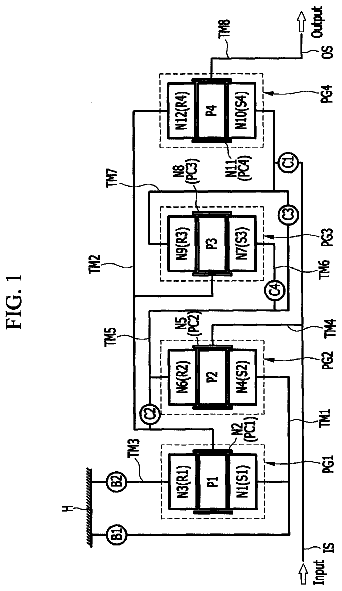
FIG. 1 is a schematic diagram of an exemplary planetary gear train according to the present invention.
FIG. 2 is an operation chart of friction elements at each speed stage in the exemplary planetary gear train according to the present invention.
It should be understood that the appended drawings are not necessarily to scale, presenting a somewhat simplified representation of various features illustrative of the basic principles of the invention. The specific design features of the present invention as disclosed herein, including, for example, specific dimensions, orientations, locations, and shapes will be determined in part by the particular intended application and use environment.
Detailed description
Reference will now be made in detail to various embodiments of the present invention(s), examples of which are illustrated in the accompanying drawings and described below. While the invention(s) will be described in conjunction with exemplary embodiments, it will be understood that the present description is not intended to limit the invention(s) to those exemplary embodiments. On the contrary, the invention(s) is/are intended to cover not only the exemplary embodiments, but also various alternatives, modifications, equivalents and other embodiments, which may be included within the spirit and scope of the invention as defined by the appended claims.
FIG. 1 is a schematic diagram of a planetary gear train according to various embodiments of the present invention.
Referring to FIG. 1 , a planetary gear train according to various embodiments of the present invention includes first, second, third, fourth planetary gear sets PG 1 , PG 2 , PG 3 , and PG 4 disposed on the same axis, an input shaft IS, an output shaft OS, eight rotations shafts TM 1 to TM 8 including at least one rotation elements of the first, second, third, and fourth planetary gear sets PG 1 , PG 2 , PG 3 , and PG 4 , seven friction elements C 1 to C 4 and B 1 to B 3 , and a transmission housing H.
As a result, torque input from the input shaft IS is changed by cooperation of the first, second, third, and fourth planetary gear sets PG 1 , PG 2 , PG 3 , and PG 4 , and the changed torque is output through the output shaft OS.
The planetary gear sets PG 1 , PG 2 , PG 3 , and PG 4 are disposed sequentially from an engine side.
The input shaft IS is an input member and power from a crankshaft of an engine is torque-converted through a torque converter to be input into the input shaft IS.
The output shaft OS is an output member, is disposed in parallel with the input shaft IS, and transmits driving torque to a driving wheel through a differential apparatus.
The first planetary gear set PG 1 is a single pinion planetary gear set and includes a first sun gear S 1 of a first rotation element N 1 , a first planet carrier PC 1 of a second rotation element N 2 rotatably supporting a first pinion P 1 externally engaged the first sun gear S 1 , and a first ring gear R 1 of a third rotation element N 3 internally engaged with the first pinion P 1 .
The second planetary gear set PG 2 is a single pinion planetary gear set and includes a second sun gear S 2 of a fourth rotation element N 4 , a second planet carrier PC 2 of a fifth rotation element N 5 rotatably supporting a second pinion P 2 externally engaged the second sun gear S 2 , and a second ring gear of a sixth rotation element N 6 internally engaged with the second pinion P 2 .
The third planetary gear set PG 3 is a single pinion planetary gear set and includes a third sun gear S 3 of a seventh rotation element N 7 , a third planet carrier PC 3 of an eighth rotation element N 8 rotatably supporting a third pinion P 3 externally engaged with the third sun gear S 3 , and a third ring gear R 3 of a ninth rotation element N 9 internally engaged with the third pinion P 3 .
The fourth planetary gear set PG 4 is a single pinion planetary gear set and includes a fourth sun gear S 4 of a tenth rotation element N 10 , a fourth planet carrier PC 4 of an eleventh rotation element N 11 rotatably supporting a fourth pinion P 4 externally engaged with the fourth sun gear S 4 , and a fourth ring gear R 4 of a twelfth rotation element N 12 internally engaged with the fourth pinion P 4 .
The second rotation element N 2 is directly connected to the sixth rotation element N 6 , the third rotation element N 3 is directly connected to the seventh rotation element N 7 , the eighth rotation element N 8 is directly connected to the twelfth rotation element N 12 , the ninth rotation element N 9 is directly connected to the eleventh rotation element N 11 , and the first, second, third, and fourth planetary gear sets PG 1 , PG 2 , PG 3 , and PG 4 are operated with eight rotation shafts TM 1 to TM 8 .
The eight rotation shafts TM 1 to TM 8 will be described in further detail.
The first rotation shaft TM 1 includes the first rotation element N 1 , and is selectively connected to the transmission housing H.
The second rotation shaft TM 2 includes the second rotation element N 2 and the fourth rotation element N 4 , and is directly connected to the input shaft IS so as to be continuously operated as an input element.
The third rotation shaft TM 3 includes the third rotation element N 3 and the tenth rotation element N 10 .
The fourth rotation shaft TM 4 includes the fifth rotation element N 5 , and is selectively connected to the third rotation shaft TM 3 .
The fifth rotation shaft TM 5 includes the sixth rotation element N 6 and the eighth rotation element N 8 , and is selectively connected to the transmission housing H.
The sixth rotation shaft TM 6 includes the seventh rotation element N 7 and is selectively connected to the first rotation shaft TM 1 or the second rotation shaft TM 2 .
The seventh rotation shaft TM 7 includes the ninth rotation element N 9 and the twelfth rotation element N 12 , is selectively connected to the fourth rotation shaft TM 4 , and is selectively connected to the transmission housing H.
The eighth rotation shaft TM 8 includes the eleventh rotation element N 11 , and is directly connected to the output shaft OS so as to be continuously operated as an output element.
In addition, four clutches C 1 , C 2 , C 3 , and C 4 which are friction elements are disposed at connection portions between any two rotation shafts.
In addition, three brakes B 1 , B 2 , and B 3 which are friction elements are disposed at connection portions between any one rotation shaft and the transmission housing H.
The seven friction elements C 1 to C 4 and B 1 to B 3 will be described in further detail.
The first clutch C 1 is disposed between the second rotation shaft TM 2 and the sixth rotation shaft TM 6 and selectively connects the second rotation shaft TM 2 and the sixth rotation shaft TM 6 .
The second clutch C 2 is disposed between the third rotation shaft TM 3 and the fourth rotation shaft TM 4 and selectively connects the third rotation shaft TM 3 and the fourth rotation shaft TM 4 .
The third clutch C 3 is disposed between the fourth rotation shaft TM 4 and the seventh rotation shaft TM 7 and selectively connects the fourth rotation shaft TM 4 and the seventh rotation shaft TM 7 .
The fourth clutch C 4 is disposed between the first rotation shaft TM 1 and the sixth rotation shaft TM 6 and selectively connects the first rotation shaft TM 1 and the sixth rotation shaft TM 6 .
The first brake B 1 is disposed between the fifth rotation shaft TM 5 and the transmission housing H and causes the fifth rotation shaft TM 5 to be operated as a selective fixed element.
The second brake B 2 is disposed between the first rotation shaft TM 1 and the transmission housing H and causes the first rotation shaft TM 1 to be operated as a selective fixed element.
The third brake B 3 is disposed between the seventh rotation shaft TM 7 and the transmission housing H and causes the seventh rotation shaft TM 7 to be operated as a selective fixed element.
The friction elements including the first, second, third, and fourth clutches C 1 , C 2 , C 3 , and C 4 and the first, second, and third brakes B 1 , B 2 , and B 3 may be multi-plates friction elements of wet type that are operated by hydraulic pressure.
FIG. 2 is an operation chart of friction elements at each speed stage in the planetary gear train according to various embodiments of the present invention.
As shown in FIG. 2 , three friction elements are operated at each speed stage in the planetary gear train according to various embodiments of the present invention. Shifting processes in the various embodiments of the present invention will be described in further detail.
If the first and second clutch C 1 and C 2 and the second brake B 2 are operated at a first forward speed stage 1 ST, the second rotation shaft TM 2 is connected to the sixth rotation shaft TM 6 , the third rotation shaft TM 3 is connected to the fourth rotation shaft TM 4 , rotation speed of the input shaft IS is input to the second rotation shaft TM 2 , and the first rotation shaft TM 1 is operated as the fixed element. Therefore, the first forward speed stage is achieved.
If the second and fourth clutches C 2 and C 4 and the second brake B 2 are operated at a second forward speed stage 2 ND, the third rotation shaft TM 3 is connected to the fourth rotation shaft TM 4 , the first rotation shaft TM 1 is connected to the sixth rotation shaft TM 6 , rotation speed of the input shaft IS is input to the second rotation shaft TM 2 , and the first rotation shaft TM 1 is operated as the fixed element. Therefore, the second forward speed stage is achieved.
If the first and fourth clutches C 1 and C 4 and the second brake B 2 are operated at a third forward speed stage, the first rotation shaft TM 1 is connected to the sixth rotation shaft TM 6 , rotation speed of the input shaft IS is input to the second rotation shaft TM 2 , and the first rotation shaft TM 1 is operated as the fixed element. Therefore, the third forward speed stage is achieved.
If the fourth clutch C 4 and the second and third brakes B 2 and B 3 are operated at a fourth forward speed stage 4 TH, the first rotation shaft TM 1 is connected to the sixth rotation shaft TM 6 , rotation speed of the input shaft IS is input to the second rotation shaft TM 2 , and the first and seventh rotation shafts TM 1 and TM 7 are operated as the fixed elements. Therefore, the fourth forward speed stage is achieved.
If the third and fourth clutches C 3 and C 4 and the second brake B 2 are operated at a fifth forward speed stage 5 TH, the fourth rotation shaft TM 4 is connected to the seventh rotation shaft TM 7 , the first rotation shaft TM 1 is connected to the sixth rotation shaft TM 6 , rotation speed of the input shaft IS is input to the second rotation shaft TM 2 , and the first rotation shaft TM 1 is operated as the fixed element. Therefore, the fifth forward speed stage is achieved.
If the third and fourth clutches C 3 and C 4 and the third brake B 3 are operated at a sixth forward speed stage 6 TH, the fourth rotation shaft TM 4 is connected to the seventh rotation shaft TM 7 , the first rotation shaft TM 1 is connected to the sixth rotation shaft TM 6 , rotation speed of the input shaft IS is input to the second rotation shaft TM 2 , and the seventh rotation shaft TM 7 is operated as the fixed element. Therefore, the sixth forward speed stage is achieved.
If the first, third, and fourth clutches C 1 , C 3 , and C 4 are operated at a seventh forward speed stage 7 TH, the second rotation shaft TM 2 is connected to the sixth rotation shaft TM 6 , the fourth rotation shaft TM 4 is connected to the seventh rotation shaft TM 7 , the first rotation shaft TM 1 is connected to the sixth rotation shaft TM 6 . Therefore, all the planetary gear sets become direct-coupling states. At this state, if rotation speed of the input shaft IS is input to the second rotation shaft TM 2 , the seventh forward speed stage is achieved. At the seventh forward speed stage, rotation speed that is the same as that of the input shaft IS is output.
If the first and third clutches C 1 and C 3 and the third brake B 3 are operated at an eighth forward speed stage 8 TH, the second rotation shaft TM 2 is connected to the sixth rotation shaft TM 6 , the fourth rotation shaft TM 4 is connected to the seventh rotation shaft TM 7 , rotation speed of the input shaft IS is input to the second rotation shaft TM 2 , and the seventh rotation shaft TM 7 is operated as the fixed element. Therefore, the eighth forward speed stage is achieved.
If the second and third clutches C 2 and C 3 and the third brake B 3 are operated at a ninth forward speed stage 9 TH, the third rotation shaft TM 3 is connected to the fourth rotation shaft TM 4 , rotation speed of the input shaft IS is input to the second rotation shaft TM 2 , and the seventh rotation shaft TM 7 is operated as the fixed element. Therefore, the ninth forward speed stage is achieved.
If the first and second clutches C 1 and C 2 and the third brake B 3 are operated at a tenth forward speed stage 10 TH, the second rotation shaft TM 2 is connected to the sixth rotation shaft TM 6 , the third rotation shaft TM 3 is connected to the fourth rotation shaft TM 4 , rotation speed of the input shaft IS is input to the second rotation shaft TM 2 , and the seventh rotation shaft TM 7 is operated as the fixed element. Therefore, the tenth forward speed stage is achieved.
If the first and second clutches C 1 and C 2 and the first brake B 1 are operated at a reverse speed stage REV, the third rotation shaft TM 3 is connected to the fourth rotation shaft TM 4 , rotation speed of the input shaft IS is input to the second rotation shaft TM 2 , and the fifth rotation shaft TM 5 is operated as the fixed element. Therefore, the reverse speed stage is achieved.
The planetary gear train according to various embodiments of the present invention may achieve ten forward speed stages and one reverse speed stage by controlling four planetary gear sets PG 1 , PG 2 , PG 3 , and PG 4 with four clutches C 1 , C 2 , C 3 , and C 4 and three brakes B 1 , B 2 , and B 3 .
In addition, step ratios between speed stages are 1.2 or more except for between the sixth and seventh forward speed stages, between the seventh and eighth forward speed stages, and between the ninth and tenth forward speed stages, and linearity of step ratios between speed stages can be secured. Thus, drivability such as acceleration before and after the shift and rhythm of engine speed may be improved.
In addition, engine driving efficiency may be maximized by achieving a span of gear ratios to be greater than or equal to 9.0.
The foregoing descriptions of specific exemplary embodiments of the present invention have been presented for purposes of illustration and description. They are not intended to be exhaustive or to limit the invention to the precise forms disclosed, and obviously many modifications and variations are possible in light of the above teachings. The exemplary embodiments were chosen and described in order to explain certain principles of the invention and their practical application, to thereby enable others skilled in the art to make and utilize various exemplary embodiments of the present invention, as well as various alternatives and modifications thereof. It is intended that the scope of the invention be defined by the Claims appended hereto and their equivalents.
 Lapsed, fee not paid6 drawings