Background
Search systems are widely used in making information available over computer networks, such as the Internet. Some search systems are very general purpose. For example, Internet search systems, such as the BING search system operated by Microsoft, respond to a user request for information by searching many different data sources accessible over the Internet. Other search systems are more focused, searching a more limited set of data sources. For example, a retail store may respond to a user request for information by only searching through data sources with information about its products. Though, even some general purpose search engines, such as BING, are able to search such “verticals” so that the system will respond to a search query identifying a product or other particular item by returning information that relates to instances of that item.
Regardless of the data sources that act as a database that are searched in response to a user query, the amount of information returned in response to a search query may depend on the format of the query submitted. Even for search systems operating on a more limited database of items, a query may be underspecified such that more items in the database match the query than a user desires to review. In some scenarios, the results of a search query may be so extensive that they cannot be easily presented to a user at one time. Though some users in some scenarios prefer to browse through a large result set, many users in many scenarios prefer to have the search system return a single or a small number of highly relevant search results.
In some scenarios, a user, upon receiving a large number of results in response to a query, may provide additional information to the search system to more narrowly define the search query. The refinement may be based on simply adding more qualifiers to the query, such as by adding terms to a search string. Though, some systems are “faceted” to facilitate narrowing a search query.
In a faceted search system, a search is conducted in a database in which attributes about the items have been predefined. Values for the attributes may be specified for each item in the database. To narrow a search, the user may be presented with options on a user interface to limit the search results to only those items having a specific value, or range of values, for an attribute.
Summary
A search system provides useful results to a user in response to an underspecified query by engaging in a dialog with the user. Questions for the dialog may be generated automatically and may be generated using techniques to efficiently arrive at a result set of appropriate size. The system may search for items matching the query in a database of items. The items may be associated with descriptive text, which may be processed to generate the questions. The system may employ techniques for automatic question generation even when the descriptive material is in the form of unstructured text.
Accordingly, in one aspect, the invention relates to a method of operating a search system that includes receiving a user query and, based on the query, identifying from a corpus of data a result set comprising information about a plurality of items. A value of an attribute is then selected from a set of attribute values characterizing assets in the corpus. That selection may be based on a ranking of attribute values in the set of attribute values, the ranking being based on a degree of discrimination among items in the result set that results from qualifying inclusion in the result set based on the selected attribute value.
In another aspect, the invention relates to a computerized apparatus that includes a database comprising data about a plurality of items, at least one computer storage medium comprising a plurality of attribute values, a network interface and at least one processor. The processor is adapted to receive a query through the network interface and select, based on the query, a result set comprising a subset of the plurality of items in the database. An attribute value may be selected from the plurality of attribute values and used to generate a question. That question may be transmitted through the network interface and a response may be received. The response may be used in updating the response set.
In yet a further aspect, the invention may relate to at least one computer-readable storage medium comprising computer-executable instructions that, when executed, perform of method of operating a search system that, in response to a user query, provides an output based on an identification of one or more items. That method may comprise acquiring textual descriptions of a plurality of items and identifying combinations of one or more words appearing in the textual descriptions. These combinations of words may be classified into a plurality of categories. A set of attribute values may be determined from the identified combinations of words and respective categories of the words. This set of attribute values may be used to generate questions that refine the user query.
The foregoing is a non-limiting summary of the invention, which is defined by the attached claims.
Brief description of drawings
The accompanying drawings are not intended to be drawn to scale. In the drawings, each identical or nearly identical component that is illustrated in various figures is represented by a like numeral. For purposes of clarity, not every component may be labeled in every drawing. In the drawings:
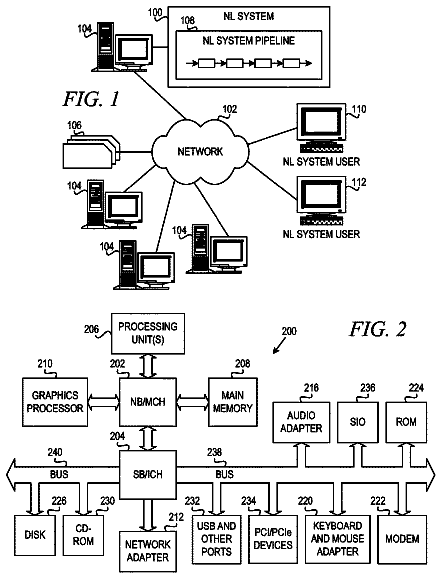
FIG. 1 is a sketch of an exemplary embodiment of a search system in a scenario in which a user is accessing the system to obtain information in response to a query;
FIG. 2 is a sketch of an exemplary embodiment of a search system in a scenario in which descriptive text is being acquired from multiple users;
FIG. 3 is a functional block diagram illustrating operation of an exemplary embodiment of a search system;
FIG. 4 is a flowchart of an exemplary method of configuring a search system that can generate questions for query refinement from unstructured text;
FIG. 5 is a flowchart of an exemplary method of operation of a search system that generates questions for query refinement from unstructured text; and
FIG. 6 is a block diagram of an exemplary computing device that may be used in implementing a search system.
Detailed description
The inventors have recognized and appreciated that a low cost, yet effective, search system may be created by automatically generating questions for query refinement, even if the query is run against a database that describes items using unstructured text. The questions may be generated such that the system quickly arrives at an appropriate number of items identified in response to the query.
Such a system may be constructed without the effort of constructing a faceted database. In some embodiments, the database may be constructed using textual descriptions about items. Those textual descriptions may be unstructured and may even be harvested from text generated for reasons other than constructing the search system. For example, if the system is to provide data about products for sale, the descriptions may be based on user evaluations of the products or postings on a social networking site. Accordingly, these and other crowd sourcing techniques may be used to construct the database.
Regardless of how the unstructured text is obtained, that text may be processed to identify attribute values characterizing items in the database. These combinations may be identified in an automated way. For example, attribute values may be identified based on one or more words that appear in unstructured text associated with multiple items in the database. In some embodiments, a useful attribute value may be identified based on computation of a metric reflecting a quantity of information about items in the database revealed by that attribute value.
Identifying useful attribute values may be performed in one or more processing steps that add or remove as candidate attribute values strings of one or more words appearing in the textual descriptions associated with items in the database. In some embodiments, for example, a first processing step may be used to identify combinations of one or more words that have a high pointwise mutual information content. Such strings of words may serve as candidate attribute values. In a separate processing step, candidate attribute values that, if used to form a question for query refinement, would generate little or no useful information for narrowing the search results may be excluded.
Regardless of the how identified, when a question is to be generated for query refinement, one or more attribute values may be selected from the set of candidates. A selected attribute value may be the basis for a question generated to a user in response to an underspecified query.
The question may be generated in any suitable way, such as by populating a template based on the selected attribute value. Though not a requirement of the invention, the question may be a binary question, asking the user whether the user is searching for information about items having a specific value of an attribute. Though, it should be appreciated that the questions may be in any suitable format, including in a format that requests a user to supply a value of an attribute or to select from among multiple attribute values.
Any suitable technique may be used to select one or more appropriate attribute values. In some embodiments, an attribute value may be selected based on the result set. For example, an attribute value may be selected based on a degree to which an answer to a question formulated based on the attribute value will narrow the result set. For binary questions, the attribute value that most nearly reduces the result set by half may be selected. For other types of questions, other criteria may be used to select one or more attribute values as the basis for a question.
Regardless of how the questions is constructed, a result to the question may be used to update the set of results generated by the query. If the updated result set still contains more items than desired, a further iteration may be performed. In each subsequent iteration, another question may be generated, and, based on the response, the result set may again be updated.
Though embodiments of a search system may be suitable for many operating environments, such a search system may be well suited for mobile devices. Mobile devices tend to have small displays, such that the amount of information that can be displayed in response to a search query is limited. Mobile devices may also have limited user input capabilities such that being able to narrow a search query by presenting simple questions to the user and receiving simples response may provide a desirable user experience. As yet another example, in some embodiments, the user interface may be presented through augmented reality glasses where the glasses act like a personal assistant (an extension of what phones can do today).
Such a search system may be implemented in any suitable way and used in any suitable environment. FIG. 1 illustrates an exemplary search system 100 in which techniques for query refinement as described herein may be applied. In the scenario illustrated in FIG. 1 , a user 110 is accessing search system 100 through a portable computing device 112 . The portable computing device, for example, may be a tablet computer or a smart phone. Though, the specific device through which a user accesses search system 100 is not critical to the invention, and any suitable computing device may be used for access.
As is known in the art, portable computing device 112 may provide a user interface through which user 110 may input a query. That query may be communicated to server 150 , which may be programmed to search for and return to computing device 112 information defined by the query. Such a query may be specified in any suitable format and communicated from portable computing device 112 to server 150 in any suitable way. For example, computing device 112 may be equipped with a browser of the type conventionally used to present a user interface to a server based system. User input entered through the browser may be communicated to server 150 .
In this scenario, communications between computing device 112 and server 150 occur over network 120 and wireless link 114 . In this example, a network 120 may be the Internet and server 150 may be connected to network 120 through any suitable network interface. Wireless link 114 may be a network formed over a wide area network, such as cellular network coupled to network 120 via a base station 122 . The specific network connections between computing device 112 and server 150 are not critical to the invention. However, search system 100 may be configured to allow a favorable user experience when a wireless link, which may limit the bandwidth of communications between computing device 112 and server 150 , is used for communication. Techniques as described herein may allow meaningful search results to be identified while limiting the amount of information exchanged between computing device 112 and server 150 .
An approach for limiting the amount of information exchanged may employ query refinement. In response to a query, which may be submitted in any suitable form, server 150 may execute that query against information stored in database 152 . That search may be conducted in any suitable way, including using a search engine or other search functionality as is known in the art. Though, queries specified using conventional search systems are frequently under constrained. As a result, when a search engine within server 150 executes the query in a known way, the result set may contain more information than is desired by user 110 . Rather than transmit the full result set, server 150 may automatically generate questions to engage in a dialogue with user 110 to update the result set, thereby reducing the number of items in the updated result set. Techniques as described herein may be used to generate questions that quickly narrow the result set.
Database 152 may contain any suitable type of information. In some embodiments, database 152 may contain information about items and unstructured textual descriptions of those items. As one example, the items in database 152 may be items for sale at a retail store. Though, it should be appreciated that the invention is not limited based on the nature of items in database 152 . The items, for example, may be movies, restaurants or anything else about which a user might desire to search for information.
Regardless of the nature of the items in database 152 , server 150 may be programmed to access descriptive information about those items and generate questions for a query refinement dialogue. The generated questions may be communicated to portable computing device 112 , where they are presented to the user 110 . The questions may be presented in any suitable way. In the embodiment illustrated, portable computing device 112 has a display on which information may be presented to user 110 . The questions may be in a textual or graphical format amenable to display on computing device 112 . In response to such a display, user 110 may provide input that allows server 152 to update the set of results generated in response to the query by eliminating some items from the result set.
Though, it should be appreciated that the mechanism by which questions are presented to the user and the user provides additional information is not critical to the invention. In some embodiments, for example, questions may be presented in an audible format and user responses may be captured using speech to text or other approaches for receiving user input.
In the embodiment illustrated, server 150 may generate questions for query refinement based on information stored in database 152 and/or other information. That information may be obtained in any suitable way. Though, in some embodiments, information about items in database 152 may be collected using crowd source techniques. In crowd sourcing, input is collected from multiple individuals. FIG. 2 , for example, shows multiple users 210 A, 210 B and 210 C. Each of the users may interact with each other and/or computerized systems accessible over the Internet 120 . In the illustrated example, each of the users 210 A, 210 B and 210 C interacts through a computing device 212 A, 212 B, 212 C, respectively. In this example, the computing devices are illustrated as desktop computers, but the specific mechanism of access is not critical to the invention.
The specific nature of interaction that generates descriptive information about items in database 152 also is not critical to the invention. In some embodiments, each of the users 210 A, 210 B and 210 C may log on to a website presented by server 150 and input information specifically about items in database 152 . Though, the descriptive information about items database 152 may be obtained based on user interactions for reasons other than providing descriptions of items in database 152 . For example, the user interactions may entail inputs to a social networking system in which users express preferences or provide ratings about items. Server 150 , or any other suitable computing device, may access this information to associate descriptive text with items in database 152 .
FIG. 3 illustrates, in a functional way, components that may perform operations of a search system, such as search system 100 ( FIG. 1 ). FIG. 3 illustrates that users 310 interact with the search system. Users 310 may include users, such as user 110 ( FIG. 1 ) who submit search queries to the system. Users 310 also may include users, such as users 210 A, 210 B and 210 C ( FIG. 2 ) who provide textual descriptions. Such users, interacting with the search system in different ways, may be the same individuals or may be different individuals who interact with the search system in different ways at different times.
In the example of FIG. 3 , an off-line process 320 and an online process 350 are illustrated. During off-line process 320 , the search system may be configured to respond to a query from a user. Configuration may entail receiving textual descriptions about items in a database 152 to be searched in response to a query. Alternatively or additionally, configuration may entail preprocessing of the textual descriptions to prepare for responding to a search query during online process 350 .
In off-line process 320 , the system receives unstructured text 312 . As described above, this unstructured text may be directly input into the search system or may be gathered from other types of user actions. Regardless of the manner in which the unstructured text 312 is obtained, it may be stored in database 152 . Any suitable storage format may be used. Though, in the embodiment illustrated, unstructured text 312 is stored in a way that there is an association between items in the database and unstructured text that describes those items.
Additionally, an index of the information in database 152 may be created during off-line process 320 . In the embodiment of FIG. 3 , an inverted index 352 is created for database 152 associating strings and information from the unstructured text and database record to database records. Inverted index 352 may be an index of the type known in the art for use by a search system. Such an index may be created in any suitable way, including using techniques as are known in the art for building an index for a search system. In some embodiments, for example, the inverted index points words into records in database 152 associated with unstructured text that matches the words.
In addition to obtaining unstructured text during off-line process 320 , that unstructured text may be preprocessed to identify candidate attribute values for use in online process 352 to generate questions. The attribute values may characterize items in database 152 .
In the embodiment illustrated in FIG. 3 , candidate attribute values are identified by processing n-grams identified in the text stored in database 152 to describe the items in that database. An n-gram may be a string of one or more words. The words in the string may occur sequentially in the descriptive text, but this is not a requirement. For example, articles such as “a” or “an” may be skipped over in forming strings. Similarly, any other words, deemed not likely to provide information about an item, may be skipped over.
In some embodiments, the size of n-grams processed may be limited. These limits may be derived in any suitable way, and may serve to limit the amount of processing performed on textual descriptions in database 152 by processing only n-grams likely to represent values of attributes characterizing items in database 152 . In some embodiments, the n-grams processed may be limited to series of words of length one, two or three. Though, the specific limits imposed are not critical to the invention, as any suitable limits may be used.
In the embodiment illustrated in FIG. 3 , the identified n-grams 322 may be provided to attribute extractor 324 . Attribute extractor 324 may perform a computation on the identified n-grams to identify a set of candidate attribute values 326 . Attribute extractor 324 may be implemented in any suitable way, including by programming server 150 ( FIG. 1 ) or any other suitable computing device. The computation performed by attribute extractor 324 may generate an indication of the amount of information on an n-gram provides about one or more items in database 152 . Those n-grams providing more information about items may be preferentially selected as values of attributes characterizing items in database 152 .
Any suitable computation may be performed to generate an indication of the amount of information conveyed by an n-gram. In some embodiments, the computation may generate a metric indicating the amount of association an n-gram has with an associated database category. For example, that computation may generate a metric derived from a statistics such as the pointwise mutual information (PMI) or log-likelihood.
As a specific example, if an attribute value, such as the sleeve length of a shirt, is salient to a category, then strings serving as a value of the value, such as “short-sleeved” and “short sleeves”, are likely to occur more often in descriptions for items of the category than for other items. Therefore, an approach for selecting candidate attribute values is to seek n-grams that are highly associated with each category, where association can be measured using statistics such as pointwise mutual information (PMI) or log-likelihood. When PMI is used, given an n-gram nεS, an association of an n-gram with a category c can be computed as:
P M I ( n ; c ) = log p ( n , c ) p ( n ) p ( c ) where P(n,c) is the probability that an n-gram in a description of an item in c is n, P(n) is the probability that an n-gram in any description is n and P(c) is the probability of any n-gram occurring in a description in class c. N-grams with a PMI score higher than a predetermined threshold with a category are selected as candidate attribute values for that category.
Based on these metrics, one or more n-grams may be selected. The specific approach used to select an n-gram is not critical to the invention. For example, n-grams having a value of the metric exceeding a predetermined threshold or the highest ranking n-grams may be selected as the values for candidate attribute values 326 . Regardless of how selected, these candidate attribute values 326 may be stored for use in online process 350 .
Regardless of the specific processing that occurs in off-line process 320 , once the system is configured, online process 350 may be performed. As part of online process 350 , a query 314 may be received from users 310 and processed. The query 314 may be supplied by a single user or a combination of users, as the invention is not limited based on the source of the query.
The invention also is not limited by the nature of the query. However, in some embodiments, the query may be a string of search terms that is processed by search engine 354 . Search engine 354 may access inverted index 352 to identify items in database 152 matching the query. This processing may be performed in any suitable way, including using search techniques as are known in the art.
As one example, inverted index 352 may map each n-gram n in the set, S, of textual descriptions in database 152 to its corresponding asset r along with its tf-idf, defined as: tfidf ( n,r )= tf ( n,r )×log idf ( n )
where tf(n,r) is the frequency of n in S.sub.r, and idf(n) is the fraction of textual descriptions sεS containing n.
Let r be a vector of all n-grams in S.sub.r where the value of each n-grams is its tf-idf with r. Then, given a query q, we form a query vector q consisting of all n-grams in q, where the value of each feature is 1. Search engine 354 may first retrieve from the inverted index 352 all items matching an n-grams with q. For each matching item r, we then compute a simple IR rank score as the cosine of the angle between q and r:
cosine ( q , r ) = .Math. i q i .Math. r i .Math. i q i r .Math. .Math. i r i 2
Such processing may generate a result set 356 . Result set 356 may contain information identifying one or more of the items in database 152 . In many scenarios, the initial result set 356 may contain multiple items. If result set 356 contains multiple items, the result set may also be referred to as a “confusion set,” indicating that the search results still allow for confusion as to the item that is the target of the search. A confusion set may be generated by an “underspecified query,” which is a query that results in one or more possible items.
In scenarios in which a user desires a relatively focused result, but submits an underspecified query, result set 356 may initially contain more items than desired. In that scenario, further processing may be performed in online process 352 to update the result set to contain fewer items. That processing may entail identifying appropriate questions and rendering those questions to prompt additional input from the user submitting a query 314 to further focus the search.
In the embodiment illustrated in FIG. 3 , appropriate questions are generated by first selecting an attribute value from the candidate attribute values 326 . In FIG. 3 , a two-step process is used to select an appropriate attribute value. The first such step is performed in classifier 360 and the second step is performed in ranker 370 . Classifier 360 and ranker 370 may be implemented in any suitable way, including through programming of the server 150 or other suitable computing device.
In this example, classifier 360 implements processing that divides the candidate attribute values 326 into categories based on their suitability for use in generating questions to narrow search query 314 . In the specific example illustrated in FIG. 3 , candidate attribute values 326 classifier 360 may divide candidate attribute values 326 into two categories, generally containing useful or not useful candidate attribute values. An attribute value may not be useful in generating questions if, for example, a user would be unable to answer the question and/or, if the user were able to answer the question, the answer would not provide useful information in narrowing a result set. The not useful attribute values may be filtered out.
Classifier 360 may be generated in any suitable way. For example, classifier 360 may be constructed in accordance with a machine learning algorithm as is known in the art. In accordance with some embodiments, a machine learned model utilizes features derived from both the user's query and the candidate attribute values 326 , and filters out candidate attribute values that lead to unanswerable questions or are not relevant given the query.
The model may be a Maximum Entropy classifier. Such a classifier may operate according to a supervised classification approach that is based on a training set. The training set may contain queries. For every query in the training set, the query may be applied to search engine 354 to generate a training result set consisted of results along with candidate attribute values each annoted, possibly manually, as useful or not useful. From this training result set, attribute values may be selected from the candidate attribute values 326 generated by attribute extractor 324 . The selected attribute values also match at least one description of the items in the training result set: an attribute value candidate that does not fulfil that criterion is by definition not able to serve as a disambiguator on the set. Ranker 370 , as described below, may be used to select candidate attribute values for every query in the training set. In the described embodiment, two candidate attribute values are selected and annotated with nine automatically extracted features.
Exemplary features that may be automatically extracted are summarized in Table 1. Though, it should be appreciated that any suitable features alternatively or additionally may be used. In this example, the unigram feature indicates that the candidate term is a unigram; similarly for bigram and trigram. The feature POS tag sequence of candidate represents the part-of-speech tags of the words in a candidate. POS tag of every word in the candidate indicates all individual POS tags. Information about the relation of the candidate to the query and the category of the queried record is captured using the features candidate is a substring of the query and candidate contains the queried category respectively. Real-valued features for the PMI score and log-likelihood score of the candidates with respect to the category may also be used.
TABLE-US-00001 TABLE 1 Binary features unigram, bigram, trigram, (Part of Speech) POS tag sequence of candidate, separate POS tag of every word in the candidate, candidate is a substring of the query, candidate contains the queried category Real-valued features PMI score, log-likelihood score
Such a training set may be derived in any suitable way, including by input from one or more humans during configuration of the search system to label questions as answerable, unanswerable and/or useful or not useful in narrowing a result set. From a set of queries, a set of positive and negative examples may be generated for training. Positive examples are attribute values that are meaningful with respect to the given query and answerable if used in a question, whereas negative examples are either not meaningful or unanswerable. For simplicity, these examples may be referred to as answerable and unanswerable, respectively. Though, it should be appreciated that usefulness of attribute values for narrowing a search query may be measured in any suitable way including by automatically using the attribute to narrow the search and computing the effect.
Some or all attribute value candidates for each query in the training set may be labeled as answerable or unanswerable. Such labeling may be performed by a human or performed in any other suitable way. In order to make the labeling task feasible, however, a label may be provided for less than all attribute value candidates.
Such an approach may still yield desirable results. Consider that the classifier, performs a runtime task of filtering out attribute values from the candidate attribute values 326 provided by attribute extractor 324 . It is reasonable, therefore, to pick examples for labeling that are likely to be relevant in that scenario. One such technique for picking examples for labeling is to first form the intersection of (i) the terms in the descriptions of the items in the result set; and (ii) the candidate attribute values 326 . This produces a set of attribute value candidates just like the ones that classifier 360 will be exposed to at runtime.
In some embodiments, a focus may be placed on finding answerable training cases, because the negative (unanswerable) cases may be in the majority and hence much easier to come by. Of particular importance are cases that are selected by the Attribute Extractor and highly ranked by the Ranker, i.e. “borderline” candidates. In some embodiments, the top-10 attribute values (selected by the Attribute Extractor) may be collected for a given query and result set as measured by the Ranker (using M_rank as a weight function). From this top-10 set, the top candidate and a random candidate to annotate as answerable or unanswerable may be selected. As a specific example, the resulting training set may consist of 100 data points, 47 answerable and 53 unanswerable. Each training case may be represented as a feature vector using the features listed in Table 1. Though, it should be appreciated that any suitable representation of the training set may be used.
The classifier may be evaluated based on 10-fold cross validation on the training set. As a specific example, a probability threshold greater than 0.7 may be used for the answerable question terms.
Regardless of the manner in which the training set for classifier 360 is created, once the result set 356 is generated, classifier 360 may be trained with that training set. The resulting trained classifier 360 may then be used to filter the candidate attribute values 326 . In the embodiment illustrated, those values from candidate attribute values 326 classified as “unanswerable” (which in this embodiment indicates that formulating a question based on the attribute value is unlikely to generate significant information useful in the near or in the result set) are removed from further consideration, leaving filtered attribute values 362 .
The filtered attribute values 362 are supplied to ranker 370 . Ranker 370 selects from among the candidate attribute values 362 , one or more values that are likely to be most effective at reducing the result set if used to formulate a question. Ranker 370 may operate in any suitable way. In some embodiments, ranker 370 may compute a metric of the effectiveness of each of the filtered attribute values 362 .
In some embodiments, the metric may indicate the degree to which a particular attribute, if used as a qualifier on the results in the set, will restrict the size of the result set.
In some embodiments, the metric may be skewed to reflect the fact that search engines output results in an order. The function used to compute the metric may be skewed to provide a better score for attributes that restrict the result set by removing results ranked lower in the order established by the search engine.
In the embodiment illustrated, ranker 370 orders the filtered attribute values 362 according to how well each is expected to reduce the size of the confusion set. The top ranking attribute value may be used in formulating a question asked to the user.
In an embodiment in which attribute value questions are binary, the most effective questions will be those that result in dividing the confusion set in half. This would result in an optimal interaction strategy where log m questions are needed to guide a user through a confusion set of size m to arrive at a single item in the result set. The ranking score for an attribute value n and confusion set R, score.sub.R(n), may be a real-valued function ranging from zero to one where zero indicates that n will cut the confusion set in half and one indicates that n will leave the confusion set unchanged. More effective questions will have a lower value of this score (Accordingly, it should be appreciated that a “higher” score, indicating a more restrictive term, may not be expressed with a value of the metric that is numerically larger than metric values indicating a less restrictive term). Formally:
score R ( n ) = 2 .Math. .Math. r ∈ R ϕ R ( n ) f ( r ) .Math. r ∈ R f ( r ) - 0.5 .Math. where score.sub.R(n): .fwdarw.[0,1], ƒ(r) represents a weight function associated with each item r in the confusion set, and φ.sub.R(n) is the number of items in the confusion set that hold the attribute value n (estimated by whether or not at least one textual description mentions n).
If ƒ(r)=1, score.sub.R(n) is minimized when n cuts the confusion set in half. However, each item in the confusion set has a relevance score assigned by search engine 354 . It is therefore reasonable to assume that items at the head of R will be more likely the target item than items at the tail of R. Various definitions of the weight function ƒ(r) may be defined to capture this intuition:
f ( r ) = { M 1 : 1 M rank : 1 rank ( r ) M ir : IR ( r ) M dcg : ( 1 forrank ( r ) = 1 rank ( r ) log 2 rank ( r ) otherwise
M.sub.1 considers all items in the confusion set equally probable to be the target asset. M.sub.rank weighs items according to their rank in R and M.sub.ir weighs them according to their cosine with the user query. Similarly, M.sub.deg weighs items according to their gain discounted by rank position (similarly to that done in the Discounted Cumulative Gain (DCG) metric used primarily in search engine 354 ).
The filtered attribute value with the lowest score is selected to form the question. In some embodiments, when multiple ones of the filtered attribute values 362 have the same lowest score, a score computed by attribute extractor 324 , as described above, may be used as a tie-breaker.
In some embodiments, a system may be built using M.sub.rank, M.sub.1, M.sub.ir, and M.sub.deg as evaluation metrics.
Regardless of the specific technique used by ranker 370 , the resulting attribute value 372 may be passed to question generator 380 . Question generator 380 may generate a question based on attribute values 372 in any suitable way. In the embodiment illustrated, question generator 380 may access a set of templates 382 . A template selected from set of templates 382 may then be used to generate a question provided back to users 310 as a query refinement 316 .
In some embodiments, a template may be selected from set 382 based on the part of speech of the selected attribute value, if the selected attribute value consists of one word. If the selected attribute value consists of multiple words, the series of parts of speech corresponding to those words may be used to select an appropriate template. Table 2 lists various question templates and corresponding sequences of parts of speech for which each question template may be appropriate. Though, it should be appreciated that these templates are exemplary, and many other question forms may be appropriate.
TABLE-US-00002 TABLE 2 Template POS Should it be JJ (Cat: NN) Should they be JJ (Cat: NNS) Do you want DT JJ NN Do you want (a/an) JJ NN NN Are these JJ VB NNS Is it RB VBN Is it (a/an) JJ VB NN Does it have NN NNS
Regardless of the manner in which the question is generated, the resulting question may be transmitted back to the user who generated query 314 as query refinement 316 . An answer to that question may be regarded as defining a refined query from the user. The refined query may be the user's initial query qualified to return as a search result only items having an attribute with the value matching the user's response to the question posed as query refinement 316 . This refined query may then generate an updated result set, which may in turn be provided to classifier 360 , resulting in an updated set 362 of filtered attribute values. The updated set may then be applied to ranker 370 , which may make a further selection of an attribute value that is applied to question generator 380 . Question generator 380 may then generate a further question, resulting in further query refinement.
The description continues in the full USPTO document.
 Lapsed, fee not paid6 drawings