 Lapsed, fee not paid5 drawings
Biotech & Lab · US 9,763,910 B1
Combination therapy for treating cancer
Disclosed is a method of treating a subject having non-small cell lung cancer.
US 9,763,950 B2 · Assignee: ASTRAZENECA AB · Inventors: Hancox; Ursula Joy et al.
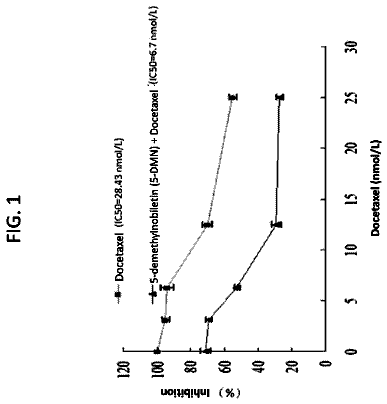
Sheet 1 of 4 from the published document. All sheets in the USPTO PDF
The present invention relates to the use of combinations comprising 8-[(1R)-1-(3,5-difluorophenylamino)ethyl]-N,N-dimethyl-2-morpholino-4-oxo-4H-chromene-6-carboxamide or a pharmaceutically acceptable salt thereof and a taxane in the treatment or prophylaxis of cancer; pharmaceutical compositions comprising Compound [I] (or a pharmaceutically acceptable salt thereof) and a taxane; kits comprising Compound [I] or a pharmaceutically acceptable salt thereof and a taxane, optionally with instructions for use; and methods of treatment comprising the simultaneous, sequential or separate administration of Compound [I] or a pharmaceutically acceptable salt thereof and a taxane to warm-blooded animal, such as man.
1 of 4 drawing sheets so far from the published document, cropped to the drawing. Every sheet is in the USPTO PDF.
What the patent claimed, word for word. All of it is now free to use.
The present invention relates to the use of combinations comprising 8-[(1R)-1-(3,5-difluorophenylamino)ethyl]-N,N-dimethyl-2-morpholino-4-oxo-4H-chromene-6-carboxamide (hereafter “Compound [I]”) or a pharmaceutically acceptable salt thereof and a taxane in the treatment or prophylaxis of cancer. Taxanes include established cancer drugs such as docetaxel (Taxotere™) and paclitaxel (Taxol™). Other taxanes include cabazitaxel, larotaxel, ortataxel, and tesetaxel. The invention also relates to pharmaceutical compositions comprising Compound [I] or a pharmaceutically acceptable salt thereof and a taxane; and to kits comprising Compound [I] or a pharmaceutically acceptable salt thereof and a taxane, optionally with instructions for use. The invention further relates to methods of treatment comprising the simultaneous, sequential or separate administration of Compound [I] or a pharmaceutically acceptable salt thereof and a taxane to warm-blooded animal, such as man.
It has been discovered that a cell may become cancerous by virtue of the transformation of a portion of its DNA into an oncogene, a gene which, on activation, leads to the formation of malignant tumour cells (Bradshaw, Mutagenesis, 1986, 1, 91). Several such oncogenes give rise to the production of peptides, which are receptors for growth factors. Activation of the growth factor receptor complex subsequently leads to an increase in cell proliferation. It is known, for example, that several oncogenes encode tyrosine kinase enzymes and that certain growth factor receptors are also tyrosine kinase enzymes (Yarden et al., Ann. Rev. Biochem., 1988, 57, 443; Larsen et al., Ann. Reports in Med. Chem., 1989, Chpt. 13). The first group of tyrosine kinases to be identified arose from viral oncogenes, for example pp60.sup.v-Src tyrosine kinase (otherwise known as v-Src), and the corresponding tyrosine kinases in normal cells, for example pp60.sup.c-Src tyrosine kinase (otherwise known as c-Src).
Receptor tyrosine kinases are important in the transmission of biochemical signals which initiate cell replication. They are large enzymes which span the cell membrane and possess an extracellular binding domain for growth factors such as epidermal growth factor (EGF) and an intracellular portion which functions as a kinase to phosphorylate tyrosine amino acids in proteins and hence to influence cell proliferation. Various classes of receptor tyrosine kinases are known (Wilks, Advances in Cancer Research, 1993, 60, 43-73) including lipid kinases, which are located intracellularly and are involved in the transmission of biochemical signals such as those that influence tumour cell growth and invasiveness. Various classes of lipid kinases are known including the PI 3-kinase family, which is alternatively known as the phosphatidylinositol-3-kinase family.
It is now well understood that deregulation of oncogenes and tumour-suppressor genes contributes to the formation of malignant tumours, for example by way of increased cell proliferation or increased cell survival. It is also now known that signalling pathways mediated by the PI 3-kinase family have a central role in a number of cell processes including proliferation and survival, and deregulation of these pathways is a causative factor a wide spectrum of human cancers and other diseases (Katso et al., Annual Rev. Cell Dev. Biol., 2001, 17: 615-617 and Foster et al., J. Cell Science, 2003, 116: 3037-3040).
The PI 3-kinase family of lipid kinases is a group of enzymes that phosphorylate the 3-position of the inositol ring of phosphatidylinositol (PI). Three major groups of PI 3-kinase enzymes are known which are classified according to their physiological substrate specificity (Vanhaesebroeck et al., Trends in Biol. Sci., 1997, 22, 267). Class III PI 3-kinase enzymes phosphorylate PI alone. In contrast, Class II PI 3-kinase enzymes phosphorylate both PI and PI 4-phosphate [abbreviated hereinafter to PI(4)P]. Class I PI 3-kinase enzymes phosphorylate PI, PI(4)P and PI 4,5-bisphosphate [abbreviated hereinafter to PI(4,5)P2], although only PI(4,5)P2 is believed to be the physiological cellular substrate. Phosphorylation of PI(4,5)P2 produces the lipid second messenger PI 3,4,5-triphosphate [abbreviated hereinafter to PI(3,4,5)P3]. More distantly related members of this superfamily are Class IV kinases such as mTOR and DNA-dependent kinase that phosphorylate serine/threonine residues within protein substrates. The most studied and understood of these lipid kinases are the Class I PI 3-kinase enzymes.
Class I PI 3-kinase is a heterodimer consisting of a p110 catalytic subunit and a regulatory subunit, and the family is further divided into Class Ia and Class Ib enzymes on the basis of regulatory partners and mechanism of regulation. Class Ia enzymes, include PI 3-kinase β, and consist of three distinct catalytic subunits (p110, p110β and p110δ) that dimerise with five distinct regulatory subunits (p85α, p55α, p50α, p85β and p55γ), with all catalytic subunits being able to interact with all regulatory subunits to form a variety of heterodimers. Class Ia PI 3-kinase enzymes are generally activated in response to growth factor-stimulation of receptor tyrosine kinases, via interaction of the regulatory subunit SH2 domains with specific phospho-tyrosine residues of the activated receptor or adaptor proteins such as IRS-1. Both p110α and p110β are constitutively expressed in all cell types, whereas p110δ expression is more restricted to leukocyte populations and some epithelial cells. In contrast, the single Class Ib enzyme consists of a p110γ catalytic subunit that interacts with a p101 regulatory subunit. Furthermore, the Class Ib enzymes are activated in response to G-protein coupled receptor (GPCR) systems as well as by the mechanisms described above.
There is now considerable evidence indicating that Class Ia PI 3-kinase enzymes, which include PI 3-kinase β, contribute to tumourigenesis in a wide variety of human cancers, either directly or indirectly (Vivanco and Sawyers, Nature Reviews Cancer, 2002, 2, 489-501). For example, the p110α subunit is amplified in some tumours such as those of the ovary (Shayesteh et al., Nature Genetics, 1999, 21: 99-102) and cervix (Ma et al., Oncogene, 2000, 19: 2739-2744). Activating mutations within the catalytic site of p110α have been associated with various other tumours such as those of the colorectal region and of the breast and lung (Samuels et al., Science, 2004, 304, 554). Tumour-related mutations in p85α have also been identified in cancers such as those of the ovary and colon (Philp et al., Cancer Research, 2001, 61, 7426-7429). PI 3 kinase-β plays a critical role in B-cell function and has been shown to be a mediator of survival signalling in a range of B-cell malignancies. This includes, but may not be limited to, chronic lymphocytic leukaemia (CLL), acute lymphoblastic leukaemia (ALL), follicular lymphoma, diffuse large B-cell lymphoma (DLBCL) and mantle cell lymphoma (Ikeda et al., Blood, 2010, 116, 1460-1468; Herman et al., Blood, 2010, 116, 2078-2088; Lannutti et al., Blood, 2011, 117, 591-594; Hoellenriegel et al., Blood, 2011, 118, 3603-3612). In addition to direct effects, it is believed that activation of Class Ia PI 3-kinase contributes to tumourigenic events that occur upstream in signalling pathways, for example by way of ligand-dependent or ligand-independent activation of receptor tyrosine kinases, GPCR systems or integrins (Vara et al., Cancer Treatment Reviews, 2004, 30, 193-204). Examples of such upstream signalling pathways include over-expression of the receptor tyrosine kinase Erb2 in a variety of tumours leading to activation of PI 3-kinase-mediated pathways (Haran et al., Oncogene, 2000, 19, 6102-6114) and over-expression of the oncogene Ras (Kauffmann-Zeh et al., Nature, 1997, 385, 544-548). In addition, Class Ia PI 3-kinases may contribute indirectly to tumourigenesis caused by various downstream signalling events. For example, loss of the effect of the PTEN tumour-suppressor phosphatase that catalyses conversion of PI(3,4,5)P3 back to PI(4,5)P2 is associated with a very broad range of tumours via deregulation of PI 3-kinase-mediated production of PI(3,4,5)P3 (Simpson and Parsons, Exp. Cell Res., 2001, 264, 29-41). Furthermore, augmentation of the effects of other PI 3-kinase-mediated signalling events is believed to contribute to a variety of cancers, for example by activation of AKT (Nicholson and Anderson, Cellular Signalling, 2002, 14, 381-395).
In addition to a role in mediating proliferative and survival signalling in tumour cells, there is also good evidence that Class Ia PI 3-kinase enzymes will also contribute to tumourigenesis via its function in tumour-associated stromal cells. For example, PI 3-kinase signalling is known to play an important role in mediating angiogenic events in endothelial cells in response to pro-angiogenic factors such as VEGF (Abid et al., Arterioscler. Thromb. Vasc. Biol., 2004, 24, 294-300). As Class I PI 3-kinase enzymes are also involved in motility and migration (Sawyer, Expert Opinion Investig. Drugs, 2004, 13, 1-19), PI 3-kinase inhibitors should provide therapeutic benefit via inhibition of tumour cell invasion and metastasis.
In addition, Class I PI 3-kinase enzymes play an important role in the regulation of immune cells with PI 3-kinase activity contributing to pro-tumourigenic effects of inflammatory cells (Coussens and Werb, Nature, 2002, 420, 860-867).
These findings suggest that pharmacological inhibitors of Class I PI 3-kinase enzymes should be of therapeutic value for treatment of the various forms of the disease of cancer comprising solid tumours such as carcinomas and sarcomas and the leukaemias and lymphoid malignancies. In particular, inhibitors of Class I PI 3-kinase enzymes should be of therapeutic value for treatment of, for example, cancer of the breast, colorectum, lung (including small cell lung cancer, non-small cell lung cancer and bronchioalveolar cancer) and prostate, and of cancer of the bile duct, bone, bladder, brain, head and neck, kidney, liver, gastrointestinal tissue, oesophagus, ovary, pancreas, skin, testes, thyroid, uterus, cervix and vulva, and of leukaemias (including acute lymphoblastic leukaemia, Chronic Lymphocytic Leukaemia and chronic myelogenous leukaemia), multiple myeloma and lymphomas (including non-Hodgkin's lymphomas such as diffuse large B-cell lymphoma, follicular lymphoma, and mantle cell lymphoma).
Generally, investigators have explored the physiological and pathological roles of the PI 3-kinase enzyme family using the aforementioned PI 3-kinase inhibitors LY294002 and wortmannin. Although use of those compounds may suggest a role for PI 3-kinase in a cellular event, they are not sufficiently selective within the PI 3-kinase family to allow dissection of the individual roles of the family members. For this reason, more potent and selective pharmaceutical PI 3-kinase inhibitors would be useful to allow a more complete understanding of PI 3-kinase function and to provide useful therapeutic agents.
In addition to tumourigenesis, there is evidence that Class I PI 3-kinase enzymes play a role in other diseases (Wymann et al., Trends in Pharmacological Science, 2003, 24, 366-376). Both Class Ia PI 3-kinase enzymes and the single Class Ib enzyme have important roles in cells of the immune system (Koyasu, Nature Immunology, 2003, 4, 313-319) and thus they are therapeutic targets for inflammatory and allergic indications. Inhibition of PI 3-kinase is also, as described earlier, useful to treat cardiovascular disease via anti-inflammatory effects or directly by affecting cardiac myocytes (Prasad et al., Trends in Cardiovascular Medicine, 2003, 13, 206-212). Inhibition of PI 3-kinase is also useful to treat thrombosis. WO2004016607 provides a method of disrupting platelet aggregation and adhesion occurring under high shear conditions, and a method for inhibiting platelet activation induced by shear, where both methods comprise the administration of a selective PI 3-kinase β inhibitor. WO2004016607 also provides an antithrombotic method comprising administering an effective amount of a selective PI 3-kinase β inhibitor. According to the method, specific inhibition of thrombosis can be obtained without affecting normal haemostasis by targeting PI 3-kinase β that is important for shear-induced platelet activation. Said antithrombotic method therefore does not involve side effects caused by disruption of normal haemostasis, such as extending of bleeding time.
Compound [I] is a selective inhibitor of phosphoinositide (PI) 3-kinase β which is disclosed amongst many other Examples in international patent application publication number WO2011/051704. Compound [I] has the following structure:
In WO2011/051704 it is stated that the compounds disclosed therein “may be applied as a sole therapy or may involve, in addition to the compound of the invention, conventional surgery or radiotherapy or chemotherapy”. WO2011/051704 then lists many potential anti-tumour agents for use in such chemotherapy.
It has now been found that the use of Compound [I] in combination with a taxane surprisingly provides a synergistic effect, and may therefore provide an improved method of treating cancer compared to the use of either Compound [I] or a taxane alone.
A combination treatment may be considered to provide a synergistic effect if the effect is therapeutically superior, as measured by, for example, the extent of the response, the response rate, the time to disease progression or the survival period, to that achievable on dosing one or other of the components of the combination treatment at their conventional dose. For example, the effect of the combination treatment is synergistic if the use of the combination is superior to the effect achievable with Compound [I] or one of the specified combination partners, when used alone. In particular, the effect of the combination treatment is synergistic if efficacy can be maintained during combination treatment at a lower dose of one or more of the combination partners than is required for the corresponding monotherapy treatment. Further, the effect of the combination treatment is synergistic if a beneficial effect is obtained in a group of patients that does not respond (or responds poorly) to Compound [I] or one of the specified combination partners, when used alone.
A combination treatment may also be considered to provide a synergistic effect if one or both of the components may be dosed less frequently than the dosing schedule used for conventional dosing of each component when used alone, while not adversely impacting the beneficial effect otherwise achieved by the use of conventional amounts of an agent used alone. In particular, synergy is deemed to be present if the frequency of dosing of Compound [I] and/or a specified combination partner may be reduced relative to what would otherwise be conventional/required when using one of the combination partners alone, without detriment to one or more factors such as: extent of the response, the response rate, the time to disease progression and survival data and in particular without detriment to the duration of the response. Decreasing the dosing amount and frequency for a particular compound can lead to fewer and/or less troublesome side-effects than those that occur when conventional scheduling/doses are used.
In a first aspect of the invention there is provided a combination comprising Compound [I] or a pharmaceutically acceptable salt thereof and a taxane, for use in the treatment of cancer.
A pharmaceutically acceptable salt is, for example, an acid-addition salt with an inorganic or organic acid, for example hydrochloric acid, hydrobromic acid, methanesulphonic acid, sulphuric acid or trifluoroacetic acid.
Herein where the term “taxane” is used it is to be understood that this may refer to any chemical analogue which exerts its anticancer effect by stabilization of the tubulin microtubules involved in cell division.
Examples of taxanes that may be combined with Compound [I] include: (2aR,3aR,4aR,6R,9S,11S,12S,12aR,12bS)-6,12b-diacetoxy-9-[3(S)-(tert-butoxycarbonylamino)-2(R)-hydroxy-3-phenylpropionyloxy]-12-benzoyloxy-11-hydroxy-8,13,13-trimethyl-2a,3,3a,4,5,6,9,10,11,12,12a,12b-dodecahydro-1H-7,11-methanocyclodeca[3,4]-cyclopropa[4,5]benz[1,2-b]oxet-5-one dihydrate; paclitaxel (Taxol), BMS-184476 (7-methylthiomethylpaclitaxel); BMS-188797; BMS-275183; BMS-188797; BMS-109881; CYC-3204 (a penetratin-paclitaxel conjugate); Taxoprexin; DJ-927; Docetaxel (Taxotere™); Larotexel (XRP9881; RPR-109881A); XRP6258 (RPR112658); Milataxel (MAC-321); MST 997; MBT-206; NBT-287; Ortataxel; Protax-3; PG-TXL; PNU-166945; PNU-106258; Orataxel (BAY 59-8862; IDN 5109; semisynthetic taxane); TPI-287; Protaxel and MAC-321 (Taxalog).
Examples of formulations for taxanes include: Conventional formulations of paclitaxel or docetaxel, for example the currently approved Taxol™ and Taxotere™ formulations; Formulations with biocompatible polymers, particularly proteins such as albumin, more particularly nano-particle or micro-particle formulations of paclitaxel or docetaxel with albumin, for example Abraxane™ (described in U.S. Pat. No. 5,439,686 and U.S. Pat. No. 6,749,868) or NAB-docetaxel (described in, for example US 20080161382, US20070117744 and US 20070082838); Polymer conjugates, particularly polymer conjugates of paclitaxel or docetaxel, more particularly conjugates of docetaxel or paclitaxel with poly-L-glutamate, for example Opaxio (also known as Xyotax, paclitaxel poliglumex, CT-2103 and described in for example Li C.; Poly (L-glutamic acid)—anticancer drug conjugates; Adv. Drug Deliv. Rev. 2002; 54: 695-713); Conjugates of docetaxel or paclitaxel with a fatty acid, particularly conjugates of paclitaxel or docetaxel with docosahexaenoic acid (DHA), for example, Taxoprexin (DHA-paclitaxel, described in for example Bradley M O et al. Tumor targeting by covalent conjugation of a natural fatty acid to paclitaxel; Clin. Cancer Res. 2001; 7: 3229-38); Microparticle compositions such as the porous microparticle formulations described in U.S. Pat. No. 6,645,528, for example the microparticle formulation of paclitaxel AI-850, comprising paclitaxel nanoparticles in a porous, hydrophilic matrix, composed primarily of a sugar; and Emulsions of paclitaxel or docetaxel in vitamin E, for example Tocosol.
In one embodiment the taxane is selected from paclitaxel, docetaxel and Abraxane.
In one embodiment the taxane is selected from docetaxel and paclitaxel.
In one embodiment the taxane is paclitaxel.
In one embodiment the taxane is docetaxel.
In one embodiment the taxane is abraxane.
In one embodiment the taxane is cabazitaxel.
In one embodiment the taxane is selected from docetaxel, paclitaxel, cabazitaxel, larotaxel, ortataxel and tesetaxel.
Herein, where the term “combination” is used it is to be understood that this may refer to simultaneous, separate or sequential administration of the components of the combination.
In one embodiment “combination” refers to simultaneous administration of the components of the combination.
In one embodiment “combination” refers to separate administration of the components of the combination.
In one embodiment “combination” refers to sequential administration of the components of the combination.
As shown hereinafter, there are benefits in combining Compound [I] with a taxane (such as docetaxel) in the PC3 and HCC70 xenograft models. Furthermore, as also shown herein intermittent dosage of Compound [I] in combination with a taxane (such as doectaxel) has similar effectiveness at regulating tumour size as continuous dosage of Compound [I] in combination with a taxane (such as docetaxel). In particular, intermittent dosage of Compound [I] following only a single dose of a taxane (such as docetaxel) has similar effectiveness at regulating tumour size as continuous dosage of Compound [I] in combination with a taxane (such as docetaxel).
Therefore, in one embodiment there is provided a combination comprising Compound [I] or a pharmaceutically acceptable salt thereof and a taxane for use in the treatment of cancer, wherein the Compound [I] or a pharmaceutically acceptable salt thereof is dosed intermittently.
In one embodiment the dosage cycle comprises the intermittent dosage of Compound [I] or a pharmaceutically acceptable salt thereof.
For the avoidance of doubt, intermittent dosage of Compound [I] or a pharmaceutically acceptable salt thereof means that in a given dosage cycle there will be one or more days (for example 1, 2, 3, 4, 5, 6 or 7 days) where no Compound [I] or a pharmaceutically acceptable salt thereof is administered.
It may be advantageous, within a given dosage cycle, to administer one specific component of the combination before the other, i.e. to dose sequentially.
Therefore, in one embodiment the dosage cycle comprises the sequential administration of the Compound [I] or a pharmaceutically acceptable salt thereof prior to the administration of the taxane (such as docetaxel).
In another embodiment the dosage cycle comprises the sequential administration of the taxane (such as docetaxel) prior to the administration of Compound [I] or a pharmaceutically acceptable salt thereof.
In one embodiment the dosage cycle involves only a single dose of the taxane (such as docetaxel).
In one embodiment the dosage cycle comprises the sequential administration of the taxane (such as docetaxel) only within the 2 days prior to the first administration of Compound [I] or a pharmaceutically acceptable salt thereof within a dosage cycle.
In one embodiment the dosage cycle comprises the sequential administration of the taxane (such as docetaxel) only within the 24 hours prior to the first administration of Compound [I] or a pharmaceutically acceptable salt thereof within a dosage cycle.
In one embodiment the dosage cycle comprises the sequential administration of the taxane (such as docetaxel) only within the 12 hours prior to the first administration of Compound [I] or a pharmaceutically acceptable salt thereof within a dosage cycle.
In one embodiment the dosage cycle comprises the sequential administration of the taxane (such as docetaxel) only within the 6 hours prior to the first administration of Compound [I] or a pharmaceutically acceptable salt thereof within a dosage cycle.
In one embodiment the dosage cycle comprises the sequential administration of the taxane (such as docetaxel) only within the 3 hours prior to the first administration of Compound [I] or a pharmaceutically acceptable salt thereof within a dosage cycle.
In one embodiment the dosage cycle comprises the sequential administration of the taxane (such as docetaxel) only within the 1.5 hours prior to the first administration of Compound [I] or a pharmaceutically acceptable salt thereof within a dosage cycle.
For the avoidance of doubt “within the x hours prior to the first administration of Compound” means any time up to x hours before the first dosing of Compound [I] or a pharmaceutically acceptable salt thereof within a given dosage cycle, and includes substantially simultaneous dosing of the taxane (such as docetaxel) with the first dosing of Compound [I] or a pharmaceutically acceptable salt thereof of a given dosage cycle.
In one embodiment the dosage cycle is from 8 to 29 days in length.
In one embodiment the dosage cycle is from 15 to 29 days in length.
In one embodiment the dosage cycle is from 15 to 22 days in length.
In one embodiment the dosage cycle is from 22 to 29 days in length.
In one embodiment the dosage cycle is from 8 to 22 days in length.
In one embodiment the dosage cycle is from 8 to 15 days in length.
In one embodiment the dosage cycle is 29 days in length.
In one embodiment the dosage cycle is 22 days in length.
In one embodiment the dosage cycle is 15 days in length.
In one embodiment the dosage cycle is 8 days in length.
In one embodiment the dosage cycle comprises Compound [I] or a pharmaceutically acceptable salt thereof being dosed for at least one period (for example 1, 2, or 3 periods) of 3-5 consecutive days (for example 3, 4 or 5 days), which period(s) are immediately followed by a further period of least one day (for example 2, 3, 4 or 5 consecutive days) where no Compound [I] or a pharmaceutically acceptable salt thereof is dosed.
In one embodiment the dosage cycle comprises at least one 7 day period, in which period Compound [I] or a pharmaceutically acceptable salt thereof is dosed only for 3-5 consecutive days.
In one embodiment the dosage cycle comprises one 7 day period in which Compound [I] or a pharmaceutically acceptable salt thereof is only dosed for 3-5 consecutive days.
In one embodiment the dosage cycle comprises two 7 day periods in which Compound [I] or a pharmaceutically acceptable salt thereof is only dosed for 3-5 consecutive days.
In one embodiment the dosage cycle comprises three 7 day periods in which Compound [I] or a pharmaceutically acceptable salt thereof is only dosed for 3-5 consecutive days.
In one embodiment the dosage cycle comprises Compound [I] or a pharmaceutically acceptable salt thereof being dosed for at least one period of 5 consecutive days immediately followed by a further period of 2 consecutive days where no Compound [I] or a pharmaceutically acceptable salt thereof is dosed.
In one embodiment the dosage cycle comprises Compound [I] or a pharmaceutically acceptable salt thereof being dosed for at least one period of 4 consecutive days immediately followed by a further period of 3 consecutive days where no Compound [I] or a pharmaceutically acceptable salt thereof is dosed.
In one embodiment the dosage cycle comprises Compound [I] or a pharmaceutically acceptable salt thereof being dosed for at least one period of 3 consecutive days immediately followed by a further period of 4 consecutive days where no Compound [I] or a pharmaceutically acceptable salt thereof is dosed.
In one embodiment the dosage cycle is 29 days long and comprises four 7 day periods, each such period consisting of 5 days where Compound [I] or a pharmaceutically acceptable salt thereof is dosed followed by 2 days where no Compound [I] or a pharmaceutically acceptable salt thereof is dosed.
In one embodiment the dosage cycle is 29 days long and comprises four 7 day periods, each such period consisting of 4 days where Compound [I] or a pharmaceutically acceptable salt thereof is dosed followed by 3 days where no Compound [I] or a pharmaceutically acceptable salt thereof is dosed.
In one embodiment the dosage cycle is 29 days long and comprises four 7 day periods, each such period consisting of 3 days where Compound [I] or a pharmaceutically acceptable salt thereof is dosed followed by 4 days where no Compound [I] or a pharmaceutically acceptable salt thereof is dosed.
In one embodiment the dosage cycle is 22 days long and comprises three 7 day periods, each such period consisting of 5 days where Compound [I] or a pharmaceutically acceptable salt thereof is dosed followed by 2 days where no Compound [I] or a pharmaceutically acceptable salt thereof is dosed.
In one embodiment the dosage cycle is 22 days long and comprises three 7 day periods, each such period consisting of 4 days where Compound [I] or a pharmaceutically acceptable salt thereof is dosed followed by 3 days where no Compound [I] or a pharmaceutically acceptable salt thereof is dosed.
In one embodiment the dosage cycle is 22 days long and comprises three 7 day periods, each such period consisting of 3 days where Compound [I] or a pharmaceutically acceptable salt thereof is dosed followed by 4 days where no Compound [I] or a pharmaceutically acceptable salt thereof is dosed.
In one embodiment the dosage cycle is 15 days long and comprises two 7 day periods, each such period consisting of 5 days where Compound [I] or a pharmaceutically acceptable salt thereof is dosed followed by 2 days where no Compound [I] or a pharmaceutically acceptable salt thereof is dosed.
In one embodiment the dosage cycle is 15 days long and comprises two 7 day periods, each such period consisting of 4 days where Compound [I] or a pharmaceutically acceptable salt thereof is dosed followed by 3 days where no Compound [I] or a pharmaceutically acceptable salt thereof is dosed.
In one embodiment the dosage cycle is 15 days long and comprises two 7 day periods, each such period consisting of 3 days where Compound [I] or a pharmaceutically acceptable salt thereof is dosed followed by 4 days where no Compound [I] or a pharmaceutically acceptable salt thereof is dosed.
In one embodiment the dosage cycle is 8 days long and comprises one 7 day period consisting of 5 days where Compound [I] or a pharmaceutically acceptable salt thereof is dosed followed by 2 days where no Compound [I] or a pharmaceutically acceptable salt thereof is dosed.
In one embodiment the dosage cycle is 8 days long and comprises one 7 day period consisting of 4 days where Compound [I] or a pharmaceutically acceptable salt thereof is dosed followed by 3 days where no Compound [I] or a pharmaceutically acceptable salt thereof is dosed.
In one embodiment the dosage cycle is 8 days long and comprises one 7 day period consisting of 3 days where Compound [I] or a pharmaceutically acceptable salt thereof is dosed followed by 4 days where no Compound [I] or a pharmaceutically acceptable salt thereof is dosed.
In one embodiment the dosage cycle is 8-29 days long and comprises a single administration of the taxane (such as docetaxel) within the 24 hours prior to the first administration of Compound [I] or a pharmaceutically acceptable salt thereof, followed by intermittent dosing of Compound [I] or a pharmaceutically acceptable salt thereof.
In one embodiment the dosage cycle is 15-29 days long and comprises the administration of the taxane (such as docetaxel) within the 24 hours prior to the first administration of Compound [I] or a pharmaceutically acceptable salt thereof, followed by intermittent dosing of Compound [I] or a pharmaceutically acceptable salt thereof in 7 day periods consisting of 5 days where Compound [I] or a pharmaceutically acceptable salt thereof is dosed followed by 2 days where no Compound [I] or a pharmaceutically acceptable salt thereof is dosed.
In one embodiment the dosage cycle is 15-29 days long and comprises the administration of the taxane (such as docetaxel) within the 24 hours prior to the first administration of Compound [I] or a pharmaceutically acceptable salt thereof, followed by intermittent dosing of Compound [I] or a pharmaceutically acceptable salt thereof in 7 day periods consisting of 4 days where Compound [I] or a pharmaceutically acceptable salt thereof is dosed followed by 3 days where no Compound [I] or a pharmaceutically acceptable salt thereof is dosed.
In one embodiment the dosage cycle is 15-29 days long and comprises the administration of the taxane (such as docetaxel) within the 24 hours prior to the first administration of Compound [I] or a pharmaceutically acceptable salt thereof, followed by intermittent dosing of Compound [I] or a pharmaceutically acceptable salt thereof in 7 day periods consisting of 3 days where Compound [I] or a pharmaceutically acceptable salt thereof is dosed followed by 4 days where no Compound [I] or a pharmaceutically acceptable salt thereof is dosed.
In one embodiment the dosage cycle comprises the following steps: a) Day 1: Administration of taxane (for example docetaxel); b) Days 2-6: Administration of Compound [I] or a pharmaceutically acceptable salt thereof; c) Days 7-8: No dosage of either Compound [I] or a pharmaceutically acceptable salt thereof or taxane; d) Days 9-13: Administration of Compound [I] or a pharmaceutically acceptable salt thereof; e) Days 14-15: No dosage of either Compound [I] or a pharmaceutically acceptable salt thereof or taxane; f) Days 16-20: Administration of Compound [I] or a pharmaceutically acceptable salt thereof; g) Days 21-22: No dosage of either Compound [I] or a pharmaceutically acceptable salt thereof or taxane.
In one embodiment the dosage cycle comprises the following steps: a) Day 1: Administration of taxane (for example docetaxel); b) Days 2-5: Administration of Compound [I] or a pharmaceutically acceptable salt thereof; c) Days 6-8: No dosage of either Compound [I] or a pharmaceutically acceptable salt thereof or taxane; d) Days 9-12: Administration of Compound [I] or a pharmaceutically acceptable salt thereof; e) Days 13-15: No dosage of either Compound [I] or a pharmaceutically acceptable salt thereof or taxane; f) Days 16-19: Administration of Compound [I] or a pharmaceutically acceptable salt thereof. g) Days 20-22: No dosage of either Compound [I] or a pharmaceutically acceptable salt thereof or taxane.
In one embodiment the dosage cycle comprises the following steps: a) Day 1: Administration of taxane (for example docetaxel); b) Days 2-4: Administration of Compound [I] or a pharmaceutically acceptable salt thereof; c) Days 5-8: No dosage of either Compound [I] or a pharmaceutically acceptable salt thereof or taxane; d) Days 9-11: Administration of Compound [I] or a pharmaceutically acceptable salt thereof; e) Days 12-15: No dosage of either Compound [I] or a pharmaceutically acceptable salt thereof or taxane; f) Days 16-18: Administration of Compound [I] or a pharmaceutically acceptable salt thereof. g) Days 19-22: No dosage of either Compound [I] or a pharmaceutically acceptable salt thereof or taxane.
In one embodiment of the invention, Compound [I] or a pharmaceutically acceptable salt thereof is administered once daily on the days of a dosage cycle when it is dosed.
In one embodiment of the invention, Compound [I] or a pharmaceutically acceptable salt thereof is administered twice daily on the days of a dosage cycle when it is dosed.
For the avoidance of doubt, dosage cycles may be separated by a number of days (for example 1, 2, 3, 4, 5, 6 or 7 days) where none of the active combination components are administered.
In one aspect where Compound [I] is mentioned, the Compound [I] is 8-[(1R)-1-(3,5-difluorophenylamino)ethyl]-N,N-dimethyl-2-morpholino-4-oxo-4H-chromene-6-carboxamide.
In another aspect where Compound [I] is mentioned, the Compound [I] is a pharmaceutically acceptable salt of 8-[(1R)-1-(3,5-difluorophenylamino)ethyl]-N,N-dimethyl-2-morpholino-4-oxo-4H-chromene-6-carboxamide.
In one embodiment of the invention there is provided a combination comprising Compound [I] or a pharmaceutically acceptable salt thereof and docetaxel, for use in the treatment of cancer.
In one embodiment of the invention there is provided a combination comprising Compound [I] or a pharmaceutically acceptable salt thereof and docetaxel, for use in the treatment of cancer.
In one embodiment of the invention there is provided a combination comprising a pharmaceutically acceptable salt of Compound [I] and docetaxel, for use in the treatment of cancer.
According to a further aspect of the invention there is provided a pharmaceutical composition which comprises Compound [I] or a pharmaceutically acceptable salt thereof and a taxane in association with a pharmaceutically acceptable diluent or carrier.
According to a further aspect of the invention there is provided a pharmaceutical composition which comprises Compound [I] or a pharmaceutically acceptable salt thereof and docetaxel in association with a pharmaceutically acceptable diluent or carrier.
In one embodiment there is provided a pharmaceutical product comprising: (i) a pharmaceutical composition which comprises Compound [I], or a pharmaceutically acceptable salt thereof, in association with a pharmaceutically acceptable diluent or carrier; and (ii) a pharmaceutical composition which comprises a taxane, in association with a pharmaceutically acceptable diluent or carrier.
In one embodiment there is provided a pharmaceutical product comprising: (i) a pharmaceutical composition which comprises Compound [I], or a pharmaceutically acceptable salt thereof, in association with a pharmaceutically acceptable diluent or carrier; and (ii) a pharmaceutical composition which comprises docetaxel, in association with a pharmaceutically acceptable diluent or carrier.
In one aspect there is provided a method of treating cancer, in a warm-blooded animal, such as a human, which comprises administering to said animal an effective amount of Compound [I], or a pharmaceutically acceptable salt thereof, in combination with an effective amount of a taxane.
In one aspect there is provided a method of treating cancer, in a warm-blooded animal, such as a human, which comprises administering to said animal an effective amount of Compound [I], or a pharmaceutically acceptable salt thereof, in combination with an effective amount of docetaxel.
Where the treatment of cancer is indicated, it is to be understood that this may refer to the prevention of metastases and the treatment of metastases, i.e. cancer spread. Therefore the combination of the present invention might be used to treat a patient who has no metastases to stop them occurring, or to lengthen the time period before they occur, and to a patient who already has metastases to treat the metastases themselves. Furthermore the treatment of cancer may refer to treatment of an established primary tumour or tumours and developing primary tumour or tumours.
Therefore, in one aspect the treatment of cancer relates to the prevention of metastases.
In another aspect of the invention the treatment of cancer relates to the treatment of metastases.
In another aspect of the invention the treatment of cancer relates to treatment of an established primary tumour or tumours or developing primary tumour or tumours.
Herein, the treatment of cancer may refer to the prevention of cancer per se.
According to a further aspect of the invention, there is provided a kit comprising Compound [I], or a pharmaceutically acceptable salt thereof and a taxane, optionally with instructions for use.
According to a further aspect of the invention, there is provided a kit comprising Compound [I], or a pharmaceutically acceptable salt thereof and docetaxel, optionally with instructions for use.
According to a further aspect of the invention, there is provided a kit comprising: a) Compound [I], or a pharmaceutically acceptable salt thereof, in a first unit dosage form; b) a taxane, in a second unit dosage form; c) container means for containing said first and second dosage forms; and optionally d) instructions for use.
According to a further aspect of the invention, there is provided a kit comprising: a) Compound [I], or a pharmaceutically acceptable salt thereof, in a first unit dosage form; b) docetaxel, in a second unit dosage form; c) container means for containing said first and second dosage forms; and optionally d) instructions for use.
An example of a unit dosage form is a tablet for oral administration.
According to a further aspect of the invention there is provided a pharmaceutical composition which comprises Compound [I], or a pharmaceutically acceptable salt thereof; and a taxane in association with a pharmaceutically acceptable diluent or carrier, for use in the treatment of cancer.
According to a further aspect of the invention there is provided a pharmaceutical composition which comprises Compound [I], or a pharmaceutically acceptable salt thereof; and docetaxel in association with a pharmaceutically acceptable diluent or carrier, for use in the treatment of cancer.
The description continues in the full USPTO document.
About 6,012 words. The USPTO PDF has it with every drawing.
Fees are due 3.5, 7.5 and 11.5 years after grant. This patent expired on September 19, 2025, so the fee marked "not paid" was the one that went unpaid.
COMBINATION TREATMENT
Filed Mar 2014 · published Jan 2016Combination treatment
Filed Mar 2014 · granted Sep 2017Earlier publications, parents and continuations. None of them can still be enforced, or this patent would not be listed.
Prior art cited by the examiner or applicant. Useful when you check your own idea for novelty.
Everything on this page comes from the documents linked above.


