Technical field
The present invention relates to a thermoplastic resin powder and a method for producing the same. Furthermore, the present invention preferably relates to a thermoplastic resin powder in which degradation caused by a decrease in fluidity of a resin can be suppressed even during melt molding and a method for producing the same.
Background art
An acrylic resin molded product consisting of a rubber-containing acrylic resin is widely used. In particular, an acrylic resin film has excellent transparency, weather resistance, flexibility, and processability, and it is laminated on a surface of various resin molded products, wood products, and metal molded products. Examples of the specific use include a surface material, a marking film, or a film for coating a highly luminescent reflecting material to be used as a constructional material including an interior material for an automobile, furniture, door material, windshield, dustcloth container, an interior material for bathroom, or the like.
The acrylic resin is produced by emulsion polymerization, for example. Furthermore, as a method for obtaining a polymer from emulsion-polymerized latex containing a polymer, a method of obtaining a resin with excellent weather resistance, water whitening resistance, or the like by using aluminum sulfate as a coagulating agent is disclosed in Patent Document 1. Furthermore, the use of sulfuric acid as a coagulating agent is disclosed in Patent Document 2. CITATION LIST Patent Document
Patent Document 1:
Jp 62-19309 b
Patent Document 2:
Jp 2008-255240 a
Patent Document 3: JP 2010-241966 A DISCLOSURE OF THE INVENTION Problem to be Solved by the Invention
Because the method suggested in the above Patent Documents 1 and 2 requires the use of a large amount of aluminum sulfate or sulfuric acid, a step of washing sufficiently the obtained thermoplastic resin powder is necessary. If the washing is insufficient, fluidity of the thermoplastic resin powder or a thermoplastic resin composition containing the thermoplastic resin powder decreases over time so that it can easily remain inside an extruder. Accordingly, a problem like degradation of a resin or the like may occur. Furthermore, when a degraded resin is incorporated in a molded product, fish eyes are generated as caused by a degraded resin to yield poor appearance of a molded product. Furthermore, as the resin remains inside an extruder, there is also a problem of having lower productivity due to a need for performing replacement operation for a long period time or dismembering and cleaning frequently an apparatus to prevent incorporation of previous resin for the case of having resin change.
To solve those problems, a method of preventing a decrease in fluidity by adding a phosphate compound to a resin is disclosed in Patent Document 3. However, when a resin suggested by the method of Patent Document 3 is molded by using an extruder, there is a possibility that an extruder is corroded by phosphoric acid contained in the resin, and thus it is desired to develop other methods.
Accordingly, an object of the present invention is to provide a thermoplastic resin powder in which a decrease in fluidity during melt molding is suppressed so as to suppress degradation caused by retention. Means for Solving Problem
Thus, one embodiment of the present invention is expressed as follows.
[1] A thermoplastic resin powder obtained by coagulating a polymer from a latex produced by means of emulsion polymerization of a monomer, in which the content of metal corroding free acids in the thermoplastic resin powder is no greater than 500 ppm, and the thermoplastic resin powder satisfies the following Formula (1); 75≦flow retention rate (%)≦200
with the proviso that the above flow retention rate is defined by (MFR.sub.20/MFR.sub.4)×100,
MFR.sub.20 indicates melt flow rate after maintaining for 20 minutes at conditions including 250° C. and a load of 49 N, and
MFR.sub.4 indicates melt flow rate after maintaining for 4 minutes at conditions including 250° C. and a load of 49 N.
[2] The thermoplastic resin powder according to [1], which satisfies the following Formula
90≦flow retention rate (%)≦120 (2).
The thermoplastic resin powder according to [1] or [2], in which the monomer contains (meth)acrylic acid ester at 50 to 100% by mass.
[4] The thermoplastic resin powder according to any one of [1] to [3], in which calcium content is less than 50 ppm.
[5] The thermoplastic resin powder according to [4], in which sum of the calcium content and magnesium content is less than 50 ppm.
[6] The thermoplastic resin powder according to any one of [1] to [5], in which aluminum content is 60 ppm or more and 300 ppm or less.
[7] The thermoplastic resin powder according to any one of [1] to [6], in which phosphorus content is 50 ppm or more.
[8] A method for producing a thermoplastic resin powder including:
an emulsion polymerization step for obtaining a latex containing the polymer by emulsion polymerization of the monomer; and
a coagulation step for coagulating the polymer by contacting a solution containing aluminum sulfate at 0.03 to 0.9 part by mass relative to 100 parts by mass of the polymer with the latex.
[9] A method for producing a thermoplastic resin powder including:
an emulsion polymerization step for obtaining a latex containing the polymer by emulsion polymerization of the monomer; and
a coagulation step for coagulating the polymer by contacting a solution containing sulfuric acid at 0.1 to 2.0 parts by mass relative to 100 parts by mass of the polymer with the latex.
[10] The method for producing a thermoplastic resin powder according to [8] or [9], in which carboxylic acid salt or phosphoric acid ester salt is used as an emulsifying agent during the emulsion polymerization step.
[11] The method for producing a thermoplastic resin powder according to [10], in which the phosphoric acid ester salt is represented by the following Formula (I);
##str00001##
[in Formula (I), R.sub.1 represents a linear or branched and substituted or unsubstituted alkyl group with 10 to 18 carbon atoms, R.sub.2 represents a linear or branched and substituted or unsubstituted alkylene group with 2 or 3 carbon atoms, M represents an alkali metal or an alkali earth metal, m represents 1 or 2, and n represents an integer from 1 to 20].
[12] The thermoplastic resin powder according to any one of [1] to [7], in which the thermoplastic resin powder does not contain butadiene as a copolymerization component.
[13] A resin molded product obtained by molding a thermoplastic resin composition which contains the thermoplastic resin powder according to any one of [1] to [7].
[14] The resin molded product according to [13], in which the resin molded product has a film shape.
Meanwhile, as described herein, aluminum sulfate indicates aluminum sulfate hexadecahydrate. Effect of the Invention
It is possible to provide the thermoplastic resin powder of the present invention in which a decrease in fluidity during melt molding is suppressed so as to suppress degradation resulting from retention.
Furthermore, according to the production method of the present invention, drying efficiency is high when a polymer is obtained and dried from a polymer latex, and thus productivity is high.
Brief description of drawings
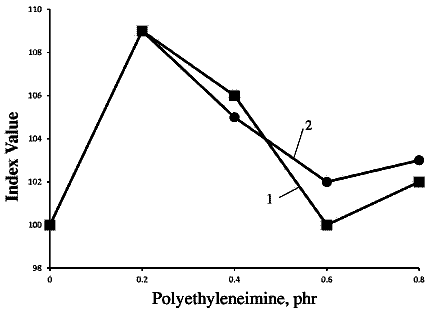
FIG. 1 is a graph illustrating the results of evaluating the retention in Examples and Comparative Examples.
FIG. 2 is a graph illustrating the whiteness and moisture ratio when the emulsifying agents 4 and 5 are used.
Mode(s)
For carrying out the invention
As a result of carrying out intensive studies, the inventors of the present invention found that the fluidity of a thermoplastic resin powder or a composition containing the thermoplastic resin powder is lowered in an extruder due to the reasons that the polyvalent metal ions included in a coagulating agent remain in the thermoplastic resin powder and an ionic cross-linking between polymer chains constituting a thermoplastic resin is formed by them. It was also found that, when melt molding is performed by using, as a molding material, a thermoplastic resin composition in which decrease in fluidity over time is suppressed, generation of foreign materials is suppressed so that a molded product with excellent appearance is obtained. The present invention is achieved accordingly.
This embodiment relates to a thermoplastic resin powder which is obtained by coagulating a polymer from a latex produced by a means of emulsion polymerization of a monomer, in which the content of metal corroding free acids is no greater than 500 ppm in the thermoplastic resin powder, and the flow retention rate is 75 to 200%. As the flow retention rate gets closer to 100%, less fluctuating fluidity is obtained. From the viewpoint of reducing the foreign materials which become a cause of a fish eye, the flow retention rate is preferably 90% or more. From the viewpoint of preventing foaming or deterioration of dynamic properties caused by thermal decomposition, it is preferably 120% or less.
The flow retention rate is defined as (MFR.sub.20/MFR.sub.4)×100. Furthermore, when the melt flow rate is measured at conditions including 250° C. and a load of 49 N, the value obtained by measuring after maintaining for 20 minutes at 250° C. corresponds to (MFR.sub.20), and the value obtained by measuring after maintaining for 4 minutes at 250° C. corresponds to (MFR.sub.4).
According to this embodiment, the monomer constituting the thermoplastic resin powder preferably contains (meth)acrylic acid ester in an amount of 50 to 100% by mass. If the monomer constituting the thermoplastic resin powder preferably contains (meth)acrylic acid ester in an amount of 50 to 100% by mass, a molded product consisting of a thermoplastic resin composition which contains the thermoplastic resin powder can have good appearance, optical properties, dynamic properties, or the like, and thus has a high industrial value.
According to this embodiment, the amount of polyvalent metal ions that are included in resin powder is reduced to achieve the aforementioned flow retention rate. To do so, it is important to suppress the use amount of a coagulating agent so that the use amount is less than the use amount of a related art, and it is preferable to select a coagulating agent which has a high coagulating property even at a small amount. Preferred examples of the coagulating agent include sulfuric acid and aluminum sulfate. Examples of the polyvalent metal ions that need to be reduced include an element of Group 2 such as calcium or magnesium. The content of calcium in the thermoplastic resin powder is preferably less than 50 ppm. Furthermore, the sum of calcium content and magnesium content in thermoplastic resin powder is preferably less than 50 ppm.
If a coagulating agent containing aluminum is used, the aluminum content in the thermoplastic resin powder is preferably 60 to 300 ppm. When the aluminum content is 300 ppm or less, the flow retention rate of a thermoplastic resin powder is further improved. When the aluminum content is 60 ppm or more in the thermoplastic resin powder obtained by using a coagulating agent containing aluminum, the moisture ratio of wet component after a coagulation step can be lowered, and thus the drying step can be simplified.
According to the present embodiment, phosphorus content in the thermoplastic resin powder is preferably 50 ppm or more and 1000 ppm or less. When the phosphorus content is 50 ppm or more in the thermoplastic resin powder obtained by using phosphoric acid ester salt as an emulsifying agent, the hot water whitening resistance of the molded product is improved. When the phosphorus content is 1000 ppm or less, coloration of the molded product to be obtained can be further suppressed.
The thermoplastic resin powder according to the present embodiment exhibits only a small decrease in fluidity during melt molding, and thus degradation of a resin caused by retention is suppressed. More specifically, the thermoplastic resin powder according to the present embodiment exhibits only a small decrease in fluidity during melt molding, and thus it is unlikely to have an occurrence of retention that is caused by decreased fluidity. As such, it is unlikely for the thermoplastic resin powder according to the present embodiment to have an occurrence of resin degradation caused by retention. Accordingly, by using the thermoplastic resin powder according to the present embodiment, foreign materials as a cause of fish eye can be reduced. Furthermore, by using a thermoplastic resin composition which contains the thermoplastic resin powder according to the present embodiment, foreign materials as a cause of fish eye can be reduced. Furthermore, as the amount of the metal corroding free acids contained in the thermoplastic resin powder is low, corrosion of an extruder is reduced. Content of the metal corroding free acids relative to the thermoplastic resin powder is 500 ppm or less, and preferably 100 ppm or less from the viewpoint of further reducing the corrosion of an extruder.
Hereinbelow, a preferred mode for producing the thermoplastic resin powder of the embodiment of the present invention is described.
<Emulsion Polymerization Step>
In this embodiment, examples of the emulsion polymerization latex include a latex containing a polymer such as poly(meth)acrylate, polybutadiene, styrene-butadiene copolymer, or styrene-butadiene-acrylonitrile copolymer. Furthermore, from the viewpoint of the appearance of a resin molded product, an acryl latex containing the (meth)acrylate component at 50% by mass or more, that is, emulsion polymerization latex containing an acrylic resin, is preferably used. Furthermore, the polymer may be a polymer with single layer structure or a polymer with multilayer structure or a multi-stage polymer consisting of plural layers. Furthermore, the emulsion polymerization step may have a single step or two or more steps.
Furthermore, the polymer is preferably a multi-stage polymer which is obtained by performing at least one stage of polymerization by supplying the monomer (b) (described below) to acryl latex having the acrylic rubber (A) (described below) dispersed in water.
Examples of the (meth)acrylate include methyl acrylate, ethyl acrylate, n-propyl acrylate, n-butyl acrylate, 2-ethylhexyl acrylate, octyl acrylate, tridecyl acrylate, ethoxyethoxyethyl acrylate, methoxytripropylene glycol acrylate, 4-hydroxybutyl acrylate, lauryl acrylate, lauryl methacrylate, stearyl methacrylate, and tridecyl methacrylate. It may be used either singly or in combination of two or more types.
<Acryl Rubber (A)>
The acryl rubber (A) is preferably a polymer having glass transition temperature of 0° C. or lower −150° C. or higher, from the viewpoint of exhibiting impact resistance. From such point of view, preferred examples of (meth)acylate particularly include alkyl(meth)acrylate such as n-butyl acrylate, 2-ethylhexyl acrylate, octyl acrylate, lauryl acrylate, tridecyl acrylate, lauryl methacrylate, or tridecyl methacrylate. Furthermore, when (meth)acrylate having crystallinity near room temperature [for example, stearyl methacrylate or the like] is used, it can be used as a mixture with a monomer which can dissolve it. As the acrylic resin used for the method for producing thermoplastic resin powder according to this embodiment, at least one selected from the above (meth)acrylates is used at 50% by mass or more, and if necessary, a homopolymer or a copolymer which can be obtained by using acrylic acid ester having an alkyl group with 1 to 8 carbon atoms, vinyl acetate, vinyl chloride, styrene, acrylonitrile, methacrylonitrile, or butadiene as a copolymerizable compound, and an acryl rubber-containing polymer having the alkyl(meth)acrylate as a main component can be used. Among them, from the viewpoint of having excellent weather resistance, those not containing butadiene are preferable.
Furthermore, as a raw material of the acryl rubber (A), it is preferable to use the monomer (a). The monomer (a) contains alkyl acrylate at 20% by mass or more on the basis of total amount of 100% by mass of the monomer (a). Furthermore, the monomer (a) becomes a raw material of the first stage polymerization. According to the first polymerization step in which the polymerization is performed by using the monomer (a) as a raw material, the acryl rubber (A) is produced. The monomer (a) may contain alkyl acrylate at 100% by mass or it may be a monomer mixture containing a monomer other than alkyl acrylate.
Examples of the alkyl acrylate (hereinbelow, it may be referred to as “the monomer (a1)”) include methyl acrylic acid, ethyl acrylic acid, propyl acrylic acid, n-butyl acrylic acid, 2-ethylhexyl acrylic acid, and n-octyl acrylic acid. Among them, n-butyl acrylic acid is preferable. It may be used either singly or in combination of two or more types.
Examples of the monomer other than alkyl acrylate in the monomer (a) include alkyl methacrylate (hereinbelow, it may be referred to as “the monomer (a2)”), a monomer having one double bond which can copolymerize with them (alkyl acrylate and alkyl methacrylate) (hereinbelow, it may be referred to as “the monofunctional monomer (a3)”), and the polyfunctional monomer having two or more double bonds which can copolymerize with them (alkyl acrylate and alkyl methacrylate) (hereinbelow, it may be referred to as “the polyfunctional monomer (a4)”).
The alkyl group in alkyl methacrylate may be linear or branched. Specific examples of the alkyl methacrylate include methyl methacrylate, ethyl methacrylate, propyl methacrylate, and n-butyl methacrylate. These may be used either singly or in combination of two or more types.
Examples of the monofunctional monomer (a3) include an acryl monomer such as lower alkoxy acrylic acid, cyanoethyl acrylic acid, acrylamide, and (meth)acrylic acid; an aromatic vinyl monomer such as styrene or alkyl substituted styrene; and a vinyl cyanide monomer such as acrylonitrile and methacrylonitrile. These may be used either singly or in combination of two or more types.
Examples of the polyfunctional monomer (a4) include a cross-linkable monomer which has at least two copolymerizable double bonds per molecule. Specific examples of the polyfunctional monomer (a4) include the followings: di(meth)acrylic acid alkylene glycol such as di(meth)acrylic acid ethylene glycol, di(meth)acrylic acid 1,3-butylene glycol, di(meth)acrylic acid 1,4-butylene glycol, or di(meth)acrylic acid propylene glycol; polyvinylbenzene such as divinylbenzene or trivinylbenzene; cyanurate monomer such as triallyl cyanurate or triallyl isocyanurate; allyl, methallyl or crotyl ester of α,β-unsaturated carboxylic acid or dicarboxylic acid such as allyl methacrylate. These may be used either singly or in combination of two or more types.
The content of the alkyl acrylate in the monomer (a) is preferably 20 to 99.9% by mass, and more preferably 30 to 99.9% by mass. The content of the alkyl methacrylate in the monomer (a) is preferably 0 to 69.9% by mass. The content of the monofunctional monomer (a3) in the monomer (a) is preferably 0 to 20% by mass. The content of the polyfunctional monomer (a4) in the monomer (a) is preferably 0.1 to 10% by mass.
The glass transition temperature of the acryl rubber (A) (hereinbelow, it may be referred to as “Tg”) is, from the viewpoint of flexibility for use as a film, for example, more preferably 0 to −60° C. Meanwhile, the Tg described in the present invention indicates the value calculated from the following FOX equation by using the values described in Polymer HandBook [(J. Brandrup, Interscience, 1989)]. In addition, the content of the acryl rubber (A) in the polymer is preferably 5 to 70% by mass from the viewpoint of a film forming property of a polymer for use as a film or the like. 1/(273+ Tg )=Σ( w .sub.i/(273+ Tg .sub.i))
In the above equation, Tg (° C.) indicates the glass transition temperature of a copolymer, w.sub.i indicates a mass fraction of monomer i as a raw material of a copolymer, and Tg.sub.i indicates the glass transition temperature (° C.) of a homopolymer that is obtained by polymerization of the monomer i.
<Monomer (b)>
The monomer (b) contains alkyl methacrylate in an amount of 50% by mass or more on the basis of 100% by mass of the total amount of the monomer (b). The monomer (b) is a raw material of the last stage polymerization, and it constitutes the outer layer of a polymer after polymerization. The monomer (b) may contain alkyl methacrylate at 100% by mass or it may be a monomer mixture which contains a monomer other than alkyl methacrylate.
Tg of a polymer composed only of the monomer (b) is preferably 70 to 120° C., and more preferably 80 to 100° C. As for the alkyl methacrylate in the monomer (b), one or two or more types of the monomer exemplified as “the monomer (a2)” in the explanation of the monomer (a) can be used. Examples of the monomer other than alkyl methacrylate in the monomer (b) include alkyl acrylate and a monomer (hereinbelow, it may be referred to as “the monofunctional monomer (b3)”) which has one double bond copolymerizable with them. As for the alkyl acrylate, one or two or more types of the monomer exemplified as “the monomer (a1)” can be used. As for the monofunctional monomer (b3), one or two or more types of the monomer exemplified as “the monofunctional monomer (a3)” can be used.
The content of alkyl methacrylate in the monomer (b) is 50 to 100% by mass, preferably 51 to 100% by mass, and more preferably 60 to 100% by mass. The content of alkyl acrylate in the monomer (b) is preferably 0 to 20% by mass. The content of the monofunctional monomer (b3) in the monomer (b) is preferably 0 to 49% by mass, and more preferably 0 to 40% by mass.
The use amount of the monomer (b) in the 100% by mass of the total amount of monomers that are used for entire steps of the polymerization of the present invention is, from the viewpoint of the film forming property of a polymer for use as a film, impact resistance of a film obtained by using the polymer for use as an impact strength modifier, or the like, preferably 30 to 95% by mass.
As for the means for performing emulsion polymerization, a known polymerization apparatus can be used. Examples of the polymerization apparatus include a polymerization tank equipped with a stirrer. When a graft copolymer is produced by graft polymerization of a monomer having a hard polymer-forming property with a rubber-like polymer, a polymerization apparatus equipped with a rubber polymerization tank and at least one graft polymerization tank can be used, for example.
As for the emulsifying agent used for emulsion polymerization (also referred to as a surface active agent), an anionic, a cationic, or a nonionic surface active agent can be used, for example. Among them, an anionic surface active agent is preferable. Examples of the anionic surface active agent include carboxylic acid salt such as rosin acid soap, potassium oleate, sodium stearate, sodium myristate, sodium N-lauroylsarsocinate, dipotassium alkenyl succinate, sodium polyoxyalkylene alkyl ether carboxylic acid, sulfuric acid ester salt such as sodium lauryl sulfate, sulfonic acid salt such as sodium dioctyl sulfosuccinate, sodium dodecylbenzene sulfosuccinate, sodium alkyl diphenyl ether disulfonate, sodium polyoxyalkylene alkyl ether sulfate, and phosphoric acid ester salt such as sodium polyoxyalkylene alkylphenyl ether phosphate. The emulsifying agent can be used either singly or in combination of two or more types.
Among them, from the viewpoint of improving the hot water whitening resistance, the emulsifying agent is preferably phosphoric acid ester salt or carboxylic acid salt, and a compound having, in the molecule, a group represented by the —PO.sub.3M.sub.2, —PO.sub.2M (with the proviso that, M is an alkali metal or an alkali earth metal) is preferable, and phosphoric acid ester salt or polyoxyalkylene alkyl ether carboxylic acid salt represented by the following Formula (I) is preferable. By using a salt of weak acid such as phosphoric acid ester salt and carboxylic acid salt as an emulsifying agent, the use amount of the coagulating agent can be reduced.
##str00002##
In Formula (I), R.sub.1 represents a linear or branched and substituted or unsubstituted alkyl group having 10 to 18 carbon atoms, R.sub.2 represents a linear or branched and substituted or unsubstituted alkylene group having 2 or 3 carbon atoms, M represents alkali metal or alkali earth metal, m is 1 or 2, and n is an integer of from 1 to 20.
Examples of the substituent for the alkyl group or alkylene group include an aryl group having 6 to 10 carbon atoms (for example, a phenyl group and a naphthyl group) and a linear or branched alkyl group having 1 to 6 carbon atoms (for example, a methyl group, an ethyl group, a propyl group, an isopropyl group, and a butyl group).
As for phosphoric acid ester salt, an alkali metal salt or an alkali earth metal salt of alkylpolyoxyalkylene phosphoric acids such as mono-n-butylphenylpentaoxyethylene phosphoric acid, di-n-butylphenylpentaoxyethylene phosphoric acid, mono-n-pentylphenylhexaoxyethylene phosphoric acid, di-n-pentylphenylhexaoxyethylene phosphoric acid, mono-n-heptylphenylpentaoxyethylene phosphoric acid, di-n-heptylphenylpentaoxyethylene phosphoric acid, mono-n-pentyloxyheptaoxyethylene phosphoric acid, di-n-pentyloxyheptaoxyethylene phosphoric acid, mono-n-hexyloxypentaoxyethylene phosphoric acid, di-n-hexyloxypentaoxyethylene phosphoric acid, mono-n-dodecyltetraoxyethylene phosphoric acid, di-n-dodecyltetraoxyethylene phosphoric acid, mono-n-butylphenylpentaoxypropylene phosphoric acid, di-n-butylphenylpentaoxypropylene phosphoric acid, mono-n-pentylphenylhexaoxypropylene phosphoric acid, di-n-pentylphenylhexaoxypropylene phosphoric acid, mono-n-heptylphenylpentaoxypropylene phosphoric acid, di-n-heptylphenylpentaoxypropylene phosphoric acid, mono-n-pentyloxyheptaoxypropylene phosphoric acid, di-n-pentyloxyheptaoxypropylene phosphoric acid, mono-n-hexyloxypentaoxypropylene phosphoric acid, di-n-hexyloxypentaoxypropylene phosphoric acid, mono-n-dodecyltetraoxypropylene phosphoric acid, and di-n-dodecyltetraoxypropylene phosphoric acid is preferably used. The phosphoric acid ester salt can be used either singly or in combination of two or more types. By performing the emulsion polymerization using an emulsifying agent of Formula (I), the water whitening resistance of a thermoplastic resin to be obtained is improved, and thus when a molded product obtained by melt molding of the thermoplastic resin is kept in a high temperature and high humidity state, it can have good appearance.
Preferred examples of the carboxylic acid salt include an alkali metal salt or an alkali earth metal salt of higher fatty acid such as oleic acid and cow fat acid, alkylene succinic acid, polyoxyethylene lauryl ether acetic acid, and polyoxypropylene lauryl ether acetic acid. The carboxylic acid ester salt can be used either singly or in combination of two or more types.
As for the alkali metal, sodium or potassium is preferable. As for the alkali earth metal, calcium or barium is preferable.
Meanwhile, it is possible that each of the phosphoric acid ester salt and carboxylic acid salt is used in combination. It is also possible that a monoester and a diester of phosphoric acid ester salt are used as a mixture.
Furthermore, the content of the phosphoric acid ester salt or carboxylic acid salt is preferably adjusted depending on the type of a monomer for polymerization or polymerization conditions, or the like. However, according to this embodiment, the content of the phosphoric acid ester salt is, relative to 100 parts by mass of the monomer, preferably 0.1 to 10 parts by mass and more preferably 0.5 to 5 parts by mass. Furthermore, the content of the carboxylic acid ester salt is, relative to 100 parts by mass of the monomer, preferably 0.1 to 10 parts by mass and more preferably 0.5 to 5 parts by mass.
The monomer is subjected to emulsion polymerization in the presence of an emulsifying agent, and the emulsion polymerization can be performed with any monomer composition.
Examples of the radical polymerization initiator include, although not particularly limited thereto, peroxides such as benzoyl peroxide, cumene hydroperoxide, or hydrogen peroxide, an azo compound such as azobisisobutryonitrile, a persulfate compound such as ammonium persulfate or potassium persulfate, a perchloric acid compound, a perborate compound, and a redox-based initiator consisting of a combination of peroxides and a reductive sulfoxy compound.
The monomer and polymerization initiator or the like can be added by any method such as bulk addition method, divided addition method, continuous addition method, monomer addition method, and emulsion addition method. Among them, from the viewpoint of obtaining a homogeneous polymer by quickly having homogenous distribution of a monomer and a polymerization initiator in a reaction vessel, the emulsion addition method is preferable. By using the emulsion addition method, aggregation of polymer microparticles or generation of coarse particles can be suppressed. When an aggregate of polymer microparticles or coarse particles are present in an obtained resin powder, fish eyes may be formed in a molded product using it, in particular, a film-shape molded product, and thus the appearance may be impaired.
Furthermore, to have a smooth progress of the reaction, the reaction system can be flushed with nitrogen. Furthermore, to remove residual monomers, temperature of the reaction system can be raised after the termination of the reaction. A catalyst can be also added to the reaction system.
<Coagulation Step>
In the present embodiment, a polymer is coagulated from a latex produced by emulsion polymerization to obtain a thermoplastic resin powder.
Examples of the coagulating agent used for the coagulation step include various inorganic acids or organics acids, and their salts, for example, sulfuric acid, nitric acid, hydrochloric acid, acetic acid, aluminum sulfate, magnesium sulfate, sodium sulfate, sodium nitrate, aluminum chloride, calcium chloride, sodium chloride, potassium acetate, and sodium acetate. Among them, those containing halogen atoms such as hydrochloric acid and hydrochloric acid salt may infiltrate a production facility and a device in which an obtained thermoplastic resin is used, and thus those not containing halogen atoms are preferable. Furthermore, as coagulation can be achieved by using a small amount, aluminum sulfate or sulfuric acid is preferable. Furthermore, from the viewpoint of preventing thermal degradation caused by residual metals and decreased fluidity accompanied with the thermal degradation, sulfuric acid is more preferable.
It is preferable to use phosphoric acid ester salt as an emulsifying agent and aluminum sulfate as a coagulating agent. It is more preferable to use carboxylic acid salt as an emulsifying agent and aluminum sulfate or sulfuric acid as a coagulating agent.
The use amount of the coagulating agent is preferably 0.03 to 2.0 parts by mass relative to 100 parts by mass of the polymer in latex. When the use amount of the coagulating agent is less than 0.03 part by mass, the moisture ratio in the obtained polymer increases and also the polymer may not be stably obtained.
When aluminum sulfate is used as a coagulating agent, the use amount of aluminum sulfate is preferably 0.03 to 0.9 part by mass and more preferably 0.09 to 0.6 part by mass relative to 100 parts by mass of the polymer in latex. When the use amount of the coagulating agent is less than 0.03 part by mass, the moisture ratio in the obtained polymer increases and also the polymer may not be stably obtained. On the other hand, when the use amount is more than 0.9 part by mass, the fluidity retention rate may be lowered when the obtained polymer is melt by heating.
When sulfuric acid is used as a coagulating agent, the use amount of sulfuric acid is preferably 0.1 to 2.0 parts by mass relative to 100 parts by mass of the polymer in latex. From the viewpoint of lowering the amount of residual free acid, it is more preferably 0.1 to 1.5 parts by mass. When the use amount is less than 0.1 part by mass, the moisture ratio in the obtained polymer increases and also the polymer may not be stably obtained. Furthermore, when the use amount is more than 2.0 parts by mass, the residual amount of sulfuric acid increases and the fluidity retention rate may be lowered when the obtained polymer is melt by heating. In addition, the water resistance or heat and coloration resistance of the obtained polymer may be deteriorated.
Aluminum sulfate may be used in combination with other acids or salts, if necessary. However, in a basic region, as aluminum sulfate forms aluminum hydroxide with low water solubility according to combined use with other acids or salts, and thus it is preferable that other bases are not added.
The temperature for coagulating the polymer by adding a coagulating agent to a latex is preferably 30 to 100° C. The coagulated polymer can be washed with water in an amount of 1 to 100 times and dried by using a fluid type dryer or a compression dehydrator. The drying temperature and drying time can be suitably determined depending on the type of a polymer.
Examples of the method for contacting an emulsion polymerization latex with a coagulating agent is, although not particularly limited, generally, a method in which an aqueous solution of a coagulating agent is stirred and a latex is continuously added thereto followed by maintaining it for a certain period of time, and a method of continuously adding and mixing an aqueous solution of a coagulating agent and a latex at a constant ratio in a vessel equipped with a stirrer and continuously discharging a mixture containing the coagulated polymer and water from a vessel.
The amount of an aqueous solution of a coagulating agent during the coagulation step is, although not particularly limited, preferably 10 parts by mass or more and 500 parts by mass or less relative to 100 parts by mass of the emulsion polymerization latex.
<Melt Extrusion>
The thermoplastic resin composition of this embodiment contains a thermoplastic resin powder, and also, if necessary, a common blending agent. By using the thermoplastic resin composition, a thermoplastic resin pellet can be produced.
The content of the thermoplastic resin powder in the thermoplastic resin composition is, although not particularly limited, for example, 20% by mass or more, preferably 20 to 100% by mass, and more preferably 50 to 99% by mass.
Examples of the blending agent include a stabilizer, a lubricant, a processing aid, a plasticizer, an ant-impact aid, a filler, an anti-microbial agent, an anti-molding agent, a foaming agent, a releasing agent, an anti-static agent, a coloring agent, a deglossing agent, a UV absorbing agent, and a thermoplastic polymer. In particular, to improve the heat resistance of a molded product of an acrylic resin and scratch resistance of a surface of a molded product, it is preferable to add a thermoplastic polymer. Examples of the thermoplastic polymer include those containing 50% by mass or more of methyl methacrylate and 50% by mass or less of other vinyl monomer which can polymerize with it (preferably less than 50% by mass). Examples of other vinyl monomer which can copolymerize with methyl methacrylate include various linear or branched alkyl(meth)acrylate such as methyl acrylate, ethyl (meth)acrylate, propyl(meth)acrylate, and butyl (meth)acrylate, aromatic (meth)acrylate such as phenyl(meth)acrylate or benzyl (meth)acrylate, aromatic vinyl monomer such as styrene or t-methyl styrene, and various acrylamide monomers. It may be used either singly or in combination of two or more types. Specific examples of the thermoplastic polymer include non-cross-linked acrylic resin such as ACRYPET VH, ACRYPET MD, and ACRYPET MF that are manufactured by Mitsubishi Rayon Co., Ltd.
Meanwhile, the method for adding a blending agent include a method of supplying, together with a thermoplastic resin powder, a blending agent to a molding machine for obtaining a molded product, and a method of kneading a raw material mixture in which a blending agent is admixed in advance with a thermoplastic resin powder by using various kneaders. Examples of the kneader used for the latter method include a common monoaxial extruder and a biaxial extruder. As for the part of an extruder such as a barrel or a screw which is in contact with a resin, various stainless steel, chrome molybdenum steel, aluminum chrome molybdenum steel, or the like is used. If necessary, a nitridation treatment, a plating treatment, a thermal spraying method or the like is performed. However, when the thermoplastic resin powder contains metal corroding free acids in an amount of more than 500 ppm, the extruder may be corroded, and therefore undesirable. Furthermore, when pellets obtained by melt extrusion contain metal corroding free acids in an amount of more than 500 ppm, the extruder may be also corroded during melt molding process described below, and thus undesirable, either. Examples of the metal corroding free acids include, in addition to an acid stronger than weak acid (that is, acid dissociation constant pKa of 3 or less in an aqueous solution), an acid including hydrogen fluoride acid. Specific examples of the metal corroding free acids include inorganic acid such as sulfuric acid, sulfide acid, nitric acid, nitrous acid, hydrogen halide, oxyhalogen acid, chromic acids, phosphoric acid, and phosphorus acid, and alkyl ester thereof, and sulfonic acids such as alkyl sulfonic acid, aromatic sulfonic acid, and trifluoromethane sulfonic acid.
The temperature for melt extrusion of a thermoplastic resin composition can be suitably determined depending on the type of a polymer or the like. In the case of an acrylic resin, for example, it is 200° C. to 280° C.
<Molding of Thermoplastic Resin Pellets>
Examples of a method for molding thermoplastic resin pellets include, although not particularly limited, extrusion molding, injection molding, vacuum molding, blow molding, and compression molding.
<Film Molding Using Thermoplastic Resin Pellets>
When the thermoplastic resin pellets are acrylic resins and molded into a film among the resin molded products, a high industrial value is obtained. Examples of the use of an acrylic resin film include an agricultural vinyl house, a marking film, a poster, a wallpaper, a foaming sheet, vinyl chloride leather for outdoor use, a roof material of vinyl chloride plate, and an outdoor wall material such as a siding material, interior and exterior materials for an automobile, a coating substitute for furniture, an interior material for elevator, a rainfall gutter, a floor material, a corrugated iron sheet, a cosmetic column, a lighting, and a surface material of a member used for a place in which water is used, for example, bathroom and kitchen. Other examples include a protective film for a polarizing film which is used for a polarizer such as a heat insulating film and a liquid crystal display and a retardation film used for a retardation plate for viewing angle compensation or retardation compensation.
Examples of the method for molding into a film include, although not particularly limited, a melt extrusion method such as a solution casting method, a T die method, or an inflation method. Among them, the T die method is preferable from the economical point of view.
The description continues in the full USPTO document.
 Lapsed, fee not paid1 drawing