 Lapsed, fee not paid7 drawings
Software & Apps · US 9,747,707 B2
Method and arrangement for 3D image production
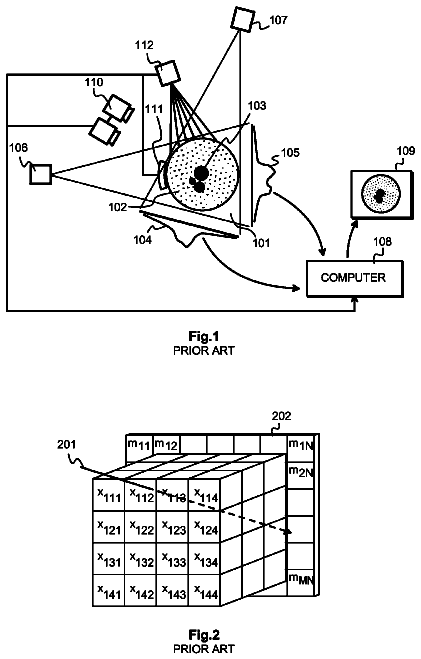
An image is produced of a target region from tomographic measurements through statistical inversion.
US 9,747,797 B1 · Assignee: Conduent Business Services, LLC · Inventors: Ghosh; Rahul et al.
Sheet 1 of 6 from the published document. All sheets in the USPTO PDF
The disclosed embodiments illustrate methods and systems for predicting an availability of a parking spot in a parking area. The method includes generating a first signature for each of one or more first users. The first signature is generated based on at least a first set of data received from at least one or more first sensors in a first user-computing device associated with each of the one or more first users. The method further includes generating a second signature for each of the one or more first vehicles, based on at least a second set of data received from one or more second sensors in a first vehicle-computing device associated with each of the one or more first vehicles. Further, the method includes determining a likelihood of the availability of the one or more parking spots based on at least the first signature and the second signature.
With increasing advancement in transportation system, demand for one or more vehicles have significantly increased. Further, one or more individuals, who possess the one or more vehicles, prefer to use the one or more vehicles while travelling from one location to another location. For example, an employee may prefer to drive his/her car to his/her workplace. Further, the one or more individuals may require one or more parking spots in a parking area to park the one or more vehicles. Generally, there are two types of parking area. For example, a first parking area corresponds to one that does not have a dashboard to display one or more available parking spots, and a second parking area corresponds to one that has dashboard. The one or more individuals, who may enter the first parking area, may have to rely on their manual observations to find the one or more available parking slots in th
1 of 6 drawing sheets so far from the published document, cropped to the drawing. Every sheet is in the USPTO PDF.
What the patent claimed, word for word. All of it is now free to use.
The presently disclosed embodiments are related, in general, to a parking system. More particularly, the presently disclosed embodiments are related to methods and systems for predicting an availability of a parking spot in a parking area.
With increasing advancement in transportation system, demand for one or more vehicles have significantly increased. Further, one or more individuals, who possess the one or more vehicles, prefer to use the one or more vehicles while travelling from one location to another location. For example, an employee may prefer to drive his/her car to his/her workplace. Further, the one or more individuals may require one or more parking spots in a parking area to park the one or more vehicles.
Generally, there are two types of parking area. For example, a first parking area corresponds to one that does not have a dashboard to display one or more available parking spots, and a second parking area corresponds to one that has dashboard. The one or more individuals, who may enter the first parking area, may have to rely on their manual observations to find the one or more available parking slots in the first parking area. Further, the one or more individuals, who may enter the second parking area, may further have to rely on their manual observations to find the one or more available parking slots, even if the dashboard may have displayed that the one or more parking slots are available in the second parking area. Such manual observations may consume time of the one or more individuals as well as unnecessary fuel of the one or more vehicles. Thus, a simplified, efficient, and automated technique may be desirable to overcome such problems faced by the one or more individuals.
Further limitations and disadvantages of conventional and traditional approaches will become apparent to one of skill in the art, through comparison of described systems with some aspects of the present disclosure, as set forth in the remainder of the present application and with reference to the drawings.
According to embodiments illustrated herein, there is provided a method for predicting an availability of a parking spot in a parking area. The method includes generating, by one or more processors, a first signature for each of one or more first users associated with one or more first vehicles, parked at one or more parking spots in the parking area, based on at least a first set of data received from at least one or more first sensors in a first user-computing device associated with each of the one or more first users. The method further includes generating, by the one or more processors, a second signature for each of the one or more first vehicles, based on at least a second set of data received from one or more second sensors in a first vehicle-computing device associated with each of the one or more first vehicles. The method further includes determining, by the one or more processors, a likelihood of the availability of the one or more parking spots based on at least the first signature and the second signature. The method further includes presenting, by the one or more processors, a user interface on a display screen associated with a second vehicle displaying the one or more available parking spots to a second user based on at least the determined likelihood, wherein the second user requires the parking spot in the parking area to park the second vehicle.
According to embodiments illustrated herein, there is provided a system for predicting an availability of a parking spot in a parking area. The system includes one or more processors configured to generate a first signature for each of one or more first users associated with one or more first vehicles, parked at one or more parking spots in the parking area, based on at least a first set of data received from at least one or more first sensors in a first user-computing device associated with each of the one or more first users. The one or more processors are further configured to generate a second signature for each of the one or more first vehicles, based on at least a second set of data received from one or more second sensors in a first vehicle-computing device associated with each of the one or more first vehicles. The one or more processors are further configured to determine a likelihood of the availability of the one or more parking spots based on at least the first signature and the second signature. The one or more processors are further configured to present a user interface on a display screen associated with a second vehicle displaying the one or more available parking spots to a second user based on at least the determined likelihood, wherein the second user requires the parking spot in the parking area to park the second vehicle.
According to embodiments illustrated herein, there is provided a server for predicting an availability of a parking spot in a parking area. The server includes one or more processors configured to receive a real-time data associated with each of: one or more first users from one or more first sensors in one or more first user-computing devices, and one or more first vehicles from one or more second sensors in the one or more first vehicles, wherein the one or more first users are associated with one or more first vehicles. The one or more processors are further configured to receive the real-time data associated with each of the one or more first users and the one or more first vehicles from one or more third sensors that are installed at one or more locations in a premise and the parking area. The one or more processors are further configured to process the real-time data associated with each of one or more first users and one or more first vehicles. The one or more processors are further configured to determine a likelihood of the availability of the one or more parking spots based on at least the processed real-time data. The one or more processors are further configured to recommend the one or more available parking spots to a second user of a second vehicle based on at least the determined likelihood. Prior to determining the likelihood of the available parking spot, the one or more processors are configured to receive a request from the second user of the second vehicle, wherein the request is indicative of at least a requirement of the available parking spot in the parking area.
According to embodiments illustrated herein, there is provided a computer program product for use with a computing device. The computer program product comprises a non-transitory computer readable medium storing a computer program code for predicting an availability of a parking spot in a parking area. The computer program code is executable by one or more processors in the computing device to generate a first signature for each of one or more first users associated with one or more first vehicles, parked at one or more parking spots in the parking area, based on at least a first set of data received from at least one or more first sensors in a first user-computing device associated with each of the one or more first users. The computer program code is further executable by the one or more processors to generate a second signature for each of the one or more first vehicles, based on at least a second set of data received from one or more second sensors in a first vehicle-computing device associated with each of the one or more first vehicles. The computer program code is further executable by the one or more processors to determine a likelihood of the availability of the one or more parking spots based on at least the first signature and the second signature. The computer program code is further executable by the one or more processors to present a user interface on a display screen associated with a second vehicle displaying the one or more available parking spots to a second user based on at least the determined likelihood, wherein the second user requires the parking spot in the parking area to park the second vehicle.
The accompanying drawings illustrate the various embodiments of systems, methods, and other aspects of the disclosure. Any person with ordinary skills in the art will appreciate that the illustrated element boundaries (e.g., boxes, groups of boxes, or other shapes) in the figures represent one example of the boundaries. In some examples, one element may be designed as multiple elements, or multiple elements may be designed as one element. In some examples, an element shown as an internal component of one element may be implemented as an external component in another, and vice versa. Furthermore, the elements may not be drawn to scale.
Various embodiments will hereinafter be described in accordance with the appended drawings, which are provided to illustrate the scope and not to limit it in any manner, wherein like designations denote similar elements, and in which:
FIG. 1 is a block diagram of a system environment, in which various embodiments can be implemented;
FIG. 2 is a block diagram that illustrates a system for predicting an availability of a parking spot in a parking area, in accordance with at least one embodiment;
FIG. 3 is a block diagram of a parking slot prediction unit for predicting an availability of a parking spot in a parking area, in accordance with at least one embodiment;
FIG. 4 is a flowchart that illustrates a method for predicting an availability of a parking spot in a parking area, in accordance with at least one embodiment;
FIG. 5 is a block diagram that illustrates a life cycle of a user who has parked a vehicle in a parking area of a premise, in accordance with at least one embodiment; and
FIG. 6 is a block diagram that illustrates a user interface displaying availability of one or more parking spots in a parking area, in accordance with at least one embodiment.
The present disclosure is best understood with reference to the detailed figures and description set forth herein. Various embodiments are discussed below with reference to the figures. However, those skilled in the art will readily appreciate that the detailed descriptions given herein with respect to the figures are simply for explanatory purposes as the methods and systems may extend beyond the described embodiments. For example, the teachings presented and the needs of a particular application may yield multiple alternative and suitable approaches to implement the functionality of any detail described herein. Therefore, any approach may extend beyond the particular implementation choices in the following embodiments described and shown.
References to “one embodiment,” “at least one embodiment,” “an embodiment,” “one example,” “an example,” “for example,” and so on, indicate that the embodiment(s) or example(s) may include a particular feature, structure, characteristic, property, element, or limitation, but that not every embodiment or example necessarily includes that particular feature, structure, characteristic, property, element, or limitation. Furthermore, repeated use of the phrase “in an embodiment” does not necessarily refer to the same embodiment. Definitions
The following terms shall have, for the purposes of this application, the meanings set forth below.
A “computing device” refers to a device that includes one or more processors/microcontrollers and/or any other electronic components, a device, or a system that performs one or more operations according to one or more programming instructions/codes. Examples of the computing device may include, but are not limited to, a desktop computer, a laptop, a personal digital assistant (PDA), a mobile device, a Smartphone, a tablet computer (e.g., iPad® and Samsung Galaxy Tab®), and/or the like.
“Parking” refers to an act of driving a vehicle to a location where a user of the vehicle can stop and leave the vehicle. Further, the vehicle may remain at the location for a time period. The duration of the time period may depend upon at least one or more activities of the user while the user is away from the vehicle.
A “parking area” refers to an area where one or more vehicles may be parked at one or more parking spots/locations. The parking area may include one or more parking lanes. Each of the one or more parking lanes may include the one or more parking spots, where the one or more vehicles may be parked. The parking area may correspond to an indoor/outdoor parking area. The indoor/outdoor parking area may be associated with one or more premises. The one or more premises may include one or more of: a house, sides of a road, multi-level structures, underground parking facilities, a business area, a shopping mall building, a grocery store building, airport, and/or the like.
A “vehicle” refers to a means of transportation that may transport one or more individuals and/or cargos between two or more locations. In one embodiment, at least one of the one or more individuals may be driving the vehicle. In another embodiment, the vehicle may correspond to an autonomous vehicle that may be capable of transporting the one or more individuals and/or the cargos between the two or more locations without being driven by the one or more individuals. In an embodiment, the vehicle may include at least one computing device that may be utilized to transmit/receive information pertaining to one or more queries (e.g., availability of a parking spot in a parking area) by the one or more individuals. Further, the vehicle may include one or more sensors (e.g., speed sensor, GPS sensor, and other vehicle sensors known in the art). In an embodiment, the vehicle may correspond to at least one of, but not limited to, a bus, a truck, a car, a ship, an airplane, and the like.
A “user of a vehicle” refers to an individual who is driving the vehicle from one location to another location. In an embodiment, the user of the vehicle may park the vehicle at an available parking spot in a parking area. In an embodiment, the parking area may be selected based on one or more of, but are not limited to, one or more needs of the user, one or more needs of one or more other users who are sitting in the vehicle, a cost of parking the vehicle in the parking area, a time duration for which the vehicle may be parked in the parking area, and one or more available parking spots in the parking area.
A “first vehicle” refers to a vehicle that is parked at a parking spot in a parking area. The first vehicle may be associated with a first user who may have driven the first vehicle to the parking spot. In an embodiment, the first vehicle may further include one or more other first users who were sitting in the first vehicle when the first vehicle may have reached the parking spot.
A “second vehicle” refers to a vehicle associated with at least one second user, who may be driving the second vehicle and may further require a parking spot in a parking area of a premise to park the second vehicle. The at least one second user may utilize a computing device in the second vehicle to transmit a request pertaining to an availability of the parking spot in the parking area.
A “first set of data of a first user” refers to a set of one or more first data that may be indicative of at least a behavior or intention (e.g., a change in position) of the first user in a parking area and/or a premise associated with the parking area. For example, the first set of data of a first user includes: a movement of the first user in the premise associated with the parking area, a number of steps taken by the first user to reach the parking area, a number of turns made by the first user, a time-stamp of one or more entries or exits of the first user from the parking area, and/or the like.
A “second set of data” refers to a set of one or more second data that may be indicative of a measure of one or more parameters of a first vehicle. For example, the second set of data of the first vehicle includes: a size of the first vehicle, a weight of the first vehicle, a duration of stay of the first vehicle in the parking area, and a location of a parking spot where the first vehicle is parked in the parking area.
A “first signature” refers to a data structure comprising a first set of data associated with a user (e.g., a first user) of a vehicle (e.g., a first vehicle).
A “second signature” refers to a data structure comprising a second set of data corresponding a vehicle (e.g., a first vehicle) parked at a parking spot in a parking area of a premise.
“One or more activities” refer to one or more actions of a user (e.g., a first user) that is indicative of a transition of the user from one phase (e.g., park car in a parking area) to another phase (e.g., enter a premise).
“Real-time” refers to a current time instant at which one or more parking spots may be available in a parking area.
“Near future-time” refers to a time instant with a delay with respect to a current time instant at which one or more parking spots may be available in a parking area.
“Real-time data” refer to a set of data that are associated with a current time instant. For example, the real-time data may include current activities of one or more users who are moving around a premise and/or a parking area associated with the premise. The real-time data may further include current activities of one or more vehicles associated with the one or more users. For example, a start of a vehicle, a movement of the vehicle, and/or the like.
FIG. 1 is a block diagram of a system environment 100 in which various embodiments may be implemented. The system environment 100 includes a premise 102 , and one or more parking areas, such as a parking area 104 associated with the premise 102 . The parking area 104 further includes one or more first vehicles (denoted by 106 A, 106 B, 106 C, . . . , 106 N) that may have been parked at one or more parking spots in the parking area 104 . Further, in an embodiment, each of the one or more first vehicles (denoted by 106 A, 106 B, 106 C, . . . , 106 N) may include one or more first vehicle-computing devices, such as a first vehicle-computing device 108 . In an embodiment, each of the one or more first vehicles (denoted by 106 A, 106 B, 106 C, . . . , 106 N) may be associated with one or more first users. Further, the one or more first users of each of the one or more first vehicles may possess or include one or more first user-computing devices, such as a first user-computing device 110 . The system environment 100 further includes one or more second vehicles, such as a second vehicle 112 comprising a second vehicle-computing device 114 . The second vehicle 112 may be associated with one or more second users. Further, the one or more second users of the second vehicle 112 may possess or include one or more second user-computing devices, such as a second user-computing device 116 . The system environment 100 further includes one or more application servers, such as an application server 118 that may be communicatively coupled with one or more communication networks, such as a communication network 120 . Various devices in the system environment 100 may be interconnected over the communication network 120 .
The premise 102 refers to a business area (indoor or outdoor) where the one or more first users may travel to perform one or more actions. For example, an individual may travel to a shopping mall, market, or a grocery store to sell or purchase one or more products/services. An employee may travel to his/her workplace to perform his/her professional work. An individual may travel to a city airport to: board an airplane, receive one or more other individuals, and/or the like. A person having ordinary skills in the art will understand that the premise 102 is not limited to the business areas as mentioned in the above examples. The premise 102 may include a house, sides of a road, a multi-level building, and/or the like known in the art. In an embodiment, the premise 102 may include the one or more parking areas, such as the parking area 104 . The parking area 104 may include one or more parking lanes. Each of the one or more parking lanes may include the one or more parking spots, where the one or more first users may have parked the one or more first vehicles (denoted by 106 A, 106 B, 106 C, . . . , 106 N).
The one or more first vehicles (denoted by 106 A, 106 B, 106 C, . . . , 106 N) may correspond to one or more vehicles that may have been utilized by the one or more first users to reach the premise 102 . After reaching the premise 102 , the one or more first users may have accessed the parking area 104 , associated with the premise 102 , to park the one or more first vehicles (denoted by 106 A, 106 B, 106 C, . . . , 106 N). In an embodiment, the one or more first users may be associated with the one or more first vehicles by offloading (e.g., by use of Bluetooth®) a unique IMEI number of one or more first user-computing device, such as the first user-computing device 110 to one or more third sensors 130 installed at the one or more parking spots in the parking area 104 . This number can later be tracked to detect whether the one or more first users are moving forward the corresponding one or more parking spots. Further, in an embodiment, the one or more first vehicles (denoted by 106 A, 106 B, 106 C, . . . , 106 N) may include the one or more first vehicle-computing devices, such as the first vehicle-computing device 108 .
The first vehicle-computing device 108 refers to a computing device that may be embedded in the first vehicle of the first user. The first vehicle-computing device 108 may comprise one or more processors and one or more memories. The one or more memories may include computer readable codes and instructions that may be executable by the one or more processors to perform one or more predetermined operations. For example, the one or more predetermined operations may include one or more of, but are not limited to, transmitting a request, pertaining to an availability of a parking spot in the parking area 104 , to the application server 118 , transmitting data detected by one or more second sensors 132 to the application server 118 , and receiving a response pertaining to the transmitted request. In an embodiment, the first vehicle-computing device 108 may be configured to perform the one or more predetermined operations over the communication network 120 .
In an embodiment, the first vehicle-computing device 108 may include the one or more second sensors 132 . The one or more second sensors 132 associated with a first vehicle may be configured to: determine a current location of the first vehicle, detect start and stop of the first vehicle, and/or the like. For example, the first vehicle computing device 108 may include a navigation device with inbuilt GPS sensors.
Further, in an embodiment, the first vehicle-computing device 108 may include a display screen that may be utilized by the first user to provide one or more inputs pertaining to the request. Further, the first user may view the availability of the one or more parking spots in the parking area 104 on the display screen of the first vehicle-computing device 108 .
The first vehicle-computing device 108 may correspond to a variety of computing devices such as, but not limited to, a laptop, a PDA, a tablet computer, a Smartphone, a phablet, and/or the like.
The first user-computing device 110 refers to a mobile device of the first user associated with the first vehicle. The first user-computing device 110 may comprise one or more processors and one or more memories. The one or more memories may include computer readable codes and instructions that may be executable by the one or more processors to perform one or more predetermined operations. For example, the one or more predetermined operations may include one or more of, but are not limited to, transmitting the request to the application server 118 over the communication network 120 , and receiving the response pertaining to the transmitted request from the application server 118 over the communication network 120 .
Further, the first user may have installed an application (e.g., a mobile app) on the first user-computing device 110 . The first user may utilize the application to transmit one or more inputs (e.g., a request for a parking spot) to the application server 118 . Further, the application on the first user-computing device 110 may be configured to track the movement of the first user in the premise 102 and/or the parking area 104 . In an embodiment, the first user-computing device 110 may be communicatively coupled with the first vehicle-computing device 108 over the communication network 120 .
The first user-computing device 110 may further comprise one or more first sensors 134 . The one or more first sensors 134 are configured to track a movement of the first user in the premise 102 and/or the parking area 104 . For example, an accelerometer sensor may be utilized to measure a distance travelled by a first user. A compass sensor may be utilized to detect one or more turns that the first user may have made while roving in the premise 102 and the parking area 104 .
The first user-computing device 110 may correspond to a variety of computing devices such as, but are not limited to, a laptop, a PDA, a tablet computer, a Smartphone, a phablet, and/or the like.
Though, the first vehicle-computing device 108 , and the first user-computing device 110 are depicted as independent with respect to each other in FIG. 1 , a person skilled in the art will appreciate that the functionality of the first vehicle-computing device 108 may be realized by use of the first user-computing device 110 without departing from the scope of the disclosure. For example, the first user-computing device 110 may include a pre-installed application. The first user of the first user-computing device 110 may utilize the pre-installed application to perform the one or more predetermined operations of the first vehicle-computing device 108 .
The second vehicle 112 refers to a vehicle associated with a second user, who may require a parking spot in the parking area 104 to park the second vehicle 112 . In an embodiment, the second user may have utilized the second vehicle 112 to travel to the premise 102 to perform the one or more actions. In an embodiment, the second vehicle 112 may comprise the second vehicle-computing device 114 .
The second vehicle-computing device 114 refers to a computing device that may be embedded in the second vehicle 112 of the second user. The second vehicle-computing device 114 may comprise one or more processors and one or more memories. The one or more memories may include computer readable codes and instructions that may be executable by the one or more processors to perform one or more predetermined operations. For example, the one or more predetermined operations may include one or more of, but are not limited to, transmitting a request, pertaining to an availability of a parking spot in the parking area 104 , to the application server 118 , and receiving a response pertaining to the transmitted request. In an embodiment, the second vehicle-computing device 114 may be configured to perform the one or more predetermined operations over the communication network 120 .
In an embodiment, the second vehicle-computing device 114 may include (or communicatively coupled to) the one or more second sensors 136 associated with the second vehicle-computing device 114 . The second vehicle-computing device 114 may further include a display screen that may be utilized by the second user to provide one or more inputs pertaining to the request. The second user may view the availability of the one or more parking spots in the parking area 104 on the display screen of the second vehicle computing device 114 .
The second vehicle-computing device 114 may correspond to a variety of computing devices such as, but not limited to, a laptop, a PDA, a tablet computer, a Smartphone, a phablet, and/or the like.
The second user-computing device 116 refers to a mobile device of the second user associated with the second vehicle 112 . The second user-computing device 116 may comprise one or more processors and one or more memories. The one or more memories may include computer readable codes and instructions that may be executable by the one or more processors to perform one or more predetermined operations. For example, the one or more predetermined operations may include one or more of, but are not limited to, transmitting the request to the application server 118 over the communication network 120 , and receiving the response pertaining to the transmitted request from the application server 118 over the communication network 120 . In an embodiment, the second user-computing device 116 may be communicatively coupled with the second vehicle-computing device 114 over the communication network 120 .
The second user-computing device 116 may further comprise the one or more first sensors 138 . The one or more first sensors 138 are configured to track the movement of the second user in the premise 102 and/or the parking area 104 . For example, an accelerometer sensor may be utilized to measure a distance travelled by a second user. A compass sensor may be utilized to detect one or more turns that the second user may have made while roving in the premise 102 and the parking area 104 .
The second user-computing device 116 may correspond to a variety of computing devices such as, but are not limited to, a laptop, a PDA, a tablet computer, a Smartphone, a phablet, and/or the like.
Though, the second vehicle-computing device 114 , and the second user-computing device 116 are depicted as independent with respect to each other in FIG. 1 , a person skilled in the art will appreciate that the functionality of the second vehicle-computing device 114 may be realized by use of the second user-computing device 116 without departing from the scope of the disclosure. For example, the second user-computing device 116 may include a pre-installed application. The second user of the second user-computing device 116 may utilize the pre-installed application to perform the one or more predetermined operations of the second vehicle-computing device 114 .
The application server 118 may refer to a computing device or a software framework that may provide a generalized approach to create the application-server implementation. In an embodiment, the functionalities of the application server 118 may be dedicated to the efficient execution of procedures such as, but not limited to, programs, routines, or scripts stored in one or more memories for supporting its applied applications.
In an embodiment, the application server 118 may receive the request, pertaining to the availability of the one or more parking spots in the parking area 104 , from the second user. The second user may have utilized the second vehicle-computing device 114 (and/or the second user-computing device 116 ) to transmit the request. After receiving the request, the application server 118 may transmit one or more queries to the one or more memories (e.g., one or more database units) to check the availability of the one or more parking spots in the parking area 104 . In case the one or more parking spots are available (e.g., in real-time), the application server 118 may present a user interface on the display screen of the second vehicle-computing device 114 (and/or the second user-computing device 116 ). The user interface may be configured to display the one or more parking spots that are available in the parking area 104 . Such one or more parking spots may be available in real-time.
In another embodiment, the application server 118 may extract the information pertaining to each of the one or more parking spots in the parking area 104 , at which the one or more first users may have parked the respective one or more first vehicles (denoted by 106 A, 106 B, 106 C, . . . , 106 N), from one or more memories. The information pertaining to a parking spot may include one or more of, but are not limited to, a location of the parking spot in the parking area 104 , and a duration for which the parking spot may have been occupied. The application server 118 may further extract a first set of data corresponding to each of the one or more first users, and a second set of data corresponding to each of the one or more first vehicles from the one or more memories. For example, the first set of data of a first user includes one or more of: a movement of the first user in the premise 102 , a number of steps taken by the first user to reach the parking area 104 , a number of turns made by the first user, and a time-stamp of one or more entries or exits of the first user from the parking area 104 . The second set of data includes at least a measure of one or more of: a size of each of the one or more first vehicles, a duration of stay of each of the one or more first vehicles in the parking area 104 , and a location of the one or more parking spots where the one or more first vehicles are parked in the parking area 104 . In an embodiment, the application server 118 may further determine one or more activities of the one or more first users.
Further, in an embodiment, the application server 118 may process the first set of data, the second set of data, and the one or more activities to determine a likelihood of the availability of the one or more parking spots in a near-future time. Thereafter, the application server 118 may present the user interface displaying the one or more parking spots, with corresponding likelihood, on the display screen of the second vehicle-computing device 114 (and/or the second user-computing device 116 ).
Prior to displaying the one or more parking spots available (real-time or near-future time) in the parking area 104 , the application server 118 may be configured to utilize one or more predefined constraints so as to avoid a traffic congestion along the one or more parking lanes of the parking area 104 . For example, four vehicles are waiting on a parking lane with an anticipation of a parking spot that may be available in a near-future time. This may generate an unnecessary traffic along the parking lane. In order to avoid such scenario, the application server 118 may allow a predefined number of vehicles to wait for the one or more parking spots that may be available along the parking lane in the near-future time. In another exemplary scenario, the one or more predefined constraints may consider a size of each of the one or more second vehicles, and a size of the one or more parking spots. For example, a size of vehicle needs to be smaller than a size of a parking spot.
The application server 118 may be realized through various types of application servers such as, but are not limited to, Java application server, .NET framework application server, and Base4 application server.
The communication network 120 corresponds to a medium through which content and messages flow between various devices of the system environment 100 (e.g., the first vehicle-computing device 108 , the first user-computing device 110 , the second vehicle-computing device 114 , the second user-computing device 116 , and the application server 118 ). Examples of the communication network 120 may include, but are not limited to, a Wireless Fidelity (Wi-Fi) network, a Wireless Area Network (WAN), a Local Area Network (LAN), or a Metropolitan Area Network (MAN). Various devices in the system environment 100 can connect to the communication network 120 in accordance with various wired and wireless communication protocols such as Transmission Control Protocol and Internet Protocol (TCP/IP), User Datagram Protocol (UDP), and 2G, 3G, or 4G communication protocols.
FIG. 2 is a block diagram that illustrates a system 200 for predicting the availability of the one or more parking spots in the parking area 104 , in accordance with at least one embodiment. In an embodiment, the system 200 may correspond to the first vehicle-computing device 108 , the first user-computing device 110 , the second vehicle-computing device 114 , the second user-computing device 116 , and the application server 118 . For the purpose of ongoing description, the system 200 is considered as the application server 118 . However, the scope of the disclosure should not be limited to the system 200 as the application server 118 . The system 200 may also be realized as the first vehicle-computing device 108 , the first user-computing device 110 , the second vehicle-computing device 114 , the second user-computing device 116 , without departing from the spirit of the disclosure.
The system 200 includes one or more processors, such as a processor 202 , one or more memories, such as a memory 204 , one or more transceivers, such as a transceiver 206 , one or more input/output units, such as an input/output (I/O) unit 208 , and one or more parking slot predictor units, such as a parking slot predictor unit 210 . The transceiver 206 is connected to the communication network 120 .
The processor 202 may be configured to execute one or more sets of instructions, codes, scripts, and programs stored in the memory 204 . The processor 202 is coupled to the memory 204 , the transceiver 206 , the I/O unit 208 , and the parking slot predictor unit 210 . The processor 202 may execute the one or more sets of instructions, codes, scripts, and programs stored in the memory 204 to perform the one or more associated operations. The processor 202 may be implemented based on a number of processor technologies known in the art. Examples of the processor 202 include, but are not limited to, an X86-based processor, a Reduced Instruction Set Computing (RISC) processor, an Application-Specific Integrated Circuit (ASIC) processor, and/or a Complex Instruction Set Computing (CISC) processor.
The memory 204 may be operable to store one or more machine codes, and/or computer programs having at least one code section executable by the processor 202 . The memory 204 may store the one or more sets of instructions, codes, scripts, and programs. Some of the commonly known memory implementations include, but are not limited to, a random access memory (RAM), a read only memory (ROM), a hard disk drive (HDD), and a secure digital (SD) card. In an embodiment, the memory 204 may include the one or more machine codes, and/or computer programs that are executable by the processor 202 to perform specific operations. It will be apparent to a person having ordinary skill in the art that the one or more sets of instructions, codes, scripts, and programs stored in the memory 204 may enable the hardware of the system 200 to perform the one or more associated operations.
The description continues in the full USPTO document.
About 6,715 words. The USPTO PDF has it with every drawing.
Fees are due 3.5, 7.5 and 11.5 years after grant. This patent expired on August 29, 2025, so the fee marked "not paid" was the one that went unpaid.
Method and system for predicting availability of parking spot in parking area
Filed Mar 2016 · granted Aug 2017Earlier publications, parents and continuations. None of them can still be enforced, or this patent would not be listed.
Prior art cited by the examiner or applicant. Useful when you check your own idea for novelty.
Everything on this page comes from the documents linked above.


