 Lapsed, fee not paid5 drawings
Cameras, Displays & Optics · US 9,740,108 B2
Scatterometry overlay metrology targets and methods
Scatterometry overlay (SCOL) targets as well as design, production and measurement methods thereof are provided.
US 9,740,119 B2 · Assignee: MITSUBISHI CHEMICAL CORPORATION · Inventors: Jo; Usei et al.
Claude can sketch it from the patent text.
The invention is to provide a positively charging electrostatic image developing toner capable of providing a high quality and high gloss and excellent in stability in long term use and environmental stability, and especially not causing fog in the use at high temperature and high humidity condition. The present invention relates to an electrostatic image developing toner comprising toner mother particles containing a binder resin and a colorant, wherein the binder resin contains a repeating unit having 4 to 20 ether bonds, containing a carbon atom, a hydrogen atom and an oxygen atom, and accounting for a specific amount.
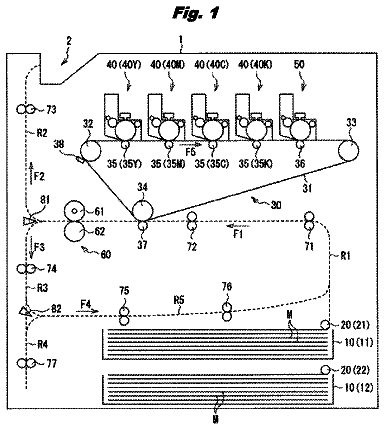
The electrostatic image developing toner is used in image forming to visualize an electrostatic image in a printer, a copier, a facsimile and the like. To take forming of an image by electrophotographic system as an example, in the first place an electrostatic latent image is formed on a photosensitive drum, in the next place the latent image is developed with a toner and the developed image is transferred to a transfer-receiving paper, and the transferred image is fixed with heat or the like, thus an image is formed. The toner used at that time as the electrostatic image developing toner is generally a toner obtained by what is called a melt-kneading pulverizing method of dry blending a charge controlling agent, a release agent, and a magnetic substance, according to necessity, with a binder resin and a colorant, melt-kneading the mixture by an extruder or the like, in the next place pu
Ask Claude for concept sketches based only on the patent's text. They are not part of the patent.
What the patent claimed, word for word. All of it is now free to use.
The present invention relates to an electrostatic image developing toner, specifically an electrostatic image developing toner capable of providing a high quality image and high gloss, and excellent in stability in long term use and environmental stability.
The electrostatic image developing toner is used in image forming to visualize an electrostatic image in a printer, a copier, a facsimile and the like. To take forming of an image by electrophotographic system as an example, in the first place an electrostatic latent image is formed on a photosensitive drum, in the next place the latent image is developed with a toner and the developed image is transferred to a transfer-receiving paper, and the transferred image is fixed with heat or the like, thus an image is formed. The toner used at that time as the electrostatic image developing toner is generally a toner obtained by what is called a melt-kneading pulverizing method of dry blending a charge controlling agent, a release agent, and a magnetic substance, according to necessity, with a binder resin and a colorant, melt-kneading the mixture by an extruder or the like, in the next place pulverizing and classifying the melt-kneaded product to thereby obtain toner particles, and attaching solid particles such as silica as an external additive on the surfaces of the particles for the purpose of imparting various performances such as a flowing property and the like.
In recent years, heightening of a highly precise image quality is required in image formation such as copiers and printers, and for responding such a requirement, it is necessary that the average particle size of toner particles is 3 μm to 8 μm or so and particle size distribution is narrow. However, it is difficult to control particle size and particle size distribution of toner particles in the melt-kneading pulverizing method, and when it is tried to obtain toner particles having an average particle size of 3 μm to 8 μm, high energy is necessary and, further, when the desired particle size is not obtained, there arises a problem such that a process of classification is further necessary.
As a means for solving such a problem in a melt-kneading pulverization method, manufacturing by a polymerization method such as a suspension polymerization method, an emulsification polymerization aggregation method, and a dissolution suspension method is proposed in place of the melt-kneading pulverizing method.
The suspension polymerization method is a method of manufacturing toner particles by suspension dispersing a composition containing a polymerizable monomer, a polymerization initiator and a colorant as the components in an aqueous medium and then polymerizing.
The emulsification polymerization aggregation method is a method of manufacturing toner particles by emulsifying a polymerizable monomer in an aqueous medium containing a polymerization initiator and an emulsifying agent, polymerizing the polymerizable monomer under stirring to obtain polymer primary particles, adding a colorant and, if necessary, a charge controlling agent or the like thereto to aggregate the polymer primary particles, and aging the obtained aggregated particles.
The dissolution suspension method is a method of manufacturing toner particles by dissolving a binder resin in an organic solvent, adding and dispersing a colorant and the like to obtain a solution phase, dispersing the solution phase with mechanical shearing force in an aqueous phase containing a dispersant and the like to form droplets, and removing the organic solvent from the droplets.
According to these polymerization methods, particle size of toner particles can be easily controlled and small size particles can be obtained in narrow particle size distribution, and so toner particles capable of forming high precise image quality can be obtained.
In particular, since the emulsification polymerization aggregation method is a method of manufacturing toner particles by aggregating polymer primary particles obtained by emulsification polymerization with emulsified particles of a colorant or the like, control of the particle size of primary particles is easier as compared with other polymerization method, and the control of the form of toner particles is also feasible. Further, since it is possible to control the structure of the toner more easily by aggregation control, realization of multifunctional performances including low temperature fixation is feasible.
As characteristics affecting image formation, improvement of charging characteristics has also been eagerly examined.
It is necessary to decide the quantity of charge in conformity with the designs of printers, copiers and the like.
There are minus charge and plus charge in the charge, and either of these is adjusted by a charge controlling agent and a binder resin, and it has been pointed out that there are various problems in the control of the quantity of charge of a positively charging toner as compared with that of a negatively charging toner.
Controlling a charging property has been conventionally performed by selection of a charge controlling agent such as a nigrosine dye, a quaternary ammonium salt, a triphenylmethane, or the like, but when such a positively charging toner is used in a two-component developer, the charge controlling agent is spent on the surface of a magnetic carrier during repeating use for a long term, and frictional charging performance of the carrier reduces, which leads to the reduction of image quality, such as the occurrence of what is called fog, PC contamination, staining, generation of an after image (a ghost), blurring (solid-following up), and cleaning performance.
In addition, a nigrosine dye is a dark brown dye and so it can be used only in a black toner, and a quaternary ammonium salt is colorless but it is inferior in a dispersing property in a binder resin, and a charging property is also inferior. If dispersion in a toner is not uniform, fogging increases and the toner causes spattering, and so a uniform dispersing property of a charge controlling agent is the more required in recent years in particle size miniaturization of a toner for aiming at achieving highly precise image quality.
Accordingly, in recent years, studies have been carried out such that a resin having charge controlling performance is used as a charge controlling agent, or various kinds of functional groups are introduced into a binder resin to thereby improve a charging property by making use of the characteristics thereof. For example, monomers containing an amino group or an amide bond are generally used.
When such monomers are used, it is necessary to use an azo-based polymerization initiator in the polymerization of a resin, but it is pointed out that azo-based polymerization initiators have a tendency to be inferior to other polymerization initiators, e.g., peroxide-based polymerization initiator, in the points of environmental stability and a color developing property of the toner. Further, when ordinary azo-based polymerization initiators are used, a toxic substance having a cyano group is generated as a by-product and also an odor deriving from an amino group occurs.
Further, in addition to these problems, there also remains some fear due to poor dispersion of pigments such that color development unevenness is generated, initial rising of charge is insufficient, and the problems of increase in fog and spattering of toner are not completely solved.
For overcoming the concerns as described above, as a means by the improvement of a binder resin, resins for positively charging toners containing one or more components of an acrylic ester component and methacrylic ester component not having an amino group in a resin have been proposed (Patent Documents 1 to 5). PRIOR ART DOCUMENT Patent Document
[Patent Document 1] JP-A-5-323660 (the term “JP-A” as used herein refers to an “unexamined published Japanese patent application”)
[Patent Document 2]
[Patent Document 3]
[Patent Document 4]
[Patent Document 5]
[Patent Document 6] JP-A-8-292601 SUMMARY OF THE INVENTION Problems that the Invention is to Solve
However, any of the inventions described in Patent Documents 1 to 5 is an easy method, and any of them has not yet come to obtain an electrostatic image developing toner capable of providing a high quality image and high gloss, and excellent in stability in long term use and environmental stability in addition to the compatibility of a fixing property and blocking resistance.
Also, a positively charging electrostatic image developing toner containing one or more components of an acrylic ester component and methacrylic ester component not having an amino group in a resin is described in Patent Document 6, but the blocking resistance and productivity of the toner cannot be said to be sufficient.
Therefore, the invention provides an electrostatic image developing toner capable of providing a high quality image and high gloss, and excellent in stability in long term use and environmental stability, especially an electrostatic image developing toner not causing fog in the use at high temperature and high humidity conditions, above all the invention provides a positively charging electrostatic image developing toner. Means for Solving the Problems
For solving the above problems, the present inventors repeated examinations and found that the above problems can be solved by an electrostatic image developing toner which contains toner mother particles containing a binder resin and a colorant, wherein the repeating unit contained in the binder resin has a carbon atom, a hydrogen atom and an oxygen atom, and also has 4 or more and 20 or less ether bonds, which resin is contained in the toner mother particles in a specific amount. The invention is based on the knowledge, and the essential points of the invention are as follows.
<1> An electrostatic image developing toner comprising toner mother particles containing a binder resin and a colorant, wherein the electrostatic image developing toner satisfies the following conditions
to (4):
the binder resin contains a repeating unit having 4 to 20 ether bonds,
the repeating unit contains a carbon atom, a hydrogen atom and an oxygen atom,
the repeating unit accounts for 0.1 parts by mass to 10 parts by mass in 100 parts by mass of the toner mother particles, and
the toner mother particles are obtained by a wet polymerization method.
<2> The electrostatic image developing toner as described in the item <1>, wherein the wet polymerization method is an emulsification polymerization aggregation method.
<3> The electrostatic image developing toner as described in the item <1> or <2>, wherein the toner mother particles are positively charging particles.
<4> The electrostatic image developing toner as described in any one of the items <1> to <3>, which further comprises an external additive.
<5> The electrostatic image developing toner as described in the item <4>, wherein the external additive contains an electrically conductive metal oxide.
<6> The electrostatic image developing toner as described in the item <5>, wherein the electrically conductive metal oxide is an electrically conductive titanium oxide.
<7> The electrostatic image developing toner as described in the item <6>, wherein the electrically conductive titanium oxide is contained in an amount of 0.1 parts by mass or more to 100 parts by mass of the toner mother particles.
<8> The electrostatic image developing toner as described in any one of the items <4> to <7>, wherein the external additive further contains silica.
<9> The electrostatic image developing toner as described in the item <8>, wherein the silica comprises silica A having a volume average primary particle size of 5 nm or more and 15 nm or less, and silica B having a volume average primary particle size greater than that of the silica A by 5 nm or more. <10> The electrostatic image developing toner as described in any one of the items <4> to <9>, wherein the external additive contains positively charging inorganic particles treated with an amino group-containing compound. Advantage of the Invention
According to the invention, an electrostatic image developing toner capable of providing a high quality image and high gloss, and excellent in stability in long term use and environmental stability, especially a positively charging electrostatic image developing toner can be provided.
This effect can be obtained by a binder resin having stable quantity of charge and environmental stability, by which deterioration of a charging property due to long term use and use under severe conditions does not occur, and deterioration of image quality is not caused. Further, as compared with binder resins deriving from conventionally used polymerizable monomers, the binder resin according to the invention is excellent in moisture resistance, and so environmental stability is exhibited.
The toner mother particles in the invention contain a binder resin and a colorant, and in addition to them, if necessary, may contain wax and a charge controlling agent. The toner mother particles in the invention are manufactured by a wet polymerization method.
In the invention, particles in the state before external additives are attached are referred to as toner mother particles and particles after external additives are attached to the surfaces of the toner mother particles are referred to as toners. Incidentally, “parts by mass” and “parts by weight” have the same meaning.
<Toner Mother Particles>
As the wet polymerization methods for manufacturing toner mother particles, a suspension polymerization method, an emulsification polymerization aggregation method and a dissolution suspension method are exemplified, but the invention is not restricted to these methods.
In the suspension polymerization method, toner mother particles are generally obtained by dissolving a colorant and wax in a binder resin monomer, and suspending the monomer solution in an aqueous medium by mechanical shearing force as monomer drops to perform polymerization.
In the emulsification polymerization aggregation method, in general, a polymerizable monomer constituting a binder resin is emulsified in an aqueous medium containing a polymerization initiator, an emulsifier, and the like, polymerizing the polymerizable monomer under stirring to obtain polymer primary particles, and adding the dispersion liquid of a colorant and, if necessary, a charge controlling agent to aggregate the polymer primary particles. And toner mother particles are obtained by aging the obtained aggregated particles.
In the dissolution suspension method, in general, a binder resin, wax, and the like are dissolved in a solvent to thereby obtain an oil phase, suspending the oil phase in an aqueous medium as oil drops, and removing the solvent, thus toner mother particles are obtained.
From the point of capable of easily controlling the physical characteristics of the obtained toner, the emulsification polymerization aggregation method is preferred of the above wet polymerization methods.
In the invention, a polymerizable monomer constituting a binder resin corresponds to the repeating unit contained in the binder resin, and the repeating unit has 4 or more and 20 or less ether bonds, and the monomer is not especially restricted so long as it has a carbon atom, a hydrogen atom and an oxygen atom. When the number of ether bonds is distributed in a wide range, the average value of the number of bonds is taken as the number of ether bonds.
By containing ether bonds, the polymerizable monomer gives a hydrophilic property necessary to stabilize particles in water during manufacture of the toner by the polymerization method and imparts a positive charging property to the toner mother particles.
It is essential that the number of ether bonds in the polymerizable monomer is 4 or more, preferably 5 or more from the point of stabilization of the particles in water, and more preferably 6 or more, on the other hand, it is essential that the number of ether bonds is 20 or less, preferably 15 or less, more preferably 12 or less, and still more preferably 10 or less.
When the number of ether bonds is too few, there are cases where a charging property is insufficient, while when the number is too many, there are cases where a preserving property and moisture resistance are deteriorated.
The polymerizable monomer having ether bonds for use in the invention is preferably nonionic from a preserving property and environmental resistance of the toner, and the polymerizable monomer having ether bonds means a monomer having a functional group capable of radical polymerization. For example, (meth)acrylic esters, vinyl ethers, vinyl esters, styrenes, and the like are exemplified, and a part of them is represented by the following formula 1 or 2:
##STR00001## wherein R.sub.1 represents a hydrogen atom or a methyl group; R.sub.2 represents an ester group, an ether group, or a phenylene group; each of R.sub.3 and R.sub.4 represents a structure having a carbon atom, a hydrogen atom, and an oxygen atom; R.sub.5 represents a structure having a carbon atom, a hydrogen atom, an oxygen atom, and, if necessary, a chlorine atom, such as an alkyl group, a phenyl group, or an alkylphenyl group; each of a and b independently represents an integer of 0 or more, and the sum of a and b is 2 or more; each of i and j independently represents 0 or 1; and each of 1, m and n independently represents an integer of 1 or more.
##STR00002## wherein R.sub.1 represents a hydrogen atom or a methyl group; R.sub.2 represents an ester group, an ether group, or a phenylene group; each of R.sub.3 and R.sub.4 represents a structure having a carbon atom, a hydrogen atom, and an oxygen atom; each of R.sub.5 an R.sub.5′ independently represents a structure having a carbon atom, a hydrogen atom, an oxygen atom, and, if necessary, a chlorine atom, such as an alkyl group, a phenyl group, or an alkylphenyl group; each of a, b and c independently represents an integer of 0 or more; each of i and j independently represents 0 or 1; each of 1, m and n independently represents an integer of 1 or more; each of s and t independently represents an integer of 0 to 2; and a+b*s+(c+1)*t is 2 or more.
More specifically, the examples thereof include polyalkylene glycol mono(meth)acrylates having an alkyl group at a terminal, such as methoxy polyethylene glycol mono(meth)acrylate, octoxy polyethylene glycol polypropylene glycol mono(meth)acrylate, lauroxy polyethylene glycol mono(meth)acrylate, stearoxy polyethylene glycol mono(meth)acrylate, phenoxy polyethylene glycol mono(meth)acrylate, nonylphenoxy polypropylene glycol mono(meth)acrylate, and the like, polyalkylene glycol mono(meth)acrylates having a hydroxyl group at a terminal, such as polyethylene glycol mono(meth)acrylate, polypropylene glycol mono(meth)acrylate, polyethylene glycol polypropylene glycol mono(meth)acrylate, and the like, and in addition to the above, vinyl ether compounds, such as methoxy polyethylene glycol vinyl ether, polyethylene glycol vinyl ether, and the like, vinyl ester compounds, such as methoxy polyethylene glycol vinyl ester, polyethylene glycol vinyl ester, and the like, and styrene compounds, such as methoxy polyethylene glycol styrene, polyethylene glycol styrene, 4-(methoxymethoxy)styrene, and the like can be used, but the invention is not restricted to these examples.
These monomers can be arbitrarily selected according to the composition of the binder resin constituting the toner of the invention and the kind of wax, and they may be used alone, or two or more monomers having different numbers of ether bonds may be used in combination, or two or more monomers having structures different in the parts other than ether bonds may be used in combination.
It is essential that the repeating unit having ether bonds contained in the binder resin in the invention is contained in an amount of 0.1 parts by mass or more in 100 parts by mass of the toner mother particles, preferably 0.5 parts by mass or more, more preferably 1 part by mass or more, still more preferably 2 parts by mass or more, and most preferably 4 parts by mass or more. On the other hand, it is essential that the repeating unit having ether bonds is contained in an amount of 10 parts by mass or less in 100 parts by mass of the toner mother particles, and preferably 8 parts by mass or less. When the content of the repeating unit part is too little, there are cases where a charging property is insufficient, while when it is too much, there are cases where a preserving property and moisture resistance are deteriorated.
In the invention, as the monomer component for use for manufacturing a binder resin by copolymerization with a polymerizable monomer having ether bonds, monomers conventionally used for manufacturing binder resins of toners can be arbitrarily used.
For example, any polymerizable monomer of a polymerizable monomer having an acid group (hereinafter sometimes merely referred to as an acid monomer), a polymerizable monomer having a basic group (hereinafter sometimes merely referred to as a basic monomer), and a polymerizable monomer having neither an acid group nor a basic group (hereinafter sometimes merely referred to as other monomers) can be used.
When toner mother particles are manufactured by an emulsification polymerization aggregation method, in the emulsification polymerization process, polymerizable monomers are generally polymerized in an aqueous medium in the presence of an emulsifier. In supplying polymerizable monomers to the reaction system, each monomer may be added separately, or two or more kinds of monomers may be mixed in advance and added at the same time. Monomers may be added as they are, or they may be mixed with water and an emulsifier in advance and added as a prepared emulsion liquid.
The examples of acid monomers include polymerizable monomers having a carboxyl group, such as an acrylic acid, a methacrylic acid, a maleic acid, a fumaric acid, a cinnamic acid, and the like, polymerizable monomers having a sulfonic acid group, such as sulfonated styrene and the like, and polymerizable monomers having a sulfonamide group, such as vinylbenzene sulfonamide and the like.
The examples of basic monomers include aromatic vinyl compounds having an amino group, such as aminostyrene and the like, nitrogen-containing aromatic ring-containing polymerizable monomers, such as vinyl pyridine, vinyl pyrrolidone, and the like, (meth)acrylic esters having an amino group, such as dimethylaminoethyl acrylate, diethylaminoethyl methacrylate, and the like.
These acid monomers and basic monomers contribute to the stabilization of the particles in water in the process of the manufacture of toner mother particles by the suspension polymerization method, emulsification polymerization aggregation method, dissolution suspension method or the like with polymerizable monomers having ether bonds having a radical property used in the invention. Acid monomers and basic monomers copolymerized with polymerizable monomers having ether bonds may be used alone, or may be used as mixture of two or more kinds, or may be present as salts with counter ions.
The rate of a polymerizable monomer having ether bonds accounting for in 100 parts by mass of the sum of a polymerizable monomer having ether bonds, an acid monomer and a basic monomer is generally 50 parts by mass or more, preferably 70 parts by mass or more, and more preferably 90 parts by mass or more.
The greatest lower bound of the total amount of a polymerizable monomer component having ether bonds, an acid monomer component and a basic monomer component accounting for in 100 parts by mass of the total monomer components for constituting a binder resin is generally 0.1 parts by mass or more, preferably 0.5 parts by mass or more, more preferably 1 part by mass or more, and, on the other hand, the least upper bound is generally 10 parts by mass or less, preferably 6 parts by mass or less, more preferably 5 parts by mass or less.
The examples of other monomers for constituting the binder resin include styrenes, such as styrene, methylstyrene, chlorostyrene, dichlorostyrene, p-tert-butylstyrene, p-n-butylstyrene, p-n-nonylstyrene, and the like, acrylic esters, such as methyl acrylate, ethyl acrylate, propyl acrylate, n-butyl acrylate, isobutyl acrylate, hydroxyethyl acrylate, 2-ethylhexyl acrylate, and the like, methacrylic esters, such as methyl methacrylate, ethyl methacrylate, propyl methacrylate, n-butyl methacrylate, isobutyl methacrylate, hydroxyethyl methacrylate, 2-ethylhexyl methacrylate, and the like, acrylamide, N-propylacrylamide, N,N-dimethylacrylamide, N,N-dipropylacrylamide, N,N-dibutylacrylamide, and the like. These other monomers may be used alone, or two or more monomers may be used in combination.
Further, when a crosslinkable resin is used as the binder resin, a polyfunctional monomer having radical polymerizability is used together with the above monomers, and the examples thereof include divinylbenzene, hexanediol diacrylate, ethylene glycol dimethacrylate, diethylene glycol dimethacrylate, triethylene glycol dimethacrylate, tetraethylene glycol dimethacrylate, hexaethylene glycol dimethacrylate, nonaethylene glycol dimethacrylate, diethylene glycol diacrylate, triethylene glycol diacrylate, neopentyl glycol dimethacrylate, neopentyl glycol diacrylate, dially phthalate, and the like.
Further, it is also possible to use polymerizable monomers having a reactive group in a pendant group, for example, glycidyl methacrylate, methylol acrylamide, acrolein, and the like can be used. A radical polymerizable bifunctional polymerizable monomer is preferred of them, and divinylbenzene and hexanediol diacrylate are especially preferred. These polyfunctional polymerizable monomers may be used alone, or two or more kinds may be used as mixture.
The number average molecular weight of the binder resin by gel permeation chromatography (hereinafter referred to as GPC) is preferably 2,000 or more, more preferably 2,500 or more, still more preferably 3,000 or more, and preferably 50,000 or less, more preferably 40,000 or less, still more preferably 35,000 or less. Also, the weight average molecular weight found by GPC is preferably 50,000 or more, more preferably 100,000 or more, still more preferably 200,000 or more, and preferably 2,000,000 or less, more preferably 1,000,000 or less, still more preferably 500,000 or less. When the number average molecular weight and the weight average molecular weight of the binder resin are in the above ranges, the durability, preservation property and fixing property of the toner are good, and so preferred.
In polymerization of a binder resin, if necessary, one or two or more kinds of known polymerization initiators may be used in combination. The examples of polymerization initiators include persulfates, such as potassium persulfate, sodium persulfate, ammonium persulfate, and the like, redox initiators obtained by combining the above persulfate as one component with a reducing agent such as acidic sodium sulfite, water-soluble polymerization initiators, such as hydrogen peroxide, 4,4-azobis-cyanovaleric acid, t-butyl hydroperoxide, cumene hydroperoxide, and the like, redox initiators obtained by combining the above water-soluble polymerization initiator as one component with a reducing agent such as ferrous salt or the like, benzoyl peroxide, 2,2-azobisisobutyronitrile and the like. These polymerization initiators may be added to the polymerization system at any time of before addition of the monomer, at the same time with the addition of the monomer, or after the addition, and these addition methods may be combined according to necessity.
In polymerization of a binder resin, if necessary, known chain transfer agents may be used. The specific examples of such chain transfer agents include t-dodecyl mercaptan, 2-mercaptoethanol, diisopropylxanthogen, carbon tetrachloride, trichlorobromomethane, and the like. Chain transfer agents may be used alone, or may be used in combination of two or more kinds, and the amount to be used is 0% by weight to 5% by weight based on the polymerizable monomer.
In polymerization of a binder resin, if necessary, known suspension stabilizers may be used. The specific examples of such suspension stabilizers include calcium phosphate, magnesium phosphate, calcium hydroxide, magnesium hydroxide, and the like. These suspension stabilizers may be used alone, or two or more kinds may be used in combination. Suspension stabilizers are used in an amount of 1 part by mass or more and 10 parts by mass or less based on 100 parts by mass of the sum of all the monomer components for constituting the binder resin.
Suspension stabilizers may be added to the polymerization system at any time of before addition of the monomer, at the same time with the addition of the monomer, or after addition, and these addition methods may be combined according to necessity.
In addition to the above, a pH controlling agent, a polymerization degree-controlling agent, a defoaming agent and the like may be arbitrarily added to the reaction system of the binder resin.
In the invention, when a binder resin is polymerized by emulsification polymerization, known emulsifiers may be used. As such emulsifiers, one or two or more emulsifiers selected from a cationic surfactant, an anionic surfactant, and a nonionic surfactant may be used in combination.
The examples of cationic surfactants include, for example, dodecylammonium chloride, dodecylammonium bromide, dodecyltrimethylammonium bromide, dodecyldimethylbenzylammonium chloride, dodecylpyridinium chloride, dodecylpyridinium bromide, hexadecyltrimethylammonium bromide, and the like.
The examples of anionic surfactants include, for example, fatty acid soaps, such as sodium stearate, sodium dodecanoate, and the like, sodium dodecylsulfate, sodium dodecylbenzenesulfonate, sodium laurylsulfate, and the like.
The examples of nonionic surfactants include, for example, polyoxyethylene dodecyl ether, polyoxyethylene hexadecyl ether, polyoxyethylene nonylphenyl ether, polyoxyethylene lauryl ether, polyoxyethylene sorbitan monooleate ether, monodecanoyl sucrose, and the like.
The amount of an emulsifier used is preferably 0.1 parts by mass or more and 10 parts by mass or less per 100 parts by mass of all the monomers for constituting the binder resin. Further, together with such an emulsifier, one or two or more polyvinyl alcohols such as partially or completely saponified polyvinyl alcohol and the like, and cellulose derivatives such as hydroxyethyl cellulose and the like may be used in combination as protective colloid.
The volume average particle size of the polymer primary particles obtained by emulsification polymerization is generally 0.02 μm or more, preferably 0.05 μm or more, more preferably 0.1 μm or more, and is generally 3 μm or less, preferably 2 μm or less, still more preferably 1 mμ or less. When the particle size is smaller than the above range, there are cases where the control of the aggregation rate in the aggregation process becomes difficult, while when the particle size is larger than the above range, there are cases where the particle size of the toner mother particle obtained by aggregation is liable to become too large and it is difficult to obtain a toner having the particle size of the objective.
Wax can be used in the toner mother particles in the invention as the offset preventive. In recent years, improvement of the fixing property of toner at a low temperature has been tried. Low temperature fixation and blocking resistance, high temperature offset resistance are generally in the relationship of antinomy, and for attaining the reconciliation of these, wax is preferably used as the offset preventive.
Known waxes may be optionally used. The specific examples of waxes include olefin waxes, such as low molecular weight polyethylene, low molecular weight polypropylene, copolymer polyethylene, and the like, paraffin wax, ester waxes having a long chain aliphatic group, such as behenyl behenate, montanate, stearyl stearate, and the like, vegetable waxes, such as hydrogenated castor oil, carnauba wax, and the like, ketones having a long chain alkyl group, such as distearyl ketone and the like, silicones having an alkyl group, higher fatty acids such as stearic acid and the like, a long chain fatty acid alcohol, a long chain fatty acid polyhydric alcohols such as pentaerythritol, a partial ester thereof, and higher fatty acid amides, such as oleic acid amide, stearic acid amide, and the like, and preferably hydrocarbon-based waxes, such as paraffin wax and Fischer-Tropsch wax, ester-based wax, and silicone-based wax are exemplified.
Waxes may be used alone, or two or more waxes may be used in combination as a mixture. Further, for improving the fixing property, the melting temperature of these waxes is preferably 110° C. or less, more preferably 90° C. or less, and especially preferably 80° C. or less. The greatest lower bound of the melting temperature is preferably 40° C. or more, and more preferably 50° C. or more. When the melting temperature is too high, there are cases where the effect of lowering the fixing temperature is inferior, while when the melting temperature is too low, there are cases where problems arise in the consolidation and preservation stability.
The amount of the wax to be used is preferably 1 part by mass or more in 100 parts by mass of the toner mother particles, more preferably 2 parts by mass or more, and still more preferably 5 parts by mass or more. Also, the amount is preferably 40 parts by mass or less, more preferably 35 parts by mass or less, and still more preferably 30 parts by mass or less. When the content of the wax in the toner mother particles is too little, there are cases where performance such as offset property at a high temperature is not sufficient, while when the content is too much, blocking resistance is not sufficient or the wax leaks out of the toner, as a result sometimes the apparatus is soiled.
As the compounding method of wax to the polymerization system, it is preferred to disperse the wax in water in advance in the state of the volume average particle size of 0.01 μm or more and 2.0 μm or less. The volume average particle size is more preferably 1.0 μm or less, and especially preferably 0.5 μm or less.
Further, when toner mother particles are manufactured by an emulsification polymerization aggregation method, the dispersion liquid of wax which is dispersed in the above range of the volume average particle size is preferably added to the polymerization system at the time of emulsification polymerization or in the aggregation process.
For dispersing the wax in the toner mother particles in a preferred dispersion particle size, what is called seed polymerization, i.e., the wax is added as seed at the time of emulsification polymerization, is preferably used. Since the wax is finely and uniformly dispersed in the toner mother particles by the addition as seed, deterioration of the charging property and heat resistance of the toner at large can be inhibited.
Further, it is also possible to prepare the dispersion liquid of wax/long chain polymerizable monomer by dispersing the wax in advance in an aqueous dispersion medium with a long chain polymerizable monomer such as stearyl acrylate, and polymerize a polymerizable monomer in the presence of a wax/long chain polymerizable monomer.
Well-known colorants can be optionally used as the colorants contained in the toner mother particles in the invention. The specific examples of such colorants include carbon black, Aniline Blue, Phthalocyanine Blue, Phthalocyanine Green, Hansa Yellow, Rhodamine-based dyes or pigments, Chrome Yellow, Quinacridone, Benzidine Yellow, Rose Bengal, triallylmethane-based dyes, monoazo-based, disazo-based, condensed azo-based dyes or pigments, and the like. These known dyes or pigments may be used alone, or as a mixture.
When the toner according to the invention is a full color toner, it is preferred to use Benzidine Yellow, monoazo-based, or condensed azo-based dyes or pigments as yellow, Quinacridone, monoazo-based dyes or pigments as magenta, and Phthalocyanine Blue as cyan. The amount of the colorants to be used is preferably 3 parts by mass or more and 20 parts by mass or less per 100 parts by mass of the polymer primary particles.
The compounding of the colorants in the emulsification polymerization aggregation method is generally performed in the aggregation process. The dispersion liquid of polymer primary particles and the dispersion liquid of colorant particles are mixed to prepare a mixed dispersion liquid, and then the mixed dispersion liquid is aggregated to thereby obtain particle aggregates. Colorants are preferably used in the state of being dispersed in water in the presence of an emulsifier. The volume average particle size of the colorant particles is preferably 0.01 μm or more, more preferably 0.05 μm or more, and is preferably 3 μm or less, more preferably 1 μm or less.
In the invention, when a charge controlling agent is used, well-known optional charge controlling agents may be used alone or in combination.
For example, as positively charging charge controlling agents, a quaternary ammonium salt, basic/electron donating metallic materials, a triaminotriphenyl-methane compound, an imidazole compound, a polyamine resin, charge controlling resins such as copolymers containing an amino group or a quaternary ammonium group, and the like are exemplified.
As negatively charging charge controlling agents, a metal chelate, a metal salt of an organic acid, a metal-containing dye, a nigrosine dye, an amide group-containing compound, a phenol compound, a naphthol compound and metal salts thereof, a urethane bond-containing compound, an acidic or electron-withdrawing organic material are exemplified.
When the electrostatic image developing toner according to the invention is used as a toner other than a black toner in a color toner or a full color toner, it is preferred to use a colorless or pale colored charge controlling agent free from color tone hindrance to the toner.
For example, as the positively charging charge controlling agent, a quaternary ammonium salt compound is preferred, and as the negatively charging charge controlling agent, a metal salt or metal complex of a salicylic acid or an alkyl salicylic acid with chromium, zinc, aluminum or the like, a metal salt or metal complex of a benzilic acid, an amide compound, a phenol compound, a naphthol compound, a phenolamide compound, a hydroxynaphthalene compound such as 4,4′-methylenebis-[2-[N-(4-chlorophenyl)amide]-3-hydroxynaphthalene], and the like are preferred.
In the invention, when a charge controlling agent is incorporated into a toner in the case of manufacturing toner mother particles by an emulsification polymerization aggregation method, compounding can be performed by any of the following methods, i.e., a method of incorporating a charge controlling agent with a polymerizable monomer and the like at the time of emulsification polymerization, a method of incorporating a charge controlling agent with polymer primary particles, a colorant and the like in the aggregation process, and a method of aggregating polymer primary particles and a colorant so as to obtain an almost objective particle size, and then incorporating a charge controlling agent to the aggregates. Of these methods, it is preferred to disperse a charge controlling agent in water by using a surfactant and to introduce the obtained dispersion liquid having a volume average particle size of 0.01 μm or more and 3 μm or less to the aggregation process.
The description continues in the full USPTO document.
About 6,212 words. The USPTO PDF has it with every drawing.
Fees are due 3.5, 7.5 and 11.5 years after grant. This patent expired on August 22, 2025, so the fee marked "not paid" was the one that went unpaid.
ELECTROSTATIC IMAGE DEVELOPING TONER
Filed Jan 2014 · published May 2014ELECTROSTATIC IMAGE DEVELOPING TONER
Filed Jan 2016 · published May 2016Electrostatic image developing toner
Filed Jan 2016 · granted Aug 2017Earlier publications, parents and continuations. None of them can still be enforced, or this patent would not be listed.
Prior art cited by the examiner or applicant. Useful when you check your own idea for novelty.
Everything on this page comes from the documents linked above.