 Lapsed, fee not paid20 drawings
Materials & Chemistry · US 9,738,773 B2
Flame retardants from renewable resources
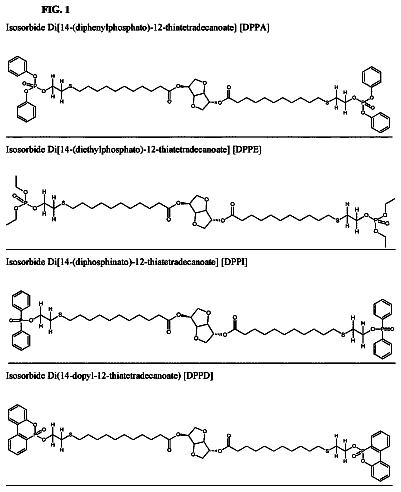
Among other things the invention provides novel flame-retardant compounds useful for increasing the flame retardance of polymers.
US 9,738,784 B2 · Assignee: Novomer, Inc. · Inventors: Allen; Scott D. et al.
Sheet 1 of 3 from the published document. All sheets in the USPTO PDF
The present invention provides, among other things, extruded blends of aliphatic polycarbonates and polyolefins. In one aspect, provided blends comprise aliphatic polycarbonates such as poly(propylene carbonate) and a lesser amount of a crystalline or semicrystalline polymer. In certain embodiments, provided blends are characterized in that they exhibit unexpected improvements in their elongation properties. In another aspect, the invention provides methods of making such materials and applications of the materials in applications such as the manufacture of consumer packaging materials.
Lessening the carbon footprint of plastics used for consumer applications such as packaging is of increasing importance. Aliphatic polycarbonates (APCs) are recognized as an attractive option in this regard since they have a very favorable carbon profile compared to traditional polymers derived exclusively from fossil fuel feedstocks. This is due in part to the fact that a significant portion of the mass of the polymer is derived from CO.sub.2 which can be derived from waste sources. APCs not only replace a significant mass of polymer with non-fossil fuel feedstock, they can actually be produced from waste CO.sub.2 that would otherwise be released to the atmosphere. Additional factors such as lower processing temperatures and lower use of energy in production make these polymers even more favorable when compared to polymers derived exclusively from petroleum or natural gas feedstocks. Li
1 of 3 drawing sheets so far from the published document, cropped to the drawing. Every sheet is in the USPTO PDF.
What the patent claimed, word for word. All of it is now free to use.
The invention pertains to the field of polymer compositions and polymer blends. More particularly, the invention pertains to aliphatic polycarbonate blends having improved properties.
Lessening the carbon footprint of plastics used for consumer applications such as packaging is of increasing importance. Aliphatic polycarbonates (APCs) are recognized as an attractive option in this regard since they have a very favorable carbon profile compared to traditional polymers derived exclusively from fossil fuel feedstocks. This is due in part to the fact that a significant portion of the mass of the polymer is derived from CO.sub.2 which can be derived from waste sources. APCs not only replace a significant mass of polymer with non-fossil fuel feedstock, they can actually be produced from waste CO.sub.2 that would otherwise be released to the atmosphere. Additional factors such as lower processing temperatures and lower use of energy in production make these polymers even more favorable when compared to polymers derived exclusively from petroleum or natural gas feedstocks. Life cycle analyses of aliphatic polycarbonates also indicate they exceed bio-based polymers that require large amounts of energy and fresh water for production and in some instances compete for the same resources required for food production.
For these advantages to have a significant environmental benefit requires the identification of large markets where significant volumes of APC can replace traditional petrochemical polymers. This has been a challenge: while epoxide CO.sub.2 polymers have been known for over 40 years, they have yet to find broad application in any commodity market This is due to their relatively poor structural and thermal characteristics, and until recently, their high cost. The cost has been reduced in recent years through the identification of efficient cobalt-based catalysts for the copolymerization of CO.sub.2. Strides have also been made in improving the physical properties of the polymers. APCs made with cobalt catalysts have much better defined structures than earlier materials based on zinc or aluminum catalysts. The newer materials exhibit a very high degree of CO.sub.2 incorporation, strict control of molecular weight (Mn) and molecular weight distribution (PDI) and lower contamination by cyclic carbonate by-products.
APCs encompassing these improvements have been demonstrated to have higher glass transition temperatures, better thermal stability, and lower gas permeability. All of these improvements have increased the likelihood of adoption of the polymers in large volume consumer applications such as uses as packaging materials. However, the polymers still have some shortcomings in terms of their physical strength and flexibility. Poly(propylene carbonate) which has been the most studied epoxide-CO.sub.2 copolymer tends to be quite brittle. This is particularly true if the polymer is produced in highly pure form free of ether linkages (caused by direct enchainment of two or more epoxides without CO.sub.2) and free of cyclic propylene carbonate (cPC) (formed as a byproduct during polymerization or by partial degradation of the polymer by nucleophilic attack of the hydroxyl chain ends on adjacent carbonate linkages). In certain cases, the presence of ether linkages can lower the Tg of the polymer and provide less brittle materials, but this generally comes at the cost of strength, lower thermal stability and poorer gas barrier properties. Likewise, while residual cyclic carbonate can act as a plasticizer to make the polymer less brittle, the presence of the byproduct has undesirable side effects and may be a problem where the polymer is to be used for food contact since small molecules such as propylene carbonate can migrate from the packaging material to contaminate the contents of the package.
Attempts have been made to blend aliphatic polycarbonates with other materials to improve their applicability, but these blends have focused on biopolymers such as polylactic acid (PLA), polyhydroxybutyrate (PHB), starch and the like. These blends still suffer the environmental disadvantages of the biopolymers used in the blends and in many cases, still have only moderate processing and physical characteristics.
Polyolefins such as polyethylene (PE) and polypropylene (PP) constitute the major portion of the consumer packaging market. These polymers are popular because they provide an excellent combination of physical properties, good processing characteristics and low cost. As noted above, one area in which they lag is their carbon footprint. Blends of polyolefins with aliphatic polycarbonates are not currently known in the art.
Lower permeability to oxygen is also important in packaging applications. Good oxygen barrier properties lead to an increased shelf-life as a result of less oxidation of food and beverages, thereby maintaining taste and quality for a longer time. This is particularly important as current trends in the packaging industry are to down-gauge films by reducing their thickness to provide light-weight packaging. Thus, an improvement in permeability at an equivalent thickness or an equivalent permeability at a much lower thickness can have significant commercial value. Improved oxygen barrier films are important for packaging a variety of foods and beverages, including meat, baked goods, snacks, juices in stand-up pouches, confectionaries, and a wide variety of moisture and oxygen sensitive nutraceuticals and health and beauty products. The food packaging industry is looking for new options as they move away from current materials like polyvinylidene chloride (PVDC) due to environmental regulatory pressures on chlorinated materials and ethylene vinyl alcohol (EVOH) due to sensitivity to moisture and higher oxygen permeability at higher humidity levels.
There remains a need for APC compositions with improved physical properties. Methods to improve the properties of the APCs without sacrificing their unique environmental benefits would be particularly valuable. The present invention addresses these needs and others.
The present invention provides, among other things, blends of aliphatic polycarbonates and polyolefins, films thereof, and methods of making such blends and films. In certain embodiments, such blends are extruded. In some embodiments, provided compositions have improved elongation properties. In some embodiments, provided compositions comprise an aliphatic polycarbonate in combination with one or more non aliphatic polycarbonate polymers characterized in that the measured oxygen permeability that is less than expected from the predicted permeability calculated using the oxygen permeability values of the polymers in the blend.
Definitions of specific functional groups and chemical terms are described in more detail below. For purposes of this invention, the chemical elements are identified in accordance with the Periodic Table of the Elements, CAS version, Handbook of Chemistry and Physics, 75.sup.th Ed., inside cover, and specific functional groups are generally defined as described therein. Additionally, general principles of organic chemistry, as well as specific functional moieties and reactivity, are described in Organic Chemistry , Thomas Sorrell, University Science Books, Sausalito, 1999; Smith and March March's Advanced Organic Chemistry, 5.sup.th Edition, John Wiley & Sons, Inc., New York, 2001; Larock, Comprehensive Organic Transformations , VCH Publishers, Inc., New York, 1989; Carruthers, Some Modern Methods of Organic Synthesis, 3.sup.rd Edition, Cambridge University Press, Cambridge, 1987; the entire contents of each of which are incorporated herein by reference.
Certain compounds of the present invention can comprise one or more asymmetric centers, and thus can exist in various stereoisomeric forms, e.g., enantiomers and/or diastereomers. Thus, inventive compounds and compositions thereof may be in the form of an individual enantiomer, diastereomer or geometric isomer, or may be in the form of a mixture of stereoisomers. In certain embodiments, the compounds of the invention are enantiopure compounds. In certain other embodiments, mixtures of enantiomers or diastereomers are provided.
Furthermore, certain compounds, as described herein may have one or more double bonds that can exist as either a Z or E isomer, unless otherwise indicated. The invention additionally encompasses the compounds as individual isomers substantially free of other isomers and alternatively, as mixtures of various isomers, e.g., racemic mixtures of enantiomers. In addition to the above-mentioned compounds per se, this invention also encompasses compositions comprising one or more compounds.
As used herein, the term “isomers” includes any and all geometric isomers and stereoisomers. For example, “isomers” include cis- and trans-isomers, E- and Z-isomers, R- and S-enantiomers, diastereomers, ( D )-isomers, ( L )-isomers, racemic mixtures thereof, and other mixtures thereof, as falling within the scope of the invention. For instance, a compound may, in some embodiments, be provided substantially free of one or more corresponding stereoisomers, and may also be referred to as “stereochemically enriched”.
The term “epoxide”, as used herein, refers to a substituted oxirane. Such substituted oxiranes include monosubstituted oxiranes, disubstituted oxiranes, trisubstituted oxiranes, and tetrasubstituted oxiranes. Such epoxides may be further optionally substituted as defined herein. In certain embodiments, epoxides comprise a single oxirane moiety. In certain embodiments, epoxides comprise two or more oxirane moieties.
The term “polymer”, as used herein, refers to a molecule of high relative molecular mass, the structure of which comprises the multiple repetition of units derived, actually or conceptually, from molecules of low relative molecular mass. In certain embodiments, a polymer is comprised of only one monomer species (e.g., polyethylene oxide). In certain embodiments, a polymer is comprised of substantially alternating units derived from CO.sub.2 and an epoxide (e.g., poly(ethylene carbonate). In certain embodiments, a polymer of the present invention is a copolymer, terpolymer, heteropolymer, block copolymer, or tapered heteropolymer incorporating two or more different epoxide monomers. With respect to the structural depiction of such higher polymers, the convention of showing enchainment of different monomer units separated by a slash may be used herein
##STR00001## These structures are to be interpreted to encompass copolymers incorporating any ratio of the different monomer units depicted unless otherwise specified. This depiction is also meant to represent random, tapered, block co-polymers, and combinations of any two or more of these and all of these are implied unless otherwise specified.
As used herein, the term “catalyst” refers to a substance the presence of which increases the rate and/or extent of a chemical reaction, while not being consumed or undergoing a permanent chemical change itself.
As used herein, the term “crystalline” refers to a polymer or polymer composition that possesses a first order transition or crystalline melting point (Tm) as determined by differential scanning calorimetry (DSC) or equivalent technique. The term may be used interchangeably with the term “semicrystalline”. Relative to an amorphous polymer, a crystalline polymer or a composition thereof possesses higher degrees of ordered structure. In some embodiments, a crystalline polymer has characteristics that may be used to differentiate the material from amorphous material. In some embodiments, crystalline material is sufficiently crystalline such that is has a melting point.
As used herein, the term “crystallizable” refers to polymers or compositions thereof which are mainly amorphous in a certain state, but can crystallize upon being subjected to conditions and methods described herein.
As used herein, the term “amorphous” refers to a polymer lacking a melting point as determined by differential scanning calorimetry (DSC) or equivalent technique.
As used herein, the “term head-to-tail” or “HT”, refers to the regiochemistry of adjacent repeating units in a polymer chain. For example, in the context of poly(propylene carbonate) (PPC), the term head-to-tail based on the three regiochemical possibilities depicted below:
##STR00002## The term head-to-tail ratio (H:T) refers to the proportion of head-to-tail linkages to the sum of all other regiochemical possibilities. Such terms may be used to describe and/or quantify the regioregularity of a polymer or polymer composition. The head-to-tail ratio of poly(propylene carbonate) can readily be determined by .sup.13C-NMR spectroscopy, as described by, for example, Lednor, et al. J. Chem. Soc., Chem. Comm. 1985, 598-599. With respect to the depiction of polymer structures, while a specific regiochemical orientation of monomer units may be shown in the representations of polymer structures herein, this is not intended to limit the polymer structures to the regiochemical arrangement shown but is to be interpreted to encompass all regiochemical arrangements including that depicted, the opposite regiochemistry, random mixtures, isotactic materials, syndiotactic materials, racemic materials, and/or enantioenriched materials and combinations of any of these unless otherwise specified.
The term “tacticity”, as used herein, refers to the stereoregularity of the orientation of the propylene unit methyl groups in a polymer or polymer composition. Such stereoregularity may be considered apart from regioregularity (e.g., head-to-tail ratio), but for simplicity the definition below considers adjacent propylene units with the same regiochemistry. Pairs (diads) of methyl residues from adjacent (i.e., spaced apart by a carbonate unit) propylene units which have the same relative stereochemical orientation with respect to the polymer backbone are termed “meso” (m). Those of opposite stereochemical configuration are termed “racemic” (r). When three adjacent propylene units (triads) have methyl groups with the same orientation, the tacticity of the triad is “mm”. If two adjacent propylene units in a three propylene unit sequence have the same stereochemical orientation, and that orientation is different from the relative configuration of the third unit, the tacticity of the triad is “mr”. When the middle propylene unit has an opposite configuration from either propylene neighbor, the triad has “rr” tacticity. The fraction of each type of triad in the polymer bases on the total chain content can be determined and when multiplied by 100 indicates the percentage of that type found in the polymer. The tacticity as used herein is the percentage of isotactic “mm” triads.
The term “syndiotactic”, as used herein, refers to a PPC polymer or polymer composition wherein the stereochemical orientation of propylene unit methyl groups alternates along the polymer chain. For example, a perfectly syndiotactic polymer has 100% racemic diads. A syndiotactic polymer or composition thereof need not be perfectly syndiotactic, but may contain a certain degree of syndiotacticity (e.g., slightly syndiotactic).
The term “isotactic”, as used herein, refers to a PPC polymer or polymer composition wherein the relative stereochemical orientation of propylene unit methyl groups is the same along the polymer chain. For example, a perfectly isotactic polymer has 100% meso diads. An isotactic polymer or composition thereof need not be perfectly isotactic, but may contain a certain degree of isotacticity (e.g., slightly isotactic).
The term “melting point” for a material as used herein is defined as the highest peak among principal and secondary melting peaks as determined by Differential Scanning calorimetry (DSC).
The term “barrier polymer”, as used herein, is defined as any polymer having a low permeability to a molecule of interest. In some embodiments, the molecule of interest is oxygen. In some embodiments, the molecule of interest is water.
The term “structural polymer”, as used herein, is defined as any polymer having a predetermined value for at least one mechanical or structural property other than permeability such as, for example, density, hardness, rigidity, impact resistance, strength, and toughness.
The term “polycarbonate”, as used herein, is defined as any polymer containing carbonate groups. The term “aliphatic polycarbonate”, as used herein is defined as any polycarbonate which does not contain aromatic rings.
The term “polyolefin”, as used herein, is defined as any polymer produced from a simple olefin as a monomer having the general formula C.sub.nH.sub.2n.
The terms “halo” and “halogen” as used herein refer to an atom selected from fluorine (fluoro, —F), chlorine (chloro, —Cl), bromine (bromo, —Br), and iodine (iodo, —I).
The term “aliphatic” or “aliphatic group”, as used herein, denotes a hydrocarbon moiety that may be straight-chain (i.e., unbranched), branched, or cyclic (including fused, bridging, and spiro-fused polycyclic) and may be completely saturated or may contain one or more units of unsaturation, but which is not aromatic. Unless otherwise specified, aliphatic groups contain 1-40 carbon atoms. In certain embodiments, aliphatic groups contain 1-20 carbon atoms. In certain embodiments, aliphatic groups contain 3-20 carbon atoms. In certain embodiments, aliphatic groups contain 1-12 carbon atoms. In certain embodiments, aliphatic groups contain 1-8 carbon atoms. In certain embodiments, aliphatic groups contain 1-6 carbon atoms. In some embodiments, aliphatic groups contain 1-5 carbon atoms, in some embodiments, aliphatic groups contain 1-4 carbon atoms, in some embodiments aliphatic groups contain 1-3 carbon atoms, and in some embodiments aliphatic groups contain 1 or 2 carbon atoms. Suitable aliphatic groups include, but are not limited to, linear or branched, alkyl, alkenyl, and alkynyl groups, and hybrids thereof such as (cycloalkyl)alkyl, (cycloalkenyl)alkyl or (cycloalkyl)alkenyl.
The term “heteroaliphatic,” as used herein, refers to aliphatic groups wherein one or more carbon atoms are independently replaced by one or more atoms selected from the group consisting of oxygen, sulfur, nitrogen, or phosphorus. In certain embodiments, one to six carbon atoms are independently replaced by one or more of oxygen, sulfur, nitrogen, or phosphorus. Heteroaliphatic groups may be substituted or unsubstituted, branched or unbranched, cyclic or acyclic, and include saturated, unsaturated or partially unsaturated groups.
As used herein, the term “bivalent C.sub.1-8 (or C.sub.1-3) saturated or unsaturated, straight or branched, hydrocarbon chain”, refers to bivalent alkyl, alkenyl, and alkynyl, chains that are straight or branched as defined herein.
The term “unsaturated”, as used herein, means that a moiety has one or more double or triple bonds.
The terms “cycloaliphatic”, “carbocycle”, or “carbocyclic”, used alone or as part of a larger moiety, refer to a saturated or partially unsaturated cyclic aliphatic monocyclic or polycyclic ring systems, as described herein, having from 3 to 12 members, wherein the aliphatic ring system is optionally substituted as defined above and described herein. Cycloaliphatic groups include, without limitation, cyclopropyl, cyclobutyl, cyclopentyl, cyclopentenyl, cyclohexyl, cyclohexenyl, cycloheptyl, cycloheptenyl, cyclooctyl, cyclooctenyl, norbornyl, adamantyl, and cyclooctadienyl. In some embodiments, the cycloalkyl has 3-6 carbons. The terms “cycloaliphatic”, “carbocycle” or “carbocyclic” also include aliphatic rings that are fused to one or more aromatic or nonaromatic rings, such as decahydronaphthyl or tetrahydronaphthyl, where the radical or point of attachment is on the aliphatic ring. In certain embodiments, the term “3- to 7-membered carbocycle” refers to a 3- to 7-membered saturated or partially unsaturated monocyclic carbocyclic ring. In certain embodiments, the term “3- to 8-membered carbocycle” refers to a 3- to 8-membered saturated or partially unsaturated monocyclic carbocyclic ring. In certain embodiments, the terms “3- to 14-membered carbocycle” and “C.sub.3-14 carbocycle” refer to a 3- to 8-membered saturated or partially unsaturated monocyclic carbocyclic ring, or a 7- to 14-membered saturated or partially unsaturated polycyclic carbocyclic ring.
The term “alkyl,” as used herein, refers to saturated, straight- or branched-chain hydrocarbon radicals derived from an aliphatic moiety containing between one and six carbon atoms by removal of a single hydrogen atom. Unless otherwise specified, alkyl groups contain 1-12 carbon atoms. In certain embodiments, alkyl groups contain 1-8 carbon atoms. In certain embodiments, alkyl groups contain 1-6 carbon atoms. In some embodiments, alkyl groups contain 1-5 carbon atoms, in some embodiments, alkyl groups contain 1-4 carbon atoms, in some embodiments alkyl groups contain 1-3 carbon atoms, and in some embodiments alkyl groups contain 1-2 carbon atoms. Examples of alkyl radicals include, but are not limited to, methyl, ethyl, n-propyl, isopropyl, n-butyl, iso-butyl, sec-butyl, sec-pentyl, iso-pentyl, tert-butyl, n-pentyl, neopentyl, n-hexyl, sec-hexyl, n-heptyl, n-octyl, n-decyl, n-undecyl, dodecyl, and the like.
The term “alkenyl,” as used herein, denotes a monovalent group derived from a straight- or branched-chain aliphatic moiety having at least one carbon-carbon double bond by the removal of a single hydrogen atom. Unless otherwise specified, alkenyl groups contain 2-12 carbon atoms. In certain embodiments, alkenyl groups contain 2-8 carbon atoms. In certain embodiments, alkenyl groups contain 2-6 carbon atoms. In some embodiments, alkenyl groups contain 2-5 carbon atoms, in some embodiments, alkenyl groups contain 2-4 carbon atoms, in some embodiments alkenyl groups contain 2-3 carbon atoms, and in some embodiments alkenyl groups contain 2 carbon atoms. Alkenyl groups include, for example, ethenyl, propenyl, butenyl, 1-methyl-2-buten-1-yl, and the like.
The term “alkynyl,” as used herein, refers to a monovalent group derived from a straight- or branched-chain aliphatic moiety having at least one carbon-carbon triple bond by the removal of a single hydrogen atom. Unless otherwise specified, alkynyl groups contain 2-12 carbon atoms. In certain embodiments, alkynyl groups contain 2-8 carbon atoms. In certain embodiments, alkynyl groups contain 2-6 carbon atoms. In some embodiments, alkynyl groups contain 2-5 carbon atoms, in some embodiments, alkynyl groups contain 2-4 carbon atoms, in some embodiments alkynyl groups contain 2-3 carbon atoms, and in some embodiments alkynyl groups contain 2 carbon atoms. Representative alkynyl groups include, but are not limited to, ethynyl, 2-propynyl(propargyl), 1-propynyl, and the like.
The term “alkoxy”, as used herein refers to an alkyl group, as previously defined, attached to the parent molecule through an oxygen atom. Examples of alkoxy, include but are not limited to, methoxy, ethoxy, propoxy, isopropoxy, n-butoxy, tert-butoxy, neopentoxy, and n-hexoxy.
The term “acyl”, as used herein, refers to a carbonyl-containing functionality, e.g., —C(═O)R′, wherein R′ is hydrogen or an optionally substituted aliphatic, heteroaliphatic, heterocyclic, aryl, heteroaryl group, or is a substituted (e.g., with hydrogen or aliphatic, heteroaliphatic, aryl, or heteroaryl moieties) oxygen or nitrogen containing functionality (e.g., forming a carboxylic acid, ester, or amide functionality). The term “acyloxy”, as used here, refers to an acyl group attached to the parent molecule through an oxygen atom.
The term “aryl” used alone or as part of a larger moiety as in “aralkyl”, “aralkoxy”, or “aryloxyalkyl”, refers to monocyclic and polycyclic ring systems having a total of five to 20 ring members, wherein at least one ring in the system is aromatic and wherein each ring in the system contains three to twelve ring members. The term “aryl” may be used interchangeably with the term “aryl ring”. In certain embodiments of the present invention, “aryl” refers to an aromatic ring system which includes, but is not limited to, phenyl, biphenyl, naphthyl, anthracyl and the like, which may bear one or more substituents. Also included within the scope of the term “aryl”, as it is used herein, is a group in which an aromatic ring is fused to one or more additional rings, such as benzofuranyl, indanyl, phthalimidyl, naphthimidyl, phenantriidinyl, or tetrahydronaphthyl, and the like. In certain embodiments, the terms “6- to 10-membered aryl” and “C.sub.6-10 aryl” refer to a phenyl or an 8- to 10-membered polycyclic aryl ring.
The terms “heteroaryl” and “heteroar-”, used alone or as part of a larger moiety, e.g., “heteroaralkyl”, or “heteroaralkoxy”, refer to groups having 5 to 14 ring atoms, preferably 5, 6, or 9 ring atoms; having 6, 10, or 14π electrons shared in a cyclic array; and having, in addition to carbon atoms, from one to five heteroatoms. The term “heteroatom” refers to nitrogen, oxygen, or sulfur, and includes any oxidized form of nitrogen or sulfur, and any quaternized form of a basic nitrogen. Heteroaryl groups include, without limitation, thienyl, furanyl, pyrrolyl, imidazolyl, pyrazolyl, triazolyl, tetrazolyl, oxazolyl, isoxazolyl, oxadiazolyl, thiazolyl, isothiazolyl, thiadiazolyl, pyridyl, pyridazinyl, pyrimidinyl, pyrazinyl, indolizinyl, purinyl, naphthyridinyl, benzofuranyl and pteridinyl. The terms “heteroaryl” and “heteroar-”, as used herein, also include groups in which a heteroaromatic ring is fused to one or more aryl, cycloaliphatic, or heterocyclyl rings, where the radical or point of attachment is on the heteroaromatic ring. Nonlimiting examples include indolyl, isoindolyl, benzothienyl, benzofuranyl, dibenzofuranyl, indazolyl, benzimidazolyl, benzthiazolyl, quinolyl, isoquinolyl, cinnolinyl, phthalazinyl, quinazolinyl, quinoxalinyl, 4H-quinolizinyl, carbazolyl, acridinyl, phenazinyl, phenothiazinyl, phenoxazinyl, tetrahydroquinolinyl, tetrahydroisoquinolinyl, and pyrido[2,3-b]-1,4-oxazin-3(4H)-one. A heteroaryl group may be mono- or bicyclic. The term “heteroaryl” may be used interchangeably with the terms “heteroaryl ring”, “heteroaryl group”, or “heteroaromatic”, any of which terms include rings that are optionally substituted. The term “heteroaralkyl” refers to an alkyl group substituted by a heteroaryl, wherein the alkyl and heteroaryl portions independently are optionally substituted. In certain embodiments, the term “5- to 10-membered heteroaryl” refers to a 5- to 6-membered heteroaryl ring having 1 to 3 heteroatoms independently selected from nitrogen, oxygen, or sulfur, or an 8- to 10-membered bicyclic heteroaryl ring having 1 to 4 heteroatoms independently selected from nitrogen, oxygen, or sulfur. In certain embodiments, the term “5- to 12-membered heteroaryl” refers to a 5- to 6-membered heteroaryl ring having 1 to 3 heteroatoms independently selected from nitrogen, oxygen, or sulfur, or an 8- to 12-membered bicyclic heteroaryl ring having 1 to 4 heteroatoms independently selected from nitrogen, oxygen, or sulfur.
As used herein, the terms “heterocycle”, “heterocyclyl”, “heterocyclic radical”, and “heterocyclic ring” are used interchangeably and refer to a stable 5- to 7-membered monocyclic or 7-14-membered polycyclic heterocyclic moiety that is either saturated or partially unsaturated, and having, in addition to carbon atoms, one or more, preferably one to four, heteroatoms, as defined above. When used in reference to a ring atom of a heterocycle, the term “nitrogen” includes a substituted nitrogen. As an example, in a saturated or partially unsaturated ring having 0-3 heteroatoms selected from oxygen, sulfur or nitrogen, the nitrogen may be N (as in 3,4-dihydro-2H-pyrrolyl), NH (as in pyrrolidinyl), or .sup.+NR (as in N-substituted pyrrolidinyl). In some embodiments, the term “3- to 7-membered heterocyclic” refers to a 3- to 7-membered saturated or partially unsaturated monocyclic heterocyclic ring having 1 to 2 heteroatoms independently selected from nitrogen, oxygen, or sulfur. In some embodiments, the term “3- to 12-membered heterocyclic” refers to a 3- to 8-membered saturated or partially unsaturated monocyclic heterocyclic ring having 1 to 2 heteroatoms independently selected from nitrogen, oxygen, or sulfur, or a 7- to 12-membered saturated or partially unsaturated polycyclic heterocyclic ring having 1-3 heteroatoms independently selected from nitrogen, oxygen, or sulfur.
A heterocyclic ring can be attached to its pendant group at any heteroatom or carbon atom that results in a stable structure and any of the ring atoms can be optionally substituted. Examples of such saturated or partially unsaturated heterocyclic radicals include, without limitation, tetrahydrofuranyl, tetrahydrothienyl, pyrrolidinyl, pyrrolidonyl, piperidinyl, pyrrolinyl, tetrahydroquinolinyl, tetrahydroisoquinolinyl, decahydroquinolinyl, oxazolidinyl, piperazinyl, dioxanyl, dioxolanyl, diazepinyl, oxazepinyl, thiazepinyl, morpholinyl, and quinuclidinyl. The terms “heterocycle”, “heterocyclyl”, “heterocyclyl ring”, “heterocyclic group”, “heterocyclic moiety”, and “heterocyclic radical”, are used interchangeably herein, and also include groups in which a heterocyclyl ring is fused to one or more aryl, heteroaryl, or cycloaliphatic rings, such as indolinyl, 3H-indolyl, chromanyl, phenanthridinyl, or tetrahydroquinolinyl, where the radical or point of attachment is on the heterocyclyl ring. A heterocyclyl group may be mono- or bicyclic. The term “heterocyclylalkyl” refers to an alkyl group substituted by a heterocyclyl, wherein the alkyl and heterocyclyl portions independently are optionally substituted.
As used herein, the term “partially unsaturated” refers to a ring moiety that includes at least one double or triple bond. The term “partially unsaturated” is intended to encompass rings having multiple sites of unsaturation, but is not intended to include aryl or heteroaryl moieties, as herein defined.
As described herein, compounds of the invention may contain “optionally substituted” moieties. In general, the term “substituted”, whether preceded by the term “optionally” or not, means that one or more hydrogens of the designated moiety are replaced with a suitable substituent. Unless otherwise indicated, an “optionally substituted” group may have a suitable substituent at each substitutable position of the group, and when more than one position in any given structure may be substituted with more than one substituent selected from a specified group, the substituent may be either the same or different at every position. Combinations of substituents envisioned by this invention are preferably those that result in the formation of stable or chemically feasible compounds. The term “stable”, as used herein, refers to compounds that are not substantially altered when subjected to conditions to allow for their production, detection, and, in certain embodiments, their recovery, purification, and use for one or more of the purposes disclosed herein.
Suitable monovalent substituents on a substitutable carbon atom of an “optionally substituted” group are independently halogen; —(CH.sub.2).sub.0-4R.sup.∘; —(CH.sub.2).sub.0-4OR.sup.∘; —O—(CH.sub.2).sub.0-4C(O)OR.sup.∘; —(CH.sub.2).sub.0-4CH(OR.sup.∘).sub.2; —(CH.sub.2).sub.0-4SR.sup.∘; —(CH.sub.2).sub.0-4Ph, which may be substituted with R.sup.∘; —(CH.sub.2).sub.0-4O(CH.sub.2).sub.0-1Ph which may be substituted with R.sup.∘; —CH═CHPh, which may be substituted with R.sup.∘; —NO.sub.2; —CN; —N.sub.3; —(CH.sub.2).sub.0-4N(R.sup.∘).sub.2; —(CH.sub.2).sub.0-4N(R.sup.∘)C(O)R.sup.∘; —N(R.sup.∘)C(S)R.sup.∘; —(CH.sub.2).sub.0-4N(R.sup.∘)C(O)NR.sup.∘.sub.2; —N(R.sup.∘)C(S)NR.sup.∘.sub.2; —(CH.sub.2).sub.0-4N(R.sup.∘)C(O)OR.sup.∘; —N(R.sup.∘)N(R.sup.∘)C(O)R.sup.∘; —N(R.sup.∘)N(R.sup.∘)C(O)NR.sup.∘.sub.2; —N(R.sup.∘)N(R.sup.∘)C(O)OR.sup.∘; —(CH.sub.2).sub.0-4C(O)R.sup.∘; —C(S)R.sup.∘; —(CH.sub.2).sub.0-4C(O)OR.sup.∘; —(CH.sub.2).sub.0-4C(O)N(R.sup.∘).sub.2; —(CH.sub.2).sub.0-4C(O)SR.sup.∘; —(CH.sub.2).sub.0-4C(O)OSiR.sup.∘.sub.3; —(CH.sub.2).sub.0-4OC(O)R.sup.∘; —OC(O)(CH.sub.2).sub.0-4SR—, SC(S)SR.sup.∘; —(CH.sub.2).sub.0-4SC(O)R.sup.∘; —(CH.sub.2).sub.0-4C(O)NR.sup.∘.sub.2; —C(S)NR.sup.∘.sub.2; —C(S)SR.sup.∘; —SC(S)SR.sup.∘, —(CH.sub.2).sub.0-4OC(O)NR.sup.∘.sub.2; —C(O)N(OR.sup.∘)R.sup.∘; —C(O)C(O)R.sup.∘; —C(O)CH.sub.2C(O)R.sup.∘; —C(NOR.sup.∘)R.sup.∘; —(CH.sub.2).sub.0-4SSR.sup.∘; —(CH.sub.2).sub.0-4S(O).sub.2R.sup.∘; —(CH.sub.2).sub.0-4S(O).sub.2OR.sup.∘; —(CH.sub.2).sub.0-4OS(O).sub.2R.sup.∘; —S(O).sub.2NR.sup.∘.sub.2; —(CH.sub.2).sub.0-4S(O)R.sup.∘; —N(R.sup.∘)S(O).sub.2NR.sup.∘.sub.2; —N(R.sup.∘)S(O).sub.2R.sup.∘; —N(OR.sup.∘)R.sup.∘; —C(NH)NR.sup.∘.sub.2; —P(O).sub.2R.sup.∘; —P(O)R.sup.∘.sub.2; —OP(O)R.sup.∘.sub.2; —OP(O)(OR.sup.∘).sub.2; SiR.sup.∘.sub.3; —(C.sub.1-4 straight or branched)alkylene)O—N(R.sup.∘).sub.2; or —(C.sub.1-4 straight or branched) alkylene)C(O)O—N(R.sup.∘).sub.2, wherein each R.sup.∘ may be substituted as defined below and is independently hydrogen, C.sub.1-8 aliphatic, —CH.sub.2Ph, —O(CH.sub.2).sub.0-1Ph, or a 5-6-membered saturated, partially unsaturated, or aryl ring having 0-4 heteroatoms independently selected from nitrogen, oxygen, or sulfur, or, notwithstanding the definition above, two independent occurrences of R.sup.∘, taken together with their intervening atom(s), form a 3-12-membered saturated, partially unsaturated, or aryl mono- or polycyclic ring having 0-4 heteroatoms independently selected from nitrogen, oxygen, or sulfur, which may be substituted as defined below.
Suitable monovalent substituents on R.sup.∘ (or the ring formed by taking two independent occurrences of R.sup.∘ together with their intervening atoms), are independently halogen, —(CH.sub.2).sub.0-2R.sup.•, -(haloR.sup.•), —(CH.sub.2).sub.0-2OH, —(CH.sub.2).sub.0-2OR.sup.•, —(CH.sub.2).sub.0-2CH(OR.sup.•).sub.2; —O(haloR.sup.•), —CN, —N.sub.3, —(CH.sub.2).sub.0-2C(O)R.sup.•, —(CH.sub.2).sub.0-2C(O)OH, —(CH.sub.2).sub.0-2C(O)OR.sup.•, —(CH.sub.2).sub.0-4C(O)N(R.sup.∘).sub.2; —(CH.sub.2).sub.0-2SR.sup.•, —(CH.sub.2).sub.0-2SH, —(CH.sub.2).sub.0-2NH.sub.2, —(CH.sub.2).sub.0-2NHR.sup.•, —(CH.sub.2).sub.0-2NR.sup.•.sub.2, —NO.sub.2, —SiR.sup.•.sub.3, —OSiR.sup.•.sub.3, —C(O)SR.sup.•, —(C.sub.1-4 straight or branched alkylene)C(O)OR.sup.•, or —SSR.sup.• wherein each R.sup.• is unsubstituted or where preceded by “halo” is substituted only with one or more halogens, and is independently selected from C.sub.1-4 aliphatic, —CH.sub.2Ph, —O(CH.sub.2).sub.0-1Ph, or a 5-6-membered saturated, partially unsaturated, or aryl ring having 0-4 heteroatoms independently selected from nitrogen, oxygen, or sulfur. Suitable divalent substituents on a saturated carbon atom of R.sup.∘ include ═O and ═S.
Suitable divalent substituents on a saturated carbon atom of an “optionally substituted” group include the following: ═O, ═S, ═NNR*.sub.2, ═NNHC(O)R*, ═NNHC(O)OR*, ═NNHS(O).sub.2R*, ═NR*, ═NOR*, —O(C(R*.sub.2)).sub.2-3O—, or —S(C(R*.sub.2)).sub.2-3S—, wherein each independent occurrence of R* is selected from hydrogen, C.sub.1-6 aliphatic which may be substituted as defined below, or an unsubstituted 5-6-membered saturated, partially unsaturated, or aryl ring having 0-4 heteroatoms independently selected from nitrogen, oxygen, or sulfur. Suitable divalent substituents that are bound to vicinal substitutable carbons of an “optionally substituted” group include: —O(CR*.sub.2).sub.2-3O—, wherein each independent occurrence of R* is selected from hydrogen, C.sub.1-6 aliphatic which may be substituted as defined below, or an unsubstituted 5-6-membered saturated, partially unsaturated, or aryl ring having 0-4 heteroatoms independently selected from nitrogen, oxygen, or sulfur.
Suitable substituents on the aliphatic group of R* include halogen, —R.sup.•, -(haloR.sup.•), —OH, —OR.sup.•, —O(haloR.sup.•), —CN, —C(O)OH, —C(O)OR.sup.•, —NH.sub.2, —NHR.sup.•, —NR.sup.•.sub.2, or —NO.sub.2, wherein each R.sup.• is unsubstituted or where preceded by “halo” is substituted only with one or more halogens, and is independently C.sub.1-4 aliphatic, —CH.sub.2Ph, —O(CH.sub.2).sub.0-1Ph, or a 5-6-membered saturated, partially unsaturated, or aryl ring having 0-4 heteroatoms independently selected from nitrogen, oxygen, or sulfur.
Suitable substituents on a substitutable nitrogen of an “optionally substituted” group include —R.sup.†, —NR.sup.†.sub.2, —C(O)R.sup.†, —C(O)OR.sup.†, —C(O)C(O)R.sup.†, —C(O)CH.sub.2C(O)R.sup.†, —S(O).sub.2R.sup.†, —S(O).sub.2NR.sup.†.sub.2, —C(S)NR.sup.†.sub.2, —C(NH)NR.sup.†.sub.2, or —N(R.sup.†)S(O).sub.2R.sup.†; wherein each R.sup.† is independently hydrogen, C.sub.1-6 aliphatic which may be substituted as defined below, unsubstituted —OPh, or an unsubstituted 5-6-membered saturated, partially unsaturated, or aryl ring having 0-4 heteroatoms independently selected from nitrogen, oxygen, or sulfur, or, notwithstanding the definition above, two independent occurrences of R.sup.†, taken together with their intervening atom(s) form an unsubstituted 3-12-membered saturated, partially unsaturated, or aryl mono- or bicyclic ring having 0-4 heteroatoms independently selected from nitrogen, oxygen, or sulfur.
Suitable substituents on the aliphatic group of R.sup.† are independently halogen, —R.sup.•, -(haloR.sup.•), —OH, —OR.sup.•, —O(haloR.sup.•), —CN, —C(O)OH, —C(O)OR.sup.•, —NH.sub.2, —NHR.sup.•, —NR.sup.•.sub.2, or —NO.sub.2, wherein each R.sup.• is unsubstituted or where preceded by “halo” is substituted only with one or more halogens, and is independently C.sub.1-4 aliphatic, —CH.sub.2Ph, —O(CH.sub.2).sub.0-1Ph, or a 5-6-membered saturated, partially unsaturated, or aryl ring having 0-4 heteroatoms independently selected from nitrogen, oxygen, or sulfur.
When substituents are described herein, the term “radical” or “optionally substituted radical” is sometimes used. In this context, “radical” means a moiety or functional group having an available position for attachment to the structure on which the substituent is bound. In general the point of attachment would bear a hydrogen atom if the substituent were an independent neutral molecule rather than a substituent. The terms “radical” or “optionally-substituted radical” in this context are thus interchangeable with “group” or “optionally-substituted group”.
FIG. 1 shows the mass over time of two samples of PPC at 200° C.
FIG. 2 shows an SEM micrograph of a polymer blend of PPC and LLDPE.
FIG. 3 shows an SEM micrograph of a polymer blend of PPC and HDPE.
Coextrusion or lamination yielding multi-layer products is typically used to obtain films with high barrier properties for packaging applications. Three to five layers and sometimes up to nine layers are used to produce a film with the desired properties. However, multi-layer products require high capital investment and complex process control. The present invention encompasses the recognition that a single blend polymer with higher barrier properties can reduce the complexity of the packaging significantly, but low moisture sensitivity of commonly used oxygen barrier polymers like EVOH requires them to be embedded in between two polyolefin layers.
The description continues in the full USPTO document.
About 5,374 words. The USPTO PDF has it with every drawing.
Fees are due 3.5, 7.5 and 11.5 years after grant. This patent expired on August 22, 2025, so the fee marked "not paid" was the one that went unpaid.
POLYMER BLENDS
Filed Oct 2011 · published Aug 2013Polymer blends
Filed Oct 2011 · granted Aug 2017Earlier publications, parents and continuations. None of them can still be enforced, or this patent would not be listed.
Prior art cited by the examiner or applicant. Useful when you check your own idea for novelty.
Everything on this page comes from the documents linked above.
