Technical field
This disclosure relates generally to session initiation protocol (SIP) trunking to perform wireline to cellular and cellular to wireline signal conversions. More specifically, this disclosure relates to facilitation of SIP trunking via a router with a cellular modem, a mobility network, and a virtual Internet gateway.
Background
SIP trunking is a voice over internet protocol (VoIP) and streaming media service by which Internet telephony service providers (ITSPs) deliver telephone services and unified communications to customers equipped with SIP-based private branch exchange (IP-PBX) and unified communications facilities. Unified communications software applications provide voice, video, and other streaming media applications such as desktop sharing, web conferencing, and shared whiteboard.
The architecture of SIP trunking provides a partitioning of the unified communications network into two different domains of expertise: 1) private domain, which is a VoIP solution realized at a customer's home that takes advantage of phone and unified communication services; and 2) public domain, which is a full VoIP access solution to the public switched telephone network (PSTN)/public land mobile network (PLMN) property and responsibility of the ITSP that provides phone service. The interconnection between the two domains must occur through a SIP trunk. The interconnection between the two domains, created by transport via an Internet protocol (IP), involves setting specific rules and regulations as well as the ability to handle some services and protocols that fall into the well-defined name of SIP trunking.
Although the ITSP is responsible to the applicable regulatory authority regarding law obligations of the public domain, the private domain is not subject to particular constraints of law, and may be either the responsibility of the ITSP, the end user (enterprise), or of a third party who provides the voice services to a company. Other contextual information may become further apparent upon review of the following detailed description.
Brief description of the drawings
Non-limiting and non-exhaustive embodiments of the subject disclosure are described with reference to the following figures, wherein like reference numerals refer to like parts throughout the various views unless otherwise specified.
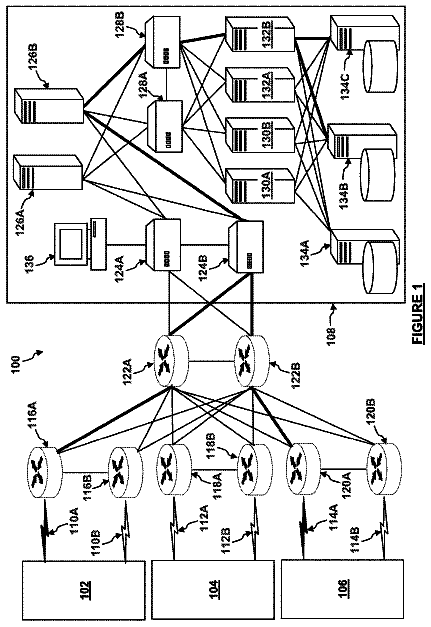
FIG. 1 illustrates an example system for a PBX router converting wireline signal data to cellular signal data.
FIG. 2 illustrates an example system for a mobility cloud device converting wireline signal data to cellular signal data.
FIG. 3 illustrates an example system for allocating internet protocol addresses based on communication between a PBX router and a mobility service provider identity.
FIG. 4 illustrates an example apparatus of a router.
FIG. 5 illustrates an example flow diagram of a method for receiving and converting cellular signal data to wireline signal data.
FIG. 6 illustrates an example flow diagram of a method for receiving and converting cellular signal data to wireline signal data and converting other cellular signal data to other wireline signal data.
FIG. 7 illustrates an example flow diagram of a system for sending cellular signal data to a virtual internet gateway as wireline signal data.
FIG. 8 illustrates an example flow diagram of a system for sending cellular signal data to a virtual internet gateway as wireline signal data and receiving a range of available internet protocol addresses.
FIG. 9 illustrates an example flow diagram of a computer readable storage medium for receiving voice signal data and decrypting the voice signal data to wireline signal data.
FIG. 10 illustrates an example flow diagram of a computer readable storage medium for receiving voice signal data and decrypting the voice signal data to wireline signal data, and managing the cellular signal data via a mobility network device.
FIG. 11 illustrates a block diagram of an example mobile handset operable to engage in a system architecture that facilitates secure wireless communication according to the embodiments described herein.
FIG. 12 illustrates a block diagram of an example computer operable to engage in a system architecture that facilitates secure wireless communication according to the embodiments described herein.
Detailed description
In the following description, numerous specific details are set forth to provide a thorough understanding of various embodiments. One skilled in the relevant art will recognize, however, that the techniques described herein can be practiced without one or more of the specific details, or with other methods, components, materials, etc. In other instances, well-known structures, materials, or operations are not shown or described in detail to avoid obscuring certain aspects.
Reference throughout this specification to “one embodiment,” or “an embodiment,” means that a particular feature, structure, or characteristic described in connection with the embodiment is included in at least one embodiment. Thus, the appearances of the phrase “in one embodiment,” “in one aspect,” or “in an embodiment,” in various places throughout this specification are not necessarily all referring to the same embodiment. Furthermore, the particular features, structures, or characteristics may be combined in any suitable manner in one or more embodiments.
As utilized herein, terms “component,” “system,” “interface,” and the like are intended to refer to a computer-related entity, hardware, software (e.g., in execution), and/or firmware. For example, a component can be a processor, a process running on a processor, an object, an executable, a program, a storage device, and/or a computer. By way of illustration, an application running on a server and the server can be a component. One or more components can reside within a process, and a component can be localized on one computer and/or distributed between two or more computers.
Further, these components can execute from various computer readable media having various data structures stored thereon. The components can communicate via local and/or remote processes such as in accordance with a signal having one or more data packets (e.g., data from one component interacting with another component in a local system, distributed system, and/or across a network, e.g., the Internet, a local area network, a wide area network, etc. with other systems via the signal).
As another example, a component can be an apparatus with specific functionality provided by mechanical parts operated by electric or electronic circuitry; the electric or electronic circuitry can be operated by a software application or a firmware application executed by one or more processors; the one or more processors can be internal or external to the apparatus and can execute at least a part of the software or firmware application. As yet another example, a component can be an apparatus that provides specific functionality through electronic components without mechanical parts; the electronic components can include one or more processors therein to execute software and/or firmware that confer(s), at least in part, the functionality of the electronic components. In an aspect, a component can emulate an electronic component via a virtual machine, e.g., within a cloud computing system.
The words “exemplary” and/or “demonstrative” are used herein to mean serving as an example, instance, or illustration. For the avoidance of doubt, the subject matter disclosed herein is not limited by such examples. In addition, any aspect or design described herein as “exemplary” and/or “demonstrative” is not necessarily to be construed as preferred or advantageous over other aspects or designs, nor is it meant to preclude equivalent exemplary structures and techniques known to those of ordinary skill in the art. Furthermore, to the extent that the terms “includes,” “has,” “contains,” and other similar words are used in either the detailed description or the claims, such terms are intended to be inclusive—in a manner similar to the term “comprising” as an open transition word—without precluding any additional or other elements.
As used herein, the term “infer” or “inference” refers generally to the process of reasoning about, or inferring states of, the system, environment, user, and/or intent from a set of observations as captured via events and/or data. Captured data and events can include user data, device data, environment data, data from sensors, sensor data, application data, implicit data, explicit data, etc. Inference can be employed to identify a specific context or action, or can generate a probability distribution over states of interest based on a consideration of data and events, for example.
Inference can also refer to techniques employed for composing higher-level events from a set of events and/or data. Such inference results in the construction of new events or actions from a set of observed events and/or stored event data, whether the events are correlated in close temporal proximity, and whether the events and data come from one or several event and data sources. Various classification schemes and/or systems (e.g., support vector machines, neural networks, expert systems, Bayesian belief networks, fuzzy logic, and data fusion engines) can be employed in connection with performing automatic and/or inferred action in connection with the disclosed subject matter.
In addition, the disclosed subject matter can be implemented as a method, apparatus, or article of manufacture using standard programming and/or engineering techniques to produce software, firmware, hardware, or any combination thereof to control a computer to implement the disclosed subject matter. The term “article of manufacture” as used herein is intended to encompass a computer program accessible from any computer-readable device, computer-readable carrier, or computer-readable media. For example, computer-readable media can include, but are not limited to, a magnetic storage device, e.g., hard disk; floppy disk; magnetic strip(s); an optical disk (e.g., compact disk (CD), a digital video disc (DVD), a Blu-ray Disc™ (BD)); a smart card; a flash memory device (e.g., card, stick, key drive); and/or a virtual device that emulates a storage device and/or any of the above computer-readable media.
As an overview of various embodiments presented herein, to correct for the above-identified deficiencies and other drawbacks of SIP trunking, various embodiments are described herein to facilitate the use of a cellular-based SIP trunking.
For simplicity of explanation, the methods (or algorithms) are depicted and described as a series of acts. It is to be understood and appreciated that the various embodiments are not limited by the acts illustrated and/or by the order of acts. For example, acts can occur in various orders and/or concurrently, and with other acts not presented or described herein. Furthermore, not all illustrated acts may be required to implement the methods. In addition, the methods could alternatively be represented as a series of interrelated states via a state diagram or events. Additionally, the methods described hereafter are capable of being stored on an article of manufacture (e.g., a computer readable storage medium) to facilitate transporting and transferring such methodologies to computers. The term article of manufacture, as used herein, is intended to encompass a computer program accessible from any computer-readable device, carrier, or media, including a non-transitory computer readable storage medium.
A mobility cloud can have several functionalities. A private broadcast exchange (PBX) wireless-modem can send unique credentials (user-ID and service-selector) of the PBX to the mobility cloud, which can facilitate several functionalities. It can increase overall security by checking the User-ID credentials to establish the right of a particular user to use the associated service-selector. If the check is successful, meaning that a particular PBX is allowed to use the associated service-selector, then an IP address from a specific range of IP addresses, which is identified by the service-selector, can be allocated to the PBX router. The Mobility cloud allocated IP address, being part of a specific IP address range, can increase overall security by allowing a firewall situated at the virtual internet gateway (VIG) to allow a particular voice signal through. If the voice signal has an IP address not belonging to an IP address range that is associated with the PBX, then that particular stream can be blocked and not allowed through.
The service-selector credential can also be utilized to determine how the wireless signal will be routed within the mobility network. The service selector can select an egress point (interface) from the mobility network to the Internet. The service-selector can establish a logical wireless signal path from the PBX wireless-modem to the selected egress point, wherein the logical path can comprise self healing and re-routing capabilities that increase the overall reliability of the wireless network. This path can tolerate various failures in the mobility network and still maintain service. Therefore, the initial processing can authenticate the user (i.e. PBX) and authenticate the user's access to the specified service-selector. Also, the service selector can establish a logical path from the PBX to the mobility cloud egress interface.
The PBX wireless-modem can convert the wireline signal to a wireless signal to be sent to the mobility cloud. The wireless signal can then be routed through the mobility network to a pre-determined egress point. That egress point can be determined by the service-selector credential sent earlier by the PBX. At the egress point, the mobility cloud can convert the wireless signal back to a wireline signal and send the wireline signal to the VIG. The egress point can be unique in the mobility cloud, wherein a particular stream can be forced to exit thru a particular interface. This, in turn, can increase overall security as the voice signal can be directed to reach a particular VIG (out of a set of VIGs) thus not allowing the voice signals from different PBXs (enterprises) to be mixed.
Utilizing a configurable network router in conjunction with a cellular network of a mobility service provider identity can improve SIP trunking efficiencies. Internet protocol addresses can be utilized based on secure private branch exchange access to the mobility service provider identity. Described herein are systems, methods, articles of manufacture, and other embodiments or implementations that can facilitate usage of SIP trunking over a cellular network. The various embodiments can be implemented in connection with any type of device with a connection to a communications network (e.g., a wireless communications network, the Internet, or the like), such as a mobile handset, a computer, a handheld device, or the like.
SIP trunking service can be provided over cellular connectivity including, but not limited to, long-term evolution (LTE). Although wireline connectivity can be provided over a cellular network, trunk side connectivity can be provided over LTE. However, SIP trunking service over wireline connectivity can suffer from long and difficult recovery in disaster recovery scenarios and extended implementation times. Implementing SIP trunking over LTE can facilitate more efficient deployment and a more efficient recovery. By mobilizing the SIP trunk (using cellular connectivity) the recovery times and implementation times can be reduced.
To support this approach a router, including but not limited to a NetGate router, with an LTE modem can establish connectivity from a mobile service provider (mobility network) to a private branch exchange network. The router can support multiple local area network (LAN) ports via an Ethernet connection. An Internet protocol private broadcast exchange (IP-PBX) can communicate with one LAN or sub-network and IP devices including, but not limited to, telephones and can communicate with another LAN port. The router can support cellular modem devices and store data related to all of the sub-networks that are communicating with the router. Although SIP signaling is done by the IP-PBX in IP telephony, the data-flow (voice over IP) can be directed to a different destination such as plain old telephones or IP phones. The router, via a cellular modem, can either originate calls or accept calls. Services can also be designed specifically for call origination only. For example, if an application queries a database, then a call origination only mode of operation can provide additional security. However, both IP streams, signaling and data can arrive over the same IP security tunnel to the router. Thus, the router can send specific IP data to selected destinations.
Additionally, the router can manage the IP devices remotely. Router management of the IP devices can include, but is not limited to, provisioning of the IP devices, updating the IP devices, adding service to the IP devices, and/or removing service from the IP devices. Furthermore, a router console can be used for troubleshooting and local management. For example, the router console can allow for viewing of log files that normal users do not have access to.
The mobility network can enable data, such as voice over IP, to travel through multiple selected paths, thus providing redundancy. The redundancy can improve the overall network service reliability. The system can provide enhanced security measures including, but not limited to, selecting a range of IP addresses. The IP-PBX and all its subtending IP devices can be the only devices that can use the data path as a closed user group. As another security measure, the system can also check to validate that a user from the PBX is allowed to use cellular services.
The cellular network can allocate IP addresses to devices that want to use its services. A range of IP addresses can be allocated to a specific enterprise. When a device, which belongs to that specific enterprise, requests a service, the device can receive an IP address from a selected range. This methodology can increase security because the firewall, at the virtual internet gateway (VIG), can know to only allow IP streams with IP addresses from the specific range. For example, once a cellular modem is powered-up, credentials including, but not limited to, a user identification and/or a service selector, can be sent to the wireless provider's mobility network as an access point name (APN). The service-selector can communicate to the mobility network to select the range of the IP addresses to be allocated. However, before the IP address is sent to the modem, the mobility network can check the user identification to ensure that the user is indeed entitled to use the service selector. Once all of the security checks are complete, the IP address of the correct range can be sent to the modem.
SIP trunking over LTE can also provide higher security by encrypting the cellular path via the cellular modem. The cellular modem, which can be a component of the router, can be provisioned with credentials that allow it to connect to the mobility network. Once the credential checks are performed and determined to be successful, one or more IP addresses, set by the mobility network provider, can be allocated to the cellular modem. These IP addresses can belong only to the cellular modem. Once the cellular modem receives the IP addresses, the cellular modem can establish a packet data protocol tunnel to the mobility network. Thus the data, from this point, can be sent through the packet data protocol tunnel. An IPSec (IP security) tunnel can also facilitate secure communication from the router to the mobility network. The IP security tunnel can begin at the router, which can be before the cellular modem, and can end at the VIG of the service provider.
The VIG can serve as the entry point from the mobility provider's network into the Internet. Additionally, the VIG can serve as the termination point of the IP security tunnel, which can exist between the router and VIG. Data passed between the router and the VIG can be encrypted. The VIG can provide customers with data services as opposed to voice services. The VIG can also be aware of selective data flows that arrive from pre-determined routers and can know to provide service only to specific routers that are pre-provisioned with the mobility provider's data service. The service, connecting IP-PBXs to the mobility provider, although voice-based, can be facilitated by the router to VIG connection. Thus, a private branch exchange network can increase topology reliability and maintain wireline and wireless connections simultaneously.
An outbound call from the IP-PBX can initiate from a subtending phone, where the IP-PBX can call a PSTN. The request can be sent by the IP-PBX to the router. The router can convert the request to cellular data and send it to a mobility cloud. The mobility cloud can convert the cellular data back to wireline data and send the request to the VIG. The VIG can then send the request via a permanent virtual connection (PVC) to a Voice over IP (VoIP) cloud which determines that the call is destined for a PSTN phone and convert it to PSTN format of signaling system no. 7 (SS7) and send it to the right network. The VoIP can comprise a business VoIP or the like.
An inbound call to the IP-PBX can be initiated from a PSTN phone call to an IP phone. A request can be sent to a VoIP network cloud, which can convert the phone call from SS7 to IP. The SIP/IP request can be sent to the VIG, and the VIG can send it to the mobility network, which converts the wireline signal data to cellular signal data and sends it to the PBX router. After receiving the request, the PBX router can convert the cellular signal data back to wireline signal data and send it to the IP-PBX. The IP-PBX can then send the request to a device associated with the PBX network.
In one embodiment, described herein is a system that can facilitate a router receiving first wireline signal data from a device associated with a private branch exchange device. The router can convert the first wireline signal data to cellular signal data and then send the cellular signal data to a virtual Internet gateway device via an Internet protocol security tunnel. The system can also facilitate a storing of Internet protocol address data. The system can include a display component and one or more servers in a cloud-computing environment that can store information about cellular data and/or Internet protocol addresses.
According to another embodiment, described herein is a method for converting cellular signal data to wireline signal data to be carried by a wireline to a user device associated with a private branch exchange device. Prior to converting the cellular signal data, the cellular signal data and Internet protocol address data can be received by a wireless router.
According to yet another embodiment, an article of manufacture, such as a computer readable storage medium or the like, can store instructions that, when executed by a computing device, can facilitate receiving cellular signal data from a virtual internet gateway device and converting the cellular signal data to wireline signal data. The wireline signal data can then be sent to another device using an Internet protocol. These and other embodiments or implementations are described in more detail below with reference to the drawings.
Referring now to FIG. 1 , illustrated is an example system of a PBX router converting wireline signal data to cellular signal data. For an outgoing call from a PBX network 100 device, wireline signal data can be sent 102 to a PBX router 104 associated with the PBX network 100 . The PBX router 104 can comprise a modem to facilitate conversion of the wireline signal data to cellular signal data. The modem can facilitate wireline signal data to cellular signal data conversions and cellular signal data to wireline signal data conversions. The cellular signal data can be sent 106 to a mobility network 108 associated with a mobility service provider identity. The mobility service provider can convert the cellular signal to a wireline signal and then send 110 the cellular signal over the Internet 112 , which can transmit 114 the cellular signal to a virtual internet gateway 116 associated with the mobile service provider identity. The virtual Internet gateway 116 can then decrypt the signal to another wireline signal and send 118 the other wireline signal, which is representative of the original wireline signal, to a router 120 associated with the service provider.
Referring now to FIG. 2 , illustrated is an example system for a virtual Internet gateway encrypting incoming signal data and forwarding to the Internet cloud. An incoming call to a PBX network 200 can begin from a service provider router 220 sending 218 wireline signal data to a virtual Internet gateway 216 associated with a service provider identity. The virtual Internet gateway 216 can encrypt the wireline signal data and send 214 the cellular signal data to a mobility network 208 , where the wireline signal to wireless signal conversion takes place, via the Internet 212 . The Internet 212 can send 210 the wireline signal data to the mobility network 210 prior to sending 208 the cellular signal data to a PBX router 206 associated with at PBX network. The PBX router 206 can then convert the cellular signal data to other wireline signal data representative of the wireline signal data from the service provider router 220 . A modem associated with the PBX router 206 can facilitate the cellular to wireline signal data conversion. The modem can facilitate wireline signal data to cellular signal data conversions and cellular signal data to wireline signal data conversions. The other wireline signal data can then be sent 202 to the PBX network 200 and a device associated with the PBX network 200 .
Referring now to FIG. 3 , illustrated is an example system for allocating internet protocol addresses based on communication between a PBX router and a mobility service provider identity. A call can be initiation from a device associated with a PBX network 300 . The PBX network 300 can send 302 wireline data associated with the call to a PBX router 304 associated with the PBX network 300 . The PBX router 304 can comprise a modem to facilitate wireline data to cellular data conversions and cellular data to wireline data conversions.
The mobility network 308 can allocate IP addresses to devices that want to use its services. A range of IP addresses can be allocated to the PBX network 300 . When a device, which belongs to the PBX network 300 , requests a service, the device can receive an IP address from a selected range. When the modem associated with the PBX router 304 is powered-up, credentials including, but not limited to, a user identification and/or a service selector, can be sent 306 to the wireless provider's mobility network 308 as an access point name (APN). The service-selector can communicate to the mobility network 308 which range of the IP addresses can be allocated. However, before the IP address is sent to the modem, the mobility network 308 can check the user identification to ensure that the user is indeed entitled to use the service selector. Once all security checks are complete, the IP address of the correct range can be sent 322 to the modem. These IP addresses can belong only to the cellular modem. Once the cellular modem receives the IP addresses, the cellular modem can establish a packet data protocol tunnel to the mobility network 308 .
After wireline signal data has been converted to cellular signal data by the PBX router 304 , the cellular signal data can then be sent 324 through the packet data protocol tunnel. The mobility network 308 can send 310 the cellular signal data over the Internet 312 , which will convert the wireless signal to wireline signal and send 314 the wireline signal data to a virtual internet gateway 316 associated with the mobile service provider identity. The virtual Internet gateway 316 can then decrypt the wireline signal data and send 318 the decrypted wireline signal data, which is representative of the original wireline signal data, to a router 320 associated with the service provider.
Referring now to FIG. 4 , illustrated is an example apparatus of a router 400 . The router 400 can comprise several components to assist in the signal conversion process. A modem component 402 can be included with the router 400 to facilitate establishing connectivity from a mobility network to a private branch exchange network. The modem component 402 can comprise a radio interface component 406 for sending and receiving cellular signals. The router 400 can support multiple local area network (LAN) ports 404 via Ethernet connectivity. The storage component 408 can store data including, but not limited to, IP addresses, user identification, devices associated with the PBX network, and/or cellular/wireline signal data. The display component 410 can allow for user interaction and/or management of the router 400 . For instance, the display component 410 can allow a secure user to view log files that other PBX network users do not have access to.
Referring now to FIG. 5 , illustrated is an example flow diagram of a method for receiving and converting cellular signal data to wireline signal data. At element 500 , a mobility cloud device, or a similar device, can receive cellular signal data representing a cellular signal via a virtual Internet gateway device. The mobility cloud device can also receive address data representing an Internet protocol address via a network device associated with a wireless carrier identity at element 502 . A wireless router, or like device, can comprise a modem component to facilitate communication with the wireless carrier identity radio interface component. At element 504 , the mobility cloud device can convert the cellular signal data to wireline signal data representing a wireline signal to be carried by a wireline. The mobility cloud device can then forward the wireline signal data to the wireless router via the modem component. At element 506 , the wireless router can use the dynamic Internet protocol address to send the wireline signal data to a user device associated with a private branch exchange.
Referring now to FIG. 6 , illustrated is an example flow diagram of a method for receiving and converting cellular signal data to wireline signal data and converting other cellular signal data to other wireline signal data. At element 600 , a mobility cloud device, or a similar device, can receive cellular signal data representing a cellular signal via a virtual Internet gateway device. The mobility cloud device can also receive address data representing an Internet protocol address via a network device associated with a wireless carrier identity at element 602 . A wireless router can comprise a modem component to facilitate communication with the wireless carrier identity radio interface component. At element 604 , the mobility cloud device can convert the cellular signal data to wireline signal data representing a wireline signal to be carried by a wireline. The mobility cloud device can then forward the wireline signal data to the wireless router via the modem component. At element 606 , the wireless router can use the dynamic Internet protocol address to send the wireline signal data to a user device associated with a private branch exchange. The mobility cloud device can convert other wireline signal data to other cellular signal data representing the other wireline signal data at element 608 .
Referring now to FIG. 7 , illustrated is an example flow diagram of a system for sending cellular signal data to a virtual Internet gateway as wireline signal data. A public broadcast exchange device can send wireline signal data to router associated with the public broadcast exchange. The router can convert the wireline signal data to cellular signal data and send the cellular signal data to a mobility cloud device. At element 700 the system can receive first cellular signal data from a device associated with a private branch exchange device of a private branch exchange. At element 702 the system can converting the first cellular signal data to first wireline signal data, and the first wireline signal data can be sent to a virtual Internet gateway device via an internet protocol security tunnel at element 704 .
Referring now to FIG. 8 , illustrated is an example flow diagram of a system for sending cellular signal data to a virtual Internet gateway as wireline signal data and receiving a range of available Internet protocol addresses. A public broadcast exchange device can send wireline signal data to router associated with the public broadcast exchange. The router can convert the wireline signal data to cellular signal data and send the cellular signal data to a mobility cloud device. At element 800 the system can receive first cellular signal data from a device associated with a private branch exchange device of a private branch exchange. At element 802 the system can converting the first cellular signal data to first wireline signal data, and the first wireline signal data can be sent to a virtual Internet gateway device via an internet protocol security tunnel at element 804 . At element 806 the system can receive range data associated with a range of available Internet protocol addresses.
The system can provide enhanced security measures including, but not limited to, selecting a range of IP addresses. The IP-PBX and all its subtending IP devices can be the only devices that can use the data path as a closed user group. The cellular network can allocate IP addresses to PBX devices. A range of IP addresses can be allocated to the PBX network thereby increasing security because the firewall, at the VIG, can know to only allow IP streams with IP addresses from the specific range.
Referring now to FIG. 9 , illustrated is an example flow diagram of a computer readable storage medium for receiving voice signal data and decrypting the voice signal data to wireline signal data. At element 900 a device can receive voice signal data, via an Internet protocol security tunnel, from a virtual Internet gateway device. The virtual Internet gateway device can serve as the entry point from the mobility provider's network into the Internet. Additionally, the virtual Internet gateway device can serve as the termination point of the IP security tunnel, which can exist between the router and the virtual Internet gateway device. Data passed between the router and the virtual Internet gateway device can be encrypted. The virtual Internet gateway device can provide customers with data services as opposed to voice services. Furthermore, the mobility cloud device can convert voice signal data to wireline signal data and wireline signal data to voice signal data. Therefore, at element 902 , a mobility cloud device can convert voice signal data to wireline signal data. The mobility cloud device can also be aware of selective data flows that arrive from pre-determined routers and can know to provide service only to specific routers that are pre-provisioned with the mobility provider's data service. The service, connecting IP-PBXs to the mobility provider, although voice-based, can be facilitated by the router to virtual Internet gateway device connection.
Once the wireless router has decrypted the wireline signal data, the wireless router can send the wireline signal data to another device using an Internet protocol address at element 904 . A range of IP addresses can be allocated to the PBX network thereby increasing security because the firewall, at the VIG, can know to only allow IP streams with IP addresses from the specific range. A cellular network can allocate IP addresses to PBX network devices. The IP-PBX and all its subtending IP devices can then be the only devices that can use the IP address path as a closed user group.
Referring now to FIG. 10 , illustrated is an example flow diagram of a computer readable storage medium for receiving encrypted voice signal data, decrypting voice signal data to wireline signal data, and managing the voice signal data via a mobility network device. At element 1000 a mobility cloud device can receive encrypted wireline signal data via an Internet protocol security tunnel. A virtual Internet gateway device can serve as the entry point from the mobility provider's network into the Internet. Additionally, the virtual Internet gateway device can serve as the termination point of the IP security tunnel, which can exist between the router and the virtual Internet gateway device. Data passed between the router and the virtual Internet gateway device can be encrypted. The virtual Internet gateway device can provide customers with data services as opposed to voice services. Therefore, at element 1002 , voice signal data can be decrypted. The virtual internet gateway device can also be aware of selective data flows that arrive from pre-determined routers and can know to provide service only to specific router that are pre-provisioned with the mobility provider's data service. The service, connecting IP-PBXs to the mobility provider, although voice-based, can be facilitated by the router to virtual Internet gateway device connection.
At element 1002 , decrypted wireline voice signal data can be sent to a device using an Internet protocol address at element 1004 . An IP address from a specific range of IP addresses can be allocated to the PBX network thereby increasing security because the firewall, at the VIG, can know to only allow IP streams with IP addresses from the specific range. A cellular network can allocate IP addresses to PBX network devices. The IP-PBX and all its subtending IP devices can then be the only devices that can use the IP address path as a closed user group.
At element 1006 the device can manage the voice signal data via a network device associated with the mobility provider's identity. The device can manage the IP devices remotely. Management of the IP devices can include, but is not limited to, provisioning the IP devices, updating the IP devices, adding service to the IP devices, and/or removing service from the IP devices.
Referring now to FIG. 11 , illustrated is a schematic block diagram of an exemplary end-user device such as a mobile device 1100 capable of connecting to a network in accordance with some embodiments described herein. Although a mobile handset 1100 is illustrated herein, it will be understood that other devices can be a mobile device, and that the mobile handset 1100 is merely illustrated to provide context for the embodiments of the innovation described herein. The following discussion is intended to provide a brief, general description of an example of a suitable environment 1100 in which the various embodiments can be implemented. While the description includes a general context of computer-executable instructions embodied on a computer readable storage medium, those skilled in the art will recognize that the innovation also can be implemented in combination with other program modules and/or as a combination of hardware and software.
The description continues in the full USPTO document.
 Lapsed, fee not paid8 drawings