Technical field
This disclosure relates in general to security in computer systems. More specifically, this disclosure relates to encryption key exchange. Even more particularly, embodiments relate to an efficient and secure authentication and key exchange protocol.
Background
In the emerging Internet of Things (IoT) market, it is often desired to remotely control or wirelessly communicate with a variety of relatively simple, relatively inexpensive, low power devices. As such, there is a need for a means to transfer data in a secure manner between large numbers of such devices. Furthermore, due to the typical usage pattern for such devices (e.g., real-time updates of sensor readings, etc.), the data exchange pattern between such devices is mostly small, frequent data updates rather than infrequent transfers of large data sets.
The standard method for accomplishing secure data transfer between such devices employs two phases: an authentication and key exchange (AKE) phase and an encrypted data transfer phase. As implied by its name, the first phase involves the two steps: first, the communicating devices must assure each other that they each know with whom they are communicating (authentication) and then they must jointly agree upon a shared key that they can both use in the second phase. This second phase is where the actual secure data transfer happens, but it cannot proceed without successful completion of the first phase. It is desirable that the overall protocol be constructed in such a manner to ensure that the exchange can be free from both eavesdropping and/or interference by any unauthorized external party.
Unfortunately, using standard methods, this AKE phase cannot be completed without using asymmetric cryptography somewhere in the process. The computational load required due to the nature of the asymmetric cryptography mathematics is quite large; in fact it is several orders of magnitude larger than the amount of computation required to encrypt and decrypt the message traffic in the second phase.
This large computational load poses a problem for both the low-power requirements of the IoT device space as well as being highly inefficient in the case where the message data that must be transmitted in the second phase is small. Thus, there is a need for a protocol where the AKE phase does not require the use of asymmetric cryptography in order to securely arrive at a shared key between devices.
Summary
Embodiments of systems and methods for providing a simple and effective method for authentication and key exchange that is secure from man-in-the-middle attacks and is characterized by perfect forward secrecy are disclosed.
In particular, in one embodiment, methods for providing secure communications between a local device and a remote device include receiving an encrypted Message Authentication Code (MAC) based on a nonce received from the remote device and the remote device's private key, wherein the decryption key for this encrypted MAC is derived from a private key of the local device. An encrypted key message is also received from a third party, wherein the decryption key for this encrypted key message is derived from the private key of the local device and a nonce received from the third party. The (decrypted) key message from the third party then contains a second MAC that is derived from the private key of the remote device. This second MAC is used as the key input to a third keyed hash function, producing a resulting third MAC. This third MAC value is either concatenated or XOR-ed with a fourth MAC (one that is derived from the local device's private key and a locally-generated nonce). This concatenated or XOR-ed data is then used as the input to a final Hash function, the output of which forms a session key that is thus based on the private keys of both the local and the remote devices. The generated session key is used to symmetrically encrypt and decrypt communications between the local device and the remote device.
In other embodiments, methods for providing secure communications between a local device and a remote device include receiving a nonce from a third party, wherein the nonce from the third party is derived from a private key of the local device and a private key of the remote device. An encrypted key is also received from the third party, wherein the encrypted key from the third party is derived from the private key of the remote device. A session key is generated using the nonce, the encrypted key from the third party, and an embedded secret of the local device. The generated session key is used to symmetrically encrypt and decrypt communications between the local device and the remote device.
In other embodiments, a computer program product comprising at least one non-transitory computer-readable storage medium storing computer instructions translatable by one or more processors to perform: receiving an encrypted Message Authentication Code (MAC) based on a nonce received from the remote device and the remote device's private key, wherein the decryption key for this encrypted MAC is derived from a private key of the local device. An encrypted key message is also received from a third party, wherein the decryption key for this encrypted key message is derived from the private key of the local device and a nonce received from the third party. The (decrypted) key message from the third party then contains a second MAC that is derived from the private key of the remote device. This second MAC is used as the key input to a third keyed hash function, producing a resulting third MAC. This third MAC value is either concatenated or XOR-ed with a fourth MAC (one that is derived from the local device's private key and a locally-generated nonce). This concatenated or XOR-ed data is then used as the input to a final Hash function, the output of which forms a session key that is thus based on the private keys of both the local and the remote devices. The generated session key is used to symmetrically encrypt and decrypt communications between the local device and the remote device.
In other embodiments, a computer program product comprising at least one non-transitory computer-readable storage medium storing computer instructions translatable by one or more processors to perform: receiving a nonce from a third party, wherein the nonce from the third party is derived from a private key of a local device and a private key of a remote device; receiving an encrypted key from the third party, wherein the encrypted key from the third party is derived from the private key of the remote device; generating a session key using the nonce, the encrypted key from the third party, and an embedded secret of the local device; and using the generated session key to symmetrically encrypt and decrypt communications between the local device and the remote device.
In other embodiments, a hardware security module is provided with a processor and at least one non-transitory computer-readable storage medium. The storage medium stores computer instructions translatable by the processor to perform: receiving an encrypted Message Authentication Code (MAC) based on a nonce received from the remote device and the remote device's private key, wherein the decryption key for this encrypted MAC is derived from a private key of the local device. An encrypted key message is also received from a third party, wherein the decryption key for this encrypted key message is derived from the private key of the local device and a nonce received from the third party. The (decrypted) key message from the third party then contains a second MAC that is derived from the private key of the remote device. This second MAC is used as the key input to a third keyed hash function, producing a resulting third MAC. This third MAC value is either concatenated or XOR-ed with a fourth MAC (one that is derived from the local device's private key and a locally-generated nonce). This concatenated or XOR-ed data is then used as the input to a final Hash function, the output of which forms a session key that is thus based on the private keys of both the local and the remote devices. The generated session key is used to symmetrically encrypt and decrypt communications between the local device and the remote device.
In other embodiments, a hardware security module is provided with a processor and at least one non-transitory computer-readable storage medium. The storage medium stores computer instructions translatable by the processor to perform: receiving a nonce from a third party, wherein the nonce from the third party is derived from a private key of a local device and a private key of a remote device; receiving an encrypted key from the third party, wherein the encrypted key from the third party is derived from the private key of the remote device; generating a session key using the nonce, the encrypted key from the third party, and an embedded secret of the local device; and using the generated session key to symmetrically encrypt and decrypt communications between the local device and the remote device.
Additionally, embodiments of systems are presented which embody these types of methodologies in computer systems, hardware, and software. It should be noted that the same hardware implementation could potentially be used to implement any one or combination of the entire range of solutions, depending on the requirements of the software.
These, and other, aspects of the disclosure will be better appreciated and understood when considered in conjunction with the following description and the accompanying drawings. It should be understood, however, that the following description, while indicating various embodiments of the disclosure and numerous specific details thereof, is given by way of illustration and not of limitation. Many substitutions, modifications, additions and/or rearrangements may be made within the scope of the disclosure without departing from the spirit thereof, and the disclosure includes all such substitutions, modifications, additions and/or rearrangements.
Brief description of the drawings
The drawings accompanying and forming part of this specification are included to depict certain aspects of the disclosure. It should be noted that the features illustrated in the drawings are not necessarily drawn to scale. A more complete understanding of the disclosure and the advantages thereof may be acquired by referring to the following description, taken in conjunction with the accompanying drawings in which like reference numbers indicate like features and wherein:
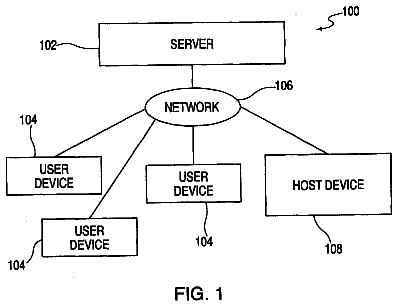
FIG. 1 depicts one embodiment of an architecture for content distribution;
FIG. 2 depicts one embodiment of a target device;
FIG. 3 depicts one embodiment of a secure execution controller;
FIGS. 4A and 4B depict an embodiment of a cache architecture used for process working set isolation;
FIG. 5 depicts an example of a Diffie Hellman based authentication and key exchange (AKE);
FIG. 6 depicts an example of a Diffie Hellman based AKE using a hardware security module;
FIG. 7 depicts an example of a station-to-station message authentication code (STS-MAC) based AKE implemented in software;
FIG. 8 depicts an example of a station-to-station message authentication code (STS-MAC) based AKE implemented partially using a hardware security module;
FIG. 9 depicts a secure AKE implemented using an HSM module and a crypto co-processor;
FIG. 10 depicts a 2-party secure AKE implemented without using asymmetric cryptography;
FIG. 11 depicts a 3-party secure AKE version of the protocol shown in FIG. 10 .
FIG. 12 depicts an embodiment of the protocol shown in FIG. 10 , but using an HSM module as an accelerator for bulk message encryption and decryption processing.
Detailed description
The disclosure and the various features and advantageous details thereof are explained more fully with reference to the non-limiting embodiments that are illustrated in the accompanying drawings and detailed in the following description. Descriptions of well-known starting materials, processing techniques, components and equipment are omitted so as not to unnecessarily obscure the disclosure in detail. It should be understood, however, that the detailed description and the specific examples, while indicating some embodiments of the disclosure, are given by way of illustration only and not by way of limitation. Various substitutions, modifications, additions and/or rearrangements within the spirit and/or scope of the underlying inventive concept will become apparent to those skilled in the art from this disclosure. Embodiments discussed herein can be implemented in suitable computer-executable instructions that may reside on a computer readable medium (e.g., a hard disk (HD)), hardware circuitry or the like, or any combination.
As will be discussed in greater detail below, embodiments provide a simple and effective method for authentication and key exchange that is secure from man-in-the-middle attacks and is characterized by perfect forward secrecy with the assumption that the management service (referred to as the Central Licensing Authority or CLA) is itself secure.
The SHA based AKE or SHAAKE protocol in accordance with embodiments operates in a similar manner to a number of “shared secret” AKE protocols, but it does not explicitly share a secret between the endpoints. In operation, the SHAAKE protocol uses a CLA that does have the ability to access the secret for each of the endpoints. However, the CLA does not share that secret with the endpoints, but rather it shares a derived secret from that secret. This derived secret is the MAC (i.e., the output of a Hash function) resulting from the secret and some other (public) piece of information. Thus, there is no requirement that any endpoint be able to have access to any other's secret in order to communicate securely. The public information can take the form of a set of nonces, in order to protect the system against replay-style attacks. Each endpoint can generate its own nonce with sufficient entropy such that neither endpoint is dependent on the trustworthiness of the other.
Before discussing embodiments in more detail, it may helpful to give a general overview of an architecture in which embodiments of the present disclosure may be effectively utilized. FIG. 1 depicts one embodiment of such a topology. Here, a content distribution system 101 may operate to distribute digital content (which may be for example, a bitstream comprising audio or video data, a software application, etc.) to one or more target units 100 (also referred to herein as target or endpoint devices) which comprise protocol engines. Examples other than the exemplary content distribution systems are also possible. These target units may be part of, for example, computing devices on a wireline or wireless network or a computer device which is not networked, such computing devices including, for example, a personal computers, cellular phones, personal data assistants, tablets, media players which may play content delivered as a bitstream over a network or on a computer readable storage media that may be delivered, for example, through the mail, etc. This digital content may compose or be distributed in such a manner such that control over the execution of the digital content may be controlled and security implemented with respect to the digital content.
In certain embodiments, control over the digital content may be exercised in conjunction with a licensing authority 103 . Although this licensing authority 103 is referred to as the CLA, it will be understood that such a licensing authority need not be centralized. The CLA function may either be distributed using well-known methods, or alternately the CLA function may be accomplished by a content distribution system 101 , including distribution of service data on a hardware device such as a memory stick, etc. in order to provide a key and/or an authorization code to a local target device. This key may be a compound key (DS), that is both cryptographically dependent on the digital content distributed to the target device and bound to each target device (TDn). In one example, a target device may be attempting to execute an application in secure mode. This secure application (which may be referred to as candidate code or a candidate code block (e.g., CC)) may be used in order to access certain digital content.
Accordingly, to enable a candidate code block to run in secure mode on the processor of a particular target device 100 to which the candidate code block is distributed, the licensing authority 103 supplies a correct value of a compound key (one example of which may be referred to as an Authorization Code) to the target device on which the candidate code block is attempting to execute in secure mode (e.g., supply DS 1 to TD 1 ). No other target device (e.g., TDn, where TDn≠TD 1 ) can run the candidate code block correctly with the compound key (e.g., DS 1 ) and no other compound key (DSn assuming DSn≠DS 1 ) will work correctly with that candidate code block on that target device 100 (e.g., TD 1 ).
As will be described in more detail below, when Target Device 100 (e.g., TD 1 ) loads the candidate code block (e.g., CC 1 ) into its instruction cache (and, for example, if CC 1 is identified as code that is intended to be run in secure mode), the target device 100 (e.g., TD 1 ) engages a hash function (which may be hardware based) that creates a message digest (e.g., MD 1 ) of that candidate code block (e.g., CC 1 ). The seed value for this hash function is the secret key for the target device 100 (e.g., TD 1 's secret key (e.g., SK 1 )).
In fact, such a message digest (e.g., MD 1 ) may be a Message Authentication Code (MAC) as well as a compound key, since the hash function result depends on the seed value of the hash, the secret key of the target device 100 (e.g., SK 1 ). Thus, the resulting value of the message digest (e.g., MD 1 ) is cryptographically bound to both the secret key of the target device 100 and to the candidate code block. If the licensing authority distributed compound key (e.g., DS 1 ) matches the value of the message digest (e.g., MD 1 ) it can be assured that the candidate code block (e.g., CC 1 ) is both unaltered as well as authorized to run in secure mode on the target device 100 (e.g., TD 1 ). The target device 100 can then run the candidate code block in secure mode.
As can be seen then, in one embodiment, when secure mode execution for a target device 100 is performed, the target device 100 may be executing code that has both been verified as unaltered from its original form, and is cryptographically “bound” to the target device 100 on which it is executing. This method of ensuring secure mode execution of a target device may be contrasted with other systems, where a processor enters secure mode upon hardware reset and then may execute in a hypervisor mode or the like in order to establish a root-of-trust.
Accordingly, using embodiments as disclosed, any or all of these data such as the compound key from the licensing authority, the message digest, the candidate code block, etc. (e.g., DS 1 , MD 1 , CC 1 ) may be completely public as long as the secret key for the target device 100 (e.g., SK 1 ) is not exposed. Thus, it is desired that the value of a target device's secret key is never exposed, either directly or indirectly. Accordingly, as discussed above, embodiments of the systems and methods presented herein, may, in addition to protecting the secret key from direct exposure, protect against indirect exposure of the secret key on target devices 100 by securing the working sets of processes executing in secure mode on target devices 100 .
FIG. 2 shows the architecture of one embodiment of a target device that is capable of controlling the execution of the digital content or implementing security protocols in conjunction with received digital content. Elements of the target unit may include a set of blocks, which allow a process to execute in a secured mode on the target device such that when a process is executing in secured mode the working set of the process may be isolated. It will be noted that while these blocks are described as hardware in this embodiment, software may be utilized to accomplish similar functionality with equal efficacy. It will also be noted that while certain embodiments may include all the blocks described herein other embodiments may utilize lesser or additional blocks.
The target device 100 may comprise a CPU execution unit 120 which may be a processor core with an execution unit and instruction pipeline. Target unit 100 may also contain a true random number generator 182 which may be configured to produce a sequence of sufficiently random numbers or which can then be used to supply seed values for a pseudo-random number generation system. This pseudo-random number generator can also potentially be implemented in hardware, software or in “secure” software.
One-way hash function block 160 may be operable for implementing a hashing function substantially in hardware. One-way hash function block 160 may be a part of a secure execution controller 162 that may be used to control the placement of the target device 100 in secure mode or that may be used to control memory accesses (e.g., when the target device 100 is executing in secured mode), as will be described in more detail herein at a later point.
In one embodiment, one way hash function block 160 may be implemented in a virtual fashion, by a secure process running on the same CPU that is used to evaluate whether a given process is secure or not. In certain embodiments two conditions may be adhered to, ensuring that such a system may resolve correctly. First, the secure mode “evaluation” operation (e.g., the hash function) proceeds independently of the execution of the secure process that it is evaluating. Second, a chain of nested evaluations may have a definitive termination point (which may be referred to as the root of the “chain of trust” or simply the “root of trust”). In such embodiments, this “root of trust” may be the minimum portion of the system that should be implemented in some non-changeable fashion (e.g., in hardware). This minimum feature may be referred to as a “hardware root of trust”. For example, in such embodiments, one such hardware root of trust might be a One-Way hash function that is realized in firmware (e.g., in non-changeable software).
Another portion of the target unit 100 may be a hardware-assisted secure mode controller block 170 . This secure mode controller block 170 can be implemented in a number of ways. In one example, the secure mode controller block 170 is a general purpose processor or a state machine. The secure execution controller 162 also includes secure mode control registers 105 , which define the configuration of the current security state on a process by process basis. As shown in FIG. 2 , the secret key 104 and another number (for example, in initialization vector or nonce) are run through the one-way hash function block 160 . The result of the hash function is repeatable and is a derivative of the secret. The result of the hash function is provided to the secure mode controller block 170 .
It is not material to embodiments exactly which encryption algorithm is used for this hardware block 170 . In order to promote the maximum flexibility, it is assumed that the actual hardware is general-purpose enough to be used in a non-algorithmically specific manner, but there are many different means by which this mechanism can be implemented. It should be noted at this point that the terms encryption and decryption will be utilized interchangeably herein when referring to engines (algorithms, hardware, software, etc.) for performing encryption/decryption. As will be realized if symmetric encryption is used in certain embodiments, the same or similar encryption or decryption engine may be utilized for both encryption and decryption. In the case of an asymmetric mechanism, the encryption and decryption functions may or may not be substantially similar, even though the keys may be different.
Target device 100 may also comprise a data cache 180 , the instruction cache 110 where code that is to be executed can be stored, and main memory 190 . Data cache 180 may be almost any type of cache desired such as a L1 or L2 cache. In one embodiment, data cache 180 may be configured to associate a secure process descriptor with one or more pages of the cache and may have one or more security flags associated with (all or some subset of the) lines of a data cache 180 . For example, a secure process descriptor may be associated with a page of data cache 180 .
Generally, embodiments of target device 100 may isolate the working set of a process executing in secure mode stored in data cache 180 such that the data is inaccessible to any other process, even after the original process terminates. More specifically, in one embodiment, the entire working set of a currently executing may be stored in data cache 180 and writes to main memory 190 and write-through of that cache (e.g., to main memory 190 ) disallowed (e.g., by secured execution controller 162 ) when executing in secured mode.
Additionally, for any of those lines of data cache 180 that are written to while executing in secure mode (e.g., a “dirty” cache line) those cache lines (or the page that comprises those cache lines) may be associated with a secure process descriptor for the currently executing process. The secure process descriptor may uniquely specify those associated “dirty” cache lines as belonging to the executing secure process, such that access to those cache lines can be restricted to only that process (e.g., be by secured execution controller 162 ).
In certain embodiments, in the event that the working set for a secure process overflows data cache 180 and portions of data cache 180 that include those dirty lines associated with the security descriptor of the currently executing process need to be written to main memory (e.g., a page swap or page out operation) external data transactions between the processor and the bus (e.g., an external memory bus) may be encrypted (e.g., using block 170 or encryption software executing in secure mode). The encryption (and decryption) of data written to main memory may be controlled by secure execution controller 162 .
The key for such an encryption may be the secure process descriptor itself or some derivative thereof and that secure descriptor may itself be encrypted (e.g., using the target device's 100 secret key 104 or some derivative thereof) and stored in the main memory 190 in encrypted form as a part of the data being written to main memory.
Instruction cache 110 is typically known as an I-Cache. In some embodiments, a characteristic of portions of this I-Cache 110 is that the data contained within certain blocks be readable only by CPU execution unit 120 . In other words, this particular block of I-Cache 130 is execute-only and may not be read from, nor written to, by any executing software. This block of I-Cache 130 will also be referred to as the “secured I-Cache” 130 herein. The manner by which code to be executed is stored in this secured I-Cache block 130 may be by way of another block which may or may not be depicted. Normal I-Cache 150 may be utilized to store code that is to be executed normally as is known in the art.
Additionally, in some embodiments, certain blocks may be used to accelerate the operation of a secure code block. Accordingly, a set of CPU registers 140 may be designated to only be accessible while the CPU 120 is executing secure code or which are cleared upon completion of execution of the secure code block (instructions in the secured I-cache block 130 executing in secured mode), or if, for some reason a jump to any section of code which is located in the non-secure or “normal” I-Cache 150 or other area occurs during the execution of code stored in the secured I-Cache 130 .
In one embodiment, CPU execution unit 120 may be configured to track which registers 140 are read from or written to while executing the code stored in secured I-cache block 130 and then automatically clear or disable access to these registers upon exiting the “secured execution” mode. This allows the secured code to quickly “clean-up” after itself such that only data that is permitted to be shared between two kinds of code blocks is kept intact. Another possibility is that an author of code to be executed in the secured code block 130 can explicitly identify which registers 140 are to be cleared or disabled. In the case where a secure code block is interrupted and then resumed, then these disabled registers may potentially be re-enabled if it can be determined that the secure code that is being resumed has not been tampered with during the time that it was suspended.
In one embodiment, to deal with the “leaking” of data stored in registers 140 between secure and non-secure code segments a set of registers 140 which are to be used only when the CPU 120 is executing secured code may be identified. In one embodiment, this may be accomplished utilizing a version of the register renaming and scoreboarding mechanism, which is practiced in many contemporary CPU designs. In some embodiments, the execution of a code block in secured mode is treated as an atomic action (e.g., it is non-interruptible) which may make this such renaming and scoreboarding easier to implement.
Even though there may seem to be little possibility of the CPU 120 executing a mixture of “secured” code block (code from the secured I-Cache 130 ) and “unsecured code” (code in another location such as normal I-cache 150 or another location in memory), such a situation may arise in the process of switching contexts such as when jumping into interrupt routines, or depending on where the CPU 120 context is stored (most CPU's store the context in main memory, where it is potentially subject to discovery and manipulation by an unsecured code block).
In order to help protect against this eventuality, in one embodiment, another method which may be utilized for protecting the results obtained during the execution of a secured code block that is interrupted mid-execution from being exposed to other execution threads within a system is to disable stack pushes while a the target device 100 is operating in secured execution mode. This disabling of stack pushes will mean that a secured code block is thus not interruptible in the sense that, if the secured code block is interrupted prior to its normal completion, it cannot be resumed and therefore must be restarted from the beginning. It should be noted that in certain embodiments if the “secured execution” mode is disabled during a processor interrupt, then the secured code block may also potentially not be able to be restarted unless the entire calling chain is restarted.
Each target unit 100 may also have one or more secret key constants 104 ; the values of neither of which are software-readable. In one embodiment, the first of these keys (the primary secret key) may be organized as a set of secret keys, of which only one is readable at any particular time. If the “ownership” of a unit is changed (for example, the equipment containing the protocol engine is sold or its ownership is otherwise transferred), then the currently active primary secret key may be “cleared” or overwritten by a different value. This value can either be transferred to the unit in a secure manner or it can be already stored in the unit in such a manner that it is only used when this first key is cleared. In effect, this is equivalent to issuing a new primary secret key to that particular unit when its ownership is changed or if there is some other reason for such a change (such as a compromised key). A secondary secret key may be utilized with the target unit 100 itself. Since the CPU 120 of the target unit 100 cannot ever access the values of either the primary or the secondary secret keys, in some sense, the target unit 100 does not even “know” its own secret keys 104 . These keys are only stored and used within the security execution controller 162 of the target unit 100 as will be described.
In another embodiment, the two keys may be constructed as a list of “paired” keys, where one such key is implemented as a one-time-programmable register and the other key in the pair is implemented using a rewriteable register. In this embodiment, the rewriteable register may be initialized to a known value (e.g., zero) and the only option that may be available for the system to execute in secure mode in that state may be to write a value into the rewriteable portion of the register. Once the value in this rewriteable register is initialized with some value (e.g., one that may only be known by the Licensing Authority, for example), then the system may only then be able to execute more general purpose code while in secure mode. If this rewriteable value should be reinitialized for some reason, then the use of a new value each time this register is written may provide increased security in the face of potential replay attacks.
Yet another set of keys may operate as part of a temporary public/private key system (also known as an asymmetric key system or a PKI system). The keys in this pair may be generated on the fly and may be used for establishing a secure communications link between similar units, without the intervention of a central server. As the security of such a system is typically lower than that of an equivalent key length symmetric key encryption system, these keys may be larger in size than those of the set of secret keys mentioned above. These keys may be used in conjunction with the value that is present in the on-chip timer block in order to guard against “replay attacks”, among other things. Since these keys may be generated on the fly, the manner by which they are generated may be dependent on the random number generation system 182 in order to increase the overall system security.
In one embodiment, one method that can be used to affect a change in “ownership” of a particular target unit is to always use the primary secret key as a compound key in conjunction with another key 107 , which we will refer to as a timestamp or timestamp value, as the value of this key may be changed (in other words may have different values at different times), and may not necessarily reflect the current time of day. This timestamp value itself may or may not be itself architecturally visible (e.g., it may not necessarily be a secret key), but nonetheless it will not be able to be modified unless the target unit 100 is operating in secured execution mode. In such a case, the consistent use of the timestamp value as a component of a compound key whenever the primary secret is used can produce essentially the same effect as if the primary secret key had been switched to a separate value, thus effectively allowing a “change of ownership” of a particular target endpoint unit without having to modify the primary secret key itself.
As may be understood then, the target device 100 may use secure execution controller 162 and data cache 180 to isolate the working sets of processes executing in secure mode such that the data is inaccessible to any other process, even after the original process terminates. This working set isolation may be accomplished in certain embodiments by disabling off-chip writes and write-through of data cache when executing in secured mode, associating lines of the data cache written by the executing process with a secure descriptor (that may be uniquely associated with the executing process) and restricting access to those cache lines to only that process using the secure process descriptor. Such a secure process descriptor may be a compound key such as an authorization code or some derivative value thereof.
When it is desired to access data in the data cache by the process the secure descriptor associated with the currently executing process may be compared with the secure descriptor associated with the requested line of the data cache. If the secure descriptors match, the data of that cache line may be provided to the executing process while if the secure descriptors do not match the data may not be provide and another action may be taken.
Moreover, in certain embodiments, in the event that the working set for a secure process overflows the on-chip cache, and portions of cache that include those dirty lines associated with the secure process descriptor need to be written to main memory (e.g., a page swap or page out operation) external data transactions between the processor and the bus (e.g., an external memory bus) may be encrypted. The key for such an encryption may be the secure process descriptor itself or some derivative thereof and that secure process descriptor may be encrypted (e.g., using the target device's secret key or some derivative thereof) prior to being written out to the main memory. Again, this encryption processes may be accomplished substantially using the hashing block of the target device or by use of an software encryption process running in secure mode on the processor itself or some other on-chip processing resource, or by use of a encryption function that is implemented in hardware.
To enhance performance, in certain cases where a secure process may have a large working set or is frequently interrupted (e.g., entailing many page swaps) a subset of the processes working set that is considered “secure” may be created (e.g., only a subset of the dirty cache lines for the process may be associated with the secure descriptor) and only encrypt those cache lines or the portion of the cache containing those lines, when it is written out to external memory.
Additionally, to enhance performance, an off-chip storage mechanism (e.g., a page swapping module) can be run asynchronously in parallel with an interrupting process (e.g., using a DMA unit with integrated AES encryption hardware acceleration) and thus, could be designed to have a minimal impact on the main processor performance. In another embodiment, a separate secure “working set encapsulation” software module may be used to perform the encryption prior to allowing working set data to be written out to memory.
Referring to FIG. 3 , one embodiment of the architecture of a secure execution controller is depicted. In this embodiment, secure execution controller 362 is associated with a CPU of a system in which it is included and is intended to support the running of a candidate code block in secure mode on the main CPU. As such, secure execution controller 362 may comprise one or more of registers, including a secret hardware key 310 which is not visible to the CPU, secure mode control register 350 , authorization code register 360 , secure mode status register 352 , hash seed register 312 and hardware generated compound key register 314 . Of these registers, all but secret hardware key 310 may be readable by a CPU without affecting the overall security of the system, although any of these other registers may or may not be visible.
The description continues in the full USPTO document.
 Lapsed, fee not paid10 drawings