 Lapsed, fee not paid3 drawings
Materials & Chemistry · US 8,800,338 B2
Manufacture of coil springs
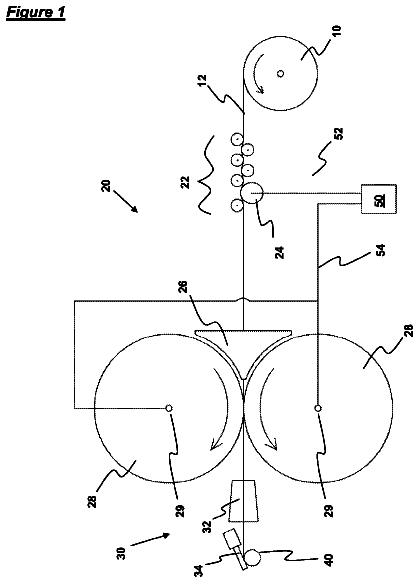
An apparatus is disclosed for the manufacture of a coil spring from a wire.
US 8,801,142 B2 · Assignee: Seiko Epson Corporation · Inventors: Ohashi; Masakazu
This patent has 4 drawing sheets. They are being downloaded; every one is in the USPTO PDF now.
Open the USPTO PDFA method for recording a glitter image includes attaching an ink composition to a recording medium using an ink jet method, attaching an adhesive composition to the ink composition which is attached to the recording medium using an ink jet method, bringing a sheet where a glitter film is formed into contact with the recording medium so that a surface where the adhesive composition is attached and a surface where the glitter film is formed are opposed, heating the adhesive composition, and peeling off the recording medium and the sheet.
In recent years, demand for recordings where an image which has glossiness is formed on a recording surface is increasing. As a method for forming images which has glossiness, in the related art, for example, there are a foil pressing recording method in which a recording medium which has a recording surface with high planarity is prepared and a metal foil is pressed onto the recording medium, a method in which a metal or the like is vacuum deposited with regard to a plastic film where the recording surface is smooth, a method in which glitter pigment ink is coated onto a recording medium and press processing is further performed, and the like. In addition, there is a method where an image is formed by ink which has a glitter pigment (hereinafter, referred to as glitter ink) being discharged using an ink jet method (for example, refer to JP-A-2008-174712). In the glitter ink, a resin is
The 4 drawing sheets are on the way. Every sheet is in the USPTO PDF.
What the patent claimed, word for word. All of it is now free to use.
Priority is claimed under 35 U.S.C. .sctn.119 to Japanese Application No. 2011-216165 filed on Sep. 30, 2011, which is hereby incorporated by reference in its entirety.
The present invention relates to a method for recording a glitter image.
In recent years, demand for recordings where an image which has glossiness is formed on a recording surface is increasing. As a method for forming images which has glossiness, in the related art, for example, there are a foil pressing recording method in which a recording medium which has a recording surface with high planarity is prepared and a metal foil is pressed onto the recording medium, a method in which a metal or the like is vacuum deposited with regard to a plastic film where the recording surface is smooth, a method in which glitter pigment ink is coated onto a recording medium and press processing is further performed, and the like.
In addition, there is a method where an image is formed by ink which has a glitter pigment (hereinafter, referred to as glitter ink) being discharged using an ink jet method (for example, refer to JP-A-2008-174712). In the glitter ink, a resin is included, bonding of the image which has been formed is improved with regard to the recording medium and an improvement in scratch resistance is expected.
However, different from the coloring of color ink, the glossiness of glitter ink is developed by the smooth arrangement of the glitter pigment on the surface after recording. As a result, when a considerable amount of resin was added in order that scratch resistance is more superior in a case where a glitter image is formed using glitter ink, there was a problem in that the arrangement was impaired and the glossiness was reduced.
On the other hand, in order to obtain the smoothness of the surface of the glitter image, a method is considered where an image with superior glitter is obtained by transferring a deposited film with glossiness, which is formed so as to have a smooth surface in advance on a film or the like, to a recording medium. In the method, for example, an adhesive agent is adhered on the recording medium and the adhesive agent comes into contact with the deposited film so that the deposited film is transferred to the recording medium from the film.
However, in the method, there are cases where a defect, where the scratch resistance of the glitter image is insufficient due to the bonding of the adhesive agent which is used for transferring and the recording medium being insufficient, and a defect, where it is not possible for the adhesive agent to be brought into contact with the deposited film due to having soaked into the recording medium, are generated.
An advantage of some aspects of the invention is to provide a method for recording a glitter image where it is possible to easily form an image with excellent glossiness and adhesion with regard to the recording medium.
The invention can be realized in the following forms or application examples.
According to the Application Example 1, there is provided a method for recording a glitter image including attaching an ink composition to a recording medium using an ink jet method, attaching an adhesive composition to the ink composition which is attached to the recording medium using an ink jet method, bringing a sheet where a glitter film is formed into contact with the recording medium so that a surface where the adhesive composition is attached and a surface where the glitter film is formed are opposed, heating the adhesive composition, and peeling off the recording medium and the sheet.
According to the recording method of the Application Example, it is possible to easily form an image with excellent glossiness and bonding with regard to the recording medium.
In the Application Example 1, the recording medium may have ink absorbability and the ink composition may contain a pigment.
According to the Application Example, it is possible to suppress the penetration of the adhesive composition to the recording medium since it is easy to close off holes in the surface of the recording medium using the ink composition. As a result, according to the Application Example, it is possible to easily form an image with excellent glossiness and bonding with regard to the recording medium which has ink absorbability.
In the Application Example 2, the pigment may be a white pigment.
According to the Application Example, it is possible to suppress the penetration of the adhesive composition to the recording medium since it is easier to close off holes in the surface of the recording medium using the ink composition. As a result, according to the Application Example, it is possible to easily form an image with excellent glossiness and bonding with regard to the recording medium which has ink absorbability.
In the Application Example 3, the volume-based average particle diameter of the white pigment may be 300 nm or more.
According to the Application Example, it is possible to suppress the penetration of the adhesive composition to the recording medium since it is easier to close off holes in the surface of the recording medium using the ink composition. As a result, according to the Application Example, it is possible to easily form an image with excellent glossiness and bonding with regard to the recording medium which has ink absorbability.
In the Application Example 1, the recording medium may not have ink absorbability in practice and the ink composition may contain a white pigment.
According to the Application Example, it is possible to form a white recording layer on a foundation of the glitter image which is recorded onto the recording medium. As a result, according to the Application Example, it is possible to easily form an image with excellent glossiness and bonding with regard to the recording medium which does not have ink absorbability in practice.
Here, the "recording medium which does not have ink absorbability in practice" in the specifications indicates a "recording medium where the water absorption rate from the start of contact to 30 msec.sup.1/2 in the Bristow method is 10 mL/m.sup.2 or less".
In the Application Example 1, the recording medium may not have ink absorbability in practice and the ink composition may not contain a pigment in practice.
According to the Application Example, it is possible to easily form an image with excellent glossiness and bonding with regard to the recording medium which does not have ink absorbability in practice.
The sentence of "the ink does not contain a specific component in practice" in the specifications indicates a case where an amount, where the meaning where the specific component is contained is sufficiently exhibited, is not intentionally contained, and for example, the amount of the specific component contained in the ink is less than 0.05 mass %, more preferably is less than 0.01 mass %, is even more preferably less than 0.005 mass %, and is most preferably less than 0.001 mass %.
In any one example out of the Application Example 1 to the Application Example 6, the ink composition may contain a resin of 3 mass % or more.
According to the recording method of the Application Example, it is possible to easily form an image with further excellence in bonding with regard to the recording medium.
In any one example out of the Application Example 1 to the Application Example 7, the adhesive composition may contain an adhesive compound and the adhesive compound may have a Tg which is -10.degree. C. or more and 70.degree. C. or less.
According to the recording method of the Application Example, it is possible to easily form an image with further excellence in glossiness and bonding with regard to the recording medium.
In any one example out of the Application Example 1 to the Application Example 8, drying may be further provided between the attaching of the ink composition and the attaching of the adhesive composition and the mass of the ink composition which is attached to the recording medium may be reduced by 40% or more and 95% or less in the drying.
According to the recording method of the Application Example, it is possible to easily form an image with further excellence in glossiness and bonding with regard to the recording medium.
The invention will be described with reference to the accompanying drawings, wherein like numbers reference like elements.
FIG. 1 is a schematic diagram of a process of a recording method of an embodiment.
FIG. 2 is a schematic diagram of a process of a recording method of an embodiment.
FIG. 3 is a schematic diagram of a process of a recording method of an embodiment.
FIG. 4 is a schematic diagram of a process of a recording method of an embodiment.
FIG. 5 is a flowchart illustrating an example of a recording method of an embodiment.
FIG. 6 is a flowchart illustrating an example of a recording method of an embodiment.
FIG. 7 is a schematic diagram illustrating an example of a recording apparatus of an embodiment.
Several embodiments of the invention will be described below. The embodiments which are described above describe examples of the invention. The invention is not limited to any of the embodiments below and includes various modifications which are executed in the scope which does not depart from the gist of the invention. Here, the entirety of the configuration which is described in the embodiments below is not necessary constituent elements of the invention.
1. Method for Recording a Glitter Image
1.1. Description of Terminology
1.1.1. Glitter Image
A glitter image which is recorded using a recording method of the embodiment has glossiness. It is possible for the glossiness to be evaluated using, for example, specular glossiness of an image (refer to Japanese Industrial Standard (JIS) Z8741). For example, in an image which is formed with ink which contains a metal pigment, the specular glossiness which is measured is high and it is possible to evaluate an image with high glossiness in a case where the surface is planar. In addition, for example, in an image which is formed with ink which contains a metal pigment, the specular glossiness which is measured is small in a case where the surface is rough and becomes a so-called mat image, but it is possible to evaluate the glossiness by measuring the specular glossiness even in such a case.
1.1.2. Ink Jet Method
An ink jet method indicates a recording method using an ink jet recording method, and for example, indicates a method (electrostatic attraction method) where a strong electric field is applied between a nozzle and an acceleration electrode which is placed in front of the nozzle, ink is continuously ejected from the nozzle in the form of liquid droplets, and printing information signal is recorded by being applied polarization electrodes while the ink droplets are flying between the polarization electrodes or the ink droplets are ejected to correspond to the printing information signal without the ink droplets being polarized, a method where ink droplets are forcibly discharged by a pressure being applied to the ink droplets using a small pump and a nozzle being mechanically vibrated using a quartz oscillator or the like, a method (piezo method) where a pressure and a printing information signal are added at the same time to ink droplets using a piezoelectric element and the ink droplets are ejected and recorded, a method (thermal jet method) where ink droplets are heated and formed into bubbles using a small electrode according to the printing information signal and the ink droplets are ejected and recorded, and the like.
It is possible for the ink jet method which is used in the recording method of the embodiment to be performed using an ink jet recording apparatus which is provided with an ink jet recording head, a body, a tray, a head driving mechanism, a carriage, and the like. Here, the ink jet recording head is provided with an ink cartridge which accommodates an ink set with at least four colors of, for example, cyan, magenta, yellow, and black and may be configured so that full color printing is possible. In addition, in the embodiment, an ink composition and an adhesive agent which will be described later may be filled into and provided in at least one of the ink cartridges. In addition, normal ink or the like may be filled in to cartridges other than these cartridges. The ink jet recording apparatus is internally provided with a dedicated control board and the like and it is possible to control the discharge timing of the ink of the ink jet recording head, the scanning of the head driving mechanism, the movement of the recording medium, and the like.
In the ink jet method, since it is possible to easily form a desired image with a comparatively small scale device configuration where it is not necessary to prepare a plate or the like, it is possible to suppress wastefulness of the ink composition and the adhesive composition.
1.1.3. Recording Medium
A recording medium 10 which is used in the recording method of the embodiment is not particularly limited. As the recording medium 10, for example, examples include various types of paper, cloth, films, sheets, and the like. More specifically, examples include types of paper which are disclosed in the Japanese Industrial Standard JIS-P0001, types of cloth which are disclosed in JIS-L0206, types of nonwoven cloth which are disclosed in JIS-L0222, types of films with materials such as polyethylene terephthalate (PET), polybutylene terephthalate (PBT), polycarbonate, polyethylene naphthalate, polyester, polyethylene, polypropylene, acrylic resin, polystyrene, polyvinyl chloride, polyvinyl acetate, polyvinyl alcohol, polyether ether ketone, polyamide, polyether sulfone, polydiacetate, triacetate, polyimide, wood, metal, ceramics, glass, and types of sheets. In addition, as the recording medium 10, coated paper such as coating paper and art paper may be used.
As commercially available products of the recording medium 10, there are Pearl Coat Paper (manufactured by Mitsubishi Paper Mills Limited), Aurora Coat Paper (manufactured by Nippon Paper Industries Co., Ltd.), Photo Crispia (manufactured by Seiko Epson Corporation), Photo <Gloss> (manufactured by Seiko Epson Corporation), Photo Entry (manufactured by Seiko Epson Corporation), Photo Gloss Paper (manufactured by Seiko Epson Corporation), and the like.
It is possible to classify the recording medium 10 which is exemplified above into those where ink is absorbed and those where ink is hardly absorbed or not absorbed at all depending on the surface characteristics. In the specifications, the latter is referred to the "recording medium which does not have ink absorbability in practice". Here, it is possible for the absorption of the ink in the recording medium 10 to be evaluated using the Bristow method. Then, the "recording medium which does not have ink absorbability in practice" indicates a "recording medium where the amount of the water absorption from the start of contact to 30 msec.sup.1/2 in the Bristow method is 10 mL/m.sup.2 or less".
The Bristow method is a method which is most wide spread as a method for measuring the amount of liquid absorption in a short period of time and is adopted by Japan Technical Association of the Pulp and Paper (JAPAN TAPPI). The details of the testing method are described in "Bristow Method--Testing Method for Liquid Absorption in Paper and Cardboard" in specification no. 51 in "Pulp and Paper Testing Methods of Japan Technical Association of the Pulp and Paper 2000 edition".
1.1.4. Ink Composition
The ink composition which is attached with regard to the recording medium 10 using an ink jet method may be an ink composition which contains a pigment or an ink composition which does not contain a pigment. The ink composition which does not contain a pigment is equivalent to an ink where the pigment has been removed from an ink composition which contains a pigment and there are cases where the ink is referred to as dye ink or clear ink. The composition of the ink composition is not particularly limited, but it is possible to contain a surfactant, a multivalent alcohol, an organic solvent, and a resin component. In addition, the ink composition may be water-based or may be solvent-based (non-water based). In addition, in a case where the ink composition contains a pigment, the ink composition may further have a dispersing agent or the like mixed in.
1.1.4.1. Water
The ink composition of the embodiment may be a water-based ink composition which contains water to be 50 mass % or more or may be a non-water-based ink composition where the content of water is less than 50 mass %. As water which is able to be used in the ink composition, there are, for example, pure water or ultrapure water such as ion-exchange water, ultrafiltered water, reverse osmosis water, or distilled water. In addition, ions or the like may be present in the water. In particular, it is preferable since it is possible for water, which has been treated by sterilization by carrying out ultraviolet irradiation on the water, the addition of hydrogen peroxide or the like, to suppress the generation of mold and bacteria over a long period of time and it is possible to stably maintain the ink composition for a long period of time.
In a case where water is contained in the ink composition of the embodiment, the content of the water is, for example, preferably 20 mass % or more and 95 mass % or less with regard to the total amount of the ink composition.
Here, that the content of the water is 20 mass % or more and 95 mass % or less indicates that the content of the components other than water is 5 mass % or more and 80 mass % or less. In the specifications, there are cases where the component other than water is referred to as solid content and that the content of the water is 20 mass % or more and 95 mass % or less indicates that the solid content in the ink composition is 5 mass % or more and 80 mass % or less.
In a case where water is contained in the ink composition, the water may function as a dispersing agent which disperses the pigment. In addition, due to the water being contained in the ink composition, it is possible to prevent unwanted drying (evaporation of the dispersing agent) in the ink composition in the vicinity of the nozzle of the ink jet recording apparatus and to perform swift drying on the recording medium where ink has been imparted. In addition, the water-based ink composition has an advantage in that the burden on the environment is small.
1.1.4.2. Surfactant
The ink composition of the embodiment may contain a surfactant. As an appropriate surfactant for the ink composition of the embodiment, examples include at least one type of an acetylene glycol-based surfactant and a polysiloxane-based surfactant. When the surfactant is mixed into the ink composition, it is possible to increase the wetting of the surface of the recording medium where recording is carried out.
As the acetylene glycol-based surfactant, for example, examples include 2,4,7,9-tetramethyl-5-decyne-4,7-diol, 3,6-dimethyl-4-octyne-3,6-diol, 3,5-dimethyl-1-hexyne-3-ol, 2,4-dimethyl-5-hexyne-3-ol, and the like. In addition, it is possible to use commercially available products as the acetylene glycol-based surfactant, and for example, examples includes Olefin E 1010, STG, Y, Surfynol 104, 82, 465, 485, TG, DF110-D (the above manufactured by Nissin Chemical Industry Co., Ltd.). It is possible to use commercially available products as the polysiloxane-based surfactant, for example, examples include BYK-347 and BYK-348 (manufactured by BYK Japan KK) and the like. Furthermore, another surfactant such as an anionic surfactant, a nonionic surfactant, or an ampholytic surfactant may be added in the ink composition of the embodiment.
In a case where the surfactant is contained in the ink composition of the embodiment, the content of the surfactant is preferably 0.01 mass % or more and 5 mass % or less and is more preferably 0.1 mass % or more and 3 mass % or less with regard to the total content of the ink composition.
1.1.4.3. Multivalent Alcohol
The ink composition of the embodiment may contain a multivalent alcohol.
As the multivalent alcohol, for example, examples include an alkane diol with 4 or more and 8 or less carbon atoms such as ethylene glycol, diethylene glycol, triethylene glycol, polyethylene glycol, polypropylene glycol, 1,2- or 1,3-propylene glycol, 1,2- or 1,4-butylene glycol, (1,2-butanediol or 1,4-butanediol), 1,2-pentanediol, 1,2-hexanediol, 1,6-hexylene glycol, 1,2-heptane diol, 1,2-octane diol, 2-butene-1,4-diol, 2-methyl-2,4-pentanediol, mono-, oligo-, or poly-alkylene glycols which have C.sub.2 to C.sub.6 alkylene units such as diethylene glycol, triethylene glycol, tetraethylene glycol, dipropylene glycol, polyethylene glycol, polypropylene glycol, and compounds which have a plurality of thiol or hydroxyl groups such as 1,2,6-hexane triol, thioglycol, hexylene glycol, glycerin, trimethylol ethane, and trimethylol propane.
As one function of the multivalent alcohol, it is possible to exemplify increasing of the penetration of the ink by increasing the wetting of the recording surface of the recording medium. In addition, in a case where the ink composition is applied to the ink jet recording apparatus, there are cases where the alkane diol which has been exemplified has the effect of preventing the drying of the ink composition and preventing clogging in the ink jet recording head portion.
In addition, out of the multivalent alcohols, 1,2-alkanediol with 4 to 8 carbon atoms such as 1,2-butanediol, 1,2-pentanediol, 1,2-hexanediol, 1,2-heptanediol, and 1,2-octanediol is more preferable since there is further excellence in the action of increasing the penetration into the recording medium of the ink composition. Furthermore, out of these, 1,2-hexanediol, 1,2-heptanediol, and 1,2-octanediol with 6 to 8 carbon atoms are more preferable since the action of increasing the penetration into the recording medium of the ink composition is particularly excellent.
In a case where the multivalent alcohol is contained in the ink composition of the embodiment, the content of the multivalent alcohol is preferably 0.1 mass % or more and 10 mass % or less and is more preferably 1 mass % or more and 8 mass % or less with regard to the total content of the ink composition.
It is possible for the multivalent alcohol to have a plurality of functions by being used singly or as a combination, and it is possible for a function of suppressing the drying of the ink to be exemplified as another function which is a function which improves penetration as described above, and it is possible to increase the effect of preventing clogging of ink in the ink jet recording head portion in a case where the ink composition is applied to the ink jet recording apparatus. Furthermore, since the effect of suppressing the drying of the ink composition by increasing the function of supplementing moisture is increased, the multivalent alcohol, which is a compound where the number of hydroxyl groups in one molecule is higher with regard to the size of a hydrophobic region, may be appropriately selected as necessary.
1.1.4.4. Organic Solvent
The organic solvent may be contained in the ink composition.
As the organic solvent, examples include water-soluble organic solvents. If the organic solvent is a water-soluble organic solvent, it is possible for the discharge stability of the ink composition to be improved and the viscosity to be easily changed without significantly changing the characteristics of the ink composition. As specific examples of the organic solvent, examples include C.sub.1 to C.sub.4 alcohols such as methanol, ethanol, n-propanol, isopropanol, n-butanol, isobutanol, secondary butanol, and tertiary butanol; amides such as N,N-dimethylformamide and N,N-dimethylacetamide; heterocyclic ketones such as 2-pyrrolidone, N-methyl-2-pyrrolidone, hydroxyethyl-2-pyrrolidone, 1,3-dimethyl imidazolydin-2-one, and 1,3-dimethyl hexahydropyrimido-2-one; ketones or keto alcohols such as acetone, methyl ethyl ketone, 2-methyl-2-hydroxypentane-4-one, and acetonylacetone; cyclic ethers such as tetrahydrofuran and dioxane; glycol ethers (C.sub.1 to C.sub.4 mono-alkyl ether which is a multivalent alcohol) such as ethylene glycol monomethyl ether, ethylene glycol monobutyl ether, diethylene glycol monomethyl ether, diethylene glycol monoethyl ether, diethylene glycol monobutyl ether (butyl carbitol), triethylene glycol monomethyl ether, triethylene glycol monoethyl ether, propylene glycol monomethyl ether, dipropylene glycol monomethyl ether, dipropylene glycol monoethyl ether, propylene glycol monobutyl ether, dipropylene glycol monobutyl ether, and triethylene glycol monobutyl ether; esters such as .gamma.-butyrolactone and triethyl phosphate; a furfuryl alcohol; a tetrahydrofurfuryl alcohol; thiodiglycol; trimethylglycine; dimethyl sulfoxide; and the like.
Here, solid substances are also contained in the organic solvent which is exemplified such as, for example, trimethylol propane and trimethyl glycine at room temperature. However, it is possible for water solubility to be expressed even if the substance or the like is a solid and furthermore the aqueous solution which includes the substance or the like to be used so that the effects of the water-soluble organic solvent are expected.
In addition, out of the organic solvents which are exemplified above, glycol ethers have a large effect as a penetration promotion agent, and when arranged in the ink composition, it is possible to increase the penetration of the ink composition into the recording medium, and in a case where color recording is performed, bleeding between adjacent inks on the recording medium is reduced and it is possible to obtain a sharper image.
Furthermore, out of the organic solvents which are exemplified above, for example, since the evaporation pressure of multivalent alcohols, ketones, esters, furfuryl alcohols, tetrahydrofurfuryl alcohol, thiodiglycol, and trimethylglycine is smaller than that of pure water or volatility is smaller by being a solid at room temperature, a moisturizing effect is high. As a result, these organic solvents have a large effect as a moisturizing agent, and when arranged in the ink composition, it is possible to expect an effect of suppressing evaporation of the moisture from the ink composition.
Here, other than the organic solvent which are exemplified above, it is possible to exemplify sugars such as maltitol, sorbitol, gluconolactone, and maltose as the moisturizing agent and it is also possible to appropriately use these sugars in the ink composition.
In addition, here, there are overlapping compounds in the compounds which are exemplified as an organic solvent in this section and the compounds which are exemplified as the multivalent alcohol in the previous section, and it is possible for such a compound to provide both functions as the organic solvent and the multivalent alcohol.
In a case where the organic solvent is contained in the ink composition, the content of the total of the organic solvent and the multivalent alcohol is preferably 1 mass % or more and 80 mass % or less with regard to the total amount of the ink composition and is more preferably, for example, 2 mass % or more and 50 mass % or less if viscosity of the ink composition, moisturizing, penetration into the recording medium, bleeding, and the like are considered.
1.1.4.5. Resin Component
The ink composition of the embodiment may contain a resin component. Due to the resin component being contained, it is possible to improve fixability and scratch resistance of the composition which is adhered. As the resin component, examples include but are not limited to a polyacrylate, a polymethacrylate, a polymethacrylate ester, a polyethyl acrylate, a styrene-butadiene copolymer, a polybutadiene, an acrylonitrile-butadiene copolymer, a chloroprene copolymer, a fluorine resin, a vinylidene fluoride, a polyolefin resin, cellulose, a styrene-acrylate copolymer, a styrene-methacrylic acid copolymer, a polystyrene, a styrene-acrylamide copolymer, a polyisobutyl acrylate, a polyacrylonitrile, a polyvinyl acetate, a polyvinyl acetal, a polyamide, a rosin-based resin, a polyethylene, a polycarbonate, a polyvinylidene chloride resin, a cellulose-based resin such as cellulose acetate butyrate, a polyvinyl acetate resin, an ethylene-vinyl acetate copolymer, a vinyl acetate-acrylic copolymer, a vinyl chloride resin, a polyurethane, a rosin ester, and the like. In addition, the resin component may be contained in the ink composition in a solution state or may be contained in a state of being an emulsion (particle dispersion body).
In a case where the resin component is used as a particle dispersion body, the volume-based average particle diameter of the resin particles is not particularly limited, but is preferably 20 nm or more and 300 nm or less. Due to this, when the ink composition is coated on the recording medium 10, it is possible to form a layer where the particles of the resin are concentrated on the surface. As a result, it is possible to expect an effect of contributing to excellent glossiness and sheen in the image which has been formed and an effect of suppressing the penetration of the adhesive composition to the recording medium 10.
In a case where the resin component is contained in the ink composition, the content thereof is preferably 1 mass % or more and 10 mass % or less with regard to the total amount of the ink composition and is more preferably 2 mass % or more and 8 mass % or less from the point of view of increasing the bonding of the recording medium and the glitter image.
1.1.4.6. Colorant
A colorant may be contained in the ink composition as necessary. Due to the colorant being contained in the ink composition, there are cases where it is possible to change the coloring in the glitter image.
As the colorant which is contained in the ink composition, examples include dyes and pigments and it is possible to use a colorant which is normally able to be used in an ink without any particular limitation.
As a dye which is able to be used in the ink composition, it is possible to use various types of dyes which are normally used in ink jet recording such as direct dyes, acid dyes, food dyes, basic dyes, reactive dyes, disperse dyes, vat dyes, soluble vat dyes, and reactive disperse dyes.
As a pigment which is able to be used in the ink composition, it is possible to exemplify an inorganic pigment and an organic pigment.
As the inorganic pigment, for example, it is possible to exemplify carbon black. In addition, as the organic pigment, for example, it is possible to use an azo pigment, a polycyclic pigment, a dye chelate, a nitro pigment, a nitroso pigment, aniline black or the like. As the color of the pigment, examples include black, yellow, magenta, cyan, and the like.
In a case where the colorant is contained in the ink composition of the embodiment, a plurality of the colorants may be contained. For example, in addition to the four basic colors of yellow, magenta, cyan, and black, a dark color and a light color in the same series for each color may be used in combination. That is, it is possible to exemplify that a light color of light magenta and a dark red are contained in addition to magenta, a light color of light cyan and a dark blue are contained in addition to cyan, grey and light black which are light colors and mat black which is a dark color to be contained in addition to black.
In addition, a white pigment may be used in the ink composition of the embodiment. As a white pigment which is able to be used in the ink composition, it is possible for examples to include oxides of elements in group IV in the periodic table such as titanium dioxide and zirconium dioxide. Other than this, as the white pigment, examples include calcium carbonate, calcium sulfate, zinc oxide, barium sulfate, barium carbonate, silica, alumina (aluminum oxide), kaolin, clay (clay mineral), talc, white clay, aluminum hydroxide, magnesium carbonate, magnesium oxide and the like and preferably, one type or a mixture of two or more types which are selected from the group formed of the white pigments above may be used.
In addition, in a case where a pigment is contained in the ink composition, furthermore, a pigment dispersing agent for dispersing the pigment may be added. As a preferably dispersing agent, it is possible to use a dispersing agent which is common in the preparing of a pigment dispersion solution, for example, a polymer dispersing agent. As such a dispersing agent, it is possible to use an arbitrary dispersing agent which is normally used in ink. The content in a case where the pigment dispersing agent is contained in the ink composition is preferably 5 to 200 mass % and is more preferably 30 to 120 mass % with regard to the content of the pigment in the ink composition and may be appropriately selected according to the colorant which is to be dispersed.
In addition, in the dispersing of the pigment in the dispersing agent, there are a plurality of methods such as resin dispersion, self-dispersion, microcapsule dispersion and the pigment may be dispersed in the ink composition of the embodiment using any of the methods.
When the pigment is contained in the ink composition of the embodiment, the volume-based average particle diameter of the pigment is preferably in the range of 10 nm or more and 500 nm or less, and more preferably is approximately 50 nm or more and 500 nm or less.
Here, it is possible to measure the volume-based average particle diameter of the pigment by determining the grain size accumulation curve or the like using, for example, a light (laser) scattering method, a nitrogen adsorption method, or the like.
In addition, in a case where the recording medium 10 which is adhered with the ink composition has ink absorbability, it is more preferable that the pigment is contained in the ink composition. When the ink composition which contains the pigment is adhered to the recording medium which has ink absorbability, it is easy for the pigment to close off concave sections in the surface of the recording medium and it is possible to obtain an effect of suppressing the adhesive composition which is adhered afterward being absorbed into the recording medium. In this case, the volume-based average particle diameter of the pigment is more preferably 300 nm or more due to the point that it is easy for the concave sections in the surface of the recording medium to be closed off.
In a case where the colorant is contained in the ink composition which is used in the embodiment, the amount of the colorant added is preferably in the range of 0.1 mass % or more and 25 mass % or less and is more preferably in a range of 0.5 mass % or more and 15 mass % or less.
1.1.4.7. Other Components
The ink composition of the embodiment may contain additives such as a fixing agent such as water-soluble rosin, a preservative/fungicide such as sodium benzoate, an antioxidant such as allophanates, a wetting agent, an ultraviolet absorber, a chelating agent, an oxygen absorbing agent, a penetration solvent, a pH adjusting agent, a fungicide, an antimold agent, a urea based compound, a drying inhibitor such as alkanolamine (triethanolamine or the like), thiourea, or the like as other components. It is possible for the additives to be used as one type singly or two or more types to be used in combination.
Furthermore, as necessary, a leveling additive, a matting agent, a polyester-based resin for adjusting the film properties of the image which is formed, a polyurethane-based resin, a vinyl-based resin, an acrylic-based resin, a rubber-based resin, or waxs may be contained in the ink composition. In addition, it is more preferable that the pigment be not redispersed in the ink composition when having come into with the adhesive composition. For example, due to a polyester-based resin, a polyurethane-based resin, a vinyl-based resin, an acrylic-based resin, a rubber-based resin, or waxs being contained, there are cases where it is possible to obtain an effect where redispersion is difficult.
1.1.4.8. Characteristics of Ink Composition
The ink composition is prepared so that adhesion to a recording medium using an ink jet method is possible. A condition for the ink composition to be applied to ink jet method is, for example, viscosity, and the viscosity of the ink composition at 20.degree. C. is preferably 2 to 10 mPas and is more preferably 3 to 5 mPas. When the viscosity of the ink composition at 20.degree. C. is in this range, since it is possible for the ink composition to be appropriately discharged from the nozzle and the curving when travelling and spattering of the ink composition to be reduced, the ink composition is more appropriate for application to the recording method of the embodiment. The viscosity of the ink composition is able to be appropriately adjusted by changing the arrangement, the types, and the composition ratios of the components described above.
1.1.5. Adhesive Composition
As the adhesive composition which is adhered using an ink jet method to the ink composition adhered to the recording medium 10, it is possible for the following to be exemplified. The adhesive composition includes at least an adhesive compound.
1.1.5.1. Adhesive Compound
As the adhesive compound which is included in the adhesive composition, it is possible to exemplify a monomer, an oligomer, and a polymer which are commonly used as an adhesion agent with an acrylic base, a urethane base, a vinyl chloride base, a vinyl acetate base, or the like, and it is possible to exemplify a vinyl-based resin such as a polyester-based resin, a polyacrylate ester-based resin, a polyvinyl acetate-based resin, a polyvinyl chloride-based resin, and a polyvinyl alcohol resin, a polyvinyl acetal-based resin such as polyvinyl acetoacetal and polyvinyl butyral, a polyether-based resin, a polyurethane-based resin, a styrene acrylate-based resin, a polyacrylamide-based resin, a polyamide-based resin, a polystyrene-based resin, a polyethylene-based resin, a polypropylene-based resin, a polyvinyl pyrrolidone-based resin, or a variant thereof. In addition, the adhesive compound may be a substance which has viscosity such as a natural resin such as rosin, gelatinized starch, glue, and various types of sugars or a variant thereof.
As further specific examples of the adhesive compound, examples include a vinyl chloride-based emulsion (Tg=-2.degree. C.), a vinyl chloride-based emulsion (Tg=42.degree. C.) (for example, vinyl chloride-based adhesive which is available from Nissin Chemical Industry Co., Ltd.), Mowinyl Powder 727 (Tg=5.degree. C.), Mowinyl Powder 718A (Tg=-6.degree. C.), Mowinyl Powder 752 (Tg=15.degree. C.), Mowinyl Powder 7525 (Tg=-16.degree. C.), Mowinyl Powder 745 (Tg=21.degree. C.) (for example, an acrylic-based adhesive which is available from Nippon Synthetic Chemical Industry Co., Ltd.), Superflex 840 (Tg=5.degree. C.), Superflex 500M (Tg=-39.degree. C.) (for example, urethane-based adhesive which is available from Dai-ichi Kogyo Seiyaku Co., Ltd.).
Here, in a case where an emulsion is adopted as the adhesive compound, the emulsion may be obtained by synthesizing and the emulsion is able to be obtained using the polymerization of a monomer of a resin using, for example, a method of emulsion polymerization, suspension polymerization, or the like.
The description continues in the full USPTO document.
About 6,471 words. The USPTO PDF has it with every drawing.
Fees are due 3.5, 7.5 and 11.5 years after grant. This patent expired on August 12, 2026, so the fee marked "not paid" was the one that went unpaid.
METHOD FOR RECORDING GLITTER IMAGE
Filed Sep 2012 · published Apr 2013Method for recording glitter image
Filed Sep 2012 · granted Aug 2014Earlier publications, parents and continuations. None of them can still be enforced, or this patent would not be listed.
Prior art cited by the examiner or applicant. Useful when you check your own idea for novelty.
Everything on this page comes from the documents linked above.

