Background of the invention
1. Field of the invention
This invention relates to remote management of a computer via a network.
2. Related art
The use of a computer typically entails some management of the operation of, and activities engaged in by, the computer. For organizations that make use of many computers, management of those computers can be an especially burdensome task; such organizations often have one or more people who are specifically responsible for the management of the organization=s computers. Management of a computer can entail any of a large variety of activities, as well known to those skilled in that art. Computer management can include, for example, one or more of the following: taking inventory of the hardware comprising a computer and/or the software installed on a computer; installation, configuration and/or updating of software on a computer; establishing and updating security parameters (e.g., passwords, access permissions) on a computer; deploying and installing system patches on a computer; monitoring usage of computer resources and/or computer operation; identifying and tracking problems with computer operation; producing an alert when a problem with computer operation occurs; controlling one or more aspects of the operation of a computer; and providing assistance to a user in effecting desired operation of a computer.
A computer to be managed may not be at the same location as the person who must do the management. This may be often be true, for example, for organizations with computers operating at different locations: there may not be a person at each such location with the skills and/or knowledge required to manage the computer(s) at that location. Thus, in the past, when it has been necessary or desirable to engage in management of computer(s) at a particular location, it has sometimes been necessary for a person with the requisite skills and/or knowledge to travel to that location. As can readily be appreciated, this may be undesirable for a variety of reasons, e.g., it may be inconvenient and/or too costly to travel to the location, it may be discovered after arriving at the location that tools and/or information necessary to manage a computer are not present at that location, etc. With the advent and increasing presence of computer networks, tools have been developed to enable remote management of a computer via a computer network, i.e., management of a computer located at one site of a computer network using a computer located at another site of the computer network.
Computers that can be connected to a network may have software installed thereon that controls access to the network by the computer and from the network to the computer. For example, a firewall can be useful in inhibiting unwanted access to or from the computer via the network. A gateway can also be useful in inhibiting unwanted access to or from the computer via the network and can additionally perform network address translation (NAT) that is used to direct network communication to an appropriate computer when multiple computers share a single network address. However, the presence of a firewall and/or gateway can also prevent remote management of a computer by stopping incoming instructions and/or data used to effect the remote management. As a result of greater concern regarding the security of computers that can be connected to a network (in particular, public networks such as the Internet), the use of firewalls and/or gateways has become common and is increasing, thus significantly inhibiting the usefulness of existing systems for remote computer management.
A proxy server can be present at a computer network site to mediate and control access to the network by computer(s) at that site. (Typically, a proxy server is used at a computer network site at which multiple computers--often, a very large number, such as 50 or 100 or more--access the network via the site, such as is the case with a large organization that has many computers accessing a computer network via a much smaller number of network sites, though this need not necessarily be the case.) All network communication from computer(s) at a network site at which a proxy server is present must be directed to the proxy server, which then decides whether the communication can pass through to the network. A proxy server can be used, for example, when it is desired to impose more--or simply different--control over access to a computer network than is provided by a firewall and/or gateway. When a proxy server is present at a computer network site, a (prospective) remotely managed computer at that site cannot directly communicate with a computer at another site of the network (i.e., attempt to communicate via the communication port assigned for communication with the computer at the other site) that is seeking to effect particular management action(s) with respect to the remotely managed computer, since all communication from the remotely managed computer must be routed to the communication port assigned for communication with the proxy server. Thus, the presence of a proxy server at a computer network site can prevent or inhibit management of computer(s) at that site by a system for remote computer management.
A computer at a computer network site may also be connected to one or more other devices present at that site, such as a switch, router, peripheral device (such as, for example, a printer, scanner, keyboard or display monitor) or another computer. It may be desirable to manage a device connected to a remote computer in addition to, or instead of, managing the computer. However, unless such device is accessible directly via the network (which is often not the case), existing systems for remote computer management do not enable this capability.
It can be desirable to update software used to implement (in whole or in part) a system for remote computer management after the software is installed and operating, e.g., to add new functionality to the remote computer management system. This can be done, for example, by uninstalling an existing version of the software and installing a new version of the software, or by installing an update to the existing version of the software. However, these approaches will disrupt operation of the remote computer management system, other operation of computer(s) on which the remote computer management system is implemented, and/or activities of users of the computer(s) on which the remote computer management system is implemented. These approaches may also experience error during the installation process, producing even more disruption or, in the worst case, precluding update of the software. Further, since these approaches are necessarily disruptive to some degree, they are typically only used to provide updates that make substantial changes (e.g., add substantial new functionality) to an existing version of the software, thus reducing the flexibility (e.g., the granularity) with which the software can be updated. Finally, these approaches can cause the instructions and/or data comprising the software to require an undesirably large amount of storage capacity. Another approach to updating software used to implement a remote computer management system is to provide one or more new stand-alone executable files that can be accessed by the remote computer management software to make use of the functionality produced by those executable file(s). However, when the new executable file(s) first attempt to operate, security software (which is frequently operating on computer(s) used to implement the remote file management system) may identify this as an attempt to begin operation of a new process that has not previously been authorized, and either stop the operation or present a user interface (e.g., dialog box) that requires instruction (often from a user who may not have the requisite knowledge to respond appropriately) as to whether the operation should be allowed to continue, in either case disrupting operation of the remote computer management system.
Summary of the invention
The invention facilitates remote management of a computer via a network. A computer at one site of a computer network is used by a remote administrator to request performance of management action(s) regarding a specified computer (the Amanaged computer@) and/or other device located at another site of the network. The request is transmitted to a remote computer management server that is typically located at still another site of the computer network that is different from the other two network sites. The remote computer management server communicates with the managed computer to effect the requested management action(s) and, as appropriate, reports the result(s) to the computer being used by the remote administrator. The invention encompasses several aspects of implementing such a remote computer management system that facilitate the remote management of a computer.
In one embodiment of the invention, remote management of a managed computer is facilitated by i) initiating, from the managed computer, communication between the managed computer and a remote computer management server via a network, the communication including querying (if the communication between the managed computer and the remote computer management server is successfully initiated) the remote computer management server regarding whether a management action is to be performed on the managed computer, wherein the communication is formatted in accordance with a network communications protocol that can be used to format communication that is allowed to pass through a firewall and/or gateway that mediates communication with the managed computer; ii) receiving a response from the remote computer management server indicating whether a management action is to be performed on the managed computer and, if so, what operation or operations are to be performed by the managed computer to effect performance of the management action; iii) effecting performance by the managed computer of the operation or operations that effect performance of a management action; and iv) communicating to the remote computer management server a result or results of the performance by the managed computer of an operation or operations that effect performance of a management action.
In another embodiment of the invention, remote management of a managed computer at a first site of a computer network is facilitated by i) detecting the presence of a proxy server at the first site of the computer network; and ii) initiating, from the managed computer, communication via the computer network between the managed computer and a remote computer management server at a second site of the computer network, the communication including querying (if the communication between the managed computer and the remote computer management server is initiated) the remote computer management server regarding whether a management action is to be performed on the managed computer, wherein communication from the managed computer to the remote computer management server is routed to a communication port assigned for communication with the proxy server, with instructions to then send the communication to the remote computer management server.
In yet another embodiment of the invention, remote computer management is performed by i) receiving at a managed computer a request from a remote computer management server to perform a management action regarding a device connected to the managed computer; ii) communicating between the managed computer and the device connected to the managed computer to effect performance of an operation or operations that effect performance of the management action regarding the device connected to the managed computer; and iii) communicating from the managed computer to the remote computer management server a result of the performance of the management action regarding the device connected to the managed computer.
In still another embodiment of the invention, remote management of a managed computer is facilitated by i) instructions and/or data for effecting performance by the managed computer of an operation or operations that effect performance of a management action, wherein the instructions and/or data for effecting performance of an operation or operations can make use of a set of instructions and/or data included in a dynamically loaded library (or other set of instructions and/or data that will not be identified as a new executing process on the managed computer) to effect performance of an operation or operations; ii) receiving at the managed computer from a remote computer management server via a network a dynamically loaded library that includes one or more sets of instructions and/or data that can be used to effect performance of an operation or operations to produce an operation or operations not previously enabled; and iii) receiving at the managed computer a request via the network from the remote computer management server to effect performance of an operation or operations that effect performance of a management action, wherein the management action requires an operation that is produced by using a set of instructions and/or data from the received dynamically loaded library.
In another embodiment of the invention, remote management of a managed computer is facilitated by i) effecting performance by the managed computer of an operation or operations that effect performance of a management action, wherein effecting performance of an operation or operations can effect performance of one or more primitive functions from a set of primitive functions including one or more of the following primitive functions: Get value for script variable, Added printers to audit, Get File in multiple blocks, Enumerate registry subkeys, Enumerate registry values, Enumerate directory listing, Incremental audit, Execute application and return output; and Extend audit to include file types in addition to .exe; and iii) communicating from the managed computer to a remote computer management server via a network a result of the performance of the management action.
Brief description of the drawings
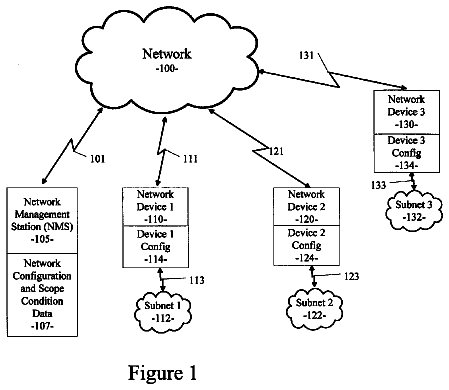
FIG. 1 is a diagram of an embodiment of a network in which remote computer management according to the invention can be used, illustrating various capabilities of the invention.
FIG. 2 is a diagram of another embodiment of a network in which remote computer management according to the invention can be used, illustrating another capability of the invention.
FIG. 3 is a diagram of another embodiment of a network in which remote computer management according to the invention can be used, illustrating another capability of the invention.
FIG. 4 is a flow chart of a method in accordance with the invention for providing secure and authenticated communication between agent software operating on a managed computer and a remote computer management server.
FIG. 5 is a diagram of another embodiment of a network in which remote computer management according to the invention can be used, illustrating another embodiment of remote computer management in accordance with the invention.
Detailed description of the invention
The invention facilitates remote management of a computer via a network. A computer at one site of a computer network is used by a remote administrator to request performance of management action(s) regarding a specified computer (the Amanaged computer@) and/or other device located at another site of the network. The request is transmitted to a remote computer management server that is typically located at still another site of the computer network that is different from the other two network sites. The remote computer management server communicates with the managed computer to effect the requested management action(s) and, as appropriate, reports the result(s) to the computer being used by the remote administrator. As described in detail below, the invention encompasses several aspects of implementing such a remote computer management system that facilitate the remote management of a computer.
According to one aspect of the invention, remote computer management in which communication between a managed computer (i.e., a computer that is to be remotely managed) and a remote computer management server (i.e., a computer that communicates with the managed computer to effect requested management action(s)) is initiated by the managed computer is implemented so that the communication is formatted in accordance with a network communications protocol that can be used to format communication that is allowed to pass through a firewall and/or gateway that mediates communication with the managed computer. According to another aspect of the invention, remote computer management in which communication between a managed computer and a remote computer management server is initiated by the managed computer is implemented so that the presence of a proxy server at the site at which the managed computer is located can be detected, and communication from the managed computer to the remote computer management server is routed to a communication port assigned for communication with the proxy server, with instructions to then send the communication to the remote computer management server. According to yet another aspect of the invention, remote management of a device connected to a managed computer can be effected by using the managed computer as a proxy for conducting a management action regarding the connected device on behalf of a remote computer management server. According to still another aspect of the invention, remote computer management capability can be updated by providing to a managed computer, for use by software operating on the managed computer to effect management actions, a dynamically loaded library (or other set of instructions and/or data that will not be identified as a new executing process on the managed computer) that includes functionality not previously enabled by the software operating on the managed computer. According to another aspect of the invention, remote computer management capability can be expanded beyond that previously available through the addition of one or more new primitive functions that can be performed on a managed computer. An embodiment of the invention can be implemented to include one or any combination (including all) of the aspects of the invention described above. Further, an embodiment of the invention can be implemented as a method in accordance with the description of the invention herein, a system or apparatus for performing such a method, or a computer program including instructions and/or data for performing such a method.
Herein, "computer" can refer to any device having computational capability sufficient to accomplish relevant functions of the invention and the capacity for communication with other such devices via a network of which the devices are part. As used herein, a "computer" can be embodied by, for example, a desktop computer, server computer, portable computer (e.g., notebook computer, personal digital assistant), cellular phone, a router or a network-ready Asmart@ appliance. The invention can be implemented with computers operating in accordance with any operating system, e.g., a Windows operating system, a Unix operating system, a MacIntosh operating system.
Management of a computer can include any of a variety of tasks (often referred to herein as Amanagement actions@). For example, as discussed above, management of a computer can include one or more of the following: taking inventory of the hardware comprising a computer and/or the software installed on a computer; installation, configuration and/or updating of software on a computer; establishing and updating security parameters (e.g., passwords, access permissions) on a computer; deploying and installing system patches on a computer; monitoring usage of computer resources and/or computer operation; identifying and tracking problems with computer operation; producing an alert when a problem with computer operation occurs; controlling one or more aspects of the operation of a computer; and providing assistance to a user in effecting desired operation of a computer. Each of these management actions can be accomplished by performing one or more operations on the managed computer, such as, for example, manipulating the file system on the managed computer, starting/stopping/monitoring any process (e.g., system services, application programs) operating on the managed computer, reading/writing/editing the registry of the managed computer, and/or remotely controlling devices such as a screen and/or keyboard of the managed computer.
The invention can be implemented to enable remote computer management via any of a variety of computer networks. In particular, the invention can be implemented to enable remote computer management via any computer network that makes use of a TCP/IP protocol (including protocols based on TCP/IP protocol, such HTTP, HTTPS and FTP) to effect communication via the network. For example, the invention can advantageously be implemented to enable remote computer management via the Internet. The invention can also be implemented to enable remote computer management via any other public computer network, as well as via a private computer network, such as an intranet for a corporation or other organization.
The invention facilitates remote computer management. In particular, a computer (for convenience, sometimes referred to herein as a Aremote administrator computer@) that is used by a remote administrator to request performance of management action(s) regarding a managed computer is remote from the managed computer. Herein, two computers are Aremote@ from each other if the two computers are located at different sites of a computer network of which the two computers are part. A Acomputer network site@ is a group of one or more computers that share a single network address. (There may also be other devices present at a computer network site.) Two computer sites can be located at the same or different geographic locations. It is anticipated that the invention will typically be implemented for use in situations in which the remote administrator computer and the managed computer are at network sites that not readily accessible to each other, such as locations separated by a large distance (e.g., several or many miles). The remote computer management server may or may not be remote from the remote administrator computer or the managed computer (though it must be remote from at least one).
FIG. 1 is a diagram of an embodiment of a network in which remote computer management according to the invention can be used, illustrating various capabilities of the invention. In FIG. 1, computers at various sites are connected to the Internet. A remote computer management server operates at site 101. A remote administrator uses a computer at site 102 to effect management of one or more remote computers by communicating request(s) for management action(s) to the remote computer management server. (In general, the invention can be used to enable management of any number of computers.) A computer at site 103 is connected to the Internet through a firewall which controls access to the Internet by the computer. Multiple computers at site 104 are connected to the Internet through a gateway and a firewall. In response to request(s) from the remote administrator, the remote computer management server can communicate one or more commands to the computers at sites 103 and/or 104 to cause those computers to perform one or more operations that effect management action(s) requested by the remote administrator. In particular, as explained in more detail below, the invention can enable the remote administrator to manage the computers at site 103 and 104, notwithstanding the presence of a firewall at both sites and a gateway at site 104.
Each managed computer has installed thereon one or more computer programs (for convenience, referred to herein as Aagent software@) including instructions and/or data that can be used in effecting requested management of the managed computer. In particular, the agent software can receive commands from a remote computer management server, perform operations on the managed computer (or, in some embodiments of the invention, on device(s) connected to the managed computer) in accordance with the received commands, and, as appropriate, report the results of the operations to the remote computer management server. The agent software can advantageously be implemented so that operation of the agent software doesn't affect other operation of the managed computer to a significant degree. The agent software can be implemented to perform only basic operations (e.g., the primitive functions discussed below) that require little processing or data storage capacity of the managed computer. For example, the agent software can be implemented by computer program(s) that require only several hundred kilobytes of data storage. Additionally, the agent software can advantageously be installed on a managed computer as a system service, thus affording the agent software the same rights and privileges as the operating system of the managed computer. This status can be useful in facilitating execution of the primitive functions discussed below because it enables the primitive functions to be executed by the managed computer without need for user logon or other user intervention. This status can also be useful in facilitating update of the agent software in accordance with an aspect of the invention described below (i.e., by using a dynamically loaded library). The invention can be implemented so that an administrator credential is securely bound to software (which can be encrypted) used to install the agent software, in order to ensure that the agent software has adequate usage rights on a managed computer (which may not otherwise be the case, e.g., if the person doing the installation does not have administrator rights on the managed computer) to enable installation of the agent software as a Asystem service@ on the managed computer.
The remote computer management server has installed thereon one or more computer programs (for convenience, sometimes referred to herein as Aserver software@) including instructions and/or data that can be used to effect management of a computer (or, in some embodiments of the invention, device(s) connected to the computer) in response to a request from a remote administrator. In particular, the server software can receive a request from a remote administrator to perform a management action on a managed computer (or connected device), receive a query from agent software regarding whether a management action is to be performed on the managed computer (or connected device) on which the agent software is operating, communicate a command to agent software to perform a specified operation on the managed computer (or connected device), and receive a response, as appropriate, from the agent software that indicates a result produced by performance of an operation on the managed computer (or connected device). The remote computer management server can also store data regarding the status and/or configuration of a managed computer (or connected device).
The invention can be implemented so that, in general, a remote administrator can use any computer that can be connected to the network to effect remote management of one or more other computers connected to the network. In that vein of generality, the invention can be implemented so that no software particular to the invention need be installed on a remote administrator computer to enable remote computer management in accordance with the invention. For example, when the invention is implemented to enable remote management of computers via the Internet, the invention can be implemented to enable the remote administrator to effect such management by using a conventional Web browser to contact the remote computer management server (e.g., access an appropriate Web site) and communicate requested management actions.
On a recurring basis, the agent software operating on a managed computer attempts to initiate communication with the remote computer management server to query whether the remote computer management server has any management actions for the agent software to perform. For example, the invention can be implemented so that the agent software attempts to initiate communication with the remote computer management server at regular intervals. It is desirable that the agent software query relatively frequently whether the remote computer management server has any management actions for the agent software to perform so that a remote administrator won=t possibly have to wait a long time for the result of a requested management action. The invention can be implemented, for example, so that the agent software attempts to initiate communication with the remote computer management server every n seconds (e.g., every 30 seconds or some other period of time less than about a minute). The invention can be implemented so that if the agent software is not successful on a first attempt in initiating communication with the remote computer management server, the agent software tries again one or more times to initiate such communication. For example, the invention can be implemented so that the agent software attempts to initiate communication with the remote computer management server at regular intervals for a specified period of time or for a specified number of attempts, e.g., attempt to initiate communication every n seconds until m attempts have been made. If the agent software is successful in initiating communication with the remote computer management server, the agent software waits for a response from the remote computer management server. If the remote computer management server has a management action or actions for the agent software to perform, then the remote computer management server will communicate one or more commands to the agent software that effect performance of the management action(s). If there are no management actions for the agent software to perform, or if the agent software was unsuccessful in initiating communication with the remote computer management server (even after making a specified number of attempts), then the agent software waits until the next specified time to attempt again to initiate communication with the remote computer management server. In this way, the agent software continually polls the remote computer management server to identify management actions to be undertaken by the agent software on the managed computer. The invention can be implemented so that the particular parameters regarding attempts to initiate communication with the remote computer management server (e.g., the times at which the agent software attempts to initiate communication with the remote computer management server; the interval between, and number of, attempts to initiate communication with the remote computer management server after an unsuccessful first attempt) can be established by a user of an embodiment of the invention (e.g., a reseller of software embodying the invention or an entity that uses the invention to remotely manage its computers).
It is desirable to make operation of the agent software on the managed computer as unobtrusive as possible. For example, as indicated above, the agent software can be implemented as one or more computer programs that require relatively little space to store and relatively little processing resources to execute. In this vein, the agent software can be implemented so that, before attempting to initiate communication with the remote computer management server, the agent software checks to determine whether a connection to the network has already been established. If so, then the agent attempts to initiate communication with the remote computer management server. If not, the agent software does not attempt to initiate such communication. Implementing the agent software in this way can be desirable because it can prevent disruption of a user of the managed computer who is working on the managed computer at a time when the managed computer is not connected to the network by the display of a dialog box (as is commonly produced on a computer when attempting to connect to a network) announcing that the managed computer is attempting to establish a network connection. Such disruption can be particularly bothersome since the agent software will typically be implemented to attempt to initiate communication with the remote computer management server on a frequent basis (e.g., every 30 seconds or a minute).
As indicated above, the invention enables a remote administrator to remotely manage a computer via a network, notwithstanding the presence of a firewall and/or a gateway that mediates connection by the managed computer to the network. A firewall or gateway is often configured to prevent communication that is not in response to an outgoing communication initiated by the computer being protected by the firewall or gateway. (For convenience, such communication is sometimes referred to herein as Ainbound communication.@) However, many firewalls and gateways allow any communication that is in response to an outgoing communication initiated by the computer being protected by the firewall or gateway. (For convenience, such communication is sometimes referred to herein as Aoutbound communication.@) Thus, a system for remote computer management in which communication with a managed computer is initiated by another computer on the network will often be prevented from managing a computer that is protected by a firewall and/or gateway (and, as discussed above, the number of such computers is significant and is increasing). A firewall and/or gateway can be configured to allow such inbound communication, but doing so reduces the efficacy of the firewall and/or gateway and is therefore generally undesirable. To address this problem, the invention can be implemented so that all communication between the remote computer management server and the agent software is initiated by the agent software, as described above, i.e., all communication required to remotely manage a computer is outbound communication from that computer. Implementing the invention in this way also enables such communication to traverse a gateway that performs NAT, since the gateway can store an identification of the managed computer that initiated communication while the a communication session is ongoing. The agent software can be implemented so that the agent software does not accept inbound communication, thus eliminating the need to configure a firewall or gateway to allow such communication. This is advantageous since, in many implementations of the invention, there will be a large number of managed computers that would otherwise require firewall and/or gateway configuration. Additionally, managed computers are often not operated by users having the requisite knowledge or inclination to appropriately configure a firewall and/or gateway; implementing the invention in this way avoids problems associated with the need for such users to configure a firewall and/or gateway. The remote computer management server does accept inbound communication. However, configuring the firewall and/or gateway of a remote computer management server to allow inbound communication imposes little burden, since there is only one (or, perhaps, a few) for which the firewall and/or gateway must be configured, and the remote computer management server is often a computer that is operated by, or readily accessible to, user(s) (e.g., information technology specialists) that are comfortable with appropriately configuring a firewall and/or gateway.
Some firewalls or gateways are more restrictive than described above: not only do they not allow inbound communication, they allow outbound communication only if the communication is formatted in accordance with a particular communication protocol that is identified as allowable by the firewall or gateway. In a further embodiment of the invention, the agent software communicates using a specified communication protocol that formats communication in a way that is expected to be identified as allowable by an adequate number of firewalls and gateways. In particular, the invention can be implemented so that the agent software communicates using a communication protocol that is used for other types of communication that firewalls and gateways typically allow. The HTTP and HTTPS protocols are examples of such communication protocols (since these protocols are often used for communication via the Internet, firewalls and/or gateways are often configured to allow outbound communication formatted in accordance with one of these protocols); the invention can be implemented so that the agent software communicates using either of those communication protocols. The invention can also be implemented so that the agent software communicates using FTP or and any other protocol based on TCP/IP protocol. Further, the invention can be implemented so that when the agent software attempts to initiate communication with the remote computer management server, a succession of attempts are made, in each of which the communication is formatted in accordance with a unique one of a set of different communication protocols, until one version of the communication is allowed by the firewall and/or gateway; subsequent communication is then formatted in accordance with the communication protocol used for that version of the communication. As the implementations of firewalls and gateways evolve in the future, the communication protocols that are typically allowed by those future firewalls and gateways may be different from those that are currently commonly allowed; the invention contemplates the use of such communication protocols in enabling communication from the agent software.
The description continues in the full USPTO document.
 Lapsed, fee not paid8 drawings