 Lapsed, fee not paid5 drawings
Consumer Products · US 8,787,122 B2
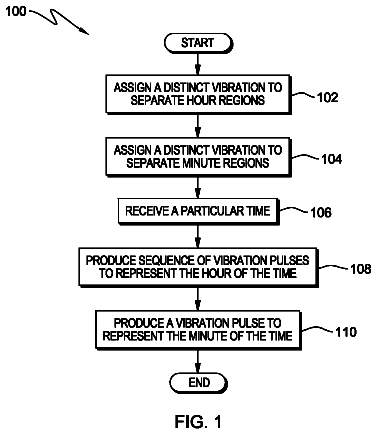
Time reporting through vibration
A tool for reporting a particular time using vibration is disclosed.
US 8,789,253 B2 · Assignee: NIKE, Inc. · Inventors: Kilgore; Bruce J. et al.
Sheet 1 of 12 from the published document. All sheets in the USPTO PDF
Footwear including removable and replaceable outsole members may include: (a) an upper member; (b) a midsole member, having an exterior surface not designed for performance use in direct contact with the ground, fixedly engaged with the upper member; and (c) an outsole member designed for performance use in contact with the ground removably attached over at least a major portion of the midsole member. The outsole member may attach to the midsole member and/or upper member in a variety of different ways. In use, the wearer may select a specific set of outsole members to use at a given time depending, for example, on the type of play surface, temperature, and/or other conditions. Worn outsole members may be replaced without the expense involved in also replacing the remainder of the footwear.
Tennis is played on a wide variety of court surfaces, including, for example, grass, clay, hardcourt, concrete, asphalt, OmniCourt.TM. or other synthetic surfaces, etc. Some of these surfaces, particularly hardcourt, concrete, and asphalt, can be very hard on footwear, particularly on the outsole structure of the footwear and any other portion that regularly contacts the ground. As an example, the average life of a tennis shoe outsole, at a collegiate level of play, when used on a hardcourt surface, is about 40 hours. Therefore, high volume players, such as professional, collegiate, or high school athletes, typically need to replace their shoes about once a month or even more often. Because tennis is a year-round activity for at least some players, particularly in warmer climates and/or for those with access to heated or indoor facilities, a high volume player may find it necessary to pu
8 of 12 drawing sheets so far from the published document, cropped to the drawing. Every sheet is in the USPTO PDF.
What the patent claimed, word for word. All of it is now free to use.
Aspects of the present invention generally relate to removable and replaceable outsole members, footwear products and footwear systems including these outsole members, and methods of using such footwear products. Such products and methods are particularly useful for athletic footwear or other footwear products subjected to hard use that tends to rapidly deteriorate conventional footwear outsoles.
Tennis is played on a wide variety of court surfaces, including, for example, grass, clay, hardcourt, concrete, asphalt, OmniCourt.TM. or other synthetic surfaces, etc. Some of these surfaces, particularly hardcourt, concrete, and asphalt, can be very hard on footwear, particularly on the outsole structure of the footwear and any other portion that regularly contacts the ground. As an example, the average life of a tennis shoe outsole, at a collegiate level of play, when used on a hardcourt surface, is about 40 hours. Therefore, high volume players, such as professional, collegiate, or high school athletes, typically need to replace their shoes about once a month or even more often.
Because tennis is a year-round activity for at least some players, particularly in warmer climates and/or for those with access to heated or indoor facilities, a high volume player may find it necessary to purchase new shoes frequently throughout the year. In light of the relatively high cost associated with high quality tennis footwear (e.g., in many instances over $100 per pair), shoe replacement costs at this frequent rate can be substantial and burdensome. Players that use excessively worn footwear, on the other hand, run an increased risk of injury from slips, slides, and footwear failure during use. Breaking in new shoes also involves injury risk, e.g., from blisters, improper fit, etc. Additionally, worn footwear or "un-broken in" footwear, in at least some instances, can adversely affect the user's performance, potentially costing points, games, sets, etc.
Tennis is not the only athletic or recreational endeavor that can be tough on footwear. For example, footwear used in skateboarding, cycling competitions (e.g., ramp jumping, SuperBMX, freestyle, supercross, motocross, etc.), basketball (particularly street basketball), volleyball, and the like, can wear very quickly, particularly under a high volume of use. Active children and adolescents also can be extremely tough on footwear and can wear through shoe outsoles very quickly. Substantial costs can be involved in frequent replacement of footwear used in these types of activities or by these users.
In some instances, footwear also can be exposed to a wide variety of conditions in use. Returning to the example of tennis, a player's tennis shoe outsoles typically are the only direct interface between the athlete and the court surface. In addition to the different potential surface types, as described above, the court surface also may be exposed to a wide variety of conditions, and play may take place under a variety of conditions. For example, in some instances the court may be wet or damp, depending on the local weather, humidity, groundskeeping, and the like. As additional examples, depending on the ambient temperature, the presence of sunshine or wind, the court surface, and the like, the court surface temperature during play or practice can vary widely, typically from as low as 50.degree. F. or even lower, to as high as 120.degree. F. or even higher. A single outsole material, design, and/or construction may not be suitable or optimal for use under this myriad of conditions. Purchasing, storing, and transporting numerous pairs of shoes to events in an effort to accommodate and optimize performance under a wide variety of potential conditions further increases the expense and burden associated with at least some athletic or recreational endeavors, particularly for high quality, competitive players.
Other athletic events also take place under a variety of different conditions, including different play conditions and/or different surface conditions. For example, track and field events may take place on a variety of different track or other field surfaces, and/or the events may take place under a wide variety of weather conditions (e.g., heat, cold, wet, dry, etc.). No single pair of shoes, including the uppers and outsoles, is necessarily best or optimized for use under this wide variety of potential track and field conditions.
Accordingly, there is a need in the art for footwear products, footwear systems, and methods that can reduce costs associated with footwear, particularly footwear used under high volume and/or heavy wear conditions. It would be advantageous, in at least some instances, if such products, systems, and methods further were capable of helping to optimize user performance, optionally taking into account a variety of use, ground surface, weather, and/or other conditions.
Aspects of the present invention relate to removable and replaceable outsole members, footwear products and/or footwear systems including these outsole members, and methods of using such footwear products and systems. Footwear products in accordance with at least some examples of this invention may include: (a) an upper member including a closure system; (b) a midsole member fixedly engaged with the upper member, wherein at least a major portion of the exterior surface of the midsole member is not designed for performance use in direct contact with a ground surface; and (c) an outsole member removably attachable over at least a major portion of the exterior major surface of the midsole member (e.g., stretched over the midsole) and designed for performance use in contact with the ground (e.g., designed for use in an athletic event or other performance). The outsole member further may include an engagement element on its interior major surface that engages with a corresponding engagement element provided on a major exterior surface of the midsole member. Additionally, the outsole member further may include an upper containing region that extends over and partially contains the upper member, wherein the upper containing region also at least partially covers the closure system. If desired, one or more additional outsole elements may be attached to the exterior major surface of the outsole member, e.g., to further increase its wear-resistance or change its tread characteristics in areas of traditionally high wear or ground contact.
Footwear products in accordance with additional example aspects of this invention may include: (a) an upper member including a closure system; (b) a midsole member fixedly engaged with the upper member, wherein an exterior major surface of the midsole member includes at least a first groove element defined therein; and (c) an outsole member removably attachable over at least the major portion of the exterior major surface of the midsole member, wherein an interior major surface of the outsole member includes at least a first raised rib element that engages with the first groove element defined in the midsole member, and wherein the outsole member further includes an upper containing region that extends over and partially contains the upper member, wherein the upper containing region at least partially covers the closure system. If desired, the major exterior surface of the midsole member may include multiple grooves that extend in different directions (e.g., substantially longitudinally and/or substantially transversely) that engage with multiple raised ribs provided in the major interior surface of the outsole member.
Additional aspects of this invention relate to footwear systems. In at least one example, the footwear system may include a pair of footwear or shoe bases (e.g., upper members and midsoles, for example, like those described above, optionally, where at least a major portion of the midsole's exterior surface is not designed for performance use in direct contact with the ground surface) and multiple pairs of removable outsole members or means for obtaining additional removable outsole members, e.g., like those described above. The removable outsole members may be freely engaged with and disengaged from the shoe bases, and the individual outsole member selected for a specific use may depend on various factors, such as field or ground surface composition or conditions, user preference, weather, or other conditions, etc. If desired, one pair of outsole members may be designed for use on one type of ground surface (e.g., a hardcourt tennis court surface) or under one set of play conditions (e.g., wet or cool conditions), while another pair may be designed for use on a different type of ground surface (e.g., a clay court surface, a grass court surface, or the like) or under different play conditions (e.g., dry or hot conditions). Alternatively, if desired, at least some of the outsole members may be designed the same such that one pair can replace another pair when it is worn out.
As another example, users may have multiple "base shoes" or upper and midsole members with varying characteristics, e.g., minimal lightweight base shoes, more supportive base shoes, more breathable base shoes, more water-resistant base shoes, etc. The plural upper members, optionally along with plural outsole members of varying characteristics, may provide a wide ranging pallet of footwear products, e.g., for use under a variety of use and/or ambient conditions, for varying aesthetic looks, etc.
Still additional aspects of this invention relate to methods of using footwear systems including the footwear systems described above. As examples, methods in accordance with this invention may include: (a) determining a type of surface or play conditions on which an event will be performed; (b) selecting a pair of outsole members, at least in part, based on the type of surface or play conditions; and (c) removably attaching the pair of outsole members to a pair of shoe base members. Methods according to aspects of the present invention further may include one or more of the following additional steps: performing the event wearing a pair of shoes including the pair of shoe base members with the pair of outsole members attached thereto; determining at least one additional condition at a location at which the event will be performed, wherein the step of selecting the outsole member additionally may take the determined additional condition into account; removing a previously selected pair of outsole members from the pair of shoe base members; and removably attaching a new pair of outsole members to the shoe base members.
The above and other objects, features, and advantages of the present invention will be more readily apparent and more fully understood from the following detailed description, taken in conjunction with the appended drawings, which illustrate examples of the present invention, wherein:
FIG. 1 illustrates an example footwear system in accordance with this invention, including a footwear base member and a removable outsole member;
FIGS. 2-4 illustrate an example outsole member useful in example structures and methods in accordance with the invention;
FIGS. 5A through 5D illustrate an example outsole removal and/or attachment procedure in accordance with examples of this invention;
FIG. 6 illustrates an ultimate end use of an example footwear system in accordance with this invention;
FIGS. 7A through 7D illustrate top, bottom, lateral, and medial views, respectively, of an example outsole member in accordance with this invention;
FIGS. 7E through 7J illustrate sectional views of the outsole member taken along lines 7E-7E, 7F-7F, 7G-7G, 7H-7H, 7I-7I, and 7J-7J, respectively, in FIG. 7B;
FIGS. 8A through 8D illustrate top, bottom, lateral, and medial views, respectively, of an example midsole member in accordance with this invention;
FIGS. 8E through 8J illustrate sectional views of the midsole member taken along lines 8E-8E, 8F-8F, 8G-8G, 8H-8H, 8I-8I, and 8J-8J, respectively, in FIG. 8B;
FIG. 9 illustrates a side view of another example removable outsole member in accordance with aspects of this invention;
FIGS. 10A and 10B illustrate an example toe cap member that may be used in accordance with some example aspects of this invention; and
FIG. 11 illustrates a side view of another example removable outsole member including toe bumper elements in accordance with example aspects of this invention.
Various specific examples of structures and methods in accordance with this invention are described in detail below in conjunction with the attached drawings. To assist the reader, this specification is divided into various subsections, as follows: Terms; General Description of Aspects of the Invention; Specific Examples of the Invention; and Conclusion.
A.
The following terms are used in this specification, and unless otherwise noted or clear from the context, these terms have the meanings provided below.
"Footwear" means any type of wearing product for the feet, and this term includes, but is not limited to: all types of shoes, boots, sneakers, sandals, thongs, flip-flops, mules, scuffs, slippers, sport-specific shoes (such as golf shoes, ski boots, etc.), and the like.
"Ground surface" or "surface" means any surface, indoors or outdoors, onto which a user's foot contacts and/or onto which a user's foot is intended to contact, e.g., during play of an athletic event, practice, or other performance.
"Performance use" or "athletic use" means use of a footwear product in its intended manner and in its intended environment, e.g., during play of an athletic event, practice, or other performance.
B.
In general, aspects of this invention relate to footwear products that include a removable outsole member that may be removed and replaced, for example, when worn out, when play takes place on different ground surfaces (e.g., grass, clay, concrete, hardcourt surfaces, asphalt surfaces, etc.), for customization purposes, etc. In at least some examples, footwear products in accordance with aspects of this invention may include: (a) an upper member including a closure system; (b) a midsole member fixedly engaged with the upper member, wherein an exterior major surface of the midsole member optionally includes at least a first engagement element, and, optionally, wherein at least a major portion of the exterior major surface is not designed for performance use in direct contact with a ground surface; and (c) an outsole member, designed for performance use in direct contact with the ground surface, removably attachable over at least a major portion of the exterior major surface of the midsole member (e.g., stretched over at least the portion of the midsole member's exterior major surface not designed to directly contact the ground in performance use). The outsole member may, in at least some examples, include various additional features in accordance with additional aspects of this invention. For example, an interior major surface of the outsole member may include a second engagement element that engages with the first engagement element of the midsole member. Additionally or alternatively, the outsole member may include an upper containing region that extends over and partially contains the upper member, optionally, wherein the upper containing region also at least partially covers the closure system. If desired, one or more additional outsole elements may be attached to the exterior major surface of the outsole member, e.g., to further increase its wear-resistance and/or change its tread characteristics in areas of traditionally high wear or ground contact.
At least some examples of this invention relate to footwear products that include: (a) an upper member including a closure system; (b) a midsole member fixedly engaged with the upper member, wherein an exterior major surface of the midsole member includes at least a first groove element defined therein; and (c) an outsole member removably attachable over at least the major portion of the exterior major surface of the midsole member, wherein an interior major surface of the outsole member includes at least a first raised rib element that engages with the first groove element defined in the midsole member, and wherein the outsole member further includes an upper containing region that extends over and partially contains the upper member, wherein the upper containing region at least partially covers the closure system. If desired, the major exterior surface of the midsole member may include multiple grooves that extend in different directions (e.g., substantially longitudinally and/or substantially transversely) that engage with multiple raised ribs provided in the major interior surface of the outsole member.
In at least some examples of the invention, the outsole member and at least one of the midsole member or the upper member may include attachment elements that help secure the outsole member to the remainder of the piece of footwear. These attachment elements may be located at any suitable or desired position in the footwear, such as in the heel area, along the lateral or medial sides, in the toe area, etc. One or more of these attachment elements, or a combination thereof, may produce an indication when the outsole member is properly seated on the remainder of the piece of footwear, such as a visual indicator, an audible indicator, or the like.
As noted above, in at least some examples, an upper containing region of the outsole member may extend over and partially contain the upper member and the closure system. This upper containing region may be constructed from a flexible material such that it moves, bends, and/or otherwise accommodates changes in position or shape of the upper member portion contained therein, e.g., during use in an athletic event or practice. Additionally, in at least some examples of this invention, the upper member may actually attach to the upper containing region, e.g., using the closure system of the upper member.
When used, particularly in athletic use or performance use, the outsole member generally must remain securely in place with respect to the midsole member and/or the upper member, e.g., to avoid slipping. The attachment elements and engagement elements described above (and described in more detail below) assist in this effort. Various ways of maintaining the relative position of the midsole and outsole members may be used in accordance with the invention. For example, the major exterior surface of the midsole member may include one or more grooves (e.g., elongated grooves) that engage one or more corresponding raised ribs (e.g., elongated ribs) on the major interior surface of the outsole member, and vice versa, to help fix the two members together and to help prevent them from moving with respect to one another. If desired, each of the midsole member and the outsole member may include a combination of grooves and/or raised ribs that engage with complementary elements on the other member without departing from the invention.
As a further or alternative aid to help hold the outsole member to the midsole and/or upper member, in at least some examples of the invention, at least one of the exterior major surface of the midsole member and the interior major surface of the outsole member may be constructed or treated so as to increase the coefficient of friction between these surfaces. For example, at least one of these surfaces may be constructed from a material that provides at least a minimum threshold coefficient of friction between the surfaces. As another alternative, one or more of the surfaces may be smoothed or roughened to increase the coefficient of friction. As still another example, one or more of the surfaces may be treated with a composition (such as an adhesive) that increases the coefficient of friction between the surfaces and/or removably holds them together. Other coefficient of friction increasing treatments or materials may be used without departing from the invention.
The coefficient of friction between these surfaces (i.e., the outsole and midsole major surfaces), at a minimum, in at least some instances, will be greater than a coefficient of friction between the outsole surface and the ground surface on which it is typically used. Desirably, in at least some examples, the outsole member will move or slide with respect to the ground surface before it will move or slide substantially with respect to the midsole member.
Additional aspects of this invention relate to footwear systems. At least one example of such footwear systems includes a pair of shoe bases (e.g., upper members and midsoles, for example, fixedly engaged with one another like those described above) and multiple pairs of removable outsole members, e.g., like those described above. The removable outsole members may be freely engaged with and disengaged from the shoe bases, depending on various factors, such as user preference, weather conditions, ground surface conditions, temperature conditions, humidity conditions, and the like. If desired, one pair of outsole members may be designed for use on one type of ground surface (e.g., a hardcourt tennis court surface) and/or under one set of conditions (e.g., wet or cold conditions), while another pair may be designed for use on a different type of ground surface (e.g., a clay court surface, a grass court surface, or the like) and/or under a different set of conditions (e.g., dry or hot conditions). Alternatively, if desired, more than one pair of the outsole members may be designed for use on the same type of ground surface, e.g., such that a second pair of outsole members is available to replace the first pair when the first pair becomes worn or otherwise unusable. More than two pair of outsole members may be included in the system, if desired.
Another example footwear system in accordance with aspects of this invention may include a pair of shoe bases (e.g., upper members and midsole members fixedly engaged with one another, for example, like those described above) and a pair of removable outsole members, e.g., like those described above. Rather than (or in addition to) providing multiple pairs of outsole members, the footwear system in accordance with this aspect of the invention includes means for obtaining an additional pair of outsole members to substitute for the initial pair of outsole members. Optionally, the additional pair of outsole members may be specially designed for use on the same type of ground surface, on another type of ground surface, under the same use conditions, under different use conditions, etc., without departing from the invention.
Various means for obtaining the additional pair of outsole members may be used in accordance with at least some examples of this invention. For example, this "means" may include a coupon redeemable for a free or discounted pair of outsole members, e.g., redeemable through a mail-in system, over a computer network (such as the Internet), at a point of sale location (e.g., a retail store, etc.), and the like. As another example, the means for obtaining the additional pair of outsole members may include a code or other information that may be entered through a computer network that results in dispatch of a free or discounted pair of outsole members to the user, e.g., through the mail to a user's home, to a retail location, etc. Other systems and methods of providing the additional pair of outsole members may be used without departing from this invention.
Additional aspects of this invention relate to methods of using footwear systems including the footwear systems described above. As a more specific example, methods in accordance with this invention may include: (a) determining a type of surface or play condition(s) under which an event will take place; (b) selecting a pair of outsole members, at least in part, based on the type of surface or play condition(s); and (c) removably attaching the pair of outsole members to a pair of shoe base members. Methods according to aspects of the invention further may include: performing the event wearing a pair of shoes including the pair of shoe base members with the pair of outsole members attached thereto.
Methods according to examples of the invention further may include determining at least one additional condition at a location at which the event will be performed, wherein the step of selecting the outsole member takes this additionally determined condition into account. Any suitable or desired condition(s) may be considered in determining which outsole member to select, such as: ambient air temperature, surface temperature, predicted high ambient air temperature during performance of the event, predicted low ambient air temperature during performance of the event, predicted high surface temperature during performance of the event, predicted low surface temperature during performance of the event, ambient humidity, presence or absence of precipitation, and predicted presence or absence of precipitation. If desired, the footwear system may be marketed with selection aids available to the user, retailer, etc., such as a "look-up" table, a movable slide rule or wheel, a computer program, or the like, into which one or more ground surface types and/or conditions may be entered, and the selection aid provides a recommended outsole member design or construction based on the input parameter(s).
During performance of an event, or between two independent events, such as athletic events, the footwear system user may remove the previously or initially selected pair of outsole members from the pair of shoe base members, removably attach a new pair of outsole members to the pair of shoe base members, and resume performing (including starting a performance of a new event) wearing the pair of shoe base members with the new pair of outsole members attached thereto. Optionally, in at least some instances, the outsole member pair may be changed to accommodate a new type of play surface, changing conditions, user choice, excessive wear or failure of the existing outsole members, etc.
At least some examples of this invention may be specifically directed to footwear used in playing tennis, wherein the type of tennis court surface, at least in part, may dictate the type of outsole member selected. For example, a player may use different outsole members on hardcourt surfaces, clay court surfaces, grass surfaces, asphalt surfaces, concrete surfaces, etc. Other ambient and/or local conditions, as described above, also may be used in selection of outsole members for use in a specific match. Of course, upper members, shoe base members, and/or outsole structures may be provided for uses other than tennis, as suitable upper members, shoe base members, and/or outsole members may be provided for a wide variety of uses, use conditions, surfaces, and the like. As one more specific example, running or jogging shoes may be provided with different upper members and/or outsole members for different uses and/or use conditions, e.g., depending on the event, the distance to be run, the event surface, weather or other ambient conditions, etc.
Specific examples of the invention are described in more detail below. The reader should understand that these specific examples are set forth merely to illustrate examples of the invention, and they should not be construed as limiting the invention.
C.
The figures in this application illustrate various example removable outsole members, footwear products, systems, and methods in accordance with this invention. When the same reference number appears in more than one figure, that reference number is used consistently in this specification and the figures to refer to the same part or element throughout.
FIG. 1 illustrates an example footwear product 100 in accordance with an example of this invention. The footwear product 100 includes a footwear or shoe base portion 102 having a removable outsole member 104 removably attached thereto. The shoe base portion 102 includes an upper member 106 that has a midsole member 108 fixedly attached to it. Any means or method may be used to attach the midsole and upper members together, including conventional means and methods known in the art, for example: adhesives, cements, laser or ultrasonic binding, sewing, other mechanical connectors, and/or the like. The shoe upper member 106 further may include a closure system 110. While any desired closure system or combination of closure systems may be used without departing from the invention (such as buckles, zippers, hook-and-loop fasteners, straps, etc.), in the illustrated example the upper member 106 is closed and secured to a user's foot using a conventional shoe lace. Also, the shoe upper members 106 and midsole members 108 may be made of any desired materials, including natural or synthetic materials or combinations thereof, including conventional materials known in the art.
In the example footwear product 100 illustrated in FIG. 1, the outsole member 104 completely covers an exterior major surface of the midsole member 108. Notably, the removable outsole member 104 has an exterior major surface 112 made of a material, construction, and/or design (e.g., sufficiently wear-resistant, with suitable tread design, etc.) such that it is suitable to directly contact the ground during use of the footwear product 100 (e.g., suitable for performance use). The exterior major surface of the midsole member 108, on the other hand, may be of a material, construction, and/or design such that, on its own, it may not be suitable for directly contacting the ground surface during performance use (e.g., in some examples, the midsole member 108 may quickly wear out; it may not provide suitable traction or tread; it may provide inadequate contact with the ground (e.g., on one or more slender raised ribs); it may puncture or provide inadequate support; etc.), if used in a prolonged manner during play of an event in direct contact with the ground or other play surface).
The outsole member 104 may be attached to the shoe base portion 102 in any suitable or desired manner without departing from the invention. For example, in the illustrated embodiment, the outsole member 104 wraps around and/or at least partially contains the base portion 102 (e.g., extends over and around the toe area of the upper member), and in this manner holds the two members together. This structure, in at least some instances, may be sufficient to hold the members together. The illustrated example, however, further includes a mechanical attachment point at the heel area of the combined shoe/outsole structure. Specifically, in this example, the outsole member 104 includes a "loop" or tab type arrangement 120 that provides a handle to help pull the outsole member 104 around and onto the shoe base portion 102. If desired, the tab arrangement 120 also may pull over and engage a "hook" or ridge type arrangement 122 (or other retaining structure) provided (e.g., integrally molded) in the midsole member 108, in a heel counter of the upper member 106, etc. Alternatively, the outsole member 104 may include a hook type device that engages an opening or retaining member provided in the midsole member 108, the upper member, or other portion of the shoe base structure 102. Additional and/or other mechanical engaging elements may be provided between the outsole member 104 and the shoe base portion 102 if desired, without departing from the invention. At least some of these engagement systems will be described in more detail below.
The removable outsole member 104 of this example further includes an upper containing region 114. As illustrated in FIG. 1, the upper containing region 114 extends at least partially around the upper member 106 to thereby contain at least a portion of the upper member 106. This upper containing region 114 helps secure the removable outsole member 104 to the shoe base portion 102 and helps maintain it securely in place during use, as will be described in more detail below. Notably, in this illustrated example, the upper containing region 114 is made from a flexible material (e.g., an elastomeric or polymeric material) such that it flexes, bends, and changes shape based on movement and/or shape changes of the underlying upper member 106. Additionally, in the illustrated example, the upper containing region 114 at least partially extends over, contains, or covers the closure system 110 (e.g., in the illustrated example, the upper containing region 114 extends over the bottom portion of the shoe lace 110).
The upper containing region 114 need not completely enclose and contain the entire footwear closure system 110, the upper member 106, and/or the midsole member 108. Rather, as illustrated in FIG. 1, the midsole member 108 may, at least in part, extend outside of the outsole member 104 (e.g., in the side and heel areas in the illustrated example). Additionally, the outsole member 104 may have an "open" construction such that some portions of the closure system 110, the upper member 106, and/or the midsole member 108 appear through or extend outside of the outsole member 104. This type of "open" construction helps reduce the overall weight of the outsole member 104 and the entire footwear product 100 without adversely impacting the strength of the outsole member 104 and/or its attachability to the shoe base 102. These "open" areas also may be provided with appropriate shapes and at appropriate locations to enhance the flexibility of the outsole member 104, to prevent excessive reduction in the flexibility of the shoe base 102, to encourage the outsole member 104 to move with the upper member 106, to maintain the position of the upper member 106 with respect to the outsole member 104 (e.g., to maintain the coefficient of friction), etc.
In some examples, if desired, the exterior major surface of the midsole member 108 may include at least some portion (e.g., a minor portion) made of a material, construction, or design suitable for direct contact with the ground surface during performance use. In such an example, the removable outsole member 104 may cover only a substantial (or major) portion of the exterior major surface of the midsole member 108 (leaving the portion of the midsole member 108 suitable for direct contact with the ground exposed and available to contact the ground). As examples, the heel area of a midsole member 108 or a toe area of a midsole member 108 may be constructed in a manner suitable for direct contact with the ground. As other examples, however, the outsole member 104 may completely cover the exterior major surface of the midsole member 108. Also, if desired, the outsole member 104 may include multiple individual pieces that, when combined on a shoe base 102 for use, cover all or a major portion of the major exterior surface of the midsole member 108.
Even when the exterior major surface of the midsole member 108 is not designed for contact with the ground during performance use, it still may have sufficient strength, durability, support, and/or wear resistance to enable at least some direct contact with the ground surface. For example, the exterior major surface of such midsole members 108 may have sufficient strength, support, wear resistance, and durability to allow a user to walk around, at least some, on the midsole member's exterior surface while not performing an event, e.g., while changing outsoles, in the locker room, indoors, or the like. At least some direct contact with the ground is envisioned, even for midsole members that are not designed for performance use in direct contact with the ground.
FIGS. 2-4 illustrate another example of a removable outsole member 200 in accordance with another example of this invention. The size, shape, and construction of this example outsole member 200 are similar to those illustrated in the example of FIG. 1, including an upper containing region 114 designed to contain, at least in part, the midsole member, the upper member, and the closure system of a shoe. An interior major surface 202 of the outsole member 200 is designed to engage and cover at least a major portion of the exterior major surface of a complementary midsole member of a shoe base portion as described above in conjunction with FIG. 1.
The example outsole member 200 of FIGS. 2-4 differs from the outsole member 104 in FIG. 1 in that the outsole member 200 of FIGS. 2-4 includes outsole attachment elements 204, 206, 208, 212, and 214. These outsole attachment elements 204, 206, 208, 212, and 214 may be attached to the outsole member 200 (e.g., to its exterior major surface 210) in any desired manner without departing from the invention, such as via cements, adhesives, laser or ultrasonic binding, sewing, other mechanical connectors, and/or the like. As additional examples, these attachment elements 204, 206, 208, 212, and 214 may be fixedly or removably attached to the outsole member 200 (e.g., to its exterior major surface 210 and/or its side surfaces) without departing from the invention. Furthermore, these attachment elements 204, 206, 208, 212, and 214 may perform any desired function without departing from the invention. For example, they may provide additional wear-resistance in selected areas of the outsole member 200, they may provide different tread designs or characteristics at selected areas of the outsole member 200, they may provide a different aesthetic appearance, they may provide logo or indicia display panels or areas, and/or etc. In the illustrated example, five independent attachment elements are shown, namely a lateral heel attachment element 204, a lateral side attachment element 206, a toe attachment element 208, a medial side attachment element 212, and a medial heel attachment element 214. Of course, any number of attachment elements may be included with a final outsole member design without departing from the invention. For example, the toe attachment element 208 may be made from two or more separate pieces (e.g., medial and lateral) and/or the two heel attachment elements 204 and 214 could be constructed from a single piece without departing from the invention. If desired, one attachment element could cover all or substantially all of the outsole member 200 perimeter. Additionally, or alternatively, one or more of the illustrated attachment elements 204, 206, 208, 212, and 214 may be omitted from the outsole member 200 structure without departing from the invention.
One or more of the outsole attachment elements 204, 206, 208, 212, and 214, along with the underlying outsole member base 200, may function as a "wear indicator." For example, by making the outsole member base 200 a different color (e.g., a contrasting color) from the outsole attachment elements 204, 206, 208, 212, and/or 214, excessive wear of the outsole attachment elements 204, 206, 208, 212, and/or 214 may be noted when the color of the outsole base member 200 appears through one or more of the outsole attachment elements. This color change or appearance may be used as a visual cue to advise the user that the time has come to change outsole members 200 (or at least attachment elements 204, 206, 208, 212, and 214).
The description continues in the full USPTO document.
About 6,294 words. The USPTO PDF has it with every drawing.
Fees are due 3.5, 7.5 and 11.5 years after grant. This patent expired on July 29, 2026, so the fee marked "not paid" was the one that went unpaid.
Footwear including replaceable outsole members
Filed Nov 2004 · published May 2006Footwear including replaceable outsole members
Filed Nov 2004 · granted Jun 2009Footwear With A Bladder Type Stabilizer
Filed Jun 2009 · published Oct 2009Footwear including replaceable outsole members
Filed Jun 2009 · granted Jul 2014Earlier publications, parents and continuations. None of them can still be enforced, or this patent would not be listed.
Prior art cited by the examiner or applicant. Useful when you check your own idea for novelty.
Everything on this page comes from the documents linked above.


