This application is a National Stage Application under 35 U.S.C. 371 of PCT International Application No. PCT/US2011/040710, filed Jun. 16, 2011, which claims priority to Indian Provisional Applications 1695/CHE/2010 filed on Jun. 18, 2010; 3386/CHE/2010, filed on Nov. 11, 2010 and U.S. Provisional Applications Nos. 61/372,566 filed on Aug. 11, 2010; 61/427,933 filed on Dec. 29, 2010; all of which are hereby incorporated by reference in their entirety.
Aspects of the present application relate to processes for preparing asenapine and pharmaceutically acceptable salts thereof. Aspects of the present application also relate to a monoclinic form of asenapine maleate, which is stable to micronization; processes for its preparation; and pharmaceutically acceptable dosage forms thereof.
The drug compound having the adopted name "asenapine" has chemical names: trans-5-chloro-2-methyl-2,3,3a,12b-tetrahydro-1H-dibenz[2,3:6,7]oxepino[4- ,5-c]pyrrole; or (3aRS,12bRS)-5-chloro-2-methyl-2,3,3a,12b-tetrahydro-1H-dibenzo[2,3:6,7]o- xepino[4,5-c]pyrrole; and is represented by structural Formula I.
##str00002##
The compound corresponding to Formula (I) is a trans-racemate. Both enantiomers within this racemate contribute to the physiologic effects of asenapine. Asenapine maleate, represented by Formula (II), is very potent dopamine and serotonin antagonist with antipsychotic activity, having CNS-depressant activity (Th. de Boer et al., "Org-5222. Antipsychotic, Dopamine D.sub.2 Receptor Antagonist, 5-HT.sub.2 Receptor Antagonist," Drugs of the Future, 18(12), pp. 1117-1123, 1993) and may be used in the treatment of depression (International Application Publication No. WO 99/32108 A1.
##str00003##
Asenapine maleate is the active ingredient in sublingual tablets sold as SAPHRIS.RTM., prescribed for acute treatment of schizophrenia in adults and acute treatment of manic or mixed episodes associated with bipolar I disorder in adults. In pharmaceutical compositions, particularly intended for sublingual and buccal administration, the asenapine is advantageously used as the maleate salt (U.S. Pat. No. 5,763,476).
A methodology, derivable from the teaching of U.S. Pat. No. 4,145,434 and disclosed in full in Example 9 of U.S. Patent Application Publication No. 2006/0229352 A1, for the preparation of asenapine is shown in Scheme 1.
##str00004## ##str00005##
It appears from the disclosure of US 2006/0229352 A1 that this reaction predominantly provides the unwanted cis-isomer of the compound of Formula VII upon subsequent work up (page 1, para [0006]). The unfavorable product ratio may be improved by subsequent partial isomerization of the unwanted cis-isomer of the Formula VII into the trans-isomer having Formula VIII using 1,5-diazabicyclo[4,3,0]non-5-ene (DBN), yielding a trans-cis equilibrium in approximately a 1:2 ratio. Repeated isomerization may provide an overall 38% yield of the trans-isomer of the Formula VIII, starting from the enamide of Formula VI.
Additional synthetic methods for the preparation of asenapine and radio labeled derivatives thereof have also been described in Vader et al., Journal of Labeled Compounds and Radiopharmaceuticals, 34, 845-869, 1994. C. W. Funke et al., "Physico-chemical Properties and Stability of trans-5-Chloro-2-methyl-2,3,3a,12b-tetrahydro-1H-dibenz[2,3:6,7]oxepino[4- ,5-c]pyrrolidine maleate," Arzneimittel-Forschung, 40(5), pp. 536-539, 1990, described physico-chemical properties of a monoclinic form of asenapine maleate having a melting point of 141-145.degree. C.
International Application Publication No. WO 2006/106135 A1 discloses a polymorphic form of asenapine maleate, which is an orthorhombic crystalline form (called "form L") having a melting point in the range of 138-142.degree. C. X-ray diffraction patterns are given for form L and the monoclinic form of Funke et al. (called "form H"). The publication states that a pharmaceutical composition comprising asenapine maleate for sublingual or buccal administration is described in U.S. Pat. No. 5,763,476. For the development of a sublingual formulation, a drug substance with small particle sizes is desired. Smaller particles of drug substance can be achieved by micronization. The outcome of the micronization process, however, appeared to be very unpredictable when crystals of the monoclinic form were subjected to such a process. Analyses of the crystals following micronization revealed the presence of a second polymorph (orthorhombic form L) in addition to the monoclinic form in the starting material. Either the monoclinic form, or the orthorhombic form or a mixture of polymorphs was obtained after micronization starting with the monoclinic form. Even when the starting material was taken from the same batch of the monoclinic form of asenapine maleate, micronization resulted in product that was not reproducible (see Examples 9 and 10 therein). In addition, drug substance with high polymorphic purity could not be obtained by micronization of the monoclinic form of asenapine maleate.
There remains a need to provide improved processes for preparing asenapine and pharmaceutically acceptable salts thereof, which are simple, cost-effective, commercially viable, sustainable, eco friendly and avoid multiple steps. There remains a need for preparing stable and polymorphically pure forms of asenapine maleate.
Summary
Aspects of the present application relate to a monoclinic form of asenapine maleate, which is stable to micronization, and processes for preparation thereof.
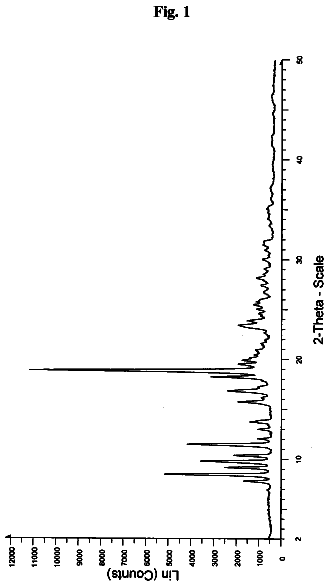
In one aspect, the present application provides a monoclinic form of asenapine maleate, which is stable to micronization, with one or more of a powder X-ray diffraction (PXRD) pattern, a differential scanning calorimetry (DSC) curve, and a thermogravimetric analysis (TGA) curve, substantially as illustrated by FIGS. 1, 3, and 4, respectively.
In one aspect, the present application relates to a microcrystalline monoclinic form of asenapine maleate and processes for preparation thereof.
Brief description of the drawings
FIG. 1 is an illustration of a PXRD pattern of a monoclinic form of asenapine maleate, which is stable to micronization, prepared according to Example 11.
FIG. 2 is an illustration of a PXRD pattern of a microcrystalline monoclinic form of asenapine maleate, prepared in Example 13, after micronization.
FIG. 3 is an illustration of a DSC curve of a monoclinic form of asenapine maleate, which is stable to micronization, prepared according to Example 11.
FIG. 4 is an illustration of a TGA curve of a monoclinic form of asenapine maleate, which is stable to micronization, prepared according to Example 11.
Detailed description
Aspects of the present application relate to a monoclinic form of asenapine maleate, which is stable to micronization, and processes for preparation thereof.
In an aspect, the present application provide a monoclinic form of asenapine maleate, which is stable to micronization, with a powder X-ray diffraction (PXRD) pattern having at least two peaks located at about 9.5, 20.3, 21.9, 23.3, 25.1, 26.1, 26.6, 29.0, or 29.9.+-.0.2 degrees 2-theta.
In an aspect, the present application provide a monoclinic form of asenapine maleate, which is stable to micronization, with a powder X-ray diffraction (PXRD) pattern having at least three peaks located at about 9.5, 20.3, 21.9, 23.3, 25.1, 26.1, 26.6, 29.0, or 29.9.+-.0.2 degrees 2-theta.
In an aspect, the present application provides a monoclinic form of asenapine maleate, which is stable to micronization, with any one or more of a powder X-ray diffraction (PXRD) pattern, a differential scanning calorimetry (DSC) curve, and a thermogravimetric analysis (TGA) curve, substantially as illustrated by FIGS. 1, 3, and 4, respectively.
In an aspect, the present application provides processes for the preparation of a monoclinic form of asenapine maleate, which is stable to micronization, comprising:
a) providing a solution of asenapine in a solvent;
b) combining the solution of asenapine prepared in step a) with a solution of maleic acid in a solvent; and
c) isolating the monoclinic form of asenapine maleate.
Step a) involves providing a solution of asenapine in a solvent. The solution of asenapine may be obtained by dissolving asenapine in a solvent, or it may be obtained directly from a reaction mixture, in which the compound is formed in the course of synthesis of asenapine. Any physical forms of asenapine, such as crystalline, amorphous, or their mixtures may be utilized for preparing the solution of asenapine in step a).
Solvents that may be employed for providing a solution of asenapine in step a) include, but are not limited to: C.sub.3-C.sub.9 alcohol solvents, e.g., 2-propanol, 1-propanol, 1-butanol, 2-butanol, or the like; ester solvents, e.g., ethyl acetate, n-propyl acetate, n-butyl acetate, t-butyl acetate, or the like; or mixtures thereof. The temperatures at which a solution may be obtained in step a) range from about 0.degree. C. to about the reflux temperature of the solvent that is used, or any other suitable temperatures.
Step b) involves combining the solution of asenapine obtained in step a) with a solution of maleic acid in a solvent. Alternatively, step b) may be conducted by adding a solution of asenapine to a solution of maleic acid, or adding solution of maleic acid to a solution of asenapine.
Suitable solvents that may be used in step b) include, but are not limited to: C.sub.3-C.sub.9 alcohol solvents, e.g., 2-propanol, 1-propanol, 1-butanol, 2-butanol, or the like; ester solvents, e.g., ethyl acetate, n-propyl acetate, n-butyl acetate, t-butyl acetate, or the like; or mixtures thereof. Suitable temperatures that may be used in step (b) may be less than about 100.degree. C., less than about 80.degree. C., less than about 60.degree. C., less than about 40.degree. C., less than about 30.degree. C., less than about 20.degree. C., less than about 10.degree. C., or any other suitable temperatures.
Step c) involves isolating the monoclinic form of asenapine maleate. Isolation in step c) may involve one or more methods, including removal of solvent, cooling, concentrating the mass, using an anti-solvent, extraction with a solvent, adding seed crystals to induce crystallization, or the like. Stirring or other alternate methods such as shaking, agitation, or the like, may also be employed for the isolation. Suitable temperatures for isolation may be less than about 60.degree. C., less than about 40.degree. C., less than about 20.degree. C., less than about 10.degree. C., less than about 5.degree. C., less than about 0.degree. C., less than about -10.degree. C., less than about -20.degree. C., or any other suitable temperatures. The isolated solid may be recovered by any methods, including decantation, centrifugation, gravity filtration, suction filtration, or any other suitable techniques for the recovery of solids.
The isolated compound may be further purified by recrystallization one or more times from a suitable solvent or a mixture of solvents, such as, but not limited to: C.sub.3-C.sub.9 alcohol solvents, e.g., 2-propanol, 1-propanol, 1-butanol, 2-butanol, or the like; ester solvents, e.g., ethyl acetate, n-propyl acetate, n-butyl acetate, t-butyl acetate, or the like; or mixtures thereof; optionally involving the addition of seed crystals of the monoclinic form. The recovered solid may optionally be dried. Drying may be carried out in a tray dryer, vacuum oven, air oven, cone vacuum dryer, rotary vacuum dryer, fluidized bed dryer, spin flash dryer, flash dryer, or the like. The drying may be carried out at temperatures less than about 100.degree. C., less than about 80.degree. C., less than about 60.degree. C., less than about 50.degree. C., less than about 30.degree. C., or any other suitable temperatures, at atmospheric pressure or under a reduced pressure, as long as the asenapine maleate is not degraded in quality. The drying may be carried out for any desired times until the desired product quality is achieved.
The dried product may be subjected to a size reduction procedure to produce desired particle sizes. Milling or micronization may be performed before drying, or after the completion of drying of the product. Techniques that may be used for particle size reduction include, without limitation, ball, roller and hammer milling, or jet milling.
Aspects of the present application relate to a microcrystalline monoclinic form of asenapine maleate and processes for preparation thereof.
In an aspect, the present application provides processes for the preparation of a monoclinic form of asenapine maleate, which is stable to micronization, comprising:
a) providing a solution of asenapine maleate in a solvent;
b) optionally, seeding the solution prepared in step a with crystals of the monoclinic form; and
c) isolating the monoclinic form of asenapine maleate.
Step a) involves providing a solution of asenapine maleate in a solvent. The solution of asenapine maleate may be obtained by dissolving asenapine maleate in a solvent, or it may be obtained directly from a reaction mixture, in which the compound is formed in the course of synthesis of asenapine maleate. Any physical forms of asenapine maleate, such as crystalline, amorphous, or their mixtures may be utilized for preparing the solution of asenapine maleate in step a).
Solvents that may be employed for providing a solution of asenapine maleate in step a) include, but are not limited to: C.sub.3-C.sub.9 alcohol solvents, e.g., 2-propanol, 1-propanol, 1-butanol, 2-butanol, or the like; ester solvents, e.g., ethyl acetate, n-propyl acetate, n-butyl acetate, t-butyl acetate, or the like; or mixtures thereof. The temperatures at which a solution may be obtained in step a) range from about 0.degree. C. to about the reflux temperature of the solvent that is used, or any other suitable temperatures.
Step b) involves optionally seeding the solution obtained in step a) with crystals of the monoclinic form. Crystals of monoclinic form that are used in step b) may be obtained by any of the processes of the present application.
Step c) involves isolating the monoclinic form of asenapine maleate. Isolation in step c) may involve any methods, including removal of solvent, cooling, concentrating the mass, using an anti-solvent, extraction with a solvent, adding seed crystals to induce crystallization, or the like. Stirring or other alternate methods such as shaking, agitation, or the like, may also be employed for the isolation. Suitable temperatures for isolation may be less than about 60.degree. C., less than about 40.degree. C., less than about 20.degree. C., less than about 10.degree. C., less than about 5.degree. C., less than about 0.degree. C., or any other suitable temperatures.
The isolated solid may be recovered by any methods, including decantation, centrifugation, gravity filtration, suction filtration, or any other suitable techniques for the recovery of solids. The recovered solid may optionally be dried. Drying may be carried out in a tray dryer, vacuum oven, air oven, cone vacuum dryer, rotary vacuum dryer, fluidized bed dryer, spin flash dryer, flash dryer, or the like. The drying may be carried out at temperatures less than about 100.degree. C., less than about 80.degree. C., less than about 60.degree. C., less than about 50.degree. C., less than about 30.degree. C., or any other suitable temperatures, at atmospheric pressure or under a reduced pressure, as long as the asenapine maleate is not degraded in quality. The drying may be carried out for any desired times until the desired product quality is achieved.
The dried product may be subjected to a size reduction procedure to produce desired particle sizes. Size reduction may be performed before drying, or after the completion of drying of the product. Techniques that may be used for particle size reduction include, without limitation, ball, roller and hammer milling, or jet milling.
In an aspect, the present application provides processes for the preparation of a microcrystalline monoclinic form of asenapine maleate, comprising:
a) providing a solution of asenapine in a solvent;
b) combining the solution of asenapine obtained in step a) with a solution of maleic acid in a solvent; and
c) isolating the microcrystalline monoclinic form of asenapine maleate.
Step a) involves providing a solution of asenapine in a solvent. The solution of asenapine may be obtained by dissolving asenapine in a solvent, or it may be obtained directly from a reaction mixture, in which the compound is formed in the course of synthesis of asenapine. Any physical forms of asenapine, such as crystalline, amorphous, or their mixtures may be utilized for preparing the solution of asenapine in step a).
Solvents that may be employed for providing a solution of asenapine in step a) include, but are not limited to: C.sub.3-C.sub.9 alcohol solvents, e.g., 2-propanol, 1-propanol, 1-butanol, 2-butanol, or the like; ester solvents, e.g., ethyl acetate, n-propyl acetate, n-butyl acetate, t-butyl acetate, or the like; or mixtures thereof. The temperatures at which a solution may be obtained in step a) range from about 0.degree. C. to about the reflux temperature of the solvent that is used, or any other suitable temperatures.
Step b) involves combining the solution of asenapine obtained in step a) with a solution of maleic acid in a solvent. Alternatively, step b) may be conducted by adding a solution of asenapine to a solution of maleic acid, or adding a solution of maleic acid to a solution of asenapine.
Suitable solvents that may be used in step b) include, but are not limited to: C.sub.3-C.sub.9 alcohol solvents, e.g., 2-propanol, 1-propanol, 1-butanol, 2-butanol, or the like; ester solvents, e.g., ethyl acetate, n-propyl acetate, n-butyl acetate, t-butyl acetate, or the like; or mixtures thereof. Suitable temperatures that may be used in step (b) may be less than about less than about 100.degree. C., less than about 80.degree. C., or less than about 60.degree. C., or less than about 40.degree. C., or less than about 30.degree. C., or less than about 20.degree. C., or less than about 10.degree. C., or any other suitable temperatures.
Step c) involves isolating the microcrystalline monoclinic form of asenapine maleate. Isolation in step c) may involve any methods, including removal of solvent, cooling, concentrating the mass, using an anti-solvent, extraction with a solvent, adding seed crystals to induce crystallization, or the like. Stirring or other alternate methods such as shaking, agitation, or the like, may also be employed for the isolation. Suitable temperatures for isolation may be less than about 60.degree. C., less than about 40.degree. C., less than about 20.degree. C., less than about 10.degree. C., less than about 5.degree. C., less than about 0.degree. C., or any other suitable temperatures. The isolated solid may be recovered by any methods, including decantation, centrifugation, gravity filtration, suction filtration, or any other suitable techniques for the recovery of solids.
The isolated compound may be further purified by recrystallization one or more times from a suitable solvent, such as, but not limited to: C.sub.3-C.sub.9 alcohol solvents, e.g., 2-propanol, 1-propanol, 1-butanol, 2-butanol, or the like; ester solvents, e.g., ethyl acetate, n-propyl acetate, n-butyl acetate, t-butyl acetate, or the like; or mixtures thereof; optionally involving the use of seed crystals of the monoclinic form. The recovered solid may optionally be dried. Drying may be carried out in a tray dryer, vacuum oven, air oven, cone vacuum dryer, rotary vacuum dryer, fluidized bed dryer, spin flash dryer, flash dryer, or the like. The drying may be carried out at temperatures less than about 100.degree. C., less than about 80.degree. C., less than about 60.degree. C., less than about 50.degree. C., less than about 30.degree. C., or any other suitable temperatures, at atmospheric pressure or under a reduced pressure, as long as the asenapine maleate is not degraded in quality. The drying may be carried out for any desired times until the desired product quality is achieved.
In an aspect, the present application provides processes for the preparation of a microcrystalline monoclinic form of asenapine maleate, comprising:
a) providing a solution of asenapine maleate in a solvent;
b) optionally, seeding the solution obtained in step a) with crystals of the monoclinic form; and
c) isolating the microcrystalline monoclinic form of asenapine maleate.
Step a) involves providing a solution of asenapine maleate in a solvent. The solution of asenapine maleate may be obtained by dissolving asenapine maleate in a solvent, or it may be obtained directly from a reaction mixture, in which the compound is formed in the course of synthesis of asenapine maleate. Any physical forms of asenapine maleate, such as crystalline, amorphous, or their mixtures may be utilized for preparing the solution of asenapine maleate in step a).
Solvents that may be employed for providing a solution of asenapine maleate in step a) include, but are not limited to: C.sub.3-C.sub.9 alcohol solvents, e.g., 2-propanol, 1-propanol, 1-butanol, 2-butanol, or the like; ester solvents, e.g., ethyl acetate, n-propyl acetate, n-butyl acetate, t-butyl acetate, or the like; or mixtures thereof. The temperatures at which a solution may be obtained in step a) range from about 0.degree. C. to about the reflux temperature of the solvent that is used, or any other suitable temperatures.
Step b) involves optionally seeding the solution obtained in step a) with crystals of the monoclinic form. Crystals of the monoclinic form that are used in step b) may be obtained by any of the processes of the present application.
Step c) involves isolating the microcrystalline monoclinic form of asenapine maleate. Isolation in step c) may involve any methods, including removal of solvent, cooling, concentrating the mass, using an anti-solvent, extraction with a solvent, adding seed crystals to induce crystallization, or the like. Stirring or other alternate methods such as shaking, agitation, or the like, may also be employed for the isolation. Suitable temperatures for isolation may be less than about 60.degree. C., less than about 40.degree. C., less than about 20.degree. C., less than about 10.degree. C., less than about 5.degree. C., less than about 0.degree. C., less than about -10.degree. C., less than about -20.degree. C., or any other suitable temperatures.
The isolated solid may be recovered by any methods, including decantation, centrifugation, gravity filtration, suction filtration, or any other suitable techniques for the recovery of solids. The recovered solid may optionally be dried. Drying may be carried out in a tray dryer, vacuum oven, air oven, cone vacuum dryer, rotary vacuum dryer, fluidized bed dryer, spin flash dryer, flash dryer, or the like. The drying may be carried out at temperatures less than about 100.degree. C., less than about 80.degree. C., less than about 60.degree. C., less than about 50.degree. C., less than about 30.degree. C., or any other suitable temperatures, at atmospheric pressure or under a reduced pressure, as long as the asenapine maleate is not degraded in quality. The drying may be carried out for any desired times until the desired product quality is achieved.
Milling or micronization techniques that may be used for particle size reduction include, without limitation sifting, milling using mills, such as, for example, ball, roller and hammer mills, or jet mills, including, for example, air jet mills, or any other conventional techniques.
The particle sizes of a drug substance can influence biopharmaceutical properties of its pharmaceutical products. For example, the particle sizes of the drug substance affects drug product manufacturing and dissolution, and hence the bioavailability from formulated products. Since asenapine maleate dissolves in saliva, the particle sizes are important. When drug substance particles are small, shorter periods of time are required to achieve high dissolved concentrations. From this perspective, smaller particles are preferred. In addition, smaller particle sizes tend to improve the homogeneity of powder blends, which may result in improved uniformity of the drug content in a pharmaceutical product.
Particle size distributions of a monoclinic form of asenapine maleate, which is stable to micronization, particles may be measured using any techniques known in the art. For example, particle size distributions of asenapine maleate particles may be measured using microscopy or light scattering equipment, such as, for example, a Malvern Master Size 2000 from Malvern Instruments Limited, Malvern, Worcestershire, United Kingdom. The particle size distributions can be expressed, for example, in terms of d(90), d(50), and d
values, where the values (e.g., expressed in .mu.m) are the maximum sizes for 90, 50, and 10 percent of the particles, respectively.
In an aspect, the present application provides processes for the preparation of a microcrystalline monoclinic form of asenapine maleate, comprising: micronizing a monoclinic form of asenapine maleate, which is stable to micronization, having particle size distributions where d
is at least 50 .mu.m.
In an aspect, processes of the present application provide a stable, polymorphically pure, microcrystalline, monoclinic form of asenapine maleate.
In an aspect, the present application provides pharmaceutical compositions comprising a monoclinic form of asenapine maleate, which is stable to micronization, together with at least one pharmaceutically acceptable excipient. In an aspect, the present application provides pharmaceutical compositions comprising a microcrystalline monoclinic form of asenapine maleate, together with at least one pharmaceutically acceptable excipient.
In one aspect, the present application provides processes comprising reacting a cis-isomer of Formula IX, or a mixture of a cis-isomer of Formula IX and a trans-isomer of Formula X, with a suitable reagent to afford a mixture of cis-isomer of Formula IX and trans-isomer of Formula X enriched with trans-isomer of Formula X:
##str00006##
wherein Z represents oxygen, sulfur, or a methylene group; R represents an C.sub.1-C.sub.6alkyl- or C.sub.7-C.sub.10(aryl)alkyl- group; R.sup.1 and R.sup.2 are each independently chosen from hydrogen, C.sub.1-C.sub.6alkyl, hydroxy, C.sub.1-C.sub.6alkoxy-, halo, nitro, amino, substituted amino, cyano, sulfonyl, carboxyl, substituted carboxy, or CF.sub.3--.
A cis-isomer of Formula IX, or a mixture of a cis-isomer of Formula IX and a trans-isomer of Formula X, may be prepared using any processes known in the art. For example, it may be prepared by a process described for a mixture of cis- and trans-2-methyl-3,4,4a,13b-tetrahydrodibenz[2,3;6,7]oxepino[4,5-c]pyridin-- 1(2H)-one; or by a process described for trans-5-chloro-2,3,3a,12b-tetrahydro-2-methyl-1H-dibenz[2,3:6,7]oxepino[4- ,5-c]pyrrol-1-one and cis-5-chloro-2,3,3a,12b-tetrahydro-2-methyl-1H-dibenz[2,3:6,7]oxepino[4,5- -c]pyrrol-1-one in Example 9E, page 9, paragraph
of US 2006/0229352 A1, which is incorporated herein by reference in its entirety.
The resulting mixture of cis-isomer of Formula IX and trans-isomer of Formula X enriched with trans-isomer of Formula X obtained above may contain cis-isomer of Formula IX in amounts less than about 95%, less than about 90%, less than about 80%, less than about 70%, less than about 60%, less than about 50%, less than about 40%, less than about 30%, less than about 20%, less than about 10%, less than about 5%, less than about 4%, less than about 3%, less than about 2%, less than about 1%, less than about 0.5%, less than about 0.2%, less than about 0.1%, less than about 0.05%, by weight. Suitable reagents for the above reaction include, but are not limited to, triethylamine, diisopropylethylamine, 1,8-diazabicyclo[5.4.0]undec-7-ene (DBU), 1,5-diazabicyclo[4.3.0]non-5-ene (DBN), pyridine, morpholine, n-propylamine, sodium methoxide, other organic bases, potassium hydroxide, sodium hydroxide, potassium tert-butoxide, potassium hexamethyldisilazane, sodium hexamethyldisilazane, or the like, or any mixtures thereof.
The reaction of the cis-isomer of Formula IX, or a mixture of cis-isomer of Formula IX and trans-isomer of Formula X, with a suitable reagent may be optionally carried out in a suitable solvent, such as, for example, an alcohol solvent, a ketone solvent, an aromatic hydrocarbon solvent, a hydrocarbon solvent, a halogenated hydrocarbon solvent, an ester solvent, e.g., ethyl acetate, n-propyl acetate, n-butyl acetate, t-butyl acetate, or the like; an ether solvent, a polar aprotic solvent, a nitrile solvent, water, or any mixtures thereof.
Suitable temperatures that may be employed for the reaction of cis-isomer of Formula IX, or a mixture of cis-isomer of Formula IX and trans-isomer of Formula X, with a suitable reagent are less than about 100.degree. C., less than about 80.degree. C., less than about 60.degree. C., less than about 40.degree. C., less than about 20.degree. C., less than about 0.degree. C., or any other suitable temperatures. Suitable times for completing the reaction of the mixture of cis-isomer of Formula IX, or a cis-isomer of Formula IX and trans-isomer of Formula X, with a suitable reagent depend on the temperature and other conditions, and may be generally about 30 minutes, or about 1 hour, or about 3 hours, or about 5 hours, or about 10 hours, or about 15 hours, or about 20 hours, or about 25 hours, or about 30 hours, or about 40 hours, or longer.
The cis-isomer of Formula IX, or mixture of cis-isomer of Formula IX and trans-isomer of Formula X enriched with trans-isomer of Formula X, thus obtained may be separated by conventional separation techniques to afford a cis-isomer of Formula IX and trans-isomer of Formula X, or their mixture enriched in one of the isomers. Examples of separation techniques include, but are not limited to, chromatography, selective crystallization, or any other suitable techniques. The solvents used for separating cis-isomer of Formula IX and trans-isomer of Formula X include, but are not limited to, alcohol solvents, ketone solvents, aromatic hydrocarbon solvents, hydrocarbon solvents, halogenated hydrocarbon solvents, ester solvents, ether solvents, polar aprotic solvents, nitrile solvents, water, or any mixtures thereof.
A trans-isomer of Formula X, or mixture of cis-isomer of Formula IX and trans-isomer of Formula X enriched with trans-isomer of Formula X, may be further purified one or more times using any suitable techniques. For example, it may be purified by precipitation, slurrying in a suitable solvent, or any other suitable techniques. Precipitation may be achieved by crystallization, such as by cooling a solution, concentrating a solution, or by combining an anti-solvent with a solution of the product, or any other suitable methods. Anti-solvents are liquids in which trans-isomer of Formula X is poorly soluble. Suitable anti-solvents include, but are not limited to, hydrocarbon solvents, ether solvents, water, or any mixtures thereof; or any other suitable anti-solvents.
The resulting trans-isomer of Formula X, or mixture of cis-isomer of Formula IX and trans-isomer of Formula X enriched with trans-isomer of Formula X, may optionally be dried. This drying may be carried out in a tray dryer, vacuum oven, air oven, fluidized bed dryer, spin flash dryer, flash dryer, rotary dryer, cone dryer, rotary cone dryer, or the like. Drying may be carried out at temperatures less than about 100.degree. C., less than about 60.degree. C., less than about 40.degree. C., or any other suitable temperatures, at atmospheric pressure or under reduced pressure, and in the presence or absence of an inert atmosphere such as nitrogen, argon, neon, or helium. The drying may be carried out for any desired time periods to achieve the desired quality of the product, such as, for example, about 1 to about 15 hours, or longer.
The trans-isomer of Formula X, or mixture of cis-isomer of Formula IX and trans-isomer of Formula X enriched with trans-isomer of Formula X, thus obtained may be optionally used for the preparation of compound of Formula XI or a mixture of cis-isomer of Formula XII and trans-isomer of Formula XI enriched with trans-isomer of Formula XI:
##str00007##
wherein R, R.sup.1, R.sup.2, and Z are as defined above.
Optionally, the cis-isomer of Formula IX, or mixture of cis-isomer of Formula IX and trans-isomer of Formula X enriched with cis-isomer of Formula IX, may be recovered from the mother liquors obtained after the separation using conventional processes known in the art, e.g., removal of solvent, cooling, concentrating the reaction mass, combining with an anti-solvent, extraction with a solvent, or the like. Stirring or other alternate methods such as shaking, agitation or the like may also be employed in the isolation. The solvents and anti-solvents were described above. The recovered cis-isomer of Formula IX, or mixture of cis-isomer of Formula IX and trans-isomer of Formula X enriched with cis-isomer of Formula IX, may be recycled by reacting with a suitable reagent, following the process as described above, to afford a trans-isomer of Formula X or a mixture of cis-isomer of Formula IX and trans-isomer of Formula X enriched with trans-isomer of Formula X.
Optionally, a mixture of cis-isomer of Formula IX and trans-isomer of Formula X enriched with trans-isomer of Formula X thus obtained may be recovered as a residue by conventional methods. The residue may be optionally dried. This drying may be carried out in a tray dryer, vacuum oven, air oven, fluidized bed dryer, spin flash dryer, flash dryer, rotary dryer, cone dryer, rotary cone dryer or the like. Drying may be carried out at temperatures less than about 100.degree. C., less than about 60.degree. C., less than about 40.degree. C., or any other suitable temperatures, at atmospheric pressure or under reduced pressure, and in the presence or absence of an inert atmosphere such as nitrogen, argon, neon, or helium. The drying may be carried out for any desired time periods to achieve the desired quality of the product, such as, for example, about 1 to about 15 hours, or longer. The residue of cis-isomer of Formula IX and trans-isomer of Formula X enriched with trans-isomer of Formula X thus obtained may be optionally used without purification for the preparation of a compound of Formula XI or mixture of cis-isomer of Formula XII and trans-isomer of Formula XI enriched with trans-isomer of Formula XI.
Optionally, the mixture of cis-isomer of Formula IX and trans-isomer of Formula X enriched with trans-isomer of Formula X thus obtained may be directly used for the preparation of compound of Formula XI or mixture of cis-isomer of Formula XII and trans-isomer of Formula XI enriched with trans-isomer of Formula XI, without further isolation or conventional work-up.
In one aspect, the present application includes processes for preparing a compound of Formula XI and the pharmaceutically acceptable salts thereof:
##str00008##
wherein R, R.sup.1, R.sup.2, and Z are as defined above, comprising one or more of the following steps, individually, or in the sequence recited:
a) reacting a cis-isomer of Formula IX, or a mixture of cis-isomer of Formula IX and trans-isomer of Formula X, with a suitable reagent to afford a mixture of cis-isomer of Formula IX and trans-isomer of Formula X enriched with trans-isomer of Formula X;
b) optionally, separating the trans-isomer of Formula X, or mixture of cis-isomer of Formula IX and trans-isomer of Formula X enriched with trans-isomer of Formula X, from the mixture obtained in a);
c) converting the trans-isomer of Formula X, or mixture of cis-isomer of Formula IX and trans-isomer of Formula X enriched with trans-isomer of Formula X, with a suitable reagent to afford a trans-isomer of Formula XI or a mixture of cis-isomer of Formula XII and trans-isomer of Formula XI enriched with trans-isomer of Formula XI; and
d) optionally, converting the resulting trans-isomer of Formula XI, or mixture of cis-isomer of Formula XII and trans-isomer of Formula XI enriched with trans-isomer of Formula XI, to a salt thereof.
Step a) involves reacting a mixture of cis-isomer of Formula IX and trans-isomer of Formula X with a suitable reagent, to afford a mixture of cis-isomer of Formula IX and trans-isomer of Formula X enriched with trans-isomer of Formula X. The resulting mixture of cis-isomer of Formula IX and trans-isomer of Formula X enriched with trans-isomer of Formula X obtained in a) may contain cis-isomer of Formula IX in amounts less than about 95%, less than about 90%, less than about 80%, less than about 70%, less than about 60%, less than about 50%, less than about 40%, less than about 30%, less than about 20%, less than about 10%, less than about 5%, less than about 4%, less than about 3%, less than about 2%, less than about 1%, less than about 0.5%, less than about 0.2%, less than about 0.1%, or less than about 0.05%, by weight.
Suitable reagents for the reaction of step a) include, but are not limited to, triethylamine, diisopropylethylamine, 1,8-diazabicyclo[5.4.0]undec-7-ene (DBU), 1,5-diazabicyclo[4.3.0]non-5-ene (DBN), pyridine, morpholine, n-propylamine, any other organic base, sodium methoxide, potassium hydroxide, sodium hydroxide, potassium tert-butoxide, potassium hexamethyldisilazane, sodium hexamethyldisilazane, or the like, or any mixtures thereof.
Step a) may be optionally carried out in a suitable solvent, such as, for example, alcohol solvents, ketone solvents, aromatic hydrocarbon solvents, hydrocarbon solvents, halogenated hydrocarbon solvents, ester solvents, ether solvents, polar aprotic solvents, nitrile solvents, water, or any mixtures thereof. Suitable temperatures that may be employed for the reaction of a) are less than about 100.degree. C., less than about 80.degree. C., less than about 60.degree. C., less than about 40.degree. C., less than about 20.degree. C., less than about 0.degree. C., or any other suitable temperatures. Suitable times for completing the reaction of a) depend on the temperature and other conditions, and may be generally less than about 30 hours, less than about 20 hours, less than about 10 hours, less than about 5 hours, less than about 2 hours, less than about 1 hour, or any other suitable times. Longer times also are suitable.
Optionally, the mixture obtained from a) may be recovered as a residue by conventional methods. The residue may optionally be dried. This drying may be carried out in a tray dryer, vacuum oven, air oven, fluidized bed dryer, spin flash dryer, flash dryer, rotary dryer, cone dryer, rotary cone dryer or the like. Drying may be carried out at temperatures less than about 100.degree. C., less than about 60.degree. C., less than about 40.degree. C., or any other suitable temperatures, at atmospheric pressure or under reduced pressure, and in the presence or absence of an inert atmosphere such as nitrogen, argon, neon, or helium. The drying may be carried out for any desired time periods to achieve the desired quality of the product, such as, for example, about 1 to about 15 hours, or longer.
The residue comprising a mixture cis-isomer of Formula IX and trans-isomer of Formula X enriched with trans-isomer of Formula X thus obtained may be optionally used for the preparation of trans-compound of Formula XI or a mixture of compound of formula XI and a cis-compound of Formula XII.
Optionally, the mixture obtained from a) may be directly used for the preparation of a compound of Formula XI or a mixture of compound of formula XI and a cis-compound of Formula XII, without further isolation or conventional work-up.
The description continues in the full USPTO document.
 Lapsed, fee not paid5 drawings